
Life, 1910-04-28 · page 19 of 40
Life — April 28, 1910 — page 19: what you’re looking at
What you’re looking at
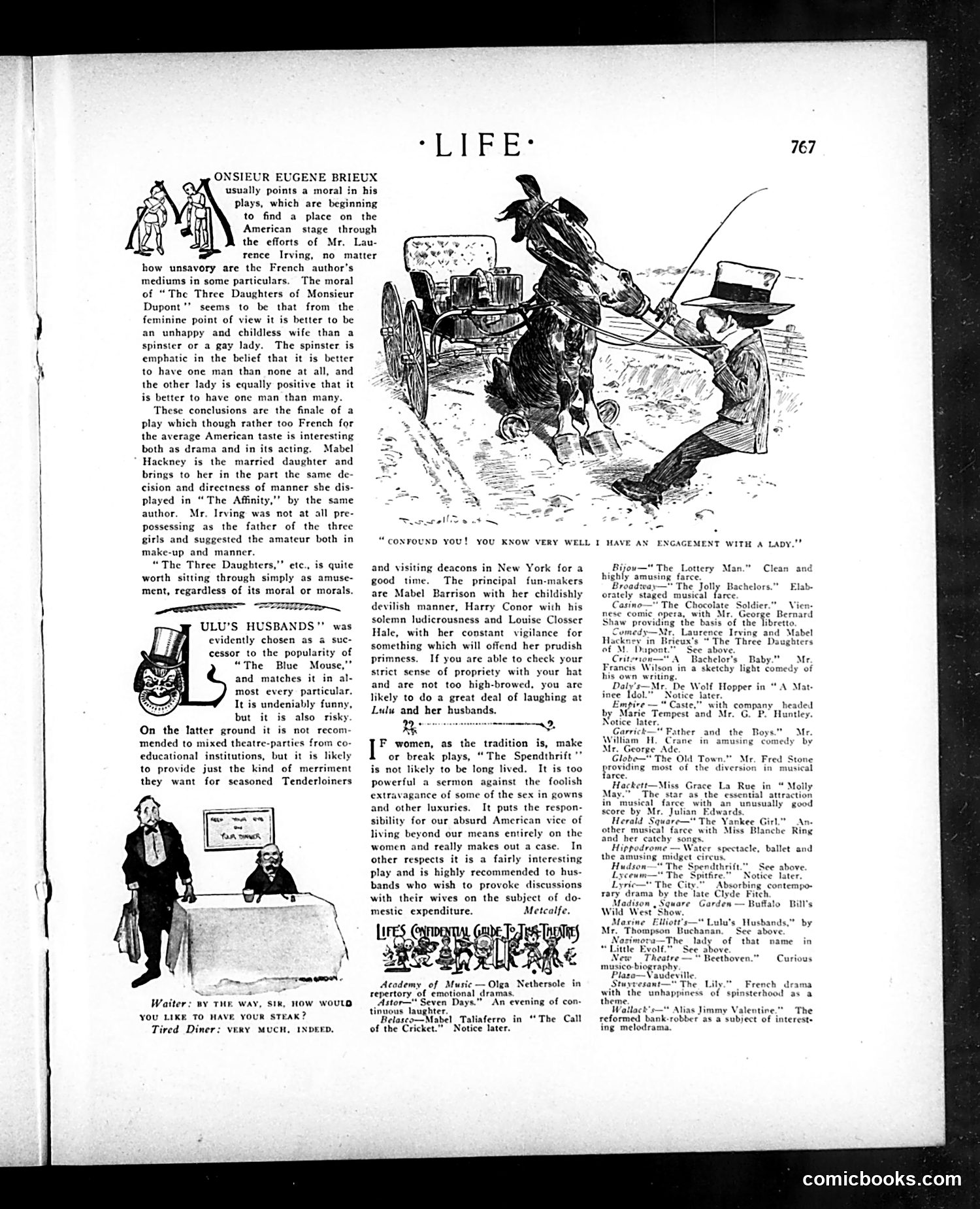
This page contains theatre reviews and two humorous cartoons satirizing dining and marital situations. The **top cartoon** depicts a man in a carriage with a woman, captioned "Confound you! You know very well I have an engagement with a lady." The joke mocks the Victorian-era convention of secret affairs—the man's irritated denial suggests he's been caught or confronted about illicit romantic involvement. The **bottom cartoon** shows a waiter asking a diner "By the way, sir, how would you like to have your steak?" The diner responds "Very much, indeed"—a non-sequitur joke playing on the diner's misinterpretation or the absurdity of asking someone how they'd *like* to have something, rather than what they'd like to eat. The page primarily reviews recent Broadway productions, including commentary on French playwright Eugène Brieux's work and shows like "Lulu's Husbands" and "The Spendthrift," which the critic notes preaches against women's excessive spending—a moralistic concern typical of the era.
📄 Transcribed text from this page (OCR, searchable)
Machine-transcribed from the original scan — historical spelling and the odd misread are preserved.
ai a to find a place on the efforts of Mr. how unsavory are the French author's mediums in some particulars. The moral of “The Three Daughters of Monsieur Dupont seems to be that from the feminine point of view it is better to be an unhappy and childless wife than a spinster or a gay lady. The spinster is emphatic in the belief that it is better to have one man than none at all, and the other lady is equally positive that it is better to have one man than many. These conclusions are the finale of a play which though rather too French for the average American taste is interesting both as drama and in its acting. Mabel Hackney is the married daughter and brings to her in the part the same de- cision and directness of manner she dis- played in “The Affinity," by the same author. Mr. Irving was not at all pre- possessing as the father of the three girls and suggested the amateur both in make-up and manne “The Three Daughters,” etc., is quite worth sitting through simply as amuse- ment, regardless of its moral or morals. ee OO ULU’S HUSBANDS" was evidently chosen as a suc- cessor to the popularity of “The Blue Mouse,’’ and matches it in al- most every particular. It is undeniably fun: but it is also risky On the latter ground it is not recom- mended to mixed theatre-parties from co- educational institutions, but it is likely to provide just the kind of merriment they want for seasoned Tenderloiners een ON Waiter: ny THe Way, Stk, HOW WOULD YOU LIKE TO HAVE YO! RAK? Tired Diner: very MUCH, INDEED. ONSIEUR EUGENE BRIEUX usually points a moral in his plays, which are beginning American stage through rence Irving, no matter the Lau- 767 “coxrouND you! YOU KNOW VERY WELL I HAVE AN ENGAGEMENT WITH A Laby.”? and visiting deacons in New York for a good time. The principal fun-makers are Mabel Barrison with her childishly devilish manner, Harry Conor with his solemn ludicrousness and Louise Closser Hale, with her constant vigilance for something which will offend her prudish primness, If you are able to check your strict sense of propriety with your hat and are not too high-browed, you are likely to do a great deal of laughing at Lulu and her husbands. F women, as the tradition is, make or break plays, “The Spendthrift is not likely to be long lived. It is too powerful a sermon against the foolish extravagance of some of the sex in gowns and other luxuries. It puts the respon- sibility for our absurd American vice of living beyond our means entirely on the women and really makes out a case. In other respects it is a fairly interesting play and is highly recommended to hus- bands who wish to provoke discussions with their wives on the subject of do- mestic expenditure. Metcalfe. LIFES Acodemy of Music— Olga Nethersole in repertory of emotional dramas. ‘Astor—"* Seven Days.” An evening of con- tinuous laughter. i Belasco—Mabel Taliaferro in “The Call of the Cricket.” Notice later. Bijov—" The Lottery Man.” Clean and highly amusing farce. Broadway—" The Jolly Bachelors.” Elab- orately staged musical farce Casino—" The Chocolate Soldier.” Vien- nese comic opera, with Mr. George Bernard Shaw‘ providing the basis of the librett Comedy: ce Irving and Mabel The Three Daughters See above Critente A Bachelor's Baby.” Mr. Fran in a sketchy light comedy of his own writing. Daly's—Mr, De Wolf Hopper in “A Mat- inee Idol. ice later. Empire —“ Caste,” with company headed by Marie Tempest and Mr. G. P. H Notice later. Garrick" F; and the Boys." Mr. w H.C in amusing comedy by Mr. George Ade Globe" The Ol Town.” Mr. Fred Stone providing most of the diversion in musical arce. Hackett—Miss Grace La Rue in “ Molly May.” The star as the essential attraction musical farce with an unusually good score by Mr. Julian Edwards. Herald uare—"* The kee Girl.” Ane other musical farce with Miss Blanche Ring and her catchy songs. Hippodrome — Water spectacle, ballet and the amusing midget circus Hudson—" The Spendthritt Lyceum The Spitfire. Notice later. Lyric—" The City Absorbing contempo- y drama by the late Clyde Fitch. Madison ware Garde - Buffalo Bill's Wild West "Show. Maxine Euliott’s—* Lulu's Husbands,” by Mr. Thompson Buchanan. See above. he lady of that name in ce above “ Beethoven.” Curious See above. Theatre - musico-biography Plazo—Vaudeville. Stuyresant—" The Lily.” French drama with the unhappiness of spinsterhood as a theme, Waitack*s—"* Alias Jimmy Valentine.” The reformed bank-robber as a subject of interests ing melodrama. comicbooks.com