
Life, 1910-04-28 · page 22 of 40
Life — April 28, 1910 — page 22: what you’re looking at
What you’re looking at
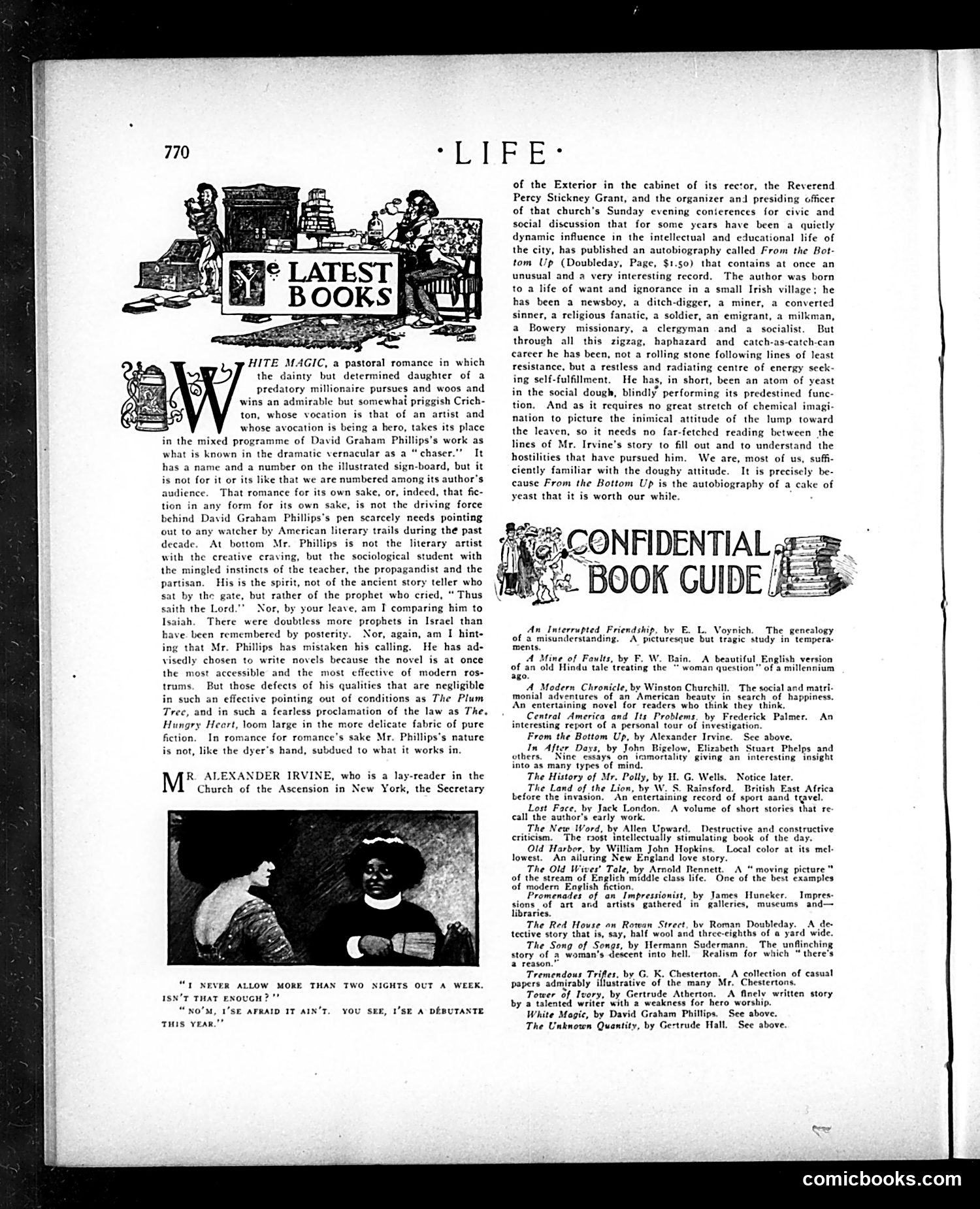
This page mixes book reviews with a cartoon joke about class and domesticity. The central cartoon depicts two figures—likely a wealthy employer and a young woman servant or "debutante"—discussing time off. The employer restricts the employee to two nights out weekly; the employee responds that two nights is insufficient because she's "a debutante this year." **The satire**: The joke exposes the absurdity of class pretension. A debutante was traditionally a young woman from an aristocratic family making her formal debut into society. The implication that a working-class woman (implied by her subservient position and dialect "I'se") claims debutante status is ridiculous—yet she's asserting her social aspirations despite her actual economic position. This mocks both the hollowness of social climbing and employers' obliviousness to their workers' independent lives. The surrounding text reviews books by authors like David Graham Phillips and Alexander Irvine, focusing on social criticism and working-class narratives—thematically aligned with the cartoon's class commentary.
📄 Transcribed text from this page (OCR, searchable)
Machine-transcribed from the original scan — historical spelling and the odd misread are preserved.
EEE HITE MAGIC, a pastoral romance in which the dainty but determined daughter of a predatory millionaire pursues and woos and wins an admirable but somewhai priggish Crich- ton, whose vocation is that of an artist and whose avocation is being a hero, takes its place in the mixed programme of David Graham Phillips's work as what is known in the dramatic vernacular as a “chaser.” It has a name and a number on the illustrated sign-board, but it is not for it or its like that we are numbered among its author's audience. That romance for its own sake, or, indeed, that fic- tion in any form for its own sake, is not the driving force behind David Graham Phillips's pen scarcely needs pointing out to any watcher by American literary trails during the past decade. At bottom Mr. Phillips is not the literary artist with the creative craving, but the sociological student with the mingled instincts of the teacher, the propagandist and the partisan. His is the spirit, not of the ancient story teller who sat by the gate, but rather of the prophet who cried, “ Thus saith the Lord."” Nor, by your leave, am I comparing him to Isaiah. There were doubtless more prophets in Israel than have. been remembered by posterity. Nor, again, am I hint- ng that Mr. Phillips has mistaken his calling. He has ad- visedly chosen to write novels because the novel is at once the most accessible and the most effective of modern ros- trums. But those defects of his qualities that are negligible in such an effective pointing out of conditions as The Plum Tree, and in such a fearless proclamation of the law as The. Hungry Heart, loom large in the more delicate fabric of pure fiction. In romance for romance’s sake Mr. Phillips's nature is not, like the dyer’s hand, subdued to what it works in. R. ALEXANDER IRVINE, who is a lay-reader in the Church of the Ascension in New York, the Secretary “T NEVER ALLOW MORE THAN TWO NIGHTS OUT A WEEK. ISN'T THAT ENOUGH?" “NO'M, I'SE AFRAID IT AIN'T. YOU SEE, 1’SE A DEBUTANTE THIS YEAR." of the Exterior in the cabinet of its rector, the Reverend Percy Stickney Grant, and the organizer and presiding officer of that church's Sunday evening conierences for civic and social discussion that for some years have been a quictly dynamic influence in the intellectual and educational life of the city, has published an autobiography called From the Bot- tom Up (Doubleday, Page, $1.50) that contains at once an unusual and a very interesting record. The author was born to a life of want and ignorance in a small Irish village; he has been a newsboy, a ditch-digger, a miner, a converted sinner, a religious fanatic, a soldier, an emigrant, a milkman, a Bowery missionary, a clergyman and a socialist. But through all this zigzag, haphazard and catch-as-catch-can career he has been, not a rolling stone following lines of least resistance, but a restless and radiating centre of energy seek- ing self-fulfillment. He has, in short, been an atom of yeast in the social dough, blindly performing its predestined func- tion, And as it requires no great stretch of chemical imagi- nation to picture the inimical attitude of the lump toward the leaven, so it needs no far-fetched reading between the lines of Mr. Irvine's story to fill out and to understand the hostilities that have pursued him. We are, most of us, suffi- ciently familiar with the doughy attitude. It is precisely be- cause From the Bottom Up is the autobiography of a cake of yeast that it is worth our while. i CONFIDENTIAL, < BOOK GUIDE An Interrupted Friendship, by E. L. Voynich. The genealogy of a mi derstanding. A picturesque but tragic study in tempera- A ine of Faults, by F. W. Bain. of an old Hindu tale treating the “ ago. A Modern Chronicle, by Winston Churchill. The social and matri- monial adventures of an American beauty in search of happiness. An entertaining novel for readers who think they think, Central America and Its Problems. by Frederick Palmer. An interesting report of a personal tour of investigation From the Bottom Up, by Alexander Irvine. See above. In After Days, by John Bigelow, Elizabeth Stuart Phelps and others. Nine essays on immortality’ giving an interesting insight into as many types of mind. The History of Mr. Polly, by H. G. Wells. Notice later. The Land of the Lion, by W. S. Rainsford. British East Africa before the invasion. An entertaining record of sport aand tyvel. Lost Face, by Jack London. A volume of short stories that re call the author's early work. The New Word, by Allen Upward. Destructive and constructive criticism. The roost intellectually stimulating book of the day. Old Harber. by William John Hopkins. Local color at its mel- lowest. An alluring New England love story. The Old Wives’ Tale, by Arnold Rennett of the stream of Englith middle class life. of modern English fiction. Promenades of an Impressionist, by James Huneker. Impres- sions of art and artists gathered’ in’ galleries, museums and— libraries. The Red House on Rotean Strect, by Roman Doubleday. A de- tective story that is, say, half wool and three-eighths of a yard wide. The Song of Songs, by Hermann Sudermann, The unflinching story of a woman's descent into hell. Realism for which “ there's a reason.” Tremendous Triftes, by G. K. Chesterton, A collection of casual papers admirably illustrative of the many Mr. Chestertons. Tower of Ivory, by Gertrude Atherton. A finely written story by a talented writer with 2 weakness for hero worship. White Magic, by David Graham Phillips. See above. The Unknown Quantity, by Gertrude Hall. See above. A beautiful, English version woman question” of a millennium A “moving picture" One of the best examples comicbooks.com