
Life, 1910-04-28 · page 27 of 40
Life — April 28, 1910 — page 27: what you’re looking at
What you’re looking at
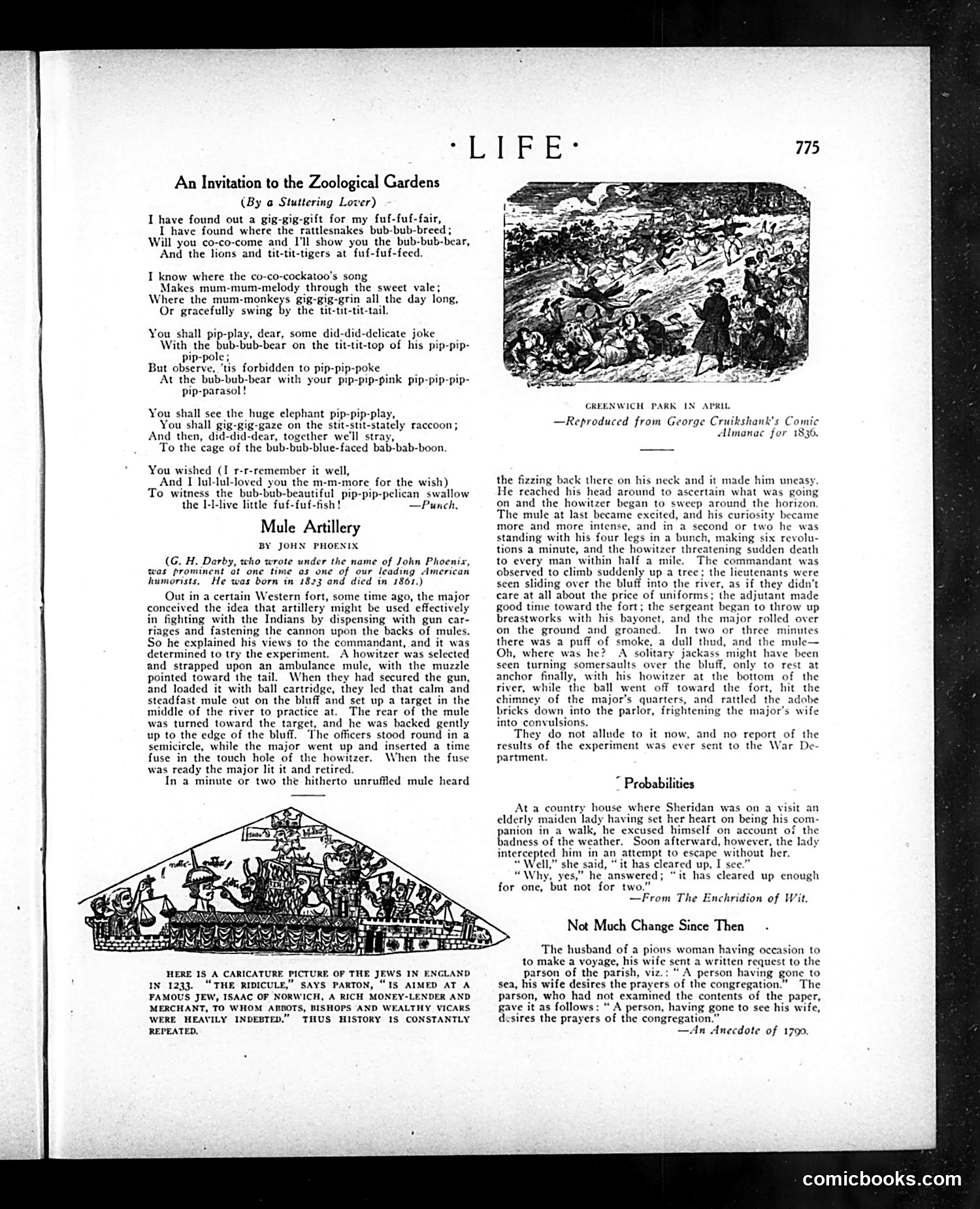
This page contains two satirical pieces: **"An Invitation to the Zoological Gardens"** is a humorous poem mocking a stuttering suitor trying to impress his girlfriend by inviting her to the zoo. The stuttering (represented by repeated syllables like "gig-gig," "bub-bub") is the joke—he can barely speak coherently while attempting romantic gestures. It's gentle mockery of both stuttering and awkward courtship. **"Mule Artillery"** is absurdist military satire. A major decides to mount a cannon on a mule's back (pointing toward its tail) to fight Indians without gun carriages. When the fuse ignites, the mule panics and spins wildly, sending officers fleeing in all directions—one up a tree, others into the river. The satire ridicules both impractical military "innovation" and the chaos that follows. The piece pokes fun at military incompetence and overconfidence in unconventional tactics. Both pieces reflect 19th-century American humor: slapstick, physical comedy, and mockery of pretension.
📄 Transcribed text from this page (OCR, searchable)
Machine-transcribed from the original scan — historical spelling and the odd misread are preserved.
An Invitation to the Zoological Gardens (By a Stuttering Lover) I have found out a gig-gig-gift for my fuf-fuf-fair, I have found where the rattlesnakes bub-bub-breed; Will you co-co-come and I'll show you the bub-bub-bear, And the lions and tit-tit-tigers at fuf-fuf-feed. I know where the co-co-cockatoo’s song Makes mum-mum-melody through the sweet val Where the mum-monkeys gig-gig-grin all the day long, Or gracefully swing by the tit-tit-tit-tail. You shall pip-play, dear, some did-did-delicate joke With the bub-bub-bear on the tit-tit-top of his pip-pip- pip-pole ; But observe, ‘tis forbidden to pip-pip-poke At the bub-bub-bear with your pip-pip-pink pip-pip-pip- pip-parasol ! You shall see the huge elephant pip-pip-play, You shall gig-gig-gaze on the stit-stit-stately raccoon; And then, did-did-dear, together we'll stra} To the cage of the bub-bub-blue-faced bab-bab-boon. You wished (I r-r-remember it well, And I lul-lul-loved you the m-m-more for the wish) To witness the bub-bub-beautiful pip-pip-pelican swallow the I-l-live little fuf-fuf-fish ! —Punch. Mule Artillery BY JOHN PHOENIX (G. H. Darby, who wrote under the name of John Phoenix, was prominent at one time as one of our leading American humorists, He was born in 1823 and died in 1861.) Out in a certain Western fort, some time ago, the major conceived the idea that artillery might be used effectively in fighting with the Indians by dispensing with gun car- riages and fastening the cannon upon the backs of mules. So he explained his views to the commandant, and it was determined to try the experiment. A howitzer was selected and strapped upon an ambulance mule, with the muzzle pointed toward the tail. When they had secured the gun, and loaded it with ball cartridge, they led that calm and steadfast mule out on the bluff and set up a target in the middle of the river to practice at. The rear of the mule was turned toward the target, and_he was backed gently up to the edge of the bluff. The officers stood round in a semicircle, while the major went up and inserted a time fuse in the touch hole of the howitzer. When the fuse was ready the major lit it and retired. In a minute or two the hitherto unruffled mule heard A CARICATURE PICTURE OF THE IN 1233. “THE RIDICULE,” SAYS PARTON, FAMOUS JEW, ISAAC OF NORWICH, A RICH MONEY-LENDER AND MERCHANT, TO WHOM ABBOTS, BISHOPS AND WEALTHY VICARS WERE HEAVILY INDEBTED.” THUS HISTORY IS CONSTANTLY REPEATED, GREENWICH PARK IN APRIL —Reproduced from George Cruikshank’s Comic Almanac for 1836. the fizzing back there on his neck and it made him uneasy He reached his head around to ascertain what was going on and the howitzer began to sweep around the horizon. The mule at last became excited, and his curiosity became more and more intense, and in a second or two he was standing with his four legs in a bunch, making six revolu- tions a minute, and the howitzer threatening sudden death to every man within half a mile. The commandant was observed to climb suddenly up a tree; the lieutenants were seen sliding over the bluff into the rive if they didn’t care at all about the price of uniforms; the adjutant made good time toward the fort; the sergeant began to throw up breastworks with his bayonet, and the major rolled over on the ground and groaned. In two or three minutes there was a puff of smoke, a dull thud, and the mu Oh, where was he? A solitary jackass might have been seen turning somersaults over the bluff, only to rest at anchor finally, with his howitzer at the bottom of the river, while the ball went off toward the fort, hit the chimney of the major’s quarters, and rattled the adobe bricks down into the parlor, frightening the major’s wife into convulsions. They do not allude to it now, and no report of the results of the experiment was ever sent to the War De- partment. “ Probabilities Ata country house where Sheridan was on a_visit an elderly maiden lady having set her heart on being his com- panion in a walk, he excused himself on account of the adness of the weather. Soon afterward, however, the lady intercepted him in tempt to escape without her. “ Well,” she said, “it has cleared up, I see.” “Why, yes,” he answered; “it has cleared up enough for one, but not for two.” rom The Enchridion of Wit. Not Much Change Since Then The husband of a pious woman having occasion to to make a voyage, his wife sent a written request to the parson of the parish, viz.: “A person having gone to sea, his wife desires the prayers of the congregation.” The parson, who had not examined the contents of the paper, gave it'as follows: “ A person, having gone to see his wife, desires the prayers of the congregation.” —An Anecdote of 1799. comicbooks.com