
Life, 1910-04-28 · page 26 of 40
Life — April 28, 1910 — page 26: what you’re looking at
What you’re looking at
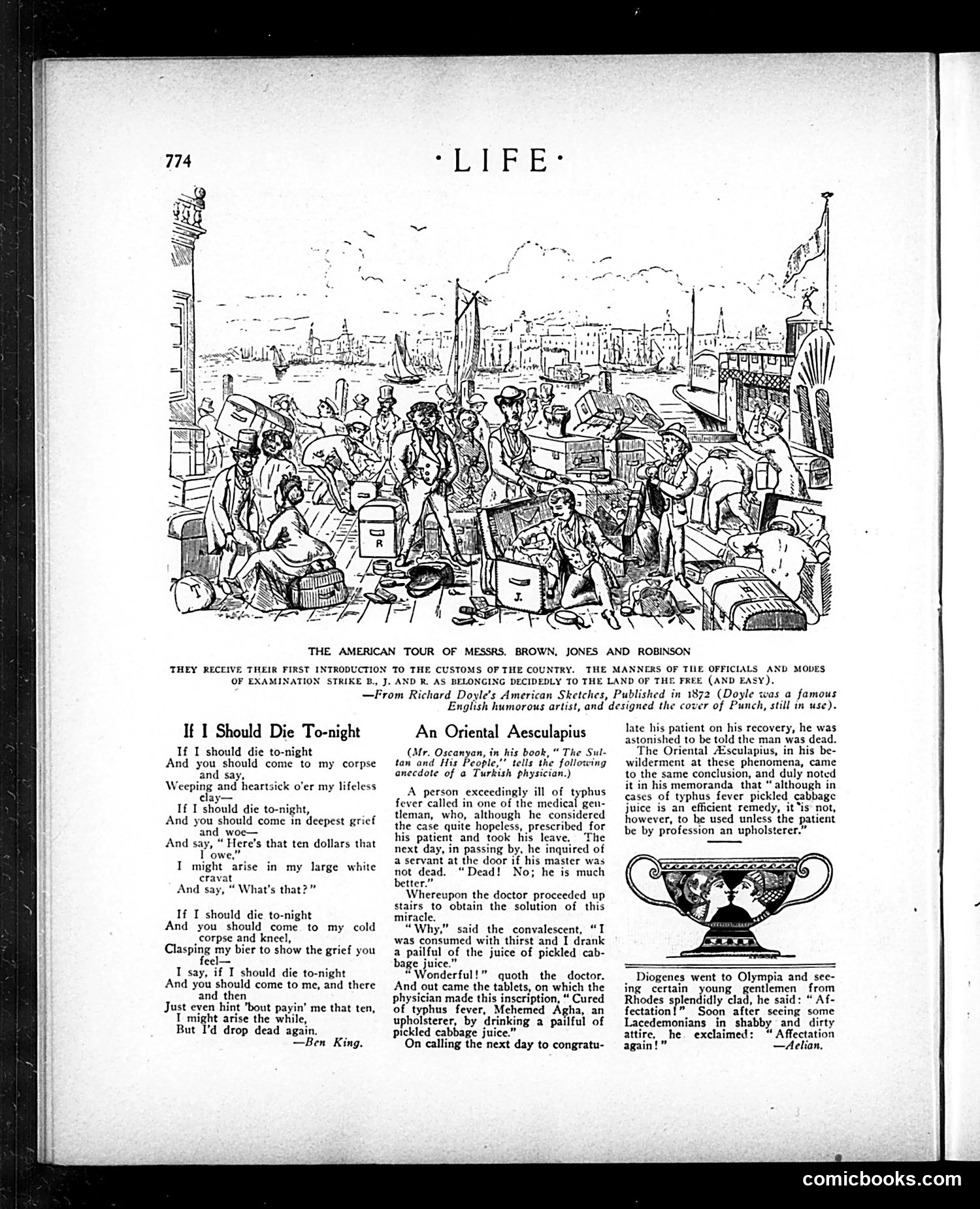
This page combines three satirical pieces from Richard Doyle's 1872 "American Sketches," originally published in the British humor magazine *Punch*. The large illustration depicts three British visitors ("Brown, Jones and Robinson") experiencing American customs and official procedures at what appears to be a port or dock. The caption sarcastically notes these customs seem decidedly characteristic of "the land of the free (and easy)"—mocking American informality and lax bureaucratic standards as seen through British eyes. Below are two humorous stories: **"If I Should Die To-night"** is a comic poem about a debtor who owes ten dollars; the speaker jokes he'd literally rise from the dead if someone reminded him to pay. **"An Oriental Aesculapius"** satirizes a Turkish physician's flawed logic: when a typhus patient recovers after drinking pickled cabbage juice, the doctor credits the remedy—then when the patient dies later, concludes the cure only works for upholsterers, missing the obvious contradiction. Together, these mock incompetence across cultures: American disorder, human absurdity, and medical charlatan-ism.
📄 Transcribed text from this page (OCR, searchable)
Machine-transcribed from the original scan — historical spelling and the odd misread are preserved.
THE AMERICAN TOUR OF MESSRS. BROWN, JONES AND ROBINSON THEY RECEIVE THEIR FIRST INTRODUCTION TO THE CUSTOMS OF THE COUNTRY. THE MANNERS OF TIE OFFICIALS AND MODES OF EXAMINATION STRIKE B., J. AND R. AS BELONGING DECIDEDLY TO THE LAND OF THE FREE (AND EASY). It I Should Die To-night If I should die to-night And you should come to my corpse and say, Weeping and heartsick o'er my lifeless clay— If I should die to-night, And you should come in deepest grief and woe— And say, “ Here's that ten dollars that 1 owe,” I might arise in my large white cravat And say, “ What’s that?” If I should die to-night And you should come to my cold “corpse and kneel, Clasping my bier to show the grief you fecl— I say, if I should die to-night And you should come to me, and there and then Just even hint "bout payin’ me that ten, I might arise the while, But I'd drop dead again. —Ben King. ‘om Richard Doyle’s American Sketches, Published in 1872 (Doyle was a famous English humorous artist, and designed the cover of Punch, still in use). An Oriental Aesculapius (Mr. Oscanyan, in his book, “ The Sul- tan and His People,’ tells the following anecdote of a Turkish physician.) A person exceedingly ill of typhus fever called in one of the medical gen- tleman, who, although he considered the case quite hopeless, prescribed for his patient and took his leave. The next day, in passing by, he inquired of a servant at the door if his master was not dead. “Dead! No; he is much better.” Whereupon the doctor proceeded up stairs to obtain the solution of this miracle. “Why,” said the convalescent, “TI was consumed with thirst and I drank a pailful of the juice of pickled cab- bage juice.” “Wonderful!” quoth the doctor. And out came the tablets, on which the physician made this inscription, “ Cured of typhus fever, Mchemed Agha, an upholsterer, by drinking a pailful of pickled cabbage juice.” On calling the next day to congratu- late his patient on his recovery, he was astonished to be told the man was dead. The Oriental A®sculapius, in his be- wilderment at these phenomena, came to the same conclusion, and duly noted it in his memoranda that “although in cases of typhus fever pickled cabbage juice is an efficient remedy, it “is not, however, to be used unless the patient be by profession an upholsterer.” from Rhodes splendidly clad, he sai fectation!” Soon after seeing some Lacedemonians in shabby and dirty attire, he exclaimed: “ Affectation again!” —Aelian, comicbooks.com