
Life, 1910-04-28 · page 10 of 40
Life — April 28, 1910 — page 10: what you’re looking at
What you’re looking at
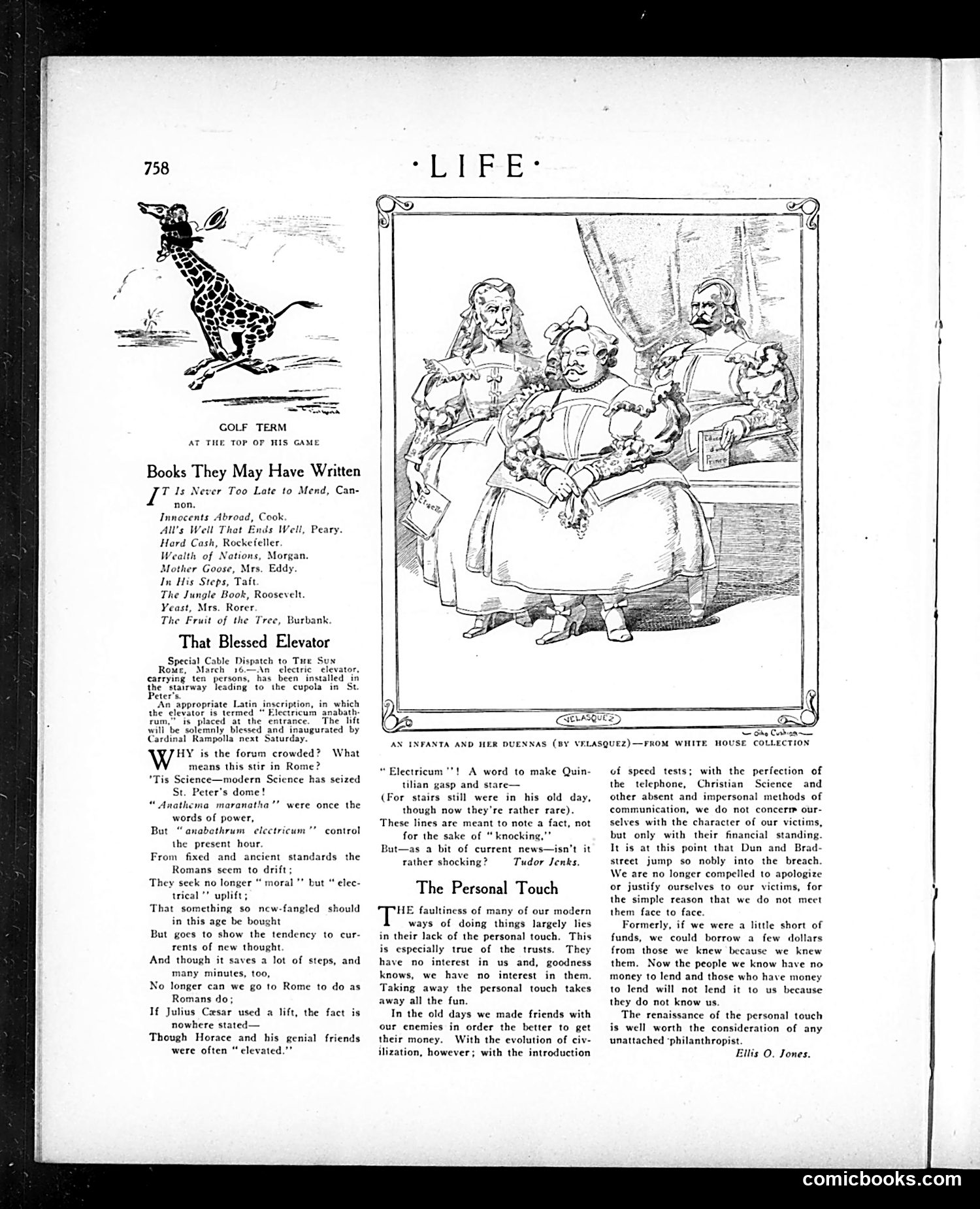
**The Main Cartoon:** "An Infanta and Her Duennas (by Velasquez)—From White House Collection" depicts a woman in elaborate dress surrounded by attendants, parodying the famous Velasquez painting. This appears to satirize a prominent woman's entourage or social pretensions, likely referencing someone from high society or politics circa this publication. **The Text Articles:** Include pieces on elevators, Latin phrases, and "The Personal Touch," discussing modern conveniences diminishing personal human connection. The recurring theme critiques how technology and social advancement have removed face-to-face interaction from daily life. **Overall Context:** This is a satirical social commentary typical of Life magazine, mocking both artistic pretension and the impersonal nature of modern civilization.
📄 Transcribed text from this page (OCR, searchable)
Machine-transcribed from the original scan — historical spelling and the odd misread are preserved.
Th Rome, March Peter's Romans do; GOLF TERM AT THE TOP OP HIS GAME Books They May Have Written L* Is Never Too Late to Mend, Can- non, Innocents Abroad, Cook. All's Well That Hard Cash, Rockeieller Wealth of Nations, Morgan. Mother Goose, Mrs In His Steps, Taft The Jungle Book, Roosevelt. Yeast, Mrs. Rorer Fruit of the Tree, Burbank. That Blessed Elevator Specia) Cable Di: nds Well, Peary. atch to Tue Sux carrying ten persons, has been. installed the stairway leading to the cupola in St. An appropriate Latin inscription, in which the elevator is termed “ Electricum anabath: rum,” is placed at the entrat will be solemnly blessed and inaugurated by Cardinal Rampolla next Saturday. HY is the forum crowded? j means this stir in Rome? ‘Tis Science—modern Science has seized St. Peter's dome! “ Anathema maranatha words of power, But “ anabethrum the present hour. From fixed and ancient standards the Romans scem to drift; They seek no longer “ moral "* but “ elec- trical"? uplif That something so ncw-fangled should in this age be bought But goes to show the tendency to cur- rents of new thought And though it saves a lot of steps, and many minutes, too, No longer can we go to Rome to do as * were once the If Julius Caesar used a lift, the fact is nowhere stated— Though Horace and his genial friends were often “ elevated.’” = Ske Corbin —— AN INFANTA AND HER DUENNAS (BY VELASQUEZ)—FROM WHITE HOUSE COLLECTION “ Electricum ''! A word to make Quin- tilian gasp and stare— (For stairs still were in his old day, though now they're rather rare). These lines are meant to note a fact, not for the sake of “ knocking,”” But—as a bit of current news—isn't it rather shocking? Tudor Jenks. The Personal Touch T' E faultiness of many of our modern ways of doing things largely lies in their lack of the personal touch. This is especially true of the trusts. They have no interest in us and, goodness knows, we have no interest in them. Taking away the personal touch takes away all the fun. In the old days we made friends with our enemies in order the better to get their money. With the evolution of civ- ilization, however; with the introduction of speed tests; with the perfection of the telephone, Christian Science and other absent and impersonal methods of communication, we do not concerm our- selves with the character of our victims but only with their financial standin It is at this point that Dun and Brad- street jump so nobly into the breach. We are no longer compelled to apologize or justify ourselves to our victims, for the simple reason that we do not meet them face to face. Formerly, if we were a little short of funds, we could borrow a few dollars from those we knew because we knew them. Now the people we know have no money to lend and those who have money to lend will not lend it to us because they do not know us. The renaissance of the personal touch is well worth the consideration of any unattached ‘philanthropist. Ellis 0. Jones. comicbooks.com