
Life, 1910-04-28 · page 33 of 40
Life — April 28, 1910 — page 33: what you’re looking at
What you’re looking at
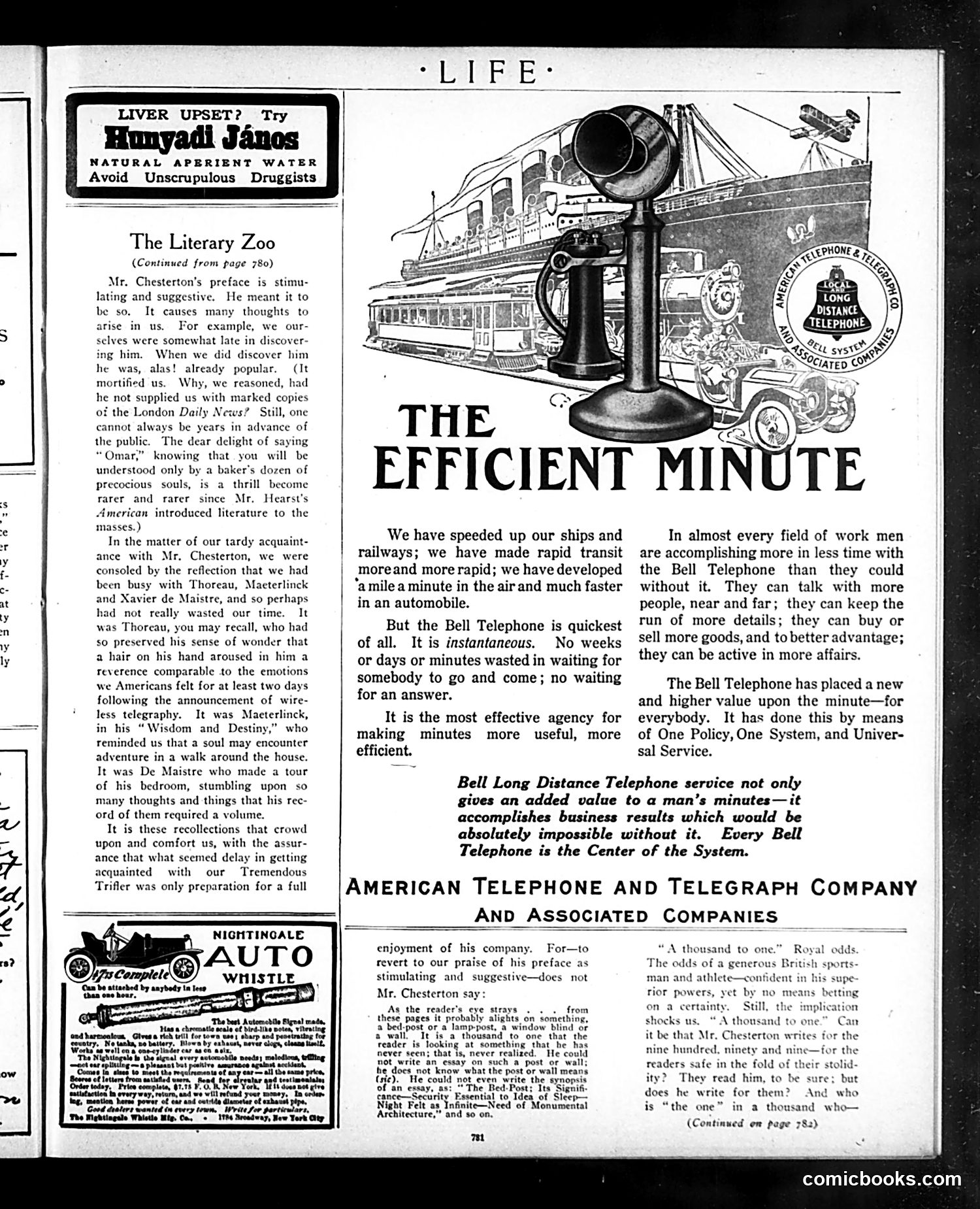
This page is primarily **advertising and literary criticism**, not political satire. The main content is "The Literary Zoo," a book review discussing G.K. Chesterton's preface to a literary collection. The critic humorously admits discovering Chesterton late, consoling himself that he'd been busy with other philosophers like Thoreau and Maeterlinck. The joke is self-deprecating: the magazine pokes fun at its own pretentiousness and the difficulty of staying ahead of literary trends, especially after mass audiences (via Hearst's publications) democratized literature. The dominant visual is a large **Bell Telephone advertisement** celebrating the telephone's efficiency in business—how it saves time compared to ships, railways, and automobiles. This reflects early-20th-century American optimism about technology. Side advertisements include **Hunyadi János** (a laxative) and the **Nightingale Auto Whistle**. The page offers no political cartoons or caricatures—it's a snapshot of 1920s middlebrow culture and early corporate advertising.
📄 Transcribed text from this page (OCR, searchable)
Machine-transcribed from the original scan — historical spelling and the odd misread are preserved.
NATURAL APERIENT WATER Avoid Unscrupulous Druggists The Literary Zoo (Continued from page 780) Mr. Chesterton’s preface is stimu- lating and suggestive. He meant it to be so. It causes many thoughts to arise in us. For example, we our- selves were somewhat late in discover- ing him. When we did discover him he was, alas! already popular. (It mortified us. Why, we reasoned, had he not supplied us with marked copies of the London Daily News? Still, one cannot always be years in advance of the public, The dear delight of saying “Omar,” knowing that you will be understood only by a baker's dozen of precocious souls, is a thrill become rarer and rarer since Mr. Hearst's American introduced literature to the masses.) In the matter of our tardy acquaint- ance with Mr, Chesterton, we were consoled by the reflection that we had been busy with Thoreau, Maeterlinck and Xavier de Maistre, and so perhaps had not really wasted our time. It was Thoreau, you may recall, who had so preserved his sense of wonder that a hair on his hand aroused in him a reverence comparable to the emotions we Americans felt for at least two days following the announcement of wire- less telegraphy. It was Maeterlinck, in his “Wisdom and Destiny,” who reminded us that a soul may encounter adventure in a walk around the house. Tt was De Maistre who made a tour of his bedroom, stumbling upon so many thoughts and things that his rec- ord of them required a volume. It is these recollections that crowd upon and comfort us, with the assur- ance that what scemed delay in getting acquainted with our Tremendous Trifler was only preparation for a full NIGHTINGALE eA) EFFICIENT MINUTE We have speeded up our ships and railways; we have made rapid transit moreand more rapid; we have developed ‘amilea minute in the airand much faster in an automobile. But the Bell Telephone is quickest of all. It is instantaneous. No weeks or days or minutes wasted in waiting for somebody to go and come; no waiting for an answer. It is the most effective agency for making minutes more useful, more efficient. In almost every field of work men are accomplishing more in less time with the Bell Telephone than they could without it. They can talk with more people, near and far; they can keep the run of more details; they can buy or sell more goods, and to better advantage; they can be active in more affairs. The Bell Telephone has placed a new and higher value upon the minute—for everybody. It has done this by means of One Policy, One System, and Univer- sal Service. Bell Long Distance Telephone service not only gives an added value to a man’s minutes— it accomplishes business results which would be absolutely impossible without it. Every Bell Telephone is the Center of the System. AMERICAN TELEPHONE AND TELEGRAPH COMPANY AND ASSOCIATED COMPANIES enjoyment of his company. For—to revert to our praise of his preface as stimulating and suggestive—does not Mr. Chesterton say: As the reader's cye strays... from these pages it probably alights on something, a bed-post or a lamp-post, a window blind oF a wall, It is a thousand to one that the reader is looking at something that he has never seen; that is, never realized. He could not write an essay on such a post or wall; he does not know what the post or wall means (sie). He could not even write the synopsis of an exsay, - Bed-Post; Its Signifi- cance—Sec Sleep— Night Felt infinite—Need of Monumental Architecture,” and so on, 7 “A thousand to .” Royal odds. The odds of a generous Briti man and athlete—contident in his supe- rior powers, yet by no means betting on a certainty, Still, the shocks us. “A thousand to ¢ it be that Mr. Chesterton writes for the nine hundred, ninety and nine—for the readers safe in the fold of their stolid- y? They read him, to be sure; but does he write for them? And who is “the one” in a thousand who— (Continued em page 782) comicbooks.com