
Life, 1910-04-28 · page 8 of 40
Life — April 28, 1910 — page 8: what you’re looking at
What you’re looking at
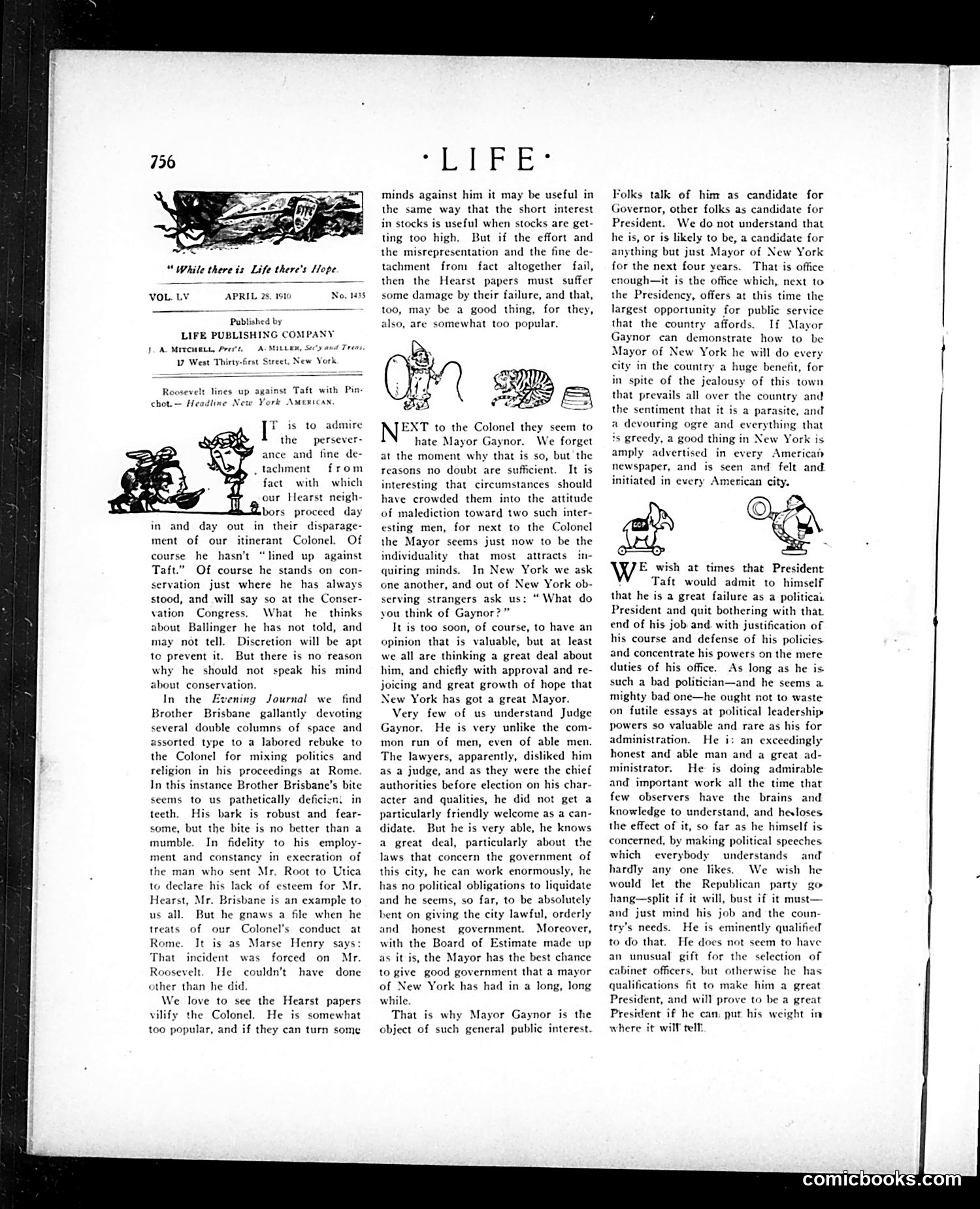
This page critiques Mayor William Jay Gaynor of New York City. The text discusses his unpopularity with various groups—lawyers disliked him as a judge candidate, and he faced criticism for mixing politics with religion at Rome proceedings. The accompanying cartoons (though small and somewhat unclear in reproduction) appear to satirize Gaynor's political position and public reception. The article acknowledges his administrative competence but suggests he lacks the political finesse needed for higher office, particularly the presidency. The piece also references Colonel Roosevelt's recent actions and the "Hearst papers," indicating this reflects broader 1910 New York political divisions among progressive factions. The overall tone is cautionary—praising Gaynor's honesty while questioning his suitability for national leadership.
📄 Transcribed text from this page (OCR, searchable)
Machine-transcribed from the original scan — historical spelling and the odd misread are preserved.
“While there is Life there's Hope. VOL. LY APRIL 25, 1910 No. 1435 Published by LIFE PUBLISHING COMPANY JOA MITCHELL, Prest, A: MILLEK, Se’y ant Treas 17 West Thirty-first Street, New York nes up against Taft with Pin- York American Roosevelt chot.— Headtin [ is to admire the — persever- fine de- from which ance and | tachment fact with our Hearst neigh- Bbors proceed day in their disparage- ment of our itinerant Colonel. Of course he hasn't “lined up against Taft.” Of course he stands on con- servation just where he has always stood, and will say so at the Conser- vation Congress. What he thinks about Ballinger he has not told, and may not tell. Discretion will be apt to prevent it. But there is no reason why he should not speak his mind about conservation. In the Evening Journal we find Brother Brisbane gallantly devoting several double columns of space and assorted type to a labored rebuke to the Colonel for mixing politics and religion in his proceedings at Rome. In this instance Brother Brisbane’s bite seems to us pathetically deficient in teeth. His bark is robust and fear- some, but the bite is no better than a mumble. In fidelity to his employ- ment and constancy in execration of the man who sent Mr. Root to Utica to declare his lack of esteem for Mr. Hearst, Mr. Brisbane is an example to us all. But he gnaws a file when he treats of our Colonel's conduct at Rome. It is as Marse Henry says: That incident was forced on Mr. Roosevelt. He couldn’t have done other than he did. We love to see the Hearst papers vilify the Colonel. He is somewhat too popular, and if they can turn some in and day out “ERE minds against him it may be useful in the same way that the short interest in stocks is useful when stocks are get- ting too high. But if the effort and the misrepresentation and the fine de- tachment from fact altogether fail, then the Hearst papers must. suffer some damage by their failure, and that, too, may be a good thing, for they, also, are somewhat too popular. XT to the Colonel they seem to hate Mayor Gaynor. We forget at the moment why that is so, but the reasons no doubt are sufficient. It is interesting that circumstances should have crowded them into the attitude of malediction toward two such inter- esting men, for next to the Colonel the Mayor seems just now to be the individuality that most attracts quiring minds. In New York we ask one another, and out of New York ob- serving strangers ask us: “What do you think of Gaynor?” It is too soon, of course, to have an opinion that is valuable, but at least we all are thinking a great deal about him, and chiefly with approval and re- joicing and great growth of hope that New York has got a great Mayor. Very few of us understand Judge Gaynor. He is very unlike the com- mon run of men, even of able men. The lawyers, apparently, disliked him as a judge, and as they were the chief authorities before election on his char- acter and qualities, he did not get a particularly friendly welcome as a can- didate. But he is very able, he knows a great deal, particularly about the laws that concern the government of this city, he can work enormously, he has no political obligations to liquidate and he seems, so far, to be absolutely bent on giving the city lawful, orderly and honest. government. Moreover, with the Board of Estimate made up as it is, the Mayor has the best chance to give good government that a mayor of New York has had in a long, long while. That is why Mayor Gaynor is the object of such general public interest. Folks talk of him as candidate for Governor, other folks as candidate for President. We do not understand that he is, or is likely to be, a candidate for anything but just Mayor of New York for the next four years. That is office cnough—it is the office which, next to the Presidency, offers at this time the largest opportunity for public service that the country affords. If Mayor Gaynor can demonstrate how to be Mayor of New York he will do every city in the country a huge benefit, for in spite of the jealousy of this town that prevails all over the country and the sentiment that it is a parasite, and a devouring ogre and everything that ts greedy, a good thing in New York is amply advertised in every Americai newspaper, and is seen and felt and. initiated in every American city. wish at times that President Taft would admit to himself that he is a great failure as a political President and quit bothering with that. end of his job and. with justification of his course and defense of his policies and concentrate his powers on the mere duties of his office. As long as he is such a bad politician—and he seems a mighty bad one—he ought not to waste on futile essays at political leadership powers so valuable and rare as his for administration. He i: an exceedingly honest and able man and a great ad- ministrator. He is doing admirable and important work all the time that few observers have the brains and knowledge to understand, and hesloses. the effect of it, so far as he himself is concerned, by making political speeches which everybody understands and hardly any one likes. We wish he would let the Republican party go hang—split if it will, bust if it must— and just mind his job and the coun- try’s needs. He is eminently qualified to do that. He does not seem to have an unusual gift for the selection of cabinet officers, but otherwise he has qualifications fit to make him a great President, and will prove to be a great Presitient if he can, put his weight in where it will tell. comicbooks.com