
Life, 1910-04-28 · page 23 of 40
Life — April 28, 1910 — page 23: what you’re looking at
What you’re looking at
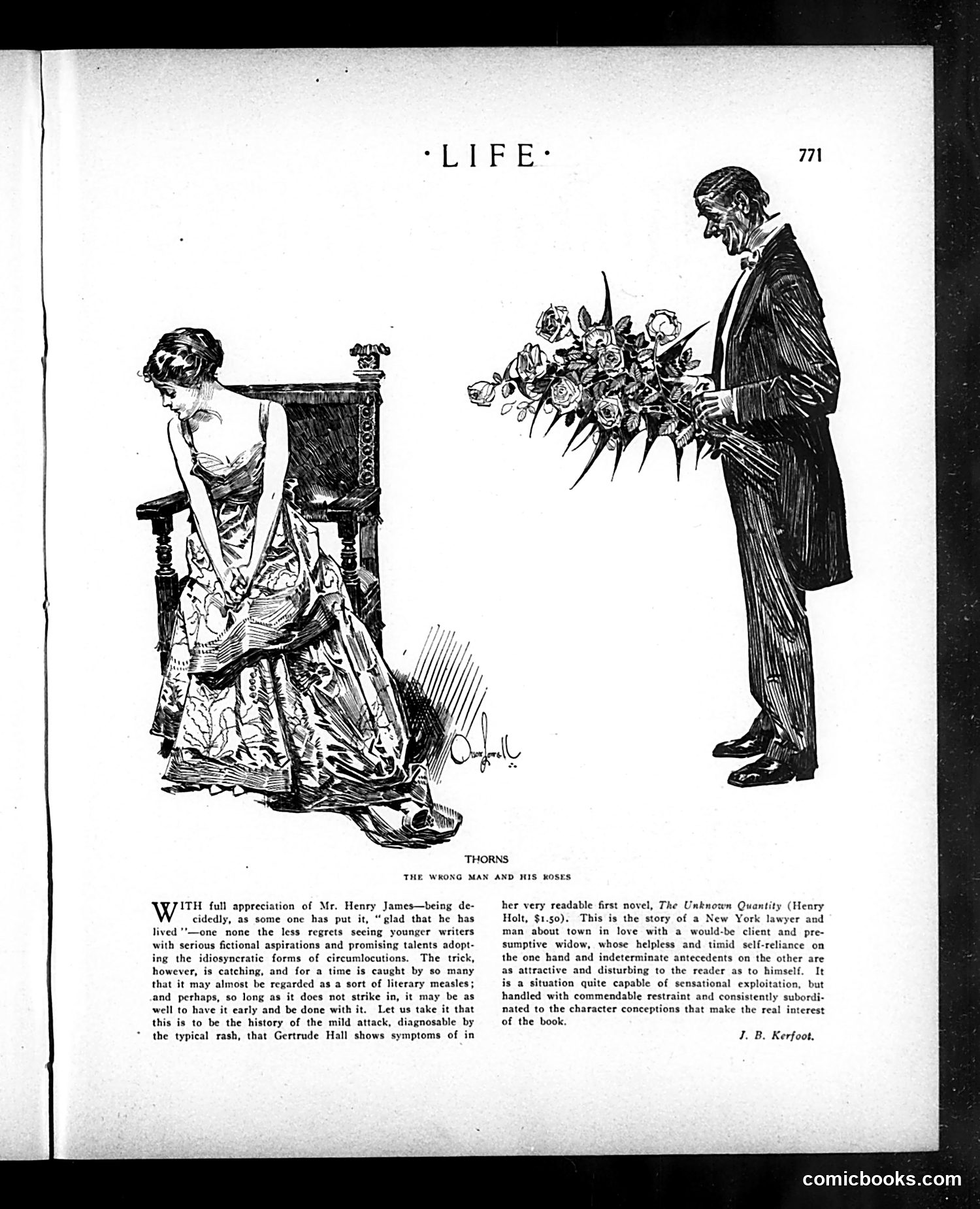
This illustration satirizes the literary style of Henry James and its influence on younger writers. The cartoon depicts a man presenting wilted roses to a seated woman—a visual metaphor for the overcomplicated, circuitous prose style ("idiosyncratic forms of circumlocutions") that James popularized. The text compares this stylistic trend to "literary measles"—a catching infection spreading among aspiring authors. The "thorns" in the image represent the difficulty and pain of this verbose approach. The review discusses Gertrude Hall's novel *The Unknown Quantity*, praising her for adopting James's complex style while maintaining narrative restraint and character focus. The joke: giving roses (romance, beauty) that are withered and thorny (James's convoluted writing) to an unimpressed woman perfectly captures the period's literary anxiety about style overwhelming substance.
📄 Transcribed text from this page (OCR, searchable)
Machine-transcribed from the original scan — historical spelling and the odd misread are preserved.
THE WRONG MAN AND WIS kOSES ITH full appreciation of Mr. Henry James—being de- cidedly, as some one has put it, “glad that he has lived ’—one none the less regrets seeing younger writers with serious fictional aspirations and promising talents adopt- ing the idiosyncratic forms of circumlocutions. The trick, however, is catching, and for a time is caught by so many that it may almost be regarded as a sort of literary measles; and perhaps, so long as it docs not strike in, it may be as well to have it early and be done with it. Let us take it that this is to be the history of the mild attack, diagnosable by the typical rash, that Gertrude Hall shows symptoms of in her very readable first novel, The Unknown Quantity (Henry Holt, $1.50). This is the story of a New York lawyer and man about town in love with a would-be client and pre- sumptive widow, whose helpless and timid self-reliance on the one hand and indeterminate antecedents on the other are as attractive and disturbing to the reader as to himself. It is a situation quite capable of sensational exploitation, but handled with commendable restraint and consistently subordi- nated to the character conceptions that make the real interest of the book. J. B. Kerfoot. comicbooks.com