
A complete issue · 40 pages · 1909
Life — February 4, 1909
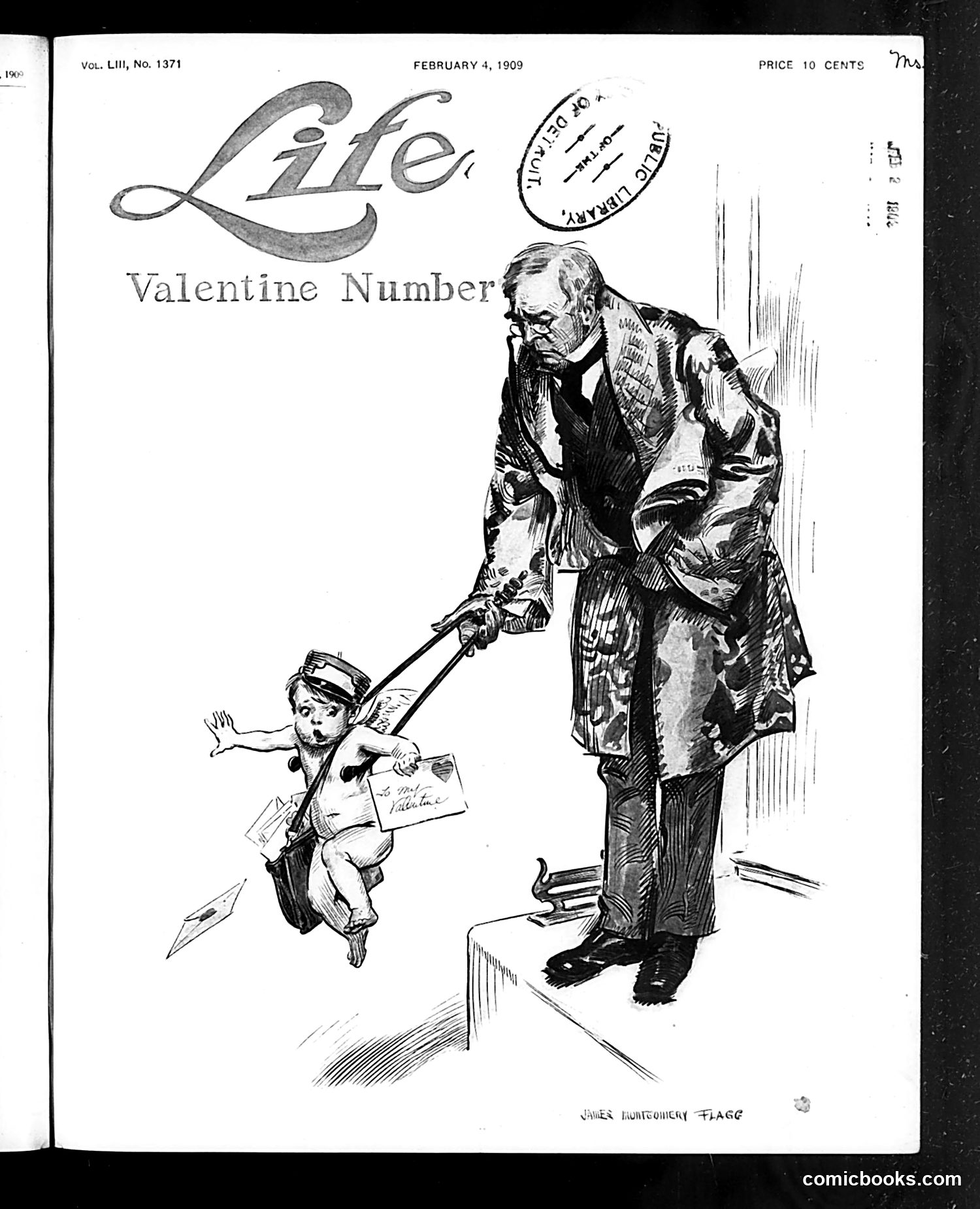
This is the cover of Life's Valentine Number. The cartoon depicts an adult man (appearing to be a political figure, though identity is unclear from the image alone) being pulled along by Cupid—represented as a small, mischievous cherub. The man looks reluctant or bewildered, being dragged toward romance despite his dignified, serious demeanor. The satire plays on the tension between romantic sentiment and masculine authority: even powerful, important men cannot resist Cupid's irresistible force on Valentine's Day. The cherub's playful dominance over the adult suggests that love makes fools of everyone, regardless of status. This was a common theme in Life's satirical humor—puncturing pretension through romantic entanglement.
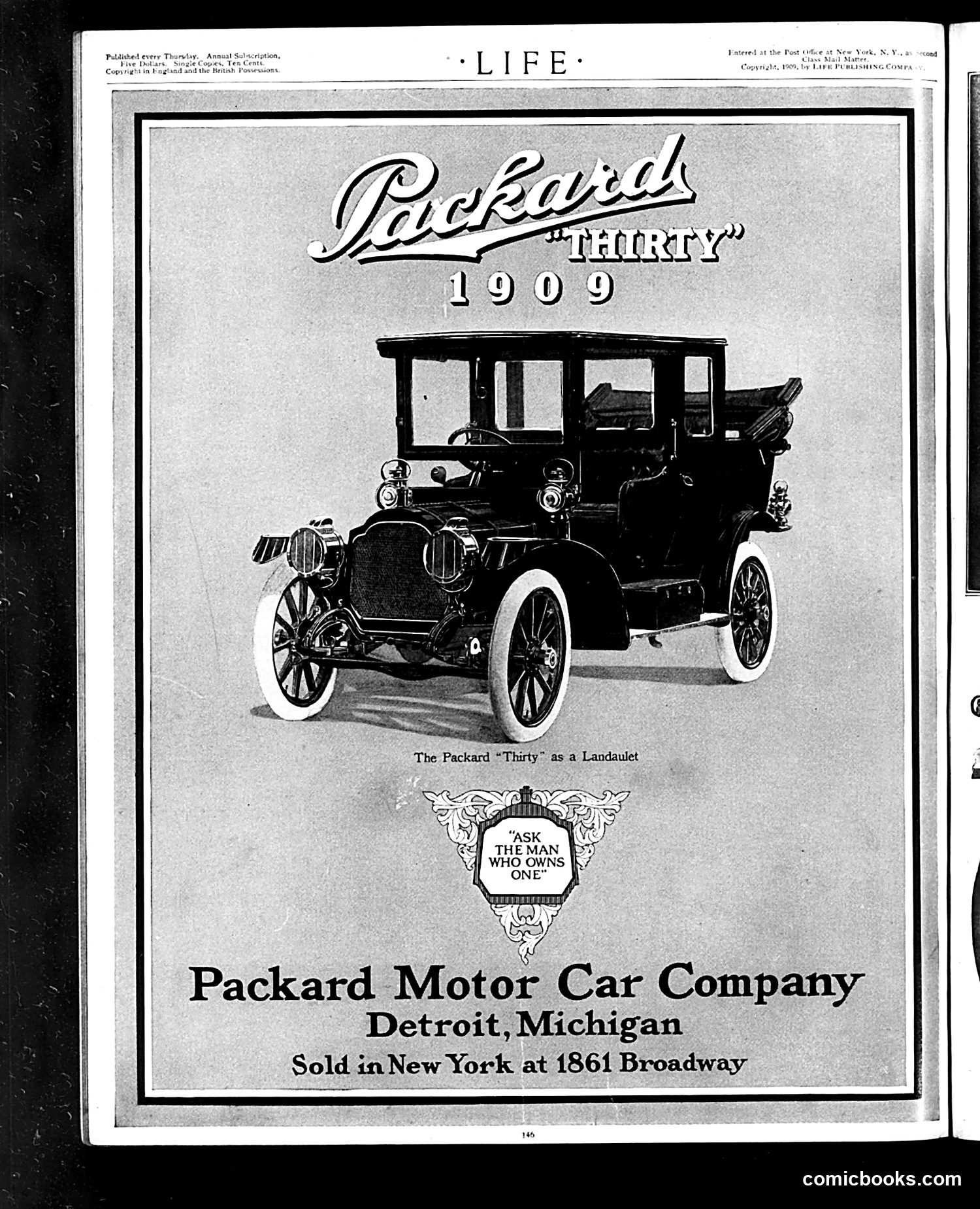
This page is **primarily an advertisement**, not satire or political commentary. It's a 1909 Packard Motor Car Company ad from *Life* magazine, featuring the Packard "Thirty" automobile configured as a Landaulet (an open-air carriage-style vehicle). The ad's only satirical element is the small tagline: "ASK THE MAN WHO OWNS ONE" — a marketing phrase suggesting satisfied customer testimonials validate the product's quality. There are no political cartoons, caricatures, or historical references here. The content is straightforward automotive promotion: showcasing the vehicle's design and directing potential New York buyers to the Broadway showroom in Detroit.
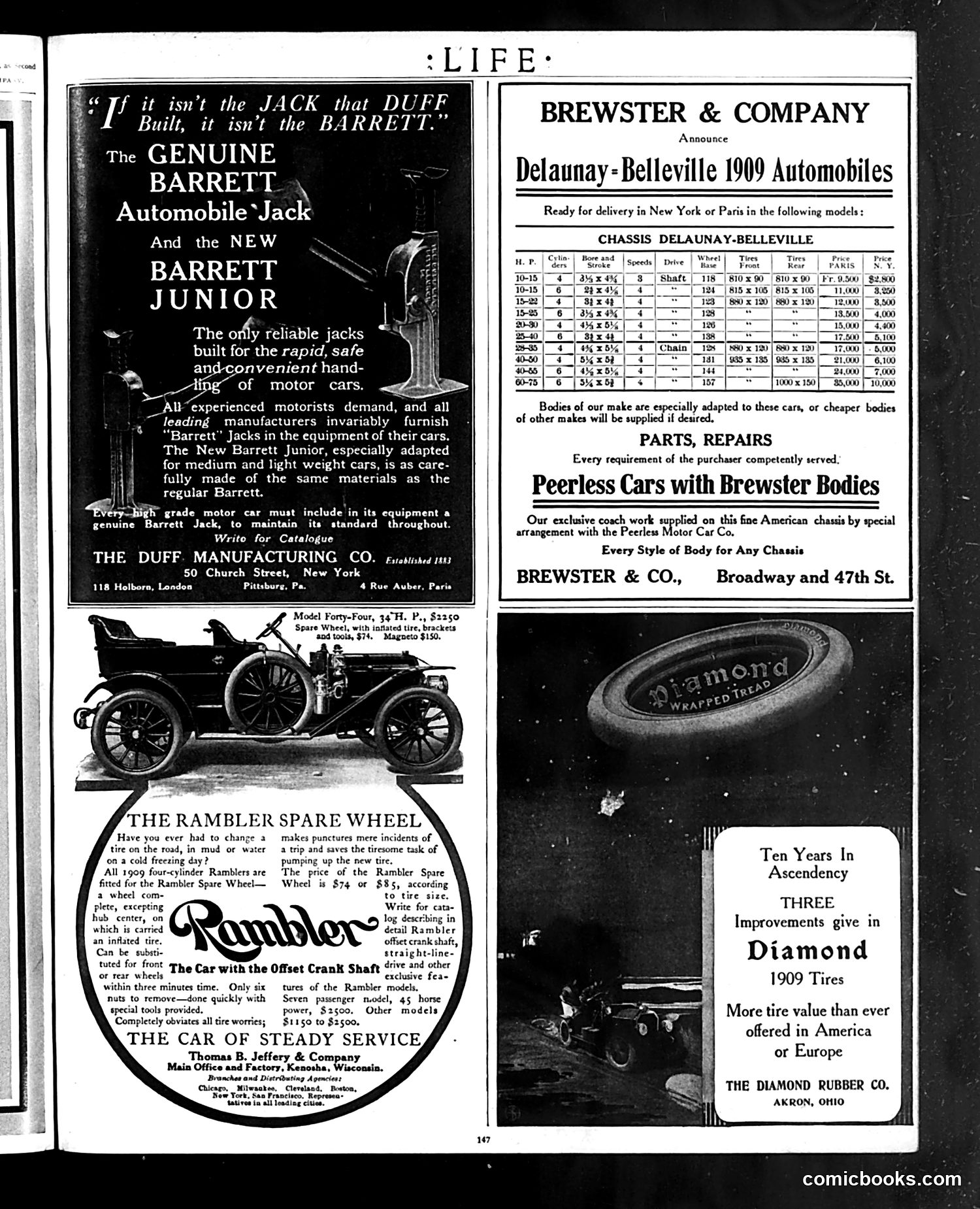
This page is **primarily automobile advertisements** from 1909, not political satire. There are no political cartoons visible. The ads feature: - **Barrett Automobile Jack** - competing with the "Duff" jack by claiming superiority - **Delaunay-Belleville automobiles** - French luxury cars available in New York or Paris, with detailed chassis specifications and pricing - **Rambler Spare Wheel** - highlighting the convenience of carrying a spare tire - **Diamond Wrapped Tires** - claiming ten years of improvements and superior durability The page reflects early 1900s automotive competition, where manufacturers emphasized reliability, safety features (spare wheels), and product superiority through direct comparison advertising. There is no satire or political content—this is straightforward commercial marketing typical of LIFE magazine's revenue model.
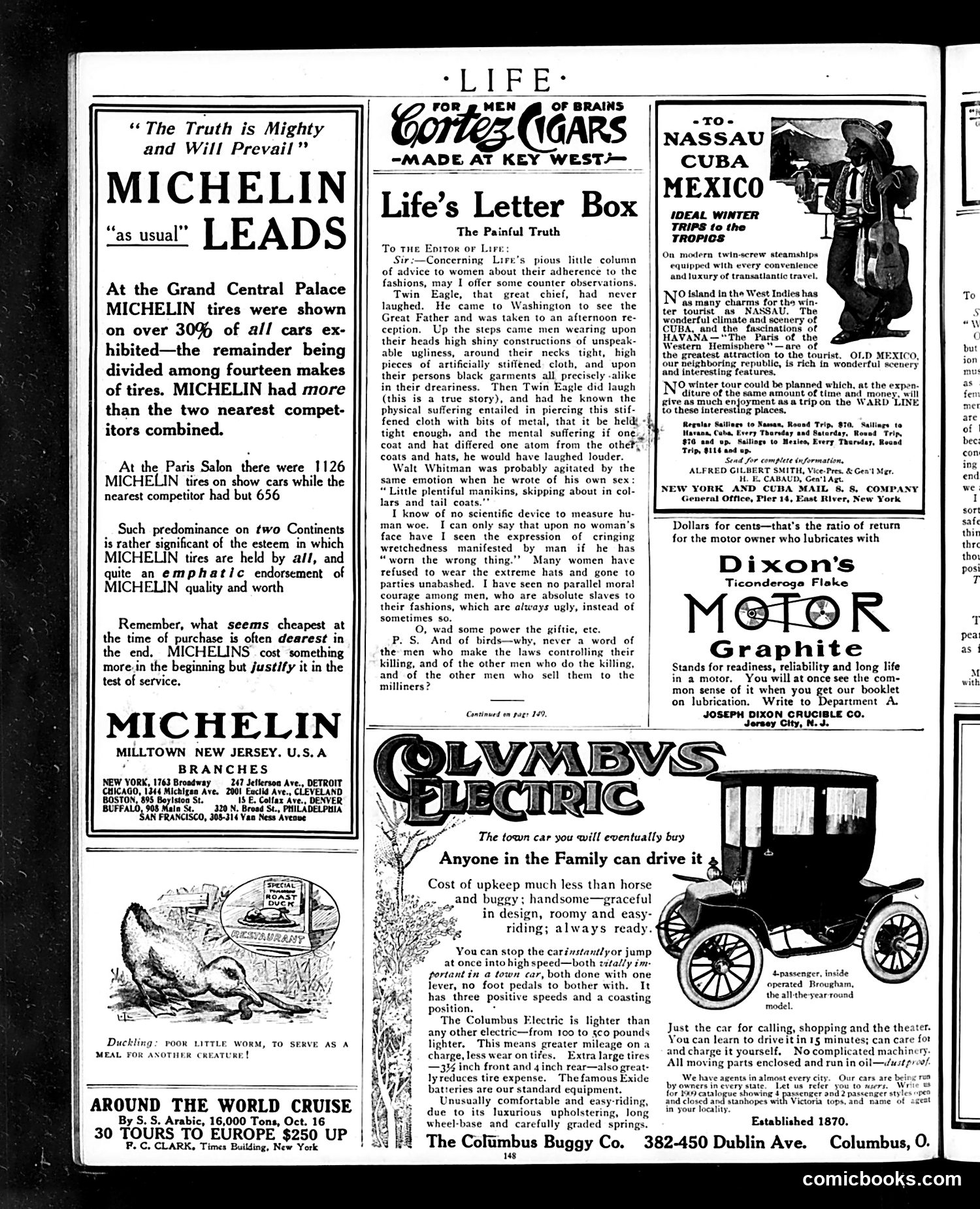
This page is primarily **advertising** rather than editorial content. The major ads feature: - **Michelin Tires**: Boasts superiority at auto shows, emphasizing cost-effectiveness and quality - **Cortez Cigars**: "For Men of Brains" - **Dixon's Motor Graphite**: Lubricant product - **Olympus Electric**: Early automobile with the tagline "Anyone in the Family can drive it" - **Columbus Buggy Co.**: Horse buggy advertising The single cartoon (lower left) labeled "Duckling" appears to be a satirical joke about food chains, showing a small worm—likely mocking the precarious survival of small creatures. The "Life's Letter Box" section addresses women's fashion concerns about hat pins and uncomfortable clothing—reflecting early 1900s social commentary on women's fashion absurdities. The content reflects the automotive industry's growth period and emerging consumer culture.
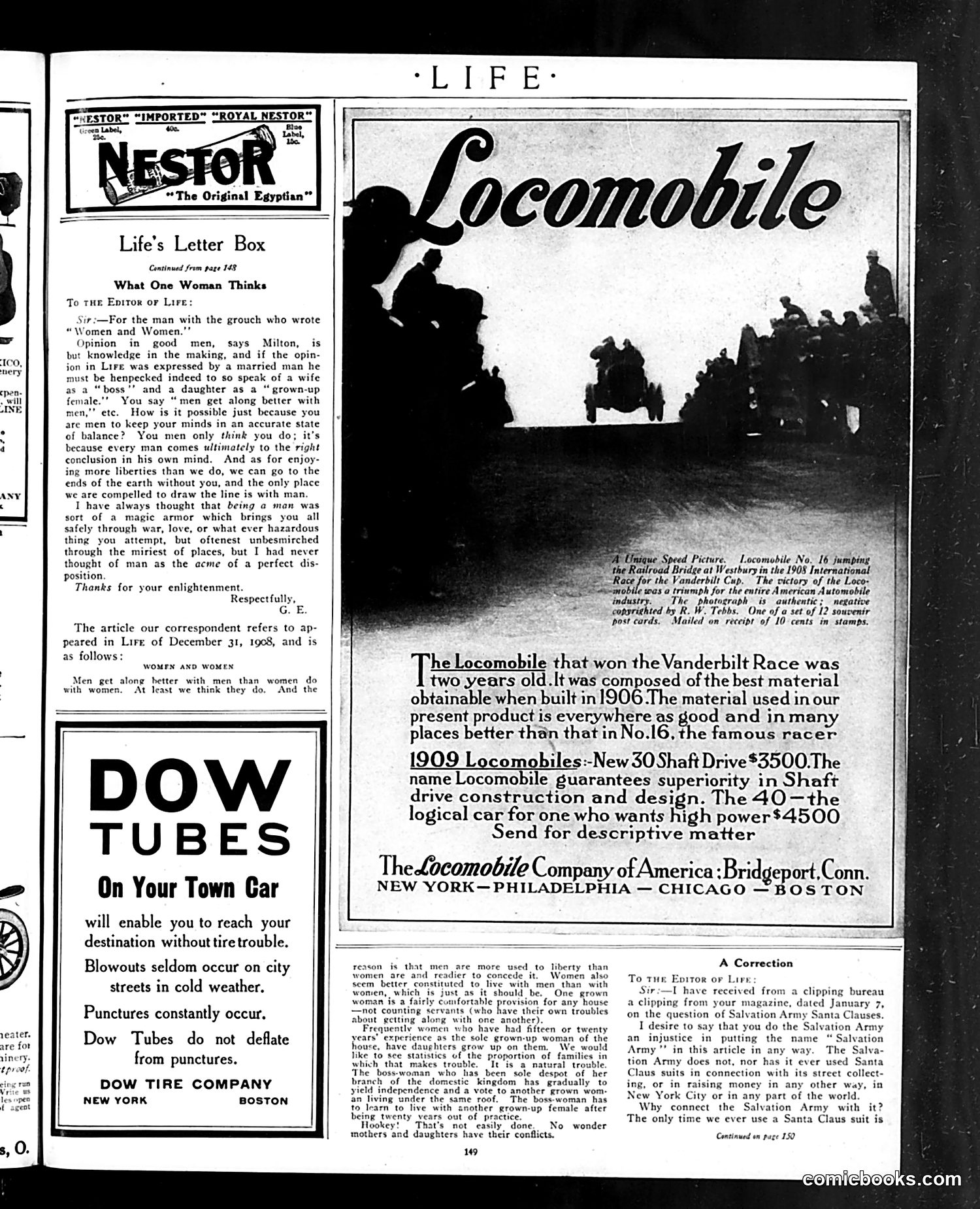
This page is primarily **advertising and reader letters**, not political satire. The main content includes: **"Life's Letter Box"**: A reader's response to an earlier article about women and men. The correspondent argues that being male is "a magic armor" conferring advantages, disagreeing with the notion that men face greater hardships. **Advertisements**: The dominant visual element is a **Locomobile automobile ad** celebrating the car's racing victory and engineering superiority. Below that is a **Dow Tubes tire advertisement** promoting their reliability. **"A Correction"**: A brief editorial note clarifying the proper name of the Salvation Army's Santa Claus initiative. This is essentially a typical magazine page mixing reader correspondence with commercial advertising—no political cartoon or satirical commentary is present.
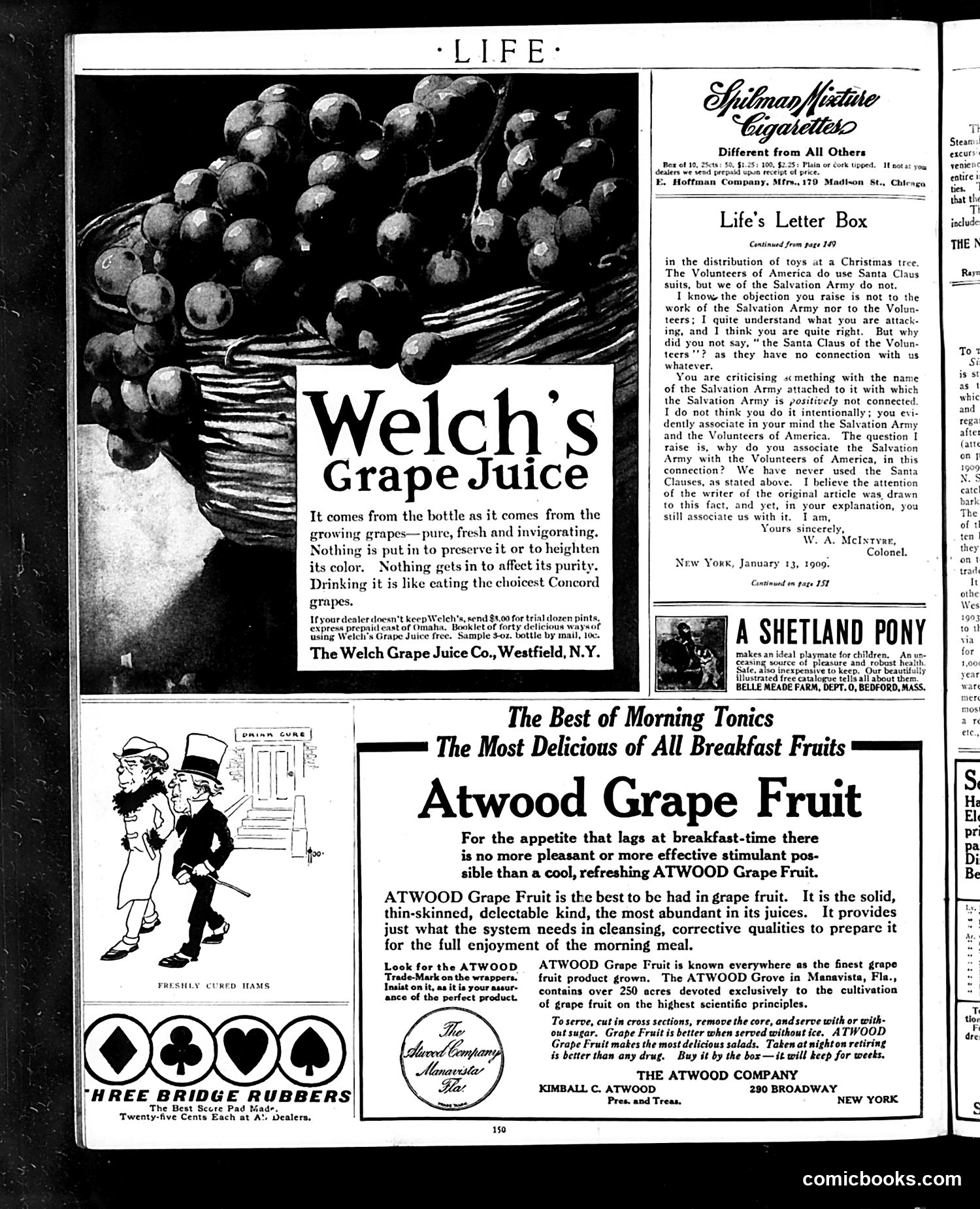
This page is **primarily advertising** (Welch's Grape Juice, Atwood Grape Fruit, Spitman cigarettes, Three Bridge Rubbers, and a Shetland pony). The only cartoon element is a small illustration in the lower left showing two figures in formal attire (top hats and coats) appearing to rush or move urgently past a "Union Club" sign. The cartoon's specific meaning is **unclear without additional context**—it may reference a social or political incident involving the Union Club, but the image alone doesn't identify the figures or satirical point. The drawing style suggests early 1900s publication, but the joke or reference isn't self-evident from the visual alone. The page's main content is commercial rather than satirical or political.
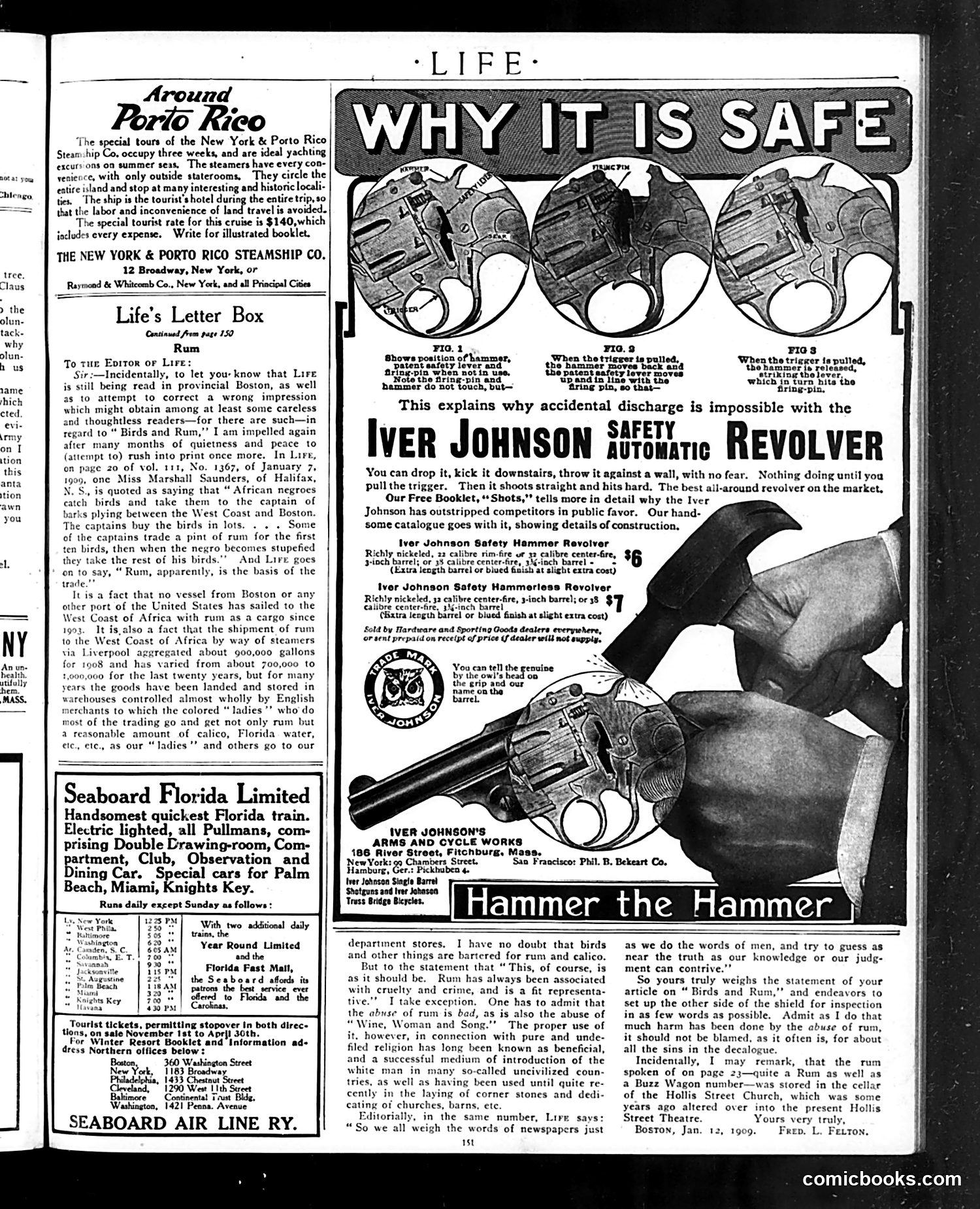
This page is primarily **advertising content**, not satire or political commentary. The dominant feature is a large advertisement for the "Iver Johnson Safety Automatic Revolver," which takes up roughly half the page. The ad's central message addresses safety concerns about accidental discharge. Diagrams labeled "Why It Is Safe" show the hammer mechanism with technical explanations. The advertisement emphasizes that the revolver cannot fire unless the trigger is deliberately pulled—a selling point highlighting the weapon's design advantage over competitors. The remainder contains travel advertisements (Seaboard Florida Limited, Porto Rico steamship) and Life's Letter Box (reader correspondence). There is no political satire or caricature visible. This represents typical early 20th-century Life magazine content: commercial advertisements interspersed with editorial material.
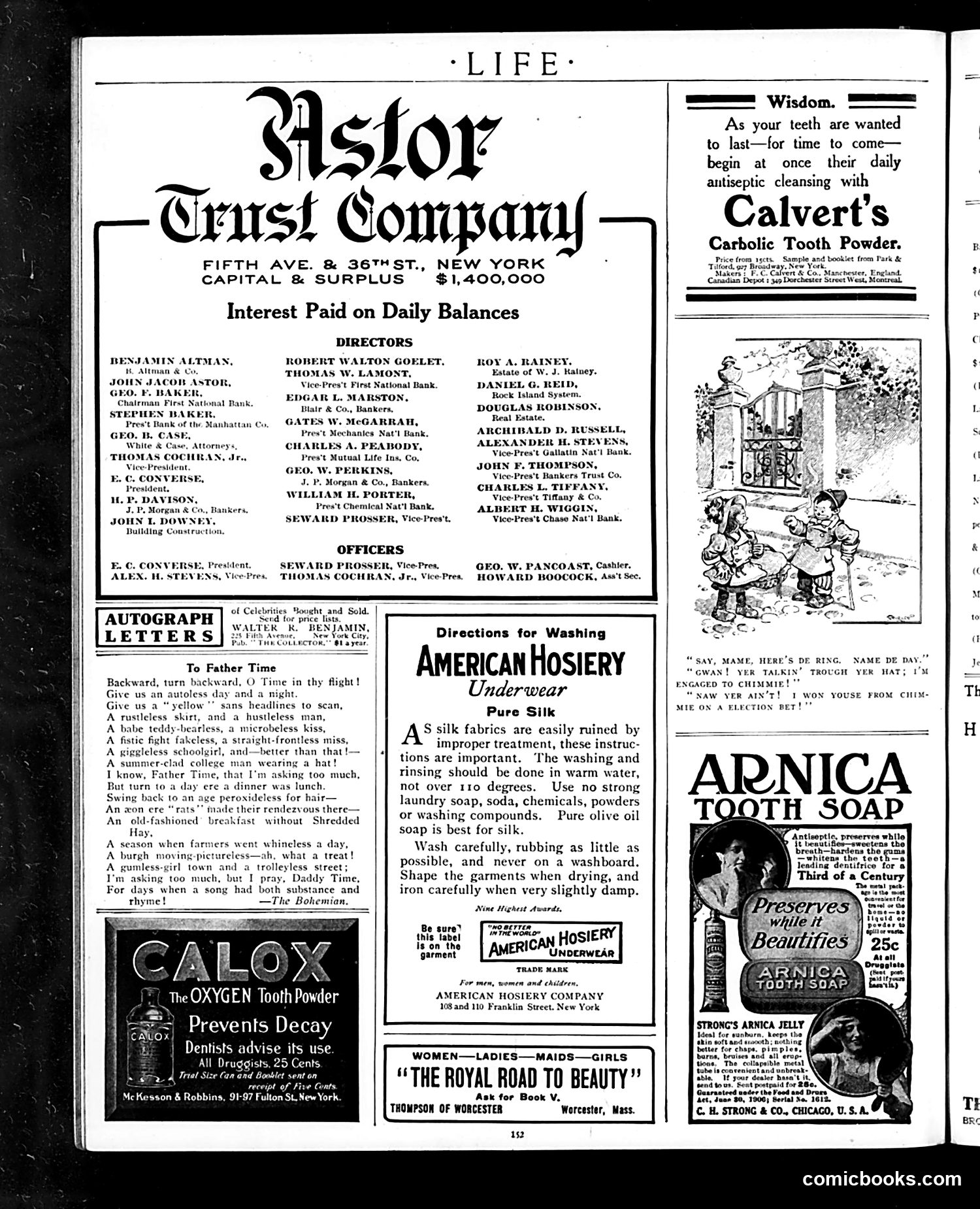
This page is primarily **advertising and business content** rather than satirical cartoons. The upper portion features the Astor Trust Company bank advertisement with a list of directors and officers. The only humorous element is the "Autograph Letters" section, which presents a poem titled "To Father Time" — a playful personification addressing Time itself with requests like "turn backward" and "give us a 'yellow' sans headlines to scan." This is gentle, nostalgic humor rather than sharp satire. The remaining content consists of product advertisements (Calvert's tooth powder, American Hosiery, Calox tooth powder, Arnica tooth soap) and a beauty guide promotion. The page reflects early 20th-century consumer marketing aimed at middle-class readers rather than political commentary.
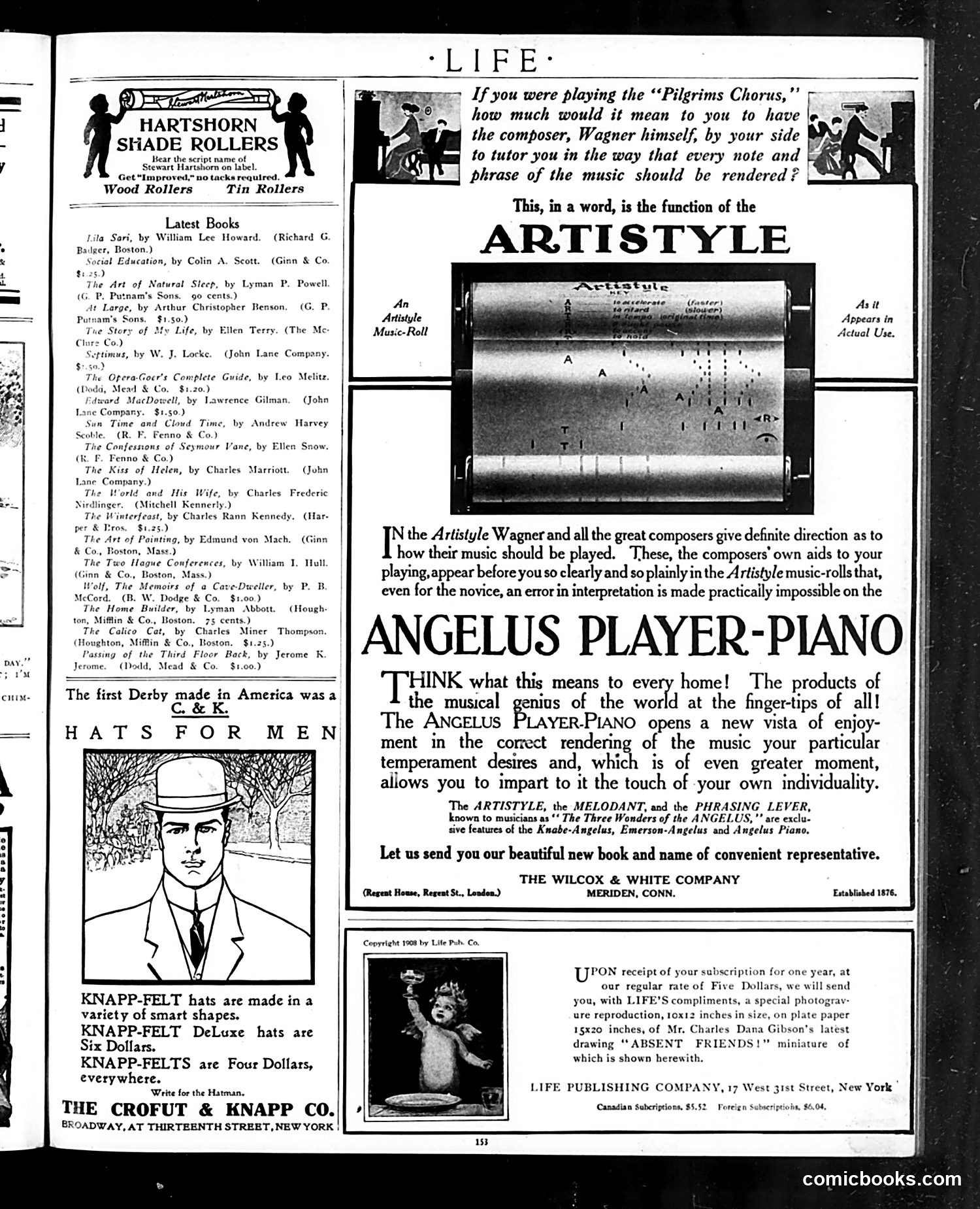
This page is primarily **advertising**, not political satire. The main content consists of: 1. **Book advertisements** (left column) - listings of recent publications with publishers and prices 2. **Hartshorn Shade Rollers** ad (top left) - window treatment product 3. **Angelus Player-Piano advertisement** (center/right) - the largest feature, promoting an automated piano that plays pre-recorded music rolls, allowing anyone to perform classical compositions without musical training 4. **Knapp-Felt hats advertisement** (bottom left) - men's hat styles 5. **Life Publishing Company subscription offer** (bottom right) The Angelus ad's pitch—that musical genius is now accessible to everyone—reflects early 20th-century consumer culture's promise that technology democratizes elite experiences. This represents no satire but straightforward marketing of mechanical music reproduction technology to affluent households.
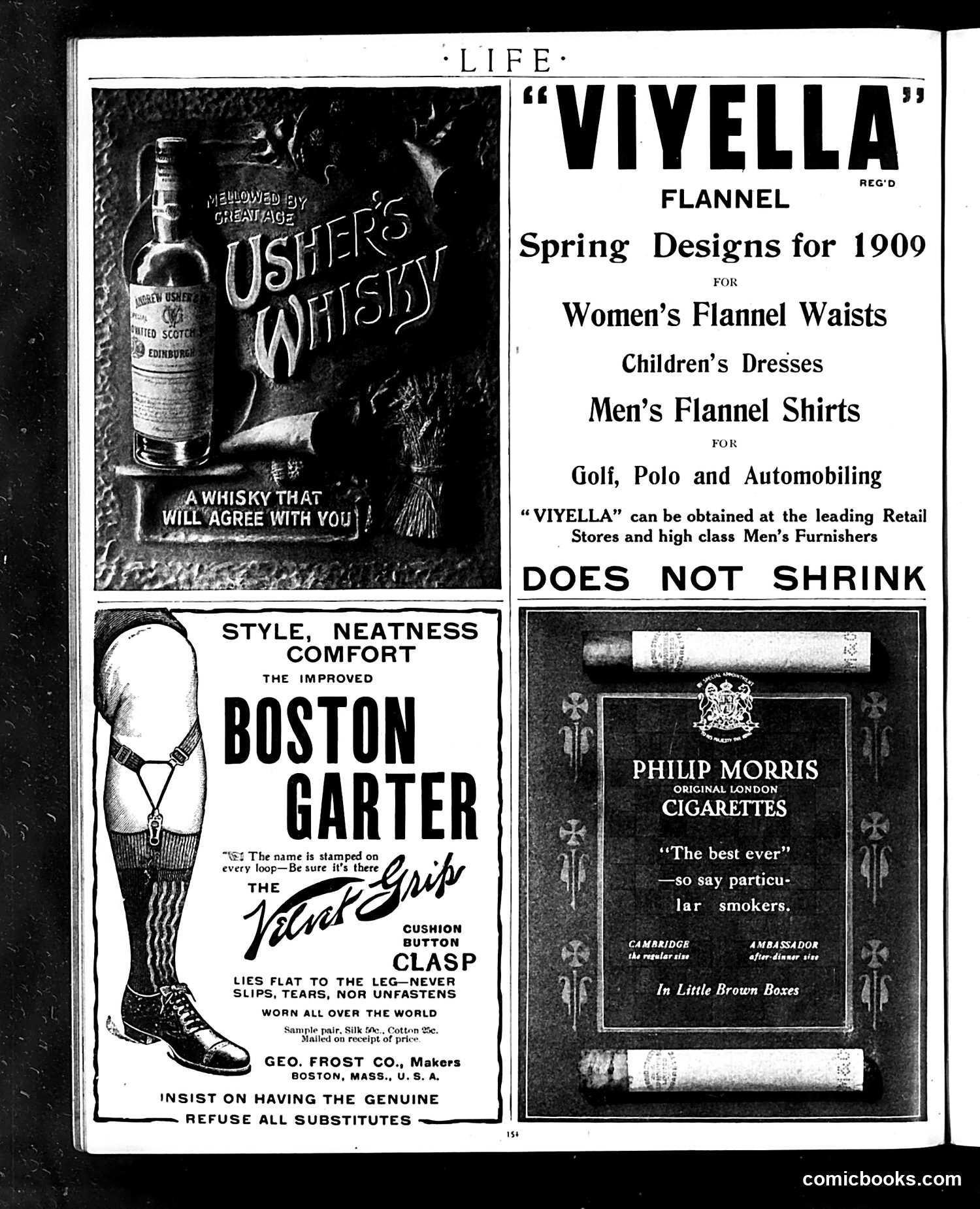
This is primarily an **advertising page** from Life magazine, circa 1909, containing four separate commercial advertisements rather than editorial cartoons or satire. The ads promote: 1. **Usher's Whisky** — positioned as agreeable/reliable 2. **Boston Garter** — a men's garter with a "cushion button clasp" that "lies flat to the leg" 3. **Vivella Flannel** — spring clothing for women, children, and men, notably advertised as non-shrinking 4. **Philip Morris Cigarettes** — positioned as "the best" in decorative packaging These represent typical early 1900s consumer goods marketed to middle and upper-class readers. The Boston Garter ad includes anatomical illustration showing the product in use. The Vivella ad emphasizes a practical advantage (no shrinkage) for its era. All reflect period commercial priorities and product categories now largely obsolete or transformed.
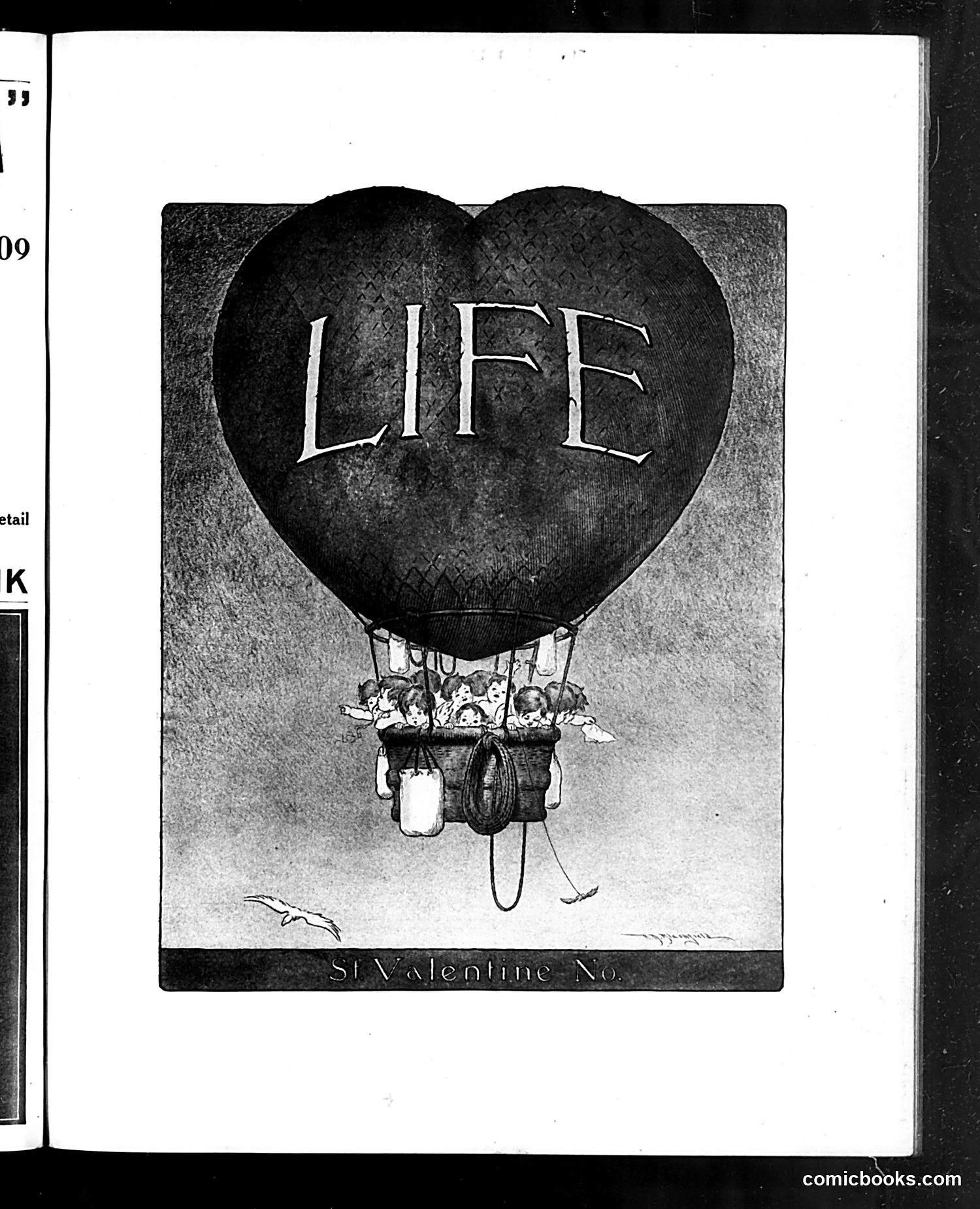
This is a Valentine's Day themed illustration from *Life* magazine showing a hot air balloon shaped like a heart, with "LIFE" written across it. The balloon carries a basket filled with passengers beneath it. The cartoon appears to be promotional or thematic rather than overtly political satire. It uses the romantic symbolism of a heart-shaped balloon to represent *Life* magazine itself, suggesting the publication as a vehicle carrying readers or representing shared human experience and sentiment. The "Valentine No." caption indicates this was part of a series of Valentine-themed content, a common tradition in satirical magazines of the early 20th century. Without additional context about the specific date or surrounding content, the precise satirical intent remains unclear, though it celebrates romantic themes appropriate to Valentine's Day.
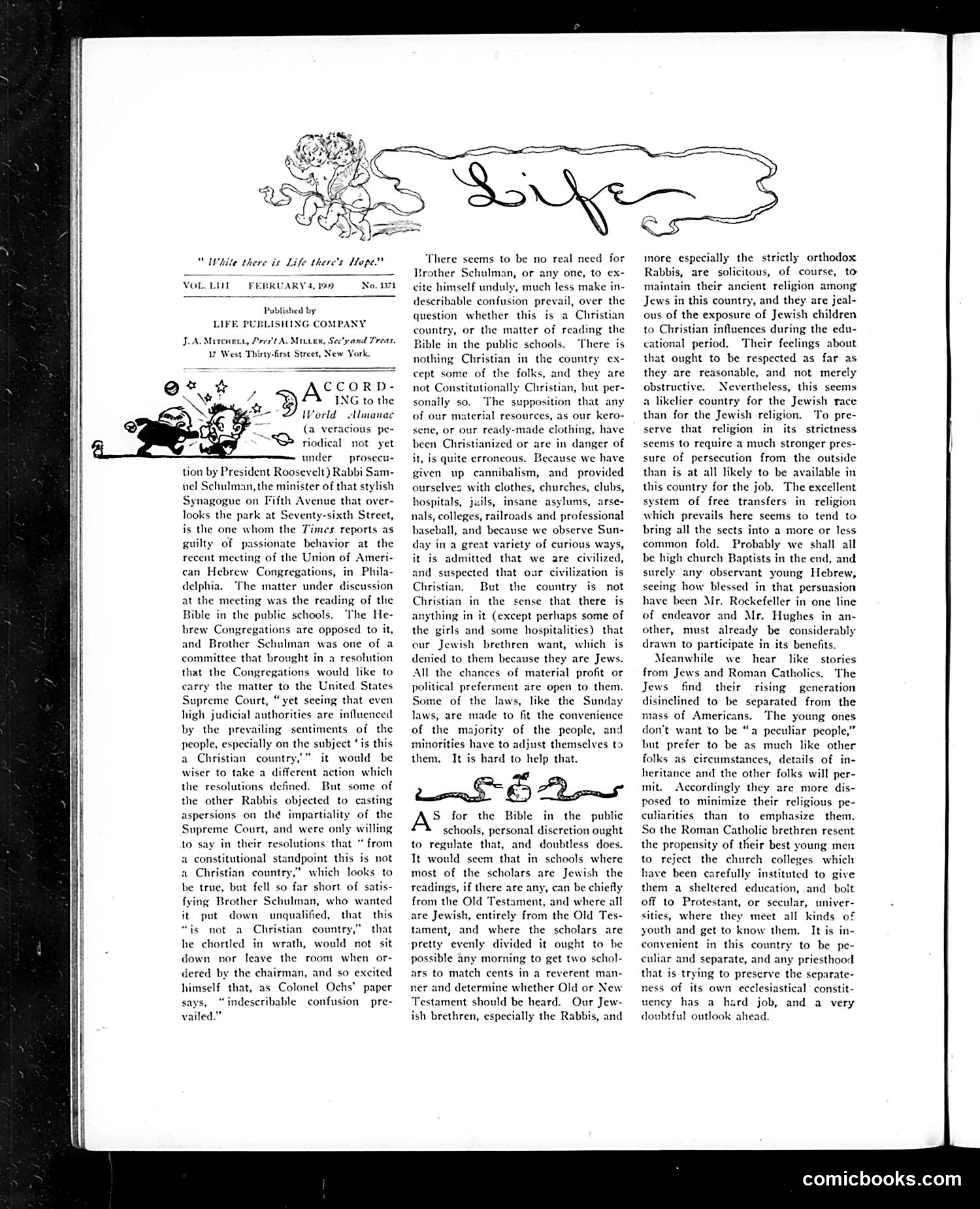
This is an editorial page from *Life* magazine (February 4, 1909) addressing whether the Bible should be read in public schools. The cartoon at top-left appears to show a figure (likely representing religious authority) in conflict—suggested by the aggressive posture and gestures. The main text debates a controversy involving Rabbi Samuel Schulman and Brother Schulman regarding Bible instruction in schools. The author argues against making schools explicitly "Christian" while acknowledging America's Christian character. The piece criticizes both strict Orthodox rabbis who want to exclude Jewish children from Christian influence *and* Catholic priests seeking to elevate church authority in education. The satire targets religious extremism on multiple sides rather than one figure—highlighting early 20th-century American anxieties about religious pluralism in public institutions.
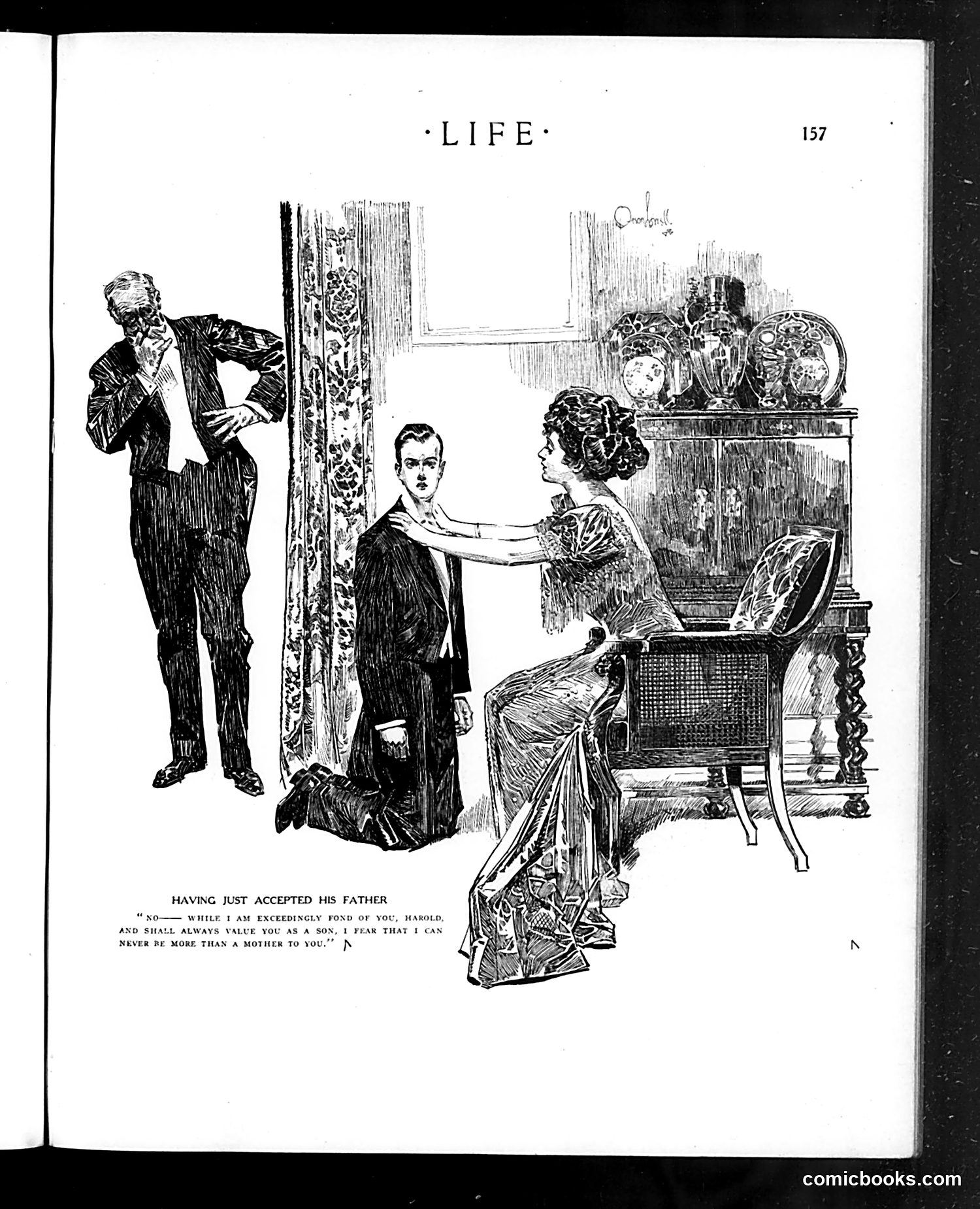
This illustration depicts a domestic scene with social commentary on family relationships and gender dynamics. A young man (Harold, named in the caption) sits while a woman touches his shoulder affectionately. An older man stands apart, observing—apparently Harold's father. The caption reads: "Having just accepted his father—while I am exceedingly fond of you, Harold, and shall always value you as a son, I fear that I can never be more than a mother to you." The satire appears to mock the awkwardness of blended family or step-relations, and possibly critiques sentimental Victorian-era family sentiments. The woman's elaborate gown and the decorated interior suggest upper-class domesticity. The joke hinges on the father's measured, somewhat cold acceptance of his son, wrapped in affectionate language that ultimately expresses emotional distance.
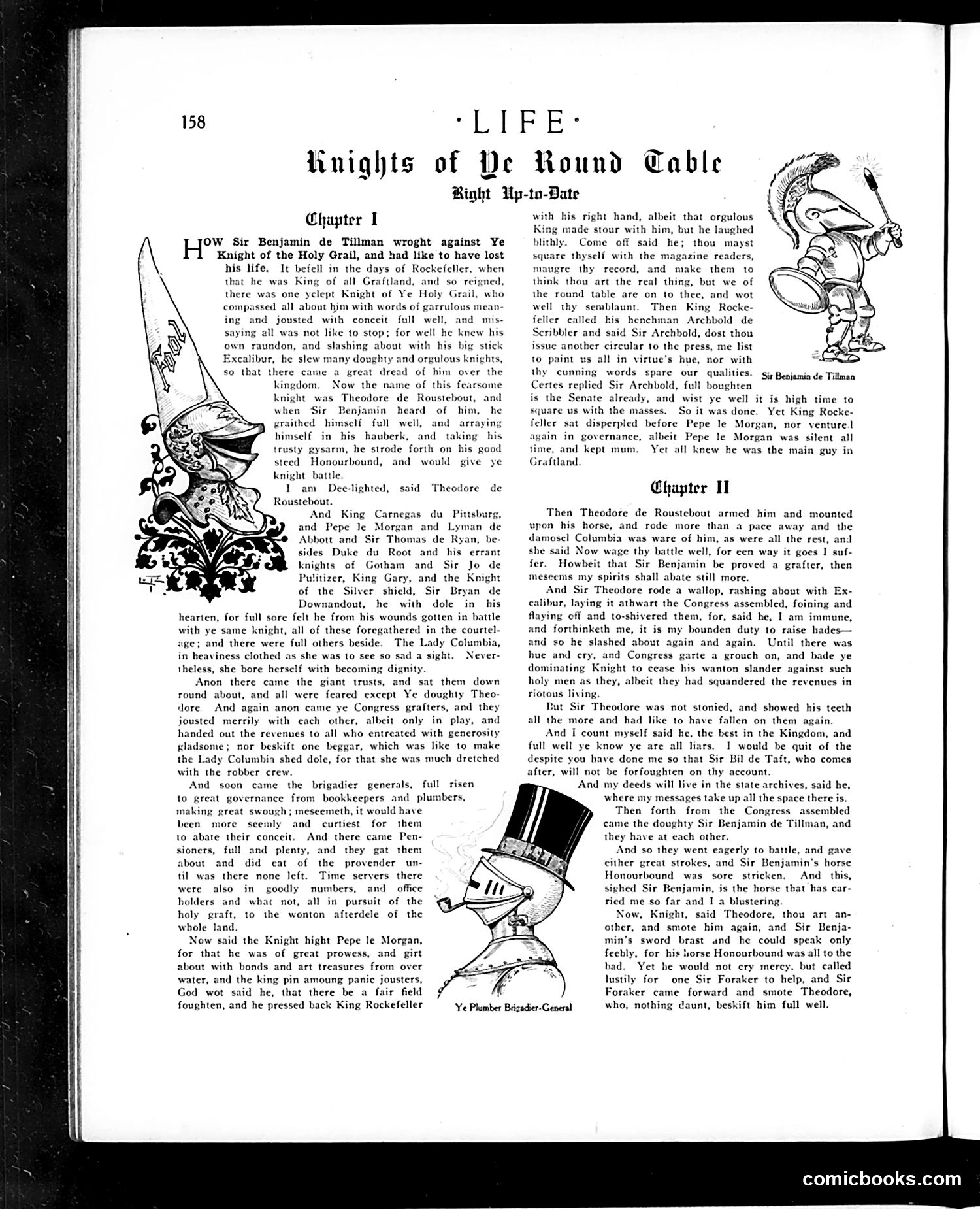
This is a mock-medieval parody mocking prominent Gilded Age industrialists and politicians as corrupt knights. The text uses deliberately archaic language to satirize these figures: - **Theodore de Roustebout** = Theodore Roosevelt, depicted as a righteously combative knight - **Sir Benjamin de Tillman** = Benjamin Tillman, a South Carolina senator - **King Rockefeller** = John D. Rockefeller, portrayed as ruling a corrupt "Graftland" - **Pepe le Morgan** = J.P. Morgan, the financier - **King Carnegas du Pittsburg** = Andrew Carnegie - **Lady Columbia** = America itself, distressed by corruption The satire targets rampant corporate monopolies, political corruption ("Congress grafters"), and the collusion between wealthy industrialists and government officials who distribute "revenues" to the highest bidder. Roosevelt's trustbusting efforts are mocked as theatrical posturing ("square thyself with the magazine readers"). The piece suggests these powerful men merely perform virtue while enriching themselves at the nation's expense.
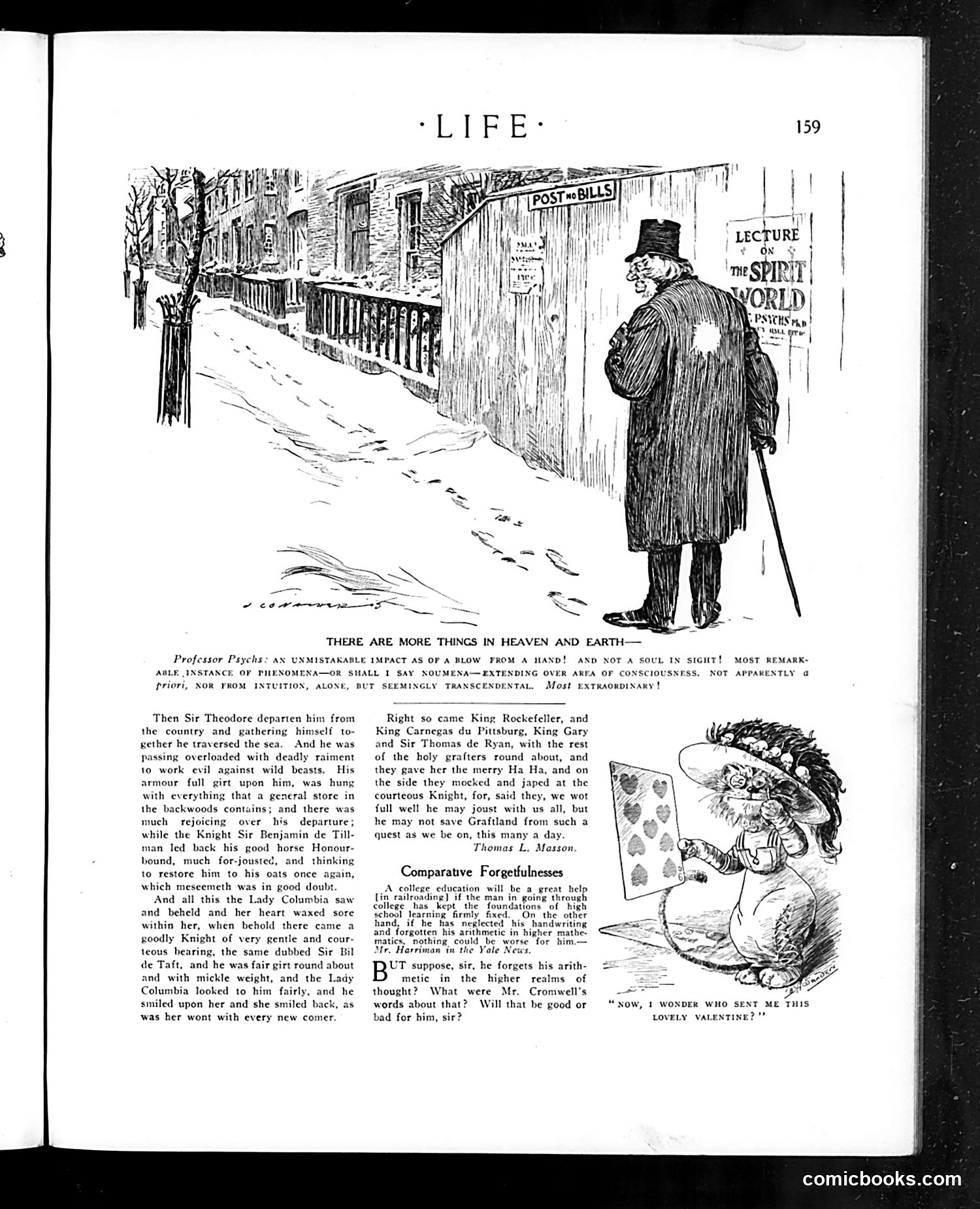
The main cartoon depicts a gentleman in winter attire reading a posted notice about a lecture on "The Spirit of the World." The caption jokes about supernatural phenomena—Professor Psyche's pseudo-intellectual rambling about mysterious forces suggests mockery of spiritualism or occult pseudoscience popular in the era. The accompanying text is a satirical medieval allegory where "Lady Columbia" (America) observes various figures: "Sir Theodore" (appears to be Theodore Roosevelt) departing, "Sir Bil de Taft" (President William Howard Taft) arriving as his successor, and corporate kings like Rockefeller and Carnegie ("holy grafters") who doubt Taft's ability to combat corruption and graft. The "Comparative Forgetfulnesses" piece satirizes education philosophy—a Yale News quote about college education preserving foundational skills is challenged with ironic questions about forgetting arithmetic in "higher realms of thought," likely mocking pretentious intellectualism divorced from practical knowledge. The valentine cartoon at bottom appears unrelated social commentary.
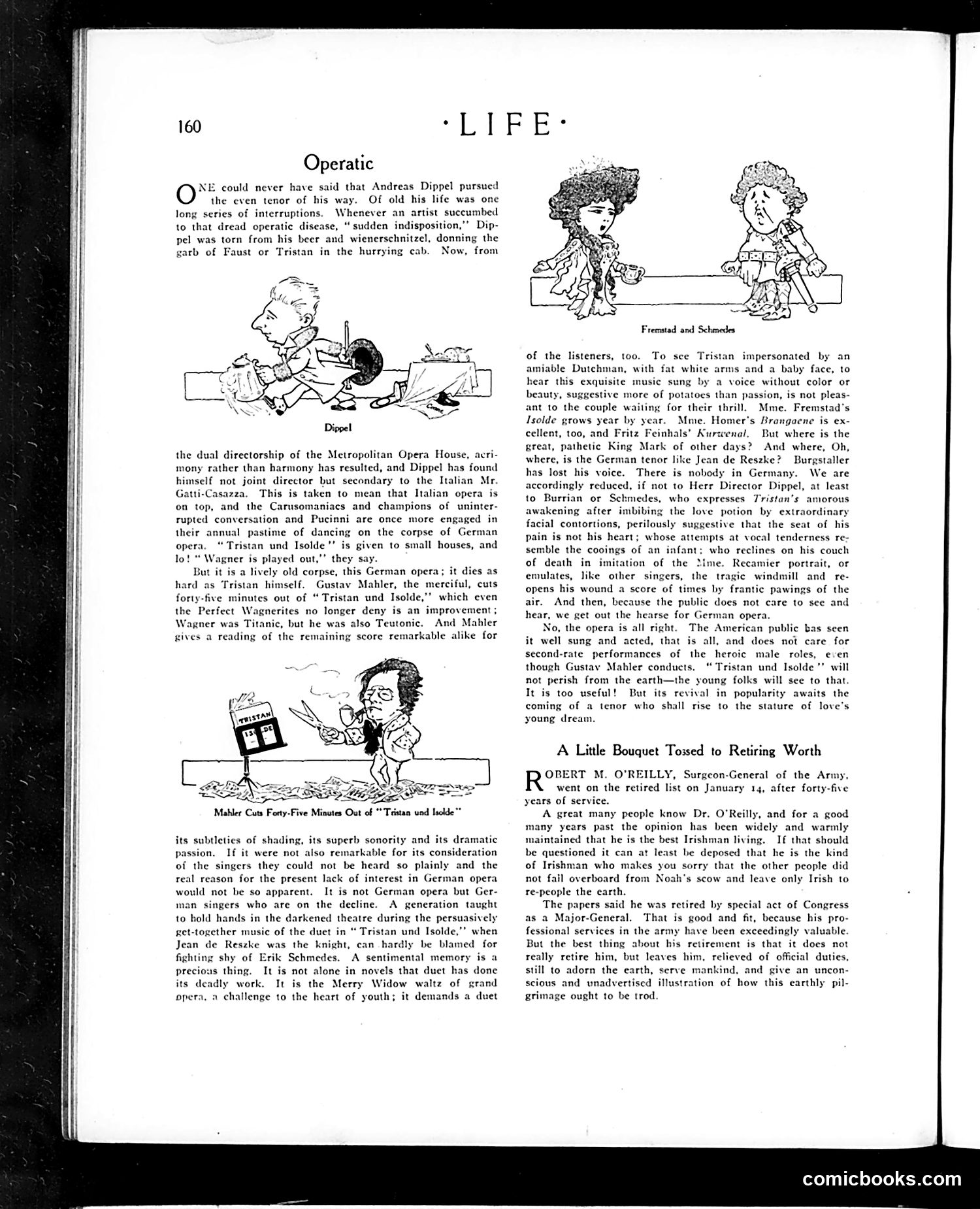
This page satirizes the declining fortunes of German opera at New York's Metropolitan Opera House, specifically blaming poor casting rather than the art form itself. **The figures:** Andreas Dippel (caricatured conducting), Gustav Mahler (who cut 45 minutes from Wagner's *Tristan und Isolde*), and tenor Erik Schmedes (mocked for his weak voice and awkward stage presence). **The complaint:** Italian opera dominates the Met under director Gatti-Casazza, relegating German opera to small houses. Wagner's *Tristan* gets poor performances because current German singers—particularly Schmedes—lack the vocal beauty and dramatic power of past stars like Jean de Reszke. **The satire's point:** The writer argues German opera isn't "played out"; rather, American audiences simply won't tolerate mediocre performances anymore. They've experienced excellence and reject inferior singers, no matter the masterpiece. It's a backhanded defense of German opera through pointed criticism of its current interpreters.
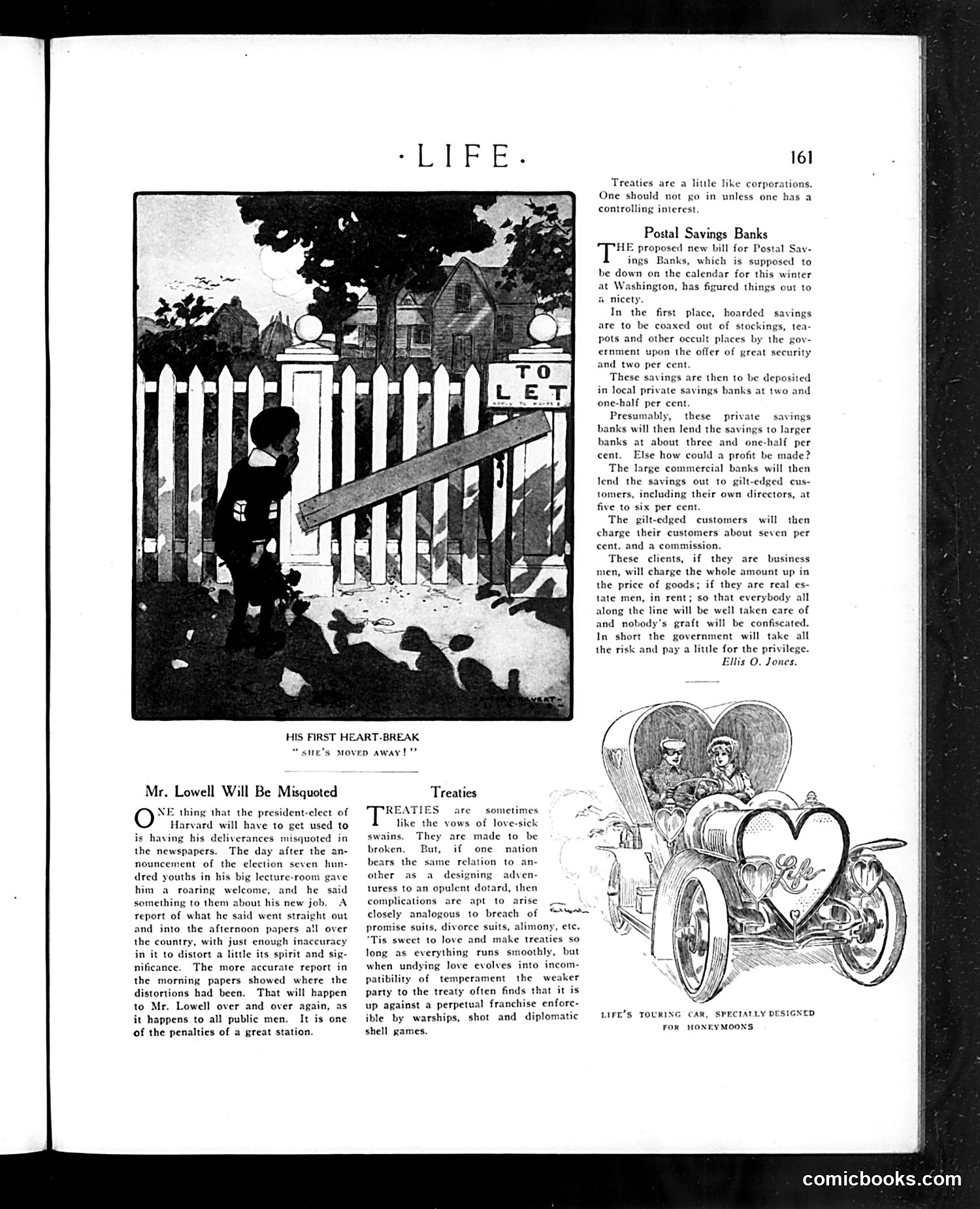
**"His First Heart-Break"** (top illustration): A sentimental cartoon showing a young boy at a gate watching a girl leave, captioned "she's moved away!" This depicts innocent childhood romance—a gentle joke about first love's disappointments. **"Mr. Lowell Will Be Misquoted"**: Commentary on A. Lawrence Lowell, newly elected Harvard president. The piece satirizes how newspapers routinely misquote public figures, distorting meaning through inaccuracy. It treats this as an inevitable "penalty" of high office—a cynical observation about press reliability. **"Treaties"**: A metaphor comparing international treaties to romantic relationships. Nations bound by treaties resemble lovers whose passion fades; weaker nations then find themselves locked into unfavorable agreements enforced by military power ("warships, shot and diplomatic shell games"). This critiques treaty enforcement as imbalanced power dynamics. **"Postal Savings Banks"**: Sharp satire on the proposed government savings program. Life skewers how each financial layer extracts profit—government, private banks, commercial banks, and businesses—while only government bears risk. The cascade of increasing interest rates shows ordinary citizens ultimately paying for the entire system's profiteering.
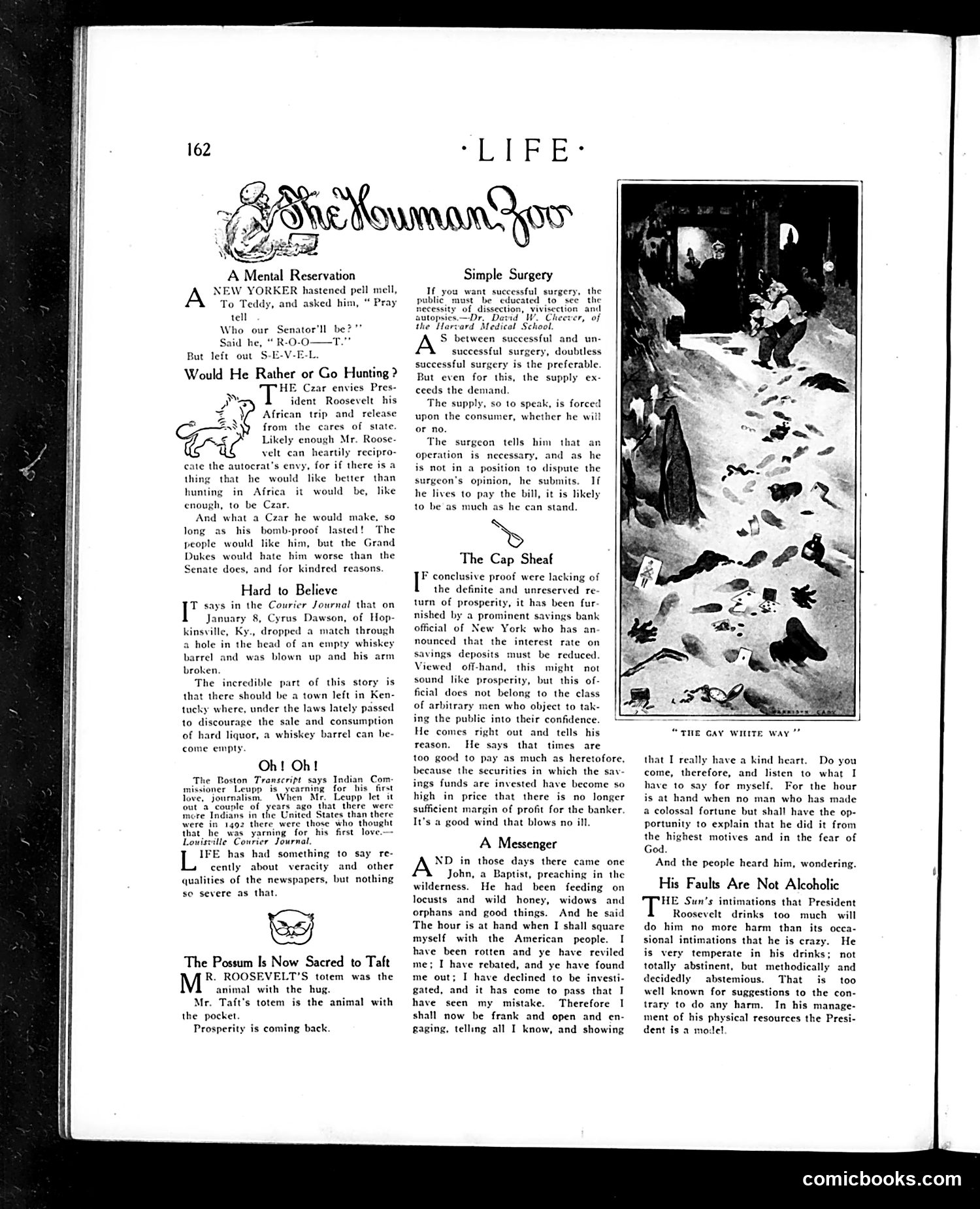
This page contains several brief satirical pieces mocking political figures and social issues of the Theodore Roosevelt era: **"Mental Reservation"** jokes about Senator selection, with Roosevelt deliberately mispronouncing a name—likely referencing New York Senate politics. **"Would He Rather or Go Hunting?"** compares Roosevelt favorably to the Russian Czar, suggesting both would prefer adventures abroad to their actual duties, though Roosevelt would make a better ruler. **"Hard to Believe"** ridicules Kentucky's recent prohibition laws by noting a whiskey barrel became empty—implying such a thing would be impossible under those new temperance regulations. **"The Possum Is Now Sacred to Taft"** contrasts Roosevelt's totem animal (associated with cunning) with Taft's (associated with pockets/money)—suggesting Taft represents financial rather than adventurous values. **"The Cap Sheaf"** satirizes a banker claiming prosperity is so good he must *reduce* savings interest rates—mocking the transparent self-interest disguised as economic explanation. The overall tone reflects progressive-era skepticism toward politicians' and businessmen's stated motives.
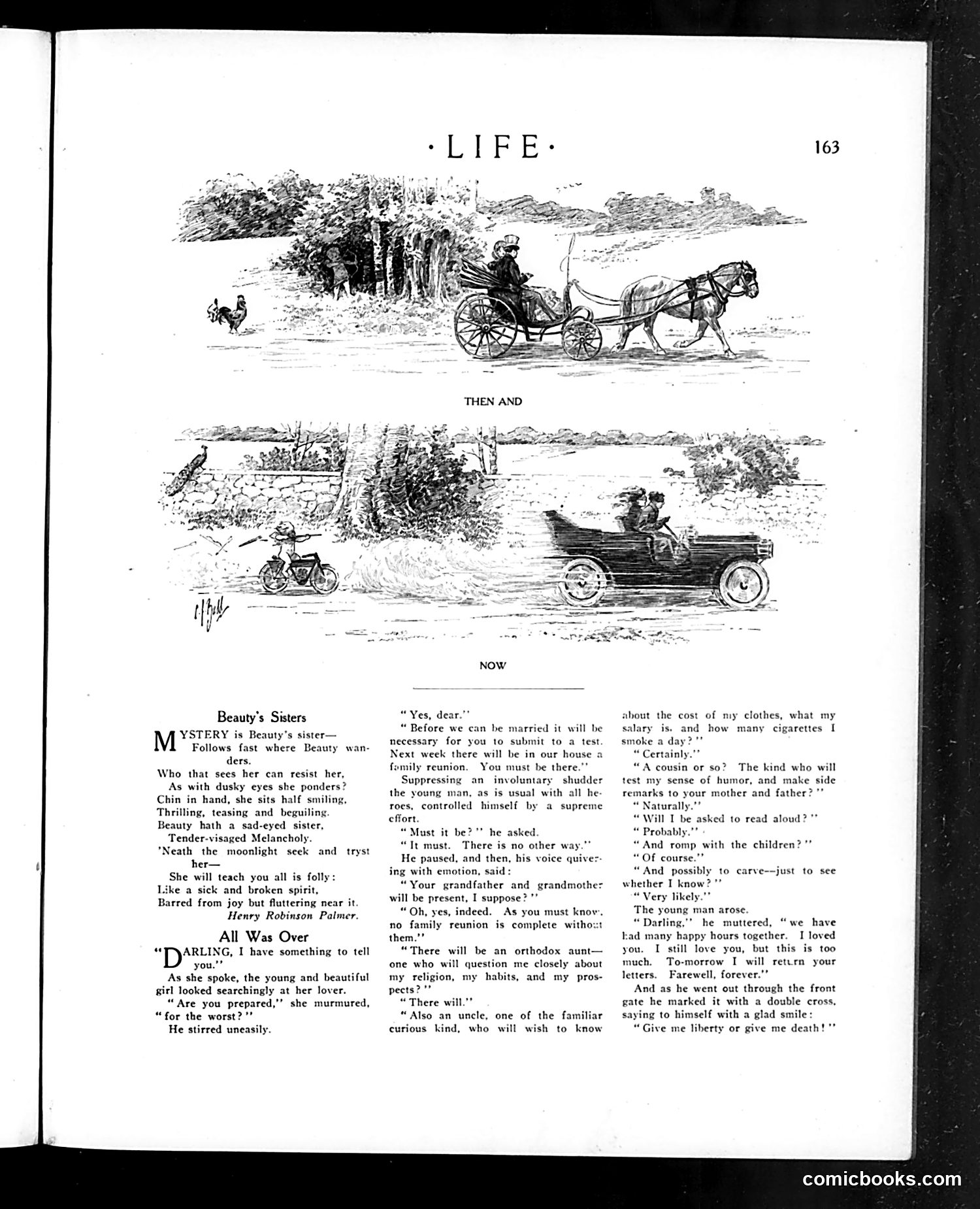
This page contains two pieces of satirical fiction from *Life* magazine, a prominent American humor publication. The top illustration contrasts transportation "Then and Now"—a horse-drawn carriage versus an early automobile—a common theme in early-1900s satire about modernization. The main story, "All Was Over," is a humorous romantic comedy. A young man must pass a family-reunion "test" before marrying his girlfriend. The satire targets the dreaded obligation of meeting extended family: intrusive grandparents, questioning aunts, nosy uncles asking about salary, cousins making awkward jokes, demands to read aloud and entertain children. The punchline mocks melodramatic male anxiety—the boyfriend dramatically flees, declaring "Give me liberty or give me death!" (Patrick Henry's famous quote) as if family obligations were unbearable tyranny. The joke reflects period anxieties about courtship rituals and family scrutiny, presented with exaggerated masculine cowardice.
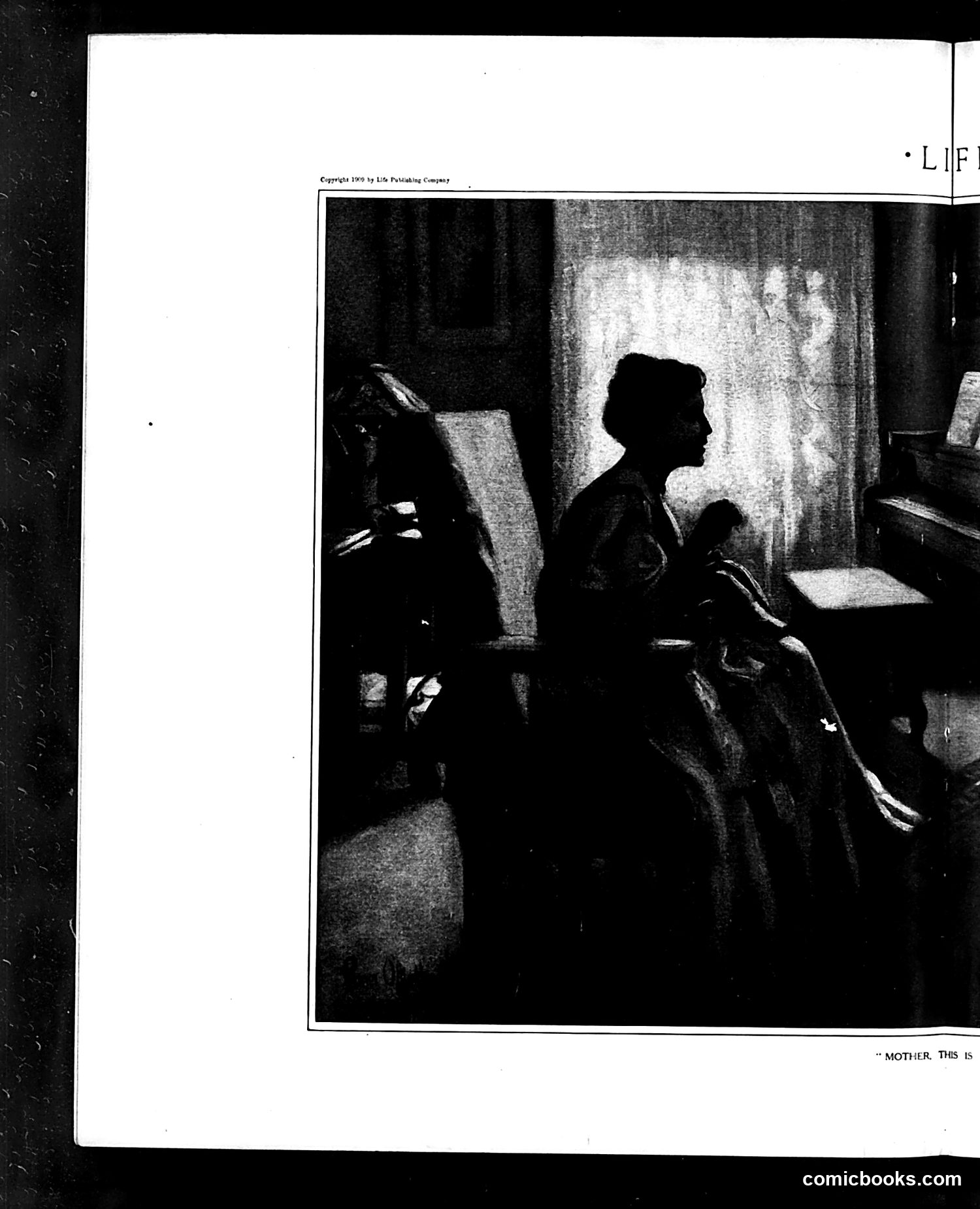
This appears to be a scene from a narrative cartoon or comic strip rather than a political cartoon. The image shows a silhouetted figure (likely a woman, given the dialogue reference to "Mother") sitting indoors, viewed from behind, looking toward a window with curtains. The scene has a domestic, intimate quality. The incomplete caption—"MOTHER, THIS IS"—suggests this is mid-narrative, with dialogue continuing beyond what's visible on this page. Without the complete text or context, the specific satirical point or joke remains unclear. The composition emphasizes mood and drama rather than explicit commentary. This appears to be from Life magazine's narrative comic content rather than its satirical editorial cartoons.
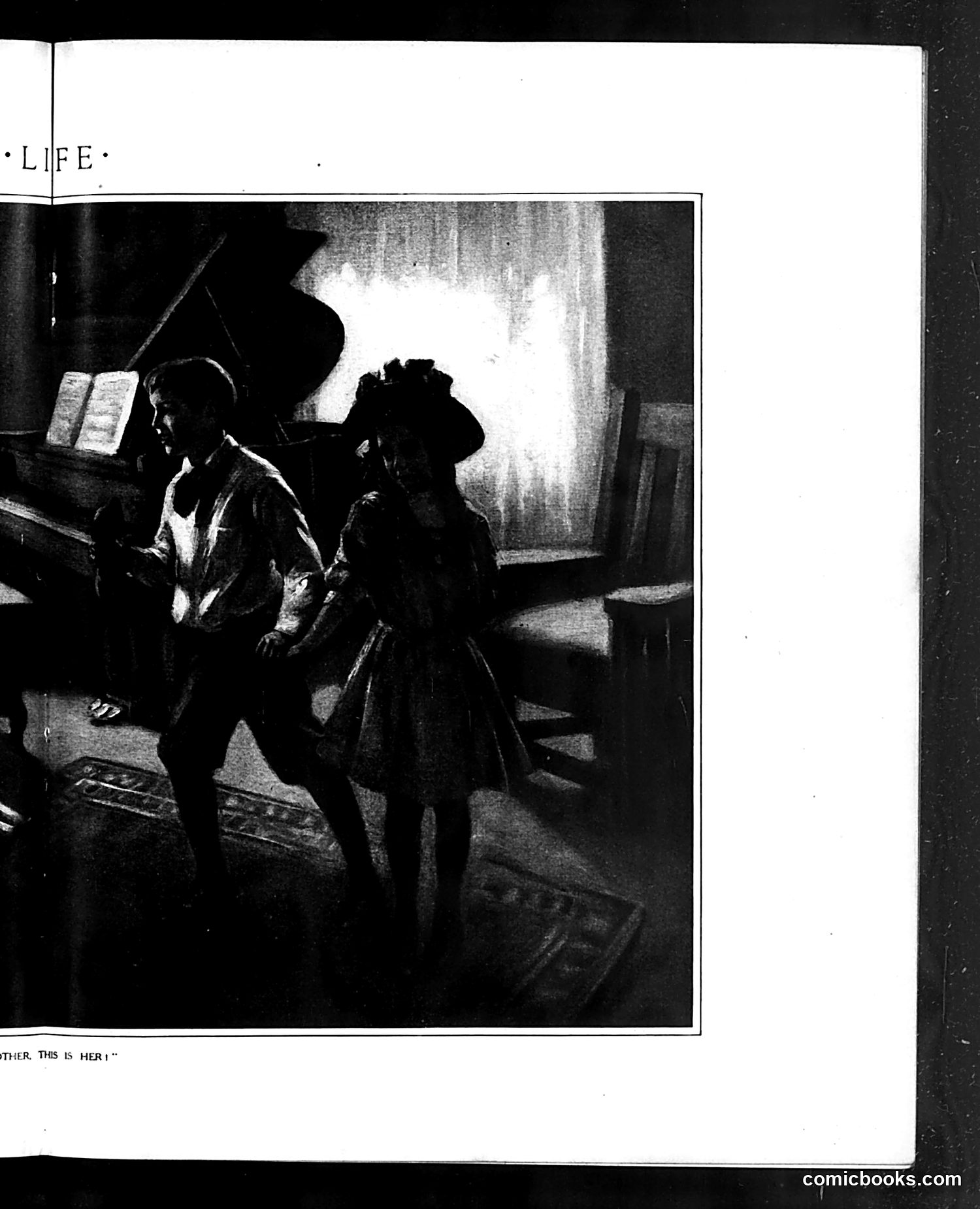
This appears to be a dramatic black-and-white illustration showing two figures in an interior scene with a bright light source (possibly a window or lamp) in the background. The silhouetted figures suggest tension or confrontation. The partial caption reads "THER. THIS IS HER!" which suggests dialogue, likely from a narrative scene or comic strip rather than political satire. Without the complete caption, headline, or surrounding context, I cannot definitively identify the specific figures, historical event, or satirical point being made. The image quality and fragmentary text prevent certain interpretation of what social or political commentary this page contained. Additional context from the magazine's date and full article would be necessary for accurate analysis.
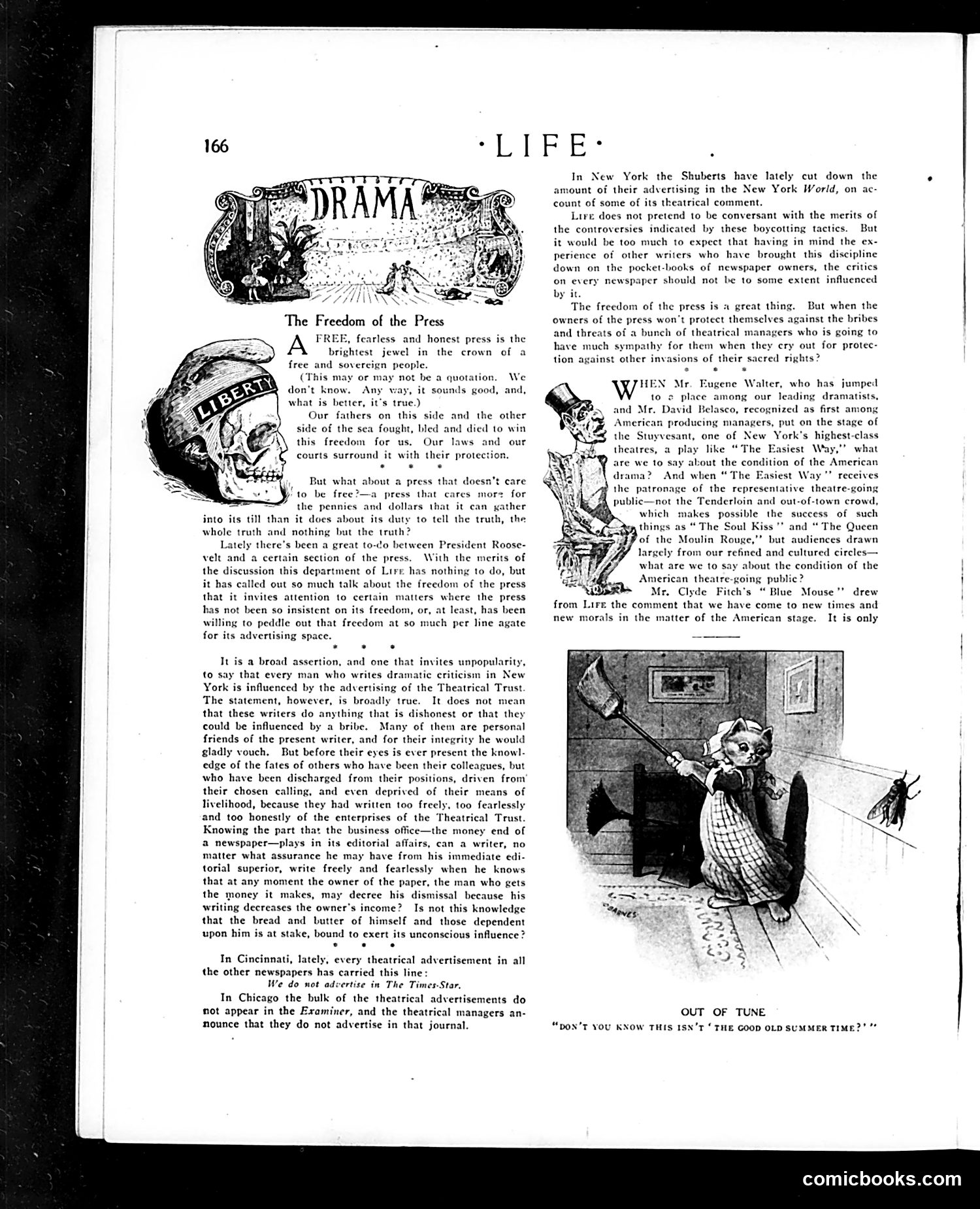
This article critiques the **Theatrical Trust** (a monopolistic theater management cartel) for using advertising boycotts to suppress honest theater criticism in newspapers. The piece argues that while press freedom is theoretically protected, it's undermined in practice by economic pressure: newspaper owners depend on theatrical advertising revenue, so critics face implicit threats of dismissal if they write unfavorably about Trust productions. Life cites specific examples—Cincinnati's *Times-Star* and Chicago's *Examiner* being punished with ad boycotts, and the Shuberts cutting *New York World* advertising due to critical coverage. The satirical point: the Theatrical Trust effectively silences critics through financial coercion rather than legal censorship, exposing the gap between America's ideals of press freedom and its commercial reality. Critics self-censor not from bribery but fear of losing their livelihoods—their employers' income depends on theatrical advertising. The cartoon ("Out of Tune") appears to illustrate this tension between stated principles and corrupted practice.
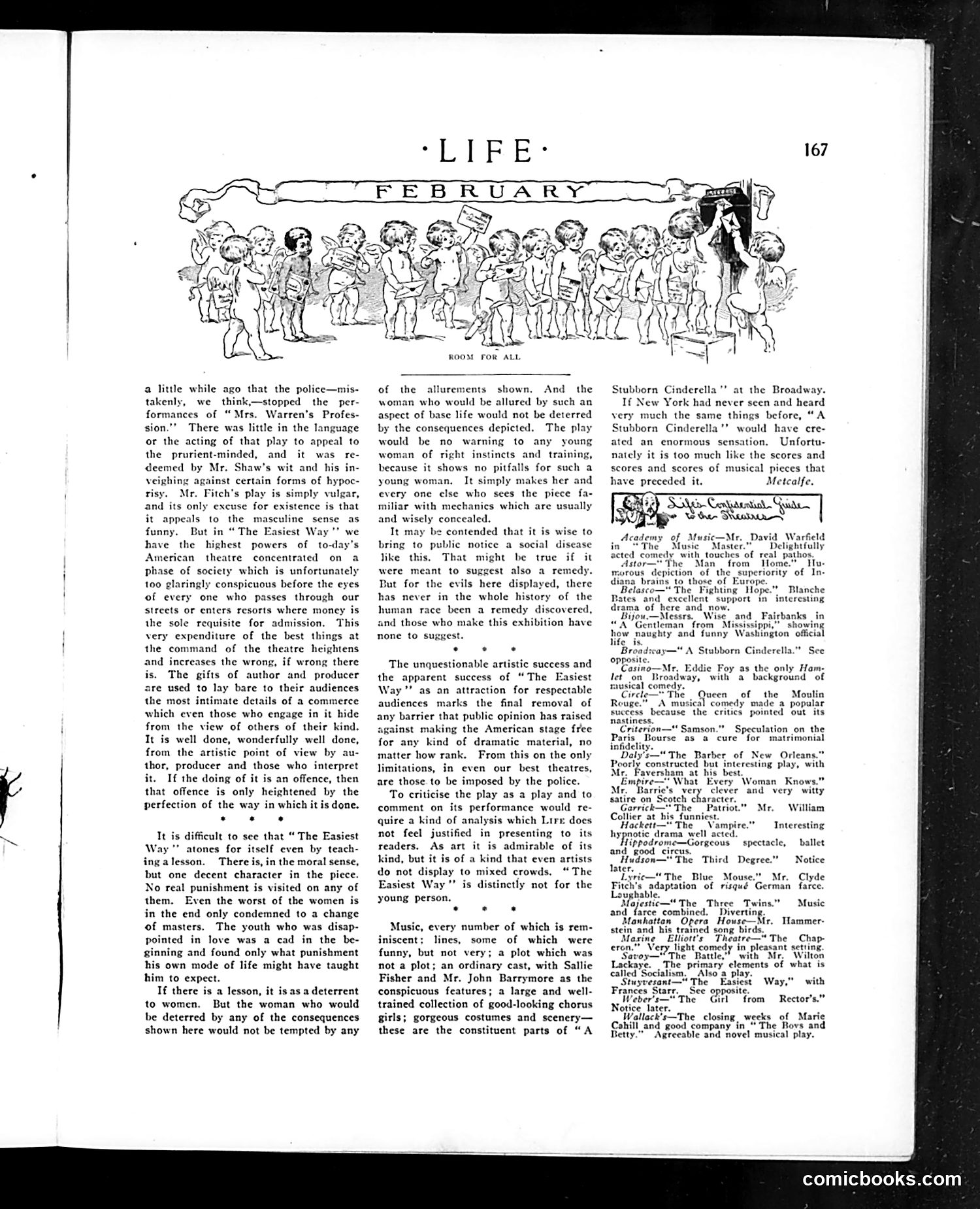
This page reviews "The Easiest Way," a Broadway play about prostitution. The critic—writing around the early 1900s—praises the play's artistic execution but condemns its moral message (or lack thereof). The satire targets the play's paradox: its technical brilliance makes the depiction of vice *more* damaging, not less. The critic argues the play teaches no genuine lesson because: 1. It shows no consequences for wrongdoing (the protagonist merely "changes masters") 2. It won't deter virtuous women (they already know better) or reform fallen ones (they're unmoved by artistic warnings) 3. It merely familiarizes respectable audiences with "mechanics" of prostitution that should remain "wisely concealed" The larger point critiques American theatre's removal of moral guardrails—now only police censorship remains. This reflects early-1900s anxieties about urbanization, commercialized sex, and theatre's role in public morality. The cartoon header showing cherubs likely represents February's innocence contrasting the page's discussion of moral corruption.
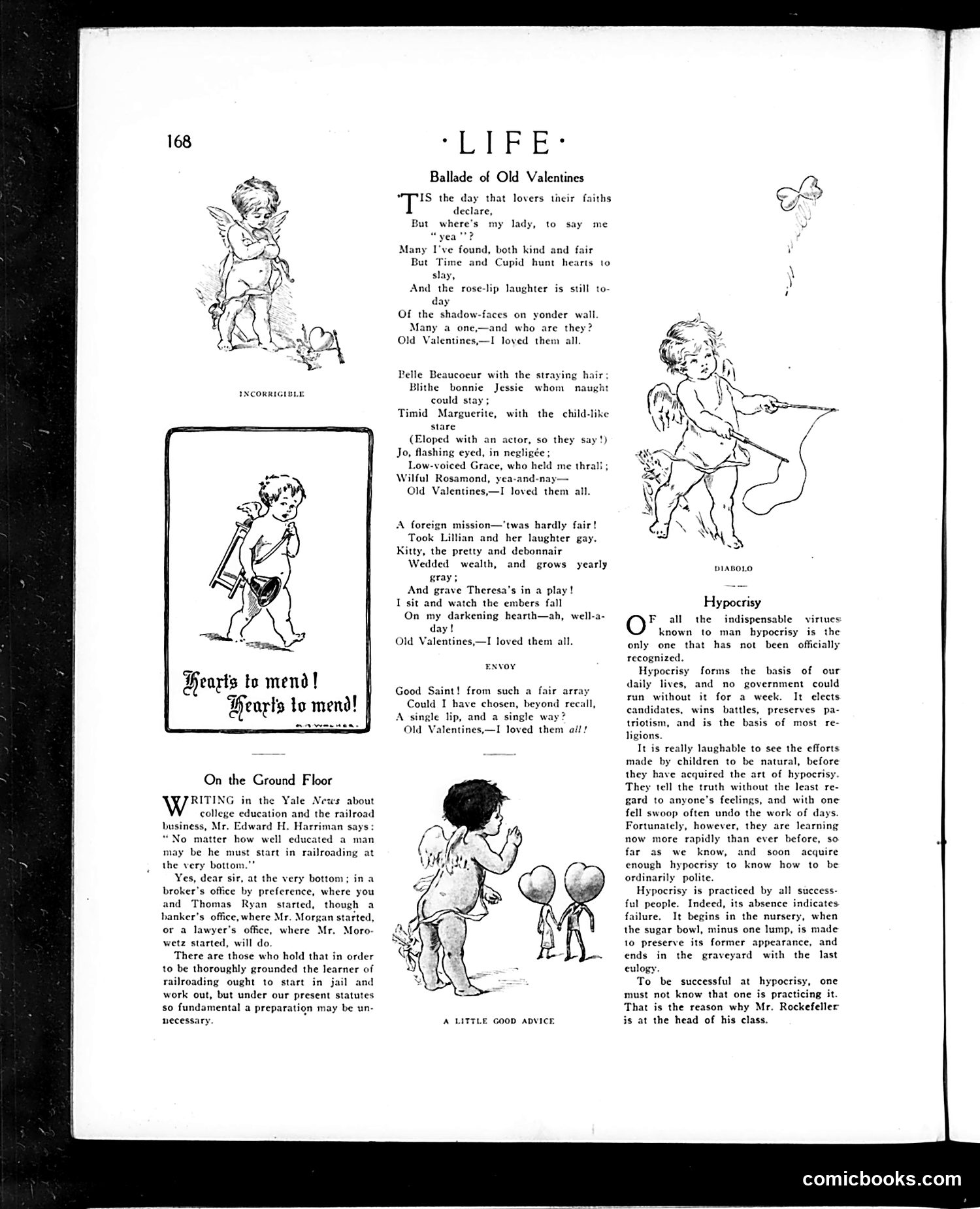
This page contains multiple satirical pieces typical of early 20th-century Life magazine: **"On the Ground Floor"** mocks railroad magnate Edward H. Harriman's claim that railroad workers must "start at the very bottom." The satire notes that Harriman himself started in a broker's office—hardly the bottom—and suggests that if truly starting from scratch were necessary, one should begin "in jail." This critiques wealthy industrialists' hypocrisy about meritocracy while implying railroad magnates operated unethically. **"Ballade of Old Valentines"** is a sentimental poem about lost romantic interests, likely not satirical. **"Hypocrisy"** is an editorial commentary praising hypocrisy as essential to society and government function. The final jab references John D. Rockefeller, suggesting his success derives from practicing hypocrisy so naturally he's unaware of it—a cutting critique of gilded-age robber barons' moral blindness. The accompanying illustrations (Cupids, a child) are decorative rather than caricatures of specific figures.
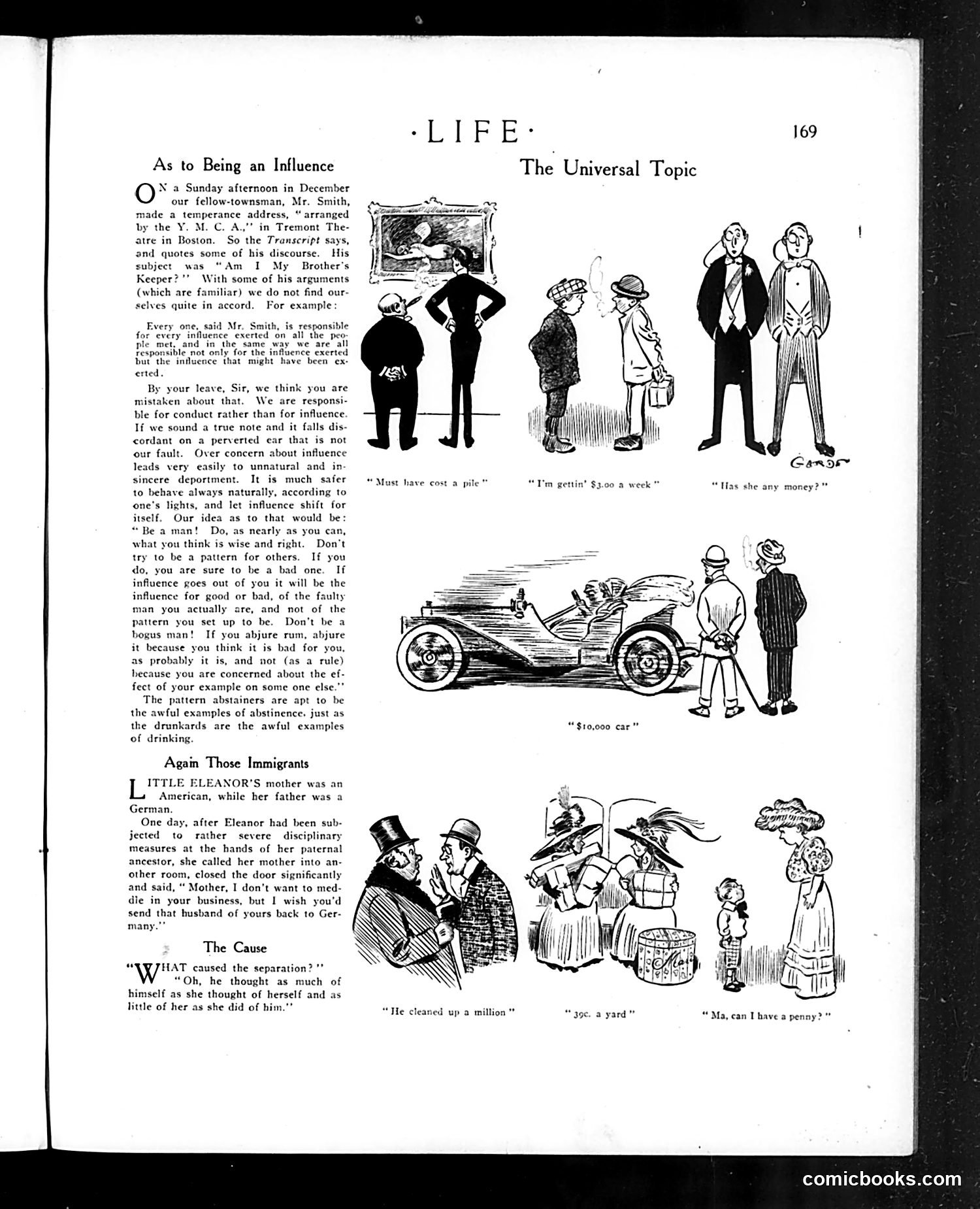
This page contains satirical commentary on early 20th-century American social issues through text and cartoons. **"As to Being an Influence"** critiques a temperance speaker (Mr. Smith) who argued we're responsible for all influence we exert. The author disagrees, advocating authentic behavior over performative morality—be genuinely virtuous, not a "bogus man" pretending for others' benefit. **"The Universal Topic"** cartoons depict class anxiety and materialism: men discuss expensive possessions ("$10,000 car"), while immigrants and the poor ask for money or work ("I'm gettin' $3.00 a week," "Ma, can I have a penny?"). **"Again Those Immigrants"** humorously critiques mixed marriages. Eleanor's German father is so self-absorbed he neglects his American wife, prompting her to request he return to Germany—satirizing stereotypical German egocentrism and tensions between immigrant and native-born Americans. The page's overall theme concerns authentic versus false social behavior and anxieties about wealth, immigration, and influence in Progressive Era America.
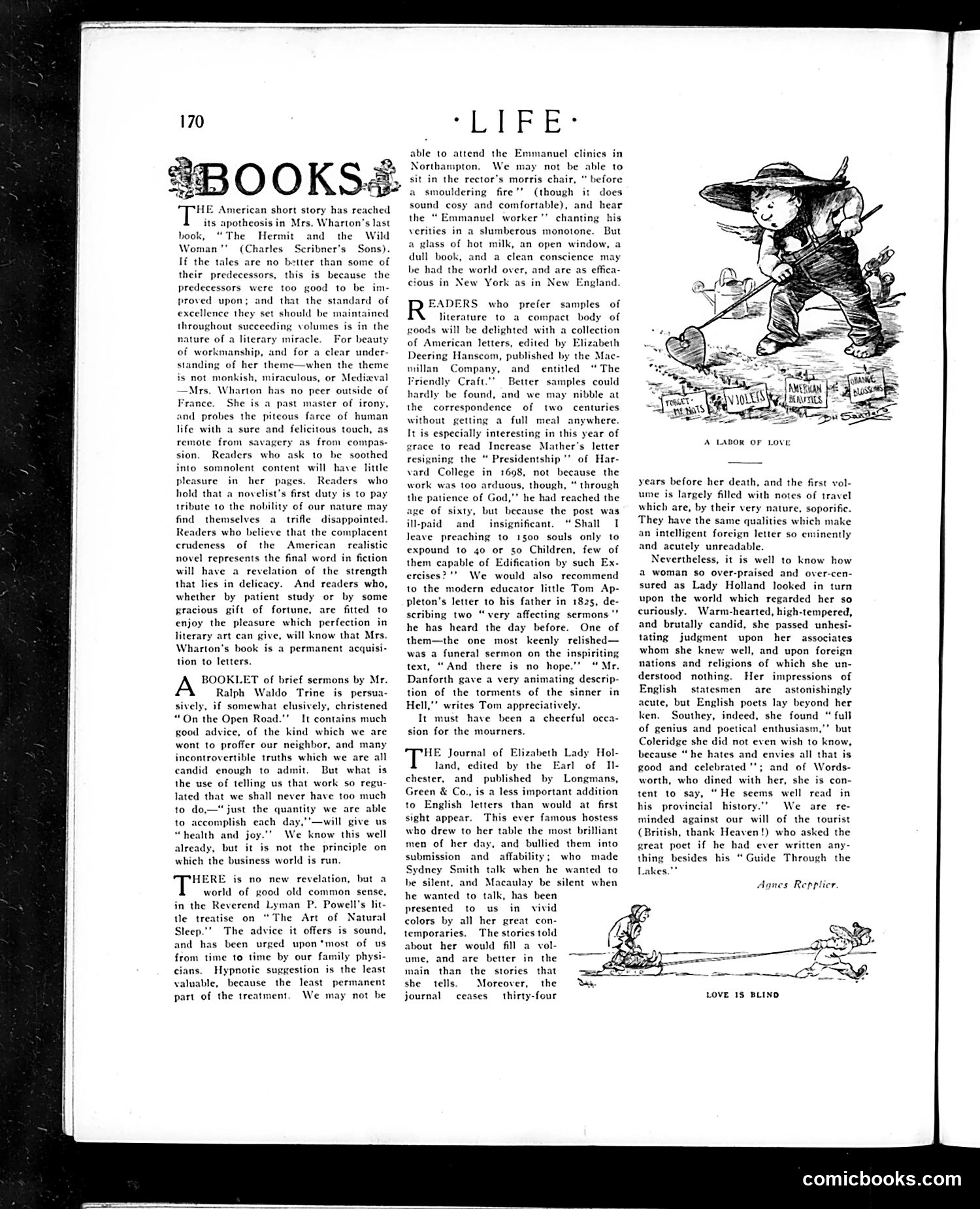
This is a book review section from Life magazine's "Books" column. The page discusses several literary works, primarily praising Edith Wharton's short story collection "The Hermit and the Wild Woman." The reviews reveal period literary tastes: Wharton is celebrated for her psychological insight, irony, and elegant prose style—contrasted favorably against "crude" American realism. The reviewer suggests readers seeking comfort or moral uplift will be disappointed by her unflinching observations of human nature. Other reviewed works include Ralph Waldo Trine's self-help sermon collection "On the Open Road" (gently mocked for dispensing obvious advice about work-life balance that contradicts actual business practices) and volumes on natural sleep and historical American letters. The two small cartoon illustrations titled "A Labor of Love" and "Love is Blind" appear to be humorous decorative elements accompanying the text, though their specific satirical targets are unclear from the image alone.
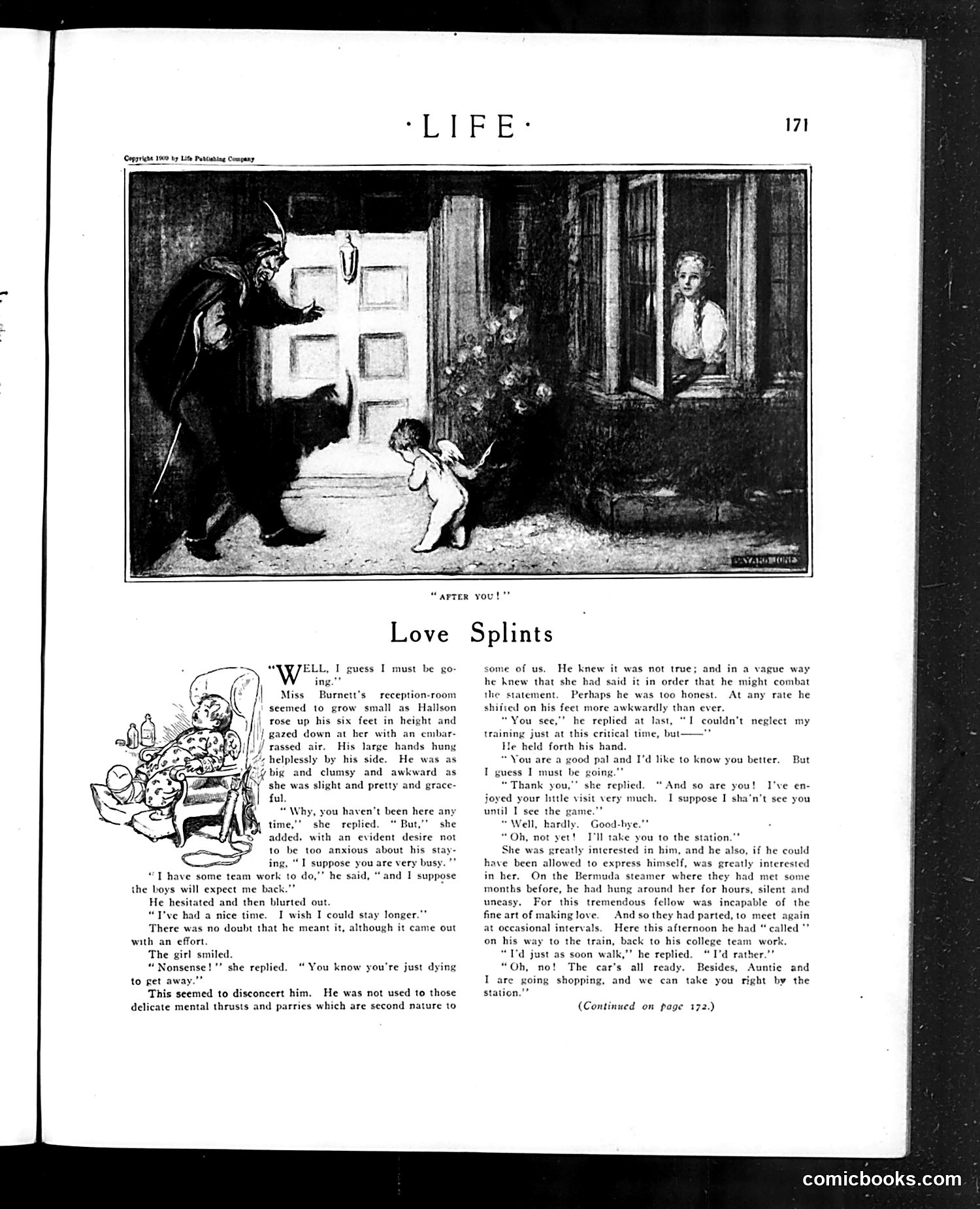
This is a romantic short story rather than a political cartoon. The narrative depicts a socially awkward college athlete named Hallson visiting a refined young woman, Miss Burnett, in her reception room. The satire targets the contrast between masculine athleticism and social grace. Hallson is physically imposing—"six feet in height"—but emotionally inarticulate, with "large hands hung helplessly by his side." He's "clumsy and awkward" compared to the "slight and pretty and graceful" Miss Burnett, who employs sophisticated verbal sparring ("delicate mental thrusts and parries") that confuses his honest, straightforward nature. The humor lies in their mutual interest despite their incompatibility: he cannot "express himself" or master "the fine art of making love," while she skillfully manipulates conversation. This early-1900s story gently mocks both the emotionally stunted athlete and the calculating society woman, suggesting that romantic compatibility requires more than physical attraction or clever wit.
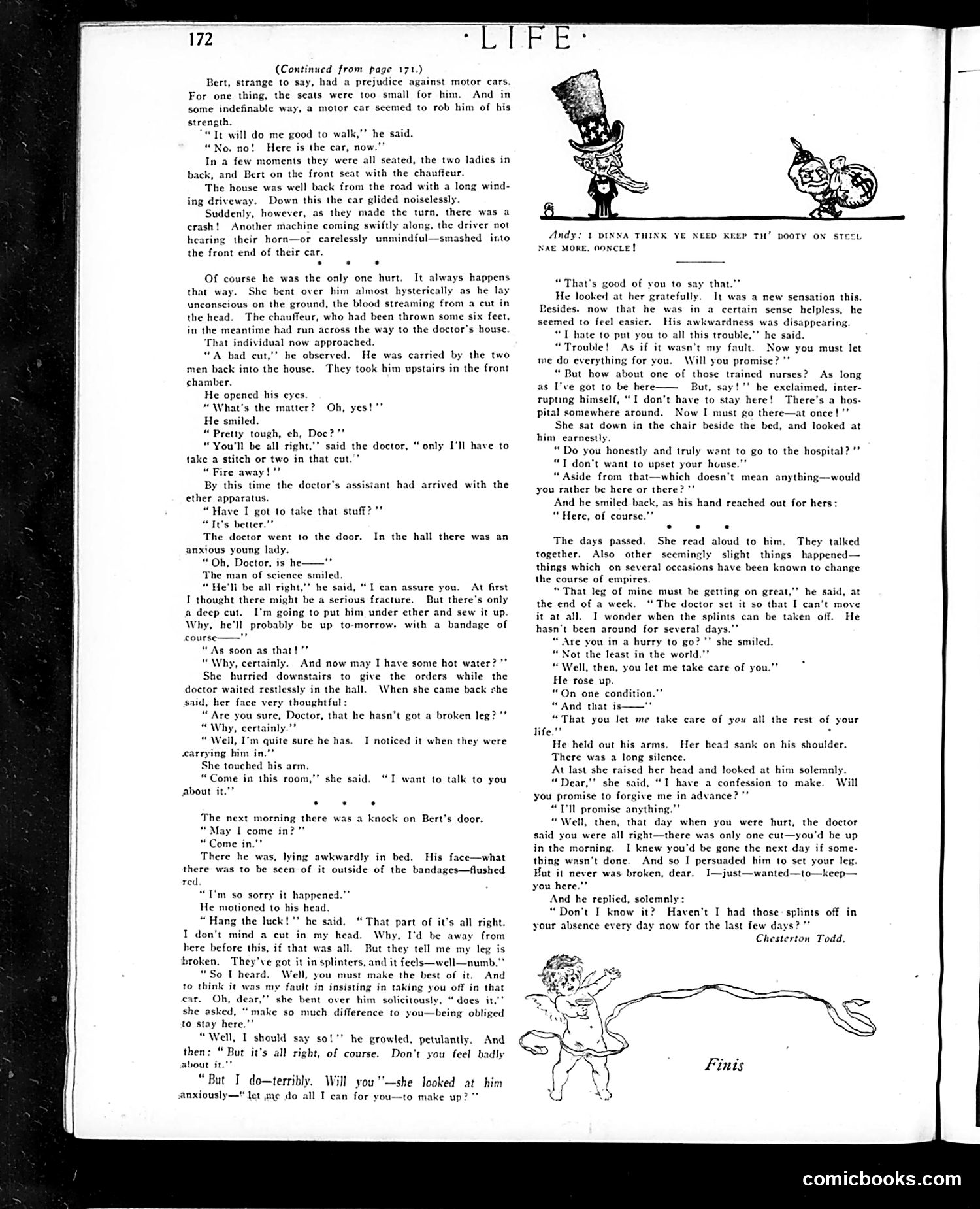
This page continues a serialized romantic story rather than presenting political satire. The narrative depicts a working-class man named Bert who injures himself in a motor-car accident and must recover in bed with a broken leg. **Key plot elements**: Bert, who distrusts automobiles, is convinced to ride in one. A collision occurs, injuring him severely. A doctor treats him, and a young woman (implied to be his love interest) nurses him devotedly, expressing guilt for encouraging him into the car. **Social commentary embedded**: The story reflects early 20th-century attitudes toward automobiles—viewed as dangerous novelties—and gender dynamics, where an injured man becomes dependent on a woman's care. **The cartoon** (top right) shows a character named Andy making a Scottish dialect joke about removing steel supports from a boot. **"Finis" illustration** (bottom) appears to conclude a related story segment. This is **serialized fiction with light humor**, not political satire.
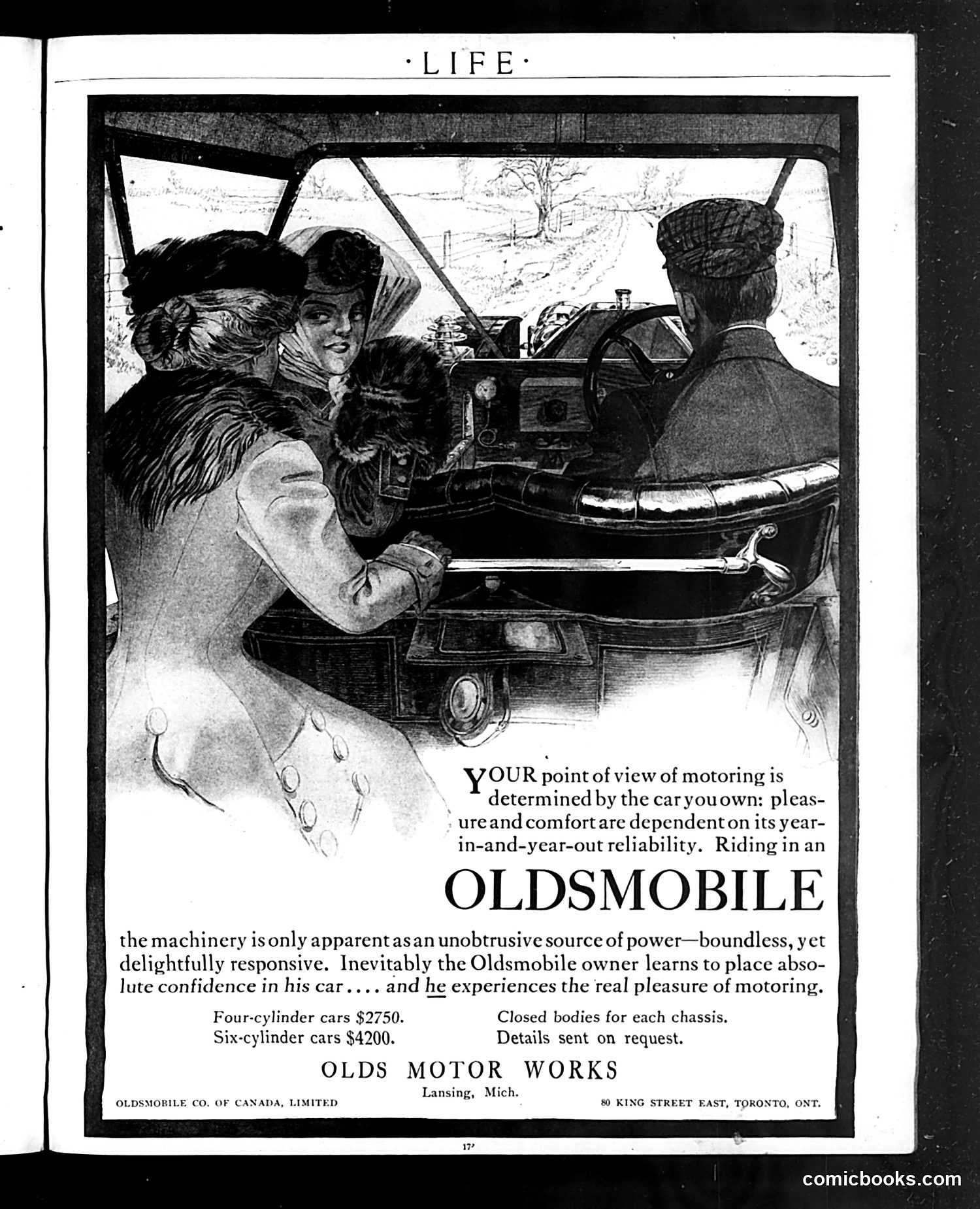
This is primarily an **advertisement**, not satire or political commentary. It's a vintage Oldsmobile car ad from Life magazine's advertising section. The image depicts an elegantly dressed couple in an early automobile, with the woman in fashionable fur and the man driving. The ad's message targets affluent consumers, emphasizing reliability and "real pleasure of motoring" as selling points. **What's notable for modern readers:** The prices ($2,750–$4,200) and gender dynamics reflect the era—automobiles were luxury items, and the woman is portrayed as a passenger being transported by the male driver, embodying early 20th-century gender roles. The language about "absolute confidence" in machinery reflects how novel and anxiety-inducing car ownership was at the time. This represents the automotive industry's early marketing to the wealthy before cars became mass-market commodities.
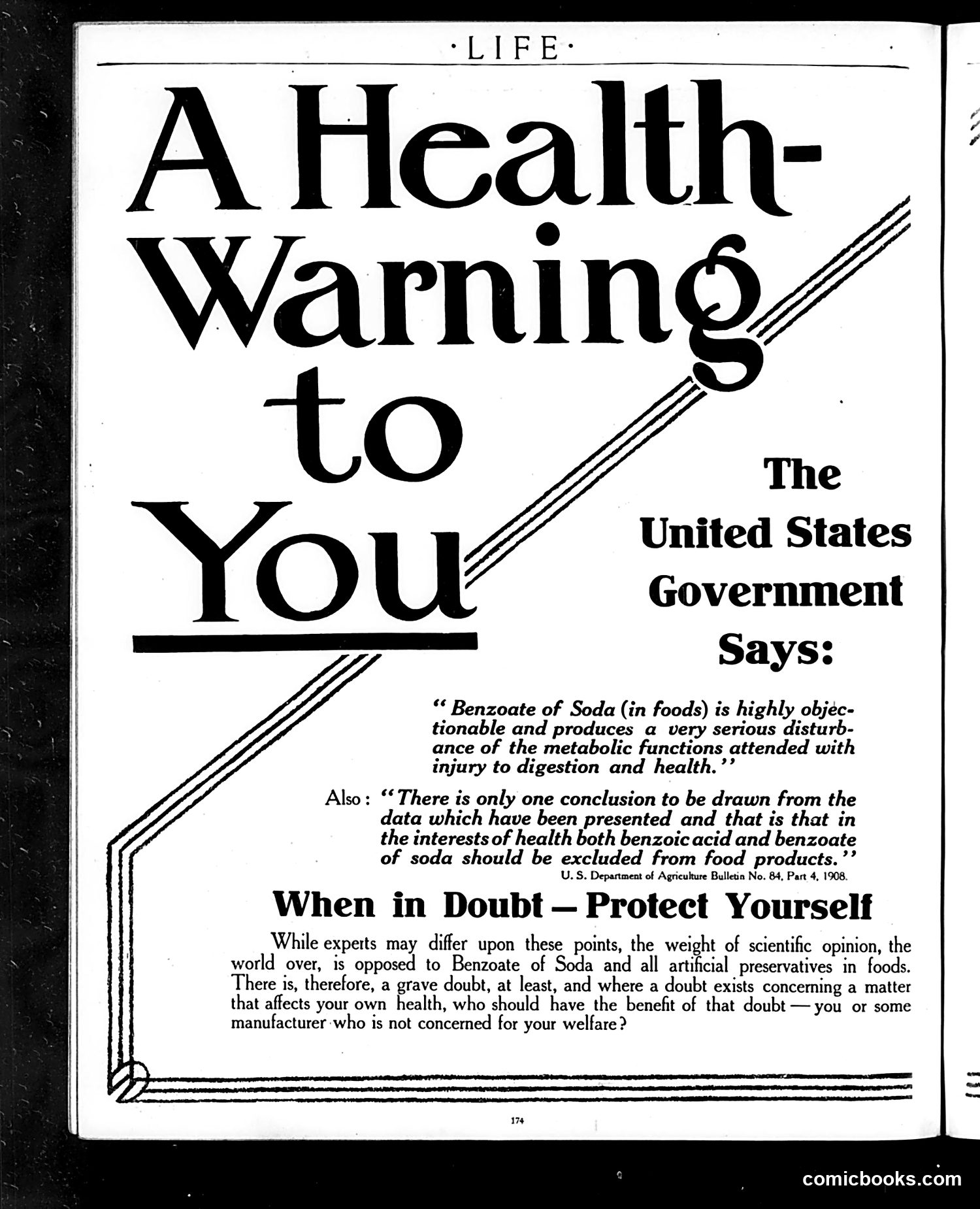
This is a **public health advocacy piece**, not a cartoon. It presents government warnings against benzoate of soda, a chemical food preservative used in the early 1900s. The page quotes the U.S. Department of Agriculture (1908) declaring benzoate of soda "highly objectionable" and calling for its exclusion from foods due to metabolic harm and digestive injury. The rhetorical argument—"When in Doubt, Protect Yourself"—frames the issue as consumer protection: if scientific doubt exists about a food additive's safety, consumers should prioritize their own health over manufacturers' commercial interests. **Historical context**: This reflects the **Pure Food and Drug Act era** (1906), when progressive reformers challenged unregulated food additives. The page leverages government authority to persuade readers to avoid products containing this preservative, positioning consumer caution as rational self-defense against corporate indifference to public health.
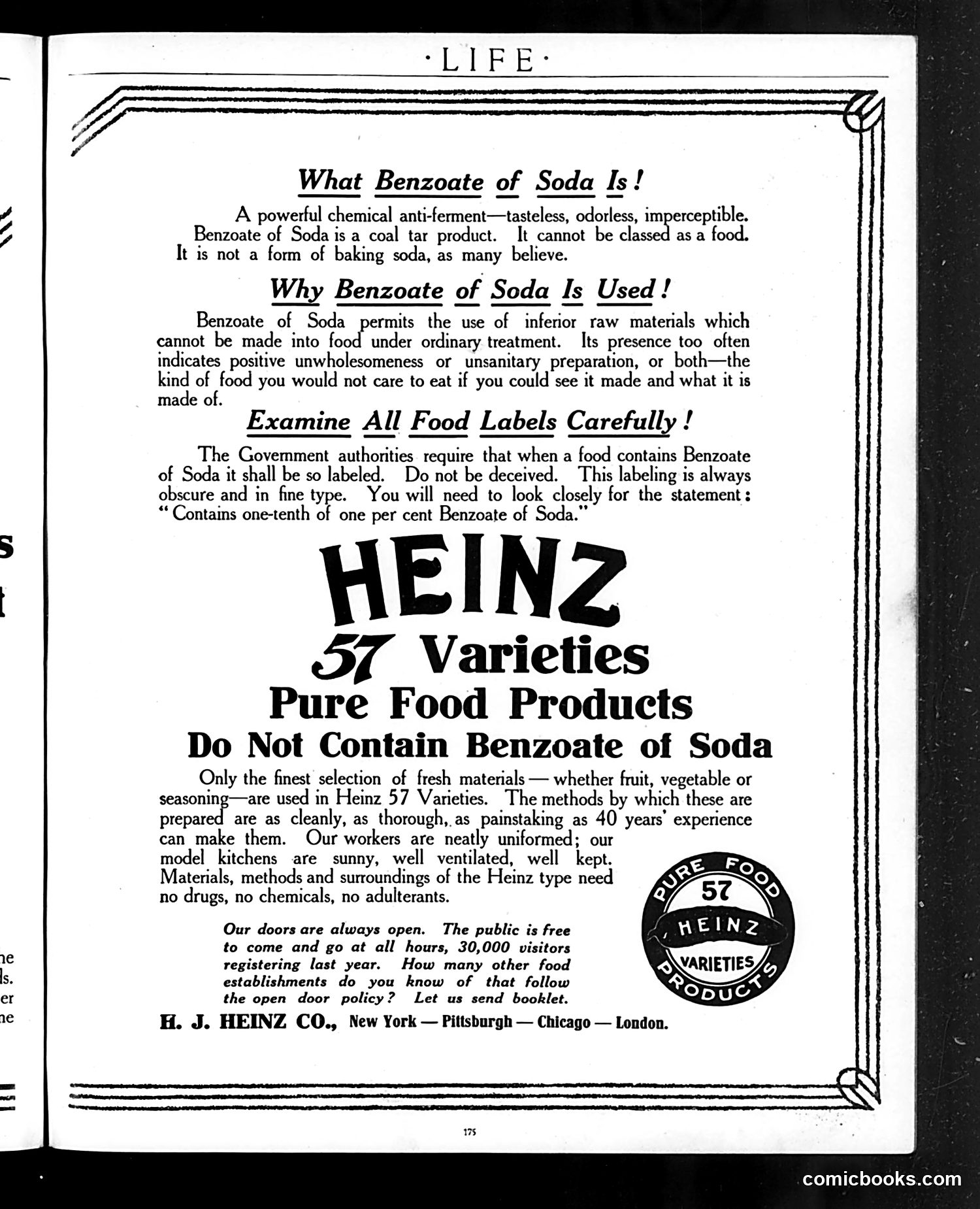
This is a **Heinz company advertisement**, not satire or a cartoon. It's a public health advocacy ad disguised as marketing. **Context:** In the early 1900s, **sodium benzoate** was a controversial food preservative. The ad educates readers that benzoate is a coal-tar chemical (not baking soda, as many mistakenly believed) that manufacturers used to mask spoilage in inferior ingredients—indicating unsafe food. **The pitch:** Government labeling laws required disclosure, but Heinz claims competitors hide this in fine print. Heinz positions itself as the ethical alternative: using quality ingredients, maintaining transparent manufacturing (they welcomed 30,000 visitors annually), employing uniformed workers, and needing "no drugs, no chemicals, no adulterants." **Why it matters today:** This reflects Progressive Era consumer activism and early FDA regulation. Heinz leveraged food safety concerns to build brand trust—a marketing strategy still used today, though modern companies now often embrace "natural" or "chemical-free" claims rather than transparency about actual processes.
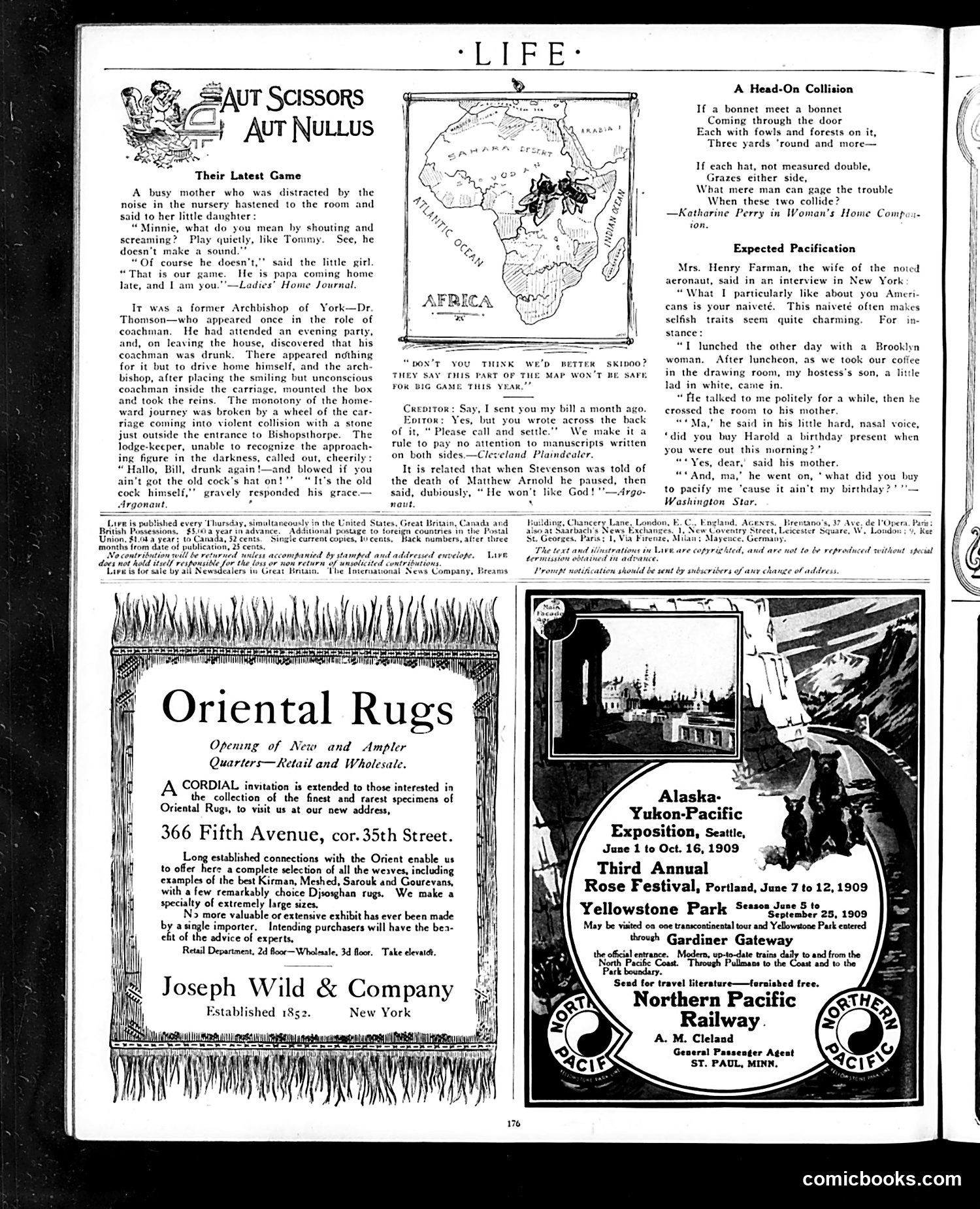
This page contains primarily **humorous anecdotes and advertisements** rather than political satire. The main humor pieces include: **"Their Latest Game"**: A children's joke about a girl pretending her quiet brother is her father coming home late—playing house while mother mistakes the silence for obedience. **"A Head-On Collision"**: A lighthearted poem about two women with large, elaborate hats (featuring fowls and forests—common Edwardian hat decorations) colliding at a doorway, satirizing the absurdly oversized women's hats fashionable in this era. **"Expected Pacification"**: An anecdote about a French aviator's wife commenting on American "naiveté," illustrated by a precocious Brooklyn boy manipulating his mother into buying him gifts by asking what she bought "to pacify" him after his birthday. The advertisements include **Oriental Rugs** (366 Fifth Avenue) and **Northern Pacific Railway** travel promotions for Alaska-Yukon-Pacific Exposition and Yellowstone Park. This is a representative page of *Life*'s mix of genteel domestic humor and commercial content, circa 1909.
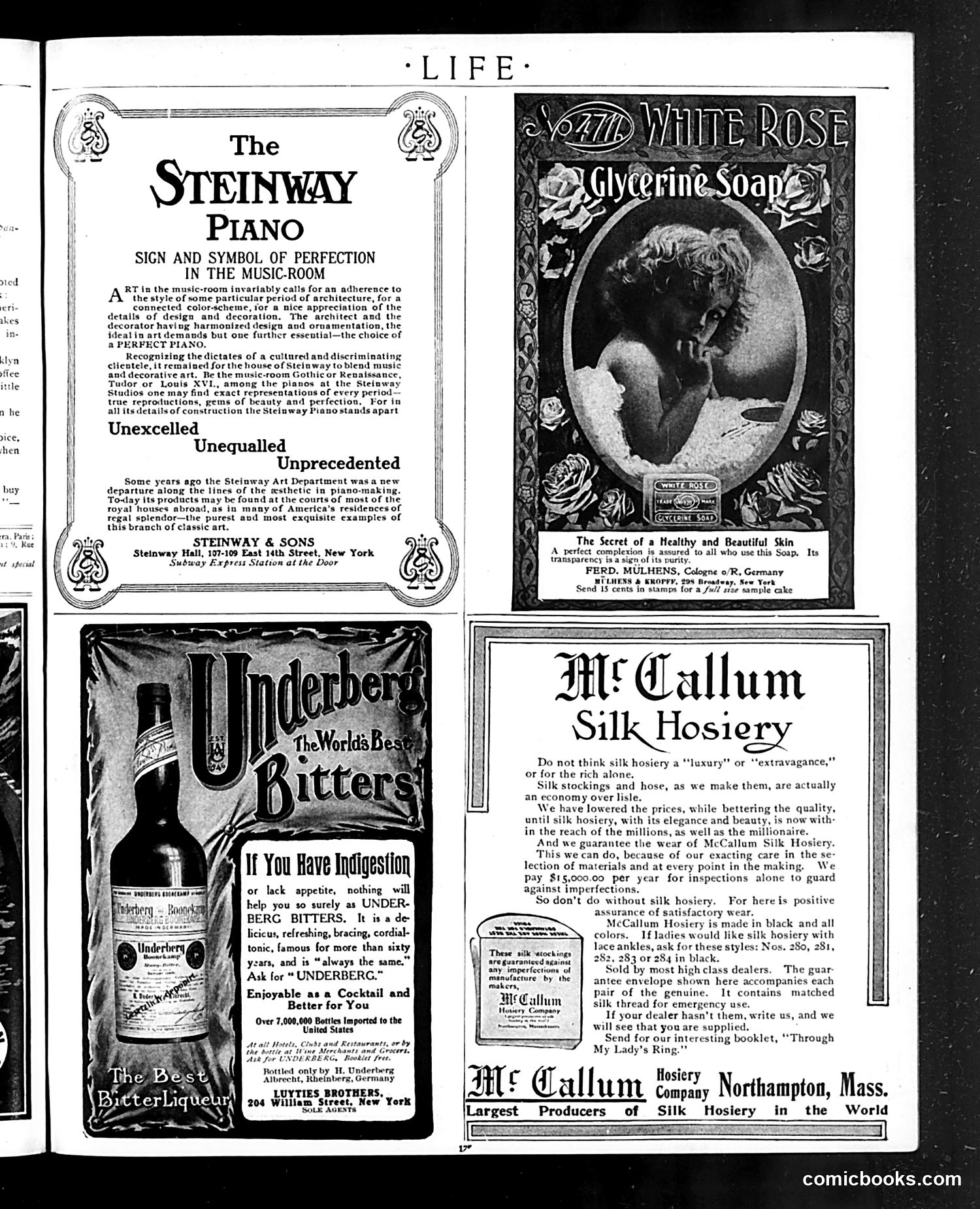
This is primarily an **advertising page** from Life magazine, not a satirical cartoon page. It contains four separate product advertisements: 1. **Steinway Piano**: Luxury piano marketed as the ultimate status symbol for refined homes, emphasizing its use in royal courts and wealthy American estates. 2. **White Rose Glycerine Soap**: Claims to ensure "healthy and beautiful skin," targeting women concerned with complexion. 3. **Underberg Bitters**: A digestive tonic marketed to address indigestion and lack of appetite, positioned as both medicinal and pleasant (comparable to cocktails). 4. **McCallum Silk Hosiery**: Attempts to democratize luxury by arguing silk stockings are economical, not just for the wealthy. **Key context**: These ads reflect early 20th-century consumer culture targeting the affluent or aspiring middle class. The messaging emphasizes that quality goods signal refinement and taste, while also (paradoxically) claiming affordability. No political satire is present—this is straightforward period advertising.
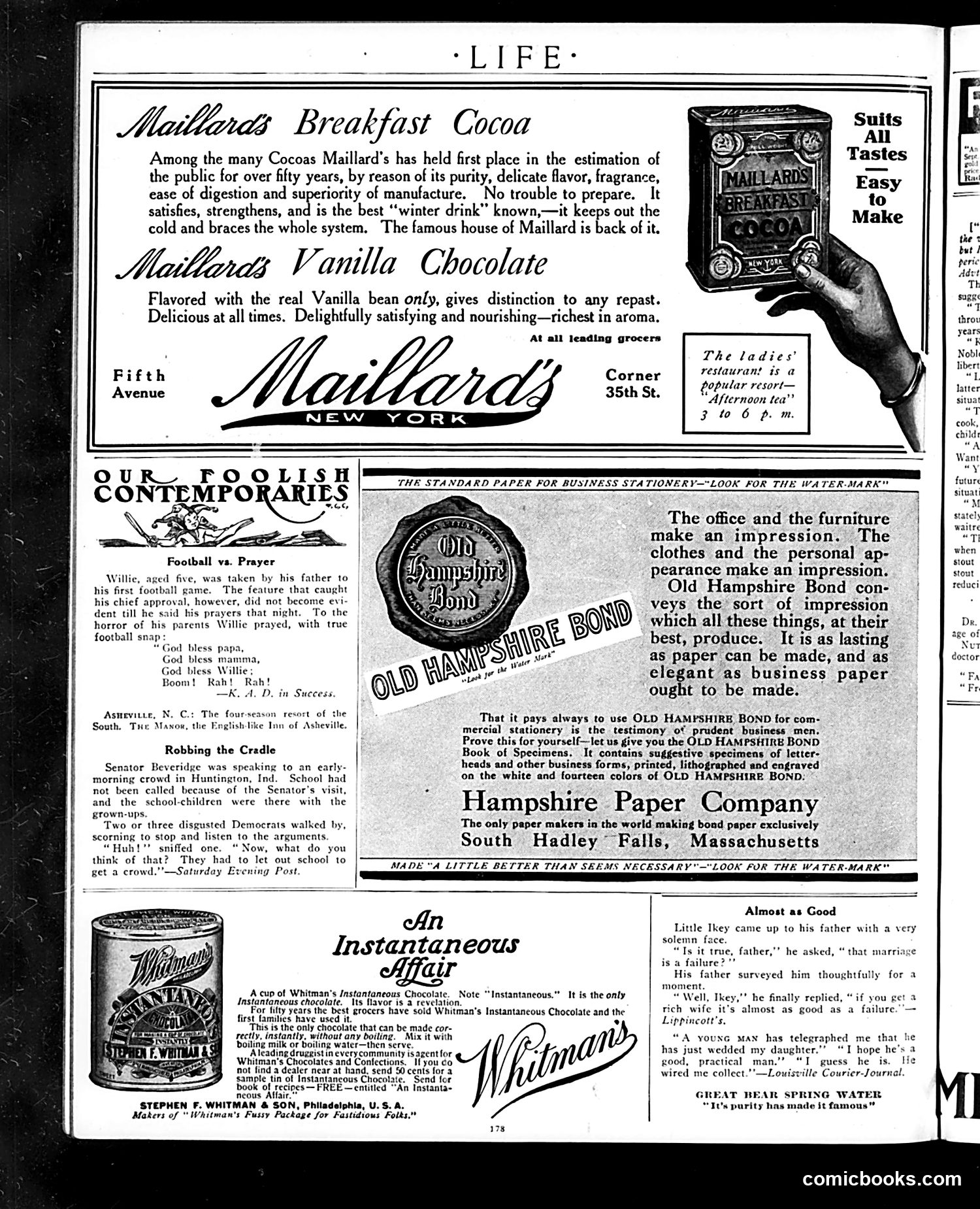
This page is primarily **advertising** with minimal satirical content. The ads promote Maillard's cocoa and chocolate, Hampshire Bond paper, and Whitman's chocolate. The small satirical section, "Our Foolish Contemporaries," contains brief jokes: 1. **"Football vs. Prayer"**: A humor piece about a five-year-old boy (Willie) who, after attending his first football game, incorporates football cheers ("Boom! Rah! Rah!") into his bedtime prayers—mocking the era's enthusiasm for American football and the incongruity of mixing sports fervor with religious devotion. 2. **"Robbing the Cradle"**: Political satire on Senator Beveridge's campaign stop in Indiana, where schools closed for his speech. Democrats mock this as manipulative—"robbing the cradle" meaning exploiting children's attendance to inflate his audience. 3. **"Almost as Good"**: A brief joke about marriage being "almost as good as a failure" if one marries wealth—satirizing materialistic attitudes toward matrimony. The page reflects early 20th-century American humor and consumer culture.
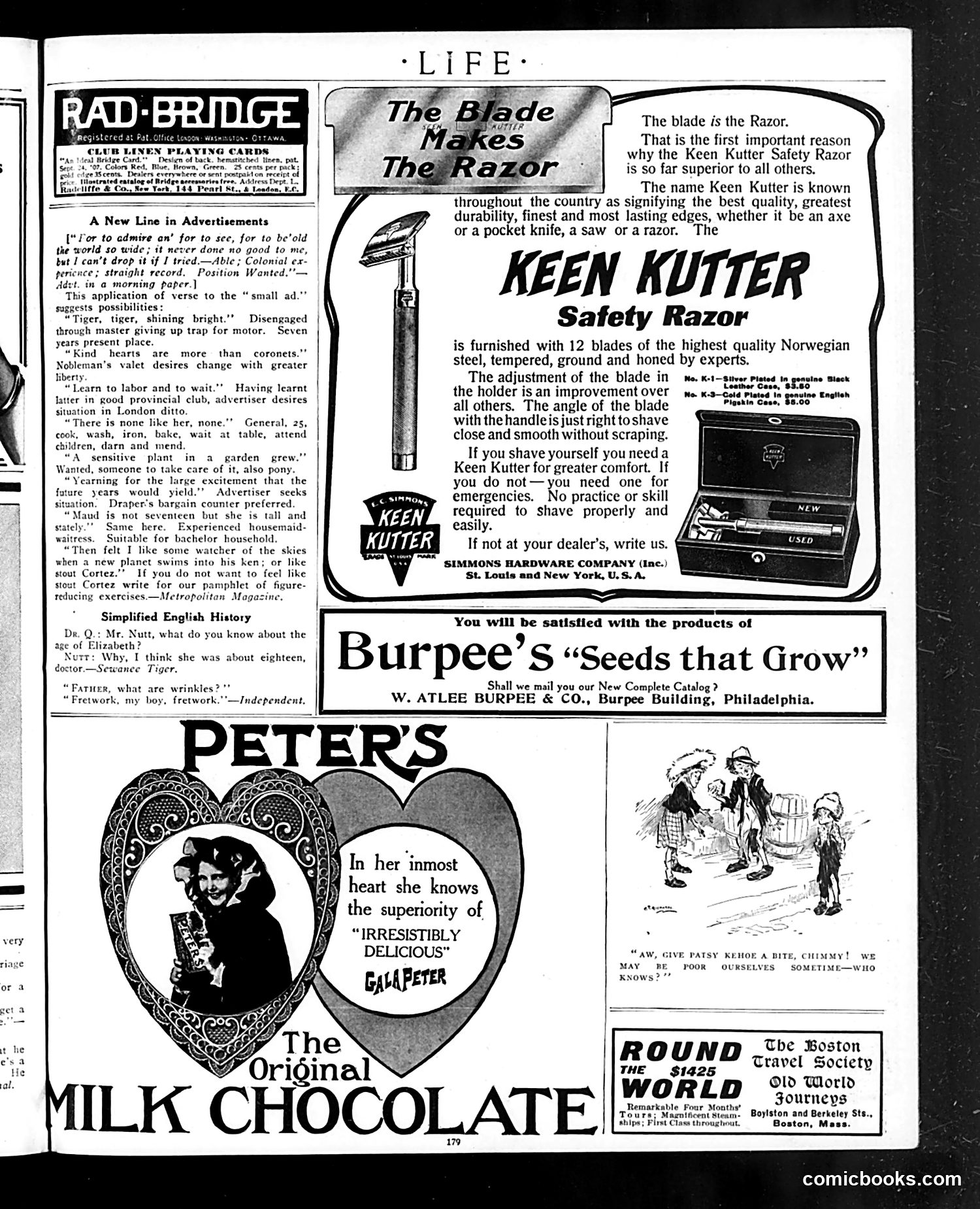
This page consists primarily of **advertisements** rather than political cartoons or satirical content. The main advertisements are: 1. **Keen Kutter Safety Razor** - promotes Norwegian steel blades and emphasizes superior quality and ease of use for home shavers 2. **Burpee Seeds** - a seed catalog advertisement promising quality garden products 3. **Peter's Milk Chocolate** - features a woman in an ornate heart-shaped frame, advertising chocolate as "irresistibly delicious" 4. **Boston Travel Society** - promotes world tours via steamship The page also includes a small section titled **"A New Line in Advertisements"** that appears to be satirizing classified ads by rewriting famous literary quotes (Kipling, Tennyson, etc.) as job postings—a lighthearted commentary on how advertisements apply poetic language to mundane situations. The "Simplified English History" section at bottom is unrelated humor about Queen Elizabeth's age. Overall, this is a typical early 20th-century magazine page mixing advertising with light editorial humor.
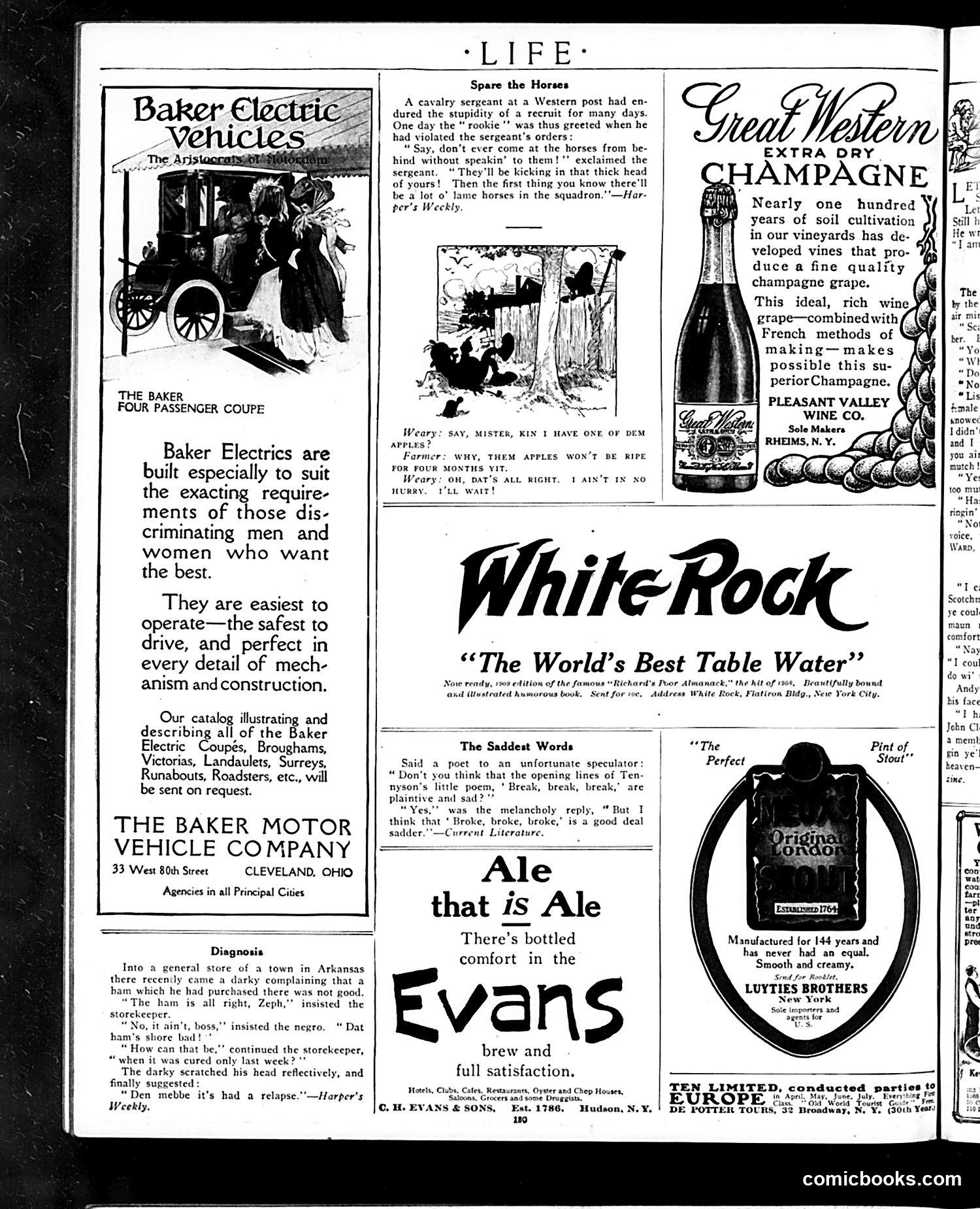
This page is primarily **advertising** interspersed with three brief humorous anecdotes typical of early 1900s Life magazine. The **cartoons/jokes** are simple, dialect-heavy humor: 1. **"Diagnosis"**: A racist caricature of a Black man ("darky") complaining about a ham to a storekeeper, with the punchline that the ham had "a relapse" — playing on the man's supposed ignorance of medical terminology. 2. **"Spare the Horses"**: A sergeant warns a recruit not to approach horses from behind, joking that the recruit's thick head is less valuable than the horses' safety. 3. **"The Saddest Words"**: A pun contrasting Tennyson's melancholy poem "Break, break, break" with "Broke, broke, broke" — referencing financial ruin during an economic period. The advertisements feature **Baker Electric Vehicles** (early automobiles), **Great Western Champagne**, **White Rock water**, and **Evans Ale** — luxury consumer goods. The humor reflects period attitudes: casual racism, class-based comedy, and financial anxiety amid economic uncertainty.
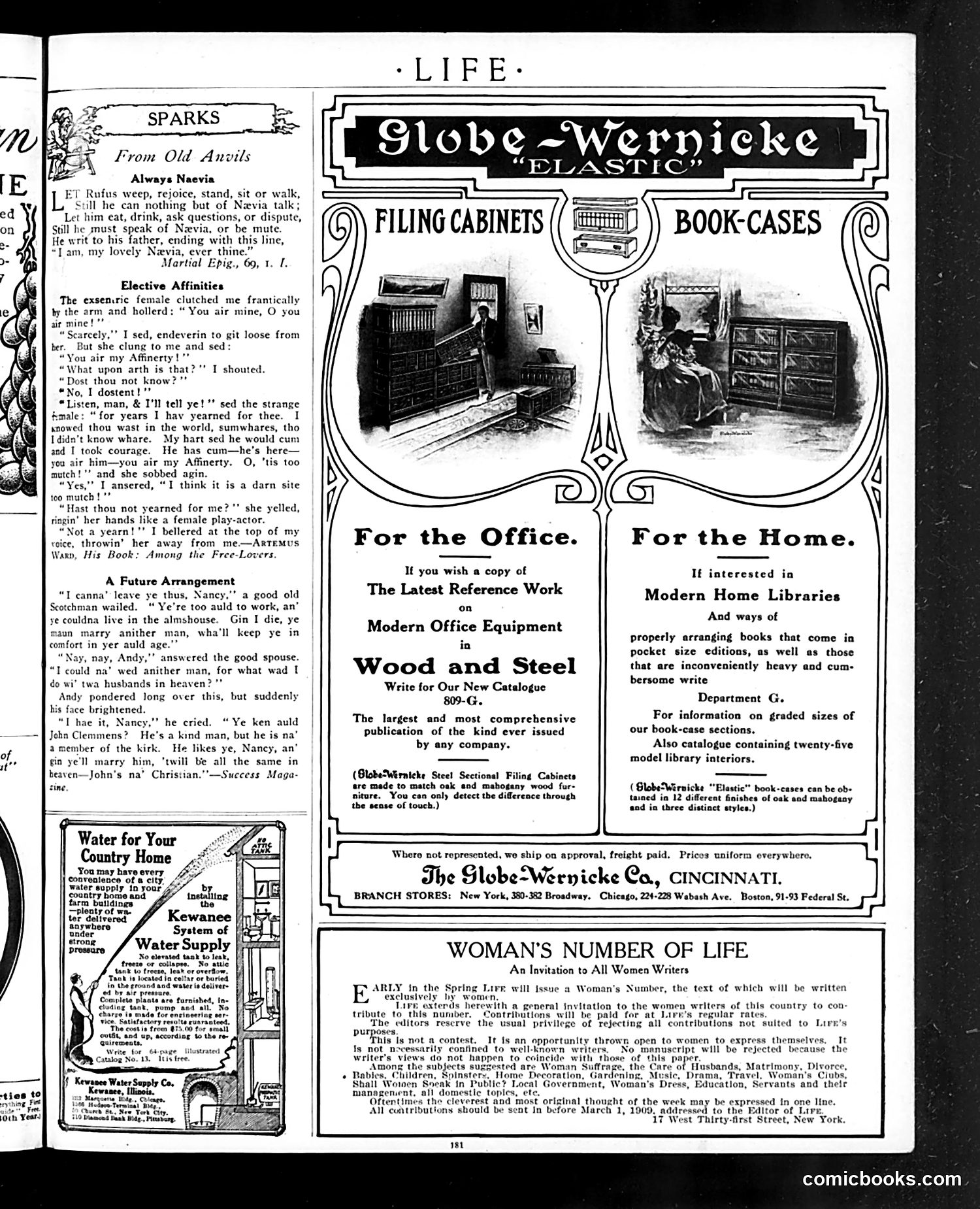
This page combines **literary humor pieces with period advertising** (circa early 1900s). ## Literary Content (Left Side) Three humorous short pieces in the style of 19th-century satirical writing: 1. **"Always Naevia"**: A classical-style poem mocking obsessive love—a man can speak only of his beloved "Naevia," echoing Martial's epigrams. 2. **"Elective Affinities"**: A comedic dialogue where a woman declares herself a man's "Affinity" (likely referencing Goethe's novel about fatalistic attraction). The man's refusal and escape is played for humor. 3. **"A Future Arrangement"**: A Scottish dialect joke about a dying husband solving his widow's remarriage dilemma by suggesting she marry an atheist, reasoning their heavenly union wouldn't count. ## Advertising (Right Side) **Globe-Wernicke furniture company** ads promoting office filing cabinets and home library bookcases—practical Victorian/Edwardian home furnishings. The page reflects Life's satirical tradition: mocking romantic idealism and human foibles through classical literary references and vernacular humor.
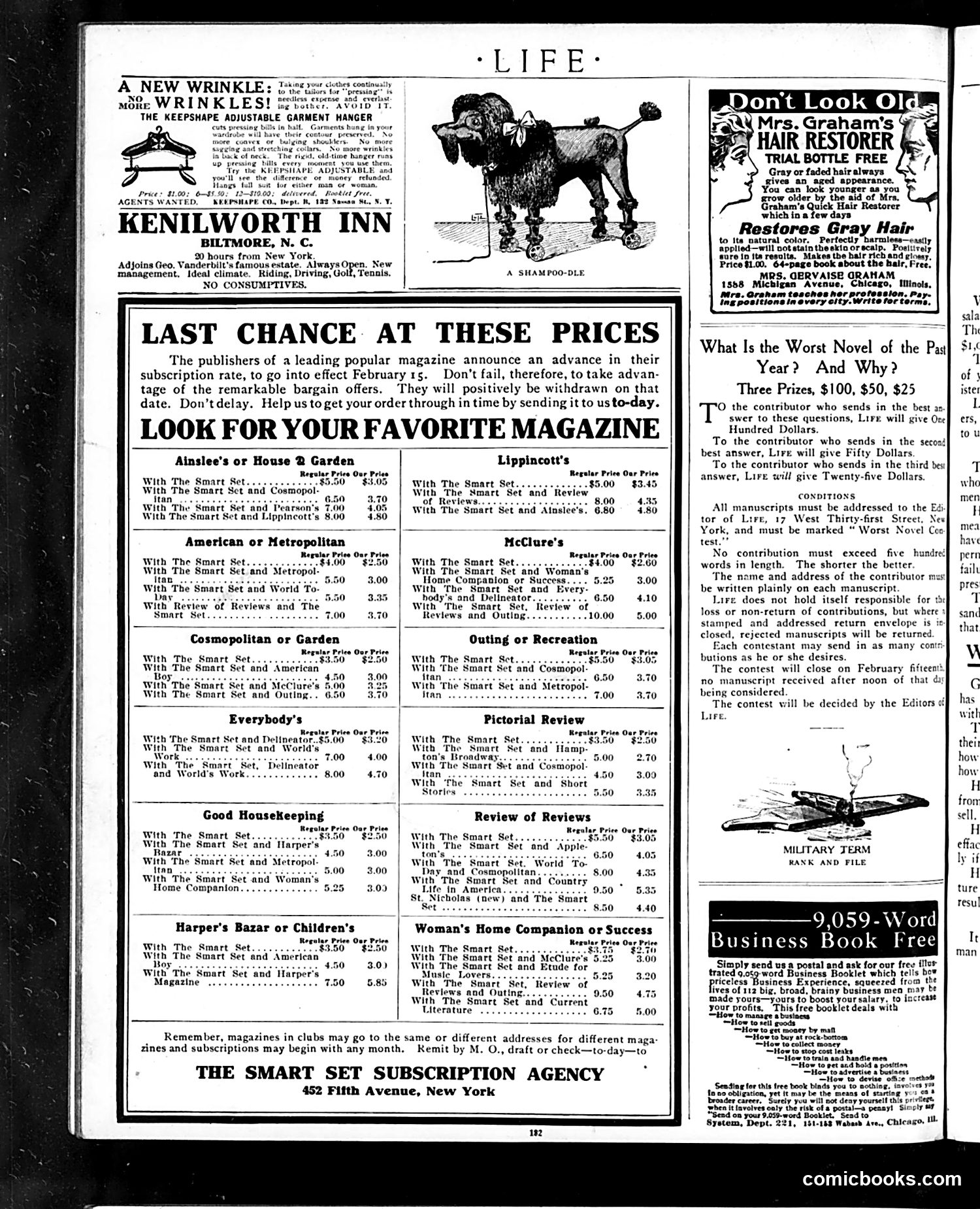
This page is primarily **advertising and subscription promotions**, not political satire. The main content consists of: 1. **Magazine subscription offers** announcing price increases effective February 15th, urging readers to subscribe immediately at current lower rates before the hike takes effect. 2. **Single cartoon**: "A Shampoo-dle" — a pun-based joke showing a shaggy dog. The humor is straightforward wordplay: "shampoo" + "doodle" (referring to the dog's breed/appearance). 3. **Product advertisements** for garment hangers, hair restoration products, hotels, and business books—typical of early 20th-century Life magazine's revenue model. There is **no political content or social satire** on this page. It's a commercial issue aimed at converting readers into magazine subscribers before subscription rates rise.
This page is primarily **advertising copy** from Lord & Thomas, a major early-20th-century advertising agency, promoting their copywriting services and expertise. The article boasts that their head copywriter earns $1,000 weekly—an astronomical sum for the era—to establish the agency's prestige. The pitch emphasizes that exceptional ad-writers are rare ("not fifty men in all America") and must be salesmen first, grammarians never. The agency claims to waste $100,000,000 annually on poorly written advertisements and positions itself as the solution through collaborative "Advisory Boards" where multiple copywriters conference on campaigns. **No political satire or cartoon figures appear on this page.** It's a straightforward (if self-congratulatory) business advertisement typical of trade publications from this period, designed to attract corporate clients by showcasing the agency's resources, methodology, and financial success.
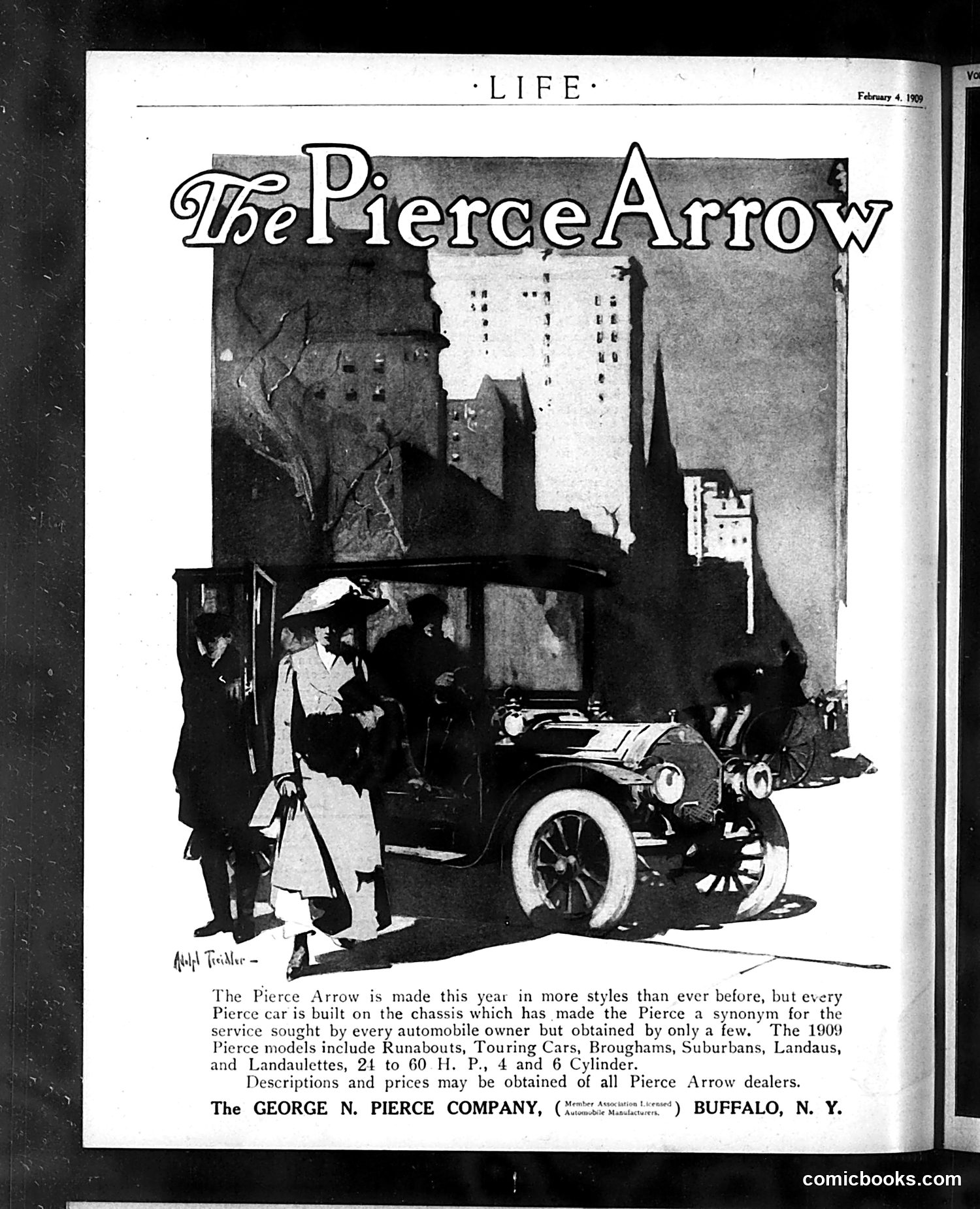
This is primarily **advertising content**, not satire or political commentary. The page features an illustration by "Adi Treicher" (signature visible) promoting the 1909 Pierce Arrow automobile. The image depicts an elegant urban street scene with well-dressed figures examining a Pierce Arrow motorcar, with tall buildings in the background. The illustration emphasizes luxury and sophistication—key selling points for high-end automobiles of this era. The text highlights Pierce Arrow's reputation for reliability and their expanded 1909 model lineup (Runabouts, Touring Cars, Broughams, etc., with 24-60 horsepower options). The advertisement targets affluent buyers by positioning Pierce as a "synonym for service," implying exclusivity and quality that "only a few" could obtain. This represents early-20th-century automotive marketing in *Life* magazine, which catered to educated, wealthy readers.