
Life, 1909-02-04 · page 25 of 40
Life — February 4, 1909 — page 25: what you’re looking at
What you’re looking at
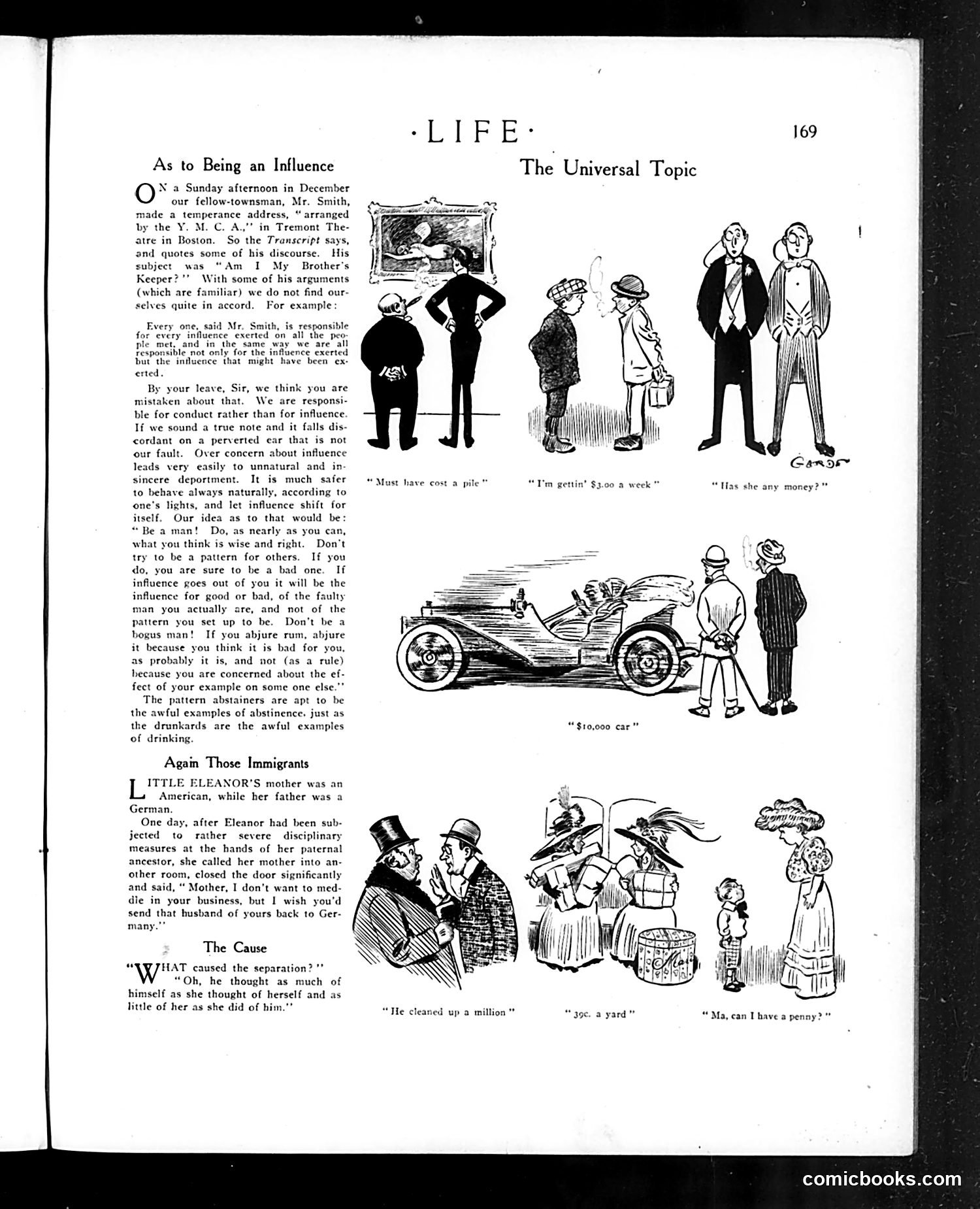
This page contains satirical commentary on early 20th-century American social issues through text and cartoons. **"As to Being an Influence"** critiques a temperance speaker (Mr. Smith) who argued we're responsible for all influence we exert. The author disagrees, advocating authentic behavior over performative morality—be genuinely virtuous, not a "bogus man" pretending for others' benefit. **"The Universal Topic"** cartoons depict class anxiety and materialism: men discuss expensive possessions ("$10,000 car"), while immigrants and the poor ask for money or work ("I'm gettin' $3.00 a week," "Ma, can I have a penny?"). **"Again Those Immigrants"** humorously critiques mixed marriages. Eleanor's German father is so self-absorbed he neglects his American wife, prompting her to request he return to Germany—satirizing stereotypical German egocentrism and tensions between immigrant and native-born Americans. The page's overall theme concerns authentic versus false social behavior and anxieties about wealth, immigration, and influence in Progressive Era America.
📄 Transcribed text from this page (OCR, searchable)
Machine-transcribed from the original scan — historical spelling and the odd misread are preserved.
-LIFE: As to Being an Influence The Universal Topic O: a Sunday afternoon in December our fellow-townsman, Mr. Smith, made a temperance address, “ arranged by the Y. M. C. A,’ in Tremont The- atre in Boston. So the Transcript says, and quotes some of his discourse. His subject was “Am I My Brother's Keeper? ’’ With some of his arguments (which are familiar) we do not find our- selves quite in accord. For example: Every one, said Mr. ith, is responsible r every influence exerted on all the peo- and in the same way we are all responsible not for the influence exerted but the indus hat might have been ex- erted. By your leave, Sir, we think you are mistaken about that.” We are responsi- ble for conduct rather than for influence If we sound a true note and it falls dis- cordant on a perverted ear that is not our fault. Over concern about influence leads very easily to unnatural and in Canom sincere deportment. It is much safer + Must have cost a pile” “T'm gettin’ $3.00 a week” “Tas she on , to behave always naturally, according to a as she any money one’s lights, and let influence shift for itself. Our idea as to that would be: “Be a man! Do, as nearly as you can, what you think is wise and right. Don’t try to be a pattern for others. If you do, you are sure to be a bad one. If influence goes out of you it will be the influence for good or bad, of the faulty man you actually are, and not of the pattern you set up to be. Don't be a bogus man! If you abjure rum, abjure it because you think it is bad for you, as probably it is, and not (as a rule) because you are concerned about the ef- fect of your example on some one else.”* The pattern abstainers are apt to be the awful examples of abstinence, just as the drunkards are the awful examples “$10,000 car” of drinking. Again Those Immigrants ITT EANOR’S mother was an American, while her father was a German. One day, after Eleanor had been sub- jected to rather severe disciplinary measures at the hands of her paternal ancestor, she called her mother into an- other room, closed the door significantly and said, “ Mother, I don’t want to med- die in your business, but 1 wish you'd send that husband of yours back to Ger- many.”" The Cause HAT caused the separation? "* “Oh, he thought as much of himself as she thought of herself and as little of her as she did of him.” ““FHe cleaned up a million * Joe Si; Gant haven penny? comicbooks.com