
Life, 1909-02-04 · page 27 of 40
Life — February 4, 1909 — page 27: what you’re looking at
What you’re looking at
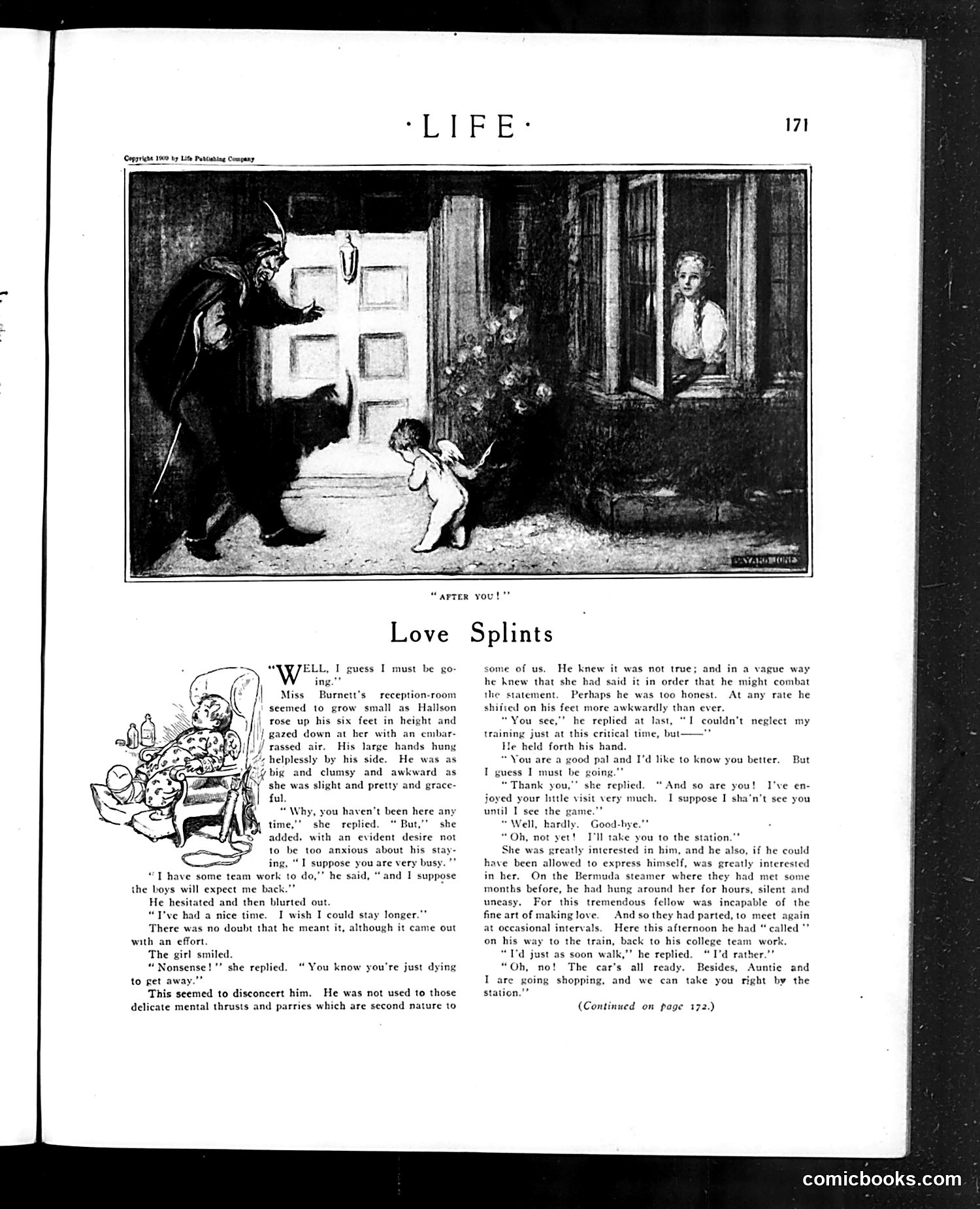
This is a romantic short story rather than a political cartoon. The narrative depicts a socially awkward college athlete named Hallson visiting a refined young woman, Miss Burnett, in her reception room. The satire targets the contrast between masculine athleticism and social grace. Hallson is physically imposing—"six feet in height"—but emotionally inarticulate, with "large hands hung helplessly by his side." He's "clumsy and awkward" compared to the "slight and pretty and graceful" Miss Burnett, who employs sophisticated verbal sparring ("delicate mental thrusts and parries") that confuses his honest, straightforward nature. The humor lies in their mutual interest despite their incompatibility: he cannot "express himself" or master "the fine art of making love," while she skillfully manipulates conversation. This early-1900s story gently mocks both the emotionally stunted athlete and the calculating society woman, suggesting that romantic compatibility requires more than physical attraction or clever wit.
📄 Transcribed text from this page (OCR, searchable)
Machine-transcribed from the original scan — historical spelling and the odd misread are preserved.
Cepyrigns 1909 by Lite Pedining Company “apTerR you!"* Love Splints —~ LL, I guess I must be go- ’) ing.” | Miss Burnett's reception-room seemed to grow small as Hallson | rose up his six feet in height and ||| gazed down at her with an embar- / rassed air. His large hands hung helplessly by his side. He was as “big and clumsy and awkward as she was slight and pretty and grace- ful. Why, you haven't been here any time,"" she replied.“ But,"” she added, with an evident desire not to be too anxious about his stay- ing, “I suppose you are very busy. “T have some team work to do,"" he said, “and I suppose the boys will expect me back.” He hesitated and then blurted out “I've had a nice time. I wish I could stay longer.”” ‘There was no doubt that he meant it, although it came out with an effort. The girl smiled. “Nonsense!” she replied. “ You know you're just dying to get away.”’ This seemed to disconcert him. He was not used to those delicate mental thrusts and parries which are second nature to some of us, He knew it was not true; and in a vague way he knew that she had said it in order that he might combat the statement. Perhaps he was too honest. At any rate he shifted on his feet more awkwardly than ever. You see,’ he replied at last, “I couldn't neglect my training just at this critical time, but—" held forth his hand. “You are a good pal and I'd like to know you better. But I guess I must be going “Thank you,”’ she replied. “And so are you! I've en- joyed your hitle visit very much. I suppose I sha’n’t see you until I see the g “Well, hardly. “Oh, not yet! I'll take you to the station.”” She was greatly interested in him, and he also, if he could have been allowed to express himself, was greatly interested in her. On the Bermuda steamer where they had met some months before, he had hung around her for hours, silent and uneasy. For this tremendous fellow was incapable of the fine art of making love. And so they had parted, to meet again at occasional intervals. Here this afternoon he had “called ”” on his way to the train, back to his college team work. I'd just as soon walk,’ he replied. “I'd rather.’” “Oh, no! The car’s all ready. Besides, Auntie and I are going shopping, and we can take you right by the Station.”” (Continued on page 172.) comicbooks.com