
Life, 1909-02-04 · page 22 of 40
Life — February 4, 1909 — page 22: what you’re looking at
What you’re looking at
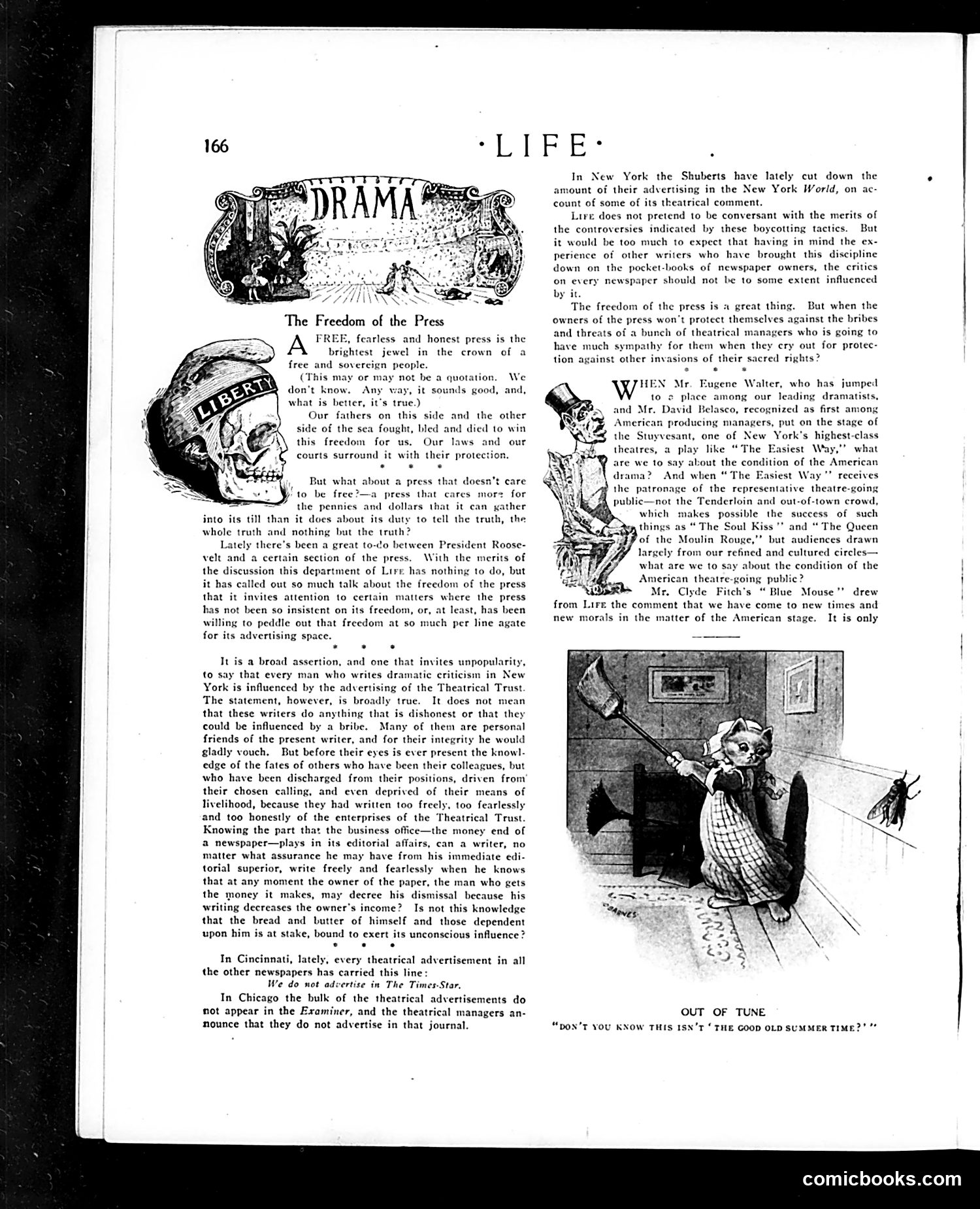
This article critiques the **Theatrical Trust** (a monopolistic theater management cartel) for using advertising boycotts to suppress honest theater criticism in newspapers. The piece argues that while press freedom is theoretically protected, it's undermined in practice by economic pressure: newspaper owners depend on theatrical advertising revenue, so critics face implicit threats of dismissal if they write unfavorably about Trust productions. Life cites specific examples—Cincinnati's *Times-Star* and Chicago's *Examiner* being punished with ad boycotts, and the Shuberts cutting *New York World* advertising due to critical coverage. The satirical point: the Theatrical Trust effectively silences critics through financial coercion rather than legal censorship, exposing the gap between America's ideals of press freedom and its commercial reality. Critics self-censor not from bribery but fear of losing their livelihoods—their employers' income depends on theatrical advertising. The cartoon ("Out of Tune") appears to illustrate this tension between stated principles and corrupted practice.
📄 Transcribed text from this page (OCR, searchable)
Machine-transcribed from the original scan — historical spelling and the odd misread are preserved.
The Freedom of the Press fearless and honest press is the brightest crown of a free and sovereign people. his may or may not be a quotation. We don't know, Any way, it sounds good, and, what is better, it’s true.) Our fathers on this side and the other side of the sea fought, bled and died to win this freedom for us. and our courts surround it with their protection. n the jewel Our laws. But what about a press that doesn’t care Y'to be free?—a press that cares mor for 7 the pennies and dollars that it can gather into its till than it docs about its duty to tell the truth, the whole truth and nothing but the truth? Lately there's been a great to-do between President Roose- velt and a certain section of the press. With the merits of the discussion this department of Lire has nothing to do, but it has called out so much talk about the freedom of the press that it invites attention to certain matters where the press has not been so insistent on its freedom, or, at least, has been willing to peddle out that freedom at so much per line agate for its advertising space. It is a broad assertion, and one that invites unpopularit to say that every man who writes dramatic criticism in New York is influenced by the advertising of the Theatrical Trust The statement, however, is broadly true, It docs not mean that these writers do anything that is dishonest or that they could be influenced by a bribe. Many of them are personal friends of the present writer, and for their integrity he would gladly vouch, But before their eyes is ever present the knowl- edge of the fates of others who have been their colleagues, but who have been discharged from their positions, driven from their chosen calling, and even deprived of their means of livelihood, because they had written too freely, too fearlessly and too honestly of the enterprises of the Theatrical Trust. Knowing the part that the business office—the money end of a newspaper—plays in its editorial affairs, can a writer, no matter what assurance he may have from his immediate edi- torial superior, write freely and fearlessly when he knows that at any moment the owner of the paper, the man who gets the money it makes, may decree his dismissal because his writing decreases the owner's income? Is not this knowledge that the bread and butter of himself and those dependent upon him is at stake, bound to exert its unconscious influence? In Cincinnati, lately, every theatrical advertisement in all the other newspapers has carried this line: We do not advertise in The Times-Star, In Chicago the bulk of the theatrical advertisements do not appear in the Examiner, and the theatrical managers an- nounce that they do not advertise in that journal. “LIFE: ; In New York the Shuberts have lately cut down the amount of their advertising in the New York World, on ac- count of some of its theatrical comment. Lire does not pretend to be conversant with the merits of the controversies indicated by these boycotting tactics. But it would be too much to expect that having in mind the ex- perience of other writers who have brought this discipline down on the pocket-books of newspaper owners, the critics fon every newspaper should not be to some extent influenced by it. The freedom of the press is a great thing. But when the owners of the press won't protect themselves against the bribes and threats of a bunch of theatrical managers who is going to have much sympathy for them when they ery out for protec- tion inst other invasions of their sacred rights? Ww! :N Mr. Eugene Walter, who has jumped to = place among our leading dramatists, ; and Mr, David Belasco, recognized as first among MEE American producing managers, put on the stage of °& the Stuyvesant, one of New York's highest-class y play like “The Easiest. Way,’” what bout the condition of the American And when “The Easiest Way"? receives the patronage of the representative theatre-going —not the Tenderloin and out-of-town crowd, which makes possible the success of such things as “ The Soul Kiss" and “The Queen of the Moulin Rouge,”’ but audiences drawn largely from our refined and cultured circles— what are we to say about the condition of the American theatre-going public? Mr. Clyde Fitch’s “Blue Mouse "* from Lire the comment that we have come to new time new morals in the matter of the American stage. theatres, drew and aa —— OUT OF TUNE THIS ISN'T ‘THE GOOD OLD SUMMER TIME?’ ’* “pon’T you KNow comicbooks.com