
Life, 1909-02-04 · page 23 of 40
Life — February 4, 1909 — page 23: what you’re looking at
What you’re looking at
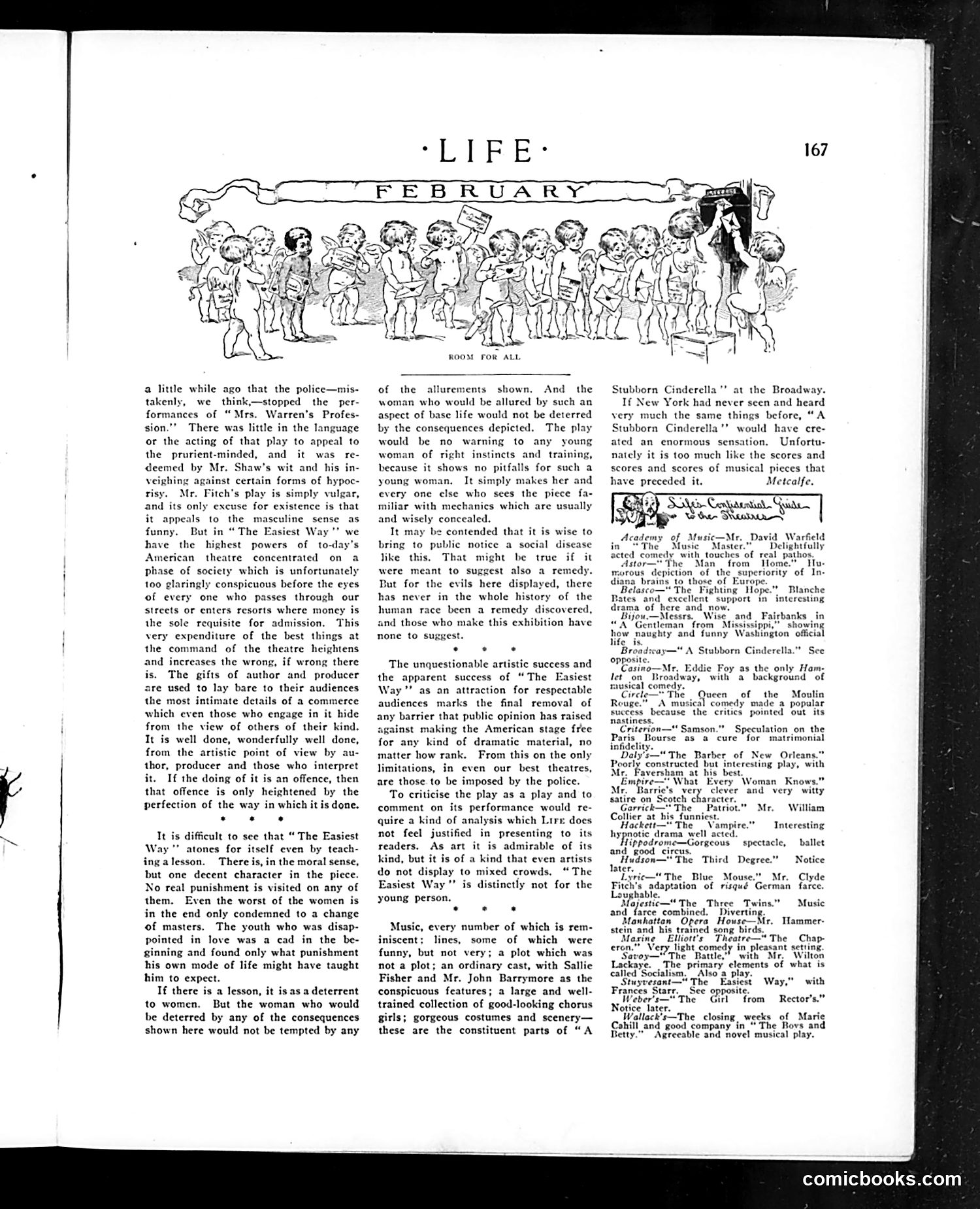
This page reviews "The Easiest Way," a Broadway play about prostitution. The critic—writing around the early 1900s—praises the play's artistic execution but condemns its moral message (or lack thereof). The satire targets the play's paradox: its technical brilliance makes the depiction of vice *more* damaging, not less. The critic argues the play teaches no genuine lesson because: 1. It shows no consequences for wrongdoing (the protagonist merely "changes masters") 2. It won't deter virtuous women (they already know better) or reform fallen ones (they're unmoved by artistic warnings) 3. It merely familiarizes respectable audiences with "mechanics" of prostitution that should remain "wisely concealed" The larger point critiques American theatre's removal of moral guardrails—now only police censorship remains. This reflects early-1900s anxieties about urbanization, commercialized sex, and theatre's role in public morality. The cartoon header showing cherubs likely represents February's innocence contrasting the page's discussion of moral corruption.
📄 Transcribed text from this page (OCR, searchable)
Machine-transcribed from the original scan — historical spelling and the odd misread are preserved.
a little while ago that the police—mis- takenly, we think,—stopped the per- formances of “Mrs. Warren's Profes- sion.” There was little in the language or the acting of that play to appeal to the prurient-minded, and it was re- deemed by Mr. Shaw’s wit and his in- veighing certain forms of bypoc- . Mr. Fitch's play is simply vulgar, and its only excuse for existence is that it appeals to the masculine sense as funny. But in “The Easiest Way" we have the highest powers of to-day’s American theatre concentrated on a phase of society which is unfortunately too glaringly conspicuous before the eyes of every one who passes through our streets or enters resorts where moncy is the sole requisite for admission. This very expenditure of the best things at the command of the theatre heightens and increases the wrong, if wrong there is. The gifts of author and producer are used to lay bare to their audiences the most intimate details of a commerce which even those who engage in it hide from the view of others of their kind. It is well done, wonderfully well done, from the artistic point of view by au- thor, producer and those who interpret it. If the doing of it is an offence, then that offence is only heightened by the perfection of the way in which it is done. . 8 6 It is difficult to see that “ The Easiest Way" atones for itself even by teach- ing alesson. There is, in the moral sense, but one decent character in the piece. No real punishment is visited on any of them. Even the worst of the women is in the end only condemned to a change of masters. The youth who was disap- pointed in love was a cad in the be- ginning and found only what punishment his own mode of life might have taught him to expect. Tf there is a lesson, it is asa deterrent to women. But the woman who would be deterred by any of the consequences shown here would not be tempted by any ROOM FOR ALL of the allurements shown. And the woman who would be allured by such an aspect of base life would not be deterred by the consequences depicted. The play would be no warning to any young woman of right instincts and training, because it shows no pitfalls for such a young woman, It simply makes her and every one else who sees the piece fa- miliar with mechanics which are usually and wisely concealed. It may be contended that it is wise to bring to public notice a social disease like this. That might be true if it were meant to suggest also a remedy. But for the evils here displayed, there has never in the whole history of the human race been a remedy discovered, and those who make this exhibition have none to suggest. oe 6 The unquestionable artistic success and the apparent success of “The Easiest Way’? as an attraction for respectable audiences marks the final removal of any barrier that public opinion has raised against making the American stage free for any kind of dramatic material, no matter how rank. From this on the only limitations, in even our best theatres, are those to be imposed by the police. To criticise the play as a play and to comment on its performance would re- quire a kind of analysis which Lure does not feel justified in presenting to its readers. As art it is admirable of its kind, but it is of a kind that even artists do not display to mixed crowds. “The Easiest Way’ is distinctly not for the young person. ee 8 Music, every number of which is rem- iniscent; lines, some of which were funny, but not very; a plot which was not a plot; an ordinary cast, with Sallie Fisher and Mr. John Barrymore as the conspicuous features; a large and well- trained collection of good-looking chorus girls; gorgeous costumes and scenery— these are the constituent parts of “A Stubborn Cinderella’ at the Broadway. If New York had never seen and heard very much the same things before, “A Stubborn Cinderella’? would have cre- ated an enormous sensation. Unfortu- cly it is too much like the scores and scores and scores of musical pieces that have preceded it. Metcalfe. of Music—Mr. David Warfield Music Master.” Delightfully edy with touches of real pathos. The Man from Home.” Ii piction of the superiority of I of Europe. hting Hop a excellent. support drama of here and now. Bijou.—Messrs. Wise’ and | Fairbanks _in “A Gentleman from Mississippi,” showing how naughty and funny Washington official life. is. Broad opposite. Casino—Mr, let on Broadway, riusical comedy, Cirele—" The Queen of the Moulin Rouge.” A musical comedy made a popular success because the critics pointed out its nastiness Criterion—" Samson.” Paris Bourse as a cure for infidelit Daly's—" The Barber of New Orleans.” Poorly constructed but interesting play, with Mr. Faversham at his best ts he seoares What Every Woman Knows.’ * Blanche n interesting ‘ay—" A Stubborn Cinderella." See Eddie Foy as the only Ham- with a background of Speculation on the matrimonial Mr, “Barrie's very clever and very witty Satire on Scotch character. : Garrick—"The Patriot.” Mr. William Collier at his funniest. Hackett—" The | Vampire.” Interesting hypnotic drama well acted. Vippodrome—Gorgeous spectacle, ballet and good circus. Hudson—" The Third Degree.” Notice The Blue Mouse." Mr, Clyde Fitch’s adaptation of risqué German farce. Loughable. Majestic—“The Three Twins.” and farce combined. Diverting Manhattan Opera House—Mr. Hammer stein and his trained song birds. Music Marine Elliot's Theatre— The | Chap cron,” Very light comedy in pleasant setting Sovoy—-The Battle.” with Mr, Wilton The primary elements of what is Lackaye. Also a play. called Socialis: Stuyvezant—" The | Easiest Way,” with See opposite. ‘The itl from Rector’ Notice later. . , Wallack’s—The closing. weeks of Marie Cahill and good company in. The Bovs and Retty.”” Agreeable and novel musical play. comicbooks.com