
Life, 1909-02-04 · page 26 of 40
Life — February 4, 1909 — page 26: what you’re looking at
What you’re looking at
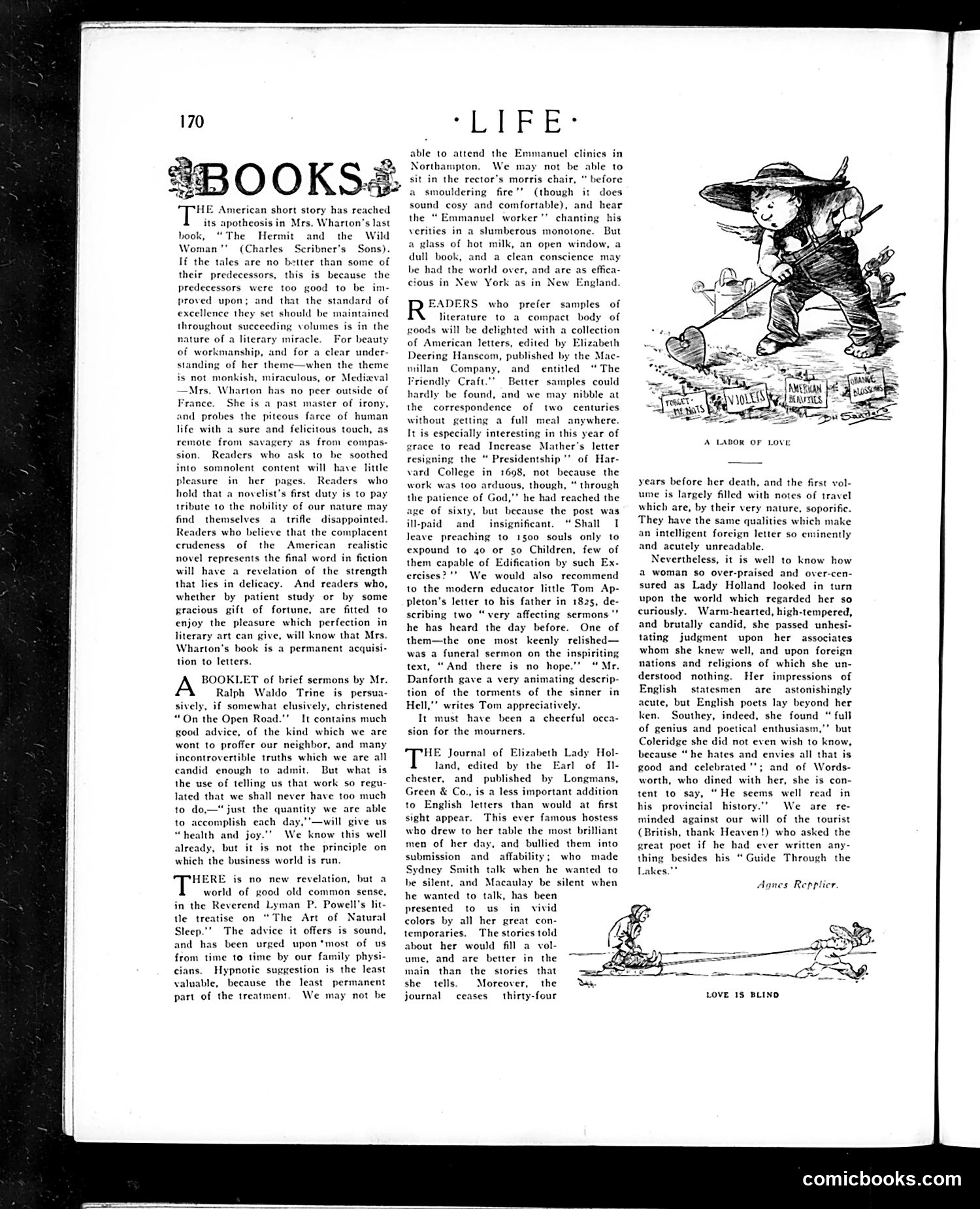
This is a book review section from Life magazine's "Books" column. The page discusses several literary works, primarily praising Edith Wharton's short story collection "The Hermit and the Wild Woman." The reviews reveal period literary tastes: Wharton is celebrated for her psychological insight, irony, and elegant prose style—contrasted favorably against "crude" American realism. The reviewer suggests readers seeking comfort or moral uplift will be disappointed by her unflinching observations of human nature. Other reviewed works include Ralph Waldo Trine's self-help sermon collection "On the Open Road" (gently mocked for dispensing obvious advice about work-life balance that contradicts actual business practices) and volumes on natural sleep and historical American letters. The two small cartoon illustrations titled "A Labor of Love" and "Love is Blind" appear to be humorous decorative elements accompanying the text, though their specific satirical targets are unclear from the image alone.
📄 Transcribed text from this page (OCR, searchable)
Machine-transcribed from the original scan — historical spelling and the odd misread are preserved.
SBOOKS# wre Ts merican short story has reached its apotheosis in Mrs. Wharton's last book, “The Hermit and the Wild Woman? (Charles Scribner’s Sons). If the tales are no better than some of their predecessors, this is because the predecessors were too good to be im- proved upon; and that the standard of excellence they set should be maintained throughout succeeding volumes is in the nature of a literary miracle. For beauty of workmanship, and for a clear under- standing of her theme—when the theme is not monkish, miraculous, or Medieval -Mrs. Wharton has no peer outside of France. She is a past master of irony, and probes the pitcous farce of human life with a sure and felicitous touch, as remote from savagery as from compas- sion. Readers who ask to be soothed into somnolent content will have little pleasure in her s. Re: who hold that a novelist’s first duty is to pay tribute to the nobility of our nature may find themselves a trifle disappointed. Readers who believe that the complacent crudeness of the American realistic novel represents the final word in fiction will have a revelation of the strength that lies in delicacy. And readers who, whether by patient study or by some gracious gift of fortune, are fitted to enjoy the pleasure which perfection in literary art can give, will know that Mrs. Wharton's book is a permanent acquisi- tion to letters. BOOKLET of brief sermons by Mr. Ralph Waldo Trine is persua- sively, if somewhat clusively, christened “On the Open Road.’” It contains much good advice, of the kind which we are wont to proffer our neighbor, and many incontrovertible truths which we are all candid enough to admit, But what is the use of telling us that work so regu- lated that we shall never have too much to do,—" just the quantity we are able to accomplish each day,’’—will give us “health and joy.’’ We know this well already, but it is not the principle on which the business world is run. ders: HERE is no new revelation, but a world of good old common sense, in the Reverend Lyman P. Powell's lit- tle treatise on “The Art of Natural Sleep."". The advice it offers is sound, and has been urged upon tmost of us from time to time by our family phys cians. Hypnotic suggestion is the least valuable, because the least permanent part of the treatment. We may not be ‘LIF E+ able to attend the Emmanuel clinics in Northampton. We may not be able to sit in the rector’s morris chair, “ before a smouldering fire’? (though it does sound cosy and comfortable), and hear the nmanuel worker"? chanting his verities in a slumberous monotone. But a glass of hot milk, an open window, a dull book, and a clean conscience may he had the world over, and are as effica- cious in New York as in New England R ADERS who prefer samples of literature to a compact body of goods will be delighted with a collection of American letters, edited by Elizabeth Deering Hanscom, published by the Mai niillan Company, and entitled “The Friendly Craft.” Better samples could hardly be found, and we may nibble at the correspondence of two centuries without getting a full meal anywhere. It is especially interesting in this year of grace to read Increase Mather’s letter resigning the “ Presidentship ’ of Har- vard College in 1698, not because the work was too arduous, though, “ through the patience of God,” he had reached the age of sixty, but because the post was ill-paid and insignificant. “Shall 1 leave preaching to 1500 souls only to expound to 40 or so Children, few of them capable of Edification by such Ex- ercises?"’ We would also recommend to the modern educator little Tom Ap- pleton’s letter to his father in 1825, de- scribing two “very affecting sermons" he has heard the day before. One of them—the one most keenly relished— was a funeral sermon on the inspiriting text, “And there is no hope."” “Mr. Danforth gave a very animating descrip- tion of the torments of the sinner in Hell,"’ writes Tom appreciativel: It must have been a cheerful occa- sion for the mourners. HE Journal of Elizabeth Lady Hol- land, edited by the Earl of Il- chester, and published by Ans, Green & Co., is a less important addition English letters than would at first sight appear. This ever famous hostess who drew to her table the most bril men of her day, and bullied them into submission and affability; who made Sydney Smith talk when he wanted to be silent, and Macaulay be silent when he wanted to talk, has been presented to us in vivid colors by all her great con- temporaries. The stories told about her would fill a vol- ume, and are better in the main than the stories that she tells. Moreover, the journal ceases thirty-four A LABOR OF LOVE years before her death, and the first vol- ume is largely filled with notes of travel which are, by their very nature, soporific. They have the same qualities which make an intelligent foreign letter so eminently and acutely unreadable. evertheless, it is well to know how a woman so over-praised and over-cen- sured as Lady Holland looked in turn upon the world which regarded her so curiously. Warm-hearted, high-tempered, and brutally candid, she passed unhesi tating judgment upon her associates whom she knew well, and upon foreign nations and religions of which she un- derstood nothing. Her impressions of English statesmen are astonishingly acute, but English poets lay beyond her ken. Southey, indeed, she found “ full of genius and poetical enthusiasm,’? but Coleridge she did not even wish to know, because “he hates and envies all that is good and celebrated '"; and of Words- worth, who dined with her, she is con- tent to say, “He scems well read in his provincial history.” We are re- minded against our will of the tourist (British, thank Heaven!) who asked the great poet if he had ever written any- thing besides his “Guide Through the Lakes.”” Agnes Repplier. LOVE 18 BLIND comicbooks.com