
Life, 1909-02-04 · page 16 of 40
Life — February 4, 1909 — page 16: what you’re looking at
What you’re looking at
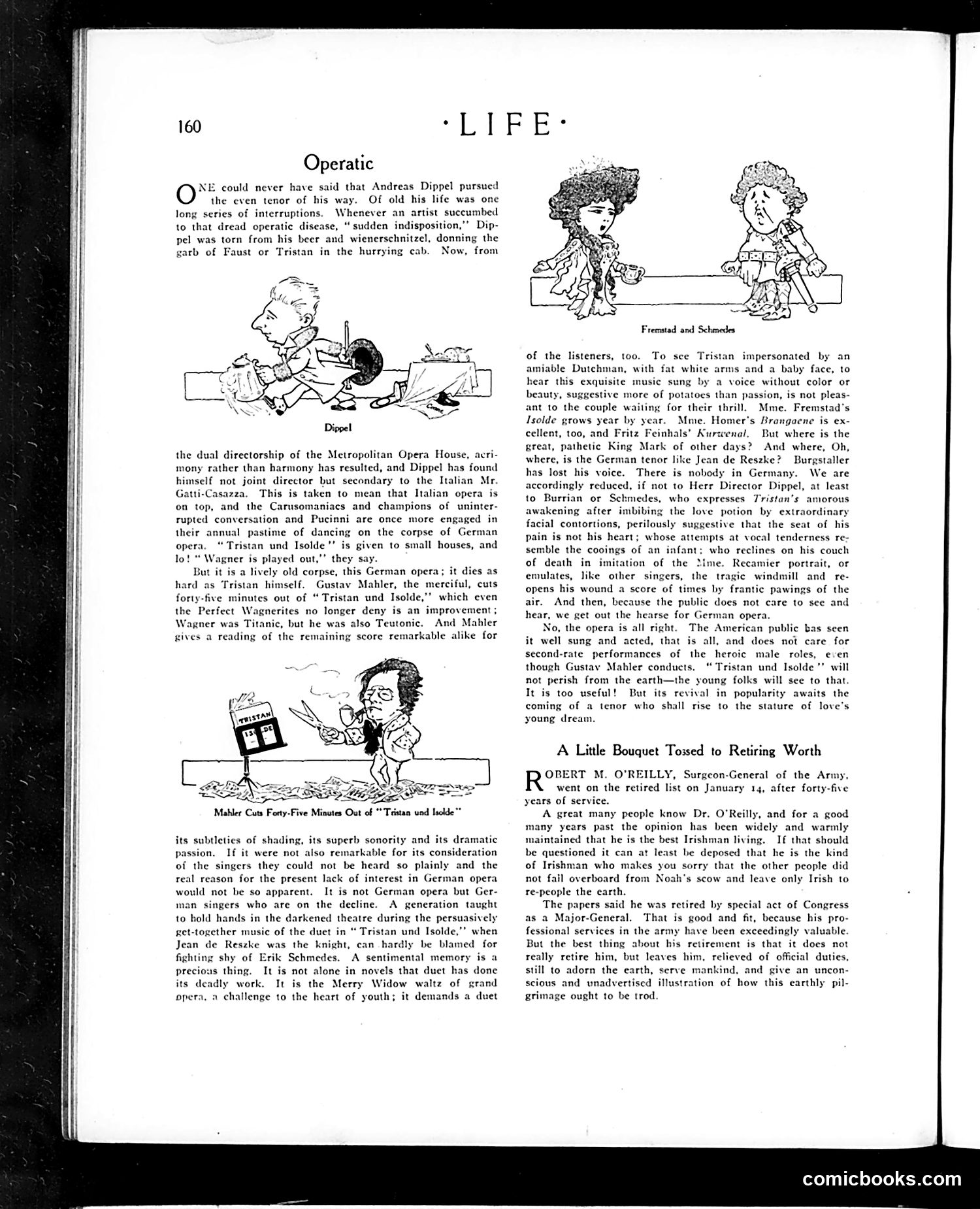
This page satirizes the declining fortunes of German opera at New York's Metropolitan Opera House, specifically blaming poor casting rather than the art form itself. **The figures:** Andreas Dippel (caricatured conducting), Gustav Mahler (who cut 45 minutes from Wagner's *Tristan und Isolde*), and tenor Erik Schmedes (mocked for his weak voice and awkward stage presence). **The complaint:** Italian opera dominates the Met under director Gatti-Casazza, relegating German opera to small houses. Wagner's *Tristan* gets poor performances because current German singers—particularly Schmedes—lack the vocal beauty and dramatic power of past stars like Jean de Reszke. **The satire's point:** The writer argues German opera isn't "played out"; rather, American audiences simply won't tolerate mediocre performances anymore. They've experienced excellence and reject inferior singers, no matter the masterpiece. It's a backhanded defense of German opera through pointed criticism of its current interpreters.
📄 Transcribed text from this page (OCR, searchable)
Machine-transcribed from the original scan — historical spelling and the odd misread are preserved.
“LIFE* Operatic <E could never have said that Andreas Dippel pursued O the even tenor of his way. Of old his life was one long series of interruptions. Whenever an artist succumbed to that dread operatic disease, “sudden indisposition,’’ Dip- pel was torn from his beer and wienerschnitzel, donning the garb of Faust or Tristan in the hurrying cab. Now, from Dippel the dual directorship of the Metropolitan Opera House, acri- mony rather than harmony has resulted, and Dippel has found himself not joint director but secondary to the Italian Mr. Gatti-Casazza. This is taken to mean that Italian opera on top, and the Carusomaniacs and champions of uninter- rupted conversation and Pucinni are once more engaged in their annual pastime of dancing on the corpse of German opera. “Tristan und Isolde’ is given to small houses, and lo! “ Wagner is played out,’ they say. But it is a lively old corpse, this German opera; it dies as hard as Tristan himself. Gustav Mahler, the merciful, cuts forty-five minutes out of “Tristan und Isolde,"” which even the Perfect Wagnerites no longer deny is an improvement; Wagner was Titanic, but he was also Teutonic. And Mabler gives a reading of the remaining score remarkable alike for Mahler Cuts Forty-Five Minutes Out of “* Tristan und Isolde’ its subtleties of shading, its superb sonority and its dramatic passion. If it were not also remarkable for its consideration of the singers they could not be heard so plainly and the real reason for the present lack of interest in German opera would not be so apparent, It is not German opera but Ger- man singers who are on the decline. A generation taught to hold hands in the darkened theatre during the persuasively get-together music of the duct in “Tristan und Isolde,"” when Jean de Reszke was the knight, can hardly be blamed for fighting shy of Erik Schmedes. A sentimental memory is a precious thing. It is not alone in novels that duet has done its deadly work. It is the Merry Widow waltz of grand opera, a challenge to the heart of youth; it demands a duet Fremstad and Schmedes of the listeners, too. To sce Tristan impersonated by an amiable Dutchman, with fat white arms and a baby face, to hear this exquisite music sung by a voice without color or beauty, suggestive more of potatoes than passion, is not pleas- ant to the couple waiting for their thrill. Mme. Fremstad’s Isolde grows year by year. Mme. Homer's Brangaene is ex- cellent, too, and Fritz Feinhals’ Kurwenal. But where is the great, pathetic King Mark of other days? And where, Oh, where, is the German tenor like Jean de Reszke? Burgstaller has lost his voice. There is nobody in Germany. We are accordingly reduced, if not to Herr Director Dippel, at least to Burrian or Sckmedes, who expresses Tristan’s amorous awakening after imbibing the love potion by extraordinary facial contortions, perilously suggestive that the seat of his pain is not his heart; whose attempts at vocal tenderness re- semble the cooings of an infant; who reclines on his couch of death in imitation of the Mme. Recamier portrait, or emulates, like other singers, the tragic windmill and re- opens his wound a score of times by frantic pawings of the . And then, because the public does not care to see and hear, we get out the hearse for German opera. No, the opera is all right. The American public bas seen it well sung and acted, that is all, and does not care for second-rate performances of the heroic male roles, even though Gustav Mahler conducts. “Tristan und Isolde’? will not perish from the earth—the young folks will see to that It is too useful! But its revival in popularity awaits the coming of a tenor who shall rise to the stature of love's young dream. A Little Bouquet Tossed to Retiring Worth Rover M. O'REILLY, Surgeon-General of the Army, went on the retired list on January 14, after forty-five years of service. A great many people know Dr. O'Reilly, and for a good many years past the opinion has been widely and warmly maintained that he is the best Irishman living. If that should be questioned it can at least he deposed that he is the kind of Irishman who makes you sorry that the other people did not fail overboard from Noah's scow and leave only Irish to re-people the earth. The papers said he was retired by special act of Congress as a Major-General. That is good and fit, because his pro- fessional services in the army have been exceedingly valuable. But the best thing about his retirement is that it does not really retire him, but leaves him, relieved of official duties, still to adorn the earth, serve mankind, and give an uncon- scious and unadvertised illustration of how this earthly pil- grimage ought to be trod. comicbooks.com