
A complete issue · 44 pages · 1907
Life — January 3, 1907
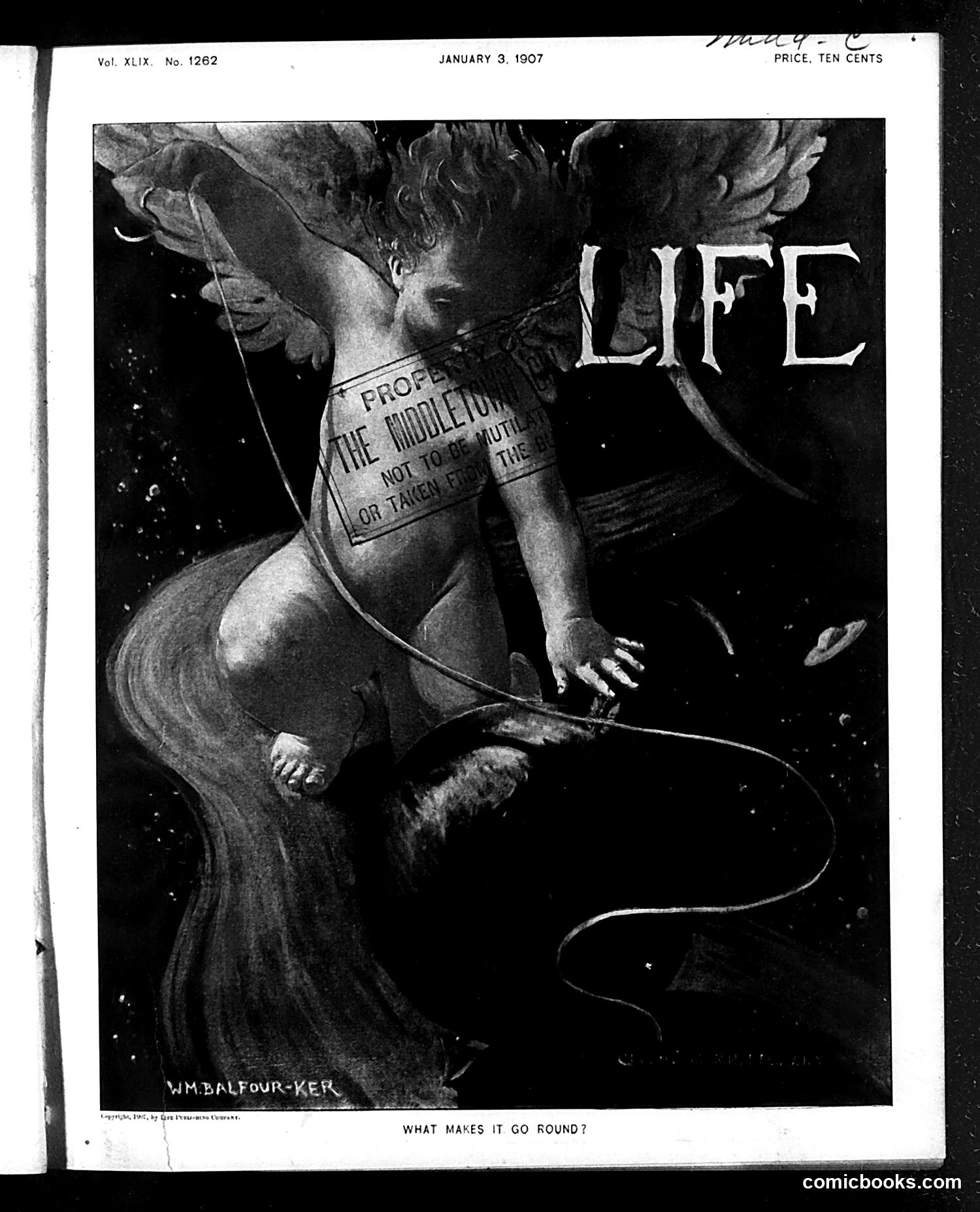
This is a Life magazine cover featuring a classical-style cherub or putto figure holding a whip. The cherub wears a band labeled "PROF. THE MIDDLETON" with text reading "NOT TO BE MUTILATED OR TAKEN FROM THE" (remainder unclear). The caption reads "WHAT MAKES IT GO ROUND?" The satirical point appears to reference a Professor Middleton, likely a public figure or academic of 1907, though the specific context is unclear from the image alone. The whip-wielding cherub suggests themes of control, discipline, or perhaps criticism of the figure's authority or methods. The "round" reference may allude to circular motion, cycles, or continuity in whatever the professor's work or influence represented. The artist is credited as W.M. Balfour-Kek.
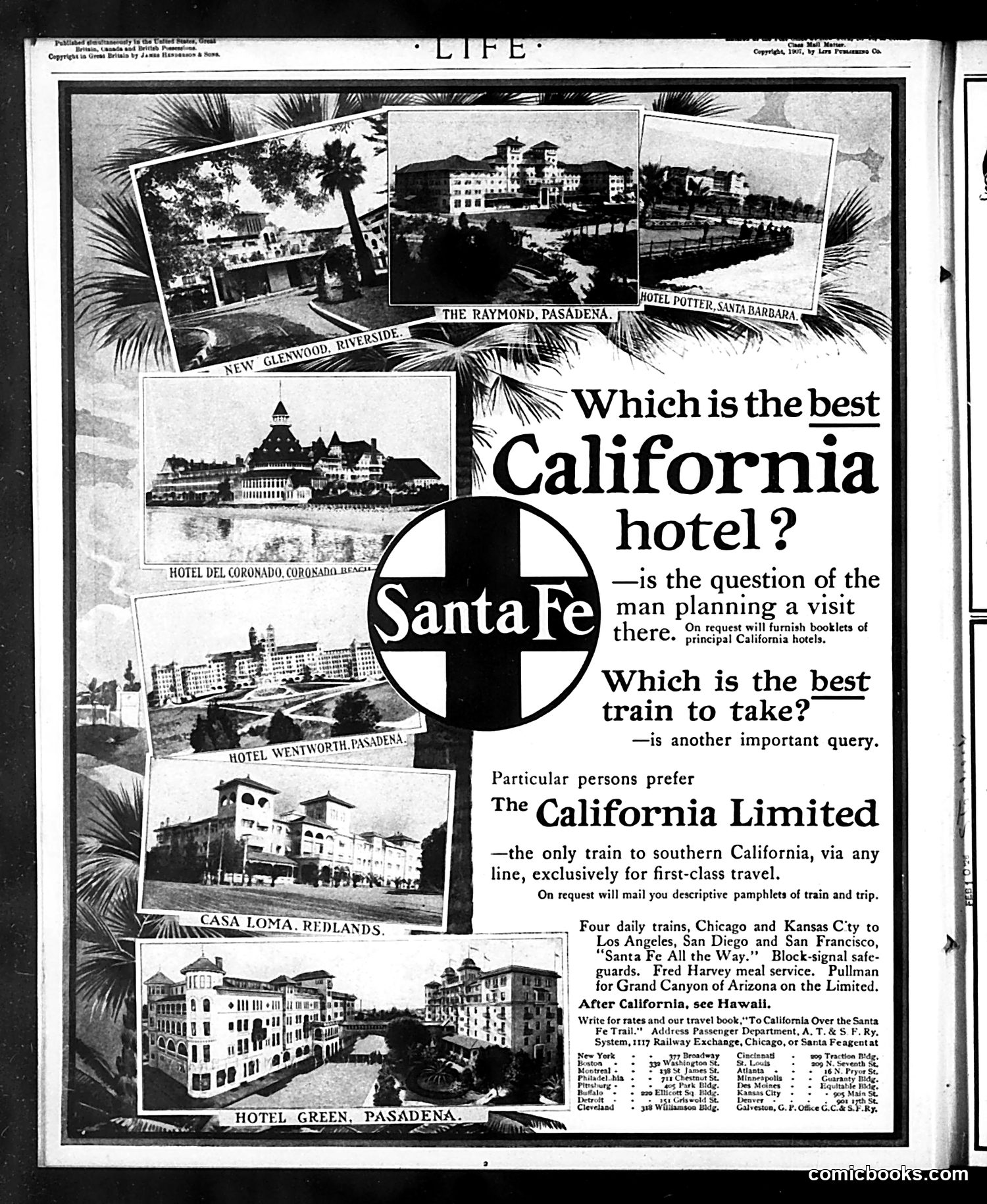
This is primarily **advertising**, not satire or political commentary. It's a Santa Fe Railway advertisement promoting California travel and hotels, published in *Life* magazine. The layout features photographs of seven luxury hotels (Hotel del Coronado, Hotel Green, Hotel Wentworth, Casa Loma, Hotel Raymond, and others) arranged around a Santa Fe Railway cross logo. The ad poses rhetorical questions to prospective travelers: "Which is the best California hotel?" and "Which is the best train to take?" The answer provided is promotional: the **California Limited**, described as the only first-class train to Southern California via the Santa Fe line, with features like block-signal safety-guards and Pullman dining service. This reflects early-20th-century American leisure travel advertising, emphasizing luxury accommodations and rail transportation for wealthy tourists visiting Southern California destinations.
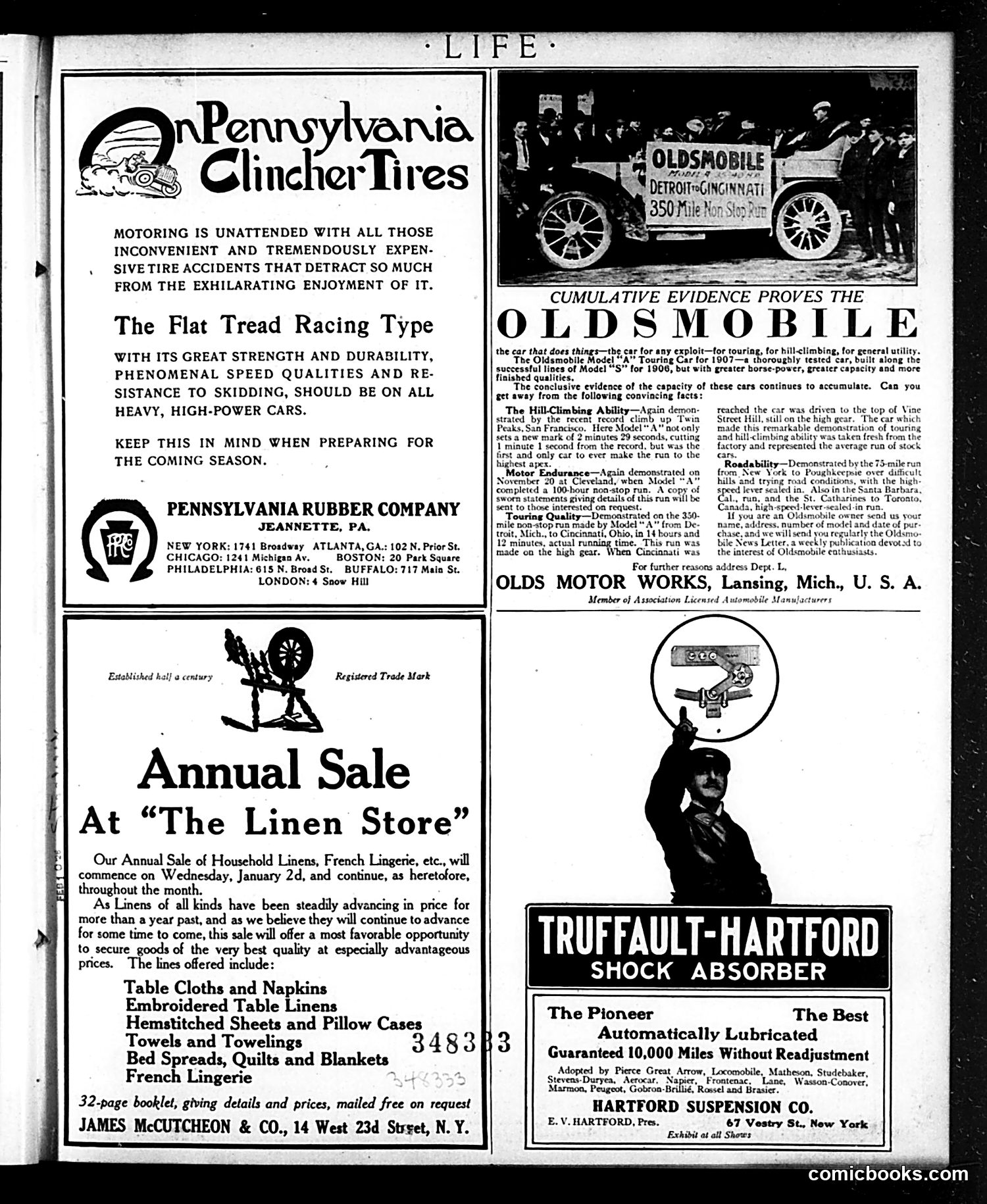
This page is **primarily advertisements** rather than editorial content or satire. The ads promote: 1. **Pennsylvania Clincher Tires** — emphasizing durability and safety for motorists 2. **Oldsmobile** — highlighting a 350-mile non-stop run from Detroit to Cincinnati as proof of reliability 3. **"The Linen Store"** — announcing a January sale on household linens 4. **Truffault-Hartford Shock Absorber** — featuring an illustration of a man holding up the product, marketed as "automatically lubricated" and endorsed by various automobile manufacturers There are **no political cartoons or satirical commentary** visible on this page. The content reflects early 20th-century automobile and consumer product advertising, showcasing the era's emphasis on motorcar reliability and comfort features.
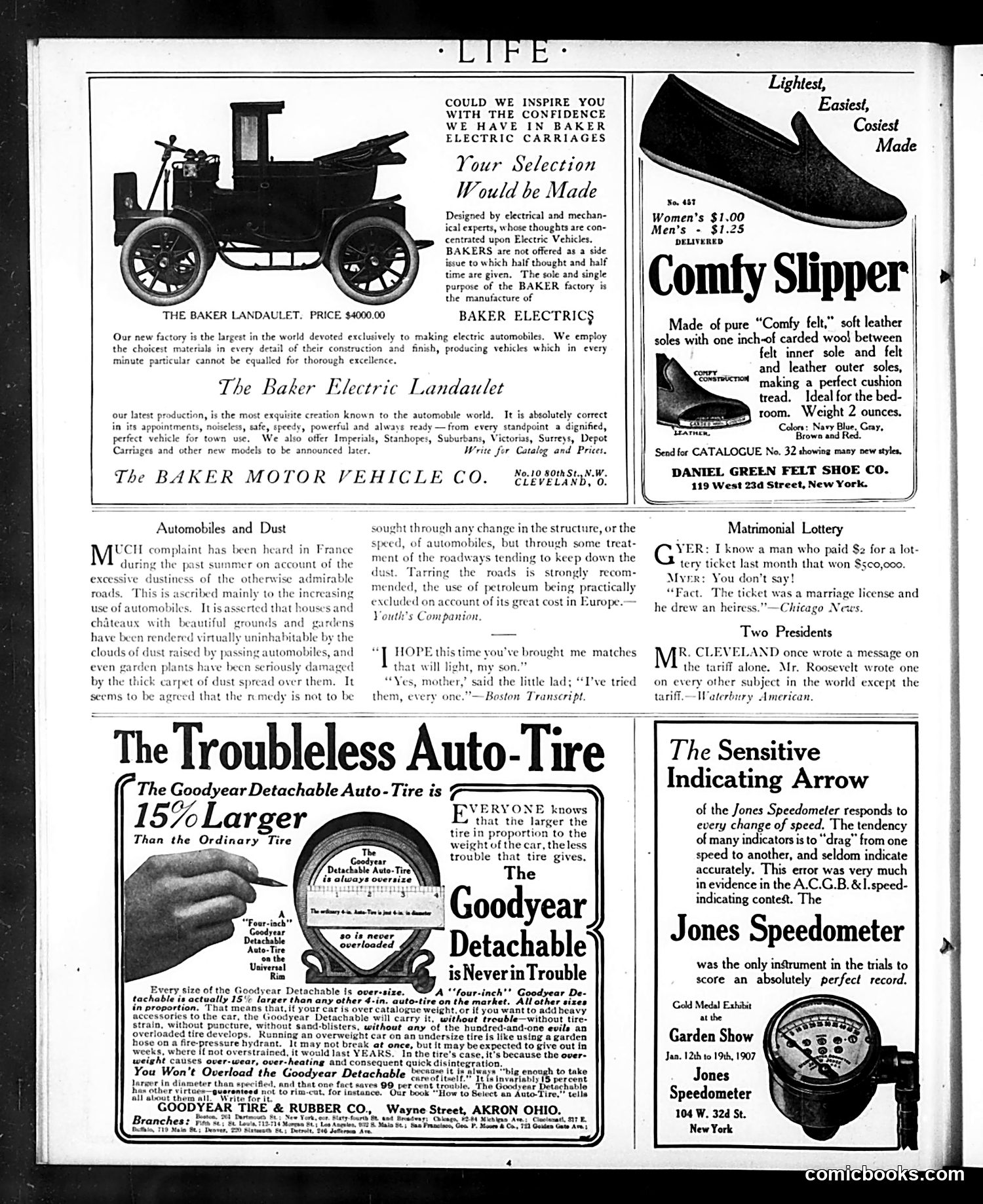
This page is primarily **advertising content**, not political satire. It features ads for: 1. **Baker Electric Carriages** — early electric automobiles marketed as reliable, safe vehicles 2. **Comfy Slipper** — felt and leather house shoes 3. **Goodyear Detachable Auto-Tire** — emphasizing the tire is 15% larger than competitors 4. **Jones Speedometer** — an automobile instrument The only non-advertising content consists of brief humorous anecdotes ("Automobiles and Dust," "Matrimonial Lottery," "Two Presidents," "I Hope This Time") — light social commentary rather than political satire. The page reflects early 1900s consumer culture and nascent automobile industry marketing, with no apparent political cartoons or caricatures present.
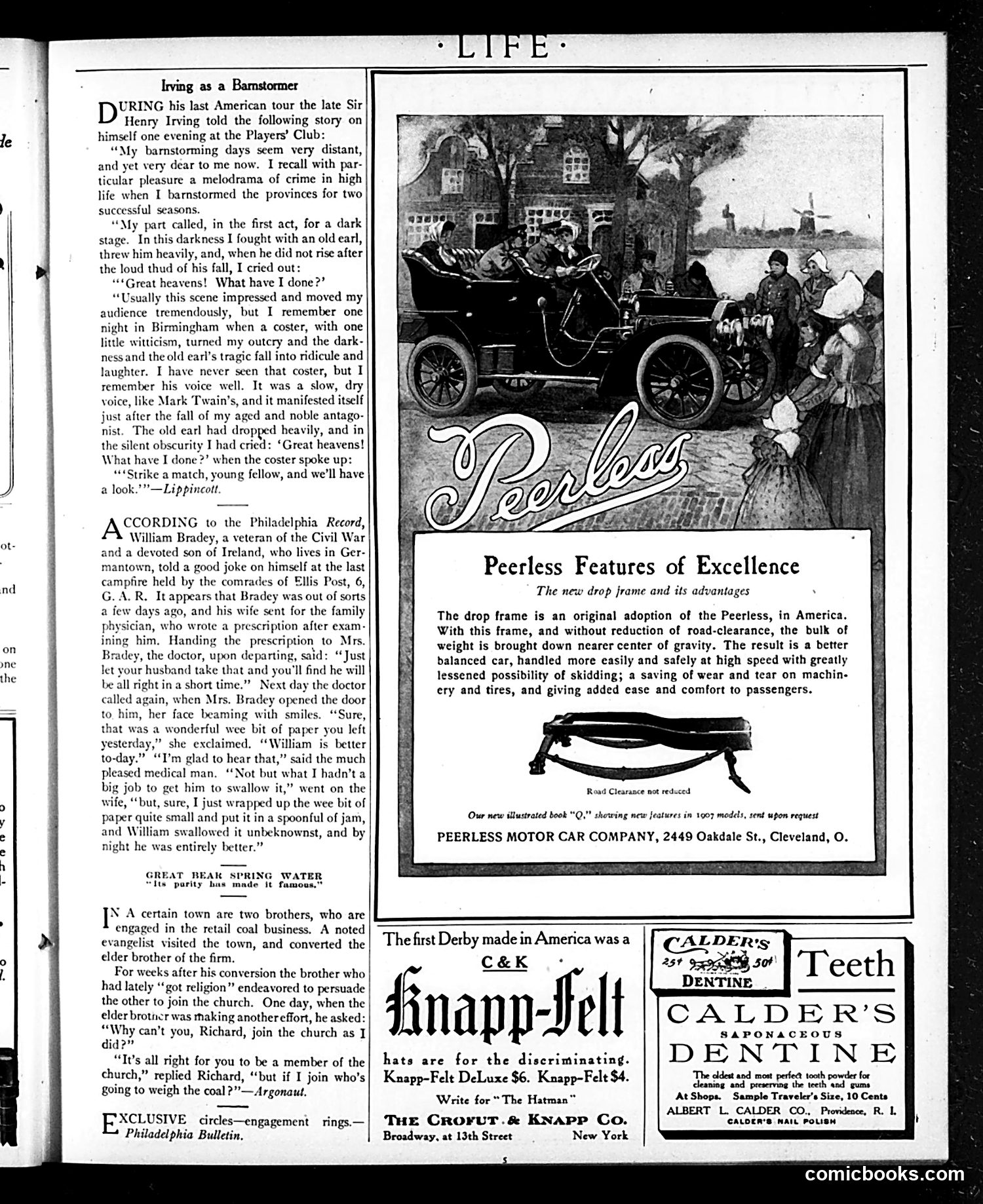
This page is primarily **advertising and anecdotal content** rather than political satire. The main image advertises the **Peerless automobile**, showcasing its "drop frame" design innovation that lowers the car's center of gravity for better balance and safety. The accompanying text explains technical advantages: reduced wear on tires and machinery, improved passenger comfort. The left column contains three unrelated humorous anecdotes: 1. **Sir Henry Irving's barnstorming story**—a theatrical reminiscence about performing Shakespeare and an audience member's unexpected reaction 2. **William Bradey's Civil War joke**—a Civil War veteran's humorous medical encounter 3. **Two brothers in coal retail**—a brief joke about religious conversion The bottom contains advertisements for **Knapp-Felt shoes** and **Calder's tooth dentine**. These are genuine product promotions typical of *Life* magazine's mixed editorial-advertising format from this era.
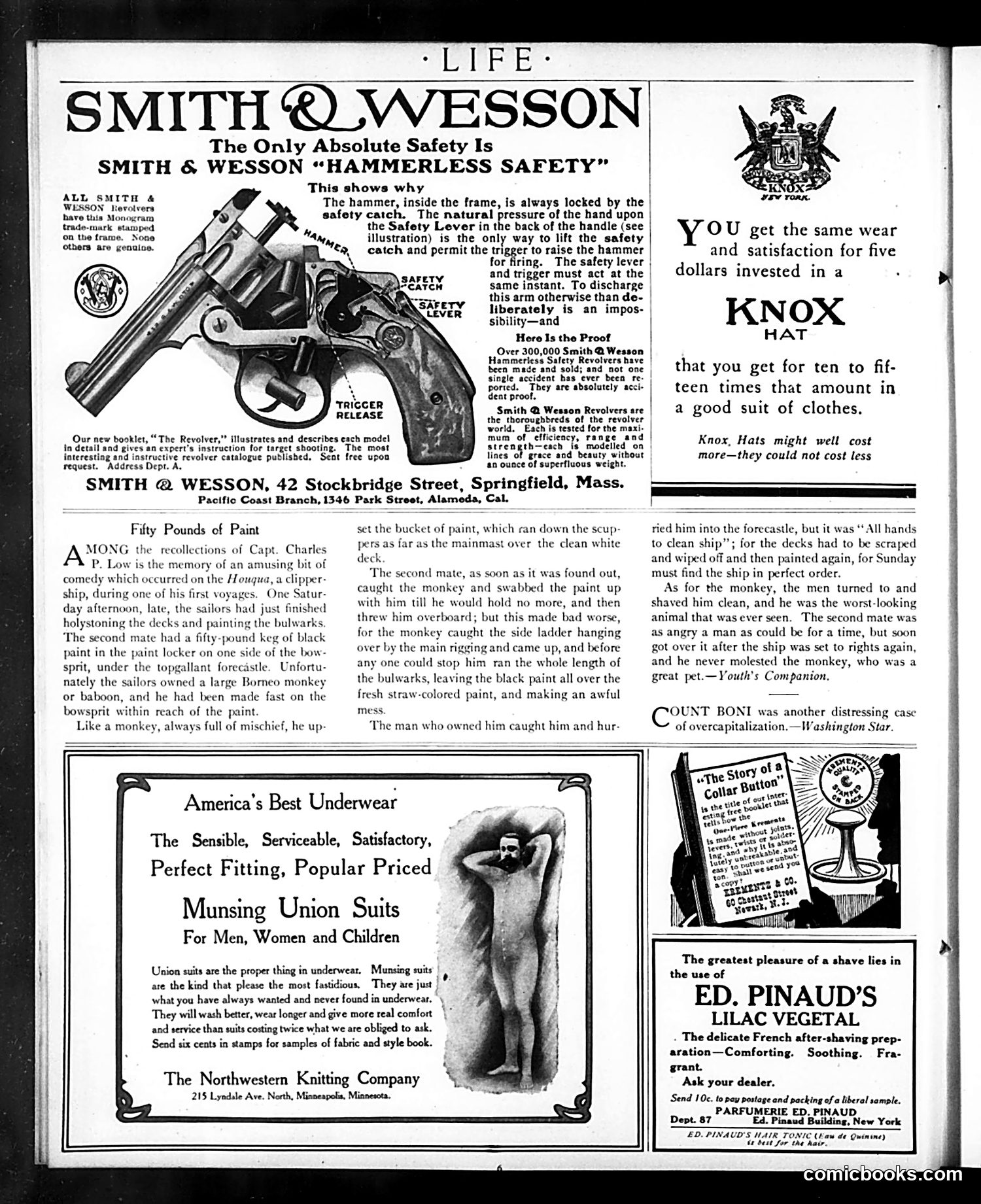
This page is **primarily advertising**, not political satire. The main content features: 1. **Smith & Wesson revolver ad** - emphasizing the "hammerless safety" mechanism that prevents accidental discharge. The detailed diagram explains the safety lever mechanism. 2. **Knox Hat advertisement** - claiming equal quality to more expensive alternatives. 3. **"Fifty Pounds of Paint" story** - a humorous anecdote about a ship's monkey accidentally causing chaos by getting into paint supplies during a voyage. This is light entertainment rather than satire. 4. **Additional ads** - for Munsing Union Suits (underwear) and Ed. Pinaud's Lilac Vegetal (after-shave). The page reflects early 20th-century consumer advertising and product safety marketing rather than political commentary. The monkey story serves as filler entertainment between advertisements.
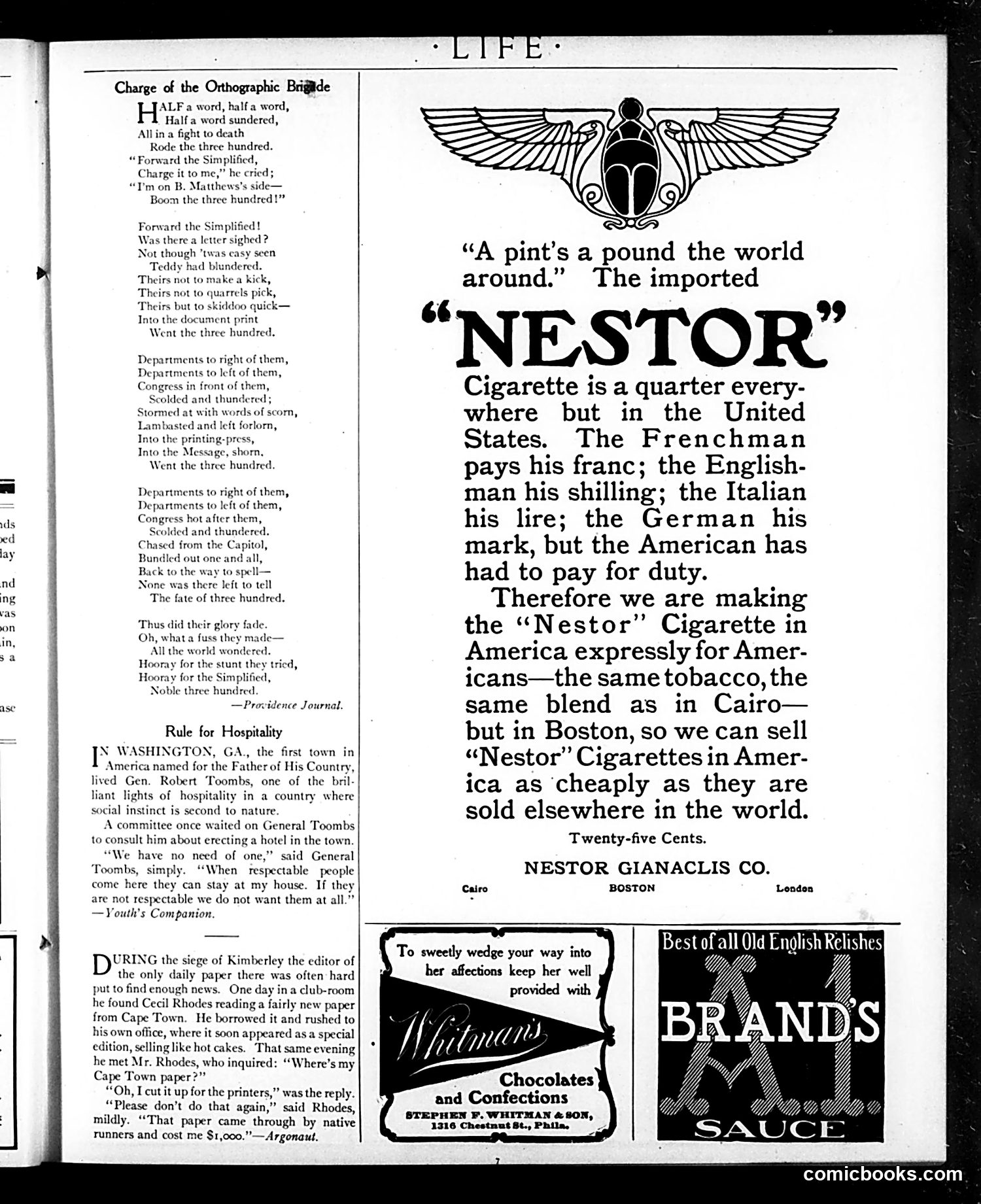
This Life magazine page contains primarily **advertisements** rather than satirical cartoons. The dominant ad promotes **"Nestor" cigarettes**, claiming they're made in America using imported tobacco from Cairo at the same blend as foreign competitors, but cheaper (25 cents). The ad emphasizes patriotic pricing—Americans previously paid duty taxes that foreigners avoided. Below are smaller ads for **Whitman's Chocolates** and **Brand's Sauce**. The left side contains a poem titled "Charge of the Orthographic Brigade" (likely a humorous take on Tennyson's "Charge of the Light Brigade") and an anecdote titled "Rule for Hospitality" about General Toombs of Georgia. The page reflects early 20th-century commercial publishing, mixing literary content with advertising rather than political satire.
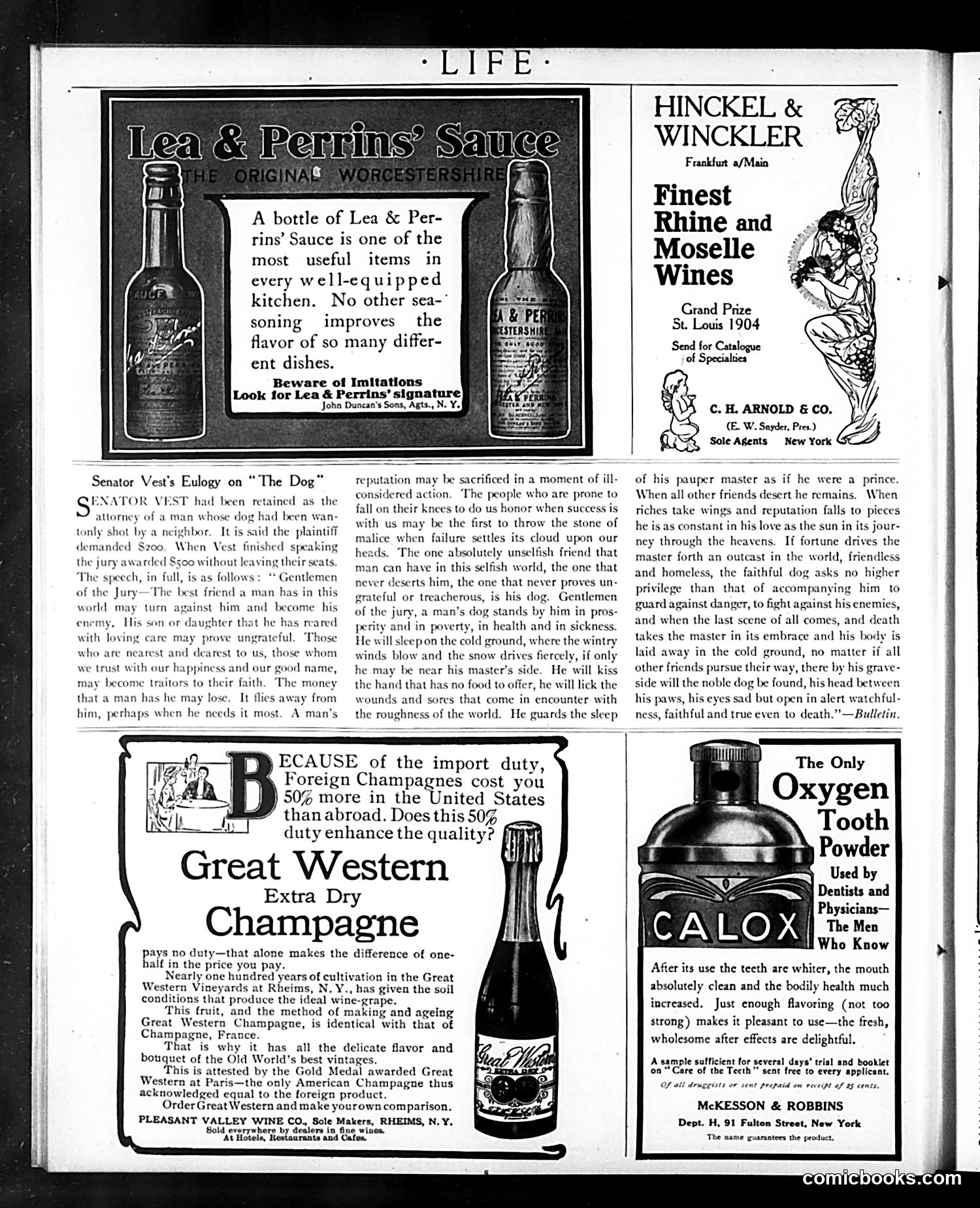
This page is primarily **advertising**, not satirical content. It contains four product advertisements: 1. **Lea & Perrins' Sauce** — promotes their Worcestershire sauce as essential for kitchens 2. **Hinckel & Winckler** — advertises Rhine and Moselle wines, won a Grand Prize at St. Louis 1904 3. **Great Western Champagne** — argues that American champagne from New York vineyards is equal to French imports, despite 50% import duty 4. **Calox Tooth Powder** — claims to be "the only oxygen tooth powder" used by dentists and physicians The only editorial content is "Senator Vest's Eulogy on 'The Dog'" — a prose piece praising dogs' loyalty and faithfulness, appearing to be a famous speech. No political satire or caricature is present on this page.
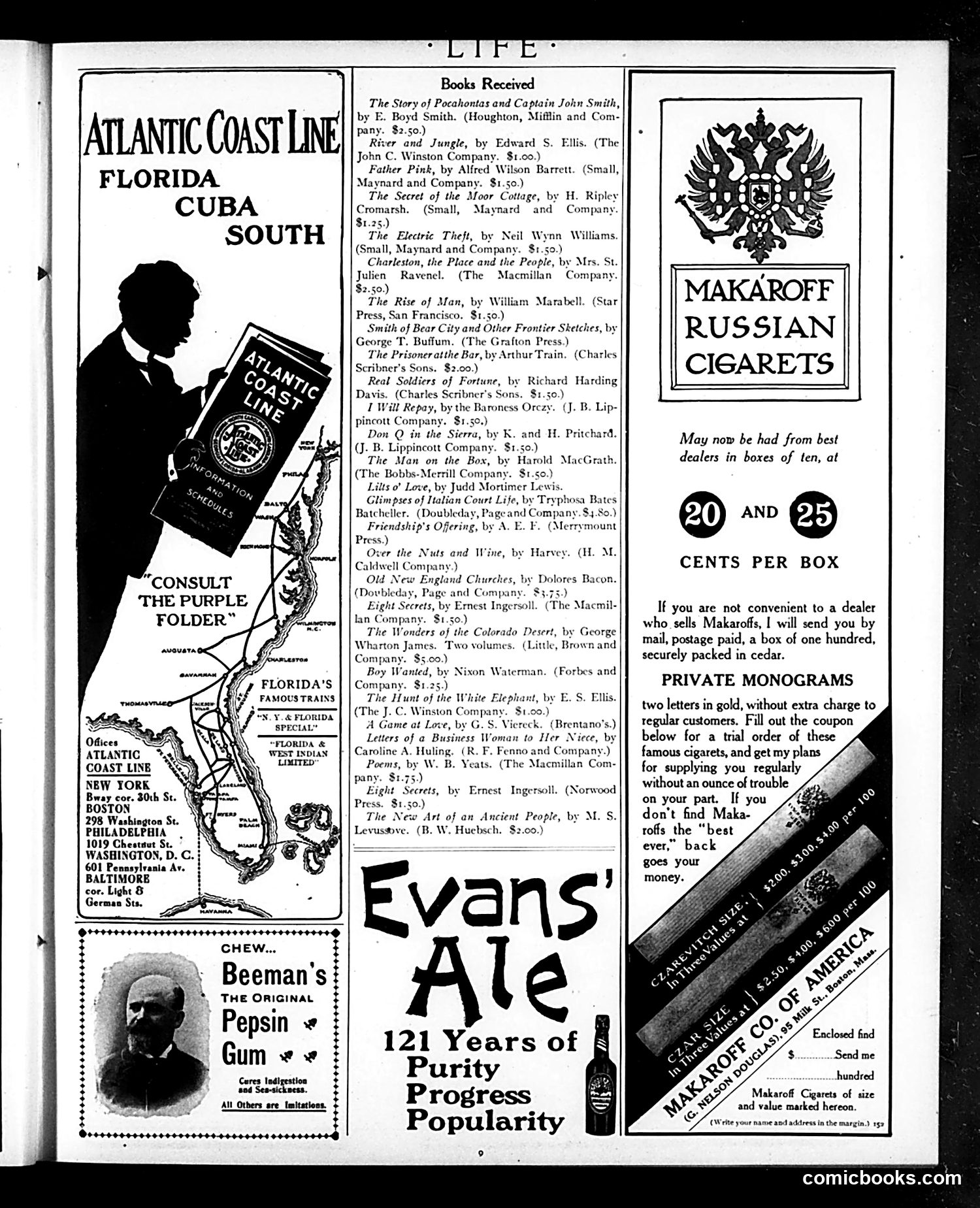
This page is primarily **advertising**, not editorial content or satire. The dominant advertisements are: 1. **Atlantic Coast Line Railroad** (left): Promotes train service to Florida, Cuba, and the South, featuring a silhouette of a man consulting "the purple folder" of travel information. 2. **Makaroff Russian Cigarettes** (right): Advertises imported cigarettes at 20-25 cents per box, with an offer of private monograms and a money-back guarantee. 3. **Evans' Ale** (center-bottom): Claims "121 Years of Purity Progress Popularity." 4. **Beeman's Pepsin Gum** (lower left): Advertises chewing gum with a portrait photograph. The page also includes a "Books Received" section listing recent publications. There is **no political cartoon or satirical content** to interpret—this is a straightforward advertising and book review page from the magazine.
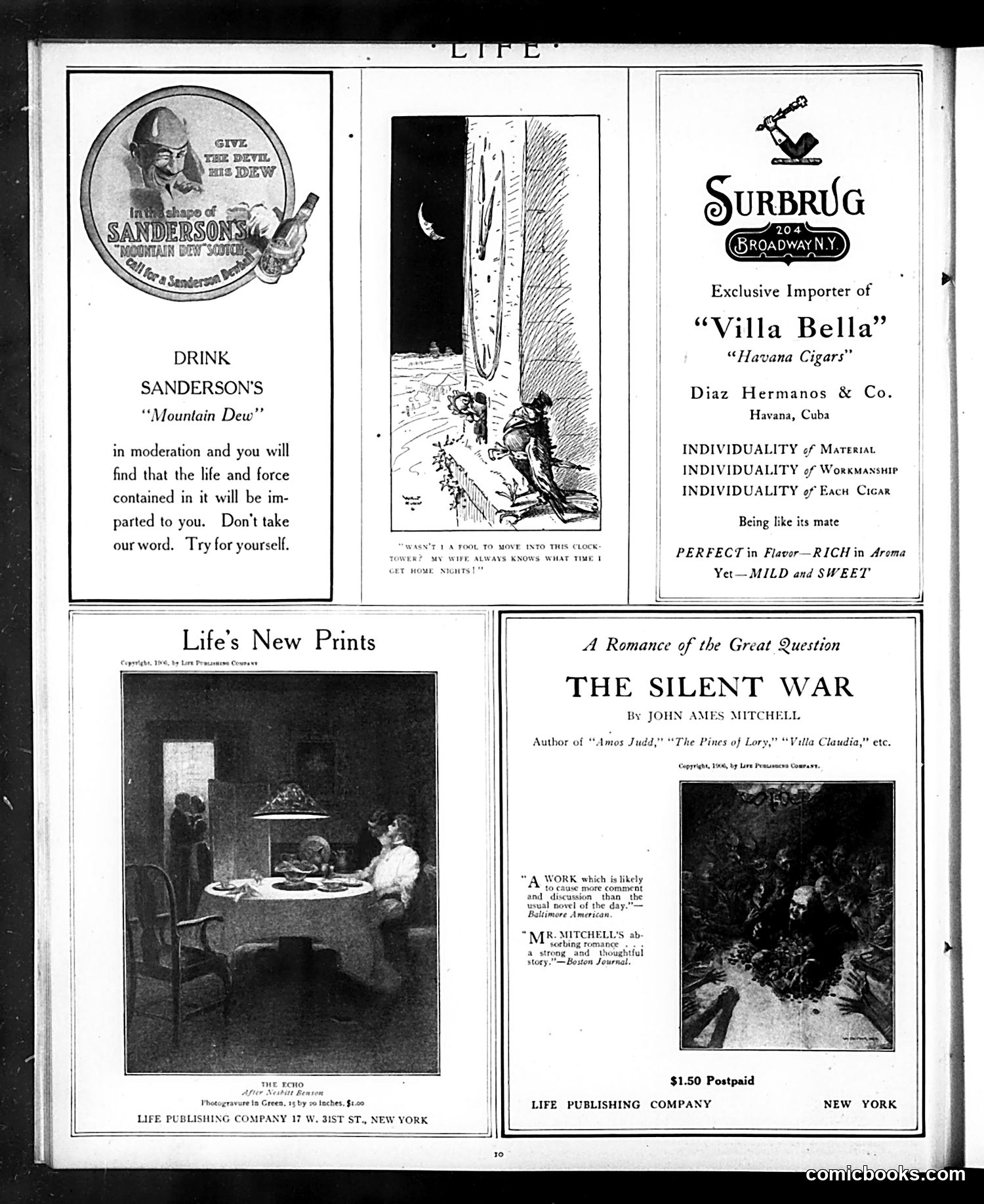
This page is primarily **advertising and literary promotion** from Life magazine, circa 1906. The top section contains three ads: Sanderson's "Mountain Dew" beverage, Surbrug cigars from Cuba, and a satirical cartoon (center) about a man trying to sneak into his house late—likely mocking infidelity or drunkenness based on the caption about his wife knowing "what time I get home nights." Below are two larger sections: "Life's New Prints" features an artistic photograph titled "The Echo," and a book advertisement for John Ames Mitchell's romance novel *The Silent War* ($1.50 postpaid). The page functions as a **commercial vehicle mixing entertainment, luxury goods, and literature**—typical of Life's business model during this period. The one cartoon is incidental to the advertising content.
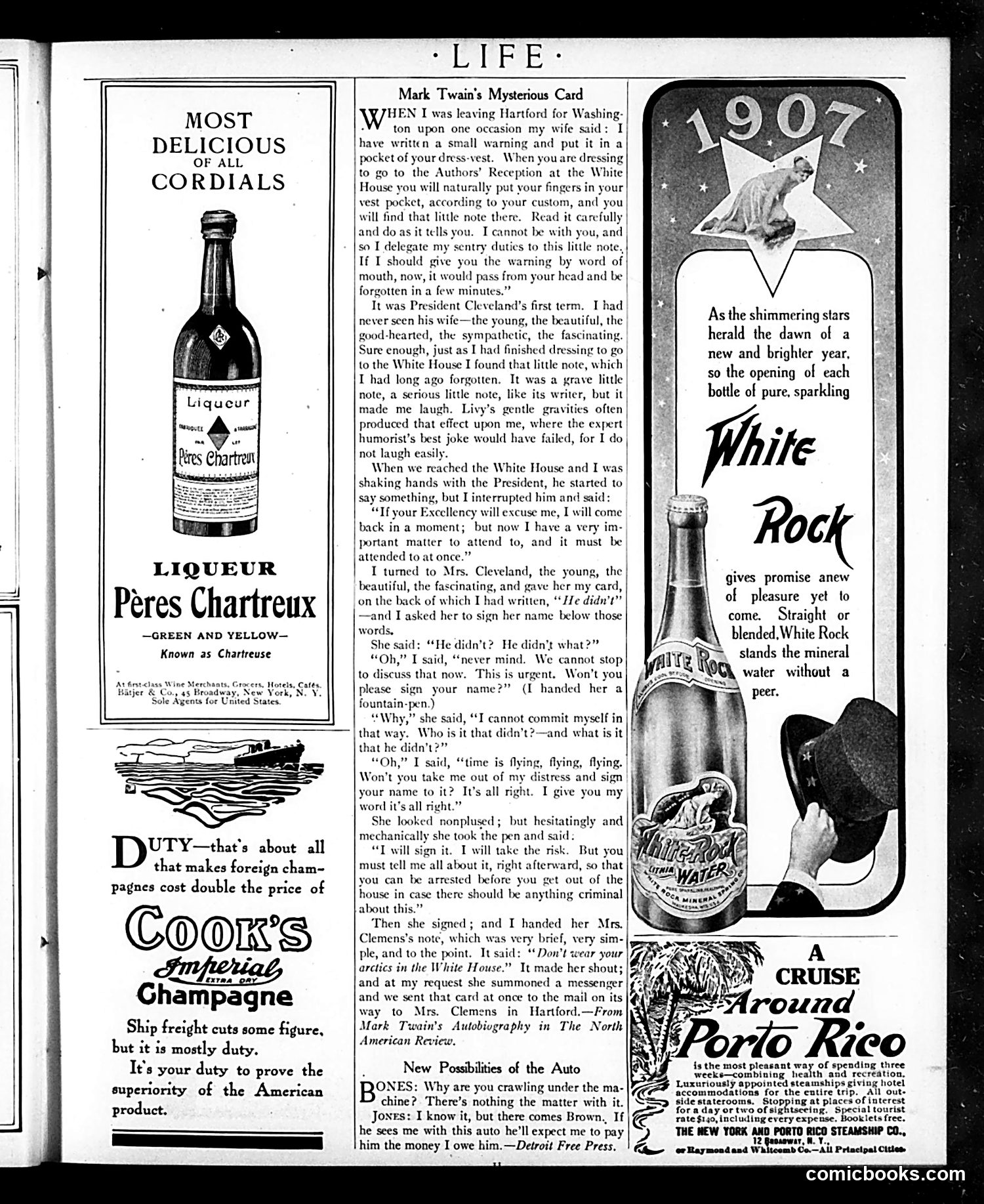
This page is primarily **advertising**, not political satire. It contains three product advertisements: 1. **Pères Chartreux Liqueur** — a cordial marketed as "Most Delicious of All Cordials" 2. **White Rock** mineral water — positioned as a premium beverage 3. **A Cruise Around Porto Rico** — a travel advertisement The only editorial content is Mark Twain's essay "Mark Twain's Mysterious Card," recounting an anecdote from President Cleveland's first term about a written warning Twain's wife prepared for him before a White House reception. The story illustrates domestic humor rather than political commentary. The page demonstrates Life's dual nature as a satirical magazine that also relied heavily on advertising revenue to sustain operations.
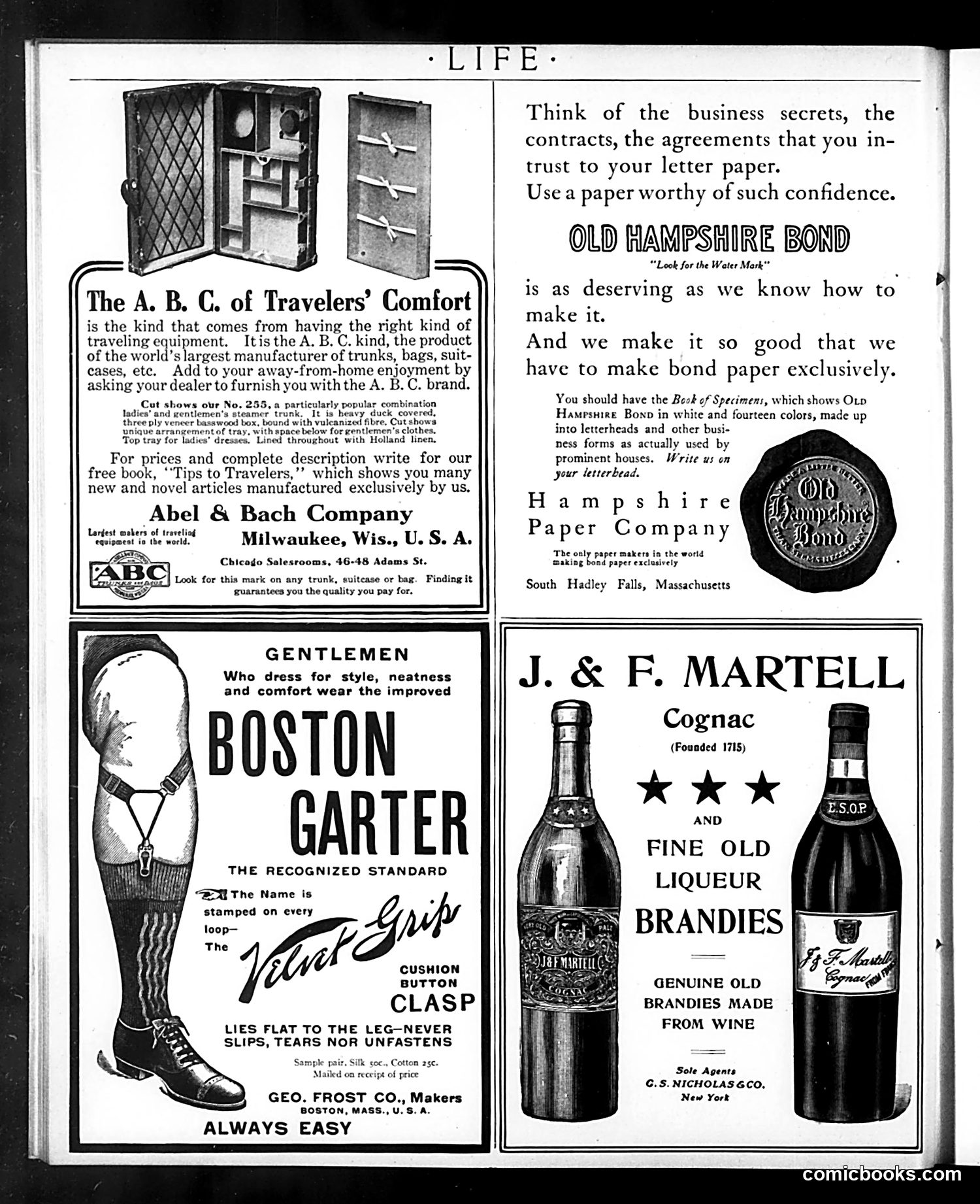
This page is primarily **advertising**, not satire or political commentary. It contains four distinct ads: 1. **Abel & Bach Company** (top left): Travel cases and trunks 2. **Old Hampshire Bond** (top right): High-quality letterhead paper, emphasizing trustworthiness for business correspondence 3. **Boston Garter** (bottom left): Men's garters with a leg illustration, claiming comfort and reliability 4. **J. & F. Martell** (bottom right): Cognac and brandy bottles The ads reflect early 20th-century consumer goods aimed at well-to-do travelers and gentlemen. There is no discernible cartoon, satire, or political commentary on this page—it is a straightforward commercial advertisement spread from *Life* magazine.
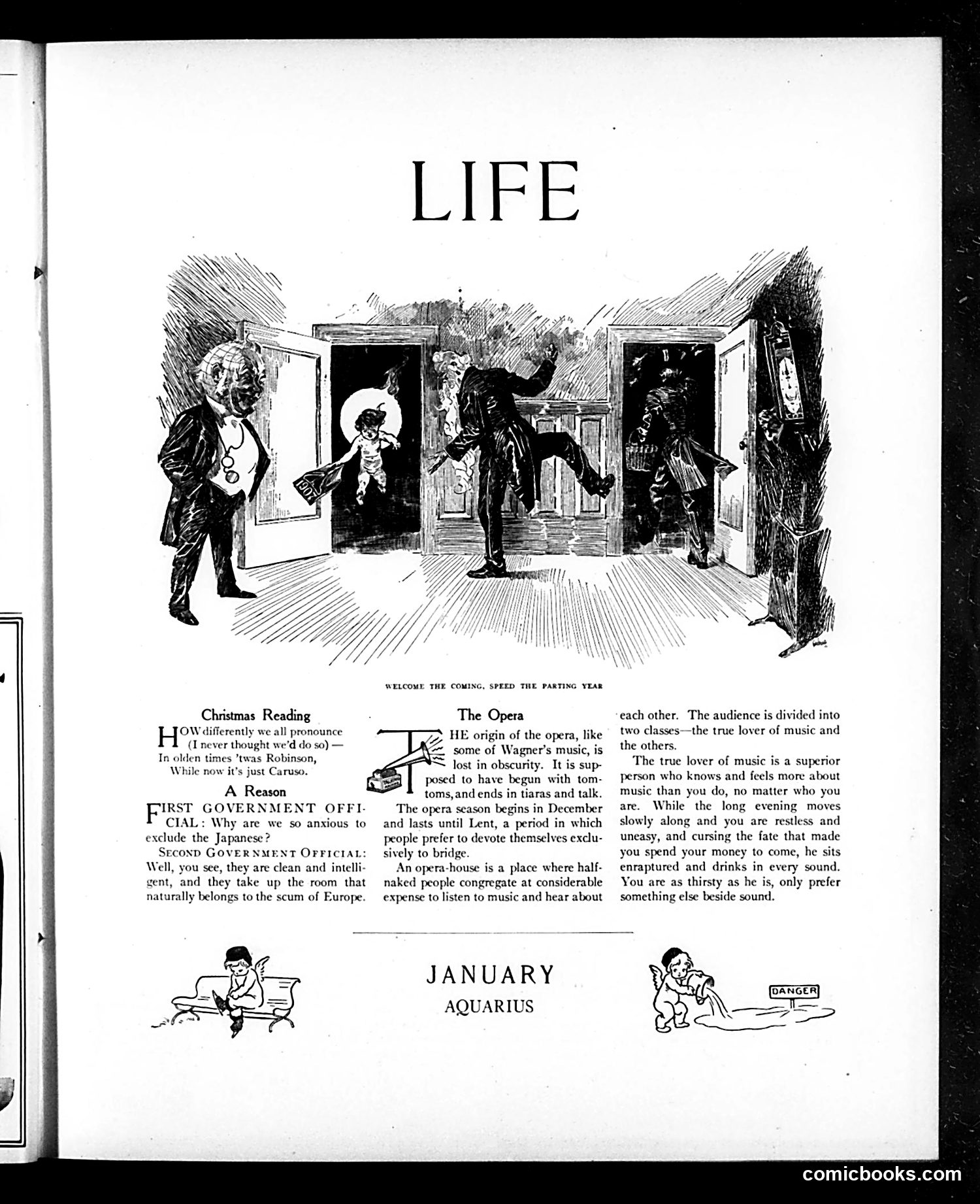
This page contains two satirical dialogues mocking period attitudes. **"Christmas Reading"** jokes about inconsistent pronouncements on foreign policy—likely referencing debates over Japanese exclusion or immigration policy. The exchange between a "First Government Official" and "Second Government Official" satirizes how politicians justify xenophobic positions by claiming Japanese people are "clean and intelligent" yet still belong "to the scum of Europe"—highlighting the logical contradictions in racist arguments. **"The Opera"** mocks class divisions among opera patrons, dividing the audience into "true lovers of music" (wealthy, refined) versus ordinary people who attend mainly for social status and distraction. The satire critiques pretentious musical culture and class snobbery. Both reflect early-20th-century American social commentary on nationalism, immigration attitudes, and class distinction.
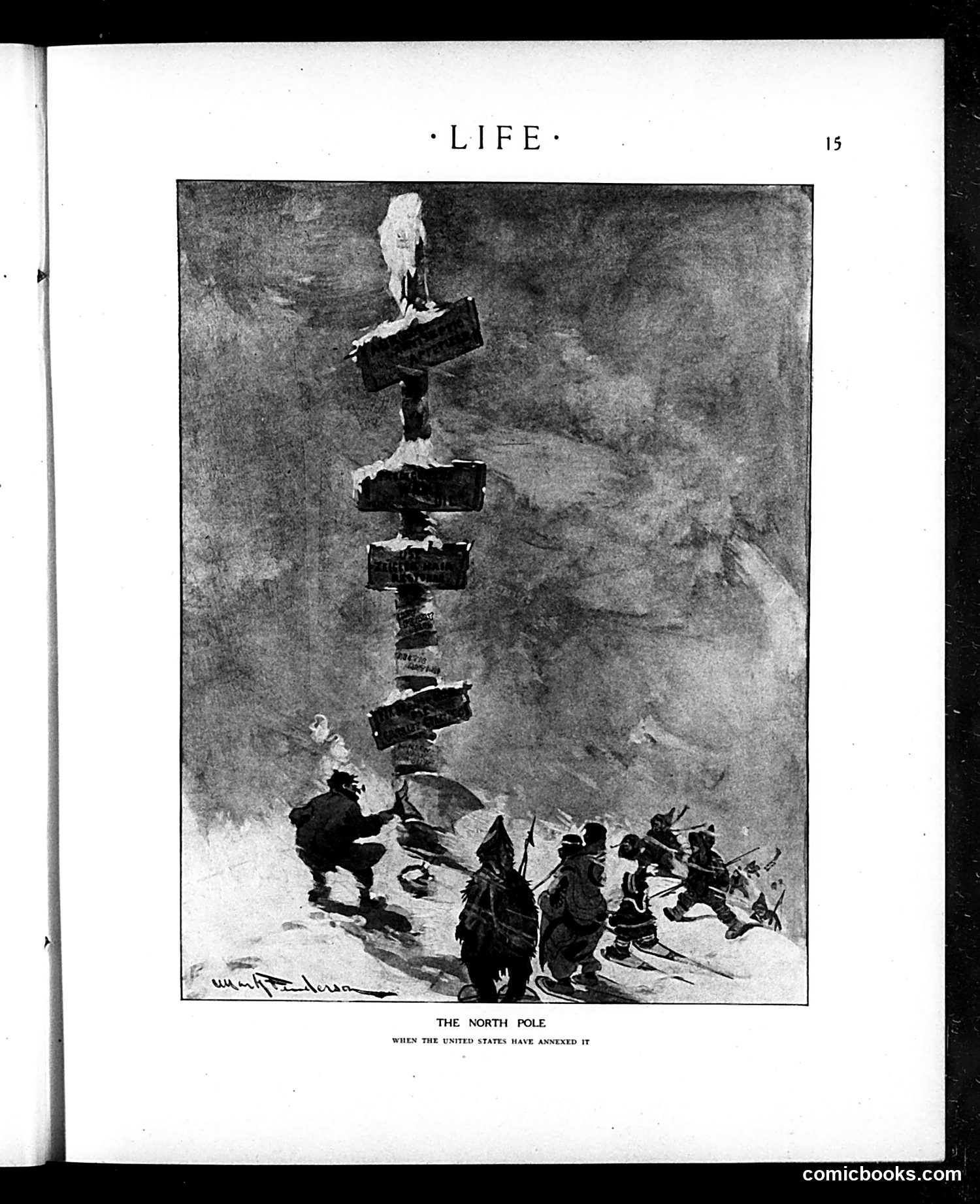
This political cartoon satirizes American territorial expansion. It depicts figures planting the U.S. flag atop a tall pole labeled "THE NORTH POLE," with additional flags stacked vertically below, suggesting the accumulation of annexed territories. The cartoon mocks the U.S. government's imperialist ambitions by imagining an absurd scenario: annexing the geographically impossible North Pole itself. The stacked flags likely reference America's actual territorial acquisitions (possibly Hawaii, Philippines, or other overseas possessions). The figures below appear to struggle with the effort, suggesting the difficulty and strain of expansionist policies. The satire critiques American imperialism as overambitious and ridiculous, extending even to claiming uninhabitable regions—a commentary on turn-of-the-century U.S. expansionist ideology.
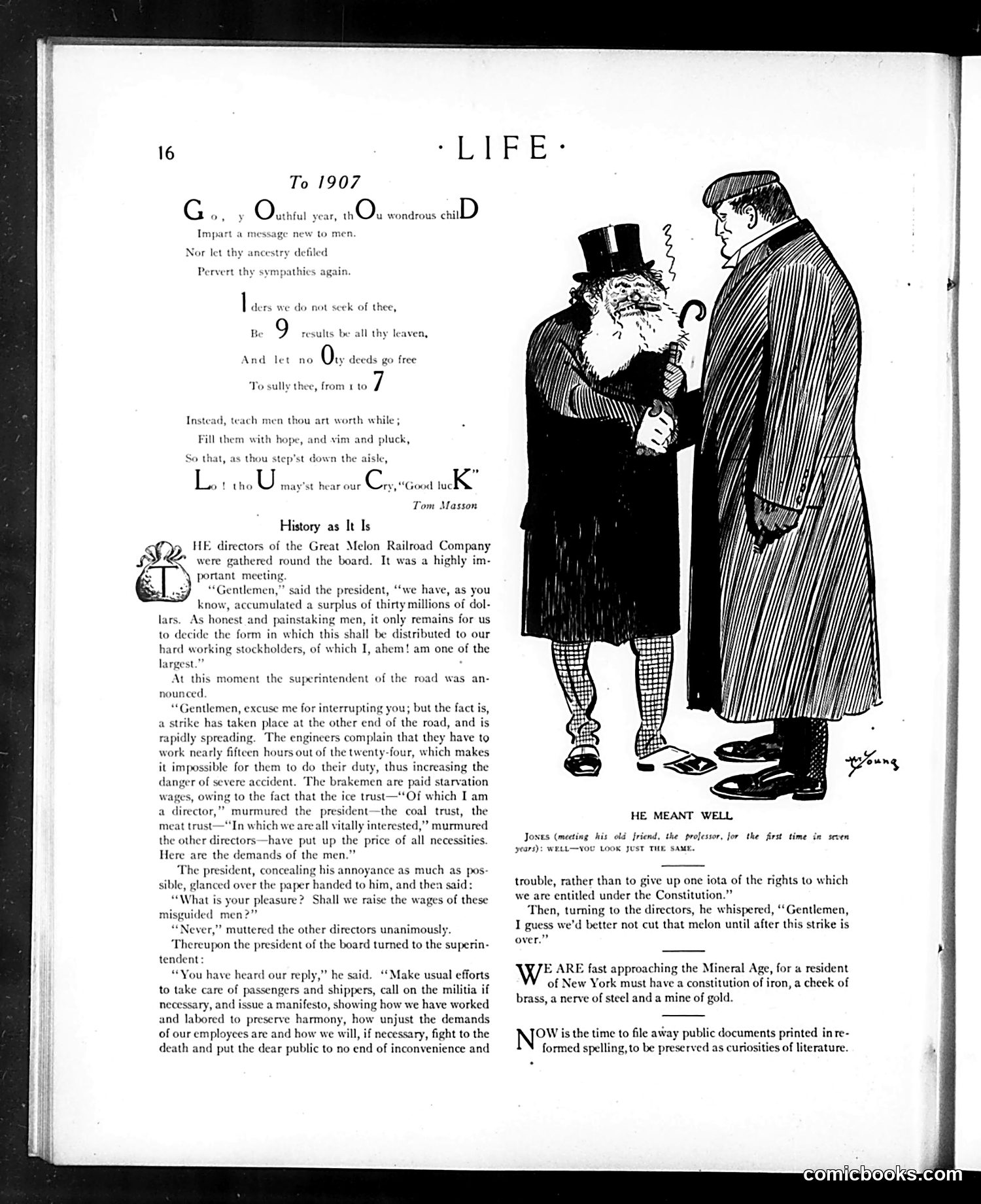
This page satirizes corporate greed and labor exploitation during the Progressive Era. The main story, "History as It Is," mocks railroad directors who accumulate massive profits while ruthlessly rejecting workers' demands for higher wages and reasonable hours. The satire's target: corporate executives claim they cannot afford wage increases because trusts (monopolies controlling ice, coal, meat) have inflated costs—yet these same directors *are* trustees of those very trusts, profiting from the price-fixing that starves workers. The superintendent reports engineers work 15-hour days in dangerous conditions; brakemen earn starvation wages. The directors unanimously refuse any concession, planning instead propaganda and militia force. The cartoon's humor is bitter: the president decides to delay dividing the $30 million surplus "melon" until after crushing the strike—revealing their true priority is profit concentration, not "honest" stewardship. The page also contains brief commentary on New York's harsh conditions and reformed spelling in documents—typical Life magazine satirical notes.
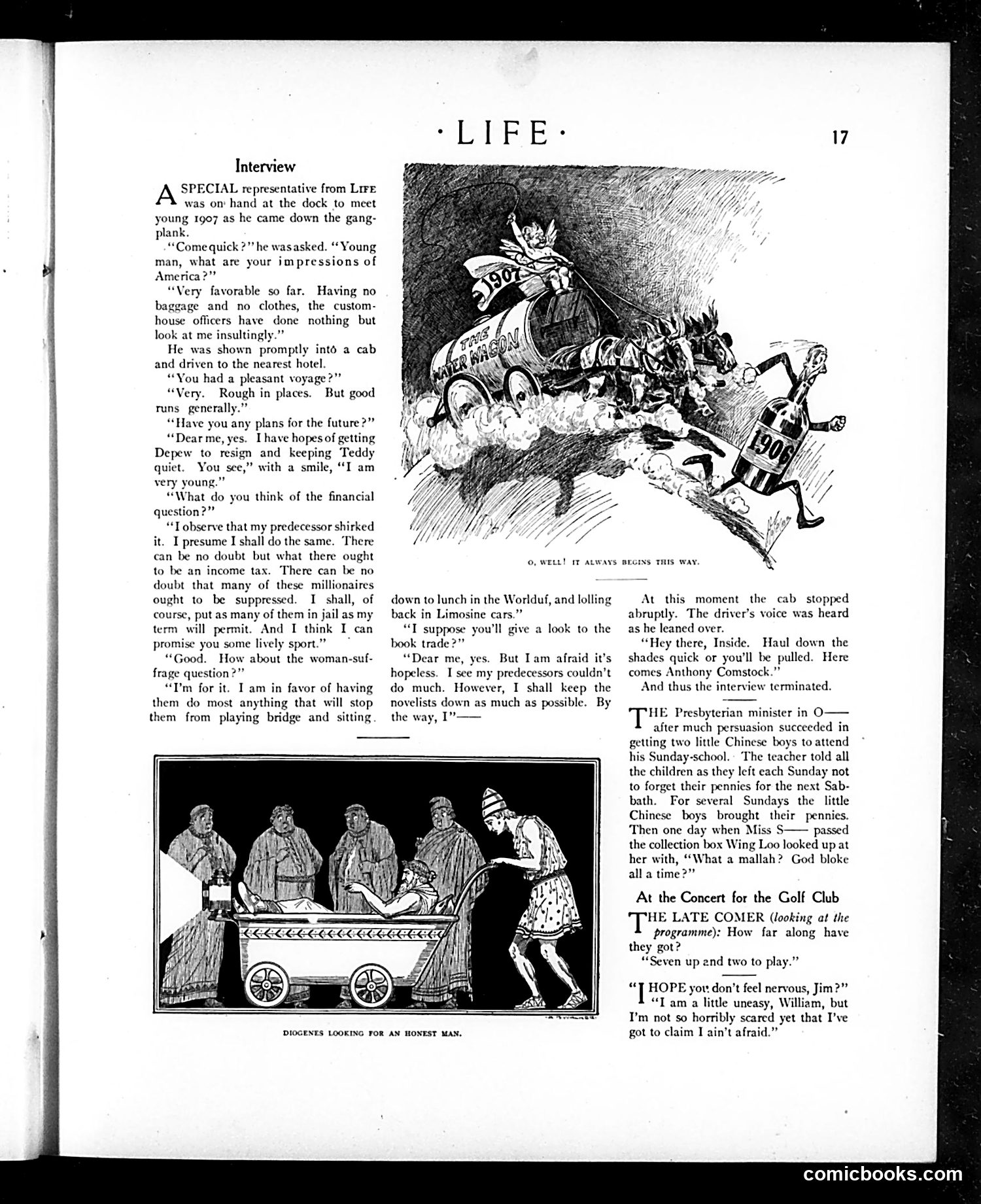
This satirical page mocks the incoming year 1907 through a fictional interview. The "young man" representing 1907 arrives at America's dock with nothing, yet confidently claims he'll accomplish what his predecessors couldn't—including getting Vice President Depew to resign and restraining President Theodore Roosevelt ("keeping Teddy quiet"). The humor lies in his absurd promises: suppressing millionaires, implementing income tax, and silencing novelists. On women's suffrage, he supports it cynically—only to stop women from leisure activities like bridge and limousine rides. The cartoon ends abruptly when Anthony Comstock—the real historical anti-vice crusader famous for aggressive censorship—appears outside the cab, forcing the interview to terminate. This is the punchline: even fictional 1907 fears Comstock's moral policing. The lower cartoons are unrelated anecdotes about Chinese children and golfers—typical magazine filler.
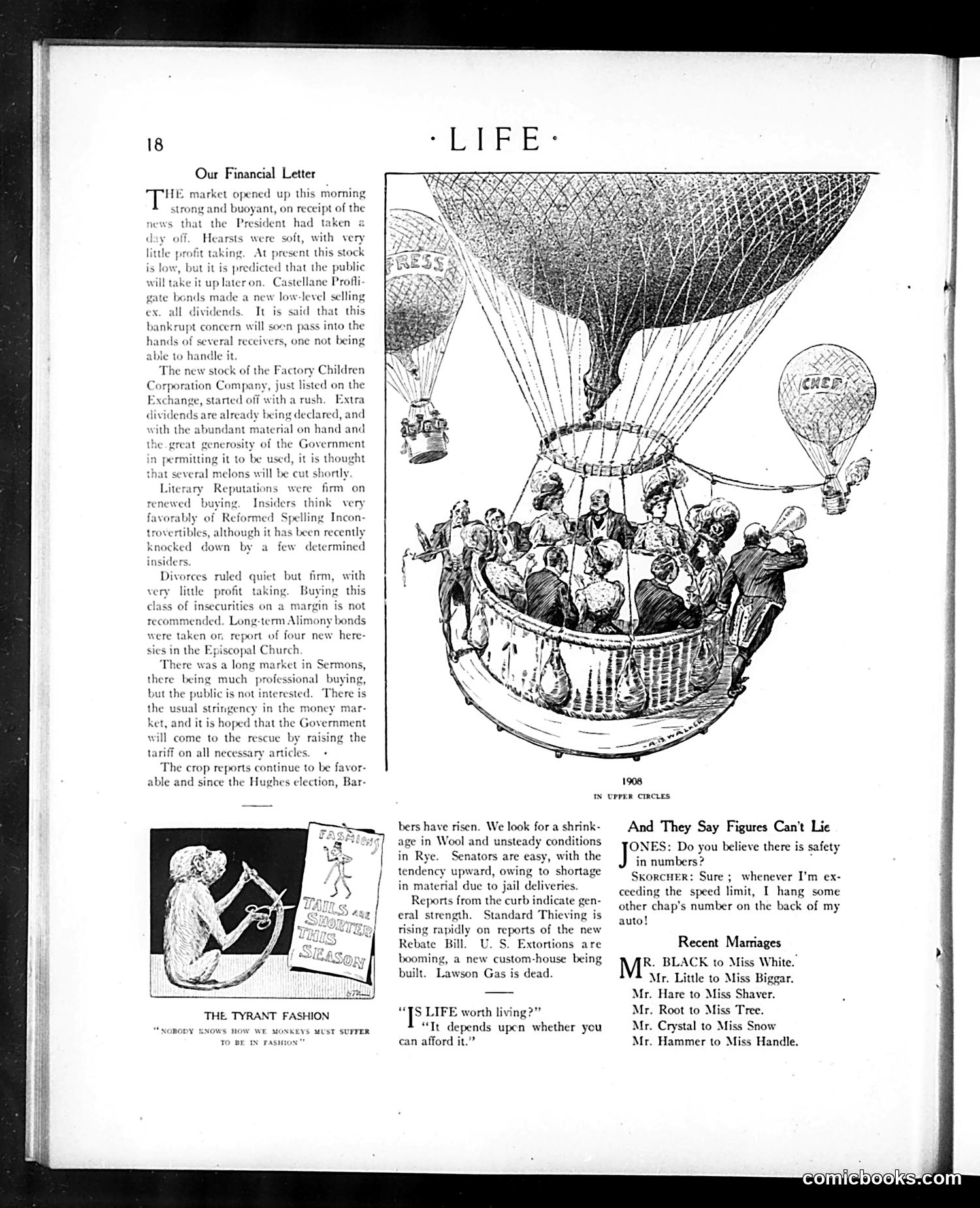
This page from *Life* magazine presents financial and social satire targeting early 20th-century American society. **"Our Financial Letter"** mocks stock market speculation and corporate malfeasance through fake investment advice. References like "Castellane Profligate bonds," "Factory Children Corporation," and "Standard Thieving" satirize actual market manipulation, child labor exploitation, and corporate corruption. The joke names ("Reformed Spelling Incon-trovertibles," "Lawson Gas") ridicule contemporary business figures and fads. **"The Tyrant Fashion"** cartoon depicts a monkey fashionably dressed, captioned with self-aware mockery: "Nobody knows how we monkeys must suffer to be in fashion." This satirizes women's restrictive fashion and the absurdity of following trends blindly. **"And They Say Figures Can't Lie"** presents wordplay humor about traffic safety—the joke relies on someone attaching another driver's license plate to avoid speeding tickets, mocking traffic enforcement. The **marriages section** uses intentionally absurd name-pairings (Black/White, Root/Tree, Hammer/Handle) as satirical filler, likely mocking society pages. Overall, the page satirizes corporate corruption, fashion excess, traffic lawlessness, and media conventions of the era.
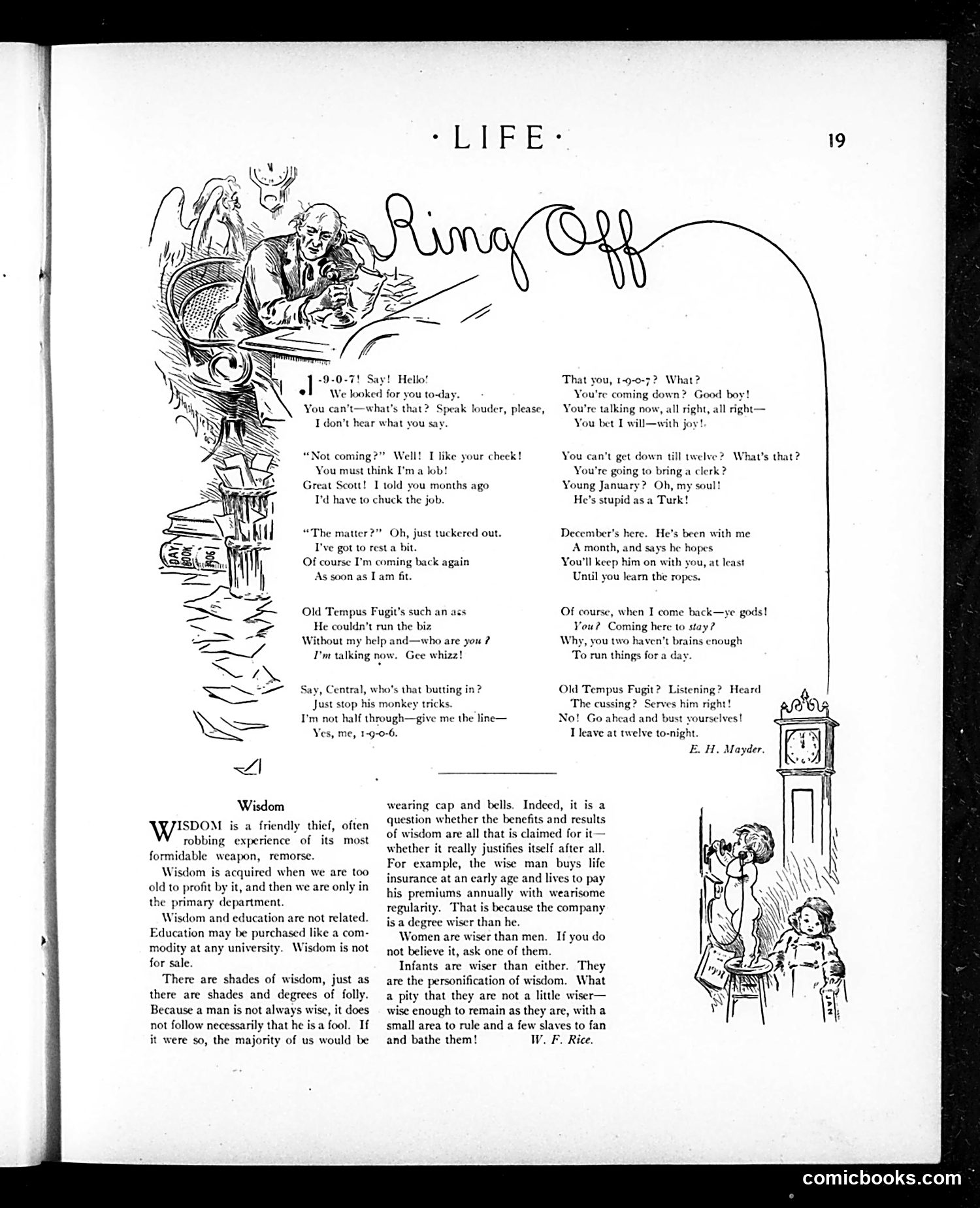
This is a humorous dialogue cartoon satirizing early 1900s telephone etiquette and workplace dynamics. The speaker (likely representing the year 1906, based on "1-9-0-6") is arguing with someone called "1-9-0-7" (presumably 1907) about staffing and job responsibilities. The joke centers on a departing employee ("Old Tempus Fugit"—Latin for "time flies") who's abandoning his job, leaving incompetent replacements (December and Young January, personified months) to manage the business. The incoming year 1907 complains these replacements lack basic competence ("haven't brains enough to run things for a day"). The satire mocks both: workplace chaos caused by poor succession planning, and the absurdity of 1906 anthropomorphically handing off to 1907—a New Year's greeting disguised as office complaint. The "Wisdom" essay below offers philosophical commentary on foolishness and competence, complementing the cartoon's theme.
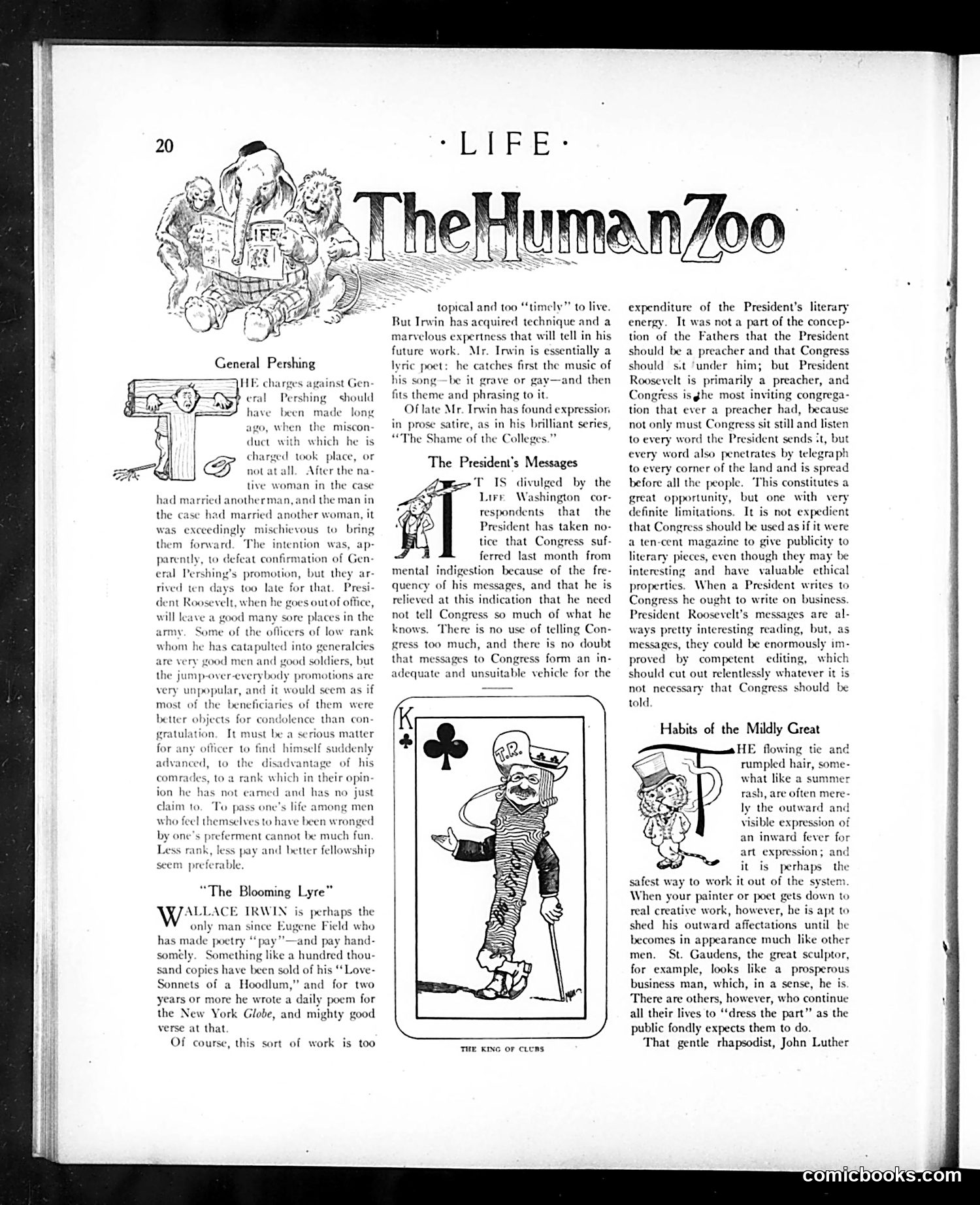
This page critiques **General John J. Pershing** and President **Theodore Roosevelt**. The **Pershing section** attacks the timing of misconduct charges against him—allegations involving a "native woman" that surfaced only after everyone involved had remarried. Life argues these charges should have been raised immediately or not at all, suggesting they were politically motivated to block his promotion (though they arrived too late). The piece also criticizes Roosevelt for making unpopular rapid promotions that anger senior officers who feel passed over. The **"King of Clubs" playing card illustration** appears to reference these military promotion controversies, though the exact connection isn't entirely clear. The **President's Messages section** satirizes Roosevelt's excessive written communications to Congress. Life argues that while Roosevelt's messages are "interesting reading," they abuse Congress's captive audience—messages penetrate nationwide via telegraph, turning legislative correspondence into personal publicity for the President's literary talents. Congress, Life suggests, should receive only necessary business communications, not presidential essays.
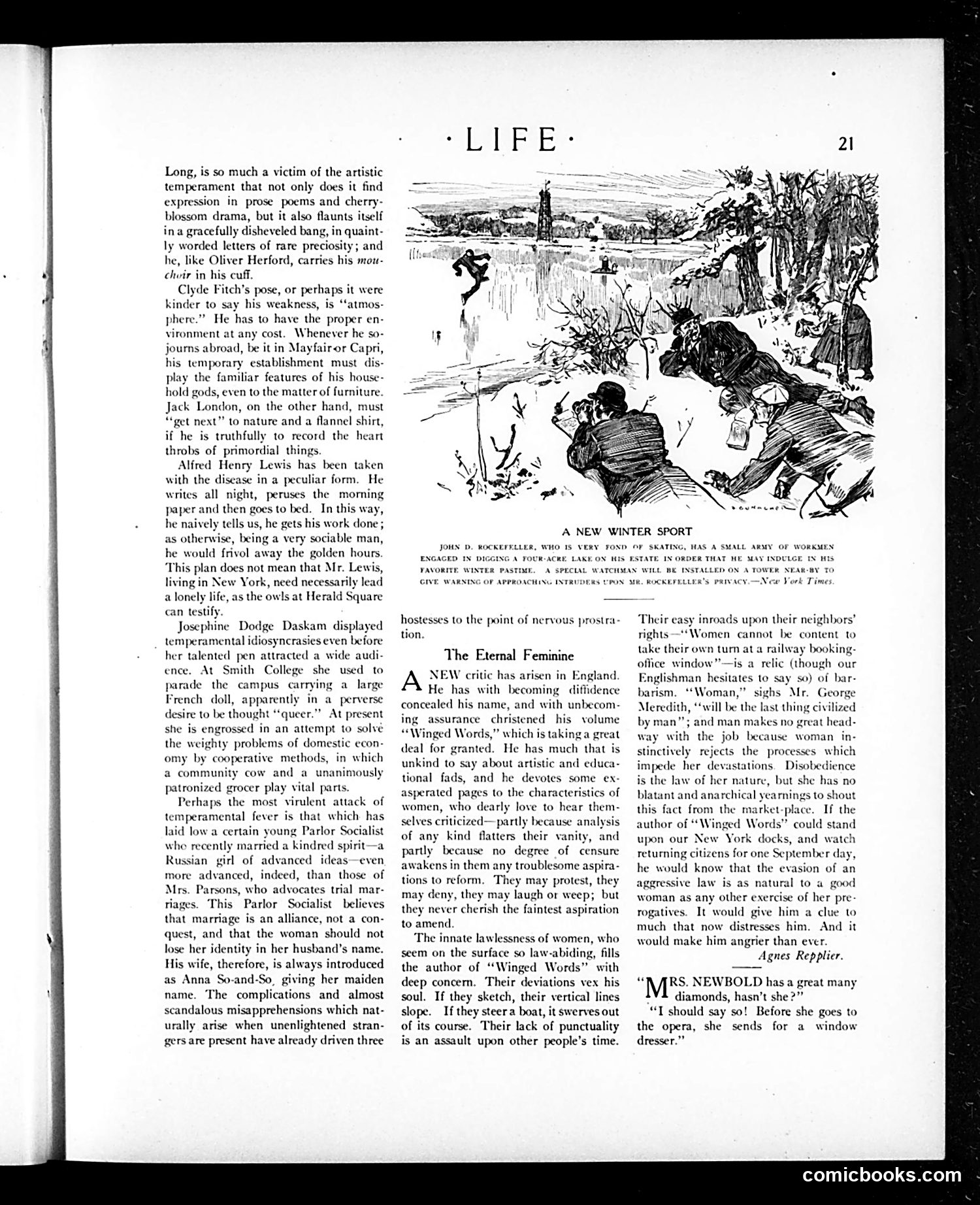
This page from *Life* magazine contains satirical portraits of American literary figures and their affectations. The text mocks writers like Clyde Fitch (who demands proper "atmosphere" wherever he lives), Jack London (who needs flannel shirts to access "primordial" authenticity), and a unnamed "Parlor Socialist" who insists his Russian wife retain her maiden name—causing social chaos among "unenlightened strangers." The cartoon depicts **John D. Rockefeller's new winter skating lake**, a satirical jab at the billionaire's wealth and the ridiculous excess it enables. The caption notes he's had workers dig a four-acre lake on his estate and installed a watchman tower to warn of "approaching intruders"—mocking both his paranoia about trespassers and the absurdity of manufacturing leisure activities. The article "The Eternal Feminine" critiques a new book attacking women's artistic pretensions and "innate lawlessness," satirizing both the book and women's supposed inability to reform themselves.
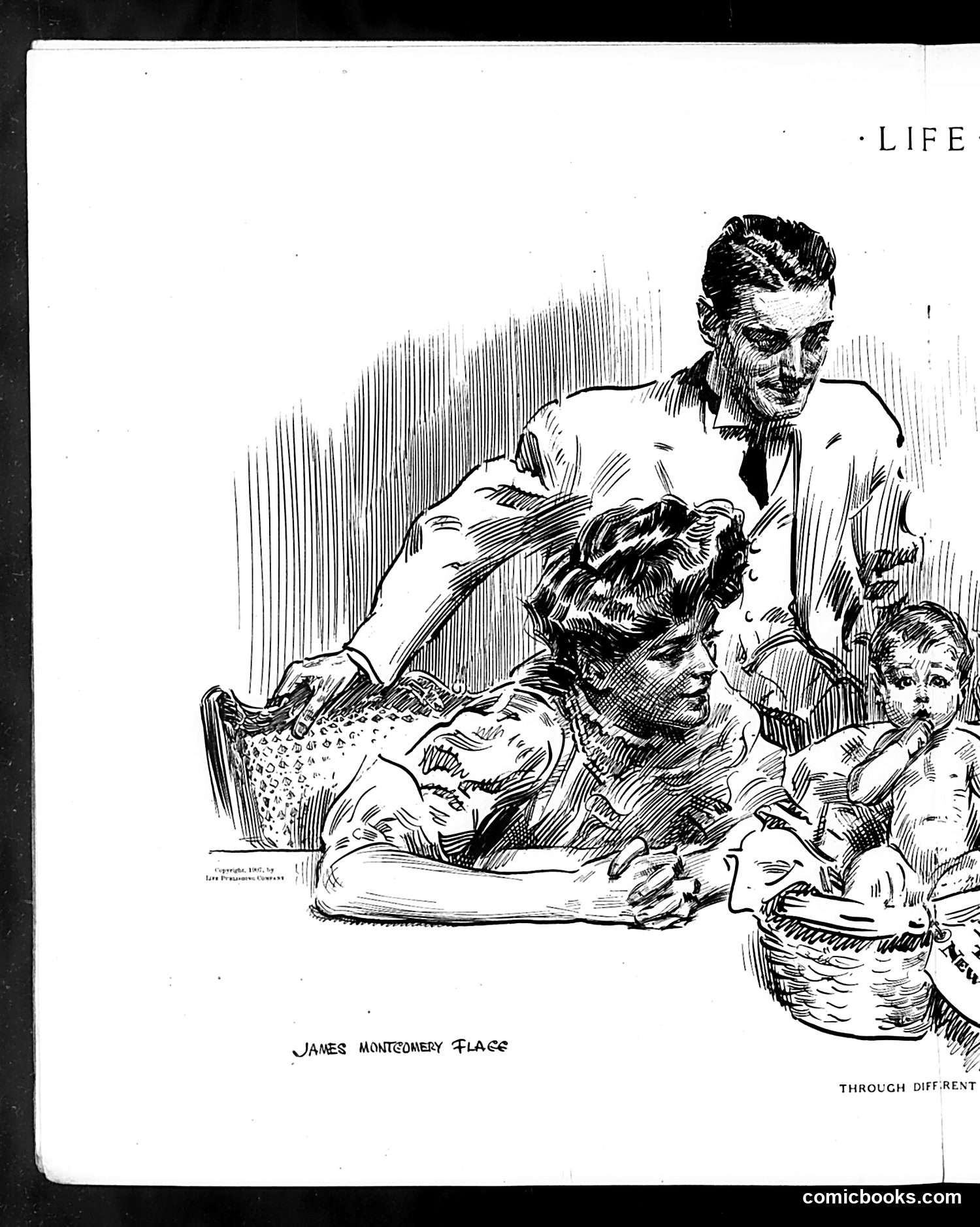
This is a pen-and-ink illustration from *Life* magazine titled "James Montgomery Flagg," crediting the artist (visible in the lower left). The image shows a man in formal attire surrounded by three children of varying ages, whom he appears to be entertaining or dandling. The caption "Through Different" (likely "Through Different [Eyes]") suggests the cartoon's satire concerns how the same person—here apparently Flagg himself—presents differently depending on perspective or audience. Flagg was a prominent American illustrator famous for patriotic imagery (notably the "I Want You" recruitment poster). This appears to be satirizing his public persona versus private life, or possibly commentary on his celebrity status. Without additional context, the exact satirical target remains unclear, though it likely references contemporary gossip or Flagg's public image circa the magazine's publication.
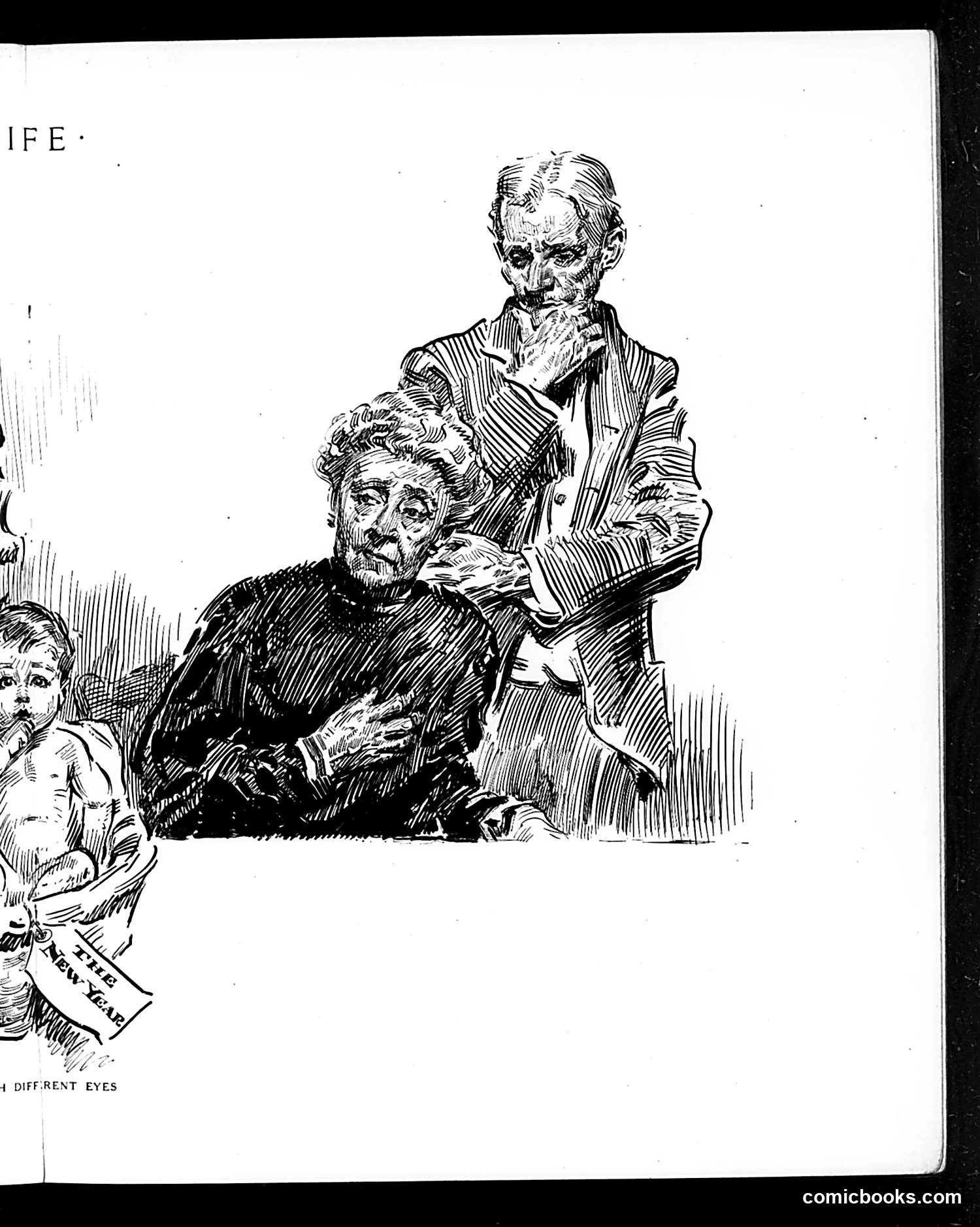
This page shows a satirical illustration titled "Different Eyes" depicting three figures with distinct facial expressions and characteristics. The central image presents two adults (one seated, one standing behind) observing a child on the left. The artistic technique uses heavy cross-hatching typical of early 20th-century satirical illustration. The title "Different Eyes" suggests the cartoon critiques how different people perceive the same subject—likely childhood, family, or innocence—through contrasting viewpoints. The varying expressions and body language of the figures suggest differing attitudes or moral perspectives. Without additional context from the magazine's surrounding content or date, the specific political or social reference remains unclear, though the composition suggests commentary on perspective and judgment.
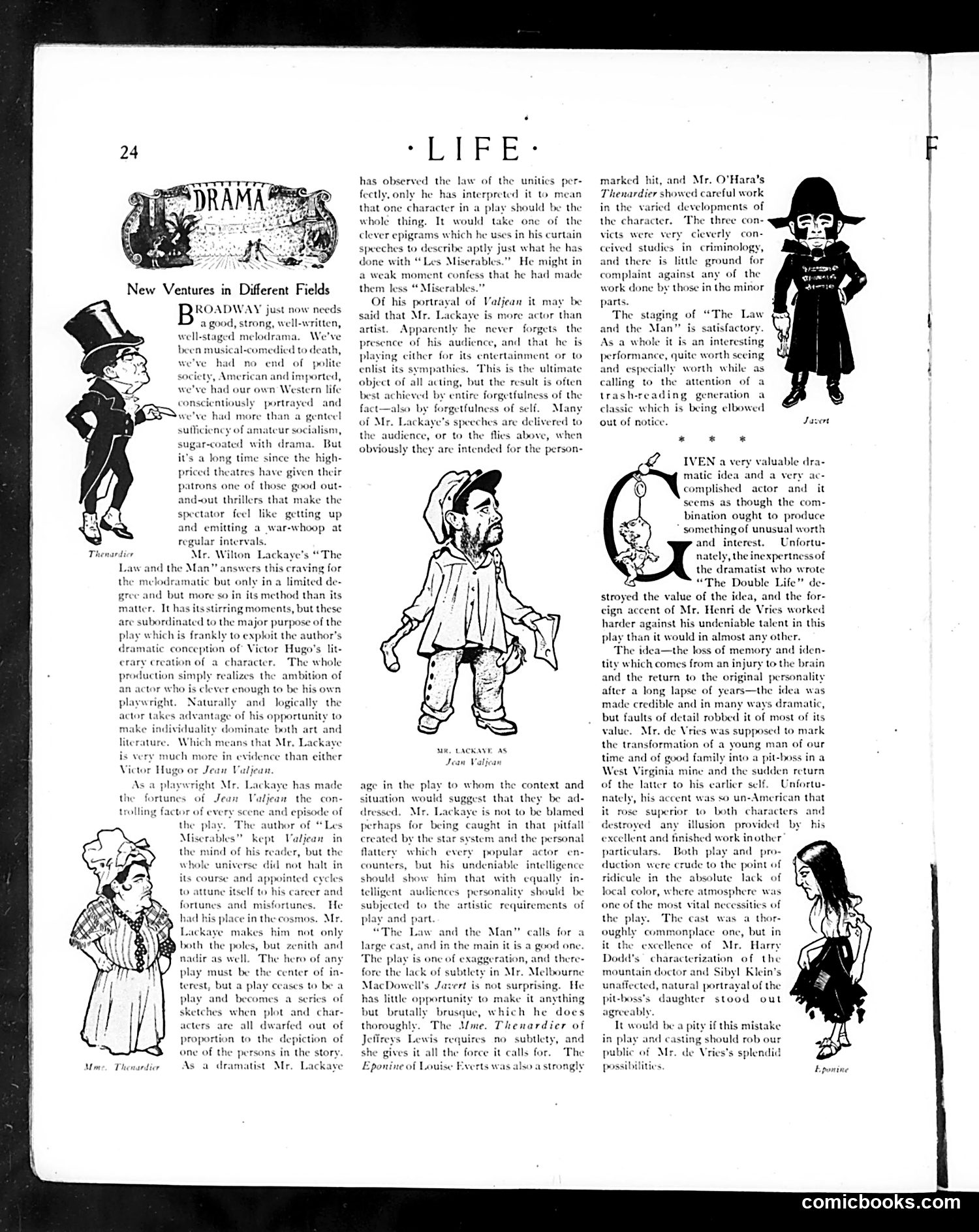
This page critiques actor **Wilton Lackaye's** stage production of "The Law and the Man" (based on Victor Hugo's "Les Misérables"). The satirical illustrations caricature Lackaye in various theatrical poses. **The satire's point:** Lackaye, while talented, allows his ego to dominate the production. The critic argues he interprets dramatic unity to mean one character—himself—must overshadow everything else. Rather than inhabit Jean Valjean authentically, Lackaye performs *for* the audience, delivering speeches to spectators or the flies above rather than to other characters onstage. **The complaint:** This reflects the "star system" problem—popular actors exploiting their status at the expense of artistic integrity. The critic suggests intelligent actors should subordinate personality to dramatic requirements, not vice versa. The page also mentions other supporting performances (Melbourne MacDowell's Javert) as adequately exaggerated for the melodramatic material, but Lackaye's self-aggrandizement undermines the work's dramatic coherence.
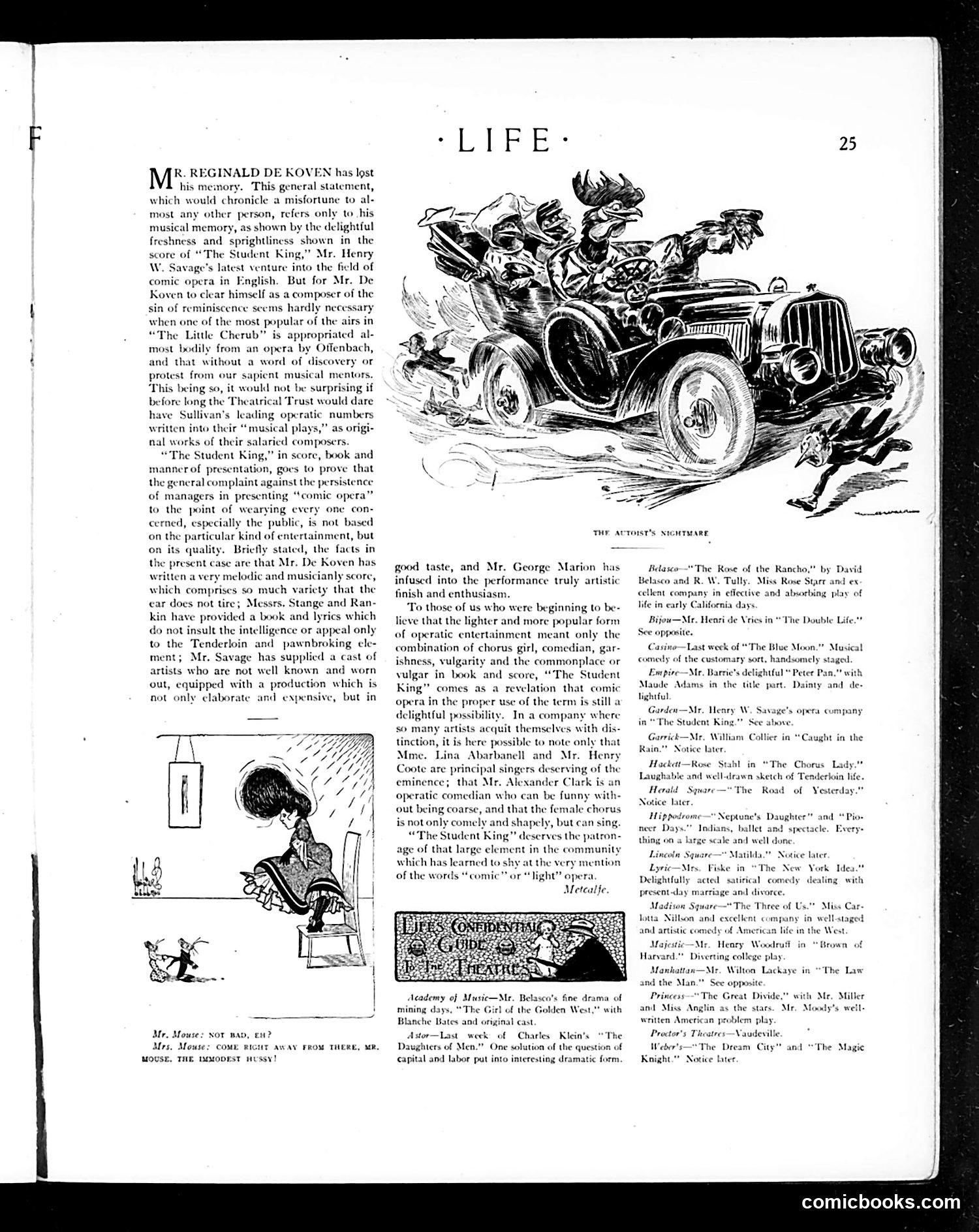
This page reviews "The Student King," a comic opera by composer Reginald De Koven. The critic praises the production while making a pointed argument about quality in popular entertainment. **The Main Satire:** The critic notes De Koven has "lost his memory"—he's accused of borrowing heavily from other composers (specifically Offenbach) without acknowledgment. Yet the reviewer uses this irony to defend him: if even established composers plagiarize without protest, why shouldn't theatrical managers do the same with Sullivan's work? **The Point:** The real target is the degradation of comic opera through mediocre productions. "The Student King" succeeds because it features *quality*—melodic scores, intelligent lyrics, and talented performers—rather than the typical formula of "chorus girl, comedian, garishness, vulgarity." **The Cartoons:** The top illustration shows an "Automist's Nightmare"—a car full of chaotic figures. The bottom strip depicts mice fleeing danger, captioned "Come right away from there, Mrs. Mouse. The lodgest not bad, eh?"—likely satirizing theatrical excess or slapstick comedy's appeal.
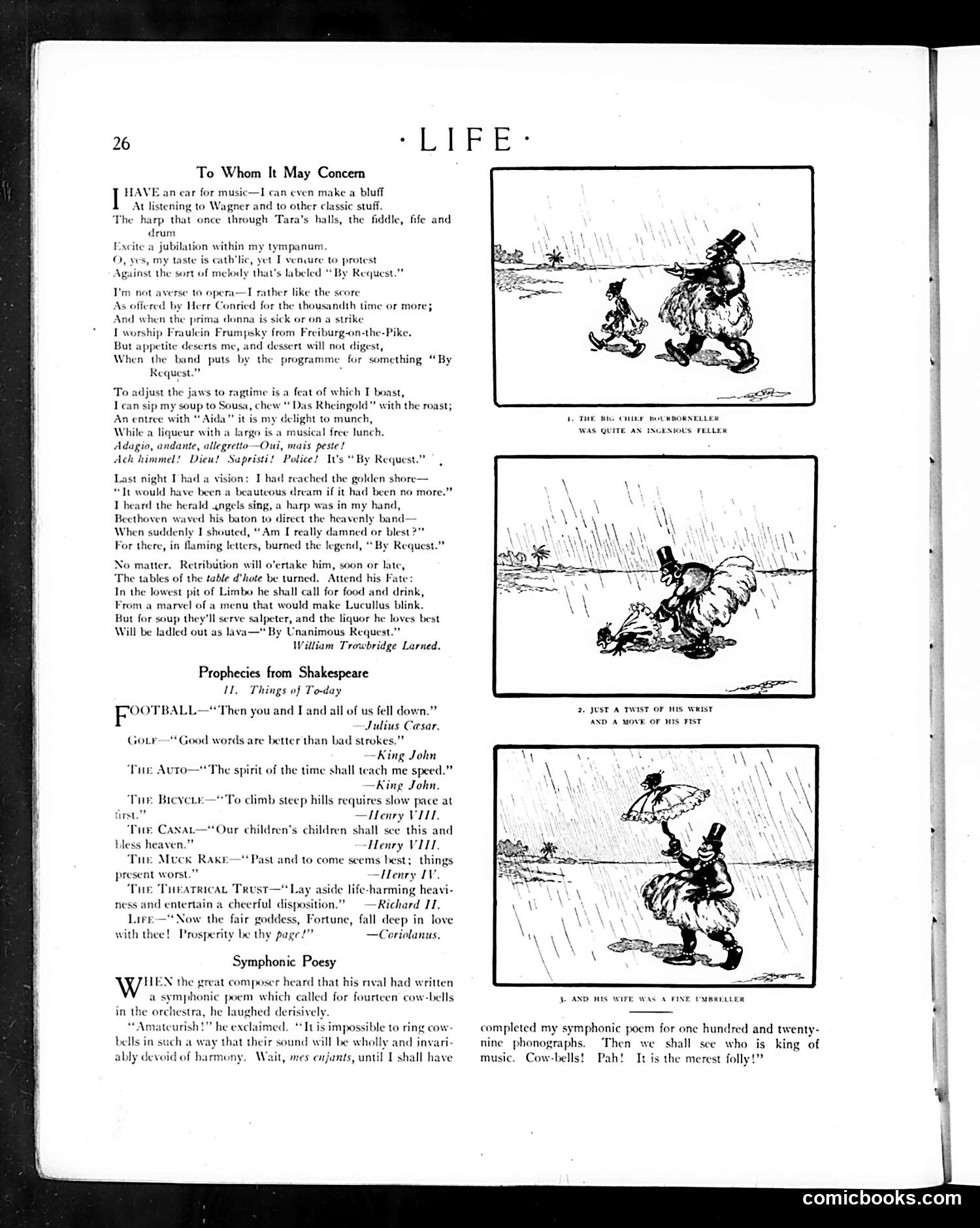
This page contains three distinct satirical pieces: **"To Whom It May Concern"** (poem by William Trowbridge Larned): A humorous complaint about orchestras playing encores "by request" rather than following their program. The author claims to enjoy classical music and even ragtime, but finds patron-demanded songs unbearable—even imagining them as eternal punishment in hell. It satirizes both pretentious concert-goers demanding familiar tunes and musicians' obligation to accommodate them. **"Prophecies from Shakespeare"**: Brief cynical Shakespeare quotes applied to modern topics (football, golf, automobiles, bicycles, muckraking journalism, theatrical monopolies, and life itself). These mock contemporary issues by pairing them with centuries-old dramatic observations. **"Symphonic Poesy"**: A joke about composer rivalry where one composer, mocked for using fourteen cow-bells in his symphony, vengefully composes a piece requiring 129 phonographs to prove his superiority. It satirizes competitive artistic pretension and absurd modernist experimentation. The three accompanying illustrations show a domestic scene involving umbrellas and umbrage, apparently humorously related to the "Umbreller" caption.
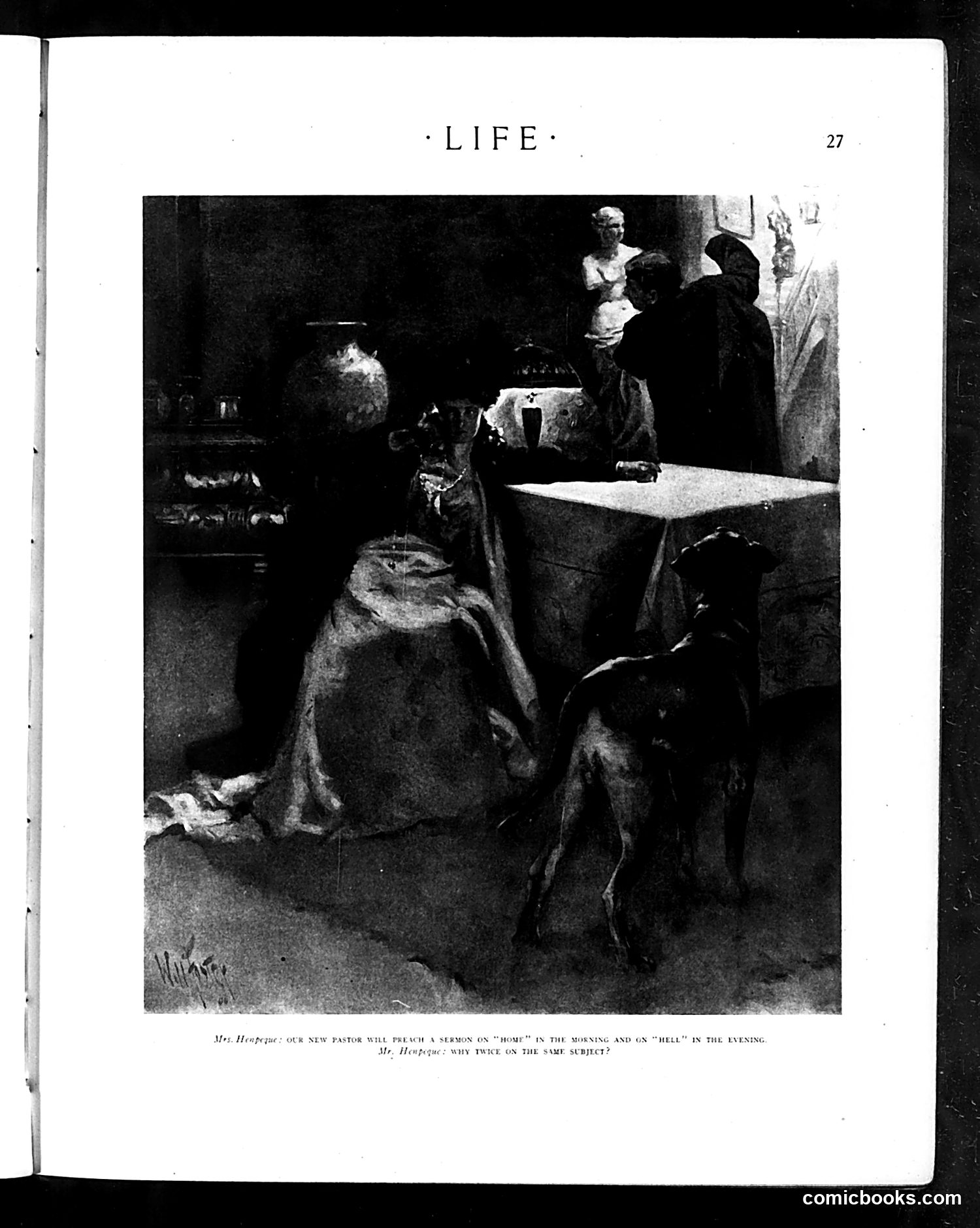
This appears to be a satirical illustration from *Life* magazine depicting a domestic scene. The caption indicates dialogue between "Mrs. Hosepipe" and "Mr. Hosepipe" regarding a new pastor who will preach sermons on "Home" in the morning and "Hell" in the evening, with Mr. Hosepipe asking why the pastor discusses the same subject twice. The joke is a cynical comment on marriage: the satire equates a wife ("home") with "hell," suggesting that domestic life—particularly married life—is torturous. This reflects common early 20th-century satirical humor about matrimony being an unpleasant or confining state. The illustration shows a woman in period dress seated while men stand nearby, emphasizing the domestic setting that forms the basis of the joke.
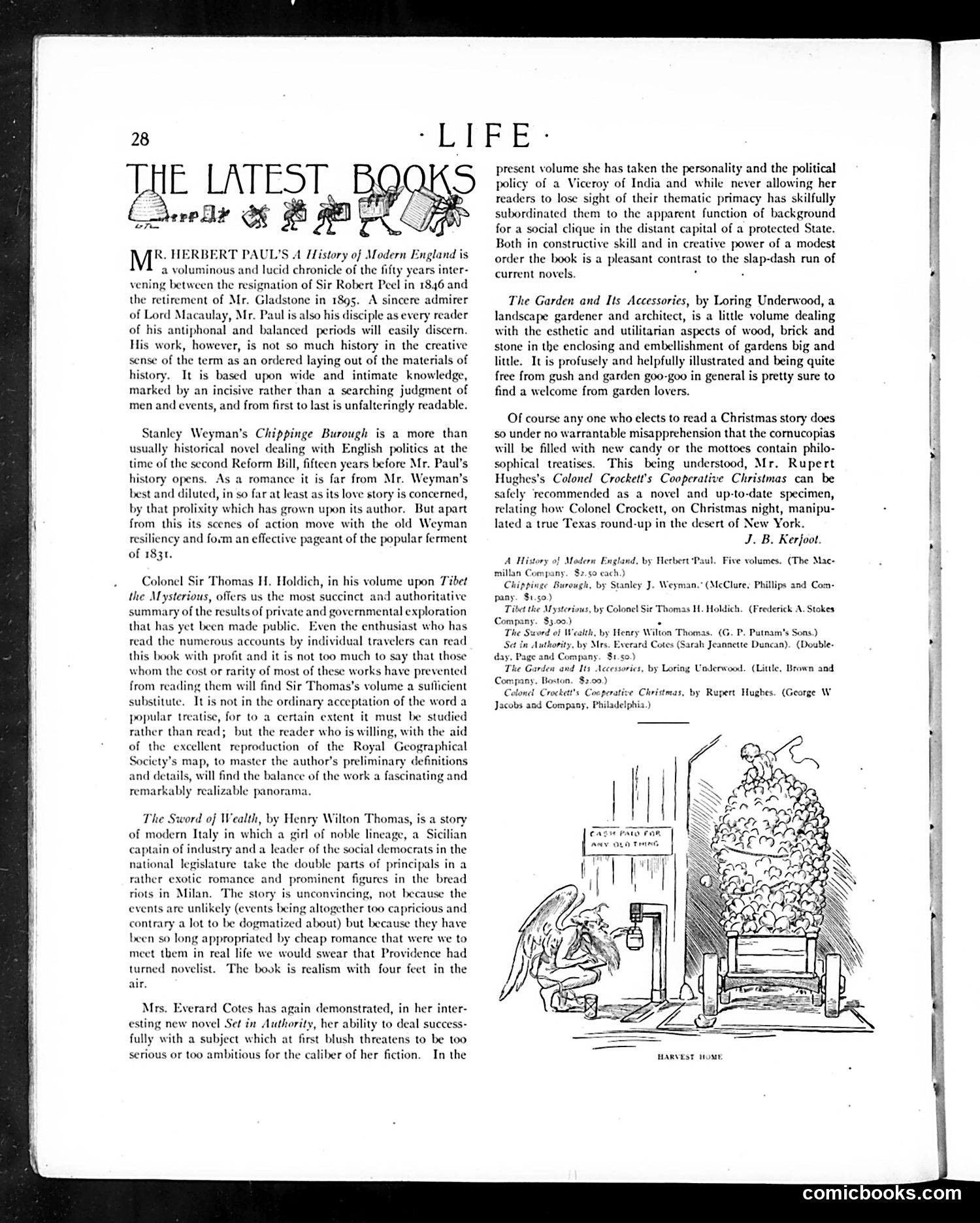
This is a book review section from *Life* magazine (page 28), not primarily satirical content. The page surveys recent literary publications, including Herbert Paul's history of England (1846-1895), Stanley Weyman's historical novel about the 1831 Reform Bill riots, and Colonel Holdich's exploration account of Tibet. The small illustration labeled "HARVEST HOME" appears to be decorative seasonal artwork accompanying a review of Loring Underwood's gardening book—showing a figure with harvest bounty near a cottage. The reviews are written in *Life*'s characteristic tone: urbane, witty, and occasionally barbed. For instance, the critic notes Weyman's novel suffers from "prolixity" and that another work's realism has "four feet in the air"—meaning it's unconvincingly melodramatic despite claiming modern authenticity. This represents *Life*'s literary criticism function rather than political satire.
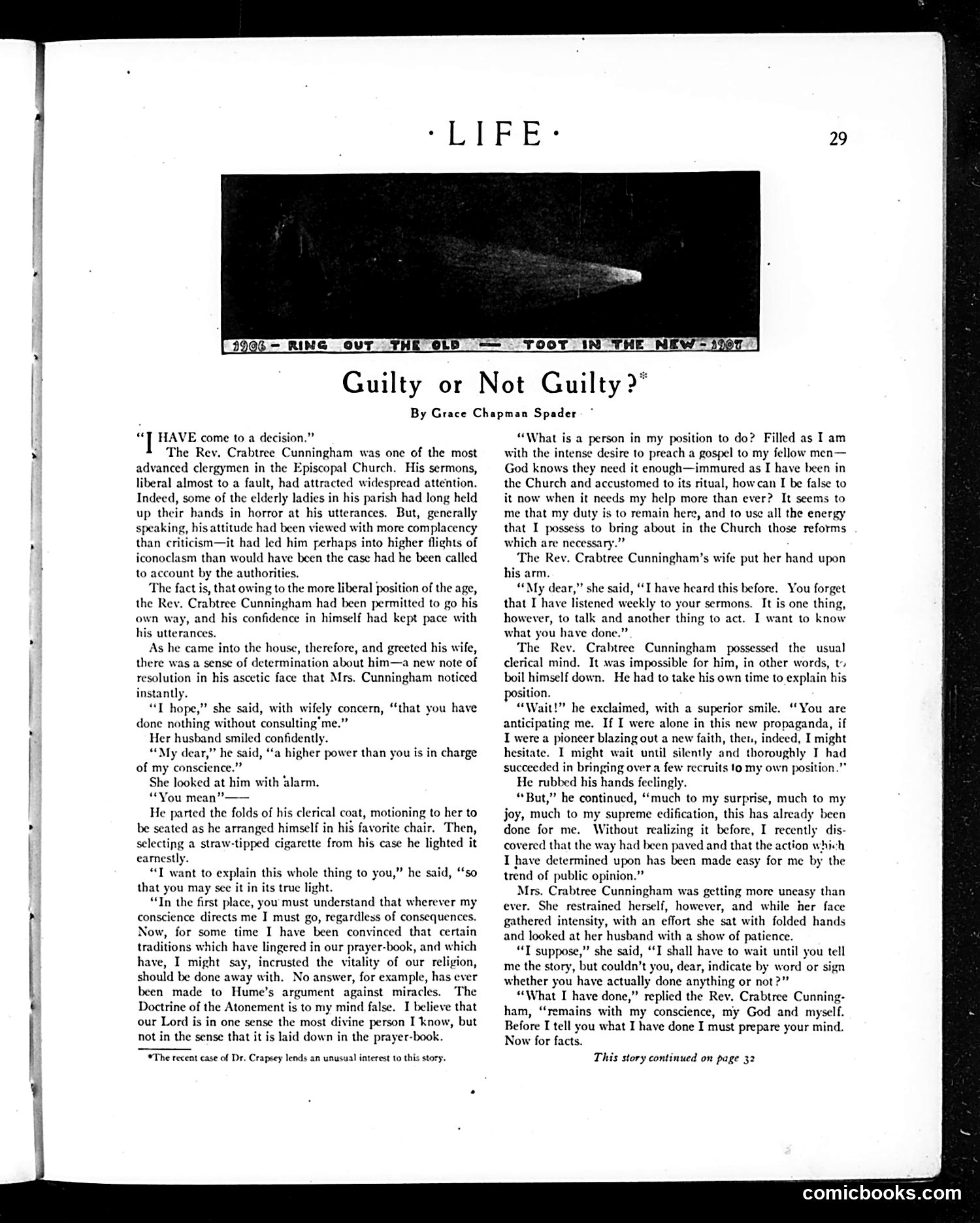
This page presents a fictional story satirizing liberal Protestant clergy and theological modernism in the early 20th century. The protagonist, Rev. Crabtree Cunningham, represents the "advanced clergyman" who privately questions traditional church doctrine—miracles, the Atonement—while maintaining his position within the Episcopal Church. The satire's point: the story exposes the hypocrisy of clergy who preach radical theological reform while remaining institutionally complicit in the very traditions they publicly criticize. The footnote references "Dr. Crapsey," likely Algernon Crapsey, an actual Episcopal priest tried for heresy in 1906 for similar modernist views. The cartoon's irony lies in Rev. Cunningham's self-justifying rationalization—he claims conscience and reform motivate him, yet his wife (the voice of practical reality) pointedly asks what he has *actually done*. The story critiques both clerical evasiveness and the tension between theological conviction and institutional conformity in Progressive-era American religion.
This page from *Life* magazine contains several brief humorous anecdotes and jokes typical of early 20th-century American satire: **"Too Wet"** mocks a life-saving crew's excuse for not practicing—they claim it's too rainy, though their job is water rescue. **"He Hadn't Caught Up"** features John D. Rockefeller (the wealthy industrialist) joking at a University of Chicago event that he feels behind schedule—like a Boston businessman whose train got snowed in. **"A Gracious Sovereign"** satirizes Tsar Nicholas II's acceptance of volunteer military offers, where his marginalia thanks them but includes an awkward phrase about hoping "your wishes may be fully realized"—unintentionally ambiguous. The remaining anecdotes mock everyday situations: a rescued man immediately proposing, expensive English dukes, a cabman's complaint about unpaid fares, and a landlord's lodger's sugar-cube numbering system. The page primarily advertises Hunter Whiskey and Wilson brand products. The humor reflects genteel, middle-class sensibilities of the era.
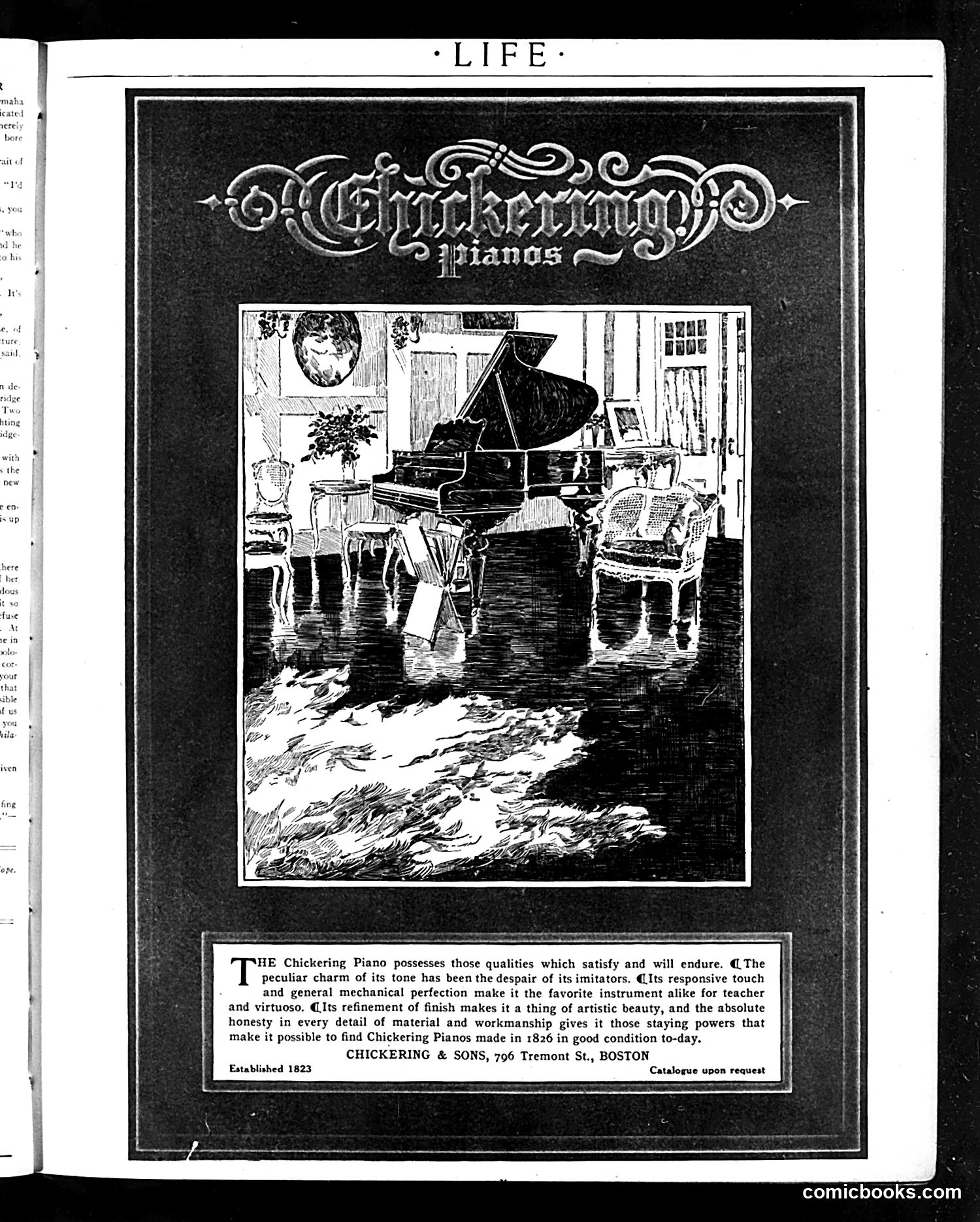
This is a full-page advertisement, not political satire. It promotes Chickering & Sons pianos, a Boston manufacturer established in 1823. The illustration shows an elegant parlor scene with a grand piano as the centerpiece, flanked by ornate chairs. The drawing emphasizes the piano's place in refined domestic life—suggesting it's an instrument for both serious musicians ("virtuoso") and music teachers. The text makes quality claims typical of early 20th-century advertising: the piano's tone is superior and imitated by competitors, its construction is honest and durable (claiming pianos from 1826 still work), and its finish represents "artistic beauty." The ornamental header reads "Chickering Pianos," using decorative typography common to period advertising. This is essentially a luxury goods advertisement targeting middle-to-upper-class households who could afford such instruments.
This page combines advertisements with a satirical story about ecclesiastical hypocrisy. The narrative mocks **Reverend Crabtree Cunningham**, who claims to have won over his entire church vestry and the Bishop himself to his theological positions through private discussions. He boasts that everyone—from vestry members to "advanced ladies" to the Bishop—privately agrees with him completely. The satire's punch line appears cut off, but the setup exposes a common social pretense: the assumption that universal agreement in private conversations reflects genuine consensus rather than politeness or people simply telling someone what they want to hear. The wife's eager question—"what did you do then?"—suggests the Reverend's next action will reveal his true character. The page's advertisements (W.K. Cowan & Company, Teco Pottery) represent typical *Life* magazine commercial content from this era.
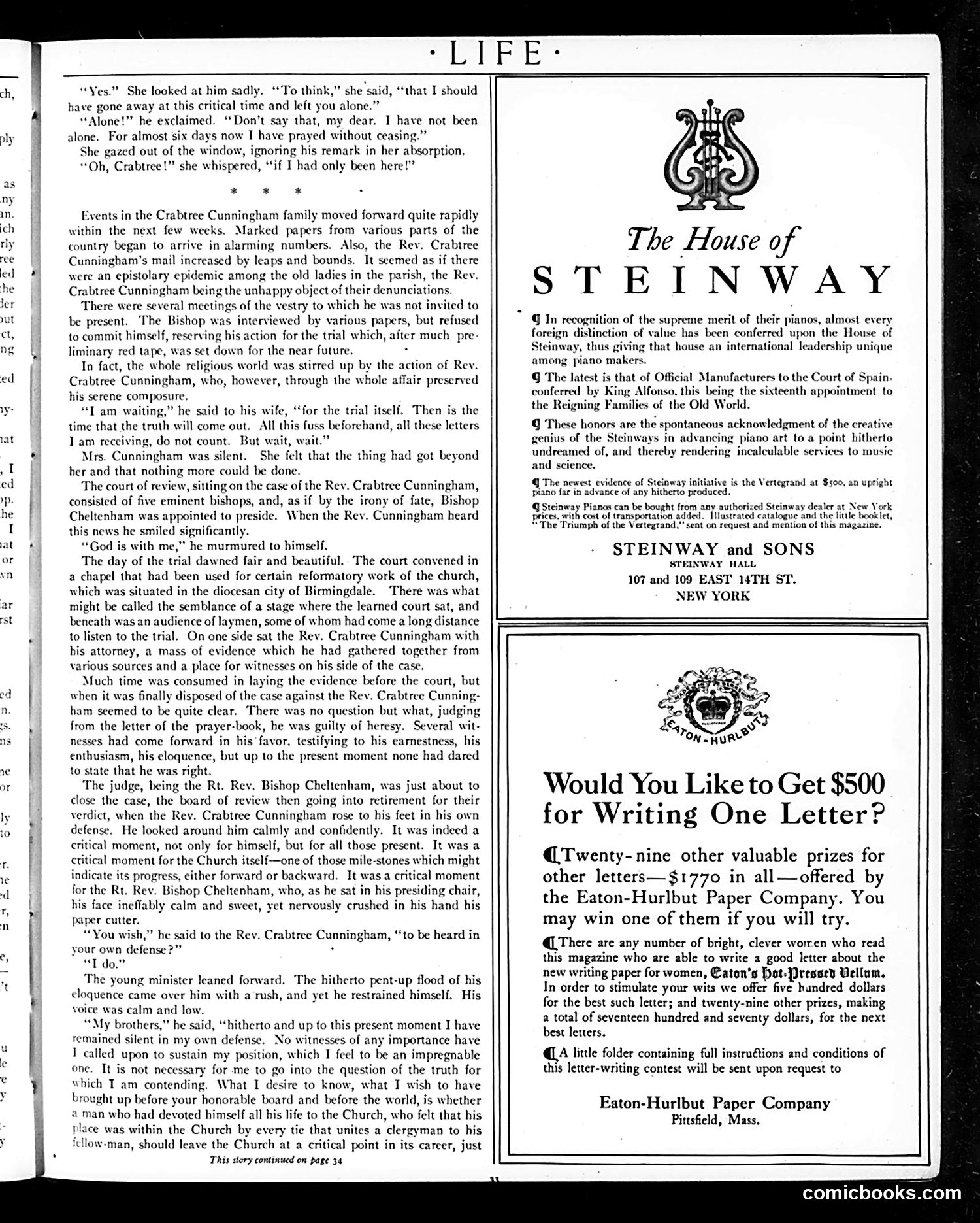
This page presents a serialized fiction story (continued from page 14) about Rev. Crabtree Cunningham, a clergyman accused of heresy. The narrative follows his ecclesiastical trial before five bishops, with Bishop Cheltenham presiding. **The Satire's Point:** The story satirizes rigid religious institutional authority and hypocrisy. Cunningham's wife and parishioners condemn him through letters, yet he maintains serene confidence in his righteousness. The irony deepens when his accuser—Bishop Cheltenham—must judge him, creating potential bias. The text emphasizes this is a "critical moment" for the Church itself, suggesting the institution's credibility hangs on the verdict. **The Social Context:** This reflects early 1900s anxieties about modernism versus church doctrine, and the power structures within religious hierarchies that could weaponize "heresy" charges against reformist clergy. The right page is primarily **advertising**: Steinway pianos and an Eaton-Hurlbut Paper Company contest offering $500 for letter-writing—unrelated to the fiction.
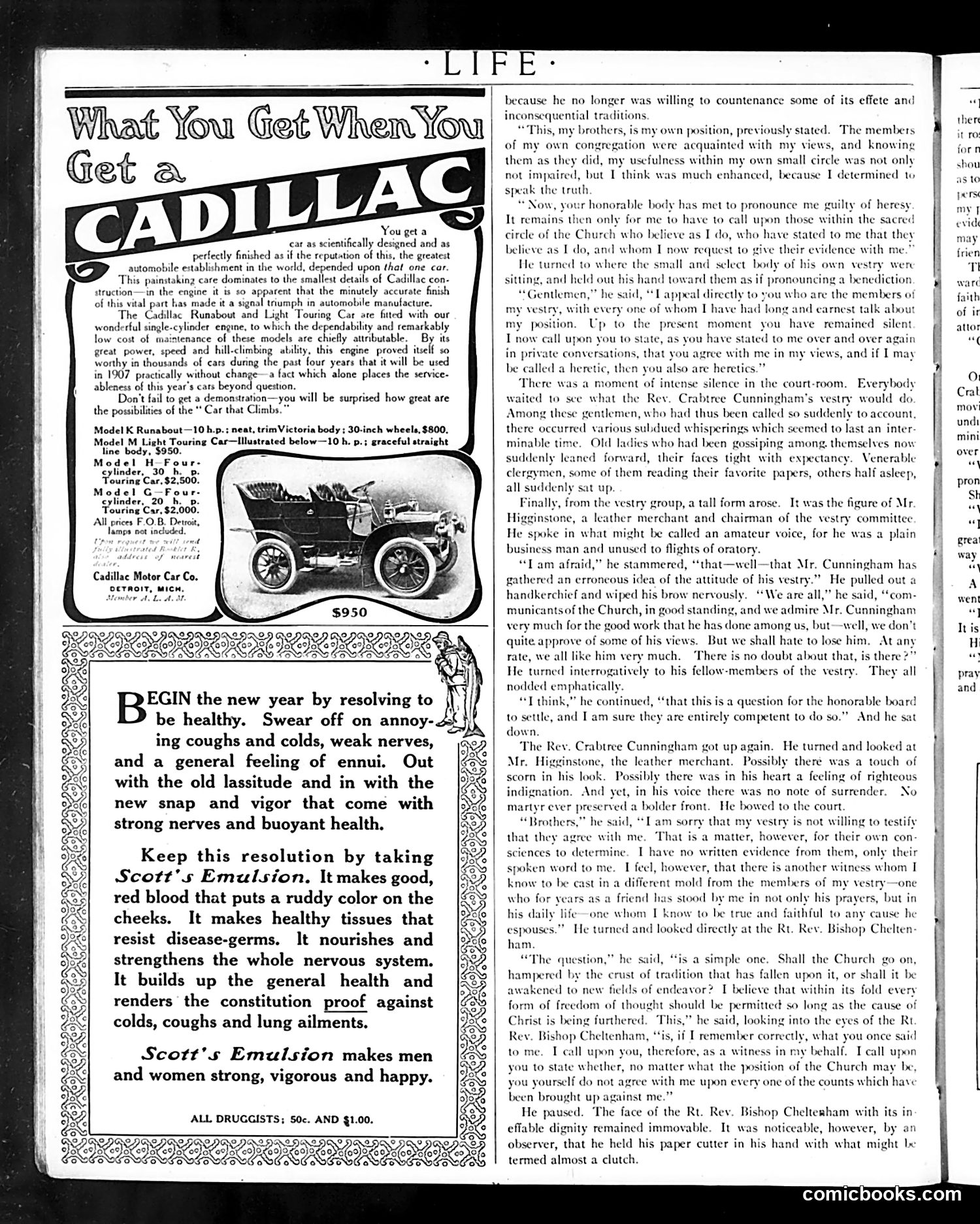
This *Life* magazine page mixes advertisements with a serialized fiction story about a church heresy trial. The main narrative concerns Reverend Crabtree Cunningham, accused of heresy for challenging "effete and inconsequential traditions" within his church. When called to defend himself before his vestry (church governing board), he turns the tables, confronting his own parishioners about whether *they* truly believe the doctrines they claim to defend. The satire targets institutional hypocrisy: church leaders maintain orthodox positions formally while privately doubting them. Cunningham exposes this gap between public profession and private belief. The advertisements (Cadillac automobiles, Scott's Emulsion) are period marketing, not part of the satire. The page appears to be from early 1900s *Life*, known for witty social commentary.
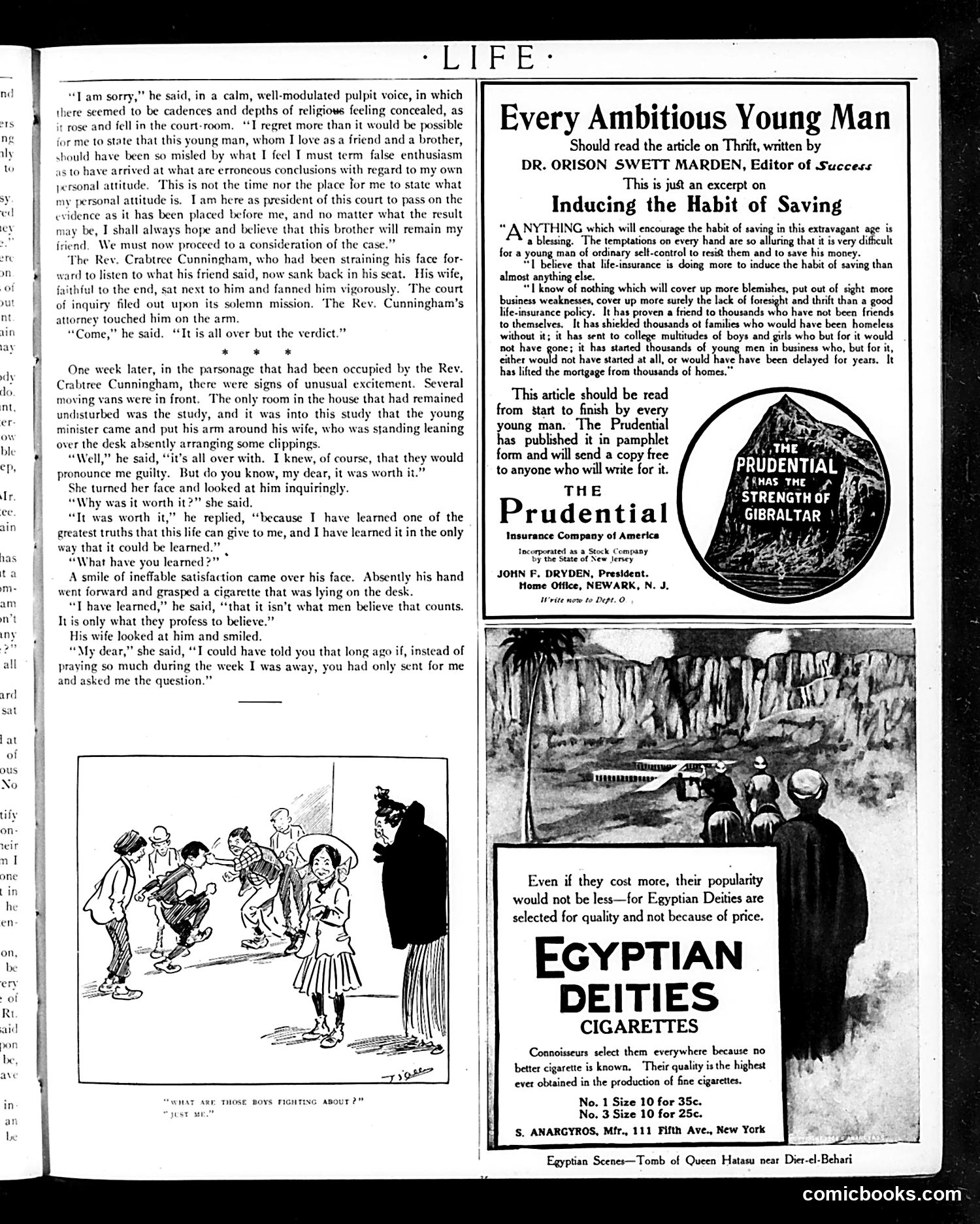
**The Main Story/Cartoon:** The narrative satirizes religious hypocrisy. A clergyman (Rev. Crabtree Cunningham) faces a court of inquiry over unspecified misconduct. He delivers a pious, eloquent defense claiming he acted from principle, and the court finds him guilty. However, the punchline reveals his actual lesson learned: "it isn't what men believe that counts. It is only what they profess to believe"—meaning appearances and professed morality matter more than actual virtue. His wife's final comment suggests she could have taught him this cynical truth through simple observation rather than legal proceedings. **The Cartoon (lower left):** Shows boys fighting while an authority figure observes. The caption reads "What are those boys fighting about?" "Just mud"—likely commenting on how people quarrel over trivial matters. **Advertisements:** The page features insurance and cigarette ads, typical of the era. **The Satire's Point:** Mocking clergy who use eloquence to mask moral compromise, and exposing the gap between professed and actual values in public life.
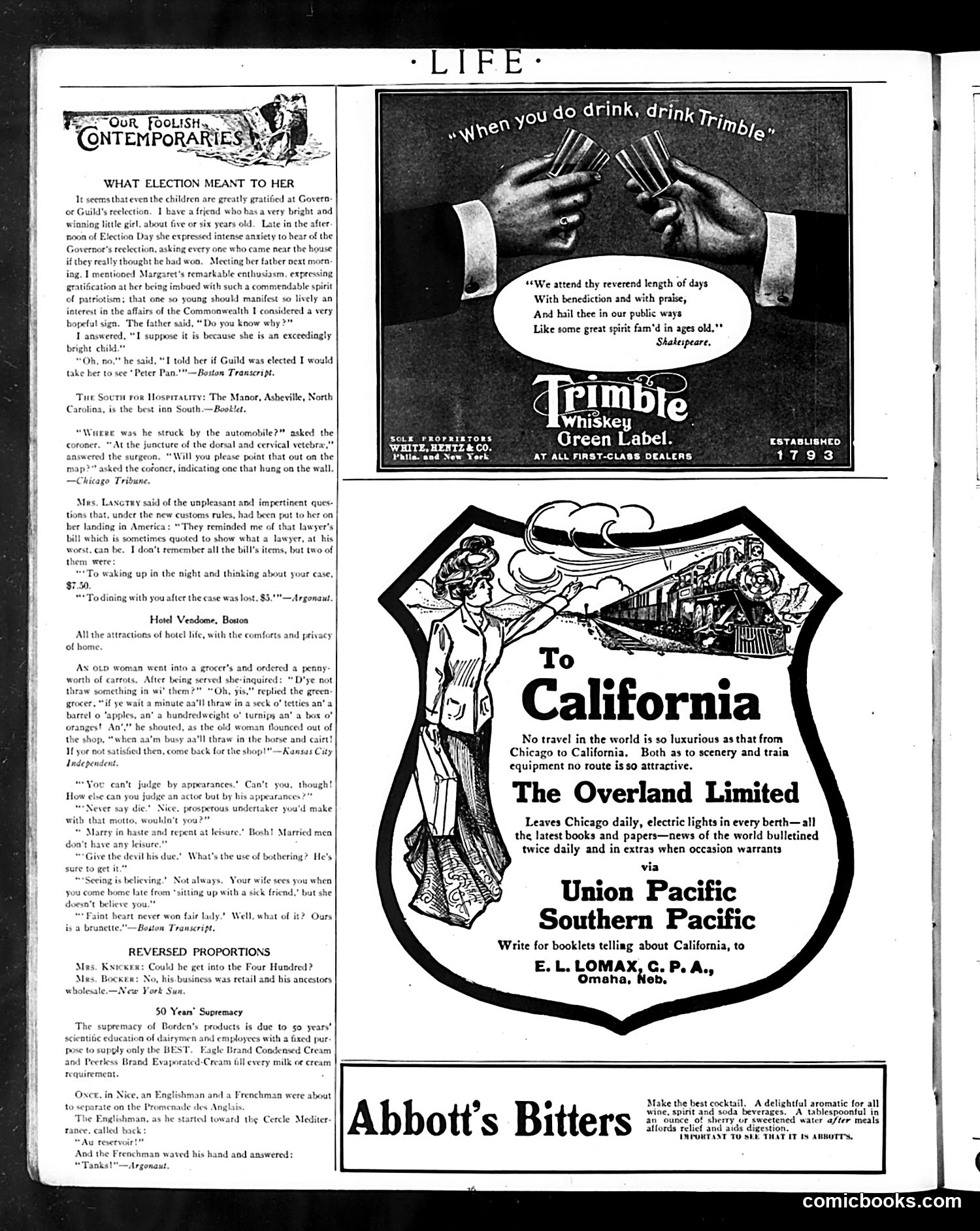
This page from *Life* magazine (a pre-1920s satirical weekly) contains mostly **short humorous anecdotes and advertisements** rather than political cartoons. The main content includes: - **"What Election Meant to Her"**: A joke about a child eager to hear election results, not from patriotism but because her father promised to take her to see *Peter Pan* if the candidate won. This appears to reference a recent U.S. election (likely Theodore Roosevelt's reelection in 1904, given "Guild's reelection"). - **Various brief comedic stories** from readers: medical jargon misunderstandings, lawyer billing jokes, customs house impertinence, and Scottish dialect humor about grocery shopping. The **advertisements** dominate the visual space: Trimble Whiskey, Abbott's Bitters, and a railroad ad for travel to California via Union Pacific and Southern Pacific lines. There is **no political satire or caricature** of identifiable figures. The humor is genteel, domestic, and relies on wordplay and situational comedy typical of early 20th-century American magazines.
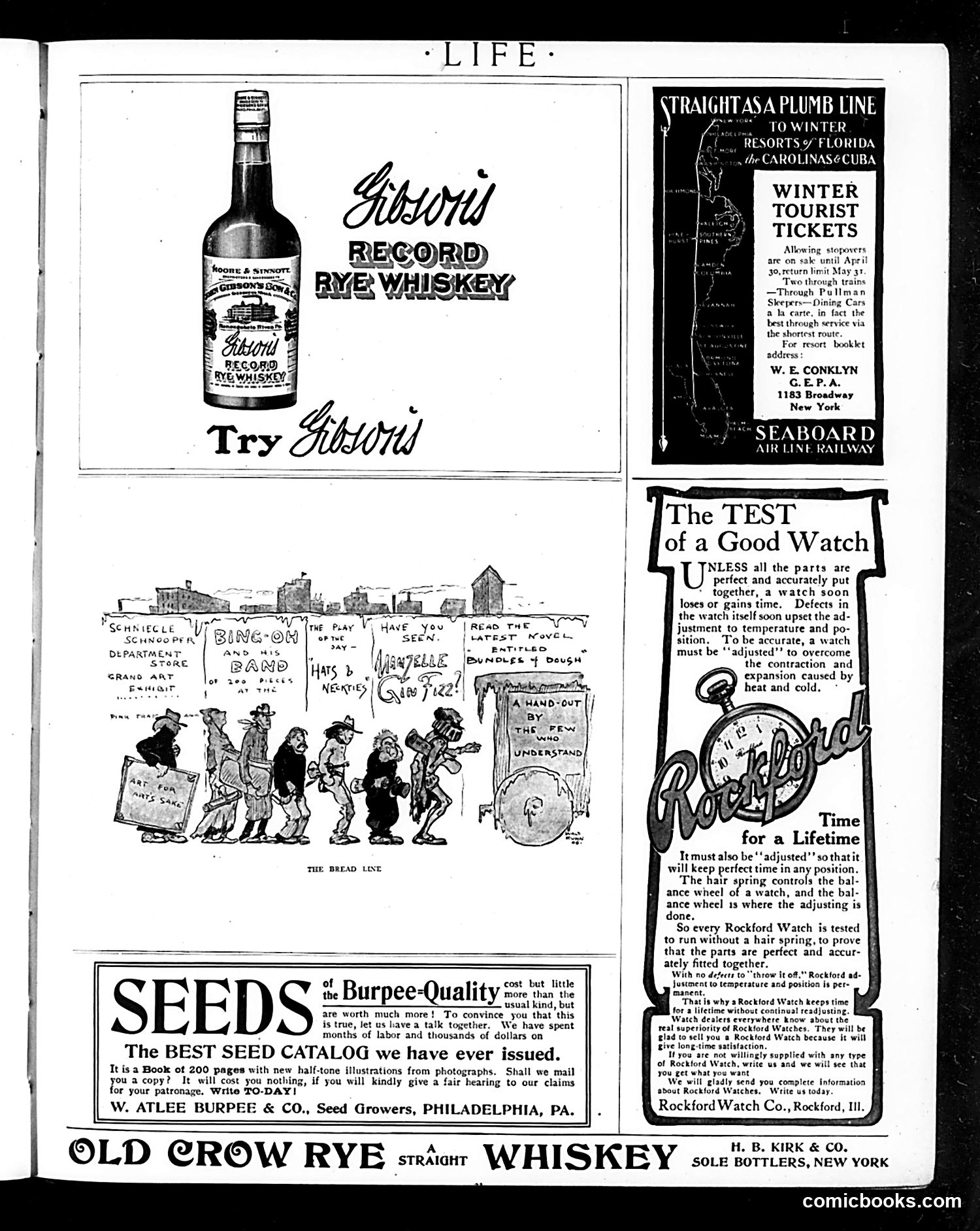
This cartoon satirizes poverty and economic hardship during what appears to be the early 20th century. It depicts a queue of desperate people—including women, children, and elderly individuals—waiting at a "bread line," a Depression-era charitable distribution of free food to the destitute. The figures carry signs with phrases like "RING-ON AND HIS BOARD," suggesting homelessness and joblessness. The cartoon's title, "THE BREAD LINE," directly references the widespread soup kitchens and breadlines that became symbols of economic desperation in America. The satire criticizes the failure of society to provide dignified employment, forcing citizens into humiliating charity situations. The ragged, distressed appearance of the queue emphasizes the human cost of poverty. This reflects contemporary social commentary about inequality and the inadequacy of charitable relief as a solution to systemic economic problems.
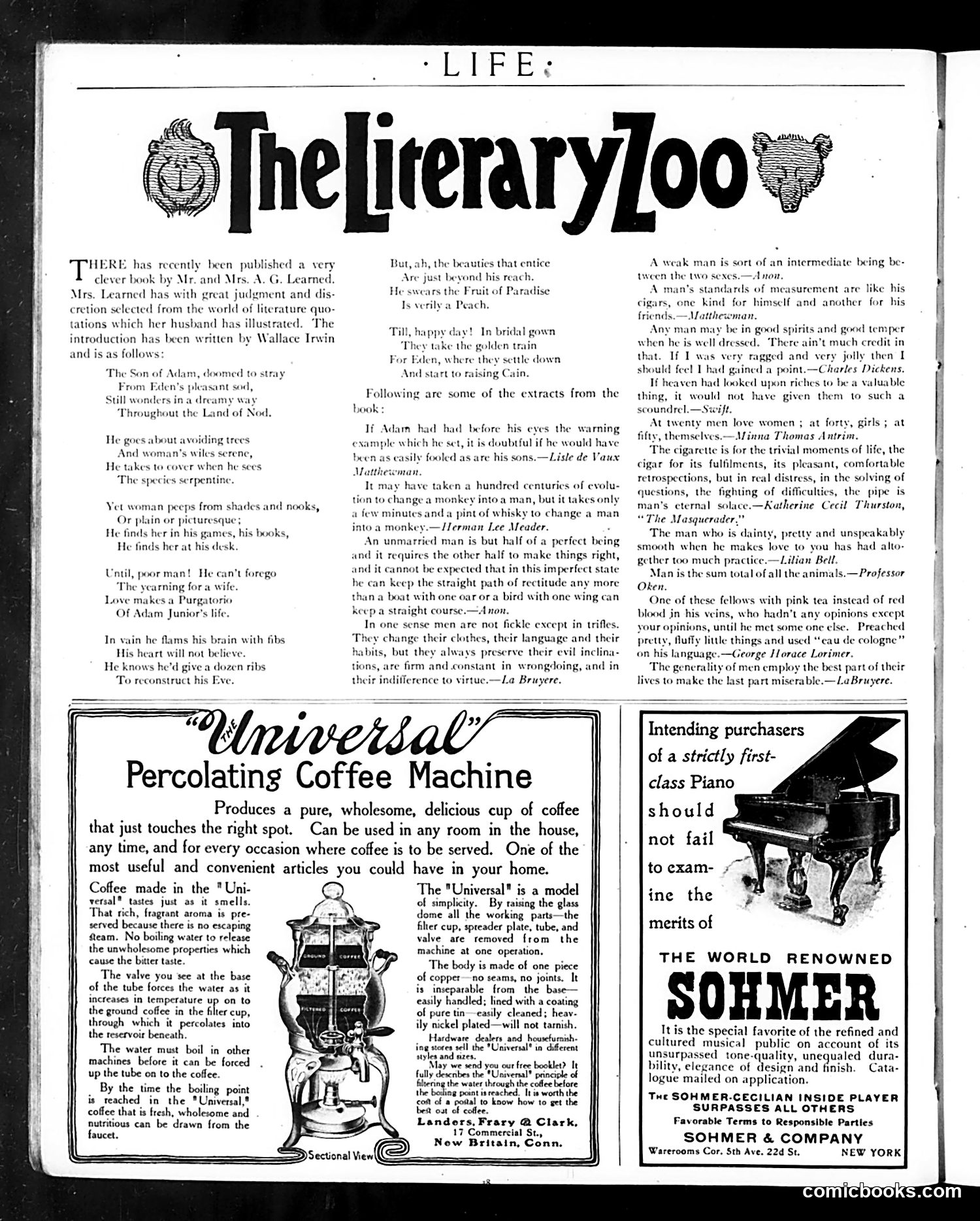
This page is primarily **literary content with advertising**, not political satire. The main feature is "The Literary Zoo"—a collection of quotations about human nature (particularly male behavior and marriage) selected from literature by Mr. and Mrs. A.G. Learned, with an introduction by Wallace Irvin. The opening poem humorously depicts Adam as perpetually tempted by women despite his attempts to avoid them, culminating in marriage where he "starts to raising Cain." The subsequent literary extracts—attributed to sources like La Bruyere and various other writers—offer cynical observations about men's weakness, their inability to resist women, and their moral inconsistency. The page includes two product advertisements: a "Universal" percolating coffee machine and a Sohmer piano. There is **no political cartoon or satire** visible. The humor is entirely social commentary about gender relations and human nature, presented through curated literary quotes rather than visual imagery.
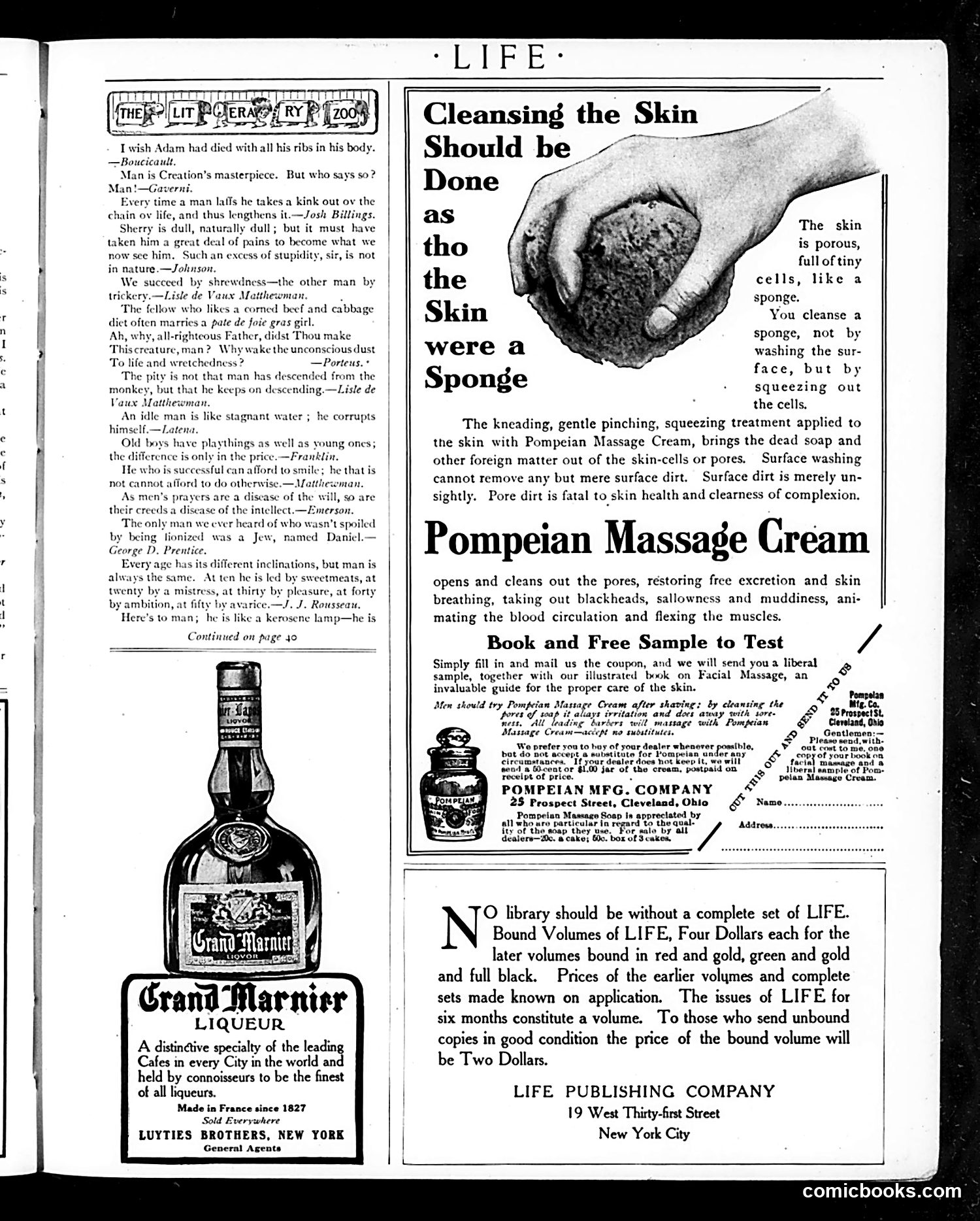
This page is primarily **advertising with minimal editorial content**. The left side features quotes about human nature and character (typical of Life's satirical editorial voice), followed by an advertisement for Grand Marnier liqueur. The main content is a **skincare advertisement for Pompeian Massage Cream** (right side), which uses an extended metaphor comparing skin to a sponge. The ad explains that pore cleansing requires mechanical action ("squeezing") rather than surface washing—a claim presented as scientific skincare advice. By modern standards, this represents typical early 20th-century cosmetics marketing: pseudo-scientific language justifying a product's necessity for health and appearance. The page concludes with subscription information for binding Life magazine volumes. There are **no political cartoons or satirical commentary** visible on this page—it functions as a commercial publication page mixed with Life's characteristic philosophical quotations.
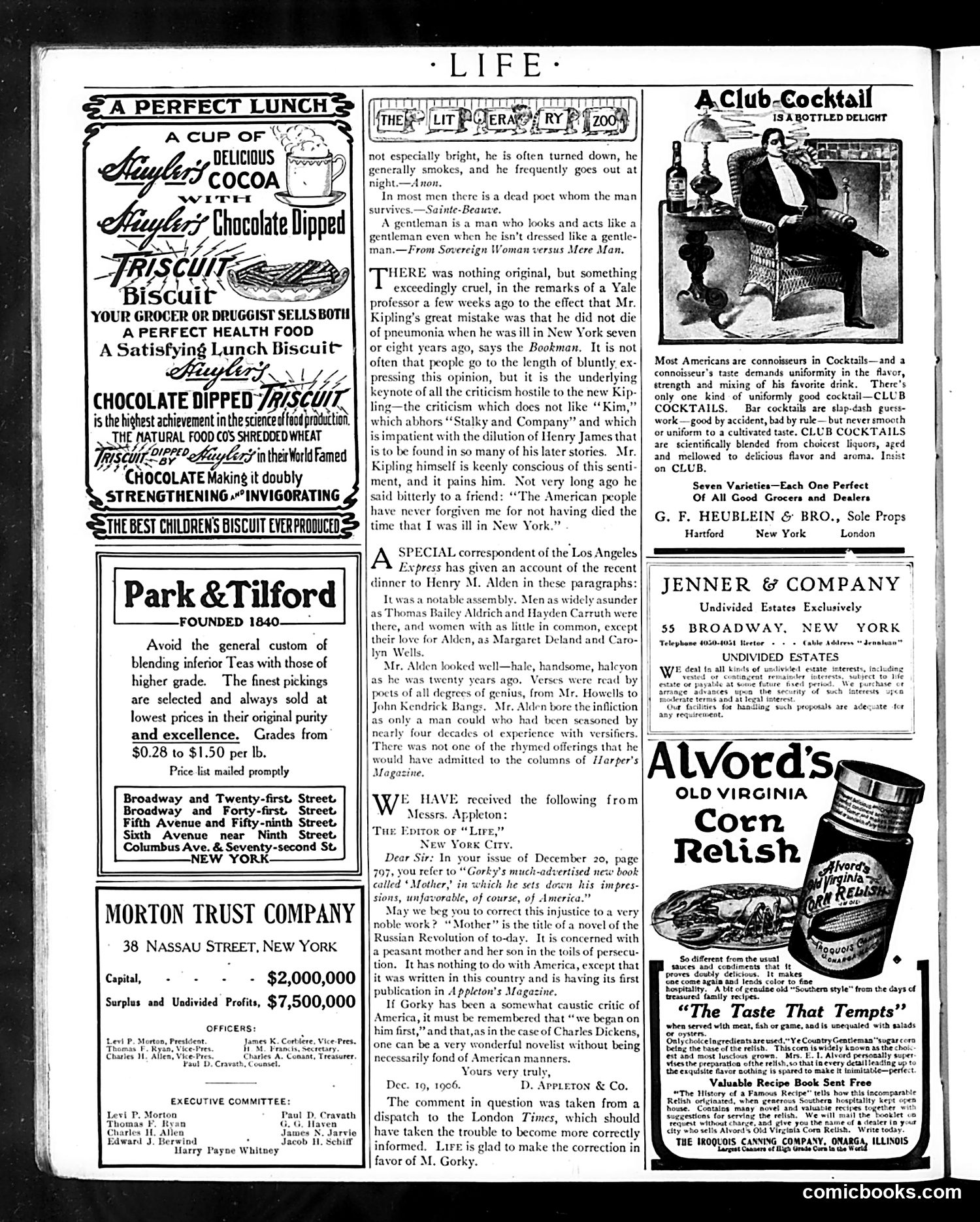
This page is predominantly **advertising**, with some editorial content. The main items are: **Advertisements** occupy most of the page—food products (Huyler's cocoa and biscuits, Alvord's corn relish), luxury goods (Park & Tilford tea), and financial services (Morton Trust Company, Jenner & Company real estate). **Editorial content** includes: - Literary commentary defending Rudyard Kipling against American critics who resented his unflattering remarks about America. The passage quotes Kipling bitterly saying Americans "never forgiven me for not having died" during his 1899 illness—suggesting they wish he hadn't survived. - A brief account of a dinner honoring Henry M. Alden (likely editor of Harper's Magazine), attended by prominent literary figures like Thomas Bailey Aldrich and Howells. - A publisher's correction regarding Maxim Gorky's novel *Mother*, clarifying it concerns Russian Revolution peasants, not anti-American sentiment. The page reflects *Life*'s role as a venue for both consumer marketing and literary-cultural commentary aimed at affluent, educated readers.
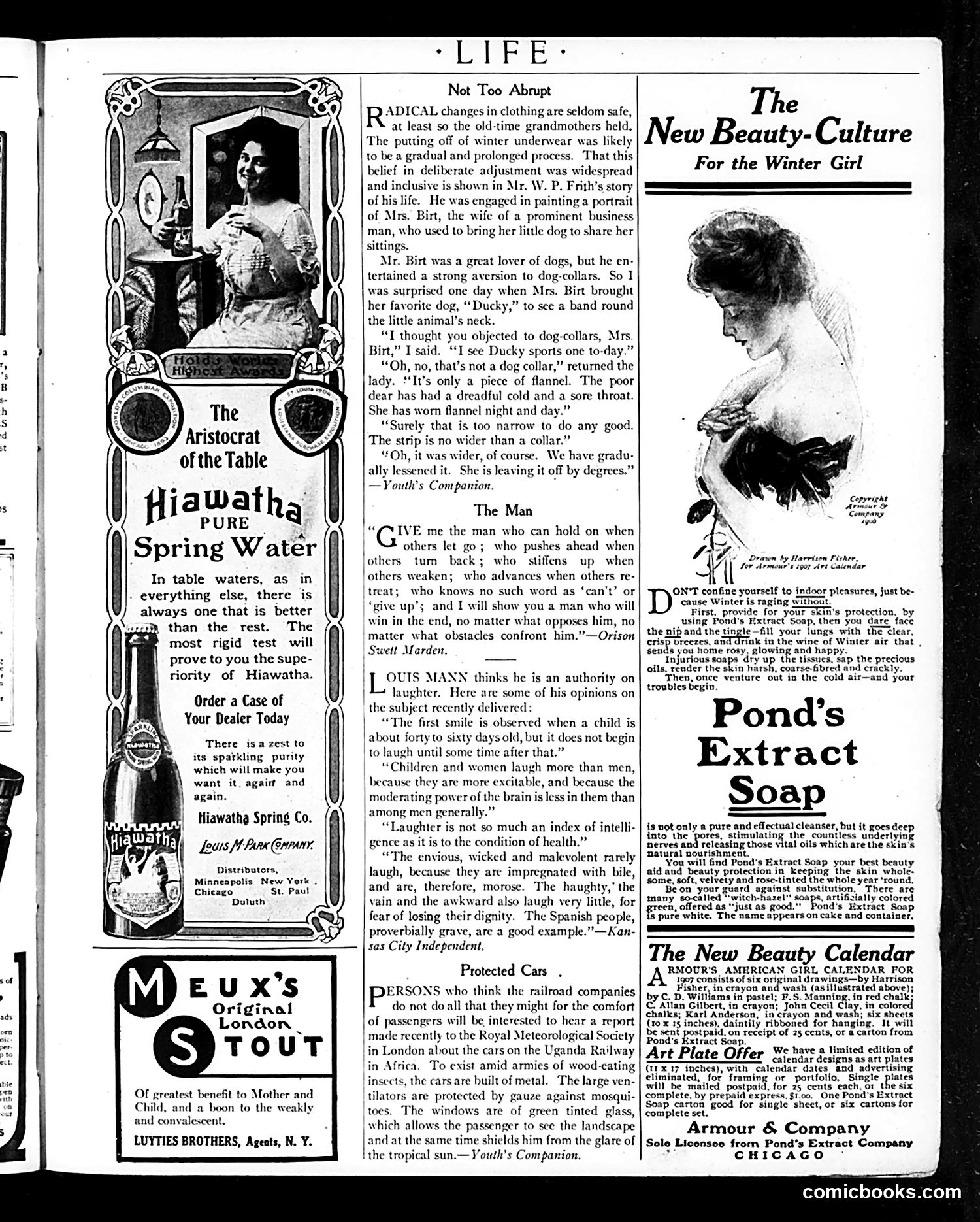
This page is primarily **advertisements and brief feature articles** rather than political satire. The main content includes: **Advertisements**: Hiawatha Spring Water, Meux's London Stout, and Pond's Extract Soap dominate the layout. **Feature Articles**: The substantive text consists of three short, moralizing pieces: 1. "Not Too Abrupt"—an anecdote about gradual clothing changes, illustrating the old wisdom that abrupt transitions (removing winter underwear) are unhealthy 2. "The Man"—an inspirational quote attributed to Orison Swett Marden about perseverance and determination 3. "Louis Mann on Laughter"—observations about laughing as a health indicator, suggesting the envious and vain laugh less 4. "Protected Cars"—a brief note praising Uganda Railway cars' mosquito and insect protection The page reflects early 20th-century *Life* magazine's mix of light humor, self-improvement content, and commercial messaging. There is no sharp political satire visible here—instead, it's genteel, advice-oriented content typical of the era's middle-class publications.
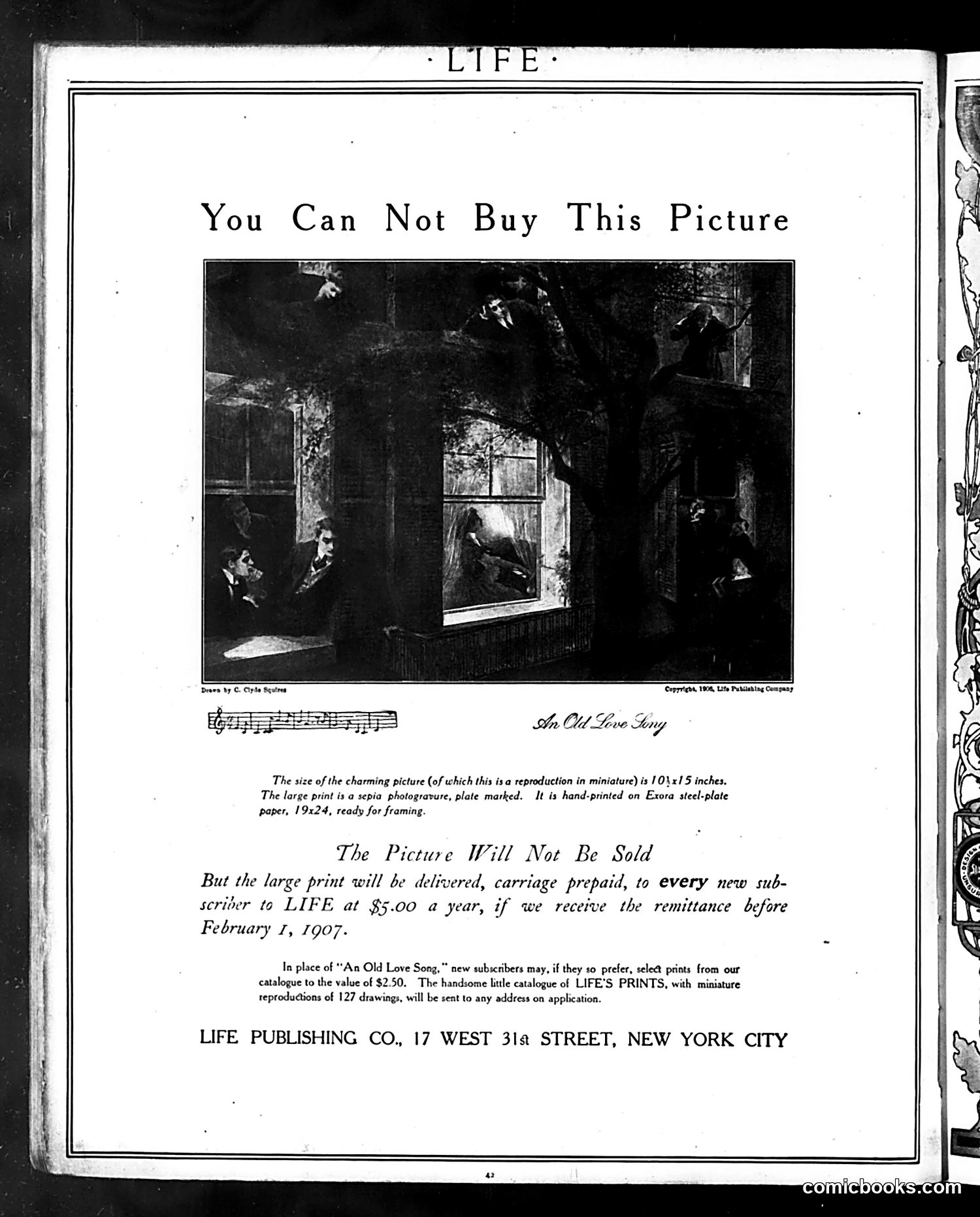
This is primarily a **subscription advertisement** rather than political satire. The page promotes Life magazine's subscription offer by showcasing an illustration titled "An Old Love Song," drawn by C. Clyde Squires. The image depicts a **romantic street scene**: figures in period dress gathered outside a lit window at night, suggesting a serenade or courtship scenario. The "old love song" theme appeals to sentimental readers. **The actual offer**: New subscribers paying $5.00 yearly before February 1, 1907 receive a large hand-printed sepia photogravure (19x24 inches) of this artwork, suitable for framing—free. Alternatively, subscribers could select other prints from Life's catalog worth $2.50. This was a common early 20th-century marketing tactic: magazines bundled subscription incentives with art prints to attract customers. The page emphasizes the print's quality and exclusivity ("You Cannot Buy This Picture"), making subscription the only means to obtain it.
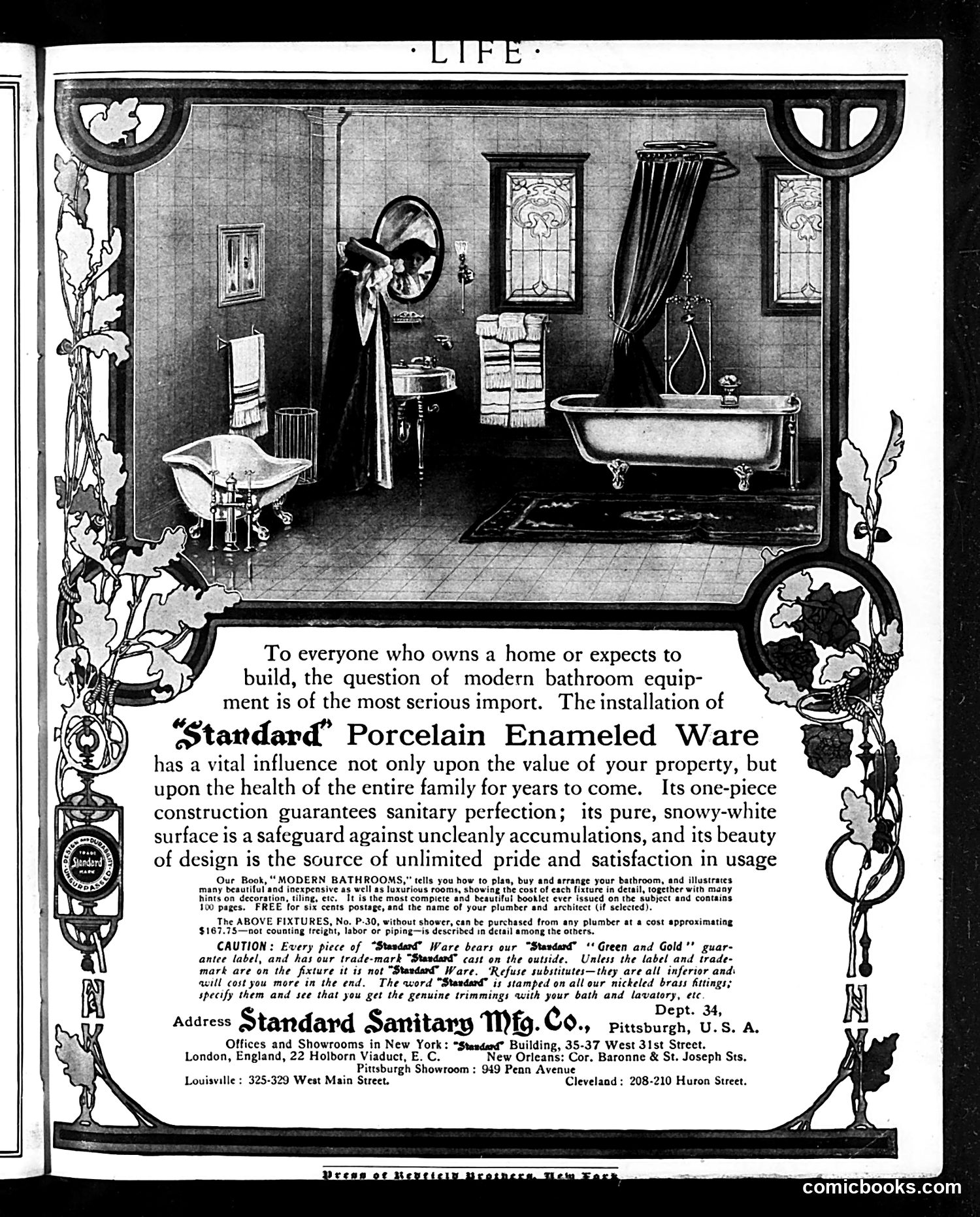
This is a **full-page advertisement**, not satirical content. It promotes Standard Sanitary Manufacturing Company's bathroom fixtures—toilets, sinks, and tubs. # The Message The ad addresses homeowners, claiming that modern porcelain-enameled bathroom equipment affects both property value and family health. It emphasizes "sanitary perfection" through one-piece construction and pure white surfaces that resist "uncleanly accumulations." The illustrated bathroom shows an elegant, contemporary setup typical of early 20th-century luxury. The ad warns against counterfeits, instructing buyers to verify the "Standard" trademark and "Green and Gold" guarantee label. # Historical Context This reflects an era when indoor plumbing and modern sanitation were still relatively new luxuries associated with status and health consciousness. The detailed showroom addresses and free booklet offer suggest this was a major purchase decision for middle/upper-class homeowners.
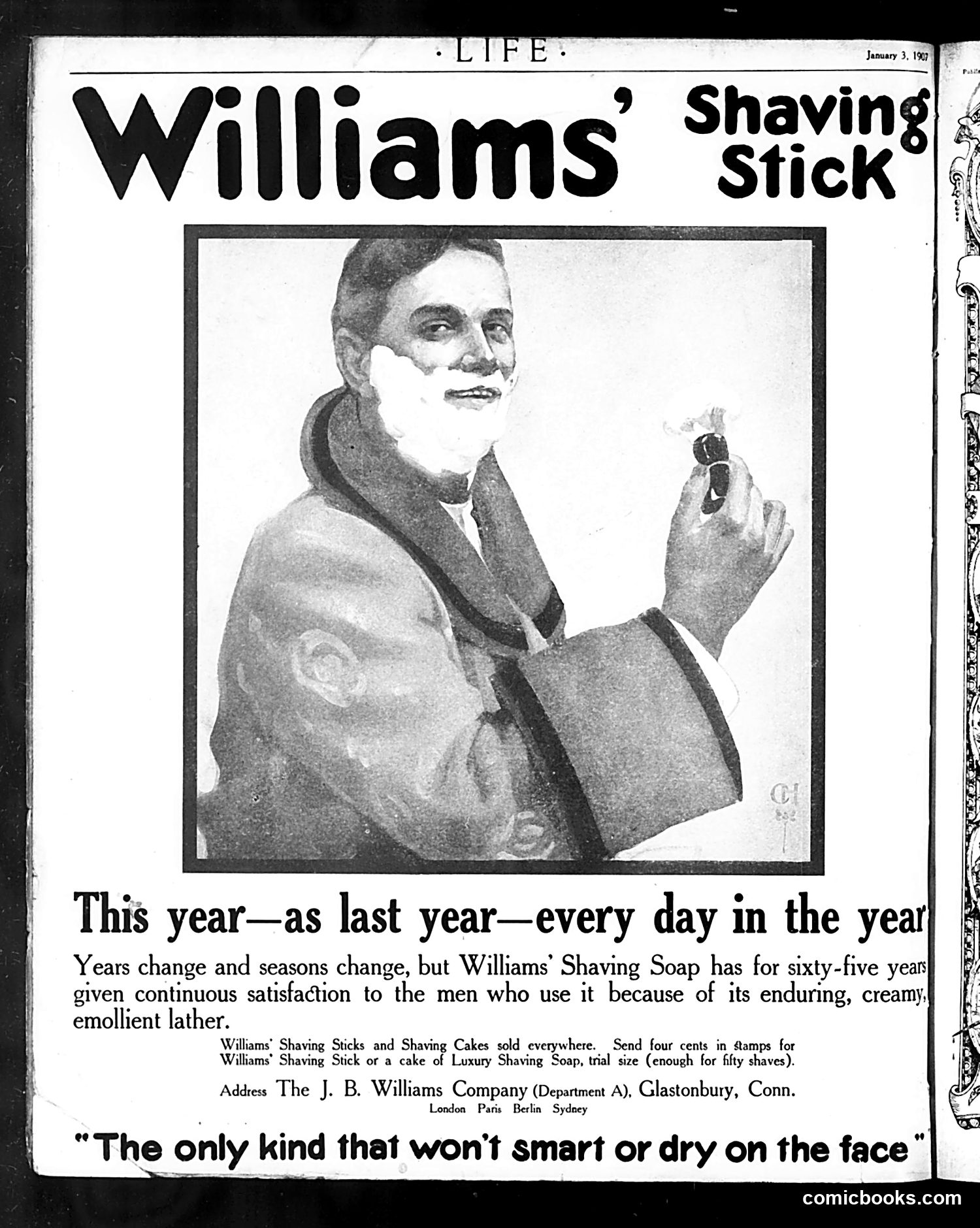
This is primarily a **product advertisement**, not political satire. It appears in *Life* magazine from January 3, 1902, promoting Williams' Shaving Soap. The image shows a man applying shaving soap with a satisfied expression. The advertisement emphasizes the product's 65-year track record and claims its soap produces a "creamy, emollient lather" that "won't smart or dry on the face"—addressing common complaints about competing shaving products of the era. The tagline positions Williams as superior to rivals that irritated skin. The company offered trial sizes for four cents in stamps, a common early 20th-century marketing tactic. The international distribution (London, Paris, Berlin, Sydney) indicates this was a major commercial product. This represents typical turn-of-the-century advertising content within *Life*'s pages.