
Life, 1907-01-03 · page 20 of 44
Life — January 3, 1907 — page 20: what you’re looking at
What you’re looking at
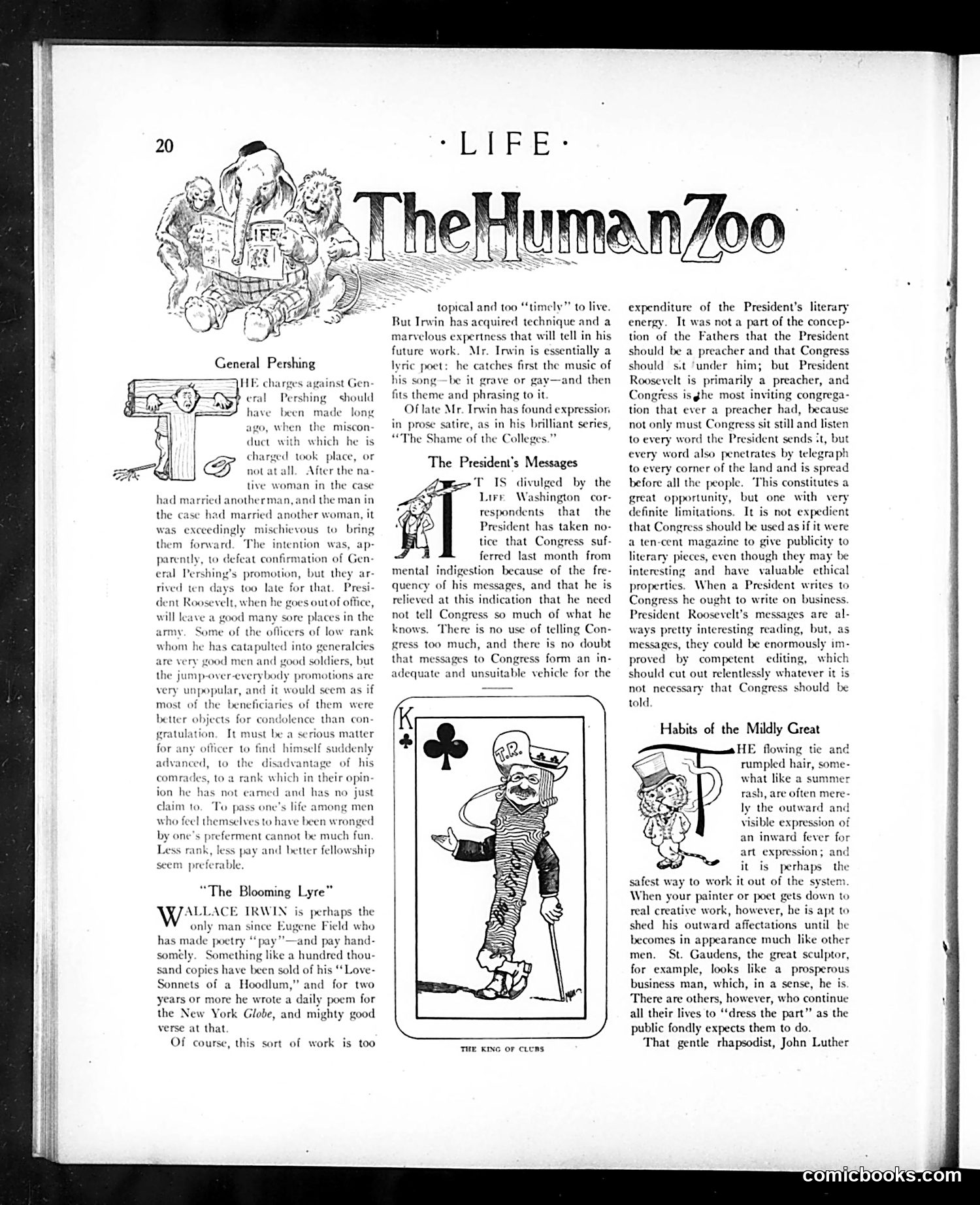
This page critiques **General John J. Pershing** and President **Theodore Roosevelt**. The **Pershing section** attacks the timing of misconduct charges against him—allegations involving a "native woman" that surfaced only after everyone involved had remarried. Life argues these charges should have been raised immediately or not at all, suggesting they were politically motivated to block his promotion (though they arrived too late). The piece also criticizes Roosevelt for making unpopular rapid promotions that anger senior officers who feel passed over. The **"King of Clubs" playing card illustration** appears to reference these military promotion controversies, though the exact connection isn't entirely clear. The **President's Messages section** satirizes Roosevelt's excessive written communications to Congress. Life argues that while Roosevelt's messages are "interesting reading," they abuse Congress's captive audience—messages penetrate nationwide via telegraph, turning legislative correspondence into personal publicity for the President's literary talents. Congress, Life suggests, should receive only necessary business communications, not presidential essays.
📄 Transcribed text from this page (OCR, searchable)
Machine-transcribed from the original scan — historical spelling and the odd misread are preserved.
General Pershing HE charges against Gen. eral Pershing should have made long ago, when the miscon been duct with which he is charged took place, or notatall. After the na- tive woman in the case had married anotherman, and the man in the case had married another woman, it was exceedingly mischievous to bring them forward. The intention was, ap- parently, to defeat confirmation of Gen eral Pershing’s promotion, but they ar- rived ten days too late for that. Presi- dent Roosevelt, when he goes outof office, will leave a good many sore places in the army. Some of the officers of low rank whom he has catapulted into generalcies are very good men and the jump-over-everybody promotions are very unpopular, and it would scem as if most of the vod soldiers, but beneficiaries of them were better objects for condolence than con Tt must be a serious matter for any officer to find himself suddenly gratulation advanced, to the diss comrades, to a antage of his rank which in their opin- ion he has not camed and | claim to. sno just pass one’s life among men who feel themselves to have been wronged by one’s preferment cannot be much fun Less rank, less pay and better fellowship seem preferable. “The Blooming Lyre” ALLACE IRWIN is perhaps the only man since Eugene Field who has made poetry “ pay”’—and pay hand- somely. Something like a hundred thou- sand copies have been sold of his ‘ Love- Sonnets of a Hoodlum,” and for two years or more he wrote a daily poem for the New York Globe, and mighty good verse at that Of course, this sort of work is too topical and too “timely” to live. But Invin has acquired technique and a marvelous expertness that will tell in his future work. Mr. Inwin is essentially a lyric poet: he catches first the music of his song—be it grave or gay—and then fits theme and phrasing to it Of late Mr. Inwin has found expression: in prose satire, as in his brilliant series, “The Shame of the Colleges.” The President's Messages T IS divulged by the Lire Washington cor- respondents that the President has taken no- tice that Congress suf- ferred last month from mental indigestion because of the fre- quency of his messages, and that he is relieved at this indication that he need not tell Congress so much of what he knows. There is no use of telling Con- gress too much, and there is no doubt that messages to Congress form an in- adequate and unsuitable vehicle for the Tue KING OF CLCRS expenditure of the President’s literary energy. It was not a part of the concep- tion of the Fathers that the President hould be a preacher and that Congress should sit ‘under him; but President Roosevelt is primarily a preacher, and Congress isghe most inviting congrega- tion that ever a preacher had, becat not only must Congress sit still and listen to every word the President sends it, but every word also penetrates by telegraph to every corner of the land and is spread before all the people. ‘This constitutes a great opportunity, but one with very definite limitations. It is not expedient that Congress should be used as if it were a ten-cent magazine to give publicity to literary pieces, even though they may be interesting and have valuable ethical properties, When a President writes to Congress he ought to write on business. President Roosevelt’s messages are al- ways pretty interesting reading, but, as messages, they could be enormously im- proved by competent editing should cut out relentlessly whatever it is not necessary that Congress should be told. Habits of the Mildly Great HE flowing tie and rumpled hair, some- what like a summer rash, are often men ly the outward an visible expression of an inward fever for art expression; and it is perhaps the safest way to work it out of the system When your painter or poet gets down to eal creative work, however, he is apt to shed his outward affectations until be becomes in appearance much like other men. St. Gaudens, the great sculptor, for example, looks like a prosperous business man, which, in a sense, he is. ‘There are others, however, who continue all their lives to “dress the part” as the public fondly expects them to do. That gentle rhapsodist, John Luther