
Life, 1907-01-03 · page 24 of 44
Life — January 3, 1907 — page 24: what you’re looking at
What you’re looking at
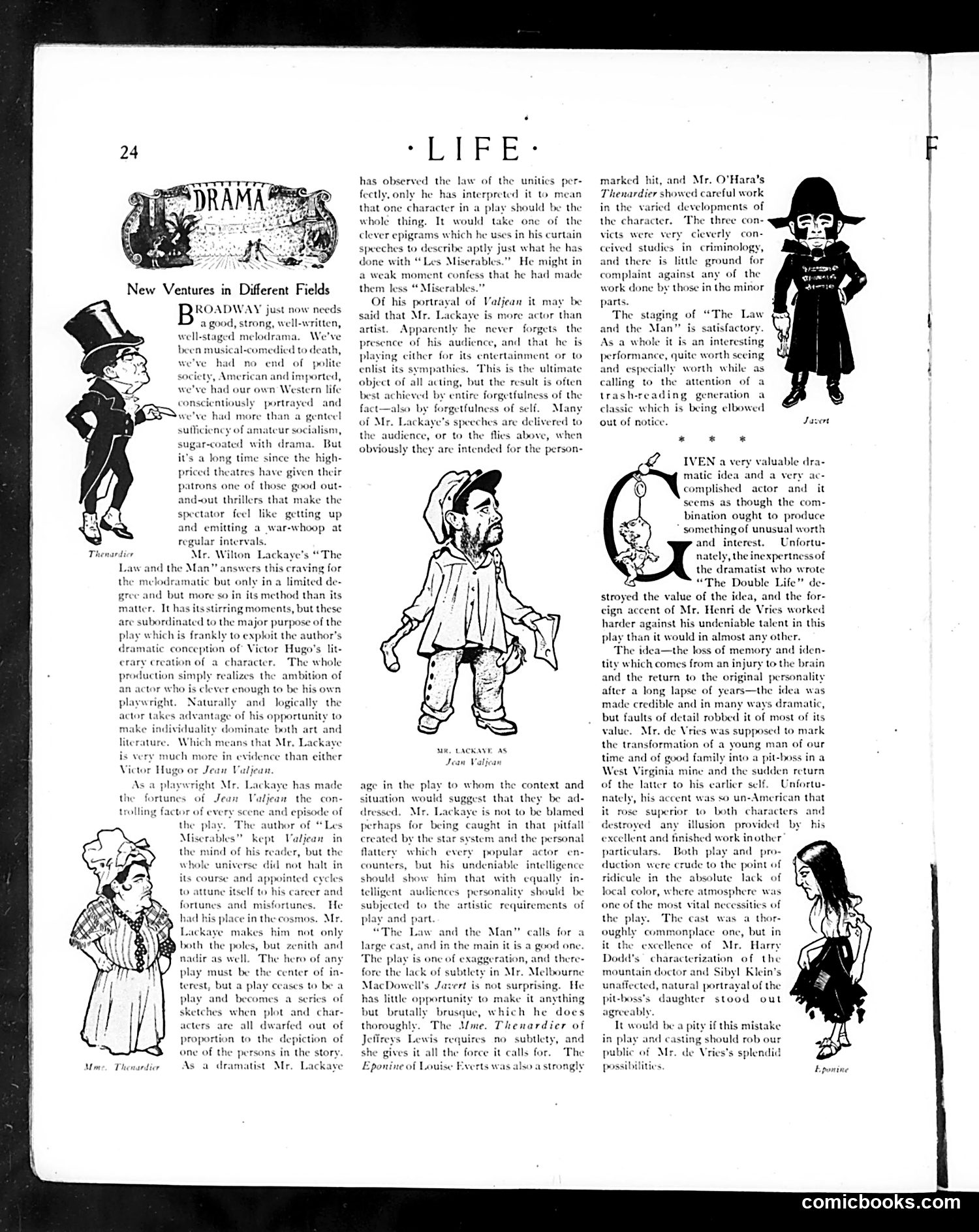
This page critiques actor **Wilton Lackaye's** stage production of "The Law and the Man" (based on Victor Hugo's "Les Misérables"). The satirical illustrations caricature Lackaye in various theatrical poses. **The satire's point:** Lackaye, while talented, allows his ego to dominate the production. The critic argues he interprets dramatic unity to mean one character—himself—must overshadow everything else. Rather than inhabit Jean Valjean authentically, Lackaye performs *for* the audience, delivering speeches to spectators or the flies above rather than to other characters onstage. **The complaint:** This reflects the "star system" problem—popular actors exploiting their status at the expense of artistic integrity. The critic suggests intelligent actors should subordinate personality to dramatic requirements, not vice versa. The page also mentions other supporting performances (Melbourne MacDowell's Javert) as adequately exaggerated for the melodramatic material, but Lackaye's self-aggrandizement undermines the work's dramatic coherence.
📄 Transcribed text from this page (OCR, searchable)
Machine-transcribed from the original scan — historical spelling and the odd misread are preserved.
New Ventures in Different Fields ROADWAY just now needs a good, strong, well-written, well-staged melodrama. W been musical-comedied to death we've had no end of polite society, American and imported, ve we've had our own Western life conscientiously portrayed and we've had more than a genteel sulliciency of amateur socialism, dr But me since the high- sugar-coated w it’s a long 1 theatres have given their d-out thrillers that n the spectator feel like getting up and emitting a war-whoop at regular intervals. Mr. Wilton Lackaye’s “The 1 the Man” answers this craving for Law an he melodramatic but only in a limited de- grec and but more so in its method than its matter, It has itsstirring moments, but these are subordinated to the major purpose of the play which is frankly to exploit the author's dramatic conception of Victor Hugo's lit- acter. ‘The whole realizes the ambition of 1 actor who is clever enough to be his own playwright. Naturally and logically the actor takes advantage of his opportunity to make individuality dominate both art and literature. Which means that Mr, Lackaye is very much more in evidence than either Victor Hugo or Jean Valjean As a playwright Mr. Lackaye has made the fortunes of Jean Valjean th trolling factor of every sc the play Miserables the 1 crary creation of a ch, duction simp! con- ¢ and episode of ne author of “Les kept. Valjean in d of his reader, but the tin its course and appointed cyc le universe did not h, to attune itself to his career and fortunes and misfortunes. He had his place in th . Mr. Lackaye makes him not only ysmc Y both the poles, but zenith and nadir as well. The hero of play must be the center of terest, but a play ceases te play and becomes a series of any be a sketches when plot and acters are all dwarfed out proportion to the depiction of one of the As a dramatist. Mr. Lackaye persons in the story * Td FE ° has observed the law of the unitics per- fectly, only he has interpreted it to mean that one character in a play should be the whole thing. It would take one of the clever ¢ speeches to describe aptly just what igrams which he uses in his curtain has done with “Les Miserables.” He might in a weak moment confess that he had made them less “ Miserables.” Of his portrayal of Valjean it may be said that Mr. Lackaye is more actor than artist. Apparently he never forgets the presence of his audience, and that he is playing cither for its entertainment or to enlist its sympathies, ‘This is the ultimate cling, but the result is often best achieved by entire forgetfulness of the fact—also by forgetfulness of self. Many of Mr. Lackaye’s speeches are delivered the audience, or to the flies above, when 'y are intended for the person- object of all MR. LACKAVE AS. I Valjean age in the play to whom the context and situation would suggest that they be ad- dressed. Mr. Lackaye is not to be blamed perhaps for being caught in that pitfall created by the star system and the personal flattery which every popular actor en- counters, but his undeniable intelligence should. s! oe him that with equally in- telligent audiences personality should be ted to the artistic requirements of y and part “The Law and the Man" calls for a large cast, and in the main it is a good one The play is onc of exaggeration, and there- fore the lack of subtlety in Mr. Melbourne MacDowell's Javert is not surprising. He has little opportunity to make it anything but brutally brusque, which he docs thoroughly. The Mme. Thenardier of Jefireys Lewis requires no subtlety, and she gives it all the calls for. The Eponine of Louise Everts was also a strongly sul roe marked hit, and Mr. O'Hara's Thenardier showed careful work in the varied developments of the character, ‘The three con- victs were very cleverly con- ceived studies in criminology, and there is littke ground for complaint against any of the work done by those in the mi parts. The staging of “The Law and the Man” is satisfactory. As a whole it is an interesting performance, quite worth seeing nd. especially h while as calling to the attention of a trash-reading generation a classic which is being elbowed out of notice. Saver * £ 2 IWENa ve matic idea and a very complished actor and it scems as though the com- bination ought to produce somethingof unusual worth and interest. Unfortu- nately, the inexper the dramatist who wrote “The Double Life” de- stroyed the value of the idea, and the for- cign accent of Mr. Henri de Vries worked harder against his undeniable talent in this play than it would in almost 3 The idea—the loss of memory and iden- tity which comes from an injury to the brain and the return to the original personality after a long lapse of years—the idea was made credible and in many ways dramatic, but faults of detail robbed it of most of its value. Mr. de Vries was supposed to mark the transformation of a young man of our time and of good family into a pit-boss in a West Virginia mine and the sudden return of the latter to his earlier self. Unfortu. nately, his accent was so un-American that it rose superior to both characters and stroyed any illusion provided by his excellent and fi hed work inother particulars. Both play duction were crude to the point of ridicule in the absolute lack of local color, where atmosphere was one of the most vital necessities of the play. The cast was a thor- oughly commonplace one, but in it the excellence of Mr. Har Dodd's characterization of the mountain doctor and Sibyl Klein’s unaffected, natural portrayal of the essof ny other. and pro- pit-boss’s daughter stood out agreeably It would be a pity if this mistake in play and casting should rob our public of Mr. de Vries's splendid possibilities. comicbooks.com i