
Life, 1907-01-03 · page 25 of 44
Life — January 3, 1907 — page 25: what you’re looking at
What you’re looking at
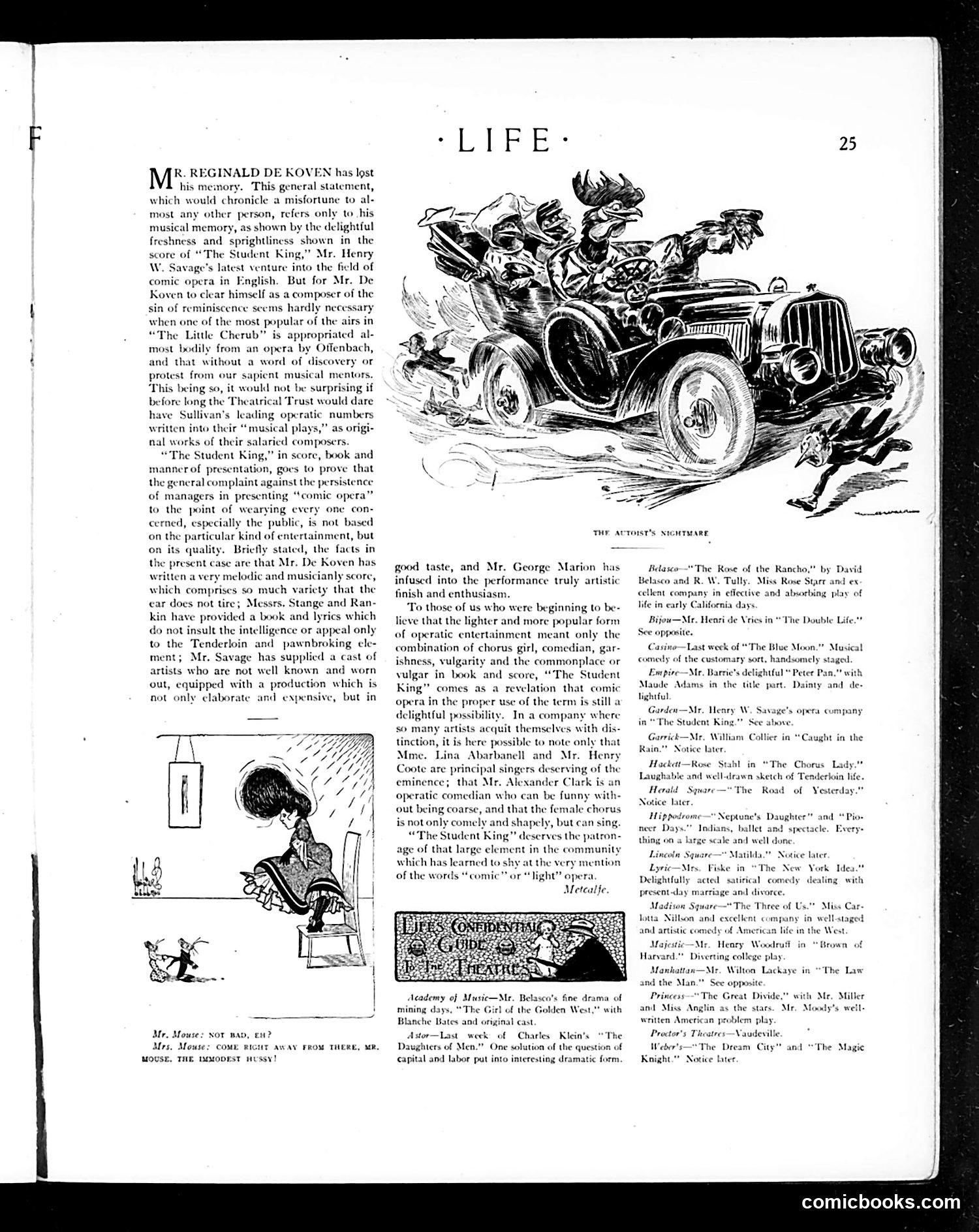
This page reviews "The Student King," a comic opera by composer Reginald De Koven. The critic praises the production while making a pointed argument about quality in popular entertainment. **The Main Satire:** The critic notes De Koven has "lost his memory"—he's accused of borrowing heavily from other composers (specifically Offenbach) without acknowledgment. Yet the reviewer uses this irony to defend him: if even established composers plagiarize without protest, why shouldn't theatrical managers do the same with Sullivan's work? **The Point:** The real target is the degradation of comic opera through mediocre productions. "The Student King" succeeds because it features *quality*—melodic scores, intelligent lyrics, and talented performers—rather than the typical formula of "chorus girl, comedian, garishness, vulgarity." **The Cartoons:** The top illustration shows an "Automist's Nightmare"—a car full of chaotic figures. The bottom strip depicts mice fleeing danger, captioned "Come right away from there, Mrs. Mouse. The lodgest not bad, eh?"—likely satirizing theatrical excess or slapstick comedy's appeal.
📄 Transcribed text from this page (OCR, searchable)
Machine-transcribed from the original scan — historical spelling and the odd misread are preserved.
R. REGINALD DE KOVEN has lost his memory. This general statement, which would chronicle a misfortune to al- most any other person, refers only to his musical memory, as shown by the delightful eshness and sprightliness shown in. the ce of “The Student King,” Mr. Henry e's latest venture into the field of comic opera in English. But for Mr. De Koven to clear himself as a composer of the sin of reminiscence seems hardly necessary when one of the most popular of the airs in ne Little Cherub” is appropriated al- most bodily from an opera by Offenbach, and that without a word of discovery or protest from our sapient musical mentors. This being so, it would not be surprising if before long the Theatrical Trust would dare have Sullivan's leading operatic numbers written into their “musical plays,” as origi- nal works of their salaried composers. “The Student King,” in score, book and manner of presentation, goes to prove that the general complaint against the persistence of managers in presenting “comic opera” to the point of wearying every one con- cerned, especially the public, is not based on the particular kind of entertainment, but on its quality. Briefly stated, the facts in the present case are that Mr. De Koven has written a very melodic and musicianly score, which comprises so much variety that the not tire; Messrs. Stange and Ran- kin have provided a book and lyrics which do not insult the intelligence or appeal only to the Tenderloin and pawnbroking cle- ment; Mr. Savage has supplicd a cast of artists who are not well known and worn out, equipped with a production which is not only claborate and expensive, but in car do Mr. Mouse Mrs, Mouse: Come RIGHT AWAY FROM THERE, a MOUSE. THE IstopEst NOT BAD, EM? seed THY AUTOIST'S NIGHTMARE good taste, and Mr. George Marion has infused into the performance truly artistic finish and enthusiasm. To those of us who were beginning to be- lieve that the lighter and more popular form of operatic entertainment meant only the combination of chorus girl, comedian, gar- ishness, vulgarity and the commonplace or vulgar in book ‘and score, “The Student King” comes as a re n that comic opera in the proper use of the term is still a delightful possibility, In a company where so many artists acquit themselves with dis- tinction, it is here possible to note only that Mme. Lina Abarbanell and Mr. Henry Coote are principal singers deserving of the eminence; that Mr. Alexander Clark is an operatic comedian who can be funny with- out being coarse, and that the female chorus is noton and shapely, but can sing. “The Student King” deserves the patron- age of that large element in the community which has learned to shy at the very mention of the words “comic” or “light” opera Metcalfe. Academy of Music—Mr. Belasco’s fine mining days, “The Girl of the Golden W Blanche Bates and original cast Astor—Last_ week of Charles Klei Daughters of Men." One solution of the question of capital and labor put into interesting dramatic form Belasco—""The Rose of the Rancho Belasco and R. W. Tully Rose cellent company in effective and absorbi life in * by David Lex ay of California days. Bijou—Mr. Heari de Vries in “The Double Life." See oppe Casine—Last week of “The Blue Moon."” Musical comedy of the customary sort, handsomely staged. Em pire—Mr. Barrie's delightful * Peter Pan,” with Maude Adams in the title part. Dainty and de- lightful den—Mr. Henry W. Savage's opera company in the Notice later Hackett—Rose Stabl in “The Chorus U-drawn sketch of Tende: ald S “The Road of Ye ice later. Hippo * Neptune's Dau, and “ neer Days.” Indians, ballet and spectacle. Every thing oa c scale and well d Lincoln Square—* Matilda.” Notice latee Fiske in “The New York Idea." acted sat present-day marriage and The Three of U lotta Nillkon and excellent company and artistic comes he West Mr. Heary Woodruff in “Brown of Diverting college play ical comedy dealing with Madis well-staged £ American life Majest Harvard. Manhattan—Mr. Wilton Lackaye in and the Man. “The Law See opposite The Great Divide,” with Me. Miller Anglin as the stars, Mr. Moody's wetl- nerican problem play Proctor's T Vaudeville Weber's—"'The Dream City” and “The Magic Knight.” Notice later comicbooks.com