
Life, 1907-01-03 · page 19 of 44
Life — January 3, 1907 — page 19: what you’re looking at
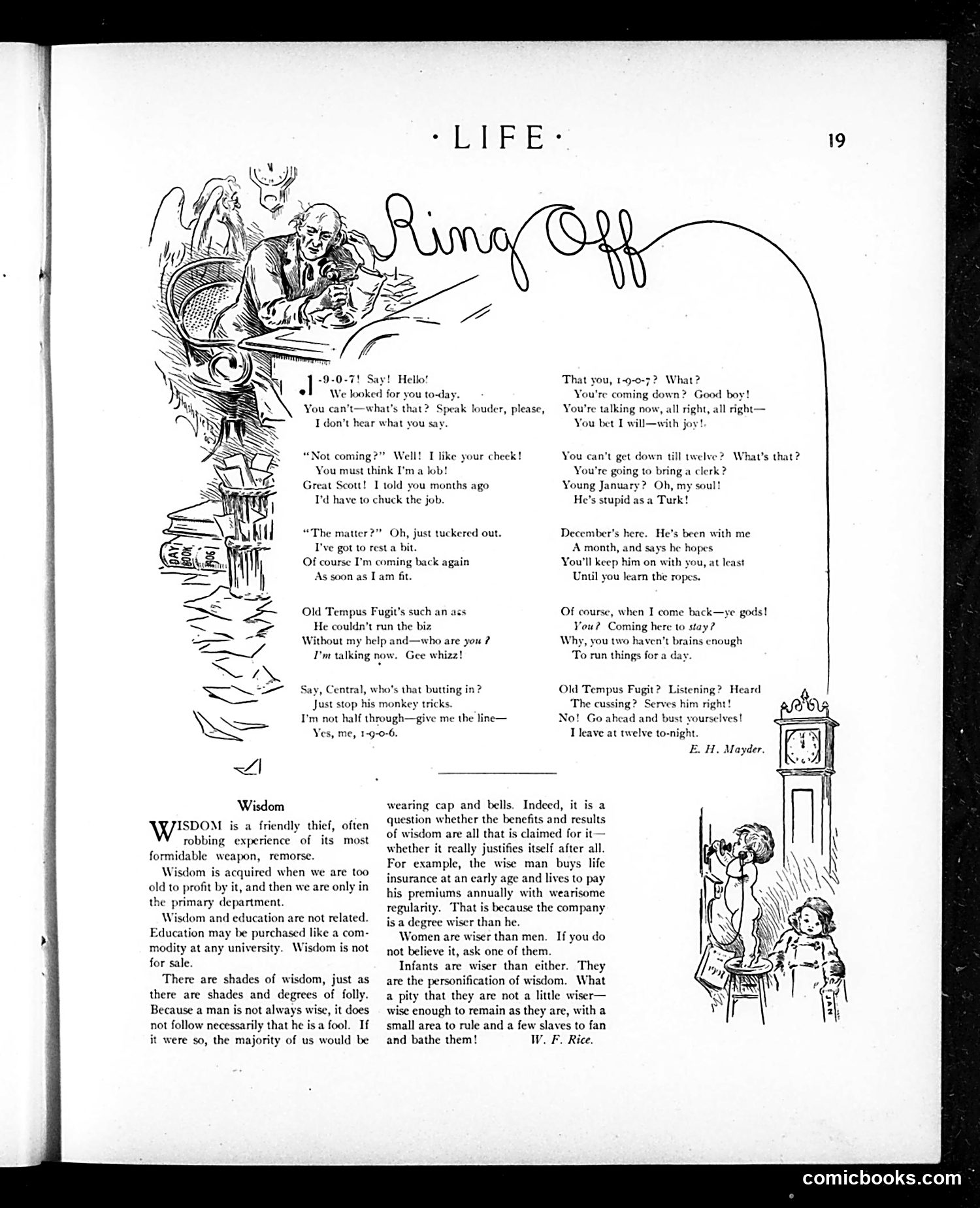
What you’re looking at
This is a humorous dialogue cartoon satirizing early 1900s telephone etiquette and workplace dynamics. The speaker (likely representing the year 1906, based on "1-9-0-6") is arguing with someone called "1-9-0-7" (presumably 1907) about staffing and job responsibilities. The joke centers on a departing employee ("Old Tempus Fugit"—Latin for "time flies") who's abandoning his job, leaving incompetent replacements (December and Young January, personified months) to manage the business. The incoming year 1907 complains these replacements lack basic competence ("haven't brains enough to run things for a day"). The satire mocks both: workplace chaos caused by poor succession planning, and the absurdity of 1906 anthropomorphically handing off to 1907—a New Year's greeting disguised as office complaint. The "Wisdom" essay below offers philosophical commentary on foolishness and competence, complementing the cartoon's theme.
📄 Transcribed text from this page (OCR, searchable)
Machine-transcribed from the original scan — historical spelling and the odd misread are preserved.
] 9-0-7! Say! Hello! el We looked for you to-day. You can't—what’s that? Speak louder, please, I don’t hear what you say. “Not coming?” Well! I like your cheek! You must think I'm a lob! Great Scott! I told you months ago I'd have to chuck the job. “The matter?” Oh, just tuckered out. I've got to rest a bit. Of course I'm coming back again As soon as Tam fit. Old Tempus Fugit’s such an acs He couldn’t run the biz Without my help and—who are you ? I'm talking now. Gee whizz! Say, Central, who's that butting in? Just stop his monkey tricks. I'm not half through—give me the line— Yes, me, 1-9-0-6. ‘ou, 1-9-0-7? What? You're coming down? Good boy! You're talking now, all right, all right— You bet I will—with joy! You can't get down till twelve? What's that? You're going to bring a clerk? Young January? Oh, my soul! He's stupid as a Turk! December's here. He's been with me A month, and says he hopes You'll keep him on with you, at least Unuil you learn the ropes. Of course, when I come back—ye gods! You? Coming here to stay? Why, you two haven't brains cnough To run things for a day. Old Tempus Fugit? Listening? Heard ‘The cussing? Serves him right! No! Go ahead and bust yourselves! T leave at twelve to-night E. H. Mayder. wearing cap and bells. Indeed, it is a ISDOM is a friendly thief, often robbing experience of its most formidable weapon, remorse. Wisdom is acquired when we are too old to profit by it, and then we are only in the primary department. Wisdom and education are not related. Education may be purchased like a com- modity at any university. Wisdom is not for sale. There are shades of wisdom, just as there are shades and degrees of folly. Because a man is not always wise, it does not follow necessarily that he isa fool. If it were so, the majority of us would be question whether the benefits and results of wisdom are all that is claimed for it whether it really justifies itself after all. For example, the wise man buys life insurance at an carly age and lives to pay his premiums annually with wearisome regularity, ‘That is because the company is a degree wiser than he. Women are wiser than men. If you do not belie , ask one of them. Infants are wiser than cither. They are the personification of wisdom. What a pity that they are not a little wiser-— wise enough to remain as they are, with a small area to rule and a few slaves to fan and bathe them! W. F. Rice. comicbooks.com