
Life, 1907-01-03 · page 33 of 44
Life — January 3, 1907 — page 33: what you’re looking at
What you’re looking at
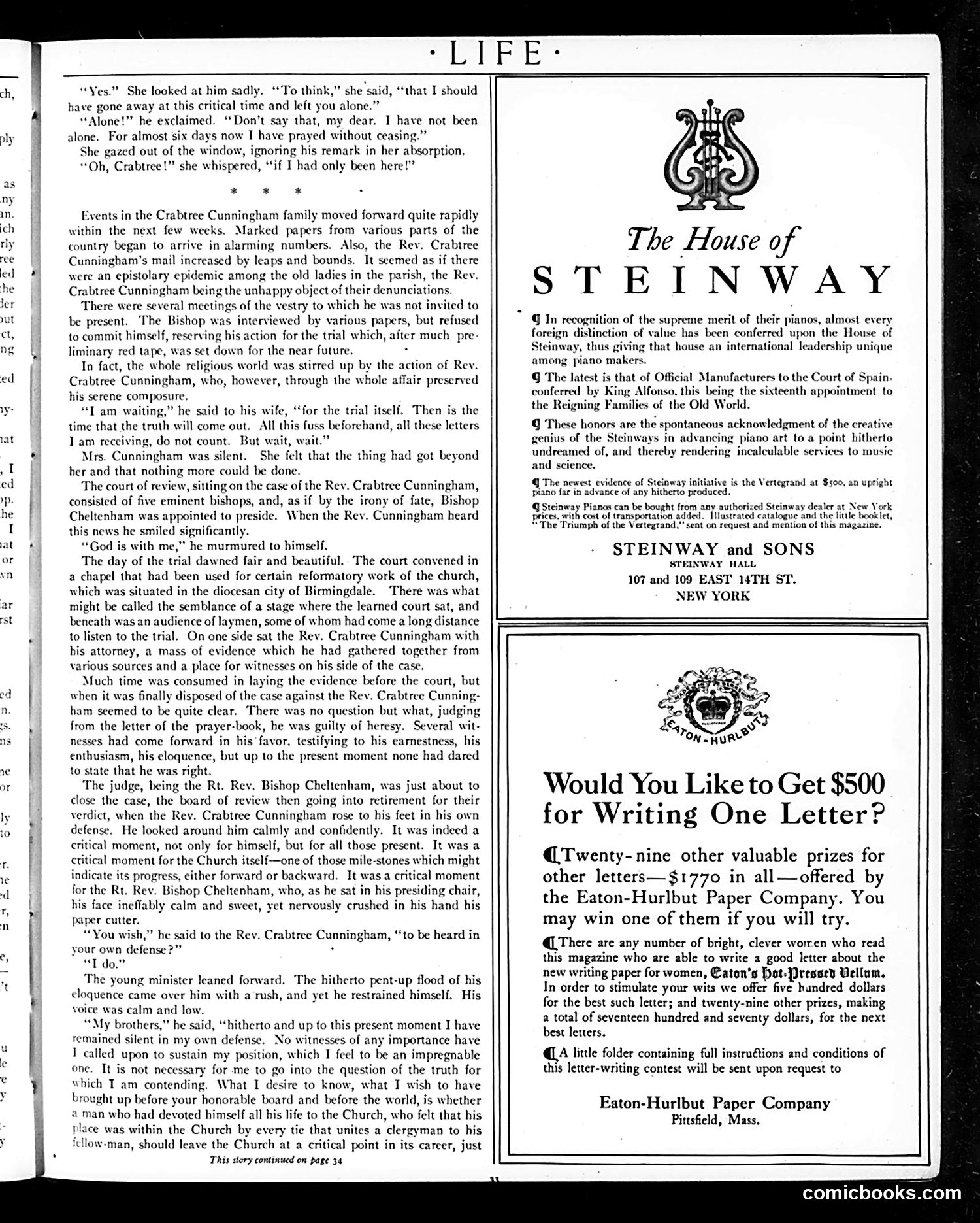
This page presents a serialized fiction story (continued from page 14) about Rev. Crabtree Cunningham, a clergyman accused of heresy. The narrative follows his ecclesiastical trial before five bishops, with Bishop Cheltenham presiding. **The Satire's Point:** The story satirizes rigid religious institutional authority and hypocrisy. Cunningham's wife and parishioners condemn him through letters, yet he maintains serene confidence in his righteousness. The irony deepens when his accuser—Bishop Cheltenham—must judge him, creating potential bias. The text emphasizes this is a "critical moment" for the Church itself, suggesting the institution's credibility hangs on the verdict. **The Social Context:** This reflects early 1900s anxieties about modernism versus church doctrine, and the power structures within religious hierarchies that could weaponize "heresy" charges against reformist clergy. The right page is primarily **advertising**: Steinway pianos and an Eaton-Hurlbut Paper Company contest offering $500 for letter-writing—unrelated to the fiction.
📄 Transcribed text from this page (OCR, searchable)
Machine-transcribed from the original scan — historical spelling and the odd misread are preserved.
e y TIESIRERE™: “Yes.” She looked at him sadly. ‘*To think,” she’ said, “that I should have gone away at this critical time and left you alone.” “Alone!’’ he exclaimed. ‘Don’t say that, my dear. I have not been alone. For almost six days now I have prayed without ceasing.” She gazed out of the window, ignoring his remark in her absorption. “Oh, Crabtree!” she whispered, “if I had only been here!” * * * . Events in the Crabtree Cunningham family moved forward quite rapidly within the next few weeks. Marked papers from various parts of the country began to arrive in alarming numbers. Also, the Rev. Crabtree Cunningham's mail increased by leaps and bounds. It seemed as if there were an epistolary epidemic among the old ladies in the parish, the Rev. Crabtree Cunningham being the unhappy object of their denunciations. ‘There were several mectings of the vestry to which he was not invited to be present. ‘The Bishop was interviewed by various papers, but refused to commit himself, reserving his action for the trial which, after much pre- liminary red tape, was set down for the near future. 7 In fact, the whole religious world was stirred up by the action of Rev. Crabtree Cunningham, who, however, through the whole affair preserved his serene composure. “Tam waiting,” he said to his wife, ‘for the trial itself. Then is the time that the truth will come out. All this fuss beforehand, all these letters lam receiving, do not count. But wait, wait.” Mrs. Cunningham was silent. She felt that the thing had got beyond her and that nothing more could be done. The court of review, sitting on the case of the Rev. Crabtree Cunningham, consisted of five eminent bishops, and, as if by the irony of fate, Bishop Cheltenham was appointed to preside. When the Rev. Cunningham heard this news he smiled significantly. “God is with me,” he murmured to himself. The day of the trial dawned fair and beautiful. The court convened in a chapel that had been used for certain reformatory work of the church, which was situated in the diocesan city of Birmingdale. There was what might be called the semblance of a stage where the learned court sat, and beneath was an audience of laymen, some of whom had come a long distance to listen to the trial. On one side sat the Rev. Crabtree Cunningham with his attorney, a mass of evidence which he had gathered together from various sources and a place for witnesses on his side of the case. Much time was consumed in laying the evidence before the court, but when it was finally disposed of the case against the Rev. Crabtree Cunning- ham seemed to be quite clear. There was no question but what, judging from the letter of the prayer-book, he was guilty of heresy. Several wit- nesses had come forward in his favor. testifying to his earnestness, his enthusiasm, his eloquence, but up to the present moment none had dared to state that he was right. The judge, being the Rt. Rev. Bishop Cheltenham, was just about to close the case, the board of review then going into retirement for their verdict, when the Rey. Crabtree Cunningham rose to his feet in his own defense. He looked around him calmly and confidently. It was indeed a critical moment, not only for himself, but for all those present. It was a critical moment for the Church itself—one of those mile-stones which might indicate its progress, either forward or backward. It was critical moment for the Rt. Rev. Bishop Cheltenham, who, as he sat in his presiding chair, his face ineffably calm and sweet, yet nervously crushed in his hand his paper cutter. “You wish,” he your own defense?” “T do.” The young minister ed forward. ‘The hitherto pent-up flood of his eloquence came over him with a ‘rush, and yet he restrained himself. His voice was calm and low. “My brothers,” he said, ‘hitherto and up fo this present moment I have remained silent in my own defense. No witnesses of any importance have I called upon to sustain my position, which I feel to be an impregnable one. Tt is not necessary for me to go into the question of the truth for which T am contending. What I desire to know, what I wish to have brought up before your honorable board and before the world, is whether a man who had devoted himself all his life to the Church, who felt that his place was within the Church by every tie that unites a clergyman to his icllow-man, should leave the Church at a critical point in its career, just This story continued on page 34 id to the Rev. Crabtree Cunningham, ‘to be heard in STEINWAY The House of @ In recognition of the supreme merit of their pianos, almost every foreign distinction of value has been conferred upon the House of Steinway, thus giving that house an international leadership unique among piano makers. G The latest is that of Official Manufacturers to the Court of Spain, conferred by King Alfonso, this being the sixteenth appointment to the Reigning Families of the Old World. These honors are the spontaneous acknowledgment of the creative genius of the Steinways in advancing piano art to a point hitherto undreamed of, and thereby rendering incalculable services to music and science. The newest evidence of Steinway initiative is the Vertegrand at $500, an upright piano far in advance of any hitherto produced. @ Steinway Pianos can be bought from any authorized Steinway dealer at New York Prices. with cost of transportation added. Illustrated catalogue and the little booklet, “The Triumph of the Vertegrand,’" sent on request and mention of this magazine. STEINWAY and SONS STEINWAY HALL 107 and 109 EAST 14TH ST. NEW YORK Would You Like to Get $500 for Writing One Letter? @ Twenty-nine other valuable prizes for other letters—$1770 in all—offered by the Eaton-Hurlbut Paper Company. You may win one of them if you will try. @ There are any number of bright, clever worren who read this magazine who are able to write a good letter about the new writing paper for women, Gaton’s Hot- Presser Vellum, In order to stimulate your wits we offer five hundred dollars for the best such letter; and twenty-nine other prizes, making a total of seventeen hundred and seventy dollars, for the next best letters. @A litle folder containing full instruétions and conditions of this letter-writing contest will be sent upon request to Eaton-Hurlbut Paper Company Pittsfield, Mass. comicbooks.com