
Life, 1907-01-03 · page 16 of 44
Life — January 3, 1907 — page 16: what you’re looking at
What you’re looking at
This page satirizes corporate greed and labor exploitation during the Progressive Era. The main story, "History as It Is," mocks railroad directors who accumulate massive profits while ruthlessly rejecting workers' demands for higher wages and reasonable hours. The satire's target: corporate executives claim they cannot afford wage increases because trusts (monopolies controlling ice, coal, meat) have inflated costs—yet these same directors *are* trustees of those very trusts, profiting from the price-fixing that starves workers. The superintendent reports engineers work 15-hour days in dangerous conditions; brakemen earn starvation wages. The directors unanimously refuse any concession, planning instead propaganda and militia force. The cartoon's humor is bitter: the president decides to delay dividing the $30 million surplus "melon" until after crushing the strike—revealing their true priority is profit concentration, not "honest" stewardship. The page also contains brief commentary on New York's harsh conditions and reformed spelling in documents—typical Life magazine satirical notes.
📄 Transcribed text from this page (OCR, searchable)
Machine-transcribed from the original scan — historical spelling and the odd misread are preserved.
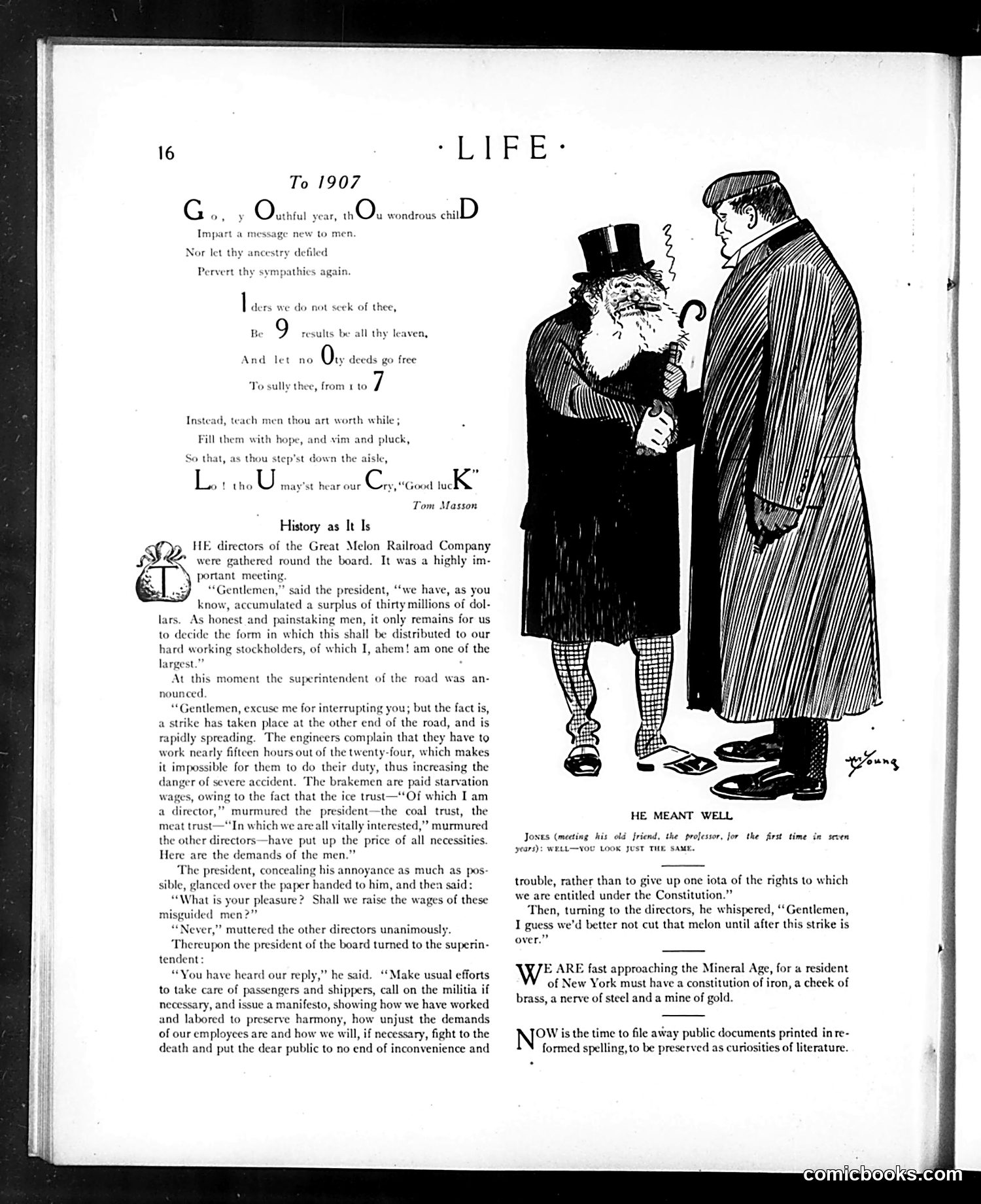
‘LAPS To 1907 Impart a mess: to men Nor let t y ancestry defiled Pervert thy sympathies again l ders we do not scek of thee, Be 9 results be all thy leaven, And let no 0: deeds go free To sully thee, from 1 to 7 Instead, teach men thou art worth while ; Fill them with hope, and vim and pluck, So that, as thou step’st down the aisle, Tom Masson History as It Is HE directors of the Great Melon Railroad Company were gathered round the board. It was a highly im- portant meeting “Gentlemen,” said the president, ‘we have, as you know, accumulated a surplus of thirty millions of dol- lars. As honest and painstal men, it only remains for us to decide the form in which this shall be distributed to our hard working stockholders, of which I, ahem! am one of the largest.” At this moment the superintendent of the road was an- nounced. “Gentlemen, excuse m interrupting you; but the fact is, a strike has taken place at the other end of the road, and is rapidly spreading. The engincers complain that they have to work nearly fifteen hours out of the twenty-four, which makes it impossible for them to do their duty, thus increasing the danger of severe accident. The brakemen are paid starvation wages, owing to the fact that the ice trust—Of which I am a director,” murmured the president—the coal trust, the meat trust—“‘In which we are all vitally interested,” murmured the other directors—have put up the price of all necessities. Here are the demands of the men.” The president, concealing his annoyance as much as sible, glanced over the paper handed to him, and the: “What is your pleasure? Shall we raise the wages of these misguided men?” “Never,” muttered the other directors unanimously. Thereupon the president of the board turned to the superin- tendent: “You have heard our reply,” he said. “Make usual to take care of passengers and shippers, call on the mil necessary, and issue a manifesto, showing how we have worked and labored to preserve harmony, how unjust the demands of our employees are and how we will, if necessary, fight to the death and put the dear public to no end of inconvenience and HE MEANT WELL Jones (meeting his old friend, the professor, Jor the first time in seven years): WELL—YOU LOOK JUST THE SAME. trouble, rather than to give up one iota of the rights to which we are entitled under the Constitution.” Then, tuming to the directors, he whispered, ‘Gentlemen, I guess we'd better not cut that melon until after this strike is over.”” E ARE fast approaching the Mineral Age, for a resident of New York must have a constitution of iron, a cheek of brass, a nerve of steel and a mine of gold. OW is the time to file away public documents printed in re- formed spelling, to be preserved as curiosities of literature.