
Life, 1907-01-03 · page 28 of 44
Life — January 3, 1907 — page 28: what you’re looking at
What you’re looking at
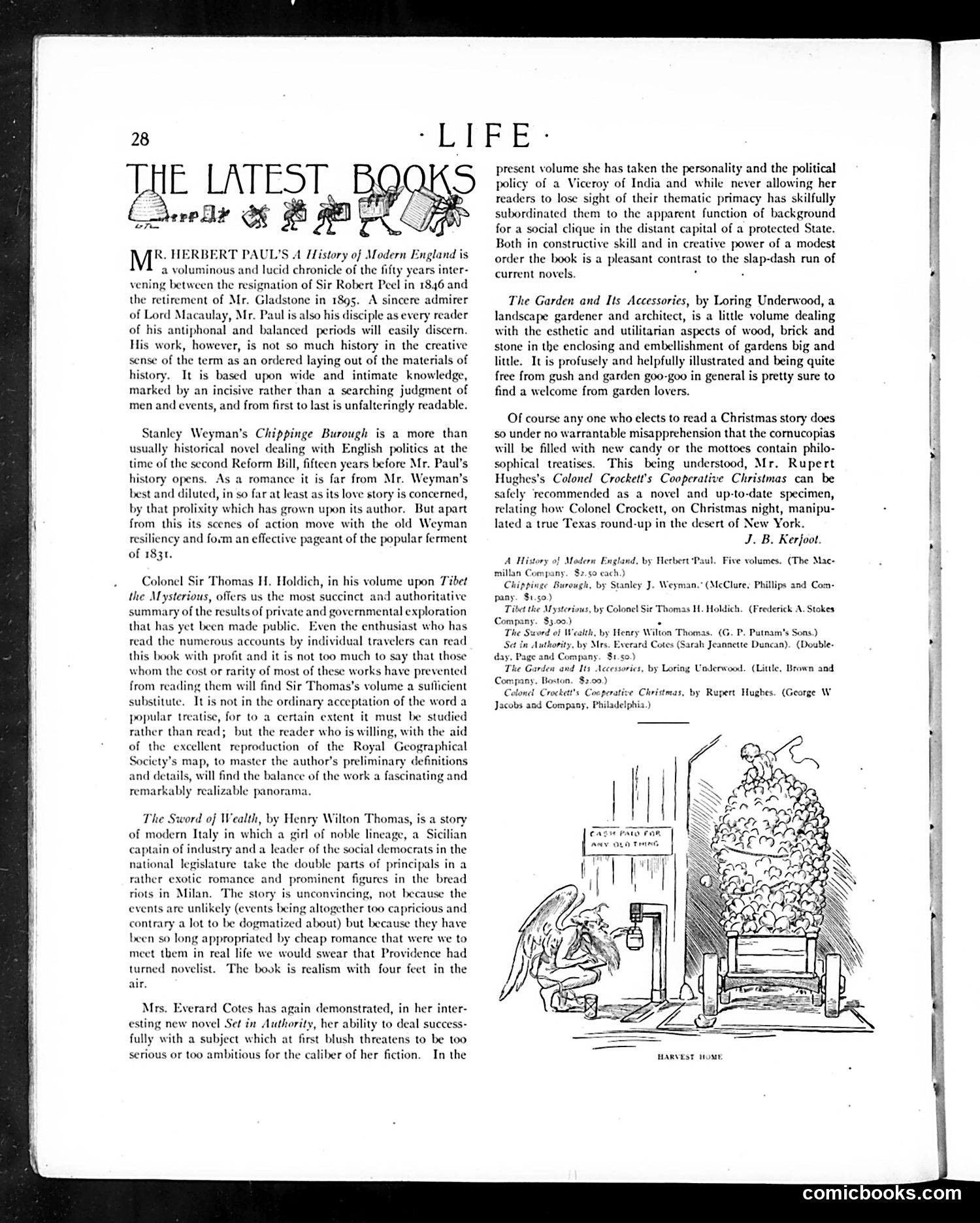
This is a book review section from *Life* magazine (page 28), not primarily satirical content. The page surveys recent literary publications, including Herbert Paul's history of England (1846-1895), Stanley Weyman's historical novel about the 1831 Reform Bill riots, and Colonel Holdich's exploration account of Tibet. The small illustration labeled "HARVEST HOME" appears to be decorative seasonal artwork accompanying a review of Loring Underwood's gardening book—showing a figure with harvest bounty near a cottage. The reviews are written in *Life*'s characteristic tone: urbane, witty, and occasionally barbed. For instance, the critic notes Weyman's novel suffers from "prolixity" and that another work's realism has "four feet in the air"—meaning it's unconvincingly melodramatic despite claiming modern authenticity. This represents *Life*'s literary criticism function rather than political satire.
📄 Transcribed text from this page (OCR, searchable)
Machine-transcribed from the original scan — historical spelling and the odd misread are preserved.
28 SLAnP IE THE LATEST oul of 98 ae R. HERBERT PAUL'S A History of Modern England is a voluminous and lucid chronicle of the fifty years inte vening between the resignation of Sir Robert Peel in 1846 and the retirement of Mr. Gladstone in 1895. A sincere admirer of Lord Macaulay, Mr. Paul is also his disciple as every reader of his antiphonal and balanced periods will easily discern. His work, however, is not so much history in the creative sense of the term as an ordered laying out of the materials of history. It is based upon wide and intimate knowledge, marked by an incisive rather than a searching judgment of men and events, and from first to last is unfalteringly readable. Stanley Weyman’s Chippinge Burough is a more than usually historical novel dealing with English politics at the time of the second Reform Bill, fifteen years before Mr. Paul's history opens. As a romance it is far from Mr. Weyman’s best and diluted, in so far at least as its love story is concerned, by that prolixity which has grown upon its author, But apart from this its scenes of action move with the old Weyman resiliency and focm an effective pageant of the popular ferment of 1831. Colonel Sir Thomas H. Holdich, in his volume upon Tibet the Mysterious, offers us the most succinct and authoritative summary of the results of private and governmental exploration that has yet been made public. Even the enthusiast who has read the numerous accounts by individual travelers can read this book with profit and it is not too much to say that those whom the cost or rarity of most of these works have prevented from reading them will find Sir Thomas’s volume a suflicient substitute. It is not in the ordinary acceptation of the word a popular treatise, for to a certain extent it must be studied rather than read; but the reader who is willing, with the aid of the excellent reproduction of the Royal Geographical Socicty’s map, to master the author's prelimi and details, will find the balance of the work a fascinatin, remarkably realizable panorama. The Sword of Wealth, by Henry Wilton Thomas, is a story of modern Italy in which a girl of noble line: Sicilian captain of industry and a leader of the democrats in the national legislature take the double parts of principals in a rather exotic romance and prominent figures in the bread riots in Milan. The story is unconvincing, not because the events are unlikely (events being altogether too capricious and contrary a lot to be dogmatized about) but because they have been so long appropriated by cheap romance that were we to meet them in real life we would swear that Providence had turned novelist. The book is realism with four feet in the air. Mrs. erard Cotes has again demonstrated, in her inter- esting new novel Set in Authority, her ability to deal success- fully with a subject which at first blush threatens to be too iber of her fiction. In the serious or too ambitious for the ¢: present volume she has taken the personality and the political policy of a Viceroy of India and while never allowing her readers to lose sight of their thematic primacy has skilfully subordinated them to the apparent function of background for a social clique in the distant capital of a protected State. Both in constructive skill and in creative power of a modest order the book is a pleasant contrast to the slap-dash run of current novels. The Garden and Its Accessories, by Loring Underwood, a landscape gardener and architect, isa little volume dealing with the esthetic and utilitarian aspects of wood, brick and stone in the enclosing and embellishment of gardens big and little. It is profusely and helpfully illustrated and being quite free from gush and garden goo-goo in general is pretty sure to find a welcome from garden lovers. Of course any one who elects to read a Christmas story does so under no warrantable misapprehension that the cormnucopias will be filled with new candy or the mottoes contain philo- sophical treati This being understood, Mr. Rupert Hughes's Colonel Crockett's Cooperative Christmas can be safely recommended as a novel and up-to-date specimen, relating how Colonel Crockett, on Christmas night, manipu- lated a true Texas round-up in the desert of New York. J.B. Kerjoot A History of Modern England, by Herbert ‘Paul. Five volumes. (The Mac- lan Company. $2.50 cach.) Chippinge Burough, by Stanley J. Weyman," (McClure, Phillips and Com: pany. $1.50.) Tibet the Mysterious, by Colonel Sir Thomas H. Holdich. (Frederick A. Stokes Company. $3.00.) «i The Sword of Wealth, by Henry Wilt hhority, by Mrs. Exerard Cotes Page and Company. $1.50.) The Garden and Its Accessories, by Loring Underwood. (Little, Brown and Company. Boston. $2.00.) Colonel Crockett's Cooperative Christmas, by Rupert Hughes. (George W Jacobs and Company, Philadelphia.) omas. (G. P. Putnam's Sons.) Sarah Jeannette Duncan). (Double- | HARVEST Howe comicbooks.com »