
A complete issue · 40 pages · 1906
Life — August 2, 1906
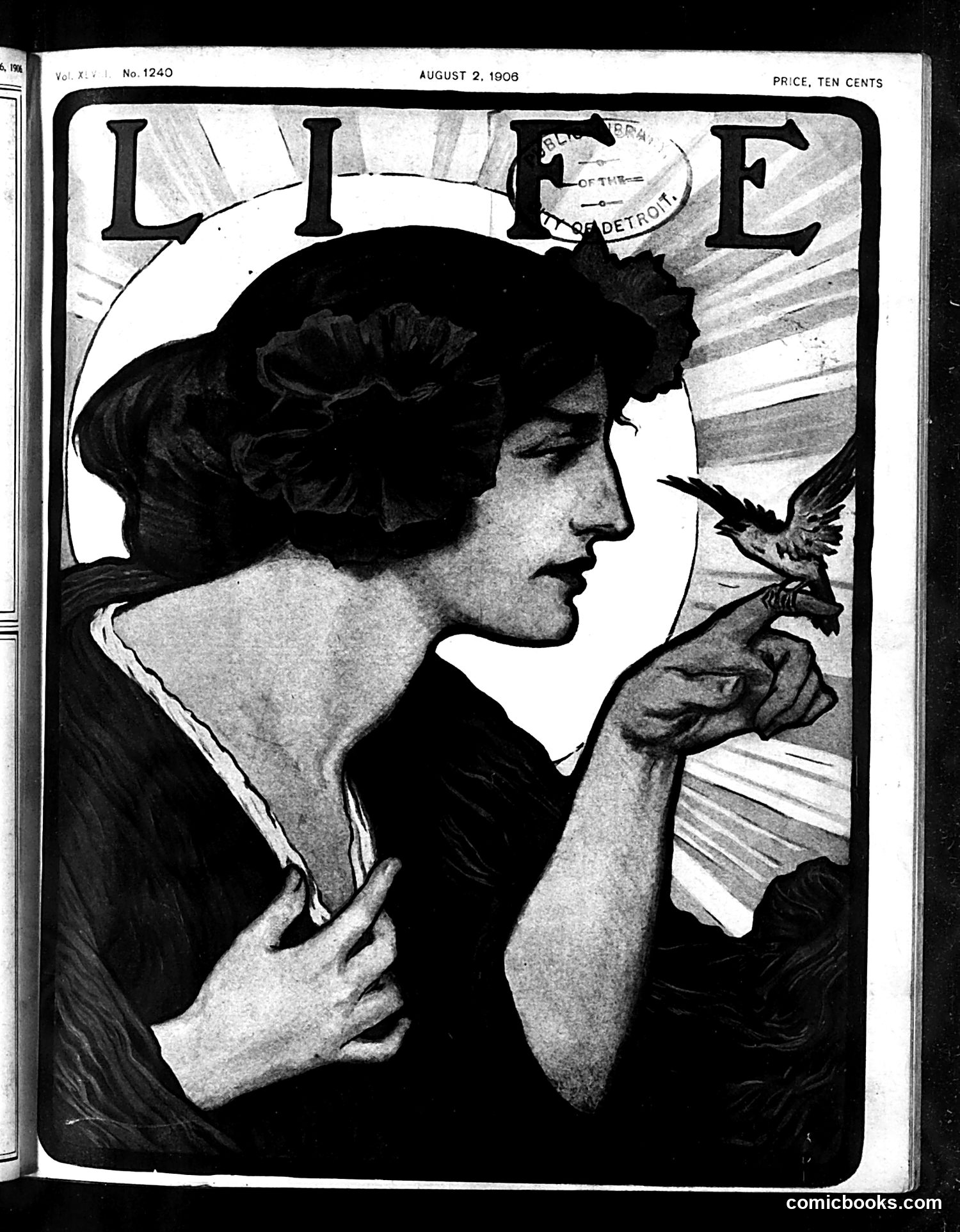
This is the cover of *Life* magazine from August 2, 1908. The illustration shows a woman in profile with elaborate dark hair, holding a small bird, with radiating lines in the background suggesting light or spiritual significance. The word "LIFE" appears prominently at the top. Without additional OCR text visible on the cover itself, the specific satirical meaning is unclear. However, the imagery—a fashionable woman with a delicate bird—likely references contemporary aesthetic movements, social commentary about women, or a specific cultural event from 1908. The artistic style is typical of early-20th-century magazine illustration. More context from the magazine's interior content would be needed to identify the precise subject of satire.
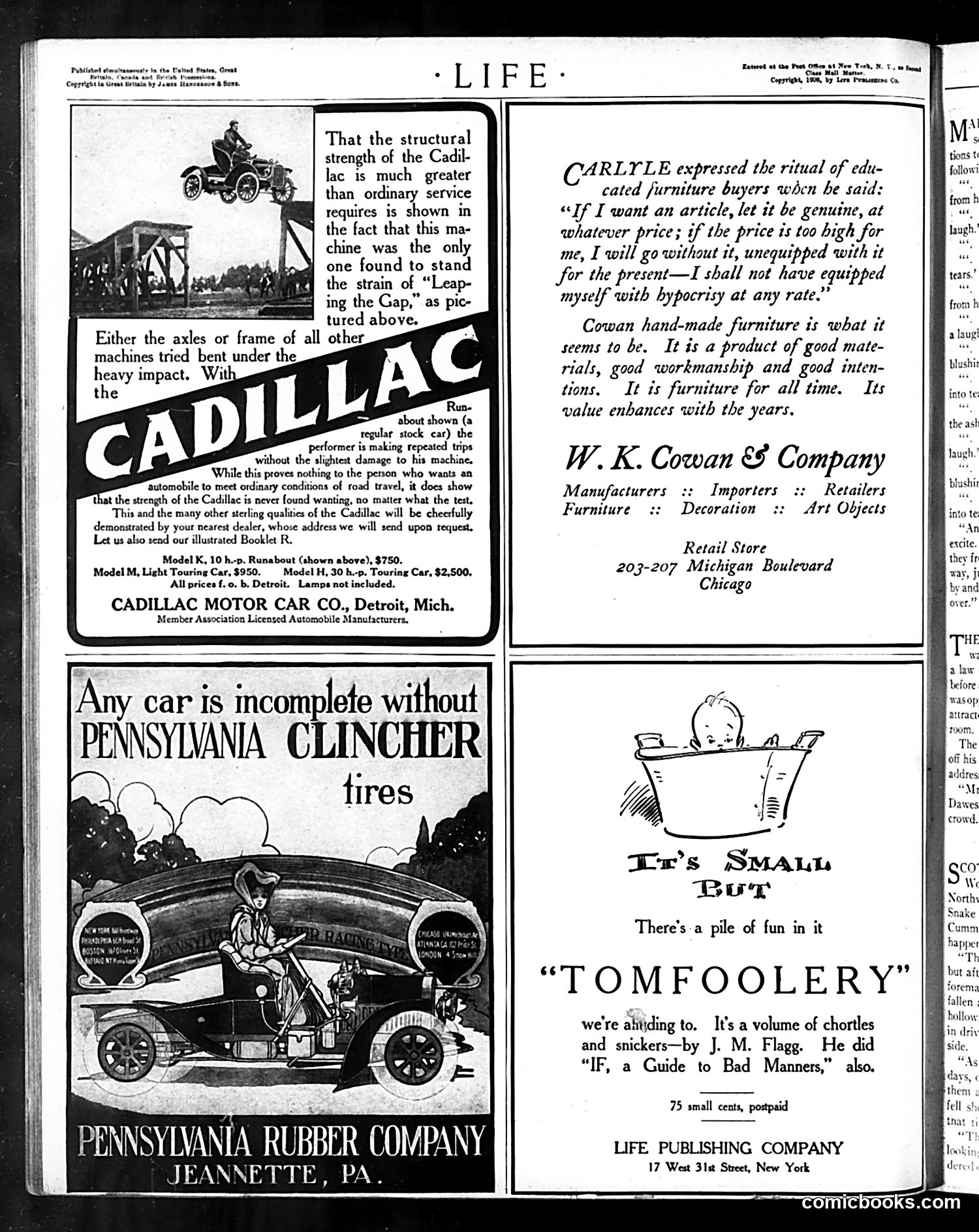
This page is primarily **advertisements**, not satirical content. The top half features a Cadillac Motor Car advertisement emphasizing the vehicle's structural durability through a "Leaping Gap" stunt photo. Below that is a Pennsylvania Clincher tires ad with an illustrated car and child. The right side advertises W.K. Cowan & Company furniture and a book called "Tomfoolery" by J.M. Flagg (described as humorous choruses and jokes, similar to his "IF, a Guide to Bad Manners"). There is **no political cartoon or satire** on this page. The small illustration of a baby in a bathtub accompanying the "Tomfoolery" book is decorative, not satirical. This appears to be a standard early-twentieth-century magazine page mixing commercial advertisements with book promotion.
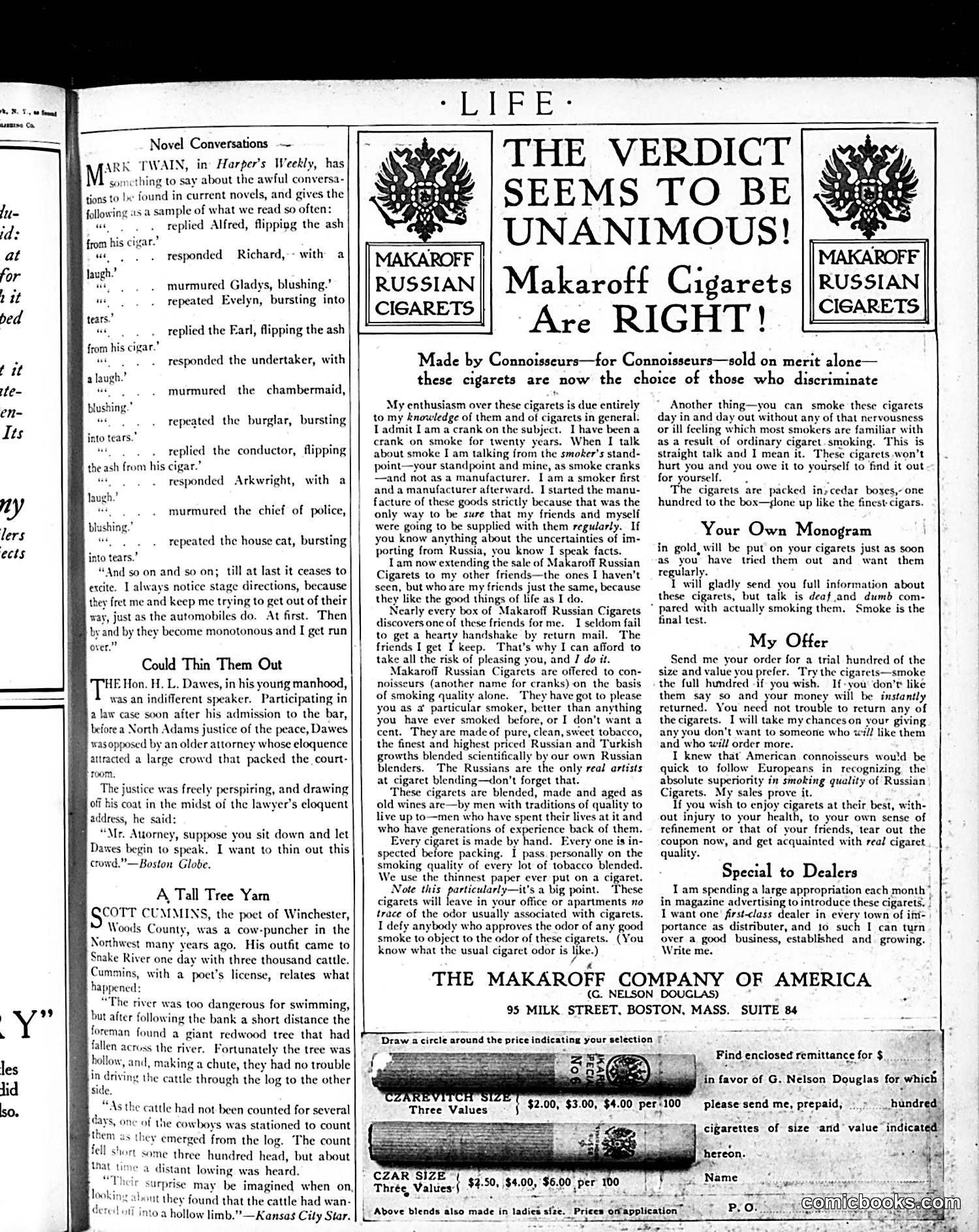
This page is primarily **advertising content** for Makaroff Russian Cigarettes, presented as editorial praise rather than labeled advertisement. The top section contains "Novel Conversations" — a satirical feature showing brief comedic exchanges where various characters (Alfred, Richard, Gladys, the Earl, the undertaker, Arkwright, the conductor, the chief of police, the house cat) all respond to unspecified statements by "flipping ash from his cigar." The repetitive structure is the joke — it's absurdist humor mocking predictable Victorian-era dialogue. Below that, "Could Thim Them Out" and "A Tall Tree Yam" are brief humorous anecdotes unrelated to cigarettes. The dominant content is the Makaroff advertisement claiming "unanimous verdict" that these Russian cigarettes are superior, with testimonials from smokers praising their quality. The advertiser offers monogrammed boxes and dealer incentives. This represents **advertising disguised as editorial content** — a common early 20th-century practice.
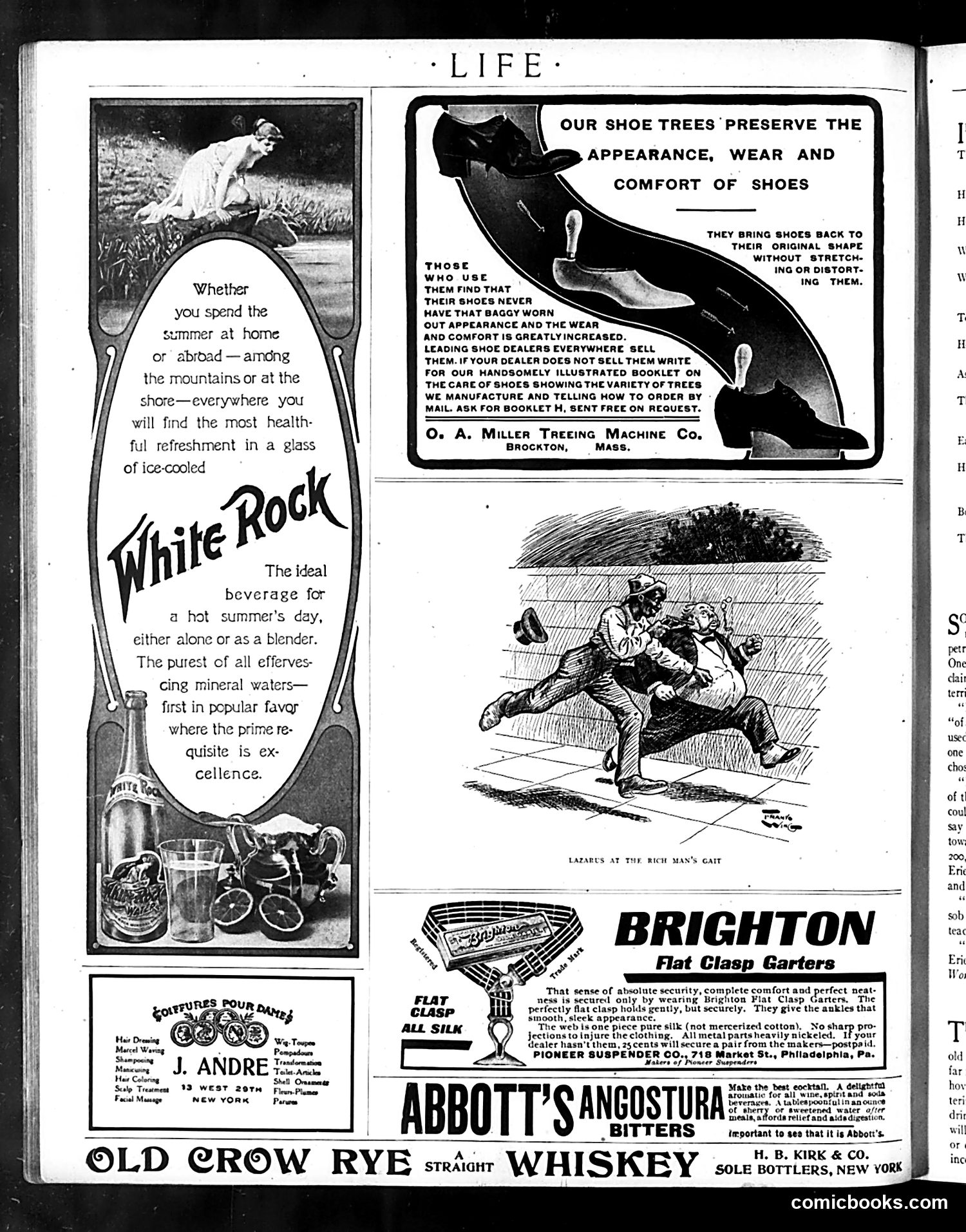
This page is primarily **advertising**, not editorial content or satire. The advertisements include: - **White Rock** mineral water (top left): promotes refreshment for summer outings - **O.A. Miller Treeing Machine Co.** (top right): shoe trees to maintain shoe shape - **J. Andre** beauty/grooming services (bottom left) - **Brighton Flat Clasp Garters** (center-right) - **Abbott's Angostura Bitters** (bottom center) - **Old Crow Rye Whiskey** (bottom) The only cartoon is captioned **"Lazies at the Rich Man's Gate"** (center), showing figures relaxing in rain—likely gentle social humor about leisure and class distinctions, though the specific satire is unclear without additional context. The page reflects early 20th-century consumer culture and product advertising standards.
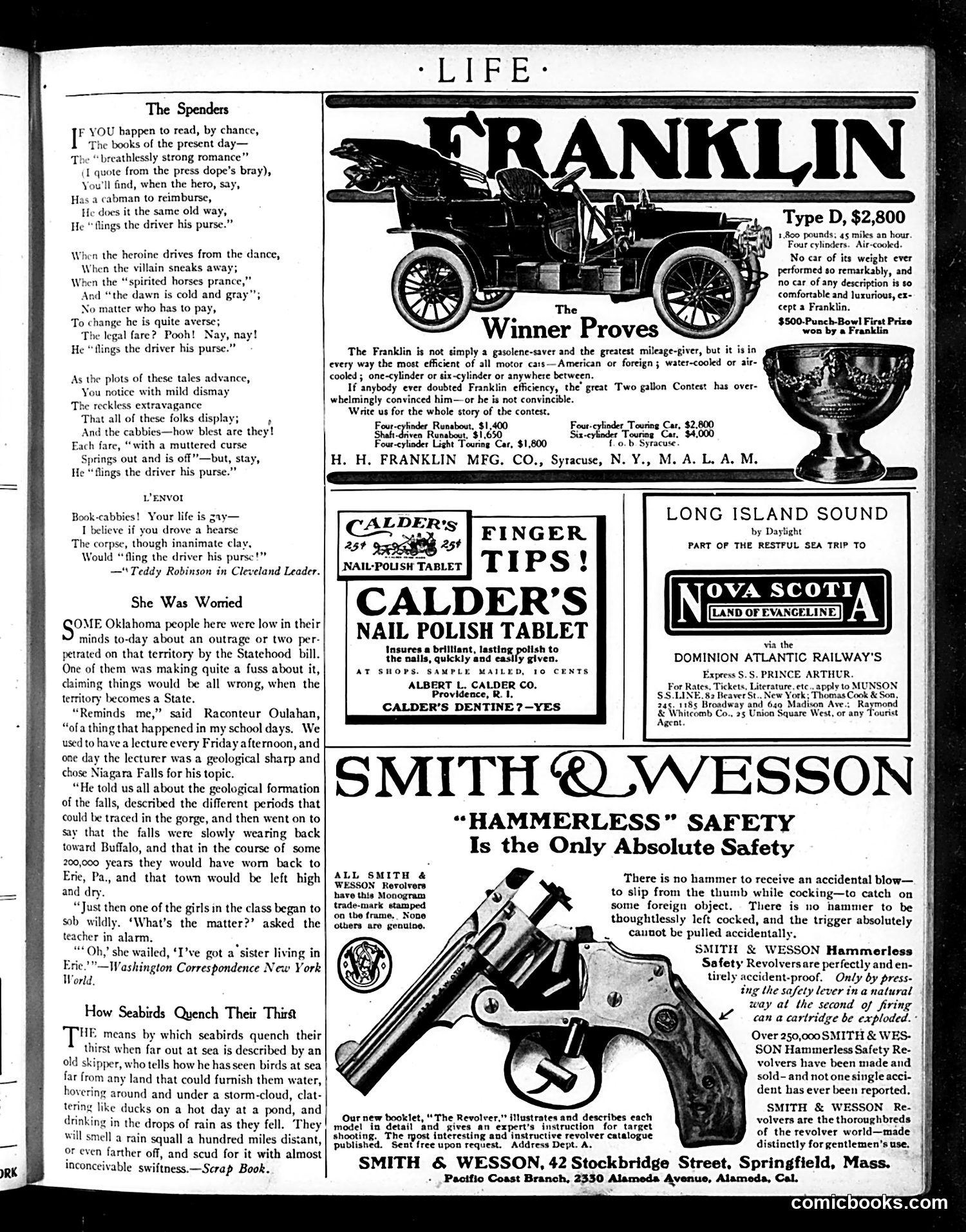
This page is primarily **advertising**, not political satire. The dominant content features commercial ads for the Franklin automobile ("Type D, $2,800"), Calder's nail polish tablets, Smith & Wesson revolvers, and travel promotions. The left column contains two brief satirical pieces: "The Spenders" (a poem mocking frivolous spending on luxury items) and "She Was Worried" (an anecdote about Oklahoma statehood concerns). These are light social commentary rather than hard political satire. The Smith & Wesson revolver ad emphasizes "hammerless" safety features—a selling point highlighting that accidental hammer strikes cannot occur. This reflects early-20th-century firearms marketing focused on consumer safety. Overall, this appears to be a typical Life magazine page blending humor, ads, and commercial promotion from the early automotive era.
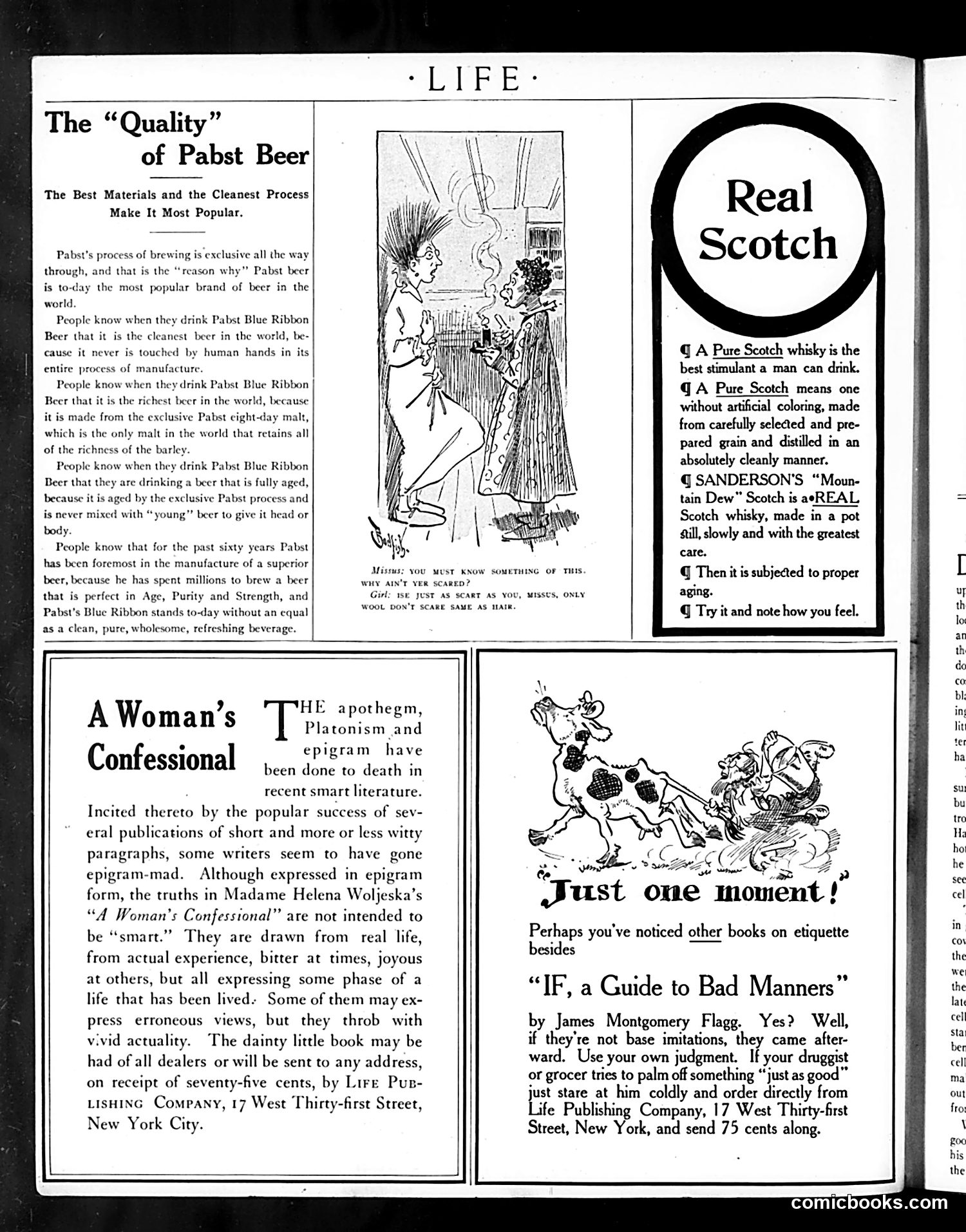
This page is primarily **advertising and literary promotion** rather than political satire. The top section advertises **Pabst Blue Ribbon Beer**, emphasizing its "quality" through claims about pure materials and manufacturing processes—typical early 20th-century beer marketing. The right side advertises **Sanderson's Mountain Dew Scotch whisky**, using similar purity claims. The main illustrated cartoon shows a man and woman in what appears to be a **domestic flirtation scene**, captioned about being "scared." This accompanies an advertisement for "A Woman's Confessional," a book of witty epigrams by Helena Woljeska. The bottom cartoon depicts cows and advertises **"If, a Guide to Bad Manners"** by James Montgomery Flagg—a humorous etiquette guide sold through Life Publishing Company. The page reflects early 20th-century magazine format: mixing social commentary, humor, and advertising.
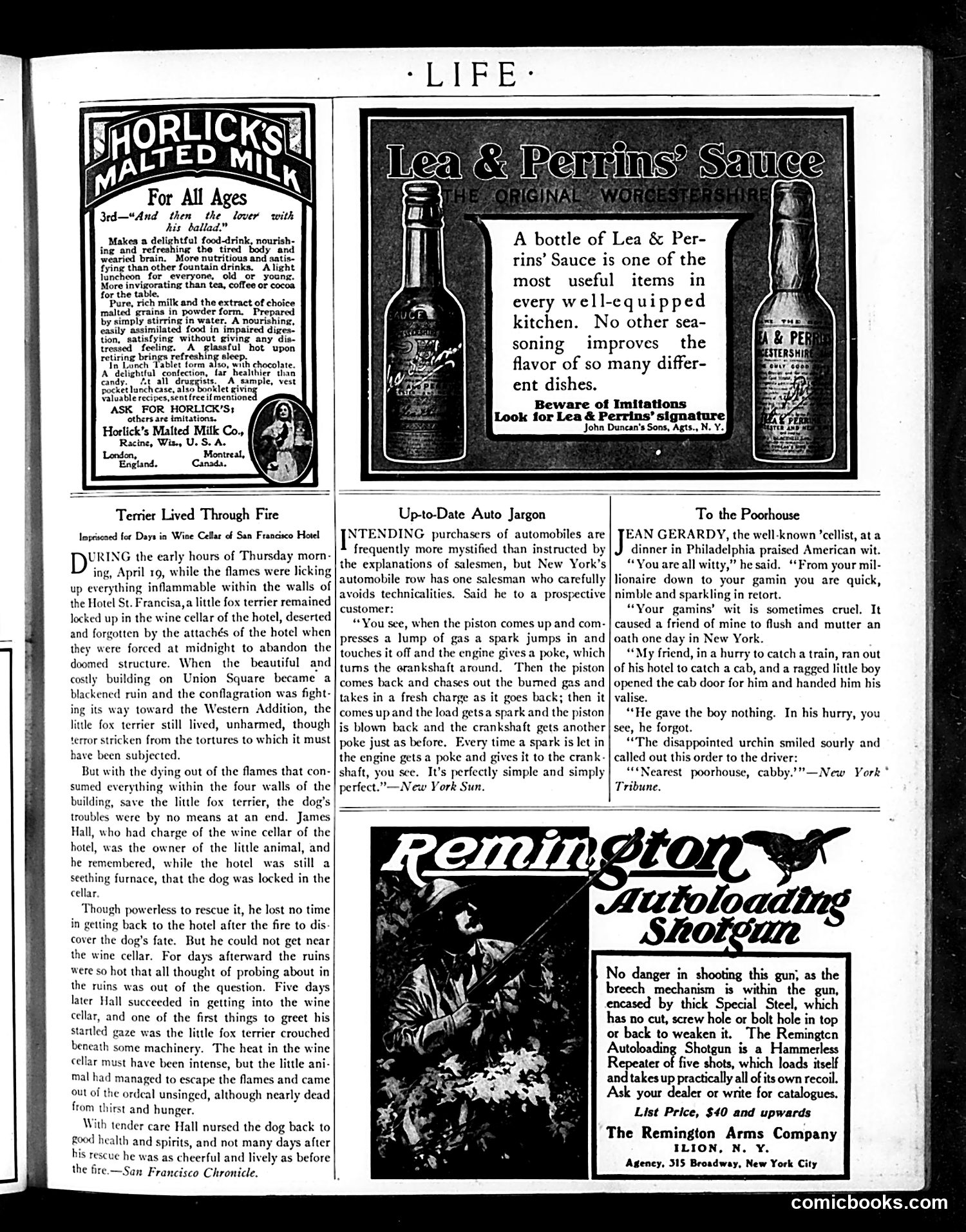
This page contains **advertisements and feature stories**, not political cartoons. The ads include: - **Horlick's Malted Milk** (nutritional drink) - **Lea & Perrin's Sauce** (condiment, warning against imitations) - **Remington Autoloading Shotgun** (firearm) The editorial content includes: **"Terrier Lived Through Fire"** — A heartwarming anecdote about a fox terrier trapped in San Francisco's Hotel St. Francis during a fire, rescued by the hotel's wine cellar manager. **"Up-to-Date Auto Jargon"** — Explains automotive terminology for prospective car buyers. **"To the Poorhouse"** — A brief humor piece about a cellist named Jean Gerardy who told a wealthy Philadelphia patron that careless behavior could lead to poverty. The page reflects early 20th-century advertising, consumer culture, and light human-interest journalism.
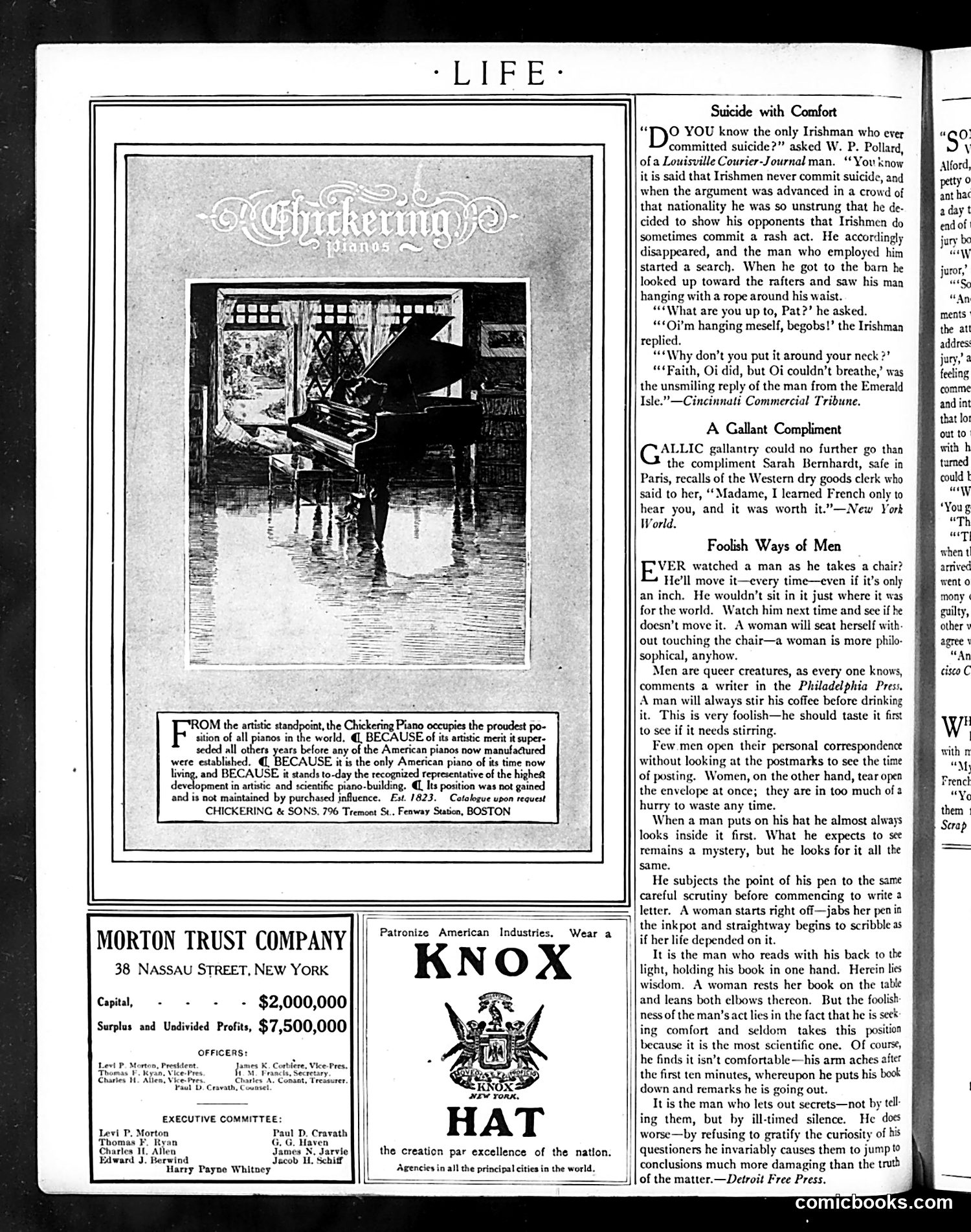
This page is primarily **advertising and humor columns** rather than political satire. The main image shows a **Chickering piano advertisement** featuring an illustration of a grand piano in what appears to be a flooded interior space. The ad emphasizes the piano's artistic prestige and American manufacturing quality, claiming it's "the only American piano of a time now living." Below are unrelated **humorous essays** about social behaviors: "Suicide with Comfort" (an anecdote about an Irishman), "A Gallant Compliment" (about Parisian salespeople), and "Foolish Ways of Men" (observations about men's quirky habits with chairs, hats, and letter-writing). Additional advertisements for **Morton Trust Company** and **Knox Hats** appear at the bottom. There is **no political cartoon** on this page—it's a standard Life magazine feature mixing commerce and light social commentary.
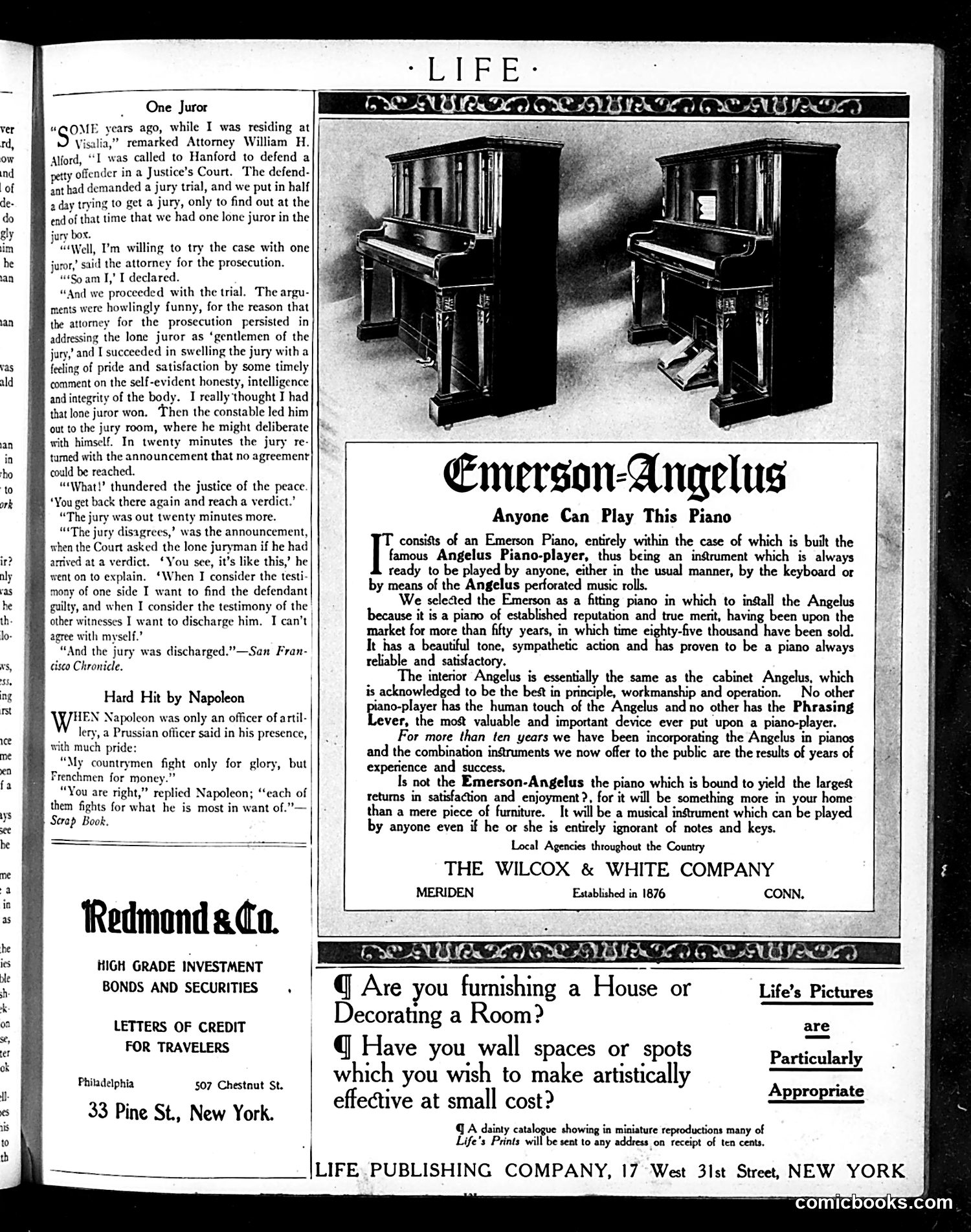
This page contains two anecdotes and advertisements rather than political cartoons. "One Juror" recounts an attorney's story about defending a petty offender and persuading a lone juror to acquit the defendant through eloquent appeals to the jury's conscience—a humorous tale about legal manipulation. "Hard Hit by Napoleon" quotes a Prussian officer's response to Napoleon's claim that soldiers fight for glory: the officer insists they fight for money instead, a cynical joke about military motivation. The bulk of the page advertises the Emerson-Angelus piano, claiming anyone can play it, along with ads for Redmond & Co. (investment bonds) and Life's Pictures (home decoration services). This is primarily a commercial page with light satirical anecdotes.
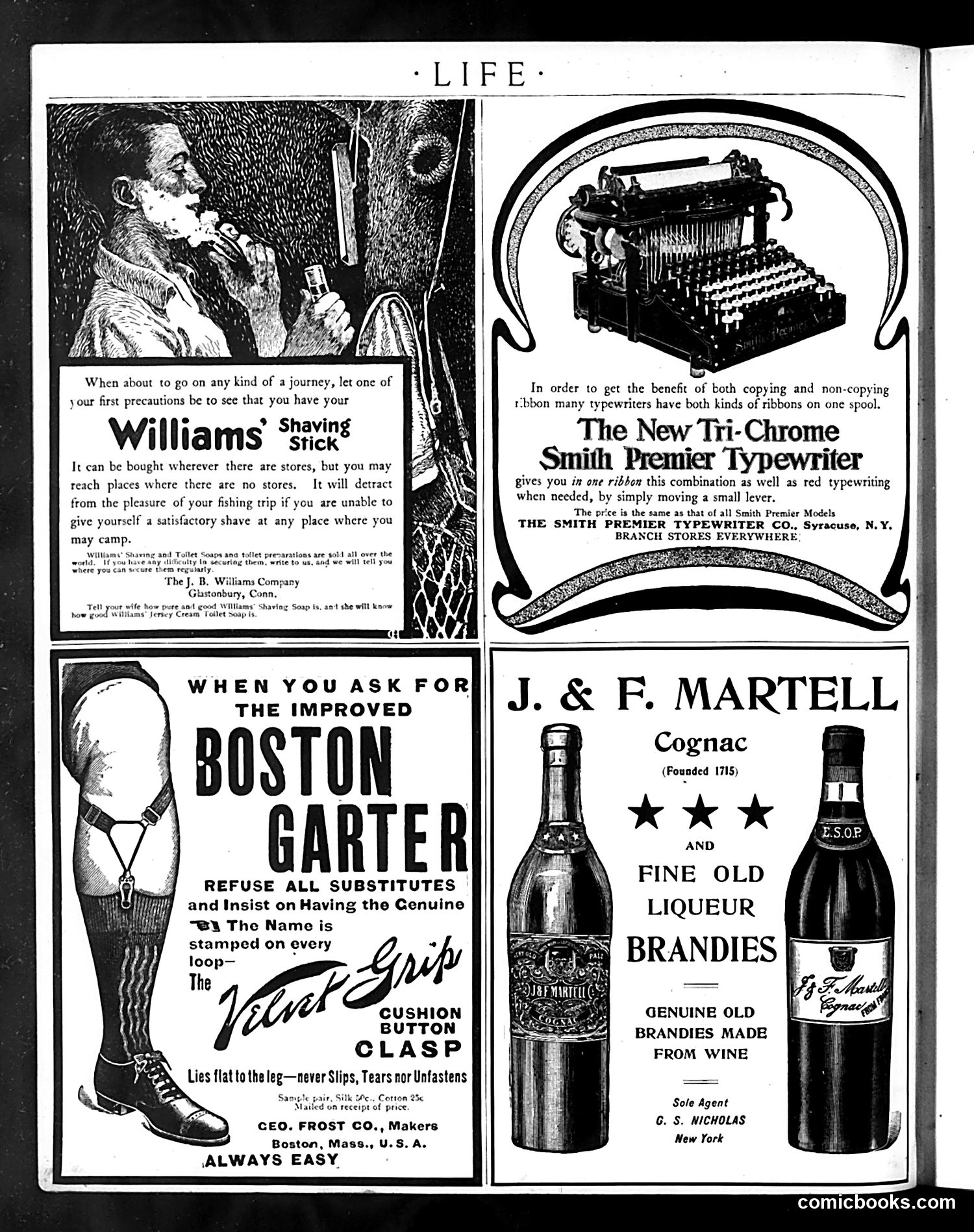
This page contains **four advertisements**, not political cartoons or satire. It appears to be from an early-20th-century issue of *Life* magazine. The ads promote: Williams' Shaving Stick (travel essential), the Smith Premier typewriter (featuring dual ribbon capability), the Boston Garter (a men's sock supporter claiming superiority over competitors), and J. & F. Martell Cognac/Brandies. Each advertisement uses period-typical marketing tactics: travel/convenience appeals, product demonstrations, emphatic claims of superiority ("refuse all substitutes"), and appeals to masculinity. The garter ad's promise that the product "never slips, tears nor unfastens" suggests competitive anxiety about inferior products in the market. These are straightforward commercial advertisements rather than satirical content.
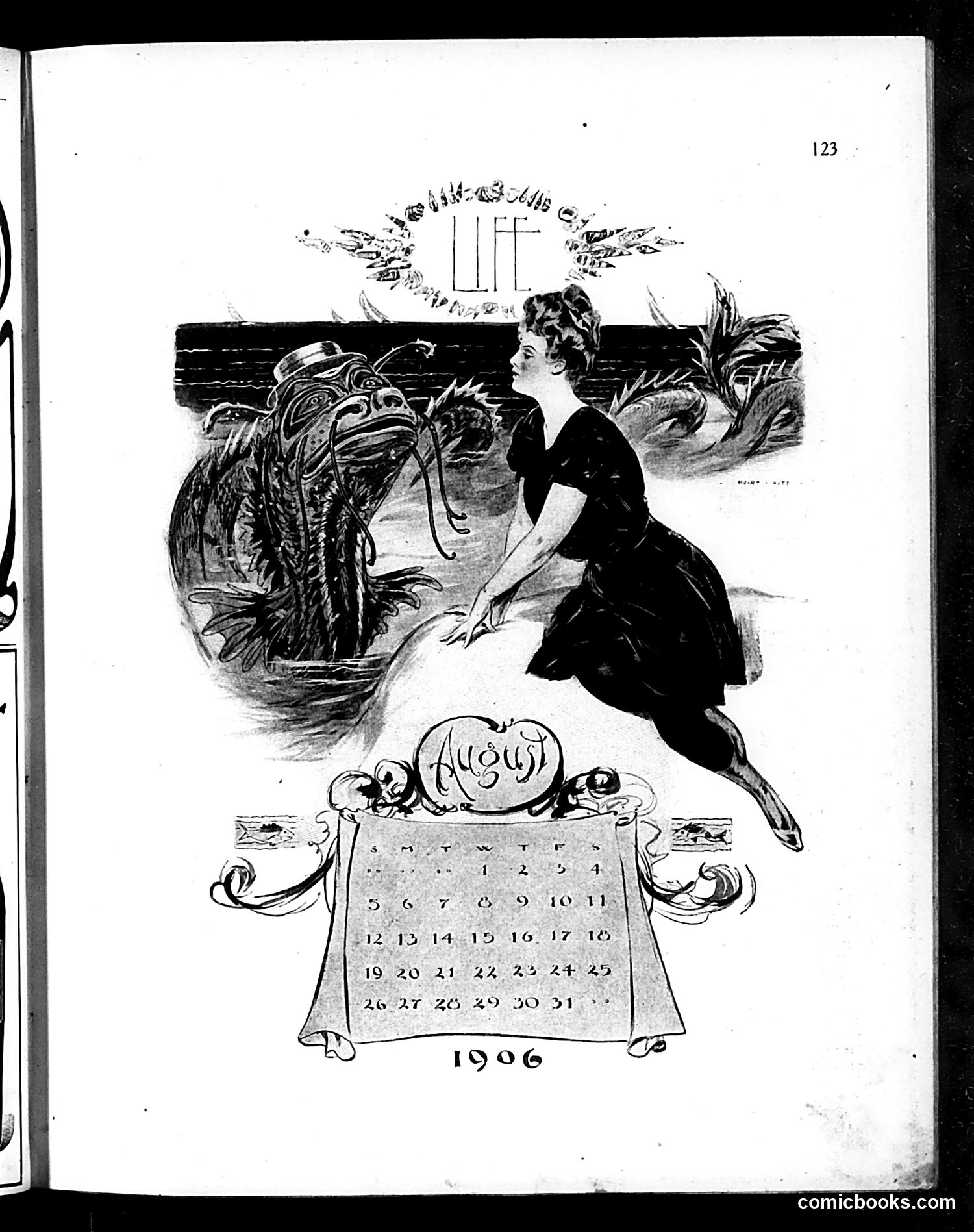
This appears to be a calendar page for August 1906 from *Life* magazine. The illustration shows a fashionable woman in an elegant black dress interacting with what looks like a fantastical sea creature or dragon emerging from water. The artistic style is typical of early 20th-century satirical illustration. The satire likely comments on summer leisure activities or romance, themes common to *Life's* humor of the era. The woman's poised, flirtatious interaction with the creature suggests either a playful social commentary or a joke about courtship and "monsters" in society. Without additional context or OCR'd text explaining the specific reference, the precise satirical target remains unclear, though the overall tone appears lighthearted rather than politically pointed.
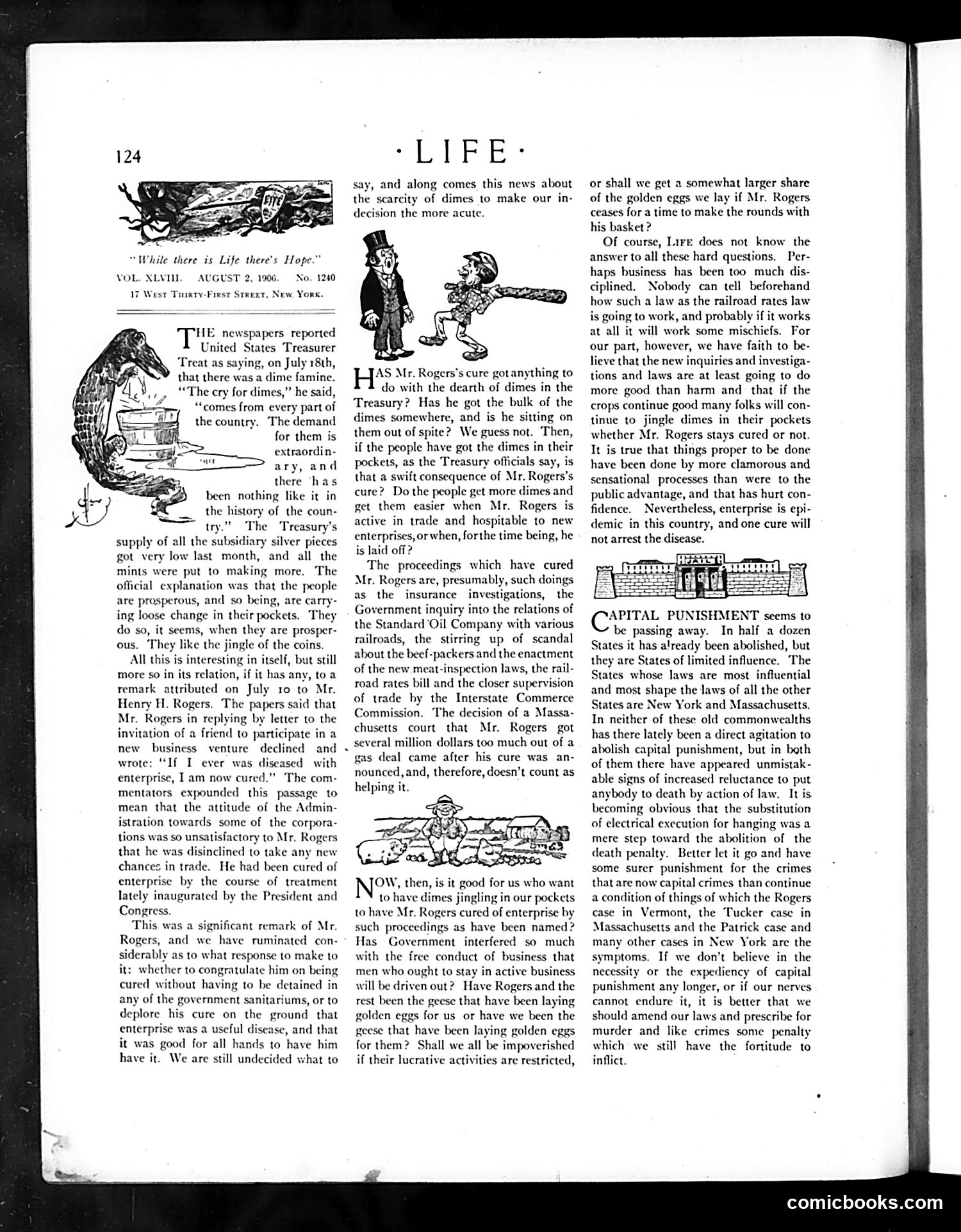
This 1906 *Life* magazine page satirizes a currency shortage and businessman H.H. Rogers. The illustrations depict the public's frustration over scarce dimes—coins needed for everyday commerce. The cartoons mock the irony that while ordinary citizens lack small change for basic transactions, wealthy industrialist Rogers has been accused of hoarding dimes or profiting from the shortage. The text suggests Roosevelt administration investigations into Rogers' business practices (likely referencing Standard Oil dealings) may have actually *helped* his financial interests rather than punishing them. The satire argues that if government interference in business had deterred Rogers' enterprises as intended, the public wouldn't now face this dime scarcity—implying his continued prosperity despite scandals has harmed the broader economy.
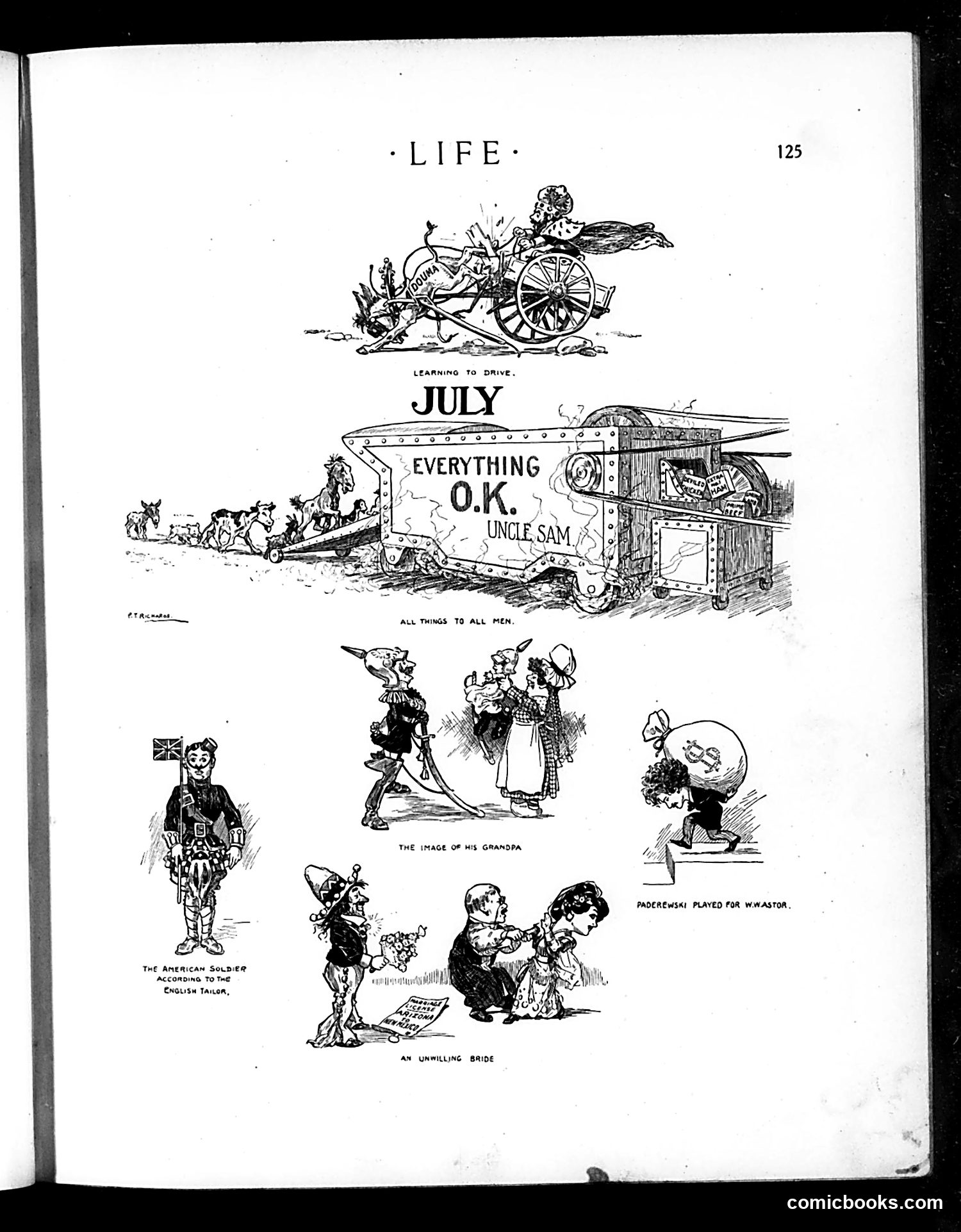
This page from Life magazine's July 1918 issue contains WWI-era political cartoons and humor: **Top section**: "Learning to Drive" and "Everything O.K. Uncle Sam" depict America's war effort as chaotic but manageable—Uncle Sam oversees a careening vehicle laden with supplies. **Middle cartoons** satirize British and American attitudes: "The American Soldier According to the English Tailor" shows a caricatured soldier; "The Image of His Grandpa" depicts family expectations during wartime. **Bottom cartoons** address domestic life during the war: "Paderewski Played for Wanaston" (likely referencing the pianist's wartime tour), and "An Unwilling Bride" appears to mock reluctant participation in wartime obligations. The overall theme reflects American homefront experiences during World War One's final year.
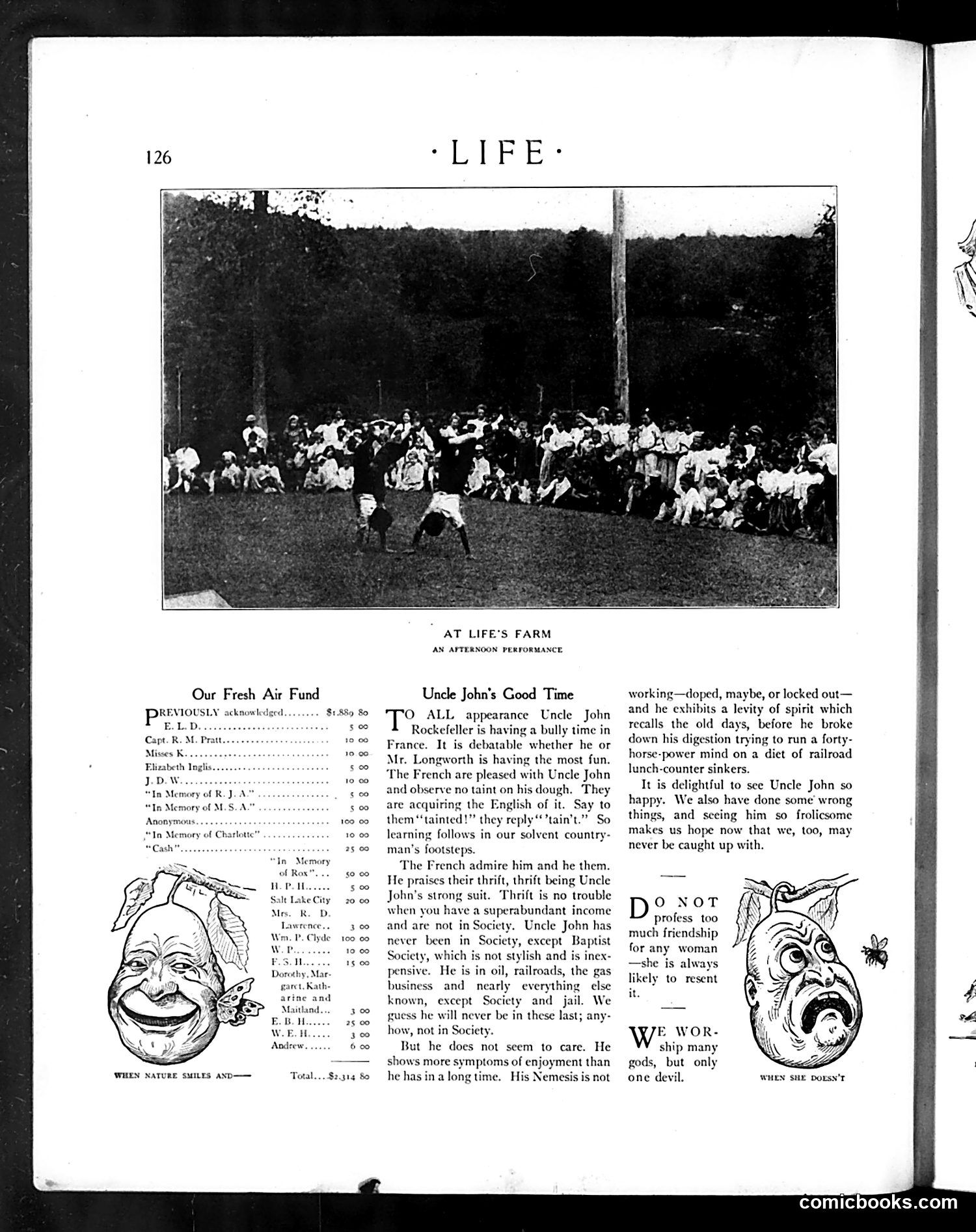
This page from *Life* magazine satirizes **John D. Rockefeller's** vacation in France. The text's central joke: Rockefeller, America's wealthiest industrialist (whose fortune came from oil and railroads), is enjoying himself abroad because the French don't morally judge his "tainted" money—they simply want to spend it. The satire mocks both Rockefeller's attempt at respectability (he's never joined high Society, only Baptist circles) and American hypocrisy about wealth. While Americans criticized his business practices, the French happily admire his "thrift." The decorative cartoons—smiling and frowning faces—are generic illustrations unrelated to the main text. The "Fresh Air Fund" section lists donations to a charitable cause, typical of *Life's* mix of satire and philanthropic reporting. The joke's sting: even the world's most controversial billionaire finds acceptance when money talks loudly enough.
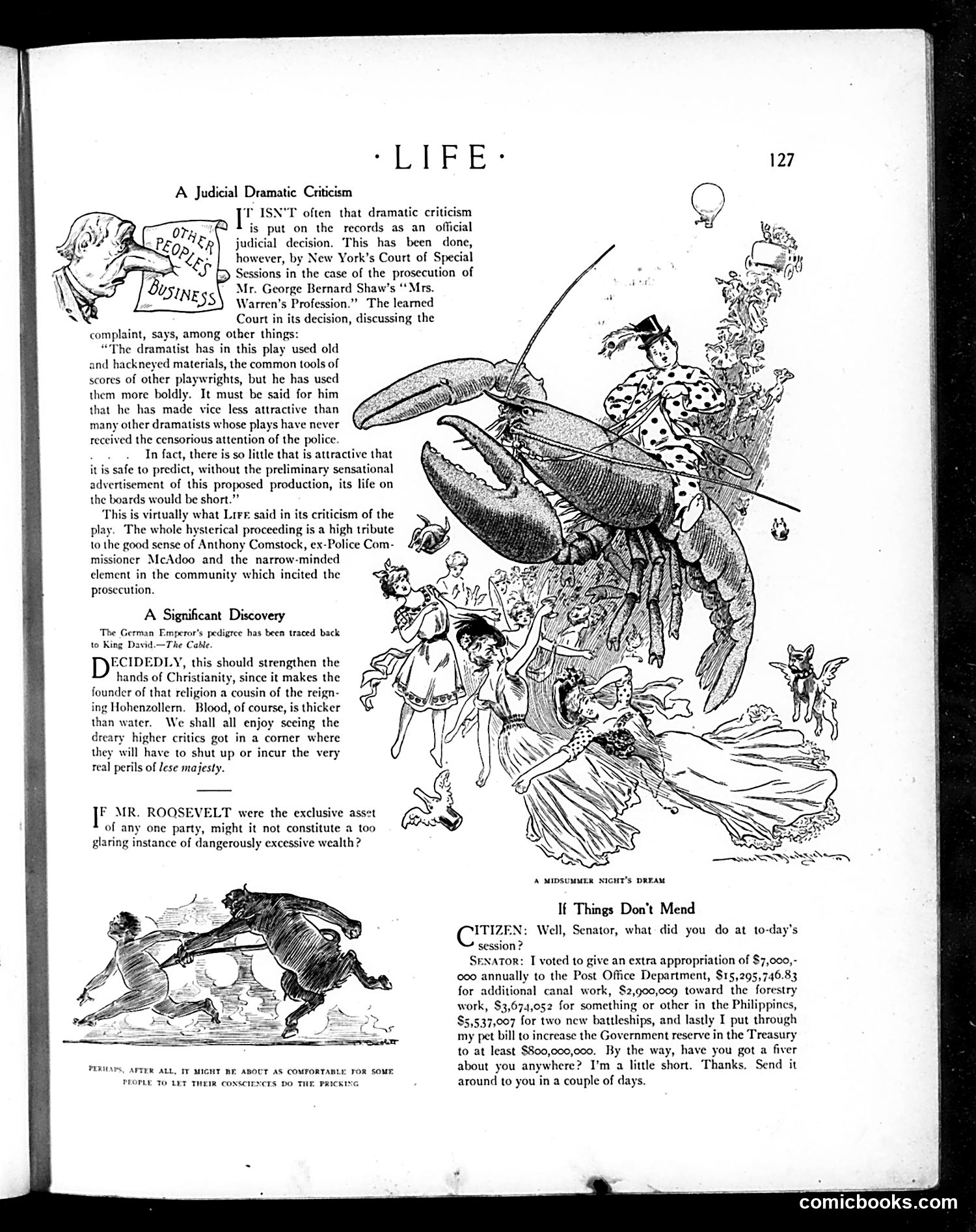
This page contains three satirical pieces mocking early 1900s American institutions: **"A Judicial Dramatic Criticism":** Life ridicules New York courts for officially censoring George Bernard Shaw's play *Mrs. Warren's Profession*—about a woman in a morally compromising profession. The court's own decision ironically admits the play isn't even that attractive, yet prosecuted it anyway. Life sarcastically praises this as a "tribute" to Anthony Comstock (a famous anti-obscenity crusader) and Police Commissioner McAdoo, while mocking their "narrow-minded" censorship. **"A Significant Discovery":** A brief jab at German Emperor Wilhelm II, whose genealogy was supposedly traced to King David. Life uses heavy irony: if the Kaiser descends from Christianity's founder, shouldn't that strengthen faith? The sarcasm suggests this discovery is meaningless propaganda. **"If Things Don't Mend":** A cartoon criticizing government spending excess. A senator votes for enormous appropriations (Post Office, canals, forestry, Philippines, battleships, Treasury reserves) totaling millions, yet admits being personally broke and asks a citizen for a five-dollar loan. The satire exposes the disconnect between senators' lavish public spending and their individual financial irresponsibility.
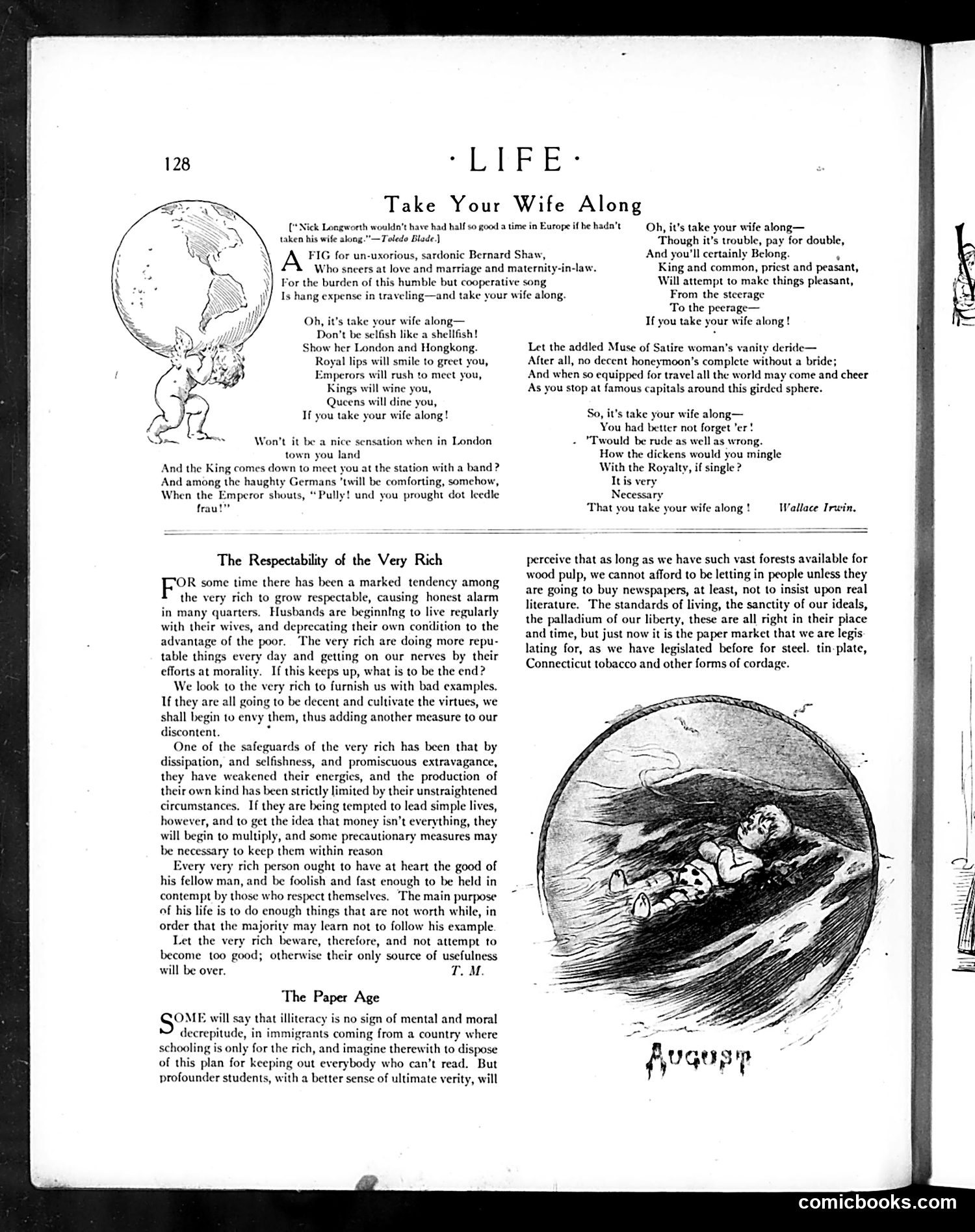
**"Take Your Wife Along"** is a humorous song-poem satirizing travel etiquette and marital dynamics. The cartoon (a cherub holding a globe) illustrates the theme of global tourism. The lyric references "Nick Longworth," likely Representative Nicholas Longworth (Ohio), mocking the social expectation that wives should accompany husbands on foreign trips for respectability. The satire ridicules both ostentatious travel and the notion that wives enhance a man's social standing with royalty. **"The Respectability of the Very Rich"** is sharp social commentary lamenting that wealthy Americans are becoming *too* virtuous and respectable. The author argues the rich traditionally served society's moral purposes through scandalous behavior—providing cautionary examples for common people to avoid emulating. If the wealthy stop being dissolute and extravagant, society loses this "safeguard." The piece sarcastically warns that respectable wealthy people will multiply, causing social problems. It's dark satire on class divisions and the perceived utility of aristocratic excess. The illustration appears unrelated to the text below it.
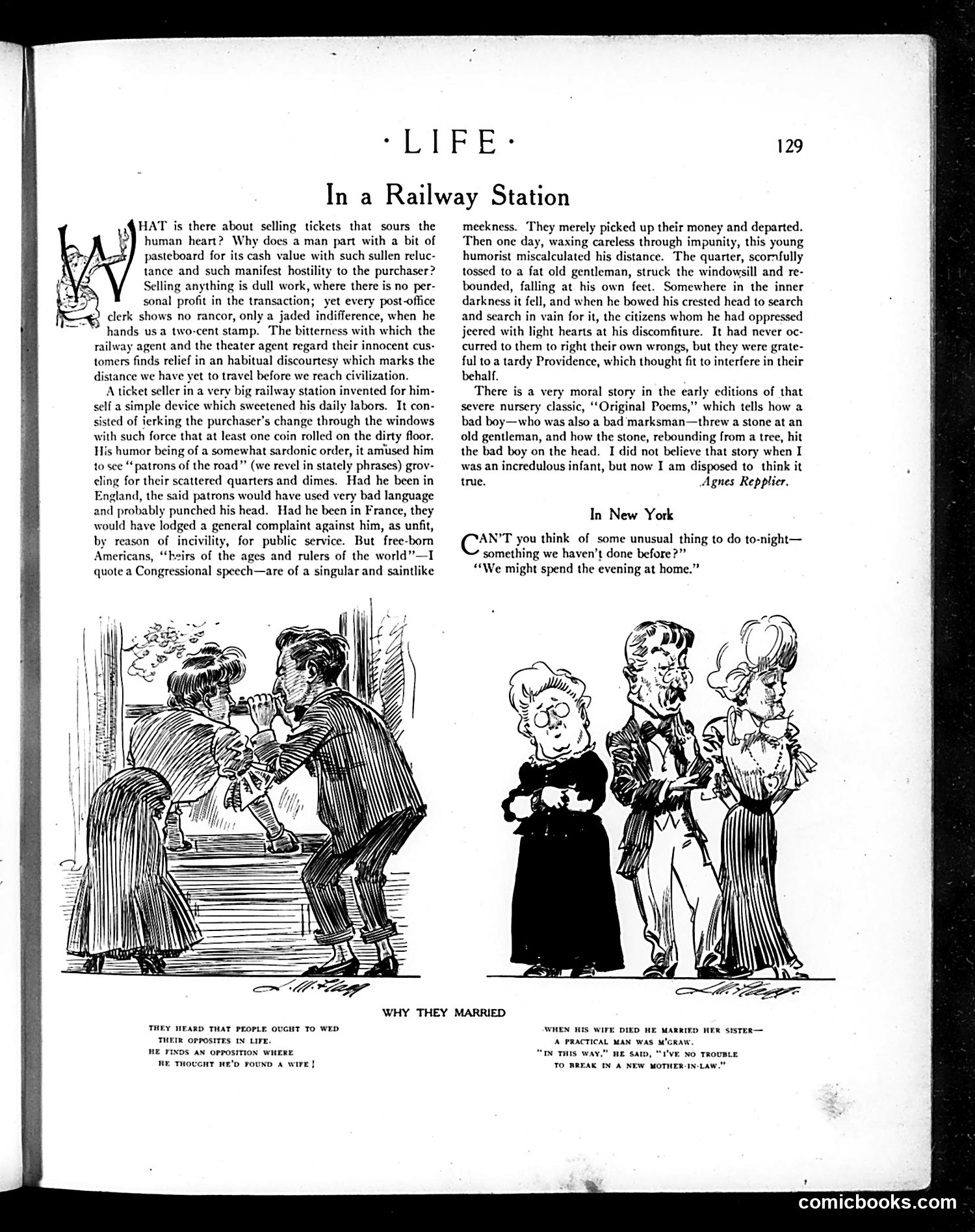
This page contains two satirical pieces: **"In a Railway Station"** by Agnes Repplier critiques American passivity and customer service rudeness. A railroad ticket clerk deliberately throws change on the floor to humiliate customers, who meekly retrieve it without complaint. The piece contrasts American behavior unfavorably with English (who would fight back) and French (who would lodge formal complaints). When the clerk finally miscalculates and the coin hits his own feet, the oppressed customers find schadenfreude in his comeuppance. Repplier uses this anecdote to mock Americans' tolerance of disrespect and their faith in divine justice rather than asserting their own dignity. **"In New York"** presents two cartoons about marriage. The first shows a couple who married because they heard opposites attract, only to discover incompatibility. The second depicts a widower who married his deceased wife's sister—portrayed as practical because he avoids "breaking in a new mother-in-law." Both cartoons satirize marital reasoning that prioritizes convenience over genuine compatibility.
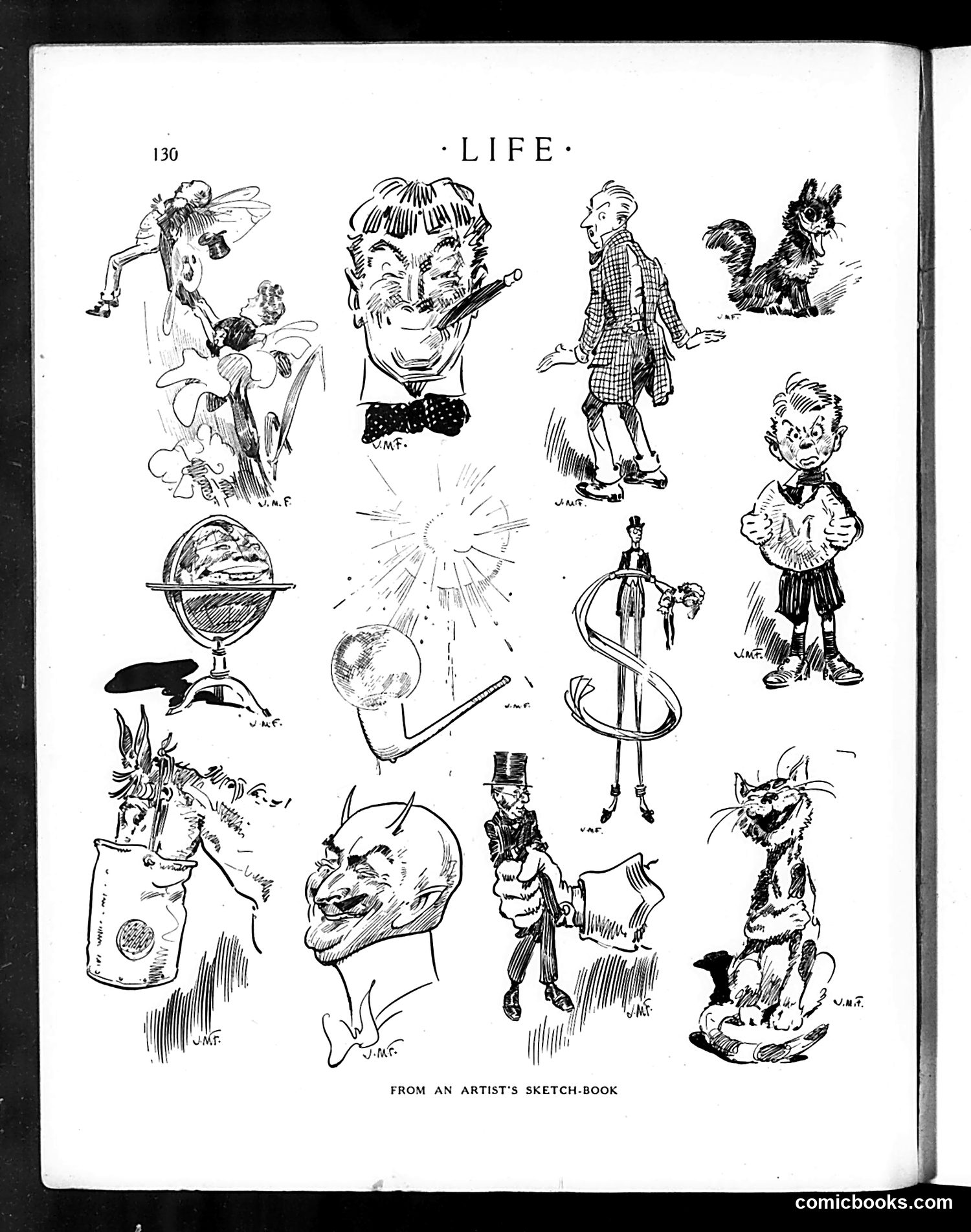
This page presents a collection of satirical character sketches "from an artist's sketch-book," typical of Life magazine's political and social commentary. The sketches include exaggerated facial caricatures and full-figure drawings of various character types—some appearing to be public figures or social archetypes of the era. The collection features grotesque facial expressions, absurd situations (a man with a telescope, figures juggling or in comedic poses), and animal characters used satirically. Without identifying specific individuals, the style suggests commentary on contemporary politics, society, or entertainment figures through physical exaggeration—a common Life magazine approach. The artistic signatures (appearing as initials) indicate multiple contributing artists. This format allowed the magazine to deliver biting social satire through visual humor accessible to readers without lengthy explanatory text.
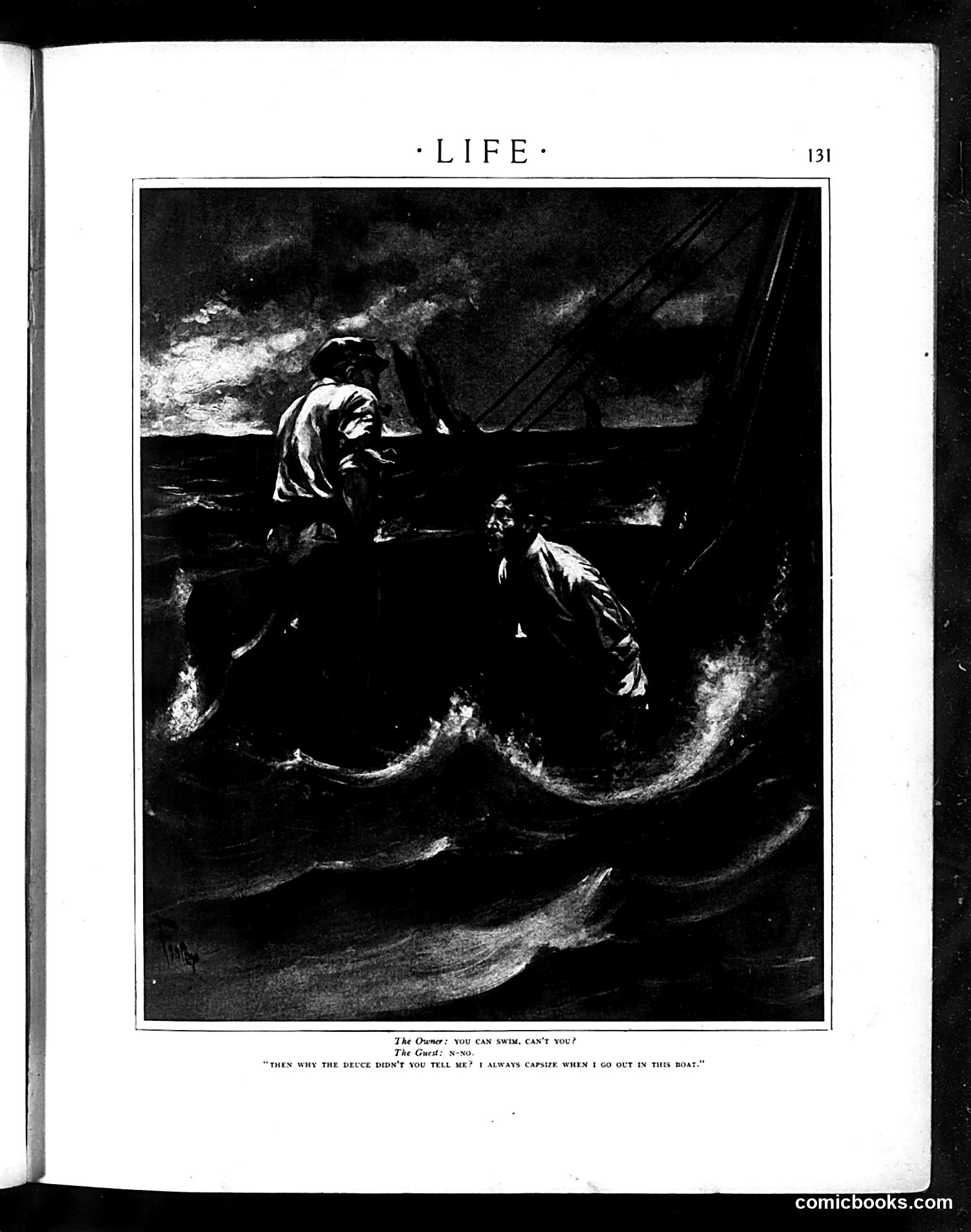
This page from Life magazine (page 131) presents a dramatic maritime scene. Two figures appear in a small boat during rough seas. The dialogue reads: **The Owner:** "YOU CAN SWIM, CAN'T YOU?" **The Guard:** "S-NO." **Caption:** "THEN WHY THE DEUCE DIDN'T YOU TELL ME? I ALWAYS CAPSIZE WHEN I GO OUT IN THIS BOAT." The satire is a classic setup: an owner casually reveals he habitually capsizes his boat, then discovers his guard—who cannot swim—failed to disclose this crucial safety concern. The joke relies on the absurdity of the owner's nonchalant attitude toward repeated capsizing and the guard's failure to mention his inability to swim. This appears to be a general humor piece rather than political satire, playing on comedic timing and situational irony about workplace communication and safety negligence.
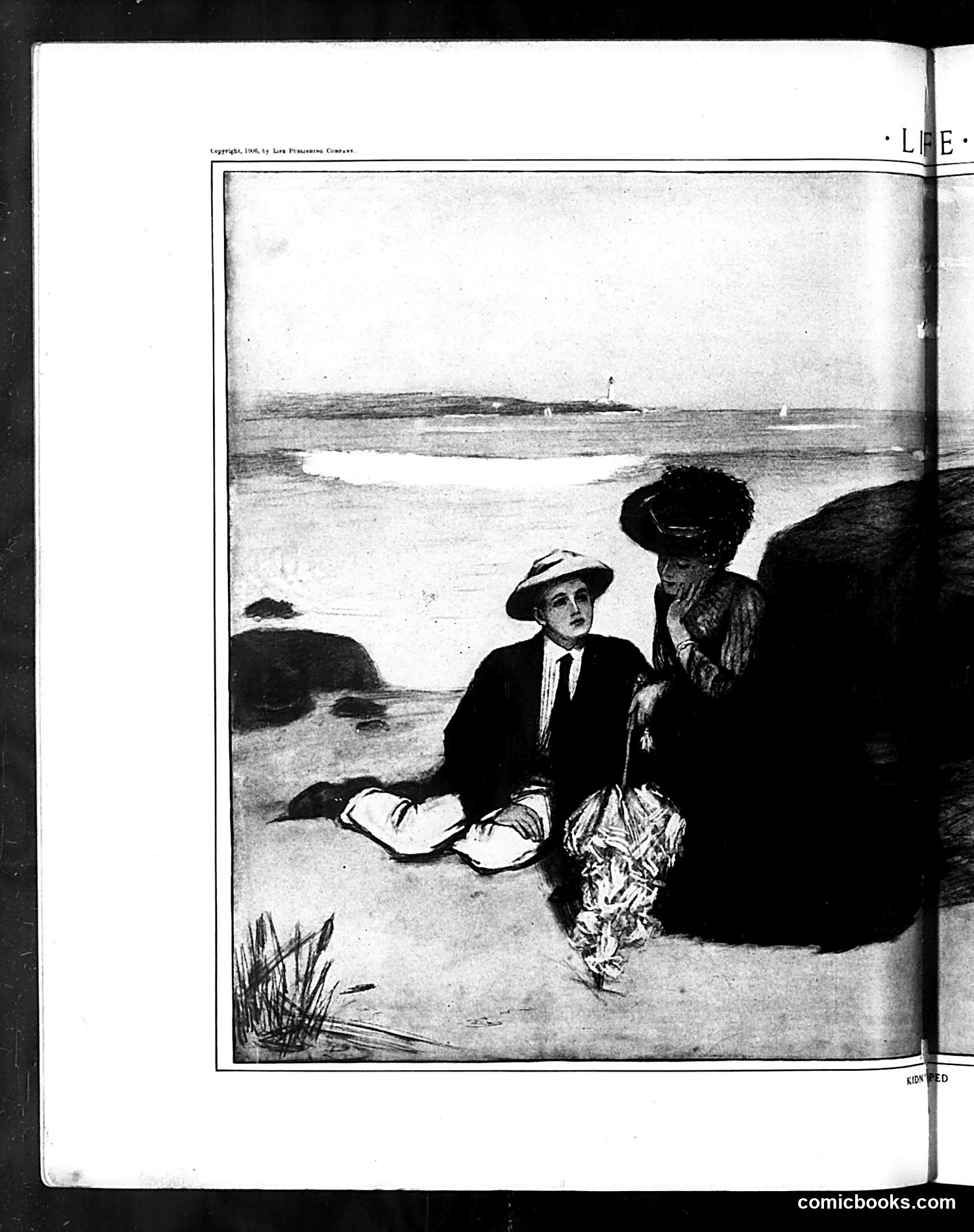
This appears to be a satirical illustration depicting a wealthy or upper-class man in formal attire (suit and hat) sitting on a beach, seemingly relaxed or oblivious to his surroundings. Two figures stand nearby—a woman in fashionable dress and what appears to be another observer. The rocky coastline and lighthouse visible in the background suggest a seaside resort setting. The satire likely critiques leisure-class indifference or detachment from reality during some unspecified period crisis or social concern. The man's composed demeanor while others attend to him suggests commentary on privilege, class divisions, or perhaps ignorance of pressing contemporary issues. However, without visible text identifying specific figures or dated context, the exact political reference remains unclear.
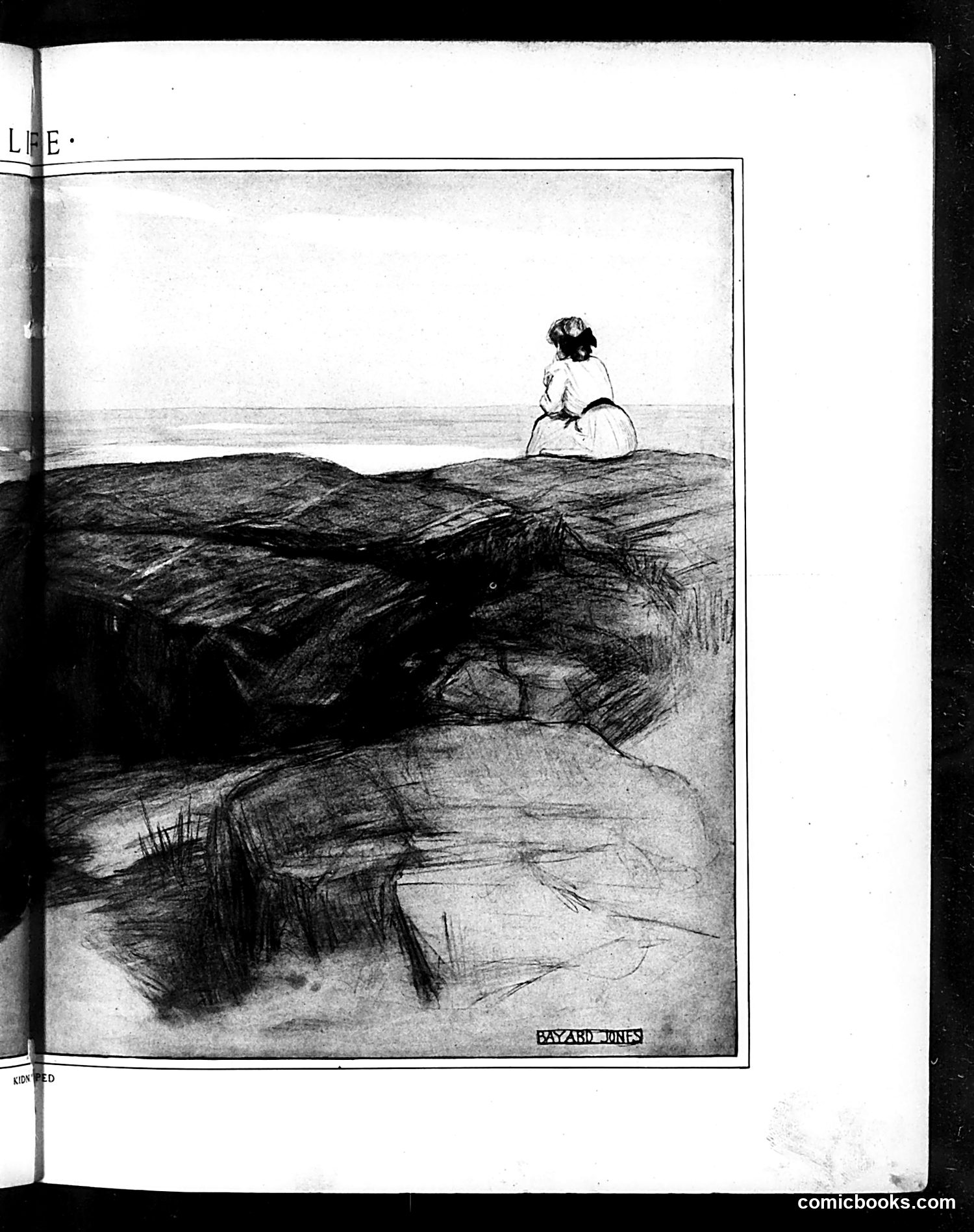
This sketch depicts a solitary figure sitting on rocky terrain overlooking water, gazing toward the horizon. The title "BAYARD JUNTS" (likely "Bayard Junts" or similar) suggests a reference to a specific person or event, though the exact identity remains unclear from the image alone. The composition—a contemplative figure in isolation against a vast landscape—suggests introspection or melancholy. Given Life magazine's satirical nature, this likely comments on a contemporary political or social figure facing adversity, exile, or romantic disappointment. The romantic, somewhat sorrowful aesthetic was typical of Life's commentary on notable personages. Without additional context identifying "Bayard," the specific target and satirical point cannot be determined with certainty.
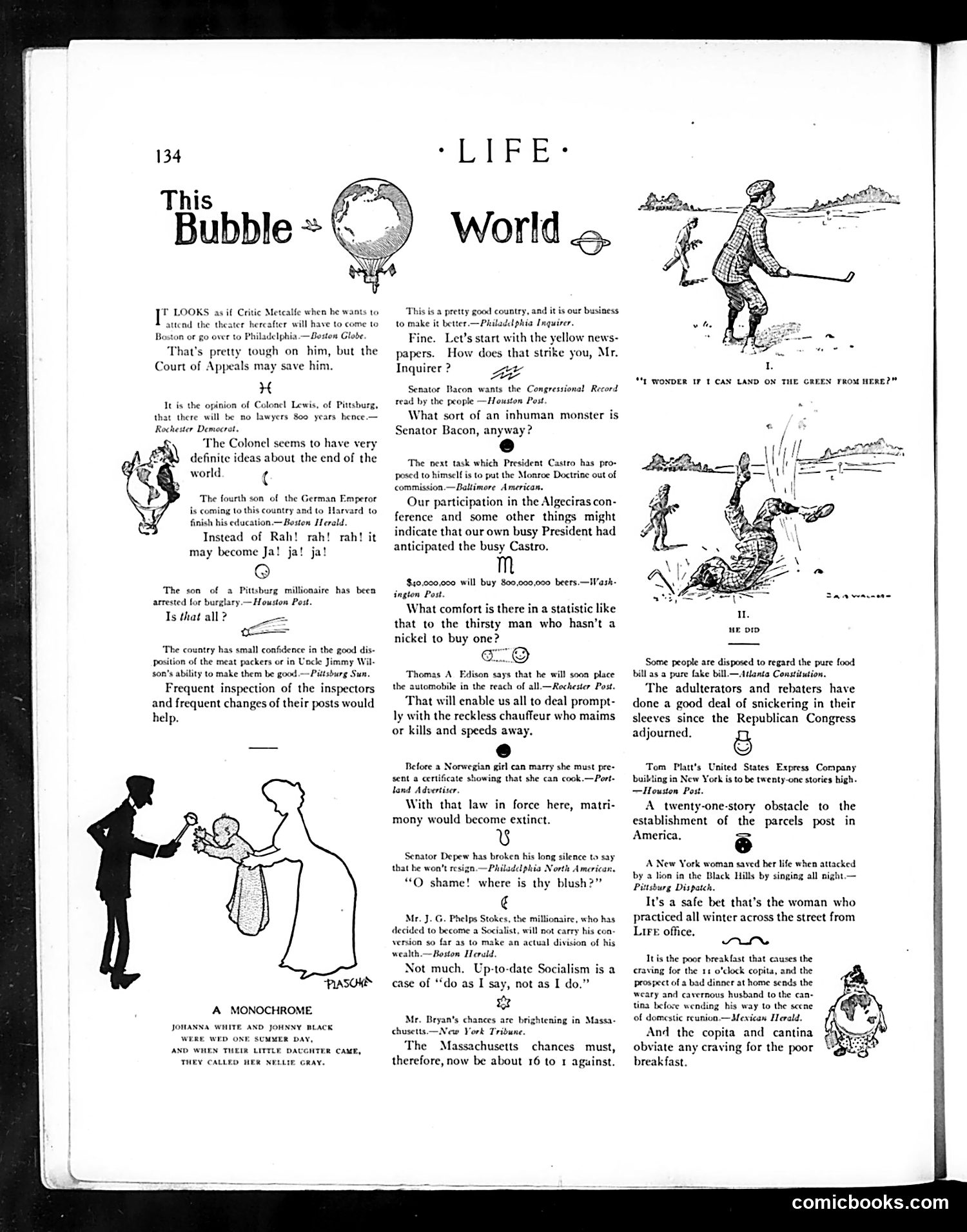
This page from *Life* magazine presents short satirical quips mocking contemporary public figures and social issues circa early 1900s. **Key targets include:** - **Senator Bacon**: Mocked for proposing the Congressional Record be read aloud to ordinary people—characterized as inhumane - **President Castro**: Criticized for attempting to overturn the Monroe Doctrine - **Senator Depew**: Shamed for refusing to resign (Shakespeare reference: "O shame! where is thy blush?") - **J.G. Phelps Stokes**: A wealthy millionaire converting to Socialism while refusing to actually redistribute his wealth—satirizing hypocrisy - **William Jennings Bryan**: His chances in Massachusetts dismissed as 16-to-1 odds - **Tom Platt's building**: A 21-story NYC skyscraper portrayed as an "obstacle" to establishing American parcel post service The "Monochrome" cartoon depicts a couple naming their daughter after her skin color. Overall, the page lampoons political reformers, wealthy socialists, and contemporary absurdities with caustic wit typical of *Life's* editorial voice.
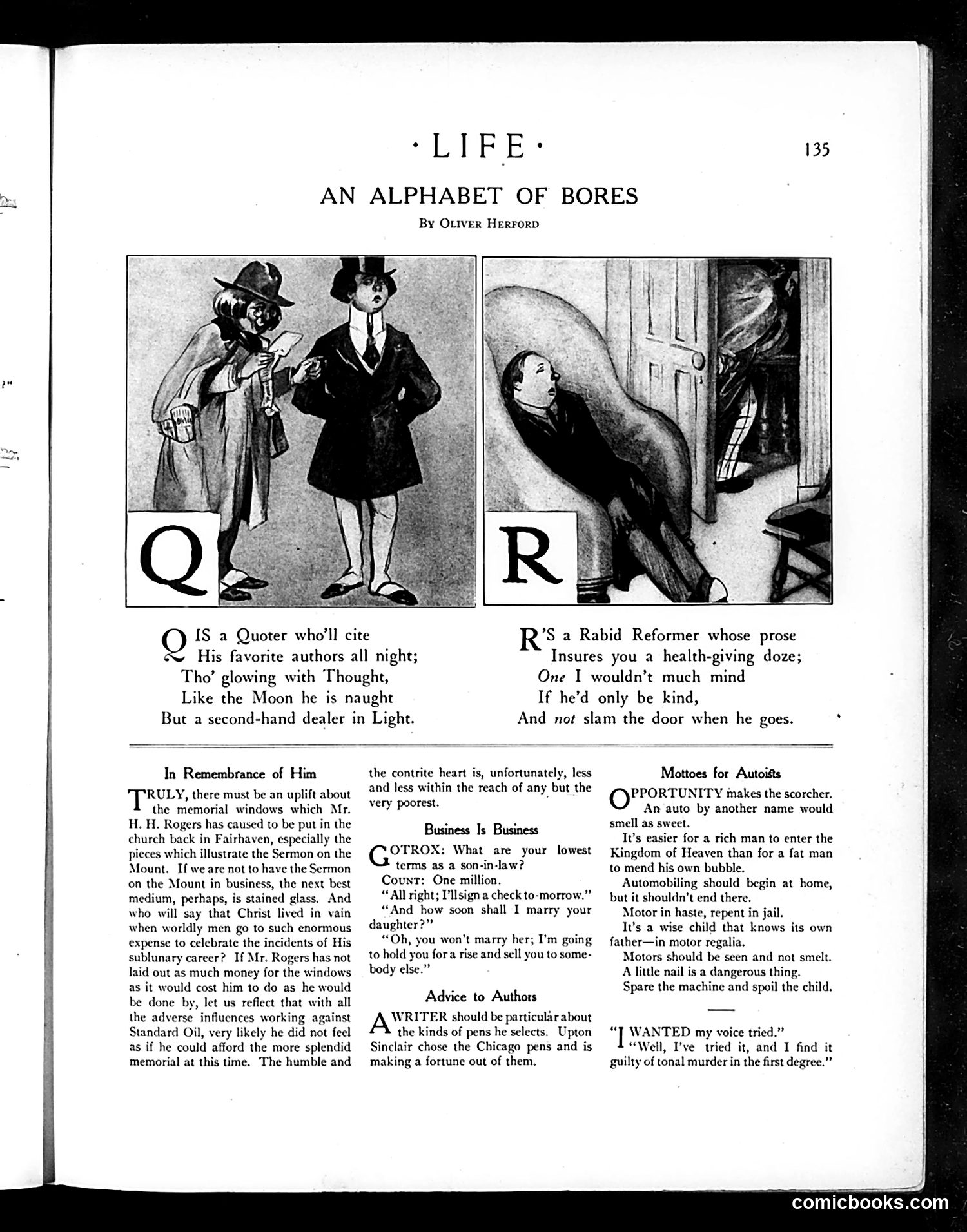
This page presents two character types from Oliver Herford's satirical alphabet series. **Q (The Quoter)** depicts someone who constantly cites favorite authors but contributes nothing original—merely a "second-hand dealer in Light," borrowing others' brilliance without genuine thought. **R (The Rabid Reformer)** mocks reform-minded writers whose well-intentioned prose is so tedious it puts readers to sleep ("health-giving doze"), and whose preachy intensity makes them socially unpleasant—slamming doors as they leave. The accompanying pieces mock wealthy industrialists' selective charity (H.H. Rogers' church windows), transactional business mentality, and early automobile culture's recklessness. The "Advice to Authors" references Upton Sinclair's muckraking *The Jungle*, suggesting his exposés made more money than actual reform achieved.
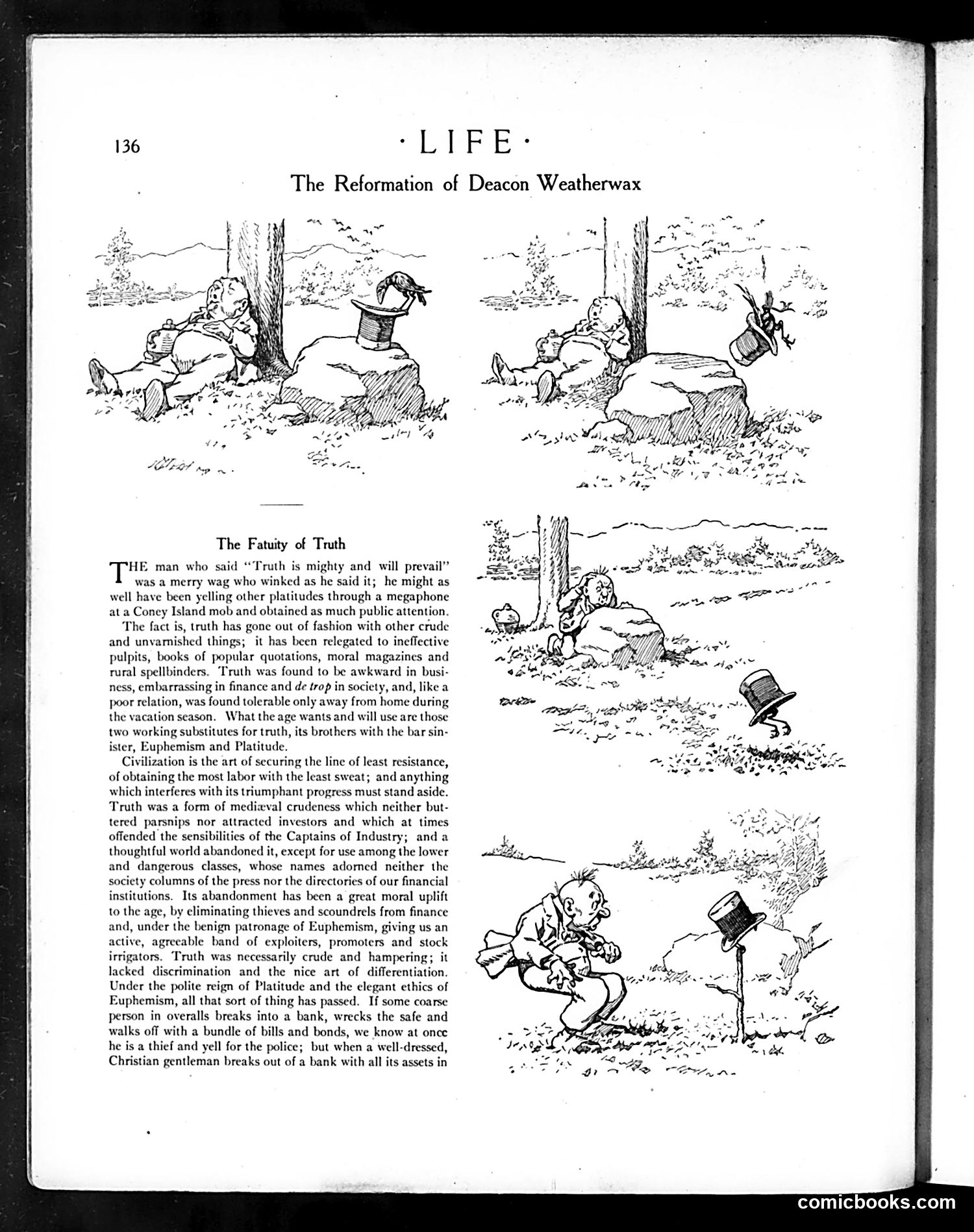
This page contains two separate satirical pieces: **"The Reformation of Deacon Weatherwax"** (top): A visual comic strip showing a rotund man in various poses near a tree, appearing to depict someone's moral or physical "reformation"—likely playing on the ironic title. **"The Fatuity of Truth"** (main text): A sharp social critique arguing that truth has become unfashionable in modern business and high society. The author mocks the phrase "Truth is mighty and will prevail" as naive platitude, contending that truth is now relegated to rural preachers and ineffective outlets while "Euphemism and Platitude" dominate finance and society. The essay's biting conclusion exposes class hypocrisy: a working-class bank robber is called a thief, but a "well-dressed, Christian gentleman" committing the same crime escapes moral judgment—suggesting that respectability and polite language ("Euphemism") allow the wealthy to escape accountability for identical crimes. This satirizes Gilded Age/Progressive Era corruption and the use of genteel language to mask financial exploitation.
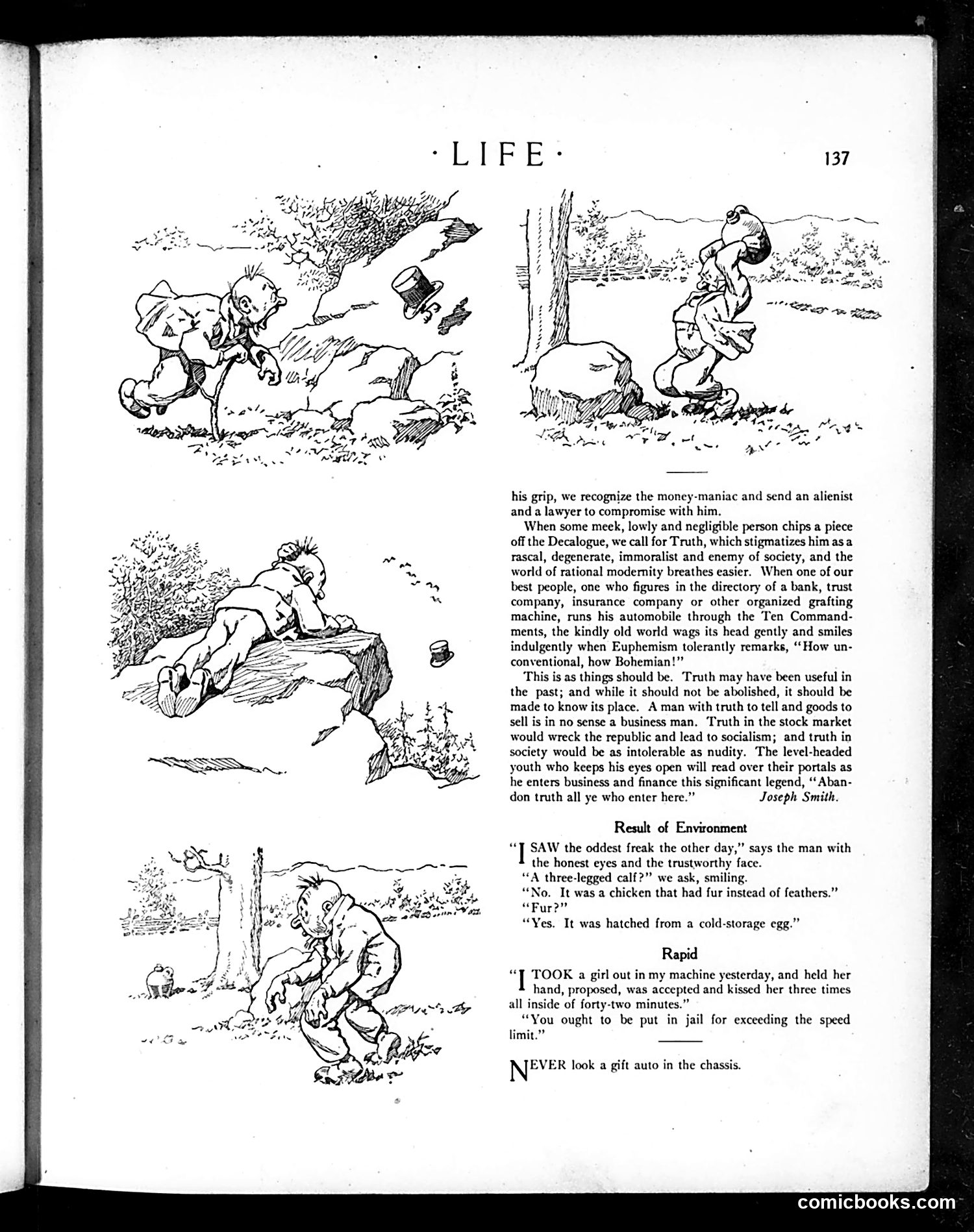
This page contains satirical commentary on hypocrisy and moral double standards in early 20th-century American society. The main text critiques how wealthy, respectable businessmen who violate ethical principles (the "Ten Commandments") are excused as "unconventional" or "Bohemian," while poor or ordinary people who commit similar moral infractions are harshly condemned as "rascals" and "degenerates." The passage sarcastically suggests that truth and honesty are impediments to business success and should be abandoned upon entering finance. The accompanying cartoons (featuring simplified figures in various scenarios) and brief jokes illustrate absurdity and rapid social change—including a humorous anecdote about a man proposing to a woman during a fast automobile ride, and wordplay about examining automobile chassis. The overall message: American society applies moral standards selectively based on social class, and modern business culture actively discourages honesty and integrity.
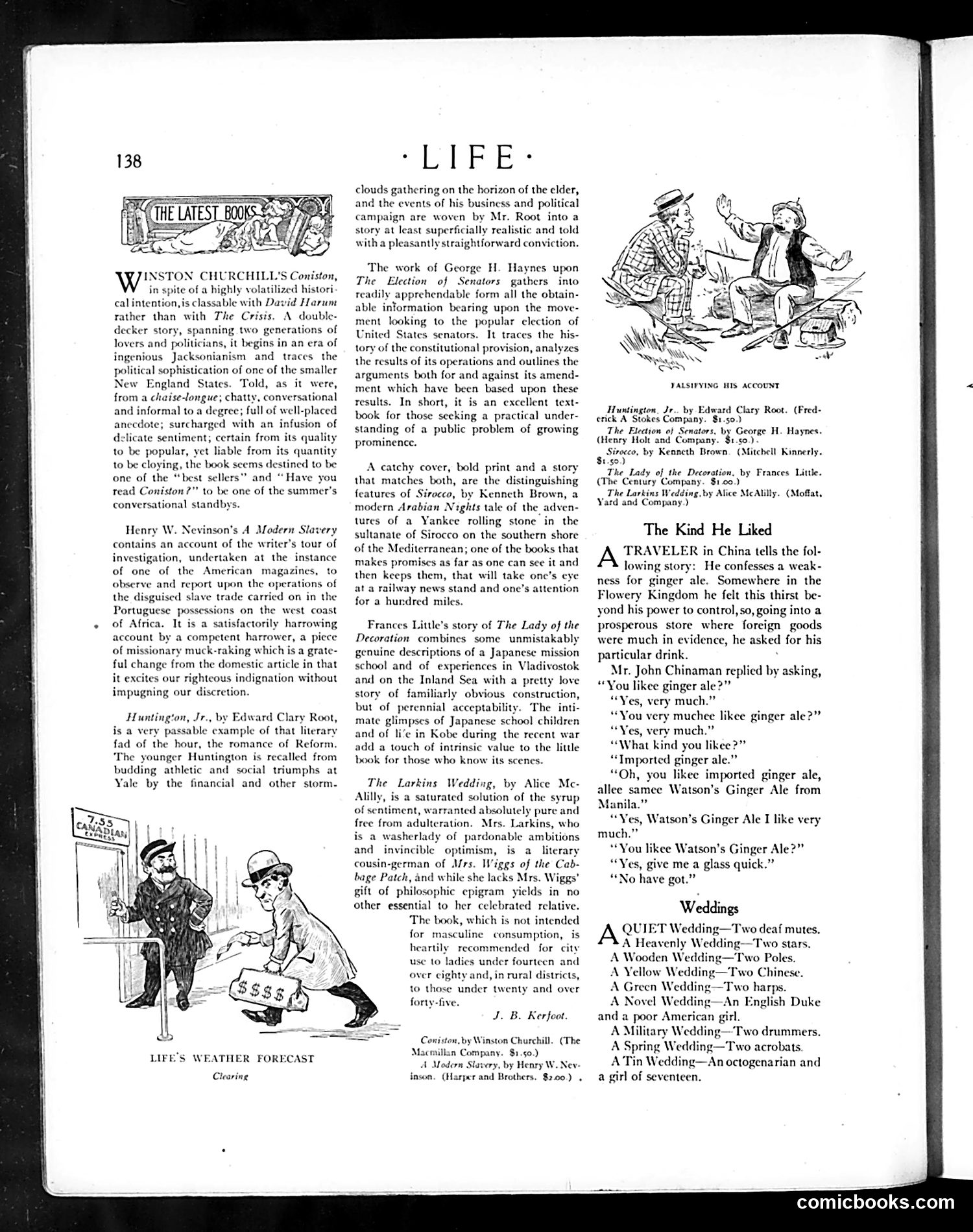
This page features book reviews and two cartoon illustrations. The top cartoon, "Settling His Account," depicts a man in casual dress confronting what appears to be a shopkeeper or creditor—likely satirizing debt collection or financial disputes common to the era. Below, "Life's Weather Forecast: Clearing" shows a man in a coat passing money to another figure at a doorway, presumably commenting on improving economic conditions or financial relief. The page reviews six contemporary books, including Winston Churchill's *Coniston* (a political romance), works on slavery and Senate reform, and adventure/romance novels. The reviews are written in Life magazine's characteristic witty, gossipy tone, evaluating books as social and entertainment commodities for the magazine's educated readership. The cartoons appear designed to provide light humor complementing the literary commentary—offering visual jokes about money and social situations rather than direct political satire.
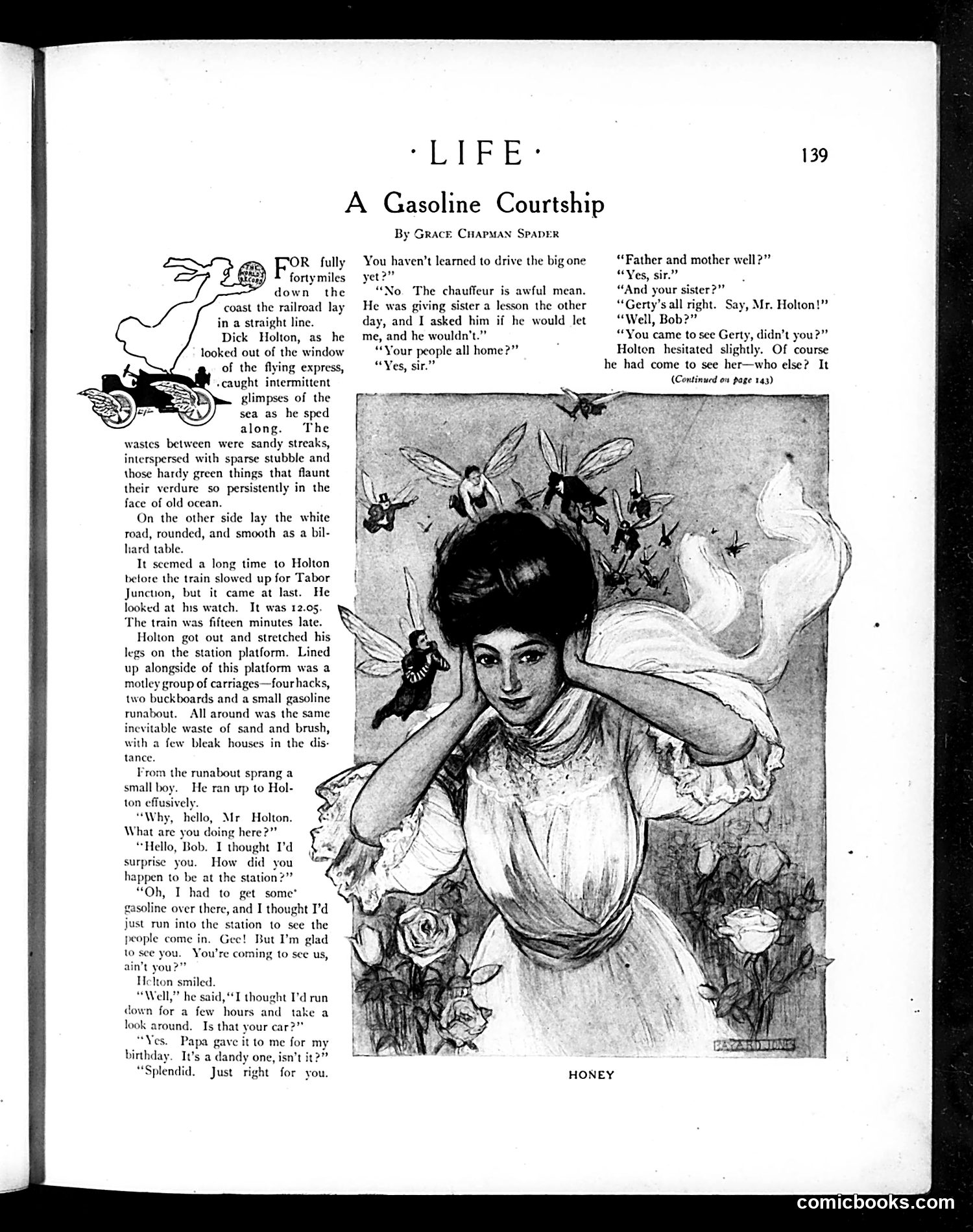
This is a serialized short story (continued on page 143) about a young man named Holton visiting a town by train. The narrative setup involves early-1900s transportation: he arrives by rail and encounters a boy with a gasoline-powered runabout—a relatively new, expensive automobile technology that marks the owner as wealthy. The story's title and the illustration (labeled "HONEY," showing a young woman's face surrounded by flowers) suggest a romantic plot. The joke appears to center on courtship rituals of the era: Holton claims to be visiting to see the boy's sister Gerty, but his hesitation when directly asked reveals his real purpose. The "gasoline courtship" likely refers to how modern automobiles were enabling young couples to court away from parental supervision—a novel social concern of the early automotive age. The satire targets both new technology and changing social customs around dating and independence.
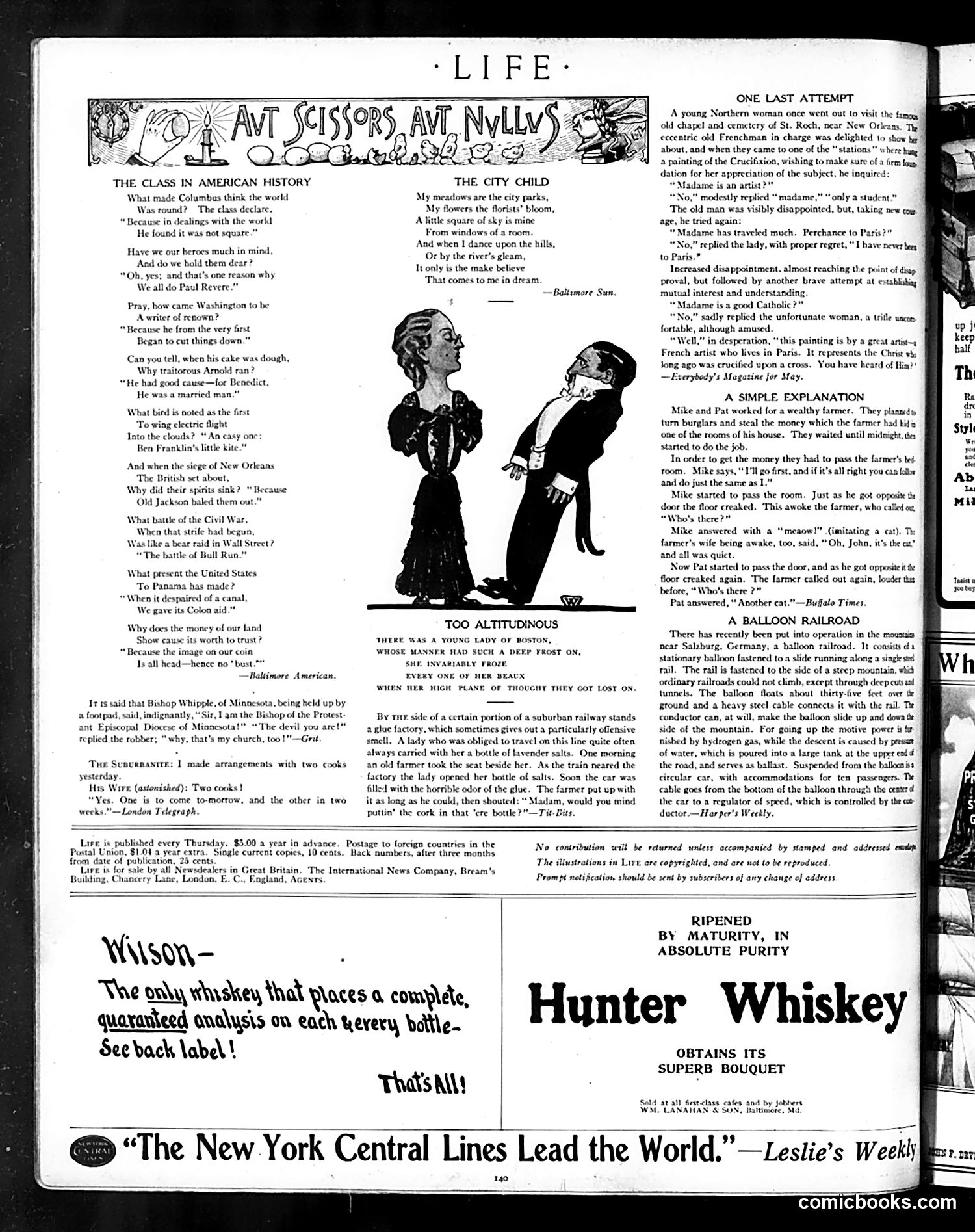
This page from *Life* magazine contains humorous content typical of early 20th-century American satire: **"The Class in American History"** presents joke answers from schoolchildren about American historical figures and events. The humor relies on wordplay and childish logic—for example, Columbus found the world "not square," Washington was a "writer of renown" because he "cut things down" (military victories), and Benedict Arnold ran away because "he was a married man." These jokes mock both naive historical understanding and contemporary figures/events. **"The City Child"** is sentimental verse about urban poverty, contrasting actual deprivation ("a little square of sky") with children's imaginative escapes. The remaining pieces are brief anecdotes: a bishop's encounter with a robber, a lady's lavender salts on a train, and a woman's failed attempts to impress a French cemetery curator through art, travel, or religion. These mock social pretension and cross-cultural misunderstandings. The page is primarily **humorous filler content** rather than political satire, characteristic of *Life*'s entertainment focus.
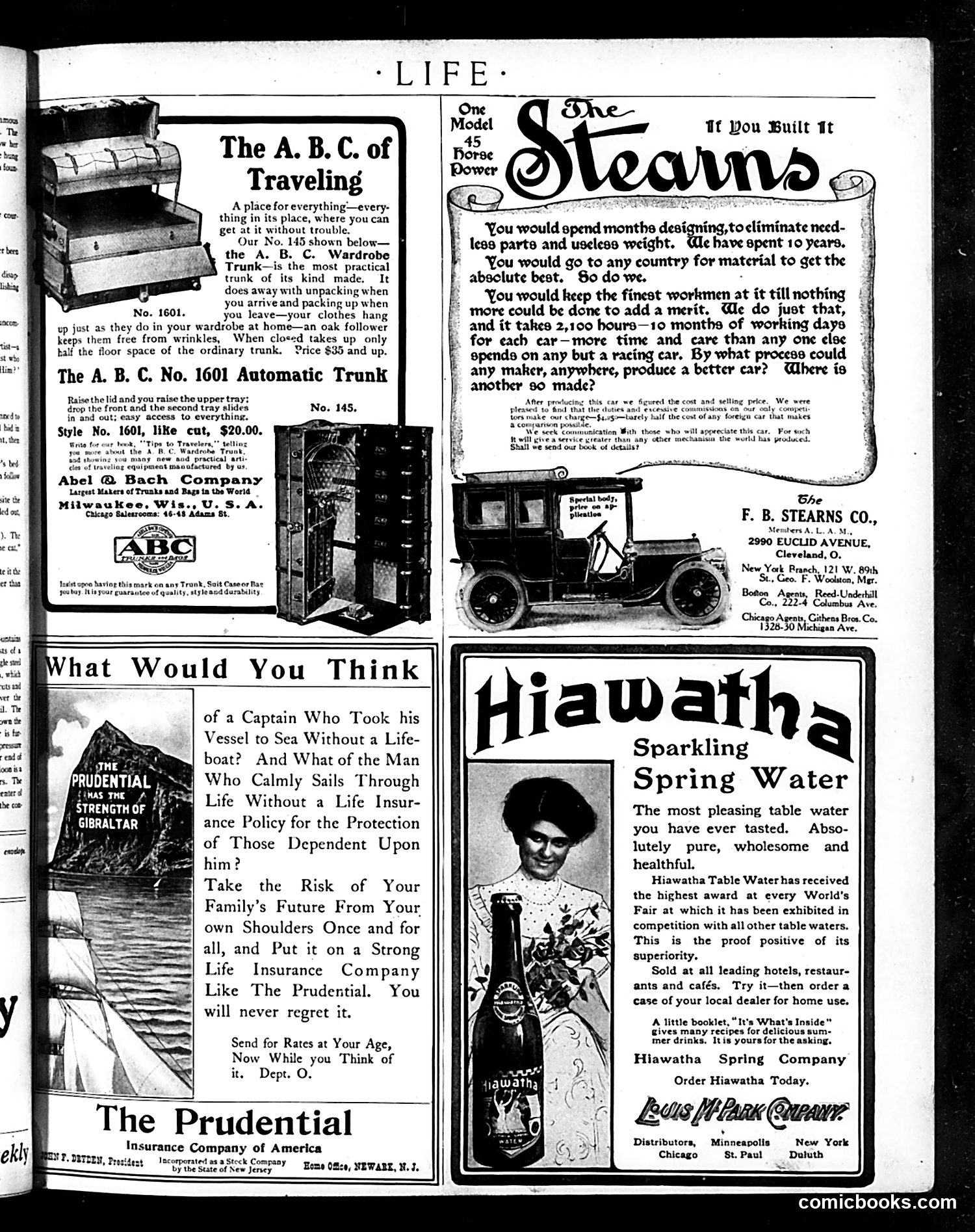
This page is primarily **advertisements**, not satire or political cartoons. It contains: **Product Ads:** - A.B.C. traveling trunks and wardrobe cases - The Stearns automobile (emphasizing quality construction and craftsmanship) - Hiawatha sparkling spring water **One Insurance Appeal:** The Prudential Insurance ad uses a moral rhetorical question: comparing a sea captain who recklessly sails without lifeboats to a man who lacks life insurance. It's an emotional appeal to family responsibility—suggesting that failing to insure oneself is dangerously negligent to dependents. **Historical Context for Modern Readers:** This appears to be from the early 1900s, when life insurance was still a relatively new concept. The ad frames insurance not as financial product but as *moral duty*. The image of a ship also plays on contemporary anxieties (the Titanic sank in 1912). The page reflects early 20th-century consumer culture and the advertising industry's emerging emotional persuasion techniques.
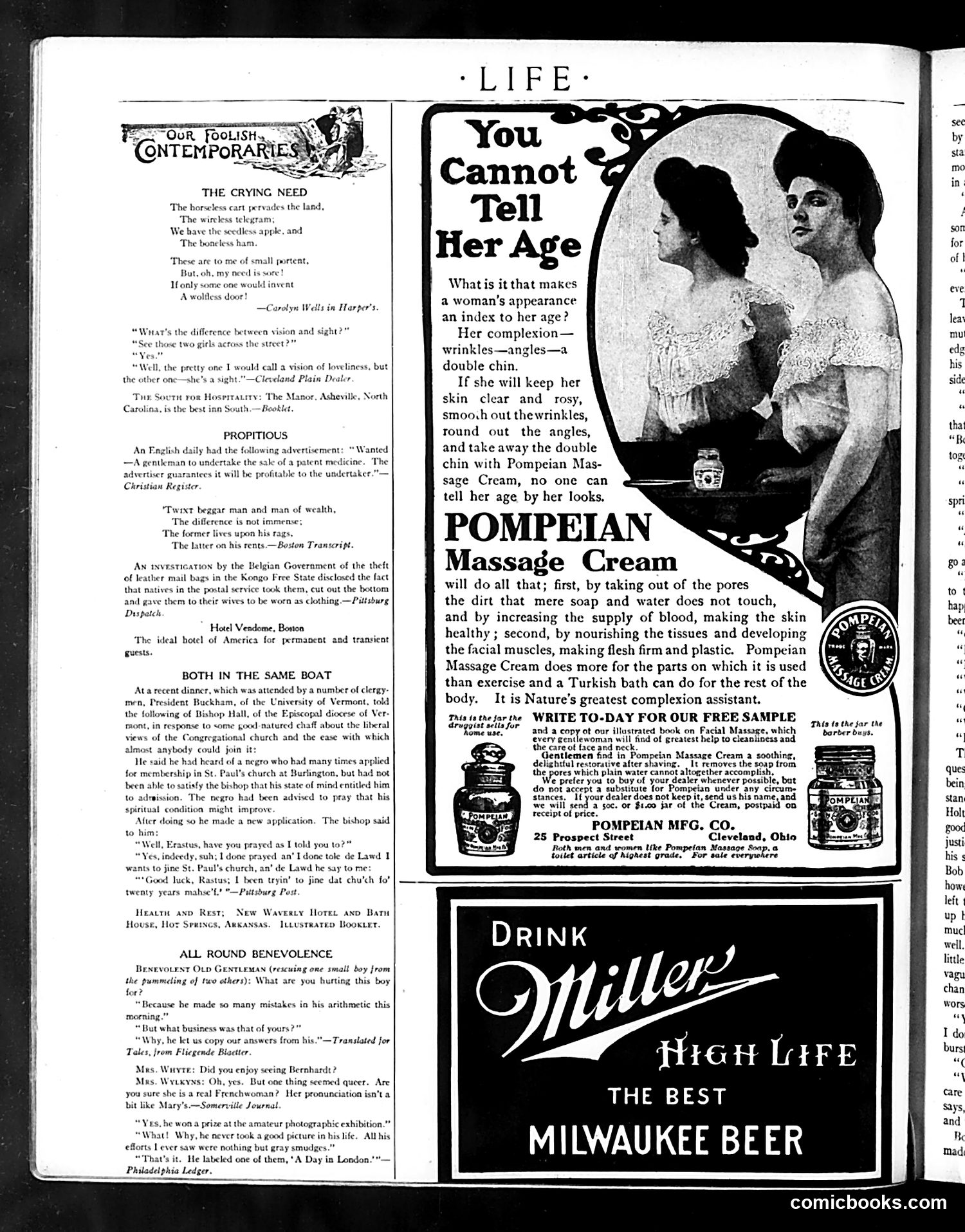
This page from Life magazine combines satirical commentary with period advertising, typical of early 20th-century American humor publications. **The Satire ("Our Foolish Contemporaries"):** The opening section mocks modern convenience culture—society has invented "horseless carts," "wireless telegrams," and "boneless ham," yet lacks useful innovations like a "woltless door." The humor targets consumer excess and technological obsession. **Supporting Anecdotes:** Brief humorous stories follow, including one about an English undertaker's business practice and a racial anecdote portraying stereotypical dialect humor (common but now offensive). These reflect the era's casual racial caricature conventions. **The Advertisements:** The Pompeian Massage Cream ad dominates the right side, addressing women's appearance anxiety—specifically how to hide aging signs (wrinkles, double chins). This reflects early 20th-century cosmetics marketing targeting women's insecurity about age and beauty standards. **Overall Context:** This page reveals period attitudes toward technology, race relations, and women's beauty expectations—documenting a very different cultural moment from today.
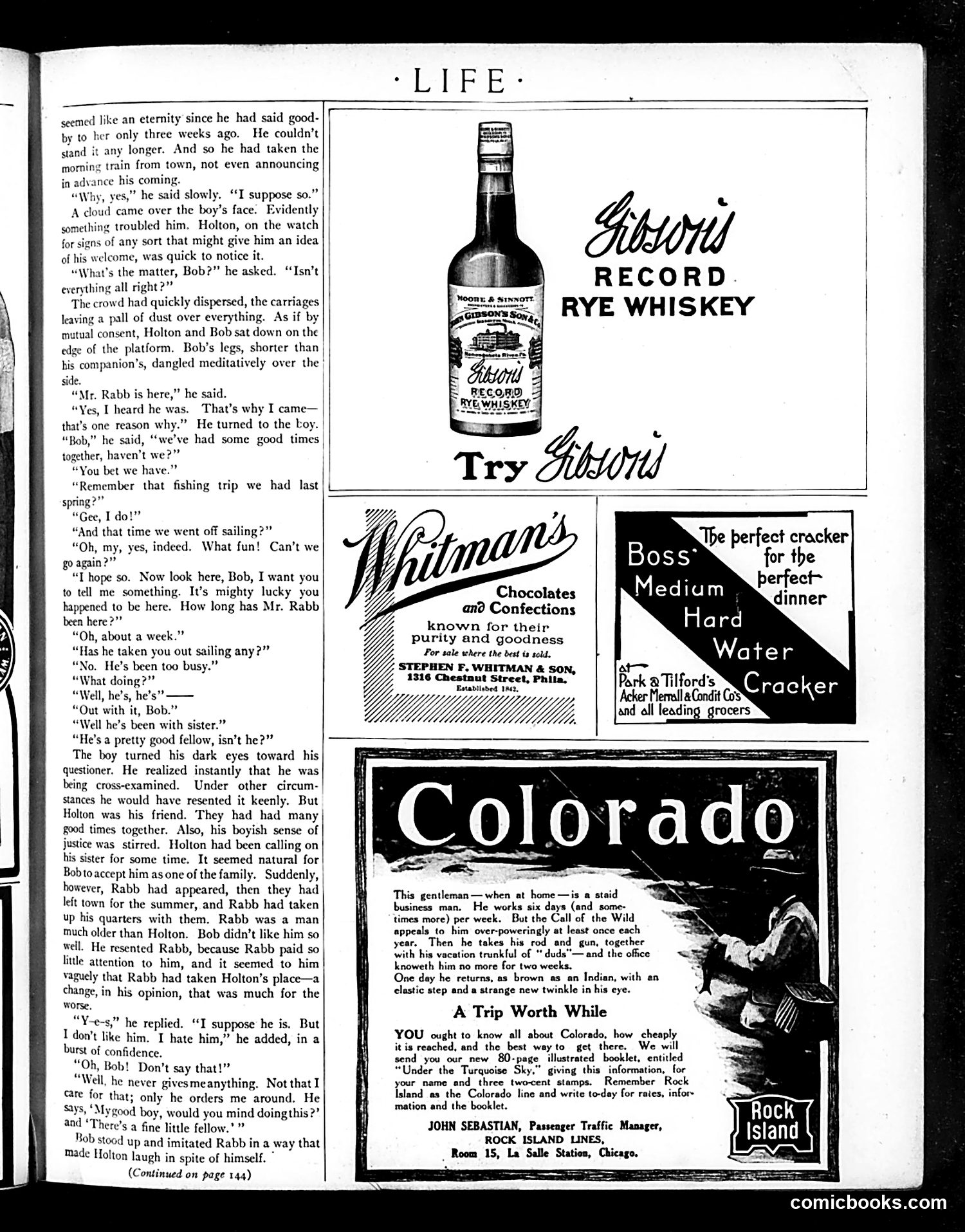
This page contains a serialized story (continued from earlier) about romantic rivalry. The narrative shows a young man named Holton questioning his friend Bob about a rival suitor, "Mr. Rabb," who has recently appeared and is now courting Bob's sister. Bob resents Rabb—both because Rabb ignores him and because his presence has displaced Holton from the family's summer life. The story illustrates early 20th-century courtship conventions and masculine anxieties about competition for a woman's affection, with the boy serving as an emotional barometer of the situation. **Advertisements** dominate the lower portion: Gilbori's Rye Whiskey, Whitman's Chocolates, "Boss" crackers, and a Rock Island Lines tourism ad promoting Colorado vacations. These ads are period-typical luxury goods marketed to middle-class readers.
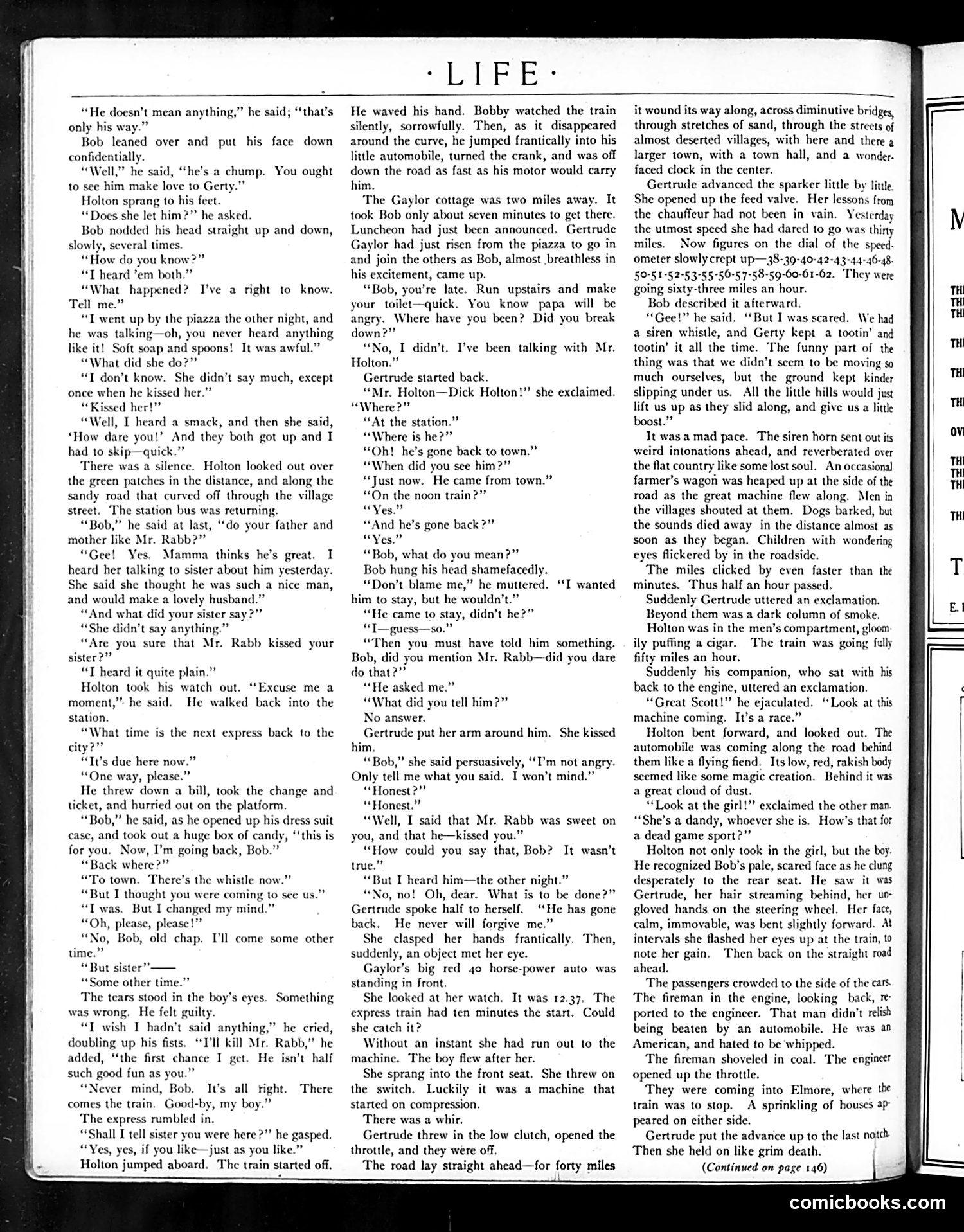
This page contains a serialized short story (not a political cartoon) about romantic complications among young people. The narrative follows a character named Holton who visits his girlfriend Gertrude at her family's cottage but abruptly leaves by train after learning from Bob (her younger brother) that another suitor, Mr. Rabb, has been courting her—specifically that Rabb kissed Gertrude. The story explores early 20th-century social conventions around courtship and jealousy. Holton's dramatic departure (buying a one-way ticket back to the city) represents wounded pride, while Bob's guilty realization that his gossip caused the problem drives the emotional climax. The narrative emphasizes propriety and the significance of a kiss as a serious romantic gesture in this era. This appears to be straightforward literary fiction rather than satire—typical serialized entertainment for Life magazine's general audience.
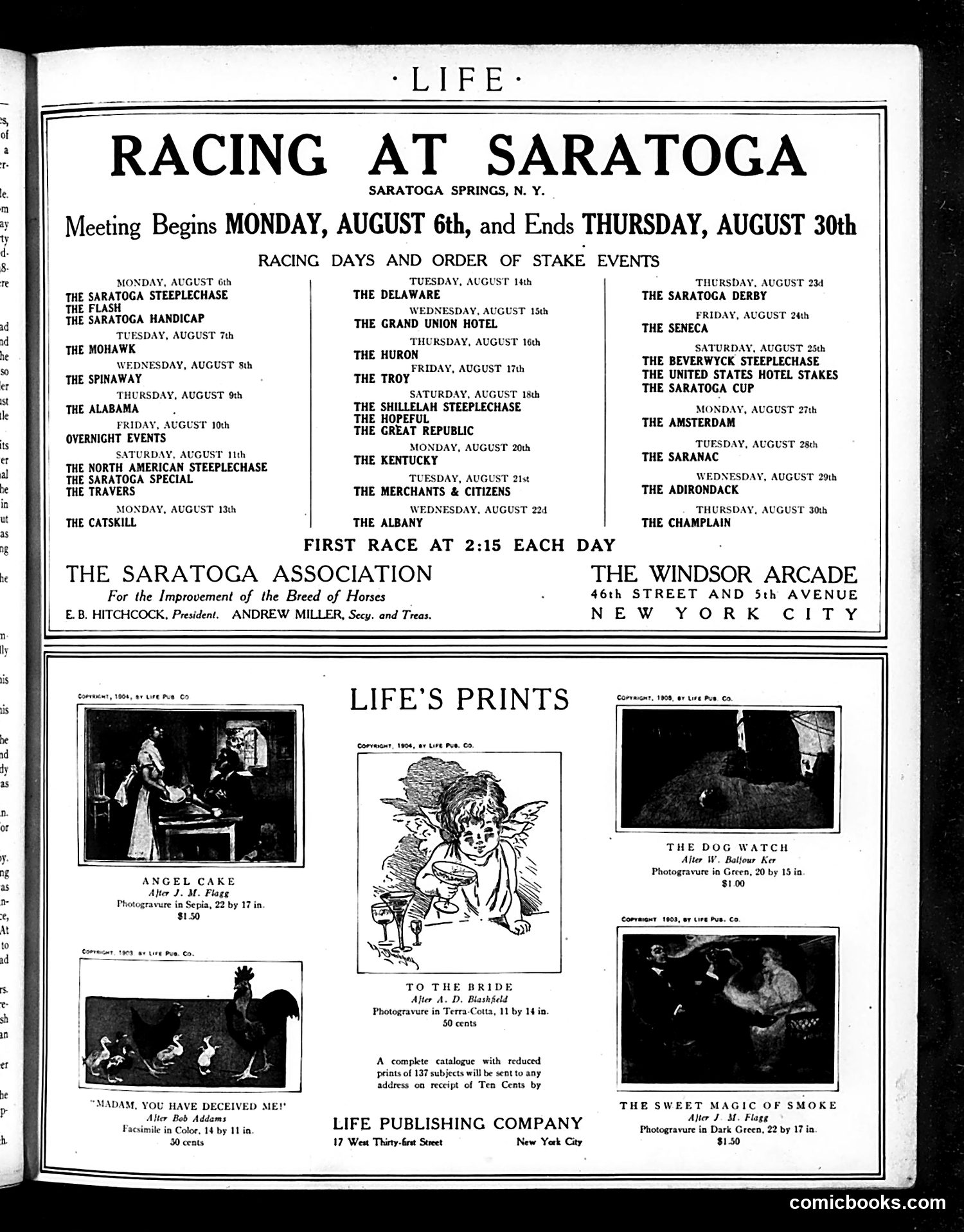
This page is primarily **advertising and announcement content**, not political satire. The top section announces the Saratoga Springs horse racing meet (August 6-30) with a full schedule of stake races—major events that attracted wealthy patrons. Racing was a prominent leisure activity for the American upper class in this era. The bottom section advertises **Life Publishing Company's art prints** for sale, featuring works by notable illustrators like J.M. Flagg and A.D. Blashfeld. These were decorative photogravures—expensive reproductions selling for 30 cents to $1.50 each. The subjects ("Angel Cake," "To the Bride," "The Sweet Magic of Smoke") appear to be sentimental or genteel domestic scenes typical of early 1900s popular art. The page reflects Life magazine's dual identity: satirical publication and lifestyle arbiter for educated, affluent readers interested in horses, art, and refined leisure pursuits.
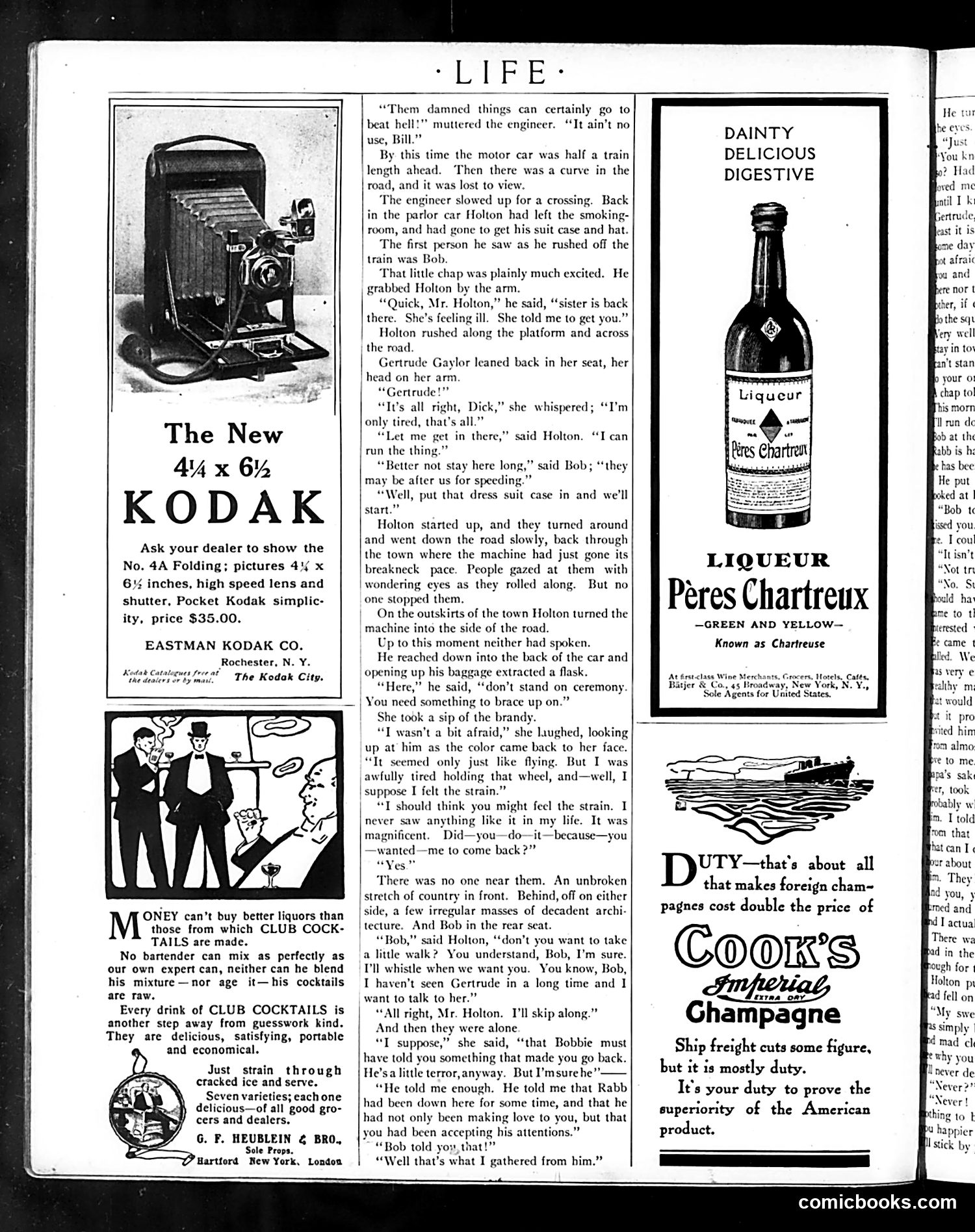
This page is primarily **advertisements interspersed with serialized fiction**, not political satire. The main content is a romantic narrative about a man named Holton reuniting with a woman named Gertrude after she's driven a motor car recklessly. The **ads** include: - Kodak cameras (4¼ x 6½ folding model, $35) - Club Cocktails pre-mixed drinks - Peres Chartreux liqueur - Cook's Imperial Champagne The fiction depicts early-1900s automotive excitement—the "damned things" (cars) are still novel enough to astonish onlookers. The romantic drama involves Holton confronting Gertrude about another suitor named Rabb. There's no discernible political cartoon or satire on this page. The small illustration shows two men in formal dress, likely advertising the cocktail product, with no satirical intent visible.
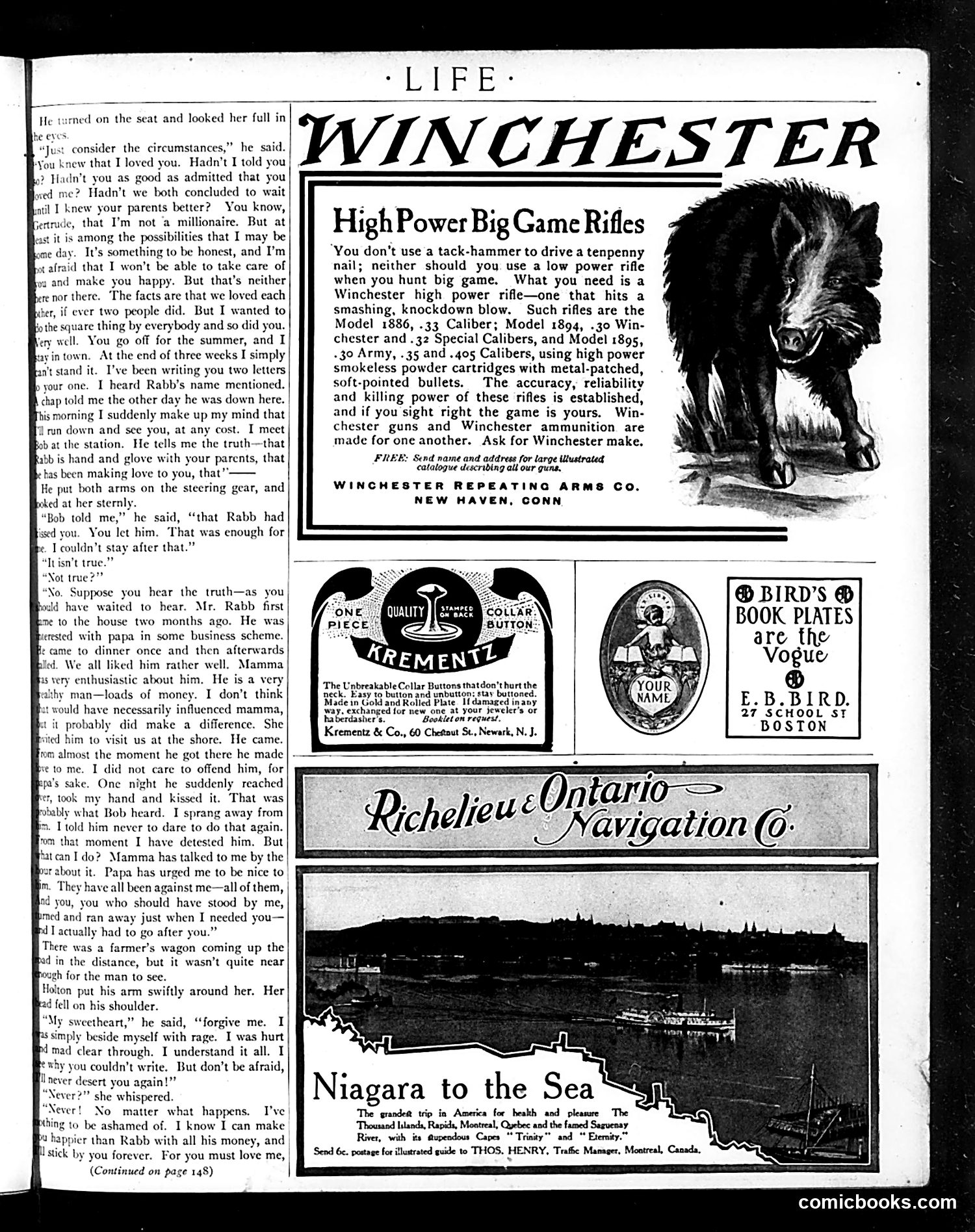
This page contains a serialized romantic story (continued from earlier) alongside period advertisements. The narrative depicts a domestic drama: a young woman explains to her suitor why she allowed another man (Rabb) to kiss her. She clarifies she rejected his advances but couldn't prevent family pressure—her parents encouraged the wealthy suitor's attention despite her objections. The protagonist's boyfriend initially abandons her in anger upon hearing of the kiss, but ultimately reconciles, pledging eternal devotion. The story reflects early-20th-century gender dynamics: women had limited autonomy against parental authority, and a woman's reputation hinged on romantic propriety. The resolution emphasizes male protection and reassurance. The advertisements—Winchester rifles, collar buttons, and boat tours—are typical period commercial content unrelated to the narrative's satirical purpose.
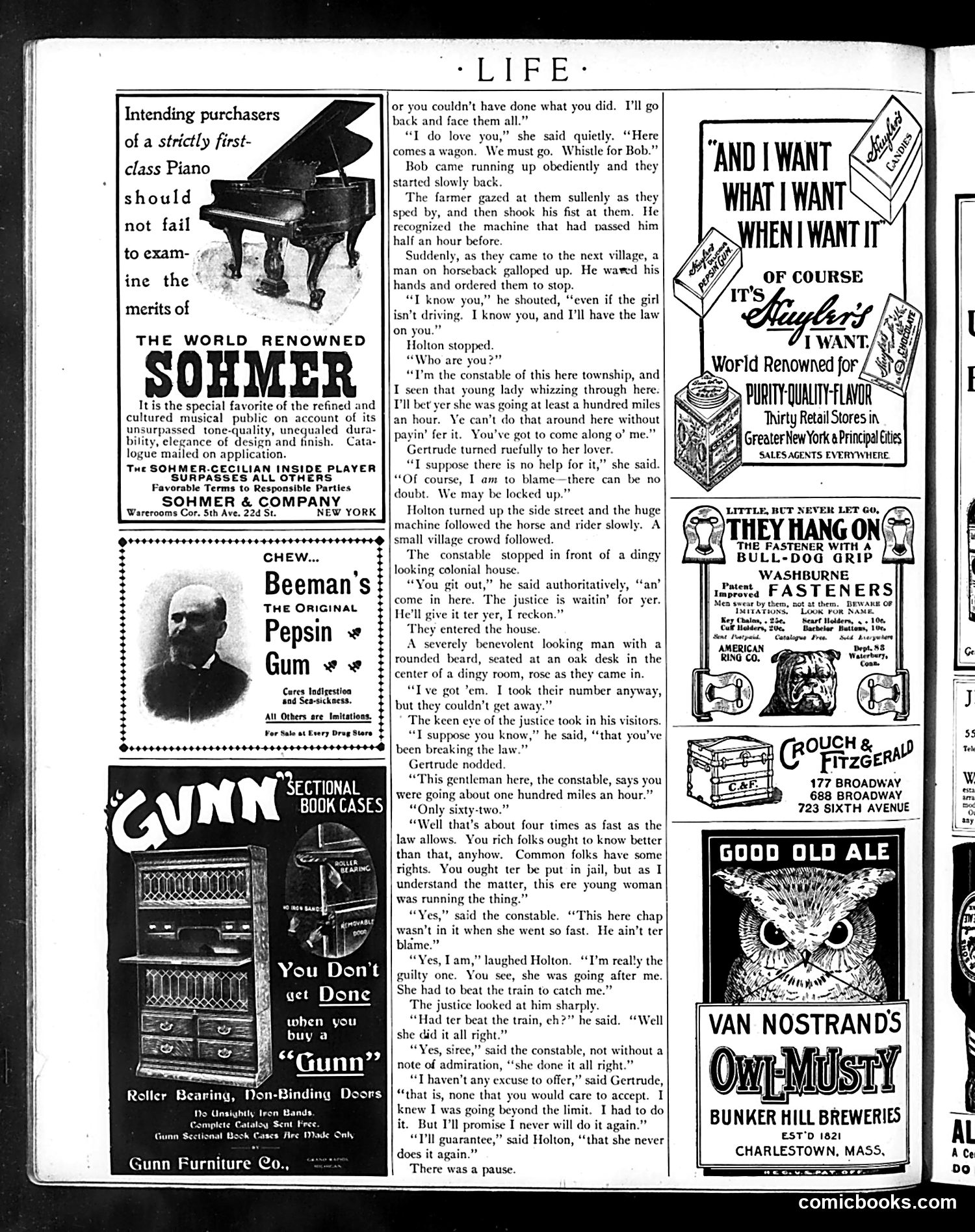
This page is primarily **advertising with an embedded serialized story**, not political satire. The narrative text describes a speeding incident: a woman driver (Gertrude) is stopped by a constable for driving roughly 60 mph through a village. A local justice confronts her, initially threatening jail time for violating speed limits. The story's point concerns **early automobile culture and gender roles**. The constable and justice initially blame the male passenger (Holton) but learn the woman was driving. Rather than condemn her, they express grudging admiration—she was speeding to catch a train to meet her lover, a romantic gesture that redeems the traffic violation in their eyes. The advertisements emphasize consumer goods (Sohmer pianos, Beeman's gum, Gunn furniture) typical of early-20th-century Life magazine. The story appears designed to entertain while subtly addressing evolving attitudes toward women drivers—still novel and controversial in this era.
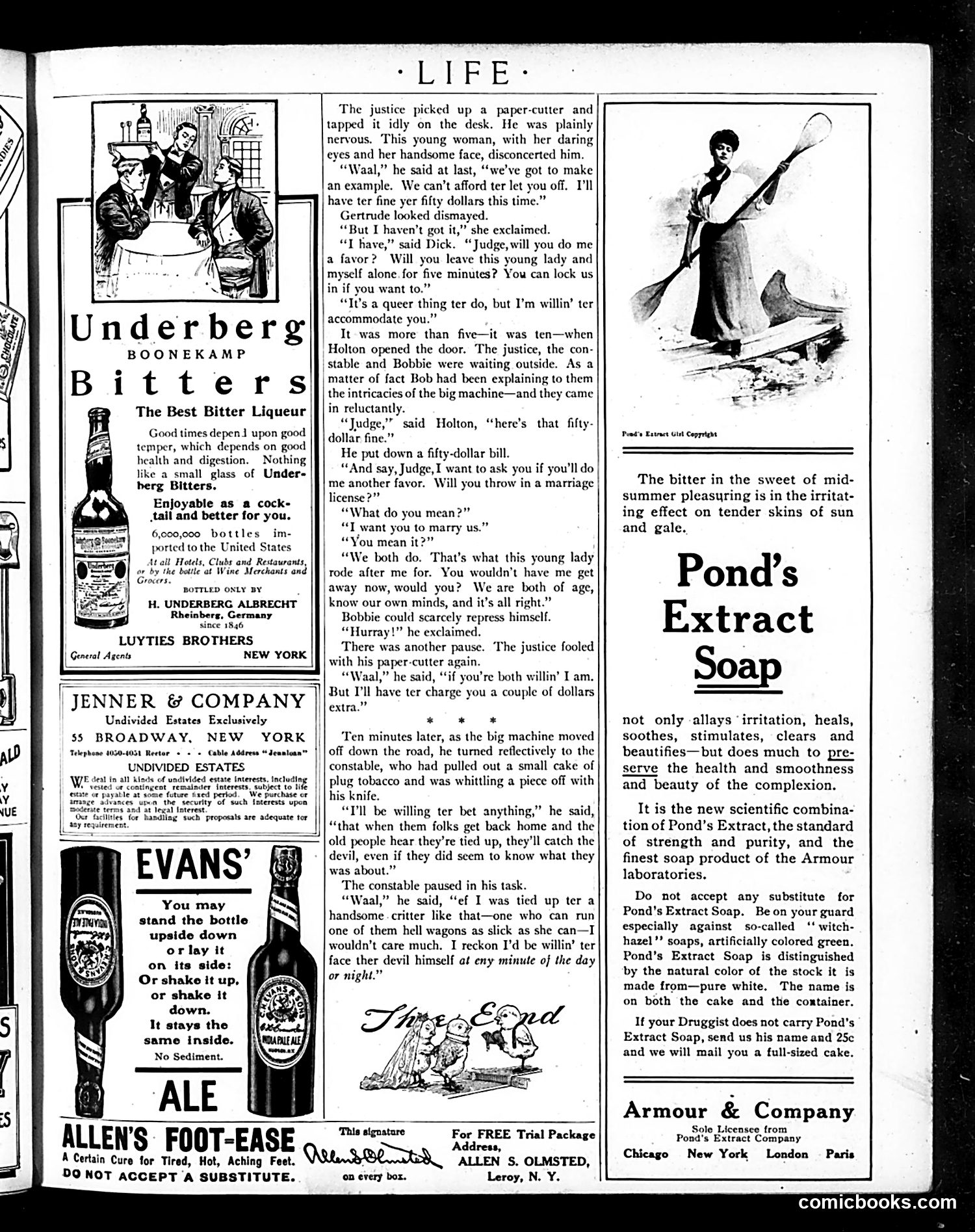
This page contains a short story titled "The Bitter in the Sweet," not a political cartoon. The narrative depicts a young woman named Gertrude caught in a legal predicament—fined $50 by a judge for an unspecified offense (likely traffic or motor-vehicle related, given references to "the big machine"). A man named Dick arranges a private meeting with the judge, after which he pays the fine and proposes marriage. The constable and judge react with resigned acceptance, predicting her parents will disapprove despite the couple's legal adulthood. **The satire**: The story mocks early 20th-century social attitudes about automobiles, courtship, and parental authority. The "bitter" is legal trouble and social scandal; the "sweet" is romance. The judges and constables' cynical acceptance suggests such hasty marriages were common enough to be unremarkable, while parental opposition remained inevitable. The page is primarily advertisements (bitters, soap, foot-ease) surrounding the story.
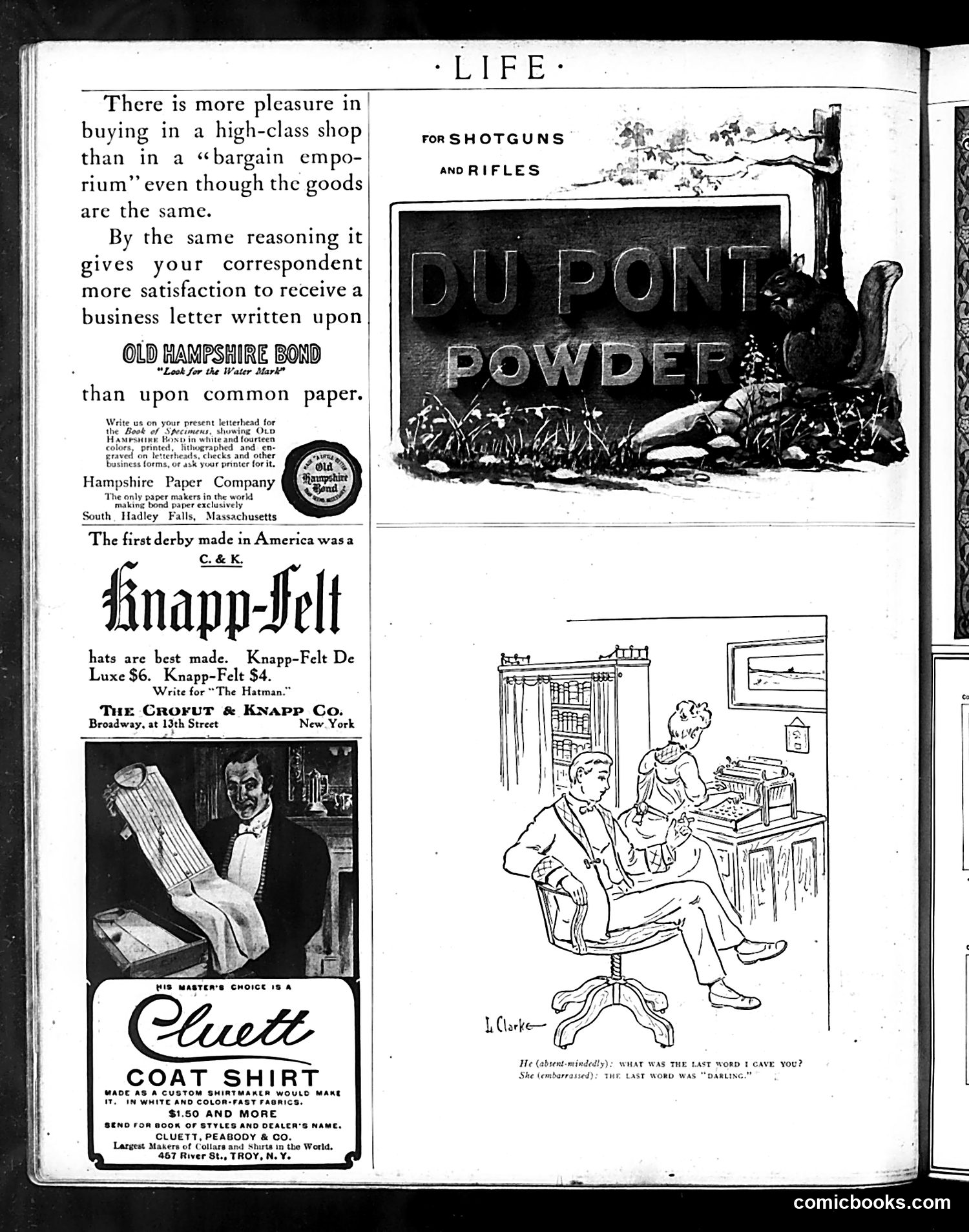
This page is primarily **advertising** with one small cartoon. The ads promote luxury goods (fine paper, hats, shirts, gunpowder) using a recurring theme: that quality and prestige matter as much as the product itself. The single cartoon depicts a domestic scene where a husband, absent-mindedly, asks his wife what the last word he gave her was. She, embarrassed, replies it was "darling"—a mild joke about marital affection and the husband's inattentiveness. The humor relies on the double meaning of "last word" (final statement vs. the constant nagging/dominance attributed to wives in period comedy). The page reflects early 20th-century consumer culture and gender stereotypes common to Life's satirical commentary. The ads target affluent readers, while the cartoon pokes gentle fun at marriage dynamics in a way considered acceptable humor of the era.
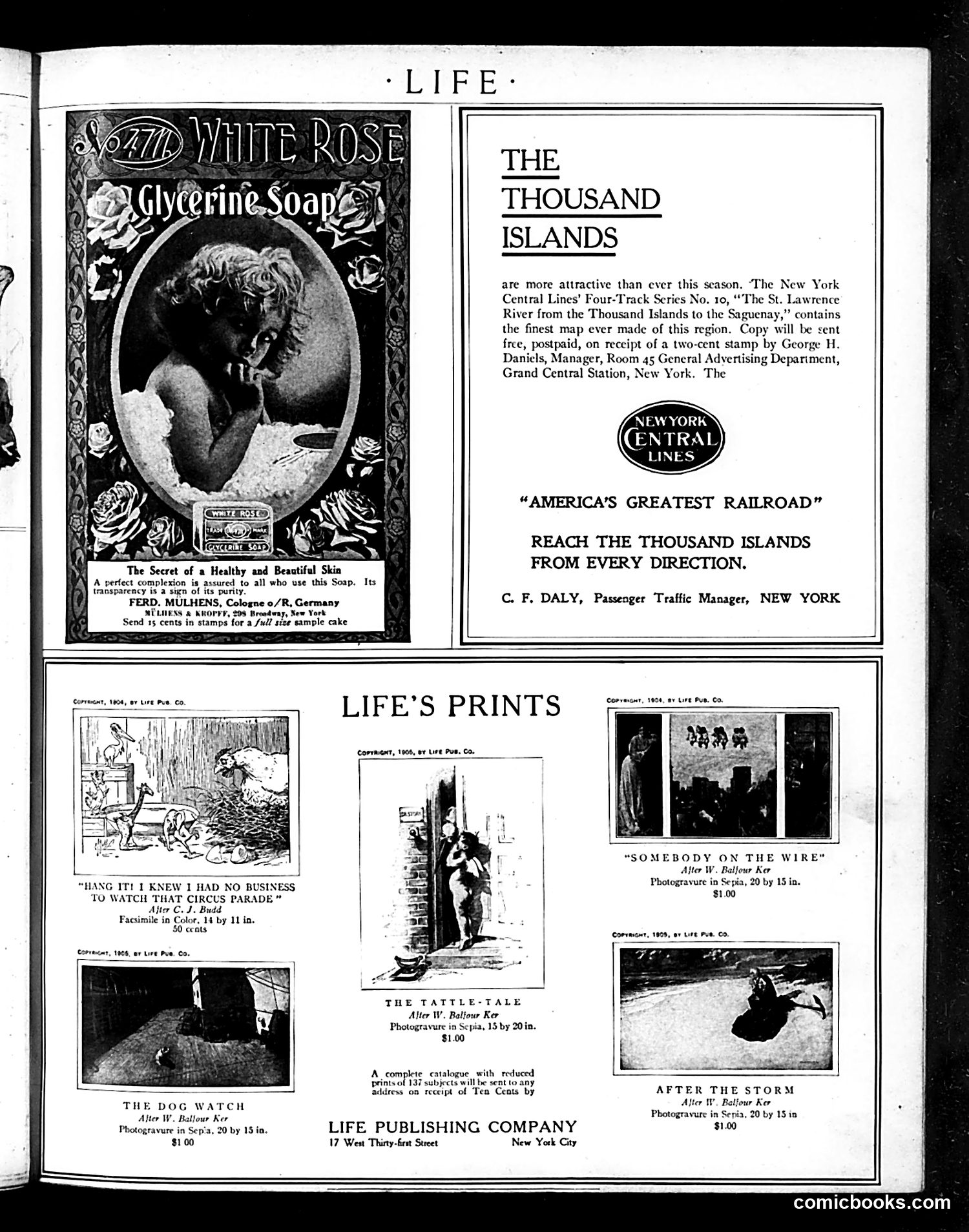
This page is primarily **advertising and promotional content** rather than political satire or editorial cartooning. The top half features two unrelated ads: a European glycerine soap (Ferd. Mulhens) and a New York Central Railroad promotion for the Thousand Islands tourist region. The bottom half showcases **Life Publishing Company's print catalog**—photogravures (fine art reproductions) available for purchase. The images shown have titles like "The Tattle-Tale," "Somebody on the Wire," "The Dog Watch," and "After the Storm," credited to artist Alice W. Balfour Ker. These appear to be sentimental or genre scenes typical of early 20th-century illustration, priced at $1.00 each. This is essentially a **catalog page** demonstrating Life's dual business model: satirical magazine *and* art print publisher. The content reflects commercial rather than political intent.
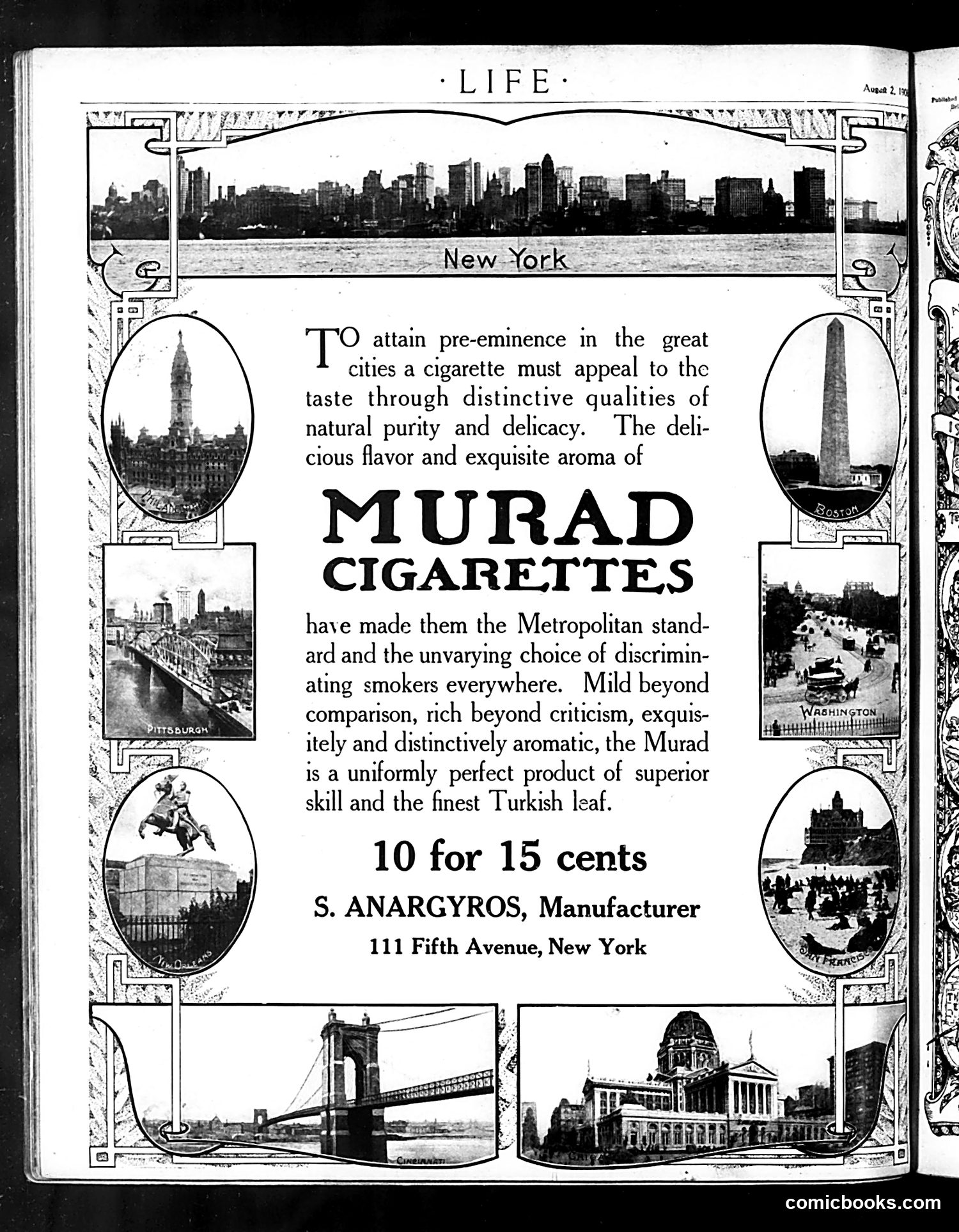
This is a full-page advertisement, not satire or cartoon commentary. It advertises Murad cigarettes manufactured by S. Anargyros in New York. The ad appeals to urban sophistication, featuring photographs of major American cities (New York, Pittsburgh, Washington, San Francisco) and landmarks (Brooklyn Bridge, Capitol Building) arranged around the central text. The pitch emphasizes "natural purity," "delicacy," and "Turkish leaf"—marketing language designed to position Murad as a premium, discriminating choice for city dwellers. The price ("10 for 15 cents") and manufacturer's Fifth Avenue address reinforce aspirational branding. To modern readers, this represents an era when cigarette advertising was unregulated and commonly appeared in mainstream magazines, before health warnings were required.