
Life, 1906-08-02 · page 24 of 40
Life — August 2, 1906 — page 24: what you’re looking at
What you’re looking at
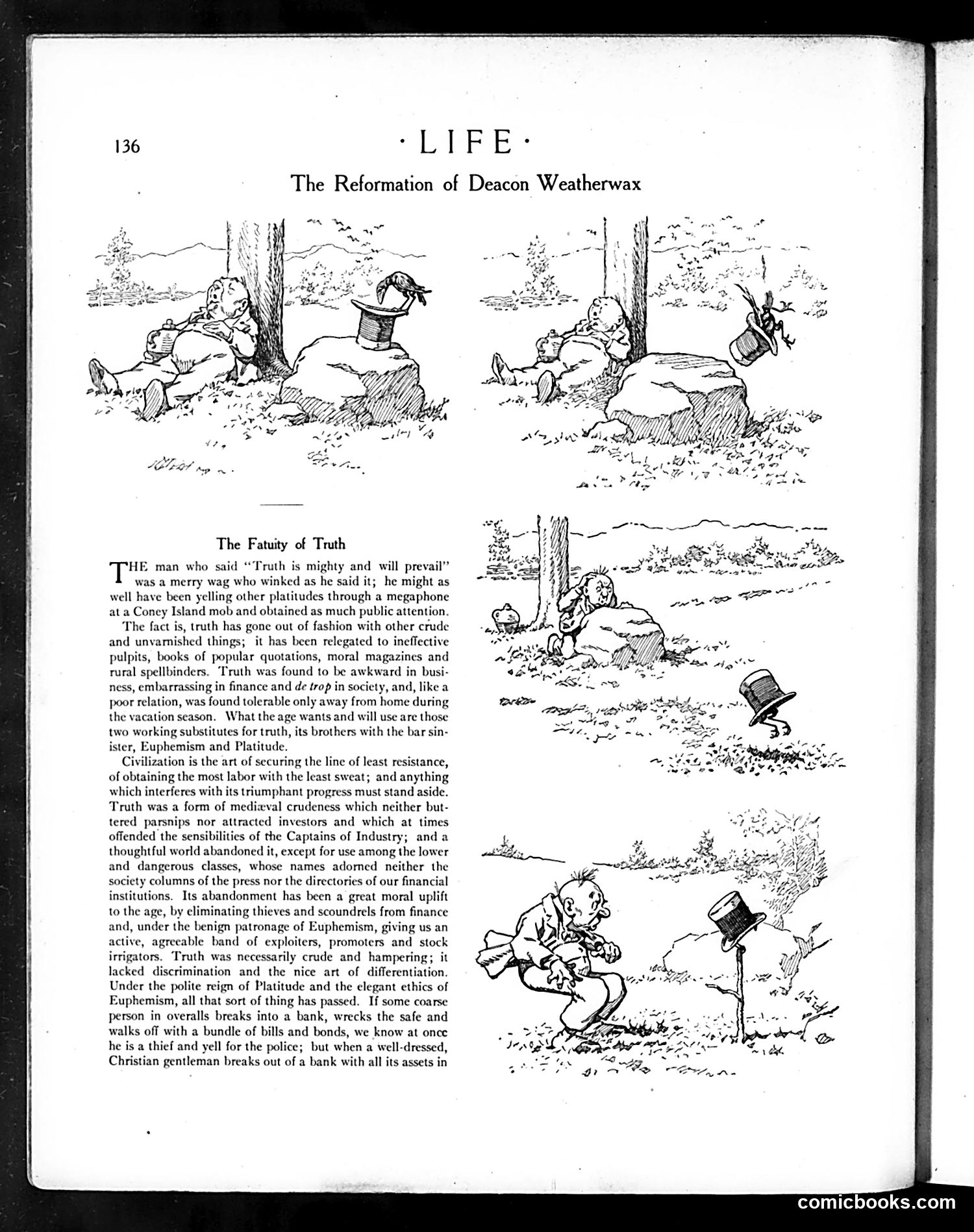
This page contains two separate satirical pieces: **"The Reformation of Deacon Weatherwax"** (top): A visual comic strip showing a rotund man in various poses near a tree, appearing to depict someone's moral or physical "reformation"—likely playing on the ironic title. **"The Fatuity of Truth"** (main text): A sharp social critique arguing that truth has become unfashionable in modern business and high society. The author mocks the phrase "Truth is mighty and will prevail" as naive platitude, contending that truth is now relegated to rural preachers and ineffective outlets while "Euphemism and Platitude" dominate finance and society. The essay's biting conclusion exposes class hypocrisy: a working-class bank robber is called a thief, but a "well-dressed, Christian gentleman" committing the same crime escapes moral judgment—suggesting that respectability and polite language ("Euphemism") allow the wealthy to escape accountability for identical crimes. This satirizes Gilded Age/Progressive Era corruption and the use of genteel language to mask financial exploitation.
📄 Transcribed text from this page (OCR, searchable)
Machine-transcribed from the original scan — historical spelling and the odd misread are preserved.
The Reformation of Deacon Weatherwax The Fatuity of Truth HE man who said ‘Truth is mighty and will prevail” was a merry wag who winked as he said it; he might as well have been yelling other platitudes through a megaphone ata Coney Island mob and obtained as much public attention. The fact is, truth has gone out of fashion with other crude and unvamished things; it has been relegated to ineffective pulpits, books of popular quotations, moral magazines and rural spellbinders. ‘Truth was found to be awkward in busi- ness, embarrassing in finance and de trop in society, and, like a poor relation, was found tolerable only away from home during the vacation season. What the age wants and will use are those two working substitutes for truth, its brothers with the bar sin- ister, Euphemism and Platitude. ration is the art of securing the line of least resistance, of obtaining the most labor with the least sweat; and anything which interferes with its triumphant progress must stand aside. Truth was a form of mediaeval crudeness which neither but- tered parsnips nor attracted investors and which at times offended the sensibilities of the Captains of Industry; and a " thoughtful world abandoned it, except for use among the lower ay, hy and dangerous classes, whose names adored neither the pre ET society columns of the press nor the directories of our financial was ad institutions. Its abandonment has been a great moral uplift to the age, by eliminating thieves and scoundrels from finance and, under the benign patronage of Euphemism, giving us an active, agreeable band of exploiters, promoters and. stock irrigators. Truth was necessarily crude and hampering; it lacked discrimination and the nice art of differentiation. Under the polite reign of Platitude and the elegant ethics of Euphemism, all that sort of thing has passed. If some coarse person in overalls breaks into a bank, wrecks the safe and walks off with a bundle of bills and bonds, we know at once he is a thief and yell for the police; but when a well-dressed, Christian gentleman breaks out of a bank with all its assets in comicbooks.com