
Life, 1906-08-02 · page 28 of 40
Life — August 2, 1906 — page 28: what you’re looking at
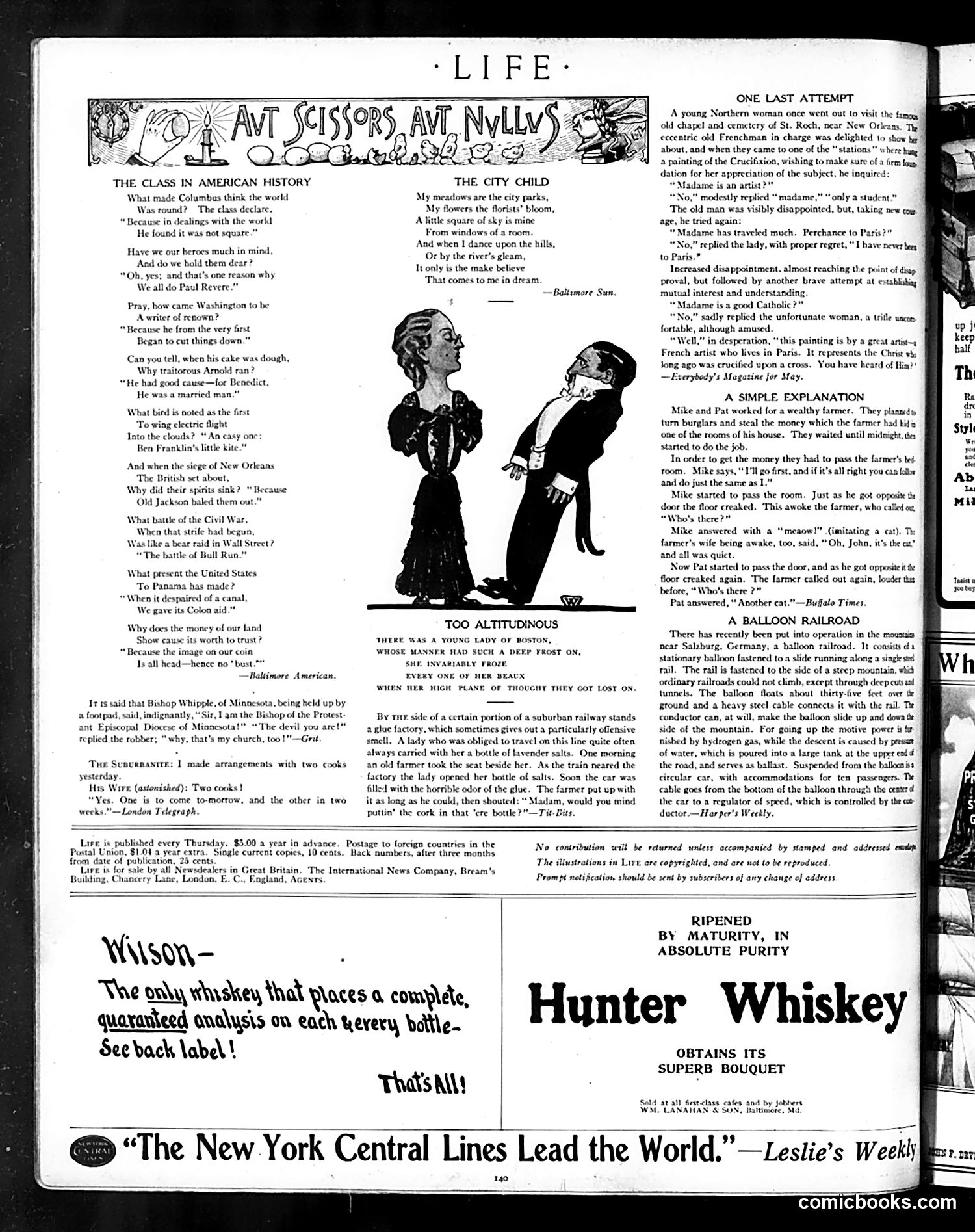
What you’re looking at
This page from *Life* magazine contains humorous content typical of early 20th-century American satire: **"The Class in American History"** presents joke answers from schoolchildren about American historical figures and events. The humor relies on wordplay and childish logic—for example, Columbus found the world "not square," Washington was a "writer of renown" because he "cut things down" (military victories), and Benedict Arnold ran away because "he was a married man." These jokes mock both naive historical understanding and contemporary figures/events. **"The City Child"** is sentimental verse about urban poverty, contrasting actual deprivation ("a little square of sky") with children's imaginative escapes. The remaining pieces are brief anecdotes: a bishop's encounter with a robber, a lady's lavender salts on a train, and a woman's failed attempts to impress a French cemetery curator through art, travel, or religion. These mock social pretension and cross-cultural misunderstandings. The page is primarily **humorous filler content** rather than political satire, characteristic of *Life*'s entertainment focus.
📄 Transcribed text from this page (OCR, searchable)
Machine-transcribed from the original scan — historical spelling and the odd misread are preserved.
THE CLASS IN AMERICAN HISTORY What made Columbus think the world Was round? The class declare, * Because in dealings with the work! He found it was not square.”” Have we our herocs much in mind, And do we bold them dear? “Oh, yes; and We all do Paul Revere.’ at's one reason why Pray, how came Washington to be A writer of renown? " Because he from the very first Began to cut things down.” Can you tell, when his cake was dough, Why traitorous Arnold ran? “He had good cause—for Benedict, He was a married man.” What bied is noted as the first To wing electric flight Into the clouds? “ An casy one: Ben Franklin’s little kite.” And when the siege of New Orleans The British set about, Why did their spirits sink? “Because Old Jackson baled them out.” What battle of the Civil W When that strife had begun, Was like a bear raid in Wall Street? “The battle of Bull Run." What present the United States To Panama has made? “ When it despaired of a canal, We gave its Colon aid." Why does the money of our land Show cause its worth to trust? * Because the image on our coin Is all head—hence no * bust." Baltimore American. Ir ts said that Bishop Whipple, of Minnesota, being held up by a footpad, said, indignantly, “Sir, 1 am the Bishop of the Protest. ant Episcopal Diocese of Minnesota 1¢ devil you are!" replied the robber; “why, that’s my church, too!"—Grit. ‘Tue Scavepantre: I made arrangements with two cooks yesterday. His Ware (astonished): Two cooks! “Yes. One is to come to-morrow, and the other in two weeks.""—London Telegraph. pA SSSR) A Nyy) : Nyt THE CITY CHILD My meadows are the city parks, My flowers the florists’ bloom, A llittle square of sky is mine From windows of a room. Aad when I dance upon the hills, Or by the river's glea It only is the make believe ‘That comes to me in dream. ~Baliimore Sun. THERE WAS A YOUNG LADY OF BOSTON, WHOSE MANNFR HAD SUCH A DEEP FROST ON, SUF. INVARIABLY FROZE EVERY ONE OF NER BEAUX NER MIGH PLANE OF THOUGHT THEY CoT Lost ON. By tHe. side of a certain portion of a suburban railway stands a glue factory, which sometimes gives out a particularly offensive amell. A lady who was obliged to travel on this line quite often. always carried with her a bottle of lavender salts. One morning an old farmer took the seat beside her. As the train neared the factory the lady opened her bottle of salts. Soon the car was filled with the horrible odor of the glue. ‘The farmer put up with it as long as he could, then shouted: "* Madam, would you mind puttin’ the cork in that ‘ere bottle?"—Tit- Bits. ONE LAST ATTEMPT A young Northern woman once went out to visit the famay old chapel and cemetery of St. Roch, near New Orleans. Tye eccentric oki Frenchman in charge was delighted to show ba” about, and when they came to one of the "stations" where hang a painting of the Crucifixion, wishing to make sure of a fiem fous dation for her appreciation of the subject, he inquired fadame is an artist ?" <0," modestly replicd “ madame," “only a student.” ‘The old man was visibly disappointed, but, taking new com he tried again: ladame has traveled much. Perchance to Paris, replied the lady, with proper regret, “I have never bees to Paris.” Increased disappointment, almost reaching the point of dip proval, but followed by another brave attempt at establsigg mutual interest and understanding * Madame is a good Catholic?" .” sadly replied the unfortunate woman, a trifle vocee fortable, although amused. “Well,” in desperation, “this painting is by a great anise French artist who lives in Paris. It represents the Christ why Jong ago was crucified upon a cross. You have heard of Him? verybody's Magazine jor May. A SIMPLE, EXPLANATION Mike and Pat worked for a wealthy farmer. They planacdy turn burglars and steal the money which the farmer had bid one of the rooms of his house. They waited until midnight, be: started to do the job. In order to get the money they had to pass the farmer's be room. Mike says,‘"I'll go first, and if it’s all right you cas fs and do just the same as I." Mike started to pass the room. Just as he got opposite de door the floor creaked. ‘This awoke the farmer, who called og, “Who's there?” Mike answered with a “‘meaow!" (imitating a cat). Te farmer's wife being awake, too, said, “Oh, John, it's the at? and all was quict. Now Pat started to pass the door, and as he got opposite ite floor creaked again. The farmer called out again, louder thas before, “Who's there ?”” Pat answered, “Another cat."”—Bufjalo Times. A BALLOON RAILROAD ‘There has recently been put into operation in the moustsis near Salzburg, Germany, a balloon railroad. It consists da stationary balloon fastened to a slide running along a single sed rail. The rail is fastened to the side of a steep mountain, whic ordinary railroads could not climb, except through deep cuz tunnels. The balloon floats about thirty-five feet owt Ge ground and a heavy steel cable connects it with the rail. Te conductor can, at will, make the balloon slide up and dows be side of the mountain. For going up the motive power is ix nished by hydrogen gas, while the descent is caused by press of water, which is poured into a large tank at the upper eatd the road, and serves as ballast. Suspended from the balloca iss Circular car, with accommodations for ten passengers. The cable goes from the bottom of the balloon through the centr the car to a regulator of speed, which is controlled by the a ductor. —Har per’s Weekly. Lire, is published every Thursday. $5.00 a year in advance, Postage to foreign countries in the No contribution will be returned unless accompanied by stamped and addressed emdoe Postal Union, $1.04 a year extra. Single current coptes, 10 cents. Back numbers, after three months from date of publication, 25 cents. Lire is for sale by all Newsdealers in Great Britain. The International News Company, Bream’s Building, Chancery Lane, London, E. C., England, Acents. The illustrations in Lure. are copyrighted, and are not to be reproduced. Prompt notiScation should be sent by subscribers of any change of address RIPENED BY MATURITY, IN ABSOLUTE PURITY Hunter Whiskey OBTAINS ITS SUPERB BOUQUET Wison- Whe only whaskiey that paces a compete, quoxankeed analysis on each kerery, batle- See back label! Thats At Sold at all Gest-class cafes and by Jobhers WM. LANAHAN & SON, Haltimore, Sd. @® “The New York Central Lines Lead the World.” —Leslie’s Week! comicbooks.com