
Life, 1906-08-02 · page 12 of 40
Life — August 2, 1906 — page 12: what you’re looking at
What you’re looking at
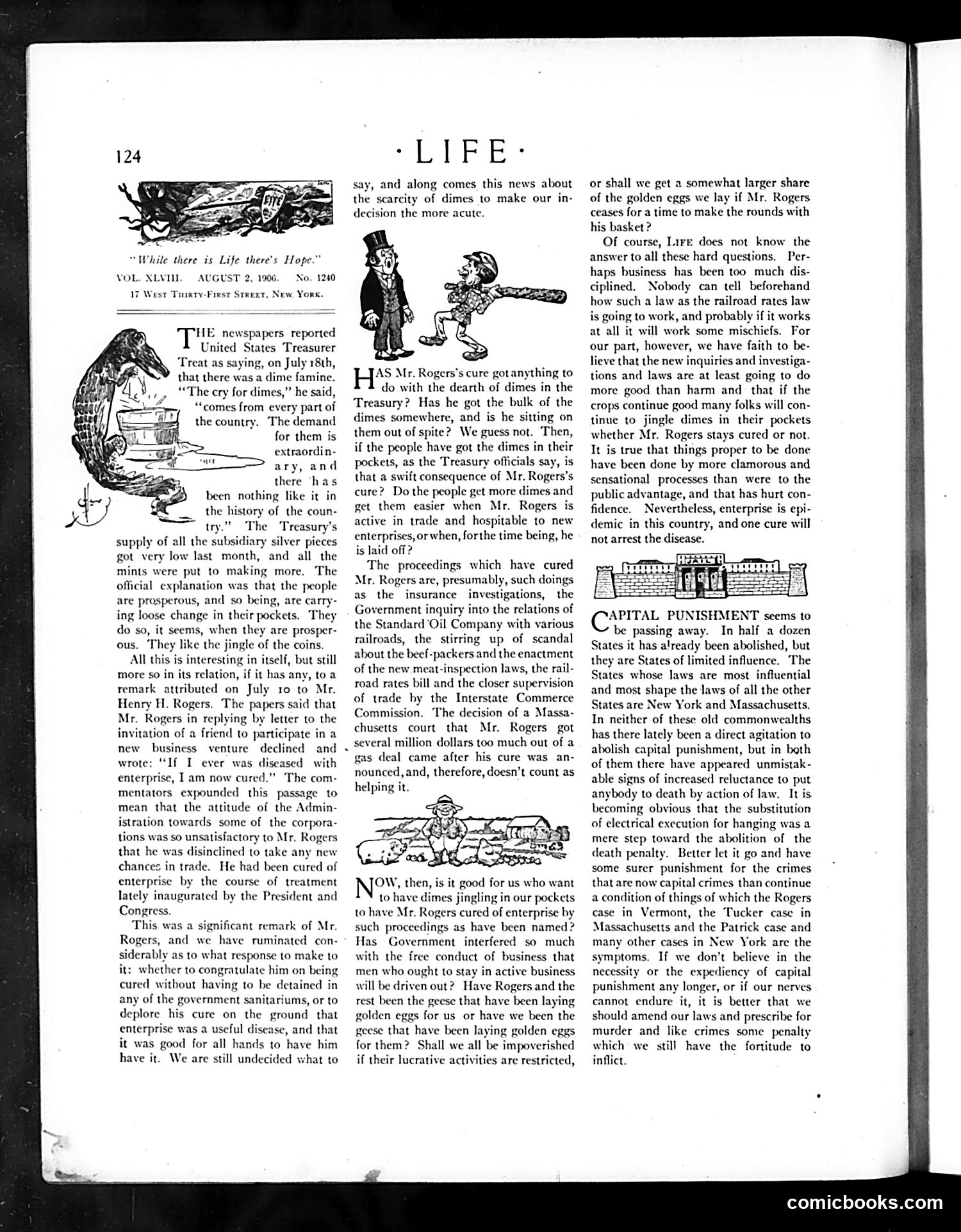
This 1906 *Life* magazine page satirizes a currency shortage and businessman H.H. Rogers. The illustrations depict the public's frustration over scarce dimes—coins needed for everyday commerce. The cartoons mock the irony that while ordinary citizens lack small change for basic transactions, wealthy industrialist Rogers has been accused of hoarding dimes or profiting from the shortage. The text suggests Roosevelt administration investigations into Rogers' business practices (likely referencing Standard Oil dealings) may have actually *helped* his financial interests rather than punishing them. The satire argues that if government interference in business had deterred Rogers' enterprises as intended, the public wouldn't now face this dime scarcity—implying his continued prosperity despite scandals has harmed the broader economy.
📄 Transcribed text from this page (OCR, searchable)
Machine-transcribed from the original scan — historical spelling and the odd misread are preserved.
“While there is Life there's Hope.” XLVILL. AUGUST 2, 1906. No. 1240 17 West Turety-First Street, New. Yorx. VoL. HE newspapers reported United States Treasurer Treat as saying, on July 18th, that there was a dime famine. “The cry for dimes,” he said, “comes from every part of the country. The demand for them is extraordin- ary, and there has been nothing like it in the history of the cou try.” The Treasury supply of all the subsidiary silver pieces got very low last month, and all the mints were put to making more. The official explanation was that the people are prosperous, and so being, are carry- ing loose change in their pockets. They do so, it seems, when they are prosper- ous. They like the jingle of the coins. All this is interesting in itself, but still more so in its relation, if it has any, to a remark attributed on July 1o to Mr. Henry H. Rogers. The papers said that Mr. Rogers in replying by letter to the invitation of a friend to participate in a new business venture declined wrote: “If I ever was diseased with enterprise, Iam now cured.” The com- mentators expounded this passage to mean that the attitude of the Admin- istration towards some of the corpor: tions was so unsatisfactory to Mr, Rogers that he was disinclined to take any new chances in trade. He had been cured of enterprise by the course of treatment lately inaugurated by the President and Congress. This was a significant remark of Mr. Rogers, and we have ruminated con- siderably as to what response to make to it: whether to congratulate him on being cured without having to be detained in any of the government sanitariums, or to deplore his cure on the ground that enterprise was a useful disease, and that it was good for all hands to have him have it. We are still undecided what to and - -LIPE * say, and along comes this news about the scarcity of dimes to make our in- decision the more acute. H*s Mr. Rogers's cure gotanything to do with the dearth of dimes in the Treasury? Has he got the bulk of the dimes somewhere, and is he sitting on them out of spite? We guess not. Then, if the people have got the dimes in their pockets, as the Treasury officials say, is that a swift consequence of Mr. Rogers's cure? Do the people get more dimes and get them easier when Mr. Rogers is active in trade and hospitable to new enterprises, or when, forthe time being, he is laid off? The proceedings which have cured Mr. Rogers are, presumably, such doings as the insurance investigations, the Government inquiry into the relations of the Standard Oil Company with various railroads, the stirring up of scandal about the beef-packers and the enactment of the new meat-inspection laws, the rail- road rates bill and the closer supervision of trade by the Interstate Commerce Commission. The decision of a Massa- chusetts court that Mr. Rogers got several million dollars too much out of a gas deal came after his cure was an- nounced, and, therefore, doesn’t count as helping it. OW, then, is it good for us who want to have dimes jingling in our pockets to have Mr. Rogers cured of enterprise by such proceedings as have been named? Has Government interfered so much with the free conduct of business that men who ought to stay in active business will be driven out? Have Rogers and the rest been the geese that have been laying golden eggs for us or have we been the geese that have been laying golden eggs for them? Shall we all be impoverished if their lucrative activities are restricted, or shall we get a somewhat larger share of the golden eggs we lay if Mr. Rogers ceases for a time to make the rounds with his basket ? Of course, Lire does not know the answer to all these hard questions. Per- haps business has been too much dis- ciplined. Nobody can tell beforehand how such a law as the railroad rates law is going to work, and probably if it works at all it will work some mischiefs. For our part, however, we have faith to be- lieve that the new inquiries and investiga- tions and laws are at least going to do more good than harm and that if the crops continue good many folks will con- tinue to jingle dimes in their pockets whether Mr. Rogers stays cured or not. It is true that things proper to be done have been done by more clamorous and sensational processes than were to the public advantage, and that has hurt con- fidence. Nevertheless, enterprise is epi- demic in this country, and one cure will not arrest the disease. APITAL PUNISHMENT seems to be passing away. In half a dozen States it has already been abolished, but they are States of limited influence. The States whose laws are most influential and most shape the Jaws of all the other States are New York and Massachusetts. In neither of these old commonwealths has there lately been a direct agitation to abolish capital punishment, but in both of them there have appeared unmistak- able signs of increased reluctance to put anybody to death by action of law. It is becoming obvious that the substitution of electrical execution for hanging was a mere step toward the abolition of the death penalty. Better let it go and have some surer punishment for the crimes that are now capital crimes than continue a condition of things of which the Rogers case in Vermont, the Tucker case in Massachusetts and the Patrick case and many other cases in New York are the symptoms. If we don’t believe in the necessity or the expediency of capital punishment any longer, or if our nerves cannot endure it, it is better that we should amend our laws and prescribe for murder and like crimes some penalty which we still have the fortitude to inflict. comicbooks.com