
Life, 1906-08-02 · page 17 of 40
Life — August 2, 1906 — page 17: what you’re looking at
What you’re looking at
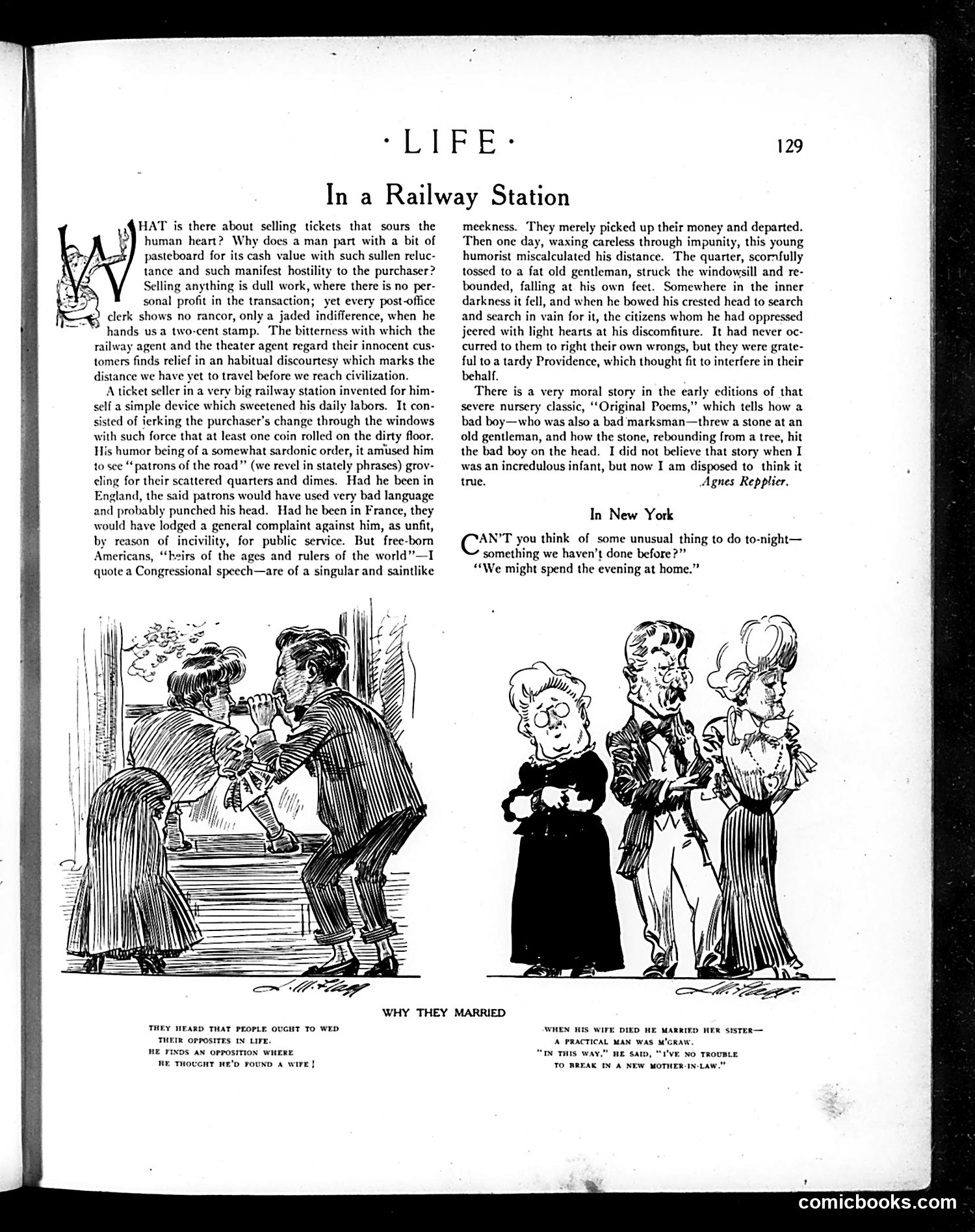
This page contains two satirical pieces: **"In a Railway Station"** by Agnes Repplier critiques American passivity and customer service rudeness. A railroad ticket clerk deliberately throws change on the floor to humiliate customers, who meekly retrieve it without complaint. The piece contrasts American behavior unfavorably with English (who would fight back) and French (who would lodge formal complaints). When the clerk finally miscalculates and the coin hits his own feet, the oppressed customers find schadenfreude in his comeuppance. Repplier uses this anecdote to mock Americans' tolerance of disrespect and their faith in divine justice rather than asserting their own dignity. **"In New York"** presents two cartoons about marriage. The first shows a couple who married because they heard opposites attract, only to discover incompatibility. The second depicts a widower who married his deceased wife's sister—portrayed as practical because he avoids "breaking in a new mother-in-law." Both cartoons satirize marital reasoning that prioritizes convenience over genuine compatibility.
📄 Transcribed text from this page (OCR, searchable)
Machine-transcribed from the original scan — historical spelling and the odd misread are preserved.
‘LIFE® In a Railway Station HAT is there about selling tickets that sours the O} human heart? Why docs a man part with a bit of pasteboard for its cash value with such sullen reluc- tance and such manifest hostility to the purchaser? Selling anything is dull work, where there is no per- sonal profit in the transaction; yet every post-office clerk shows no rancor, only a jaded indifference, when he —"™“* hands usa two-cent stamp. The bitterness with which the railway agent and the theater agent regard their innocent cus- tomers finds relief in an habitual discourtesy which marks the distance we have yet to travel before we reach civilization. A ticket seller in a very big railway station invented for him- self a simple device which sweetened his daily labors. It con- sisted of ierking the purchaser’s change through the windows with such force that at least one coin rolled on the dirty floor. His humor being of a somewhat sardonic order, it amused him to see “patrons of the road” (we revel in stately phrases) grov- cling for their scattered quarters and dimes. Had he been in England, the said patrons would have used very bad language and probably punched his head. Had he been in France, they would have lodged a general complaint against him, as unfit, by reason of incivility, for public service. But free-born Americans, “heirs of the ages and rulers of the world”—I quote a Congressional speech—are of a singular and saintlike THEY HEARD THAT PEOPLE OUGHT TO WED THEIR OPPOSITES IN LITE. NE FINDS AN OPPOSITION WHERE RE THOUGHT HE'D FOUND A WITE | meekness. They merely picked up their money and departed. Then one day, waxing careless through impunity, this young humorist miscalculated his distance. The quarter, scornfully tossed to a fat old gentleman, struck the windowsill and re- bounded, falling at his own feet. Somewhere in the inner darkness it fell, and when he bowed his crested head to search and search in vain for it, the citizens whom he had oppressed jeered with light hearts at his discomfiture. It had never oc- curred to them to right their own wrongs, but they were grate- ful to a tardy Providence, which thought fit to interfere in their behalf. There is a very moral story in the early editions of that severe nursery classic, “Original Poems,” which tells how a bad boy—who was also a bad marksman—threw a stone at an old gentleman, and how the stone, rebounding from a tree, hit the bad boy on the head. I did not believe that story when I was an incredulous infant, but now I am disposed to think it true. Agnes Repplier. In New York AN’T you think of some unusual thing to do to-night— something we haven’t done before?” ‘We might spend the evening at home.” WHEN HIS WIFE DIED HE MARRIED HER SISTER— A PRACTICAL MAN WAS M'GRAW. “IN THIS WAY," HE SAID, “I'VE NO TROUBLE To BREAK IN A NEW MOTHER-IN-LAW.” comicbooks.com