
Life, 1906-08-02 · page 26 of 40
Life — August 2, 1906 — page 26: what you’re looking at
What you’re looking at
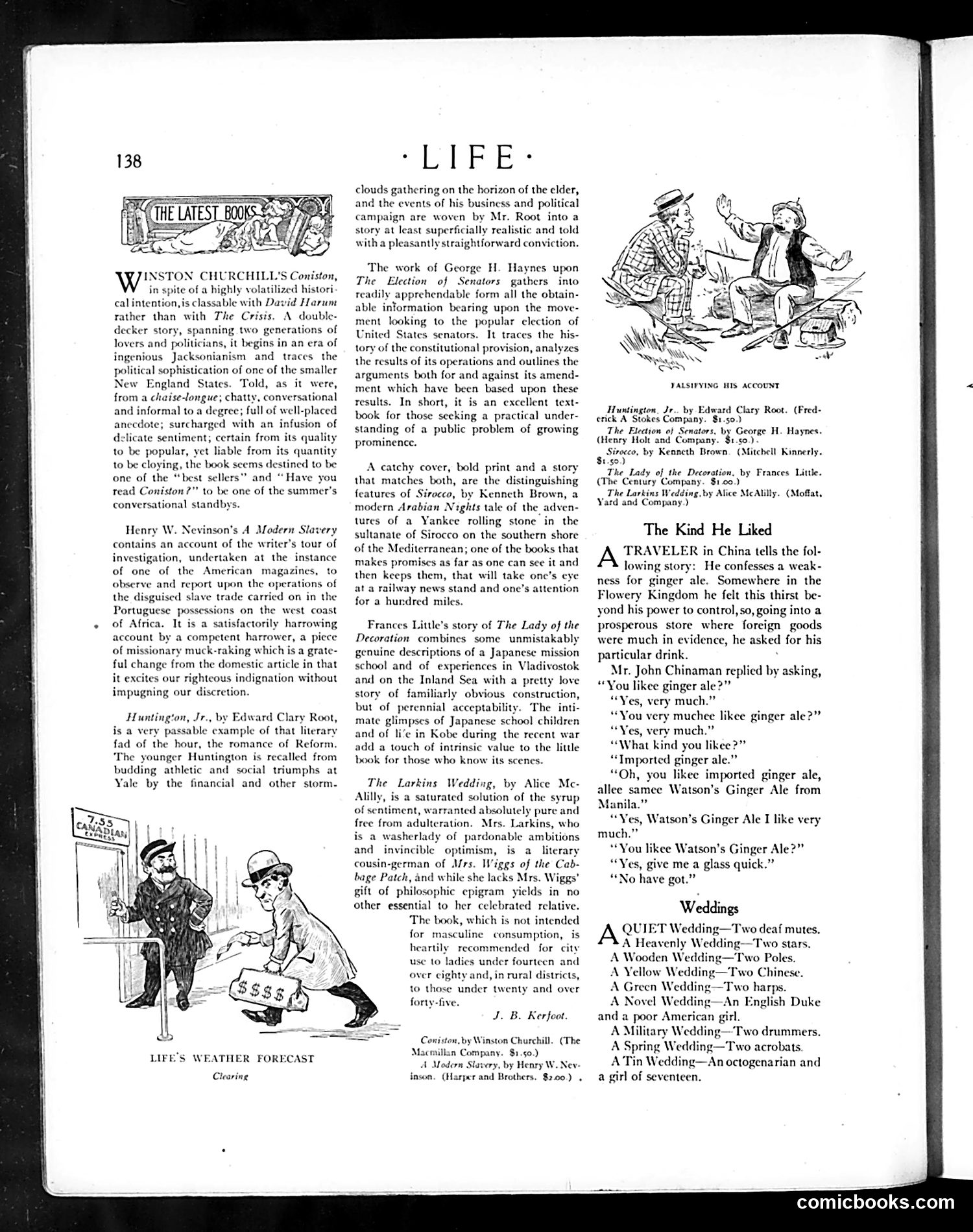
This page features book reviews and two cartoon illustrations. The top cartoon, "Settling His Account," depicts a man in casual dress confronting what appears to be a shopkeeper or creditor—likely satirizing debt collection or financial disputes common to the era. Below, "Life's Weather Forecast: Clearing" shows a man in a coat passing money to another figure at a doorway, presumably commenting on improving economic conditions or financial relief. The page reviews six contemporary books, including Winston Churchill's *Coniston* (a political romance), works on slavery and Senate reform, and adventure/romance novels. The reviews are written in Life magazine's characteristic witty, gossipy tone, evaluating books as social and entertainment commodities for the magazine's educated readership. The cartoons appear designed to provide light humor complementing the literary commentary—offering visual jokes about money and social situations rather than direct political satire.
📄 Transcribed text from this page (OCR, searchable)
Machine-transcribed from the original scan — historical spelling and the odd misread are preserved.
INSTON CHURCHILL'S Coniston, in spite of a highly volatilized histori cal intention, is classable with David Harum rather than with The Crisis. A double- decker story, spanning two generations of lovers and politicians, it begins in an era of ingenious Jacksonianism and traces the political sophistication of onc of the smaller New England States. Told, as it were, from a chaise-longue; chatty, conversational and informal to a degree; full of well-placed anecdote; surcharged with an infusion of delicate sentiment; certain from its quality to be popular, yet liable from its quantity to be cloying, the book seems destined to be one of the “best sellers” and “Have you tread Coniston?” to be one of the summer's conversational standbys. Henry W. Nevinson's A Modern y contains an account of the writer’s tour of investigation, undertaken at the instance of one of the American magazines, to observe and report upon the operations of the disguised slave trade carried on in Portuguese possessions on the west coast of Africa. It is a satisfactorily harrowing account by a competent harrower, a picce of missionary muck-raking which is a grate- ful change from the domestic article in that it excites our righteous indignation without impugning our discretion. Huntington, Jr., by Edward Clary Root, is a very passable example of that literary fad of the hour, the romance of Reform. The younger Huntington is recalled from budding athletic and social triumphs at Yale by the financial and other storm. LIFE'S WEATHER FORECAST Clearing *LIFE:> clouds gathering on the horizon of the elder, and the events of his business and political campaign are woven by Mr. Root into a story at least superficially realistic and told witha pleasantly straightforward conviction. The work of George H. Haynes upon The Election of Senators gathers into readily apprehendable form all the obtain- able information bearing upon the move- ment looking to the popular clection of United States senators. It traces the his- tory of the constitutional provision, analyzes the results of its operations and outlines the arguments both for and against its amend- ment which have been based upon these results. In short, it is an excellent text- book for those seeking a practical under- standing of a public problem of growing prominence. A catchy cover, bold print and a story that matches both, are the distinguishing features of Sirocco, by Kenneth Brown, a modern Arabian Nigits tale of the adven- tures of a Yankee rolling stone in the sultanate of Sirocco on the southern shore of the Mediterranean; one of the books that makes promises as far as one can see it and then keeps them, that will take one’s cye ata railway news stand and one’s attention for a hurdred miles. Frances Little's story of The Lady of the Decoration combines some unmistakably genuine descriptions of a Japanese mission school and of experiences in Vladivostok and on the Inland Sea with a pretty love story of familiarly obvious construction, but of perennial acceptability. ‘The inti- mate glimpses of Japanese school children and of li’e in Kobe during the recent war add a touch of intrinsic value to the litle book for those who know its scenes. The Larkins Wedding, by e Me- Alilly, is a saturated solution of the syrup of sentiment, warranted absolutely pure and free from adulteration. Mrs. Larkins, who is a washerlady of onable ambitions and invincible optimism, is a literary cousin-german of Mrs. Wiggs of the Cab- bage Patch, and while she lacks Mrs. Wiggs’ gift of philosophic epigram yields in no other essential to her celebrated relativ The book, which is not intended for masculine consumption, is heartily recommended for city use to ladies under fourteen and over eighty and, in rural districts, to those under twenty and over forty-five. J. B. Kerfoot. Coniston, by Winston Churchill. (The Mactillan Company. $1.50.) A Modern Slavery, by Henry W. Nev- inson. (Harper and Brothers. $200.) . Huntington. Jr. by Clary (Fred- erick A Stokes Compan: The Flection of Senators, by George H. Haynes. (Henry Holt and Company. $1.50.) 4g, Sie by Kenneth Brown, (Mitchell Kinnerly. . The Lady of the Decoration, by Frances Little. (The Century Company. $1.00.) The Larkins Wedding, by Alice McAlilly. (Moffat, Yard and Company.) The Kind He Liked TRAVELER in China tells the fol- lowing story: He confesses a weak- ness for ginger ale. Somewhere in the Flowery Kingdom he felt this thirst be- yond his power to control, so, going into a prosperous store where foreign goods were much in evidence, he asked for his particular drink. Mr. John Chinaman replied by asking, “You likee ginger ale?” “Yes, very much.” “You very muchee likee ginger ale?” “Yes, very much.” “What kind you likee?” “Imported ginger ale.” “Oh, you likee imported ginger ale, allee samee Watson's Ginger Ale from Manila.” “Yes, Watson’s Ginger Ale I like very much.” “You likee Watson’s Ginger Ale?” “Yes, give me a glass quick.” “No have got.” Weddings A QUIET Wedding—Two deaf mutes. A Heavenly Wedding—Two stars. A Wooden Wedding—Two Poles. A Yellow Wedding—Two Chine: A Green Wedding—Two harps. A Novel Wedding—An English Duke and a poor American girl. A Military Wedding—Two drummers. A Spring Wedding—Two acrobats. A Tin Wedding—An octogenarian and a girl of seventeen. comicbooks.com