
Life, 1906-08-02 · page 32 of 40
Life — August 2, 1906 — page 32: what you’re looking at
What you’re looking at
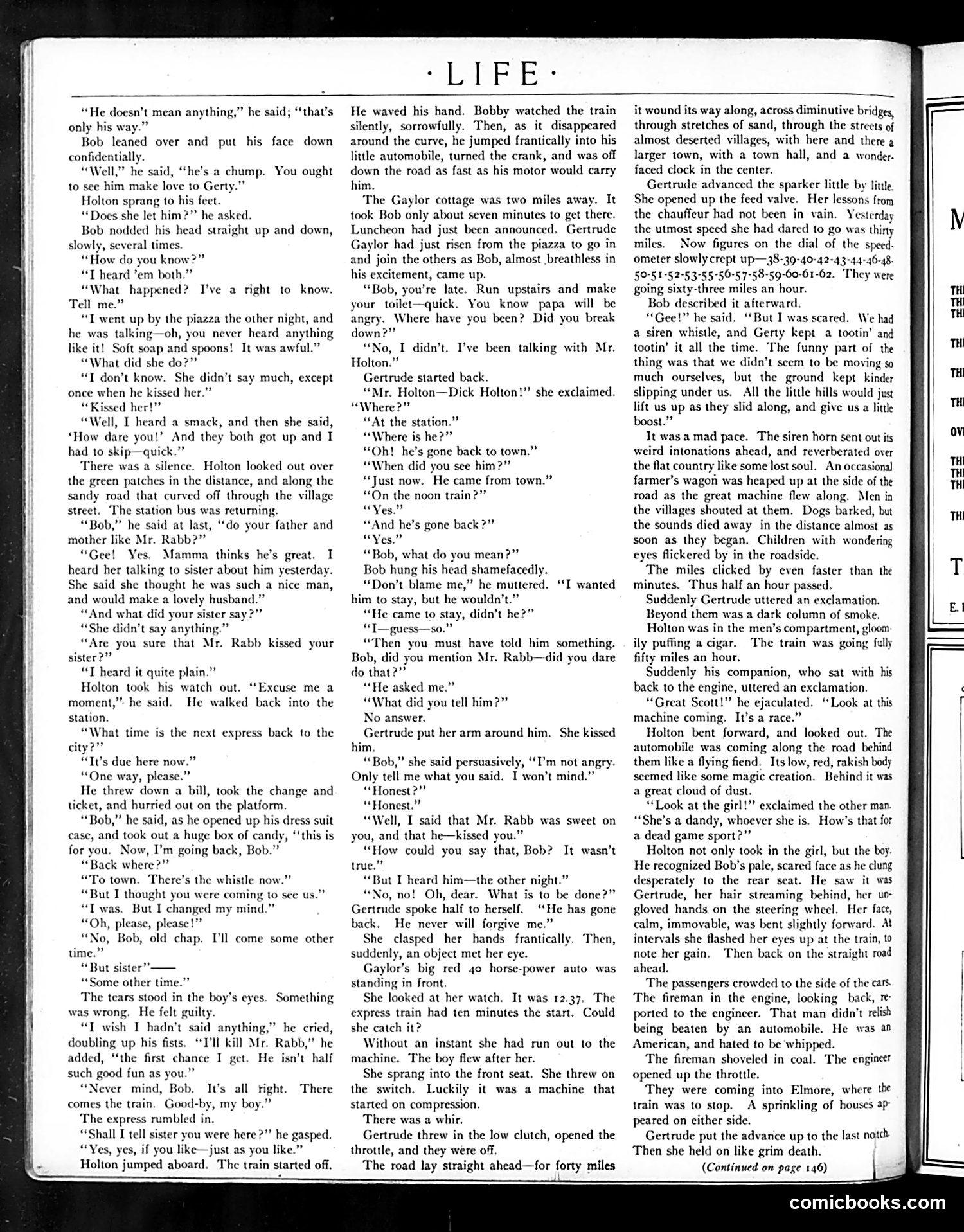
This page contains a serialized short story (not a political cartoon) about romantic complications among young people. The narrative follows a character named Holton who visits his girlfriend Gertrude at her family's cottage but abruptly leaves by train after learning from Bob (her younger brother) that another suitor, Mr. Rabb, has been courting her—specifically that Rabb kissed Gertrude. The story explores early 20th-century social conventions around courtship and jealousy. Holton's dramatic departure (buying a one-way ticket back to the city) represents wounded pride, while Bob's guilty realization that his gossip caused the problem drives the emotional climax. The narrative emphasizes propriety and the significance of a kiss as a serious romantic gesture in this era. This appears to be straightforward literary fiction rather than satire—typical serialized entertainment for Life magazine's general audience.
📄 Transcribed text from this page (OCR, searchable)
Machine-transcribed from the original scan — historical spelling and the odd misread are preserved.
a ile eas “He doesn’t mean anything,” he said; “that’s only his way.” Bob leaned over and put his face down confidentially. “Well,” he said, “he’s a chump. You ought to see him make love to Gerty.”” Holton sprang to his feet. “Does she let him?” he asked. Bob nodded his head straight up and down, slowly, several times. “How do you know?” “T heard ’em both.” “What happened? Tell me.” “I went up by the piazza the other night, and he was talking—oh, you never heard anything like it! Soft soap and spoons! It was awful.” “What did she do?” “T don’t know. She didn’t say much, except once when he kissed her.” “Kissed her!”” “Well, I heard a smack, and then she said, ‘How dare you!’ And they both got up and I had to skip—quick.” There was a silence. Holton looked out over the green patches in the distance, and along the sandy road that curved off through the village street. The station bus was returning. “Bob,” he said at last, ‘do your father and mother like Mr. Rabb?” “Gee! Yes. Mamma thinks he’s great. I heard her talking to sister about him yesterday. She said she thought he was such a nice man, and would make a lovely husband.” “And what did your sister say?” “She didn’t say anything.” re you sure that Mr. Rabb kissed your sister?” “T heard it quite plain.” Holton took his watch out. ‘Excuse me a moment,” he said. He walked back into the station. What time is the next express back to the city?” “It’s due here now.” “One way, please.” He threw down a bill, took the change and ticket, and hurried out on the platform. “Bob,” he said, as he opened up his dress suit case, and took out a huge box of candy, ‘‘this is for you. Now, I’m going back, Bob.” “Back where?” “To town. There’s the whistle now.” “But I thought you w coming to see us.” “Twas. But I changed my mind.” “Oh, please, please!” “No, Bob, old chap. I'll come some other time.” “But sister”— “Some other time.” The tears stood in the boy’s eyes. Something was wrong. He felt guilty. “I wish I hadn't said anything,” he cried, doubling up his fists. “I'll kill Mr. Rabb,” he added, ‘the first chance I get. He isn’t half such good fun as you.” “Never mind, Bob. It’s all right. comes the train. Good-by, my boy.” The express rumbled in. “Shall I tell sister you were here?” he gasped. “Yes, yes, if you like—just as you like.” Holton jumped aboard. The train started off. I’ve a right to know. There He waved his hand. Bobby watched the train silently, sorrowfully. Then, as it disappeared around the curve, he jumped frantically into his little automobile, turned the crank, and was off down the road as fast as his motor would carry him. The Gaylor cottage was two miles away. It took Bob only about seven minutes to get there. Luncheon had just been announced. Gertrude Gaylor had just risen from the piazza to go in and join the others as Bob, almost breathless in his excitement, came up. “Bob, you’re late. Run upstairs and make your toilet—quick. You know papa will be angry. Where have you been? Did you break down?” “No, I Holton.” Gertrude started back. “Mr. Holton—Dick Holton!” she exclaimed. “Where?” “At the station.” “Where is he?” “Oh! he’s gone back to town.” “When did you see him?” “Just now. He came from town.” “On the noon train?” “Yes.” “And he’s gone back?” “Yes.” “Bob, what do you mean?” Bob hung his head shamefacedly. “Don’t blame me,” he muttered. him to stay, but he wouldn't.” “He came to stay, didn’t he?” “T—guess—so.” “Then you must have told him something. Bob, did you mention Mr. Rabb—did you dare do that?” “He asked me.” “What did you tell him?” No answer. Gertrude put her arm around him, She kissed him. “Bob,” she said persuasively, “I’m not angry. Only tell me what you said. I won't mind.” “Honest?” “Honest.” “Well, I said that Mr. Rabb was sweet on you, and that he—kissed you.” “How could you say that, Bob? It wasn’t true.” “But I heard him—the other night.” “No, no! Oh, dear. What is to be done?” Gertrude spoke half to herself. ‘He has gone back. He never will forgive me.” She clasped her hands frantically. Then, suddenly, an object met her eye. Gaylor’s big red 40 horse-power auto was standing in front. She looked at her watch. It was 12.37. The express train had ten minutes the start. Could she catch it? Without an instant she had run out to the machine. The boy flew after her. She sprang into the front seat. She threw on the switch. Luckily it was a machine that started on compression. There was a whir. Gertrude threw in the low clutch, opened the throttle, and they were off. The road lay straight ahead—for forty miles didn’t. I’ve been talking with Mr. “T wanted it wound its way along, across diminutive bridges, through stretches of sand, through the streets of almost deserted villages, with here and there a larger town, with a town hall, and a wonder. faced clock in the center. Gertrude advanced the sparker little by litte. She opened up the feed valve. Her lessons from the chauffeur had not been in vain. Yesterday the utmost speed she had dared to go was thirty miles. Now figures on the dial of the speed. ometer slowly crept up—38-39-40-42-43-44-46-48- $0-51-52-53-55-56-57-58-59-60-61-62. They were going sixty-three miles an hour. Bob described it afterward. “Gee!” he said. “But I was scared. We had a siren whistle, and Gerty kept a tootin’ and tootin’ it all the time. The funny part of the thing was that we didn’t seem to be moving so much ourselves, but the ground kept kinder slipping under us. All the little hills would just lift us up as they slid along, and give us a little boost.” It was a mad pace. The siren horn sent out its weird intonations ahead, and reverberated over the flat country like some lost soul. An occasional farmer’s wagon was heaped up at the side of the road as the great machine flew along. Men in the villages shouted at them. Dogs barked, but the sounds died away in the distance almost as soon as they began. Children with wondering eyes flickered by in the roadside. The miles clicked by even faster than the minutes. Thus half an hour passed. Suddenly Gertrude uttered an exclamation. Beyond them was a dark column of smoke. Holton was in the men’s compartment, gloom. ily puffing a cigar. ‘The train was going fully fifty miles an hour. Suddenly his companion, who sat with his back to the engine, uttered an exclamation. “Great Scott!” he ejaculated. ‘Look at this machine coming. It’s a race.” Holton bent forward, and looked out. The automobile was coming along the road behind them like a flying fiend. Its low, red, rakish body seemed like some magic creation. Behind it was a great cloud of dust. “Look at the girl!”’ exclaimed the other man. “She’s a dandy, whoever she is. How’s that for a dead game sport?” Holton not only took in the girl, but the boy. He recognized Bob’s pale, scared face as he clung desperately to the rear seat. He saw it was Gertrude, her hair streaming behind, her un- gloved hands on the steering wheel. Her face, calm, immovable, was bent slightly forward. At intervals she flashed her eyes up at the train, t0 note her gain. Then back on the straight road ahead. The passengers crowded to the side of the cars. The fireman in the engine, looking back, re ported to the engineer. That man didn’t relish being beaten by an automobile. He was an American, and hated to be whipped. The fireman shoveled in coal. The engineer opened up the throttle. They were coming into Elmore, where the train was to stop. A sprinkling of houses ap- peared on either side. Gertrude put the advance up to the last notch Then she held on like grim death. (Continued on page 146) comicbooks.com