
A complete issue · 48 pages · 1905
Life — May 4, 1905
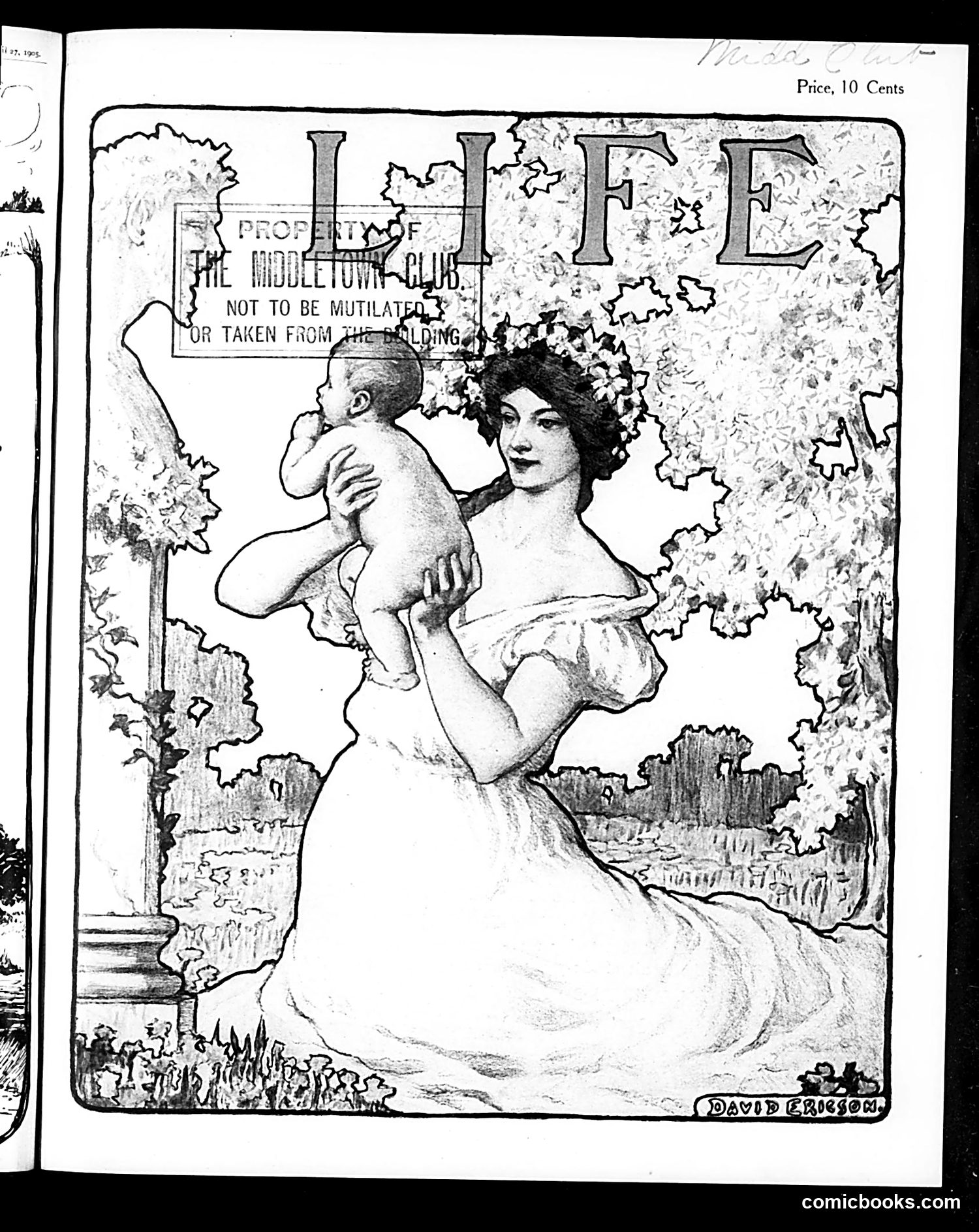
This is a cover illustration by David Ericson for *Life* magazine (priced at 10 cents, suggesting early 20th century). The image depicts a woman in classical/allegorical style holding an infant, set in a pastoral landscape. The stamp reading "PROPERTY OF THE MIDDLETOWN CLUB / NOT TO BE MUTILATED OR TAKEN FROM THE BUILDING" indicates this was a library or club copy. Without additional context from the magazine's date or accompanying text, the specific satirical meaning remains unclear. The classical female figure and infant could reference fertility, motherhood, or an allegorical national concept, but the precise political or social commentary cannot be determined from the image alone. The illustration appears decorative rather than overtly satirical.
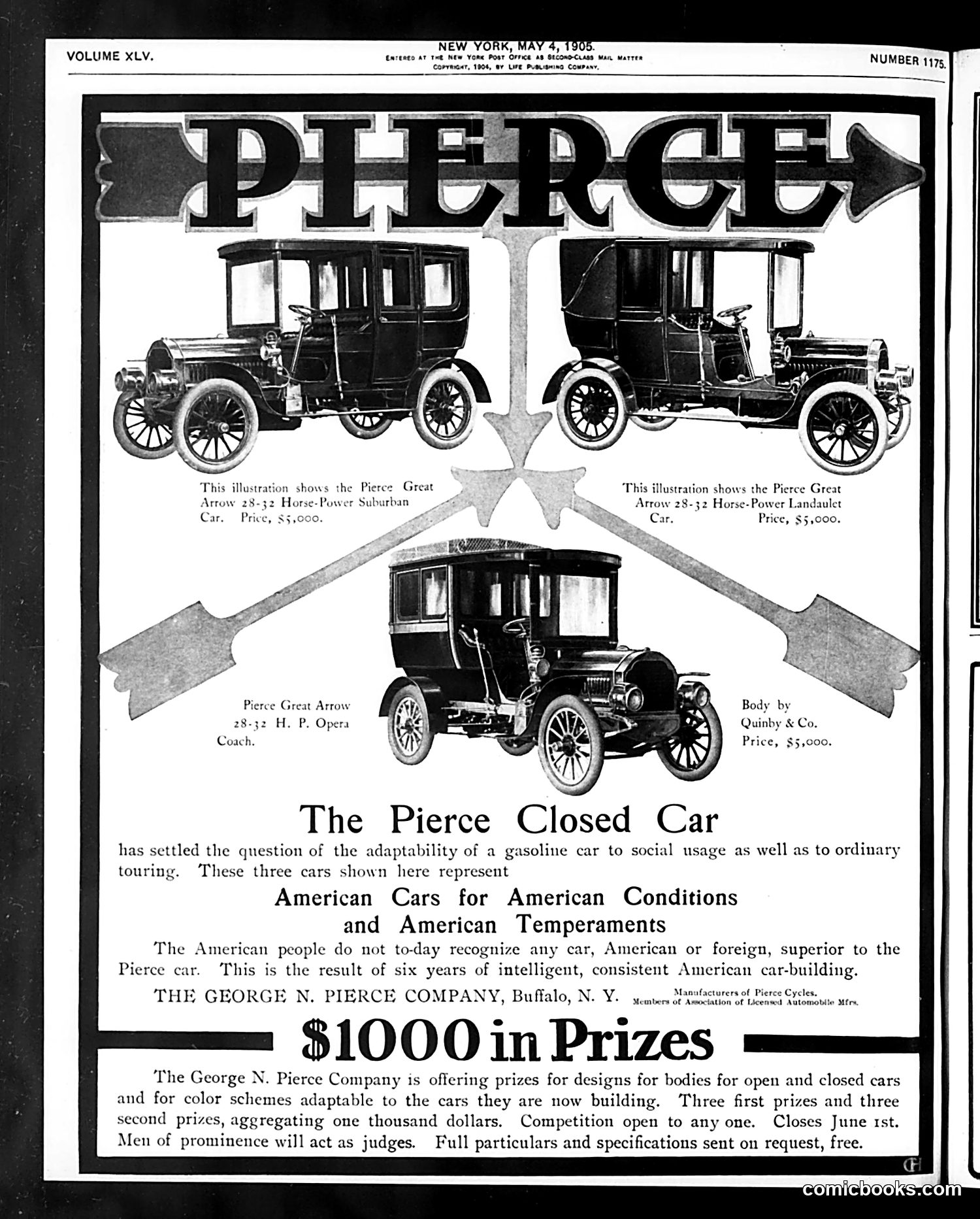
This is **not a political cartoon or satire page**—it is a straightforward advertisement for Pierce automobiles from May 4, 1905. The page showcases three Pierce Great Arrow models: a 28-32 horsepower Suburban Car ($3,000), a 28-32 horsepower Landaulet Car ($5,000), and a 23-32 horsepower Opera Coach ($5,000, body by Quinby & Co.). The advertisement's headline claims Pierce closed cars have "settled the question" of gasoline cars' suitability for both social occasions and touring—positioning them as practical for "American Conditions and American Temperaments." The page concludes with a notice that Pierce is offering $1,000 in prizes for body design competitions, closing June 1st. This is commercial promotion, not editorial commentary.
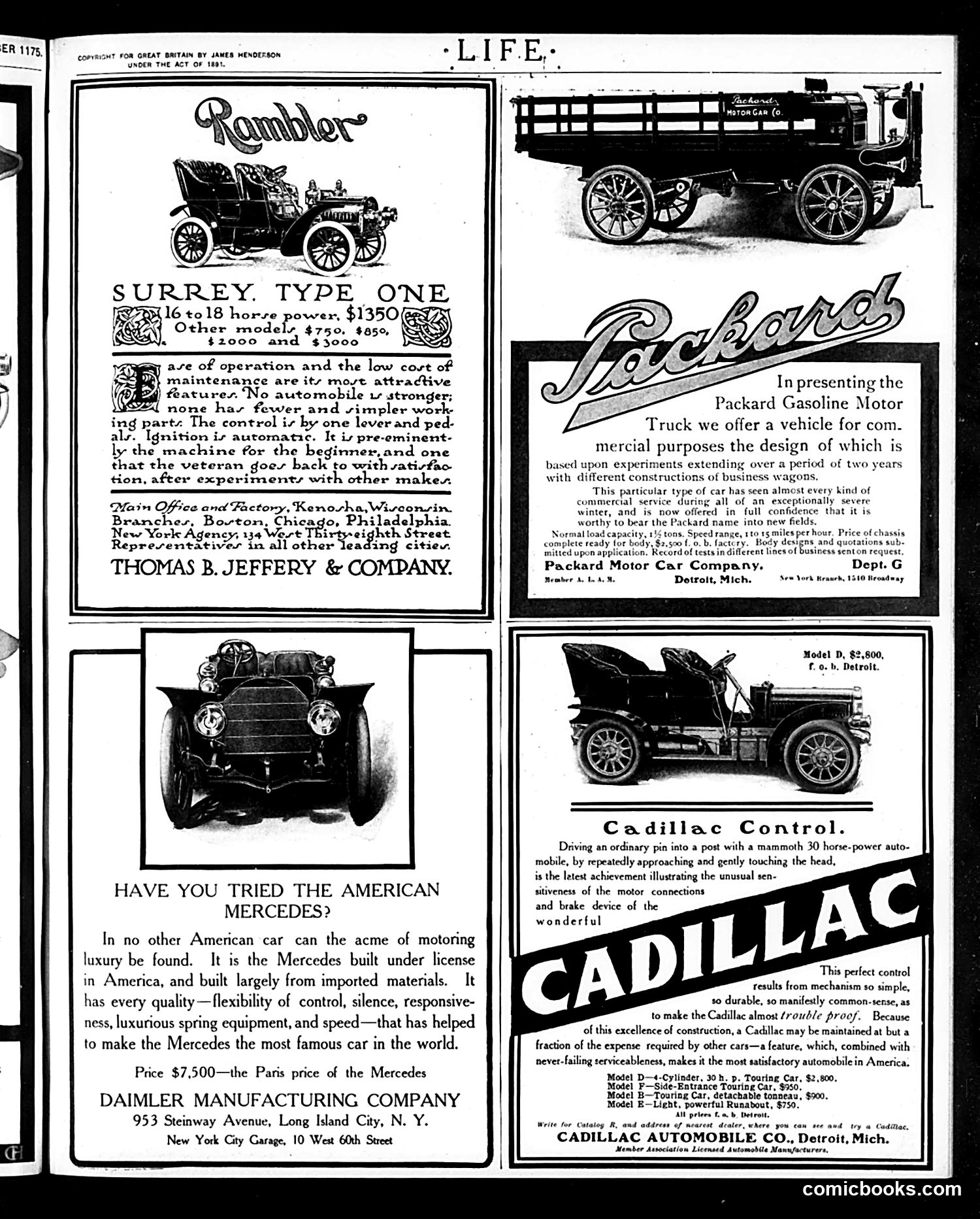
This page is primarily **advertising, not satire or political commentary**. It contains four automobile advertisements from the early 1900s: 1. **Rambler Surrey** (top left) - a 16-18 horsepower vehicle priced $1,350 2. **Packard Gasoline Motor Truck** (top right) - emphasizing commercial truck design 3. **American Mercedes** (bottom left) - highlighting luxury features and imported construction, priced $7,500 4. **Cadillac Control** (bottom right) - demonstrating advanced brake and control mechanisms The Mercedes ad does contain a rhetorical boast ("In no other American car can the acme of motoring luxury be found"), reflecting early automotive competition and brand positioning. These ads collectively showcase the nascent American automobile industry's emphasis on engineering, luxury, and commercial capability during this period.
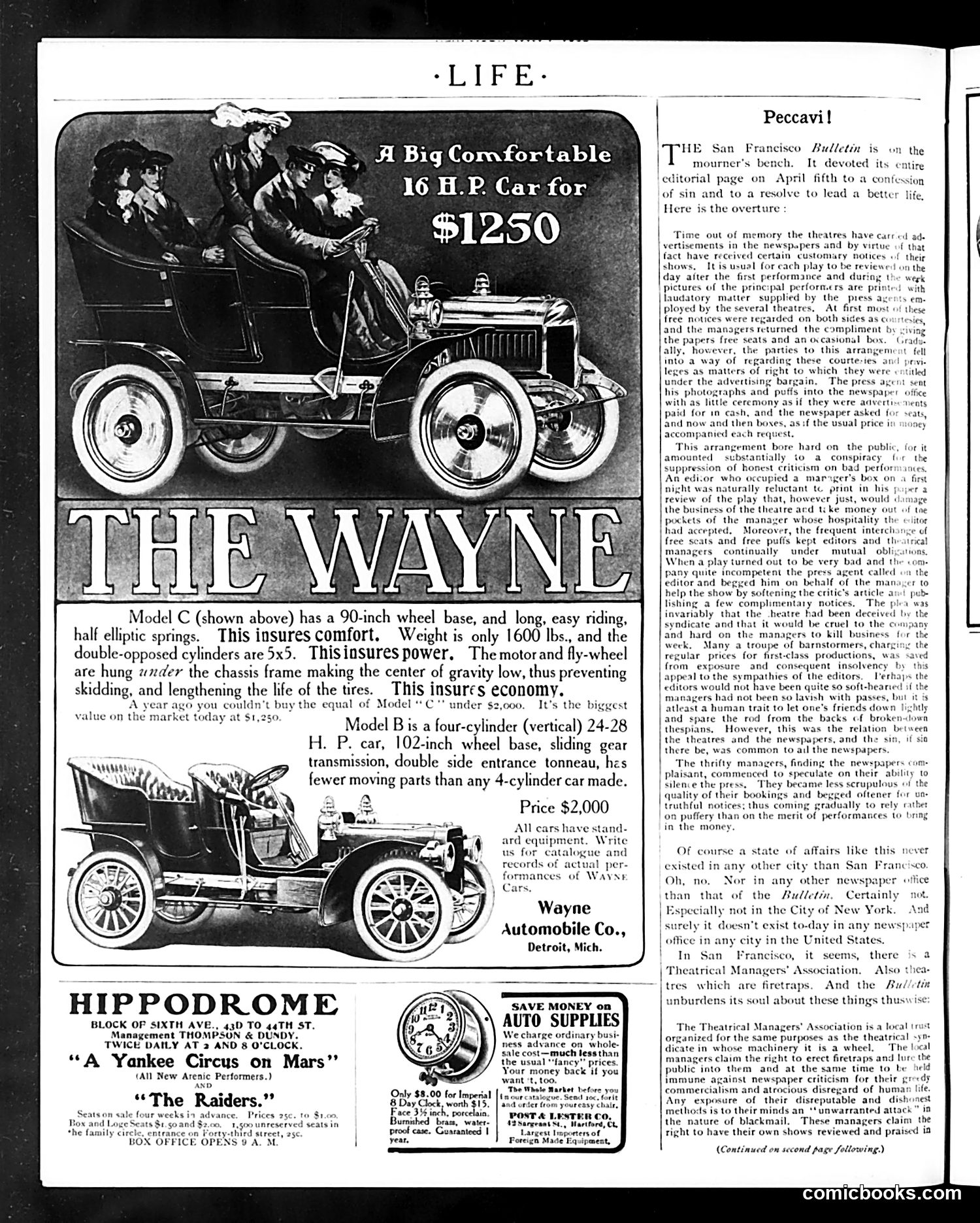
This page is **primarily advertising**, not political satire. The dominant content features two Wayne automobile advertisements promoting Model C ($1,250) and Model B ($2,000) vehicles, emphasizing comfort, power, and economy. Below the car ads is promotional material for theatrical entertainments: a Hippodrome advertisement and what appears to be theater listings for "A Yankee Circus on Mars" and "The Raiders." On the right side is an editorial column titled "Peccavi" discussing San Francisco theater critics and their relationship with theatrical managers—specifically how newspapers received complimentary notices and free seats in exchange for favorable reviews. **The satirical element** (limited here) appears in the "Peccavi" column's critique of this quid pro quo arrangement between press and theater management, but this occupies minimal space on a largely commercial page.
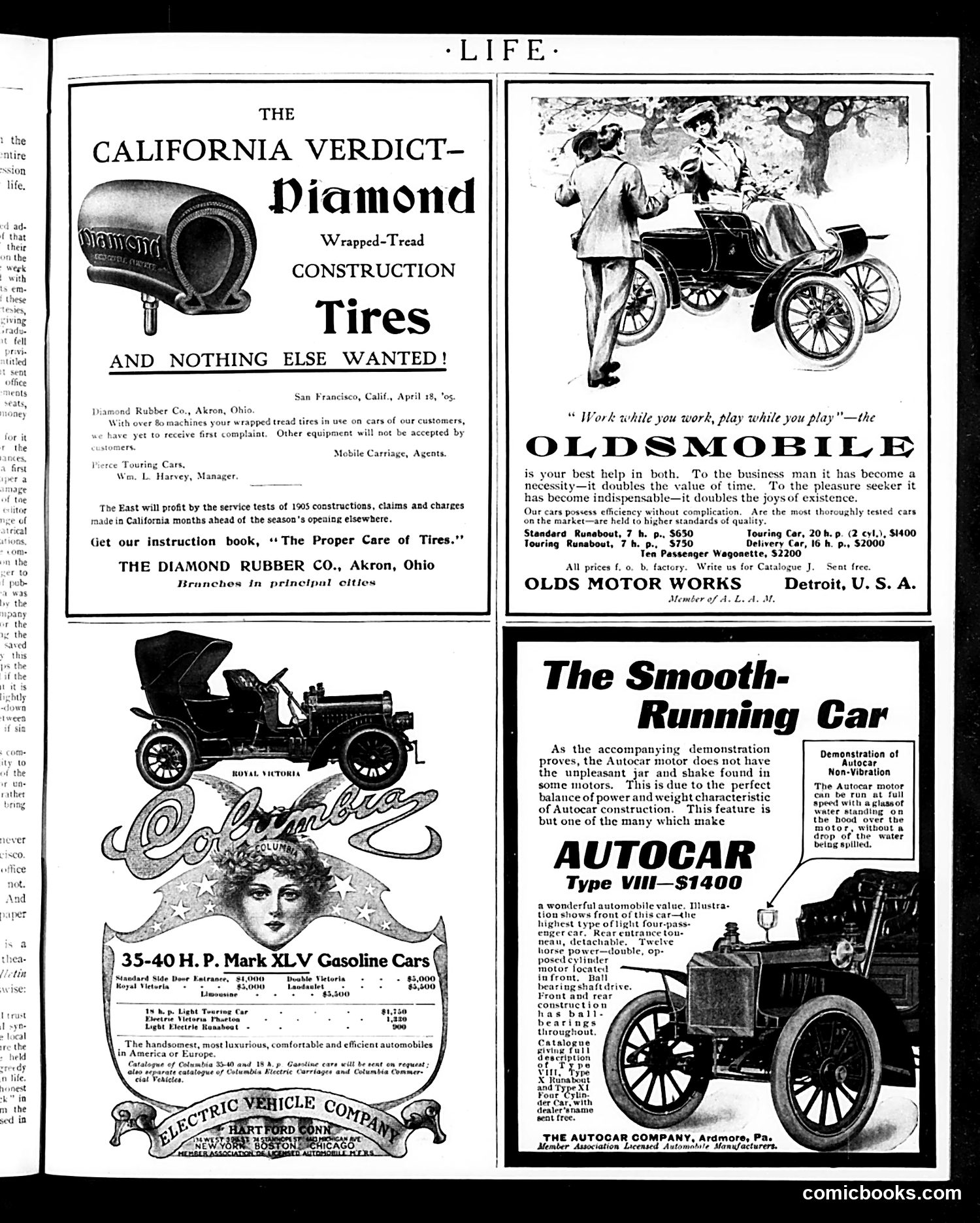
This page is **primarily advertising**, not satire or political commentary. It contains four automobile advertisements from circa 1905: 1. **Diamond Tires** (top left): Promotes wrapped-tread tire construction from Akron, Ohio 2. **Oldsmobile** (top right): Shows a touring car with the tagline "Work while you work, play while you play" 3. **Autocar** (bottom right): Advertises a Type VIII model priced at $1400, emphasizing smooth running and balanced construction 4. **Autocar** (bottom left): A Columbia Electric Vehicle Company ad featuring an ornate design with a woman's face and a Royal Victoria automobile The page reflects the early automotive era when cars were luxury goods. There is no discernible political cartoon or satire—it's a straightforward commercial publication showcasing competing automobile manufacturers and their features.
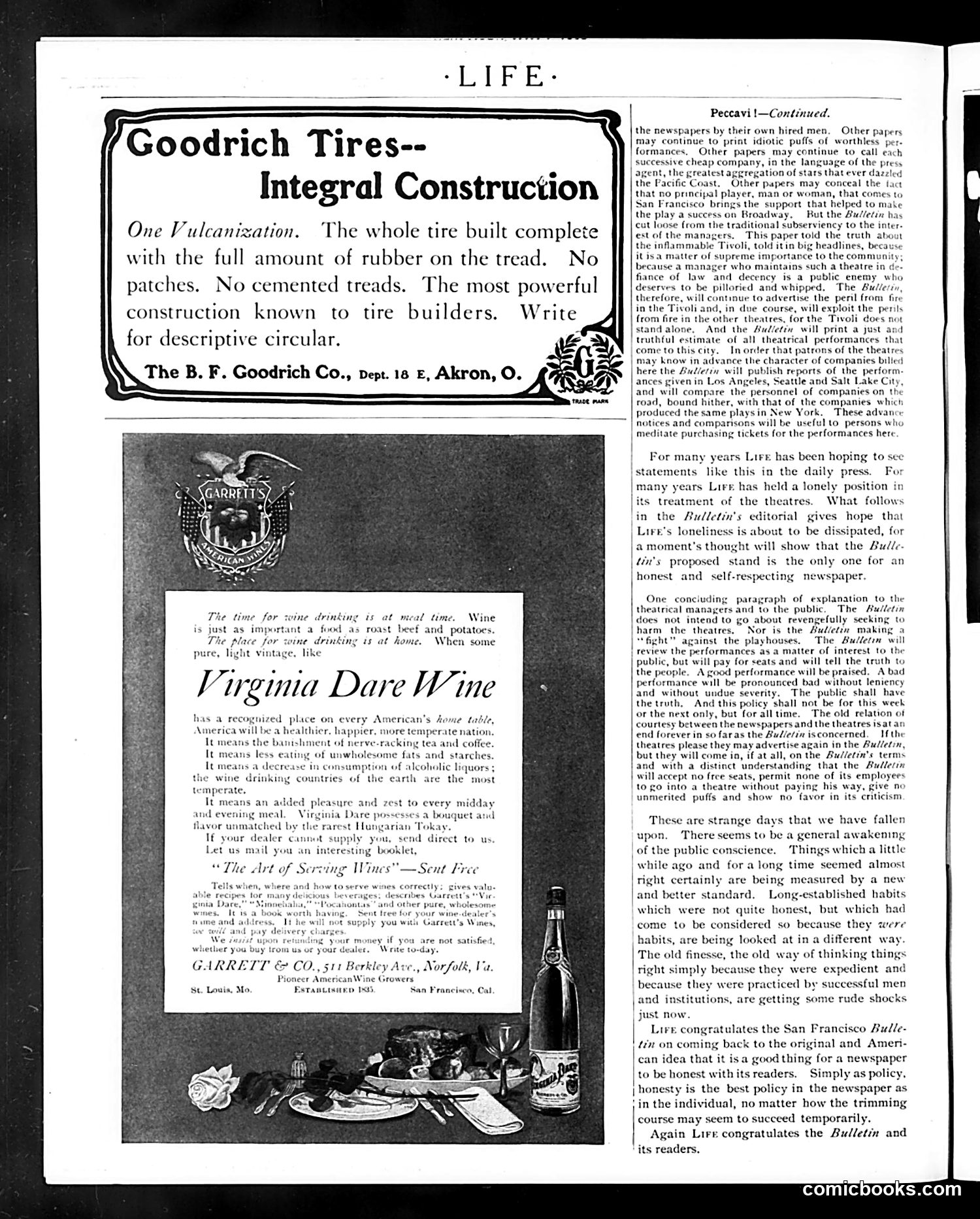
This page is primarily **advertising content** rather than political satire. It features three ads: 1. **Goodrich Tires** (top): Promotes their "Integral Construction" vulcanization method with no patches or cemented treads. 2. **Virginia Dare Wine** (center): The dominant ad emphasizes wine's place "on every American's home table," claiming it promotes health, temperance, and family dining. This appears to reference the **Prohibition era debates**—the ad defends wine consumption against temperance movements. 3. **Garrett Wine** (bottom): Similar wine promotion ad. The right column contains editorial text defending theatrical review practices and newspaper honesty. **Context**: These wine ads likely date from the **pre-Prohibition period** (before 1920), when the alcohol industry aggressively advertised to counter growing temperance sentiment.
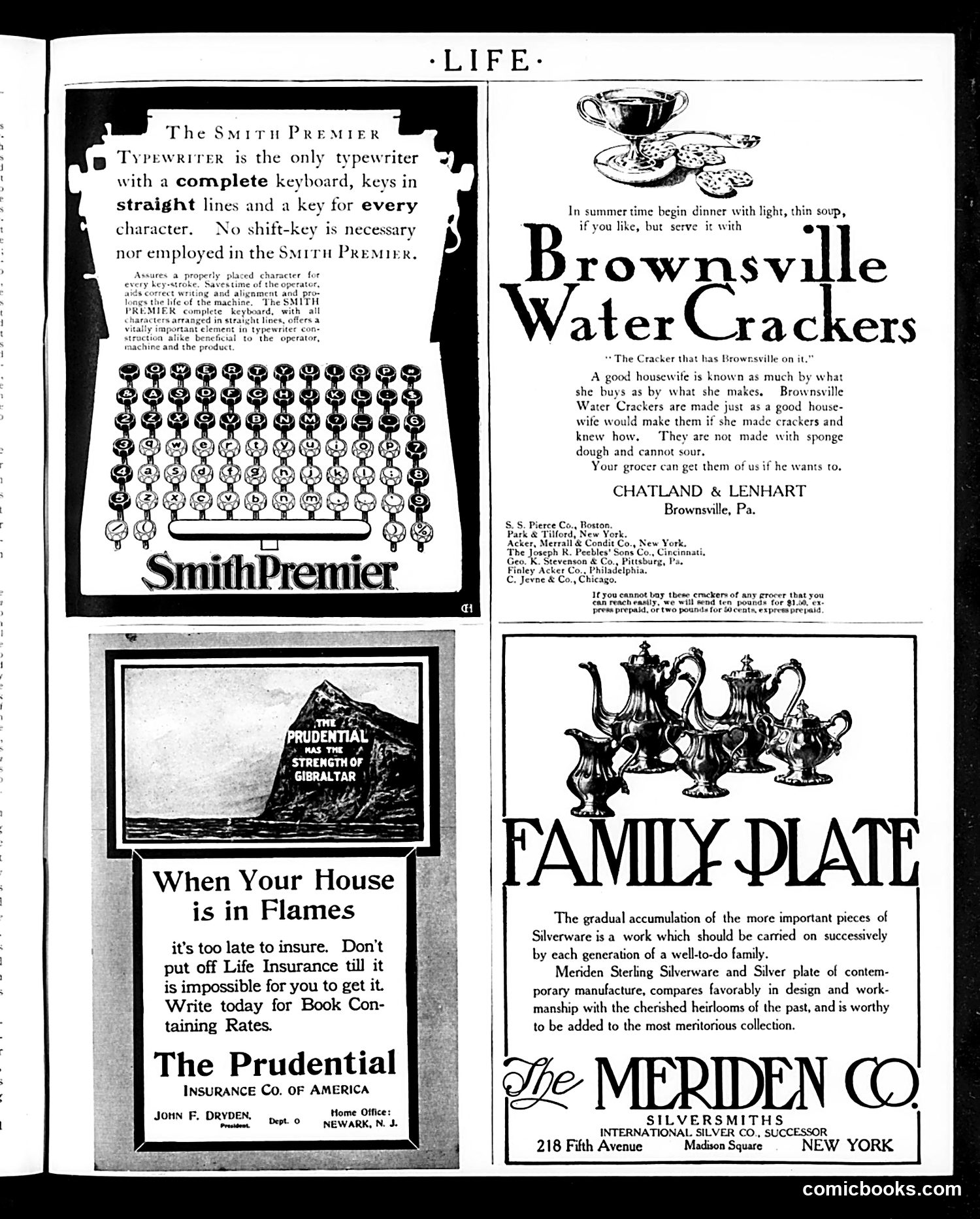
This is primarily an **advertising page**, not satirical content. It contains four separate advertisements: 1. **Smith Premier Typewriter** - Emphasizes its "complete keyboard" with keys "in straight lines" and "a key for every character," requiring no shift-key. This highlights a competitive advantage in typewriter design of the era. 2. **Brownsville Water Crackers** - A food product advertisement appealing to housewives as a quality purchase item. 3. **Prudential Insurance** - Uses a dramatic image of Gibraltar on fire to warn about home insurance urgency. 4. **Meriden Co. Silverware** - Markets "Family Plate" as an heirloom-quality silverware for families to accumulate across generations. The page reflects early 20th-century consumer advertising targeting middle-class households, emphasizing quality, status, and domestic security.
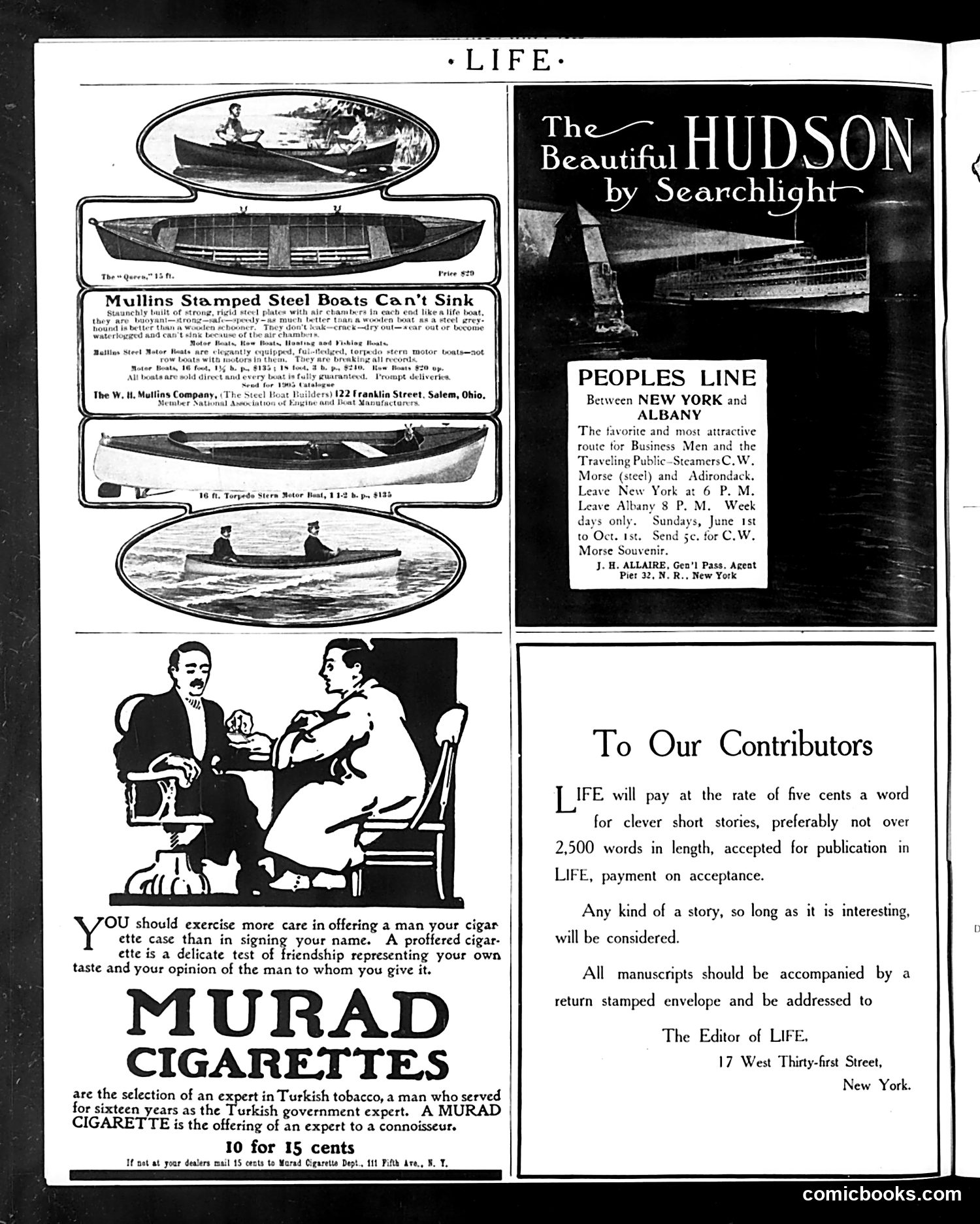
This is primarily an **advertising and editorial page** from *Life* magazine, not a political cartoon. The left side features **product advertisements**: Mullins Stamped Steel Boats (unsinkable vessels), a Torpedo stern motor boat, and Murad Cigarettes. The cigarette ad includes a cartoon showing two men, where one offers a cigar to another as a "delicate test of friendship." This is straightforward advertising playing on masculine social conventions of the era. The right side contains **editorial content**: an advertisement for the Peoples Line steamship service between New York and Albany, and submission guidelines for short story contributors to *Life* magazine, offering five cents per word for stories under 2,500 words. There is **no political satire or social commentary** on this particular page—it's a standard magazine issue mixing advertisements with publication business information.
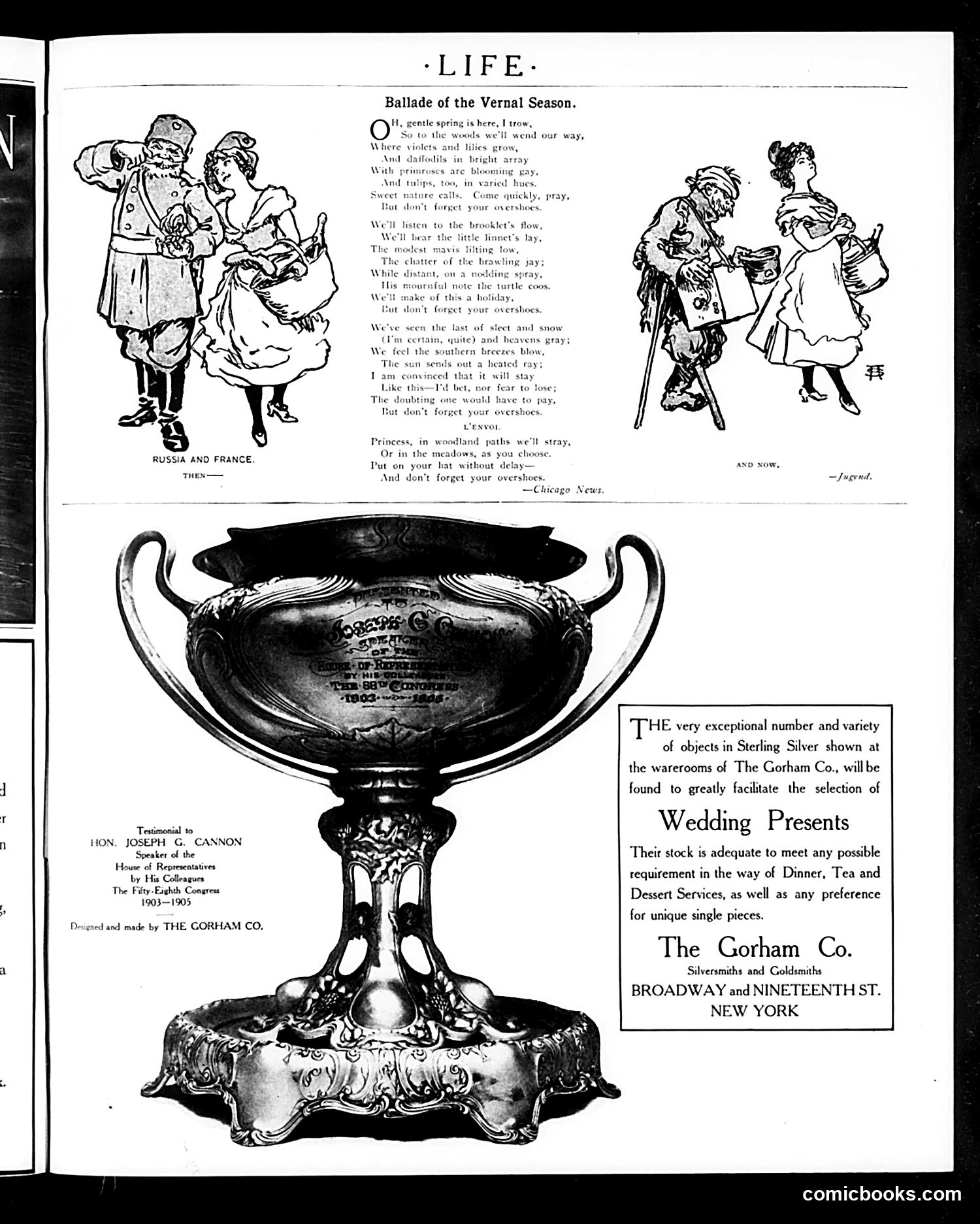
This page features a satirical poem about spring with allegorical illustrations. The two sketch pairs labeled "RUSSIA AND FRANCE" (left) and "AND NOW" (right) appear to depict figures in period dress—likely representing those nations or their leaders—engaged in spring activities. The poem humorously contrasts the arrival of pleasant weather with practical concerns ("don't forget your overshoes"), suggesting the unreliability of spring weather. The bottom half is a full-page advertisement for The Gorham Co., a New York silversmith, promoting their wedding present offerings. A tribute to Hon. Joseph G. Cannon (Speaker of the House) is also visible on the vessel. The page mixes political/social satire with commercial advertising, typical of Life magazine's format.
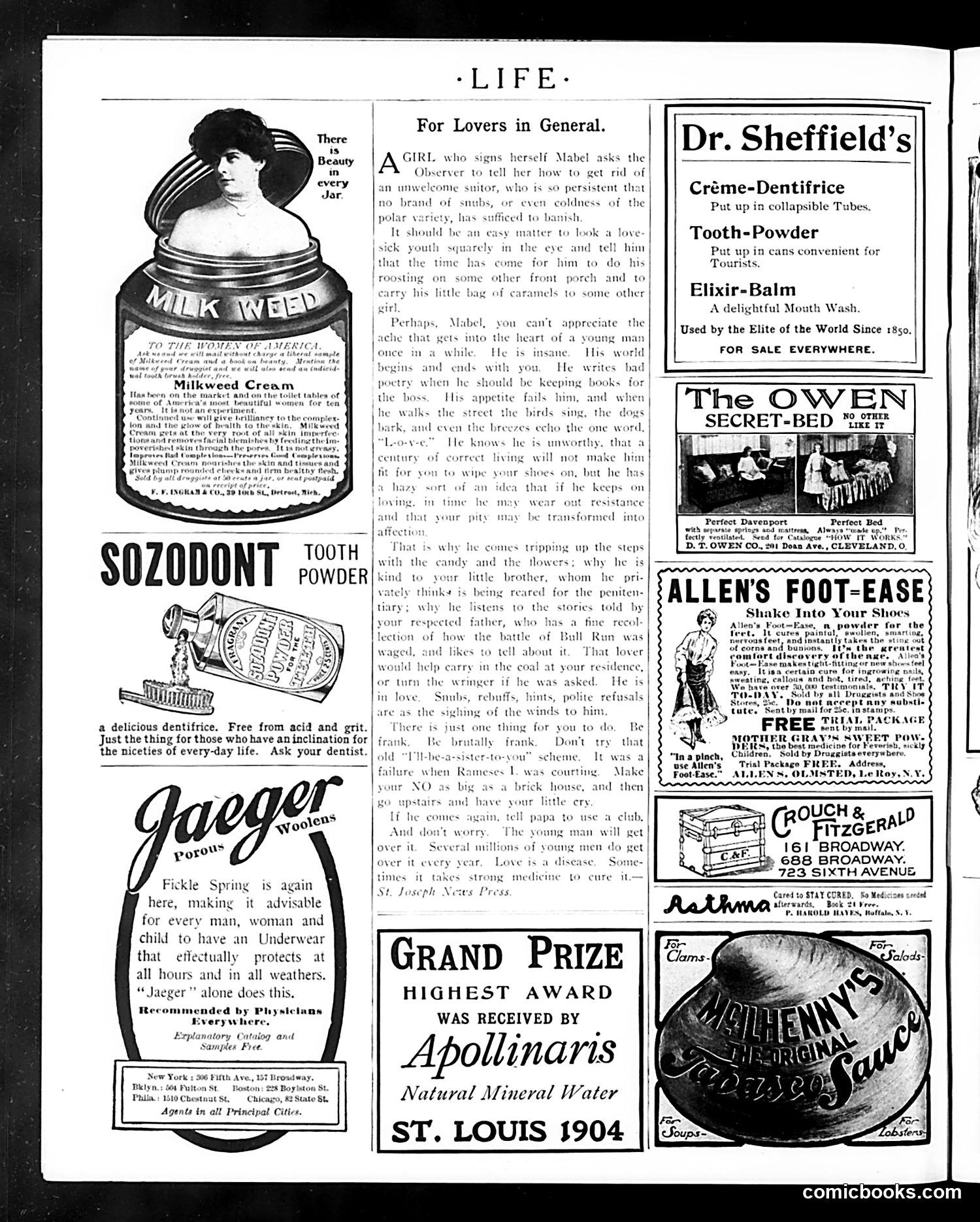
This page is primarily **advertising**, not satire or political commentary. It contains multiple product advertisements from the early 1900s, including: - **Milk Weed Cream** (with illustration of a woman's face) - **Sozodont Tooth Powder** - **Jaeger Porous Woolens** (undergarments) - **Dr. Sheffield's dental products** - **The Owen Secret-Bed** - **Allen's Foot-Ease powder** - **Crouch & Fitzgerald** (luggage) - **Apollinaris Natural Mineral Water** (won a "Grand Prize" at St. Louis 1904) - **Hagenbrett's Original Sauce** The one editorial piece, "For Lovers in General," is relationship advice, not satire. The page reflects Life magazine's business model: mixing advertising with content, targeting early-20th-century consumer culture with products addressing hygiene, health, and domestic comfort.
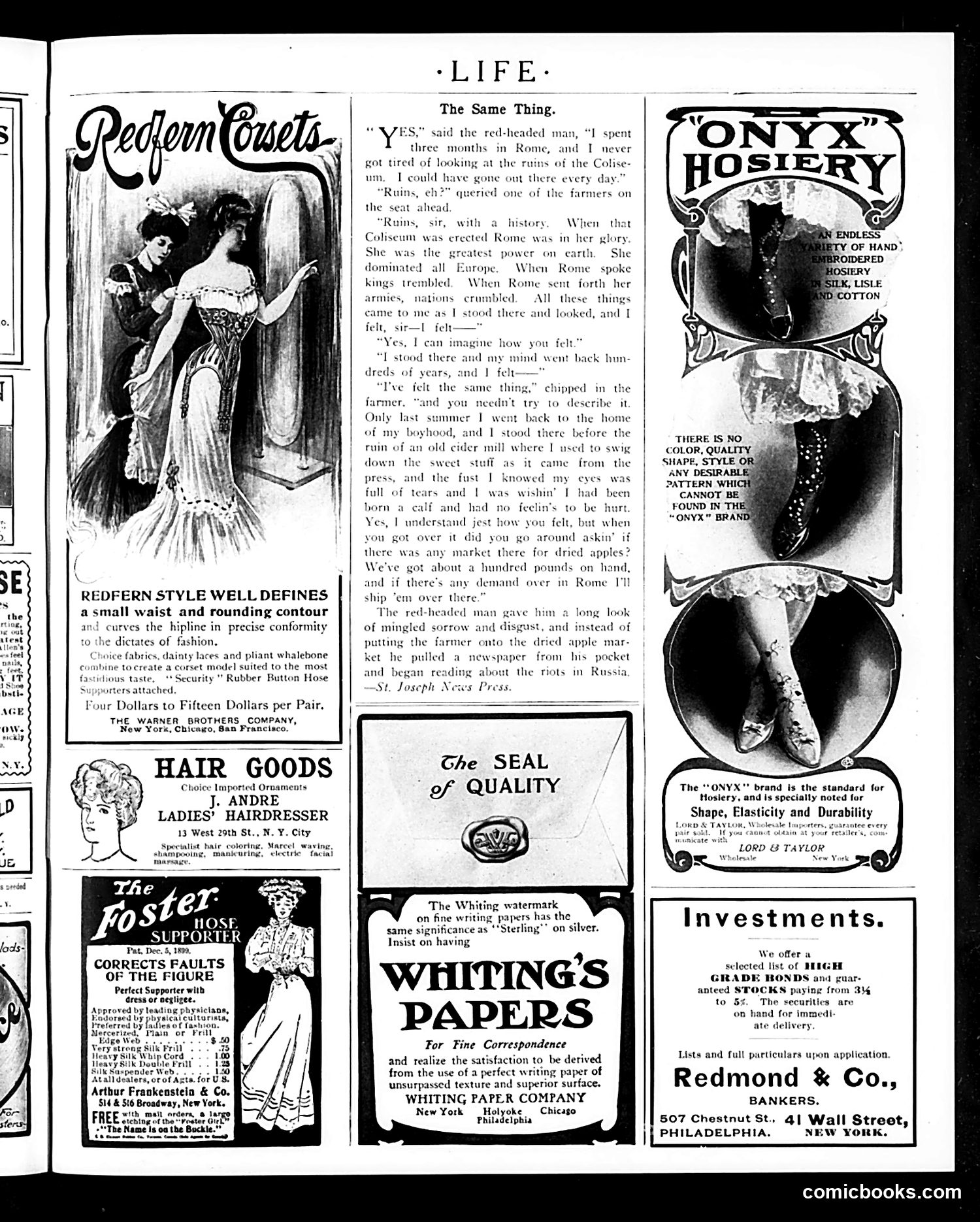
This page is primarily **advertisements** rather than satirical content. The ads include: - **Redfern Corsets**: Fashion advertisement emphasizing a "small waist and rounded contour" - **Hair Goods**: Hairpieces for women - **Foster Hose Supporter**: Undergarment that "corrects faults of the figure" - **Whiting's Papers**: Fine writing paper - **Onyx Hosiery**: Women's stockings - **Redmond & Co.: Banking/investment services** The only editorial content is "The Same Thing," a brief story about a man recounting memories of Rome and a farm, with no apparent satire. The ads collectively reflect early 20th-century women's fashion obsessions with corseting and reshaping the body—typical Life magazine commercial content of the era, not satirical commentary.
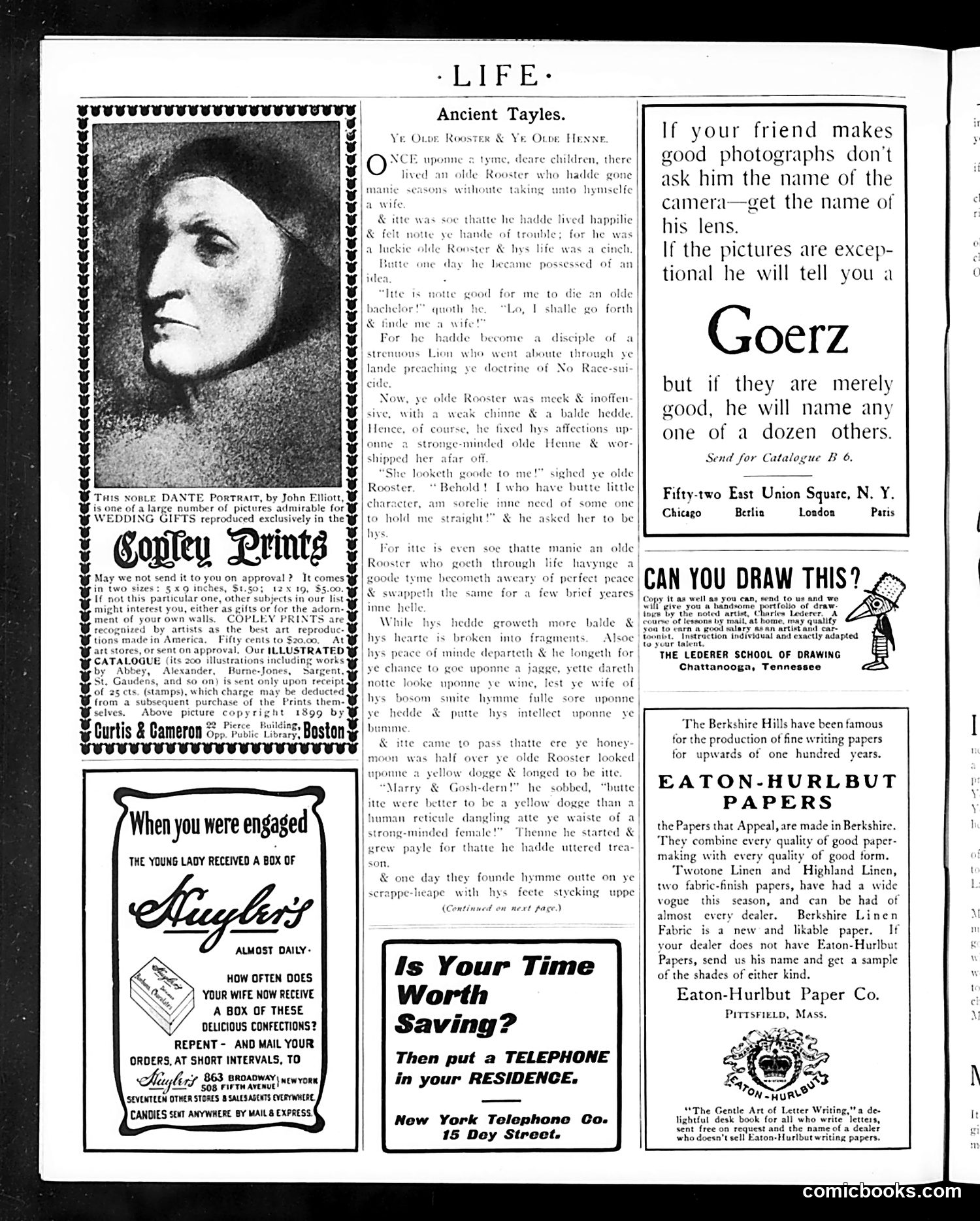
This page is primarily **advertising and editorial content** rather than political satire. The main visual element is a portrait labeled "Ancient Tayles: Ye Olde Rooster & Ye Olde Henne," accompanied by archaic English text telling the story of an old rooster and hen. The narrative appears to be whimsical period fiction rather than satire. The surrounding advertisements promote Copley Prints, Auyler's chocolates, the Lederer School of Drawing, Goerz camera lenses, Eaton-Hurlbut Papers, and New York Telephone service. These are straightforward commercial pitches typical of early 20th-century magazine advertising, with no apparent political or social commentary embedded within them.
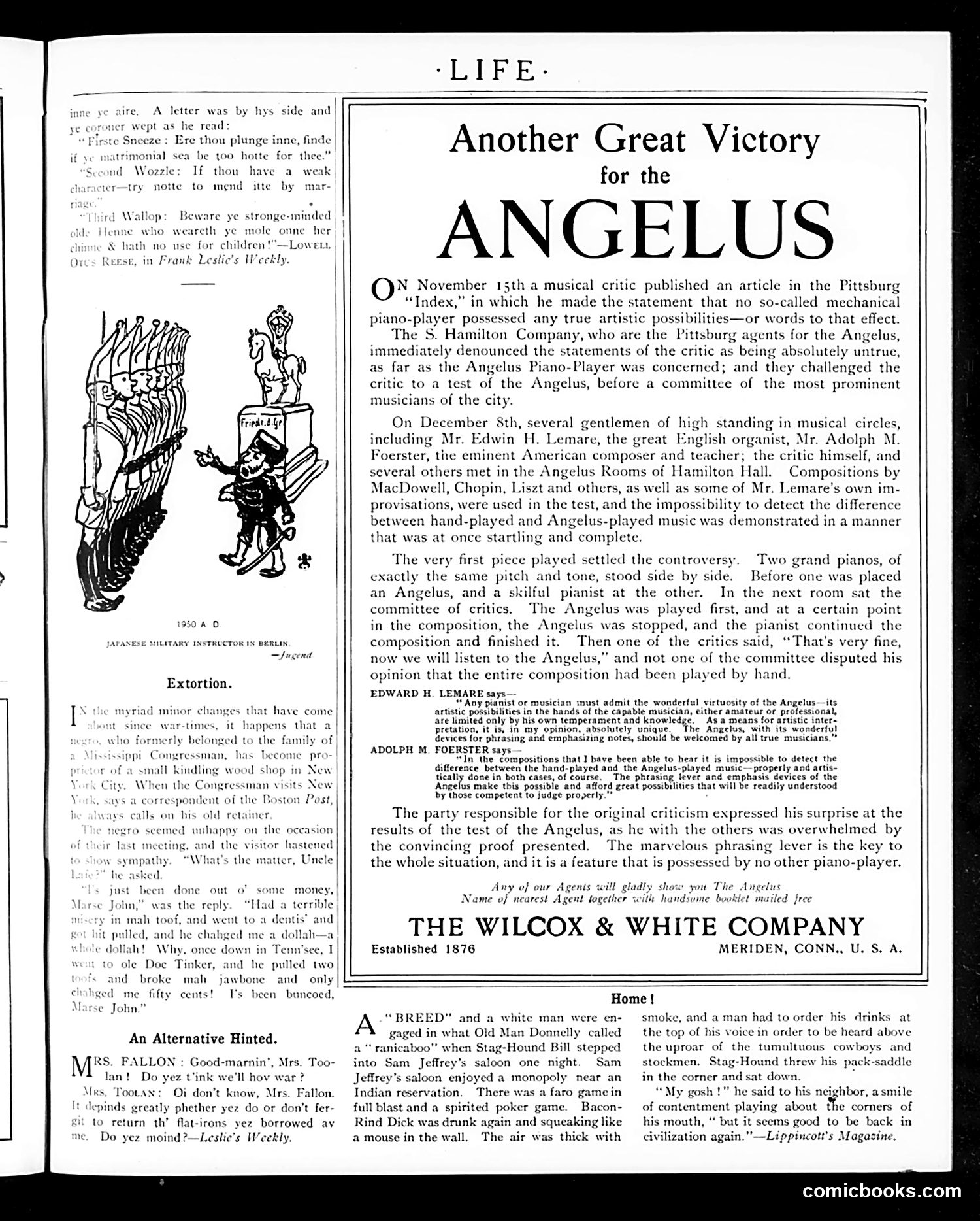
This page contains two distinct items: **Left side ("Exortion"):** A brief humorous anecdote about a Mississippi Congressman visiting Boston. His old African American retainer seems unhappy about the trip. When asked why, the servant replies he once lost money in Boston—a pickpocket stole his dollars. The joke plays on period stereotypes about Black servants and their speech patterns, presenting the anecdote as lighthearted folk humor. **Right side ("Another Great Victory for the Angelus"):** This is primarily **advertising** for the Angelus piano-player—a mechanical player-piano device. It describes a December 8th test where prominent musicians, including organist Edwin Lemare and composer Adolph Foerster, allegedly couldn't distinguish between hand-played piano and Angelus-played music. The "victory" is the machine fooling the critics. Testimonials from the musicians endorse the device's "phrasing lever" capabilities. This advertorial format was common in Life magazine.
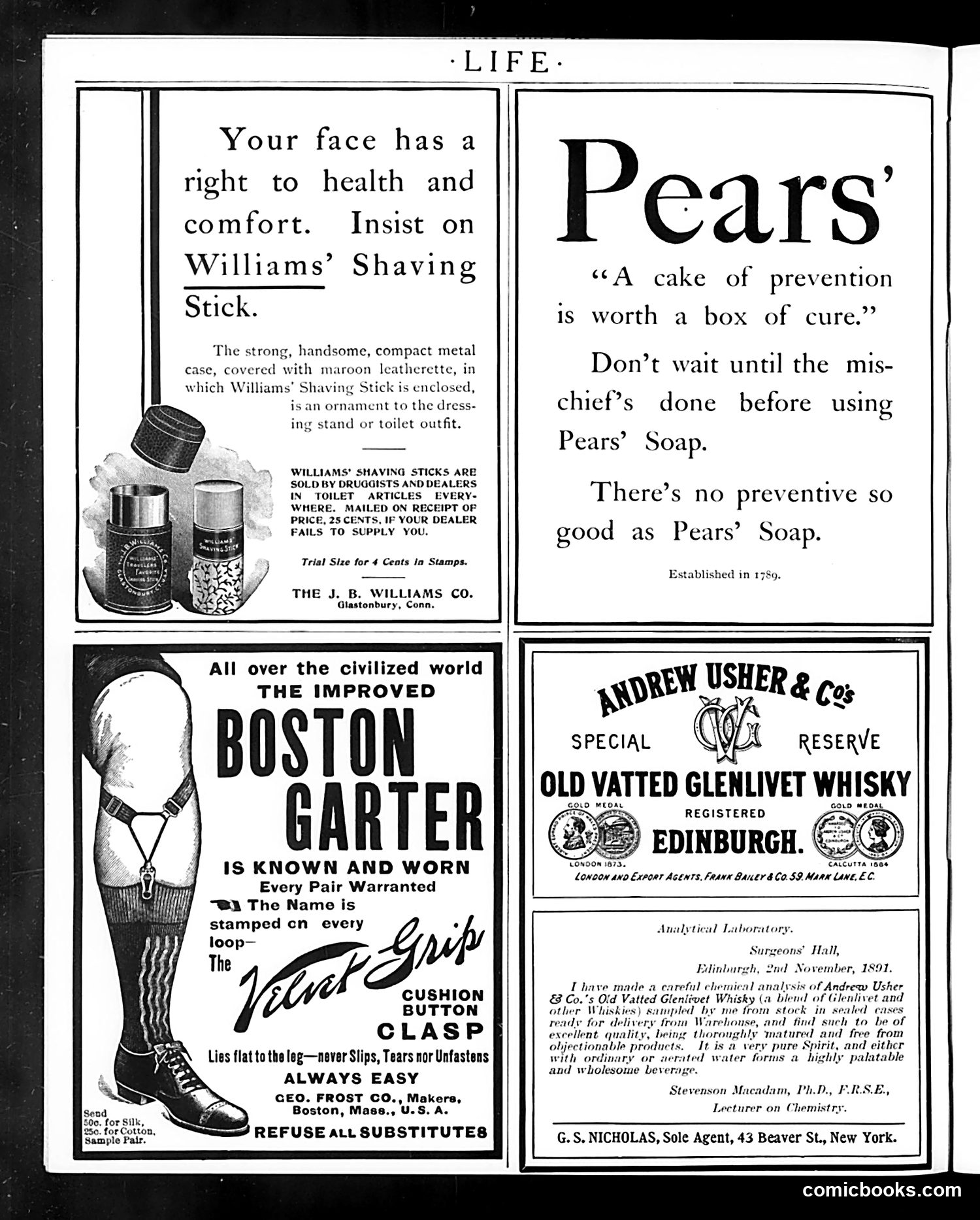
This page consists entirely of **period advertisements** with no satirical content or cartoons. It promotes four products circa 1890s-early 1900s: 1. **Williams' Shaving Stick** — marketed as promoting facial health and comfort, emphasizing its elegant metal case as a decorative bathroom item 2. **Boston Garter** — a men's sock garter with a "cushion button clasp" designed not to slip or tear, sold by George Frost Co. in Boston 3. **Pears' Soap** — using the preventive medicine slogan "a cake of prevention is worth a box of cure," established 1789 4. **Andrew Usher's Old Vatted Glenlivet Whisky** — a Scottish whisky with chemical analysis certification from Edinburgh (1891) endorsing its quality and purity The ads reflect Victorian-era consumer culture emphasizing product reliability, gentlemanly grooming, and scientific legitimacy through expert testimonials. There is **no satire present**—this is straightforward commercial advertising typical of Life's revenue model.
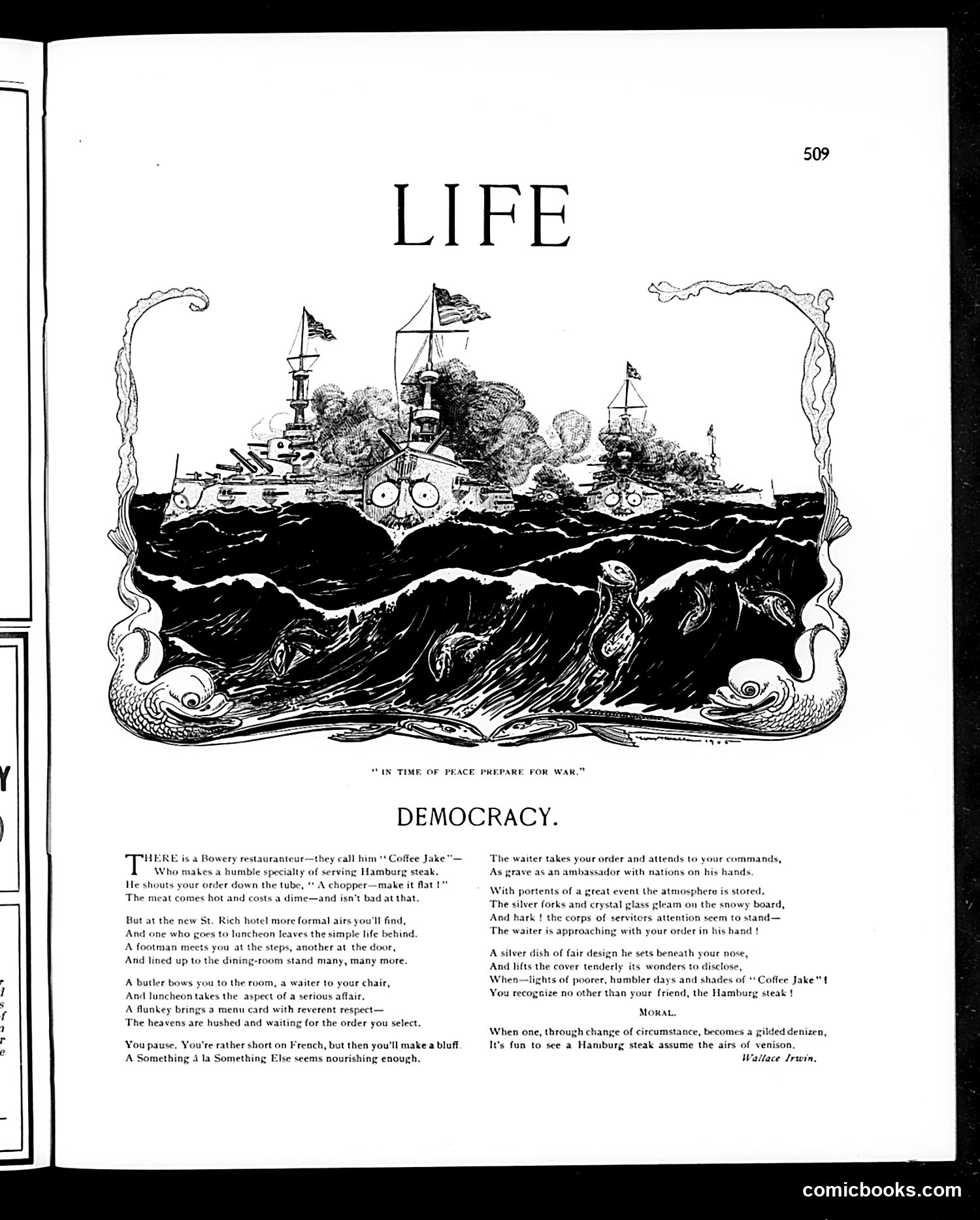
This satirical piece by Wallace Irwin contrasts class differences in early 20th-century America through dining. "Coffee Jake's" Bowery restaurant serves humble Hamburg steaks cheaply and informally to working-class customers. At the fancy St. Rich Hotel, the same Hamburg steak is served with elaborate ceremony—multiple servants, fine china, and pretentious French menu names—creating the *illusion* of sophistication. The joke: regardless of social status or presentation, it's still just a Hamburg steak. The satire mocks both the nouveau riche who adopt pretentious airs upon gaining wealth, and the absurdity of class-based dining rituals that transform simple food through pageantry alone. The header "In Time of Peace Prepare for War" paired with "Democracy" suggests irony about American ideals—the piece critiques how democracy coexists with rigid class hierarchies that persist even in casual dining.
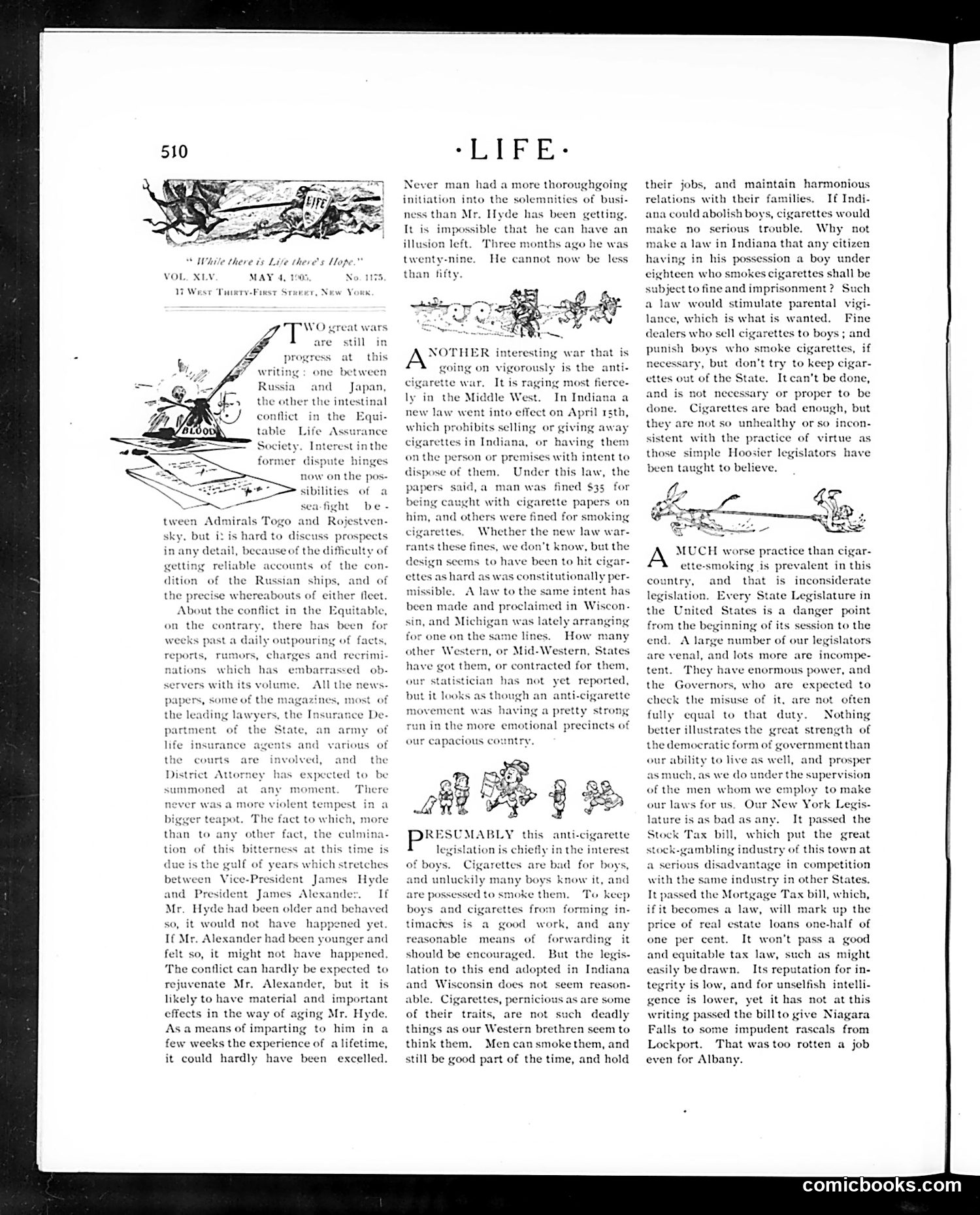
This page discusses two major conflicts of the era: the Russo-Japanese War (naval battle between Admirals Togo and Rojestvensky) and an anti-cigarette legislative campaign in the American Midwest. The satire centers on **Indiana and Wisconsin's new laws prohibiting cigarette sales to minors**. The author sarcastically proposes that rather than banning cigarettes, these states should ban *boys*—suggesting the real problem isn't the product but parental negligence. The piece mocks Midwestern moral legislation as well-intentioned but misguided, arguing that men can smoke cigarettes and still be productive citizens with good families. The article also critiques the **Equitable Life Assurance Society scandal**, involving a bitter dispute between Vice-President James Hyde and President James Alexander. Life magazine presents this as a generational conflict aged into tragedy—suggesting Hyde's ordeal will prematurely age him. The cartoons (partly illegible in reproduction) appear to illustrate these conflicts, though specific figures are unclear from the image quality provided.
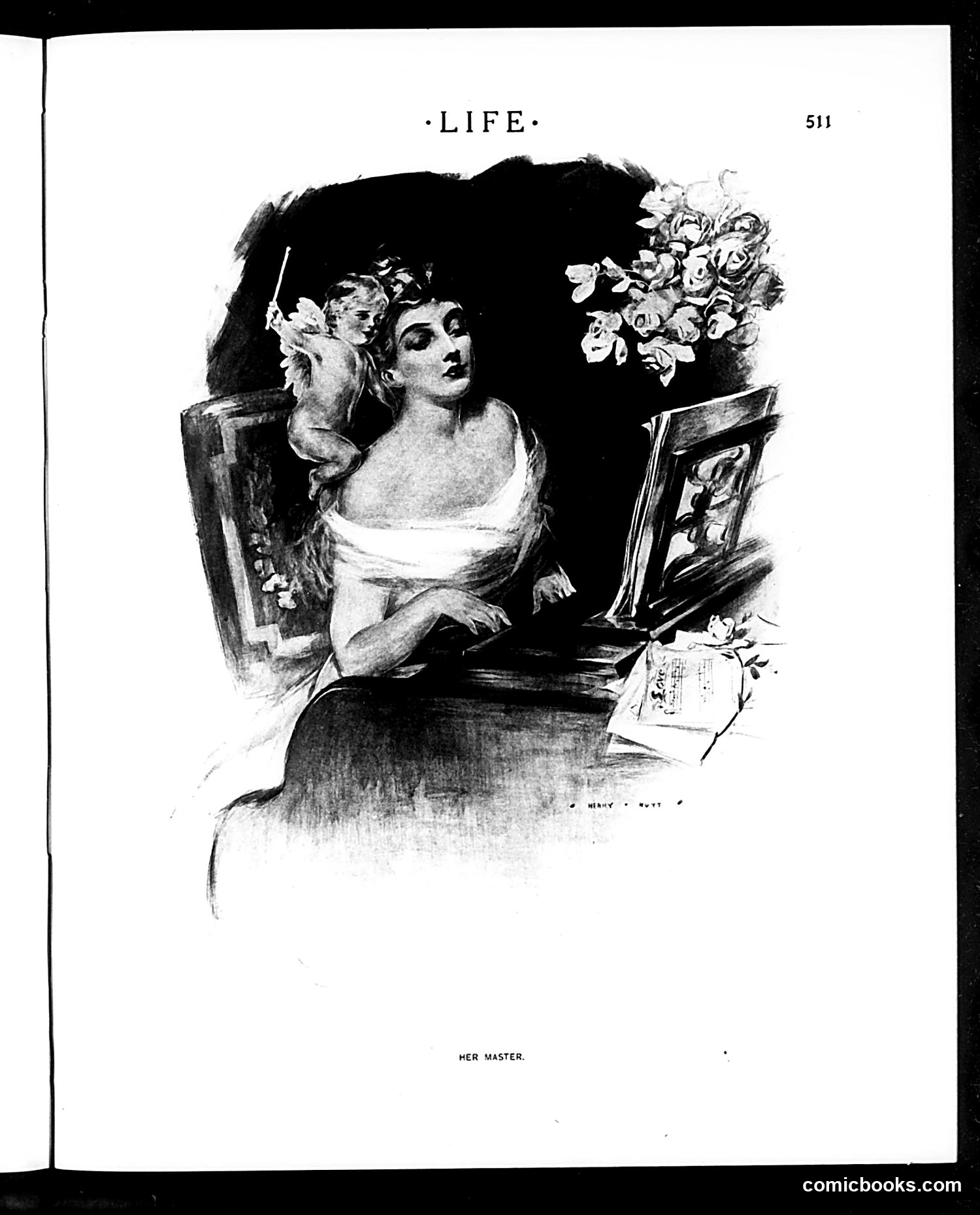
This illustration depicts a woman at her vanity, surrounded by luxurious items: mirrors, flowers, and cosmetics. The caption "Her Master" suggests satirical commentary on female vanity and materialism. The cartoon likely mocks upper-class women's preoccupation with appearance and luxury goods as their "master"—implying that these superficial concerns dominate their lives rather than intellectual or substantive pursuits. The woman gazes at her reflection while surrounded by the trappings of beauty and wealth, reinforcing the satirical point. This reflects early-20th-century *Life* magazine's frequent social satire targeting wealthy society women, their leisure pursuits, and consumer habits. The humor relies on the period's gender assumptions about women's priorities and vanity.
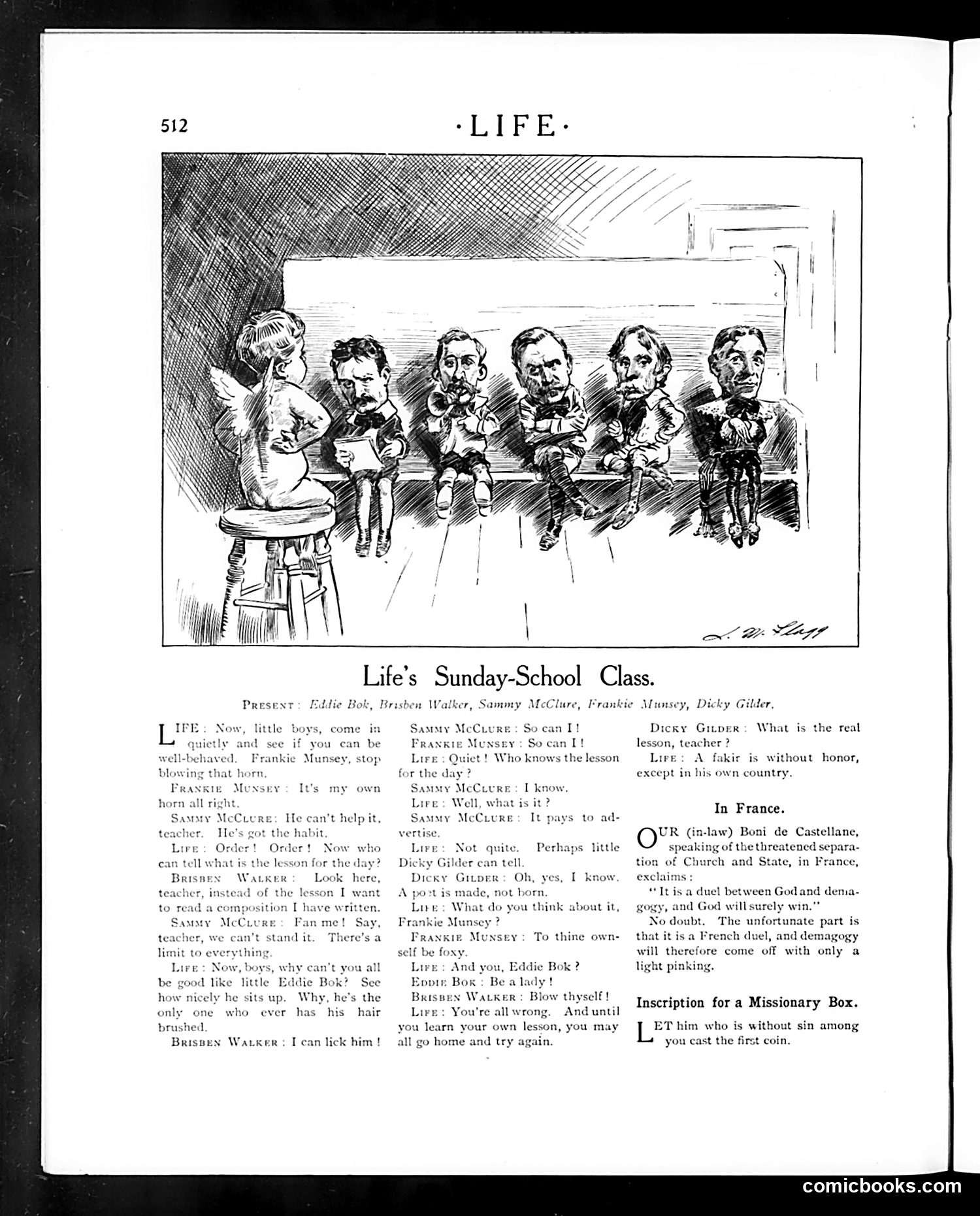
This satirical cartoon depicts six prominent American publishing figures as misbehaving schoolboys being disciplined by "Life" (personified as a teacher). The named figures are Eddie Bok, Brisben Walker, Sammy McClure, Frankie Munsey, and Dicky Gilder—all real magazine editors and publishers of the era. The satire mocks these rivals for their competitive boasting, ethical shortcuts, and self-promotion. When asked the lesson ("A fakir is without honor, except in his own country"), the cartoon suggests these publishers behave like charlatans, prioritizing advertising and circulation-building over journalistic integrity. Their childish quarreling and empty braggadocio are presented as moral failings. The piece uses the Sunday-school format to imply these powerful men lack basic ethical principles that even children should learn—a cutting critique of Gilded Age media competition and commercialism.
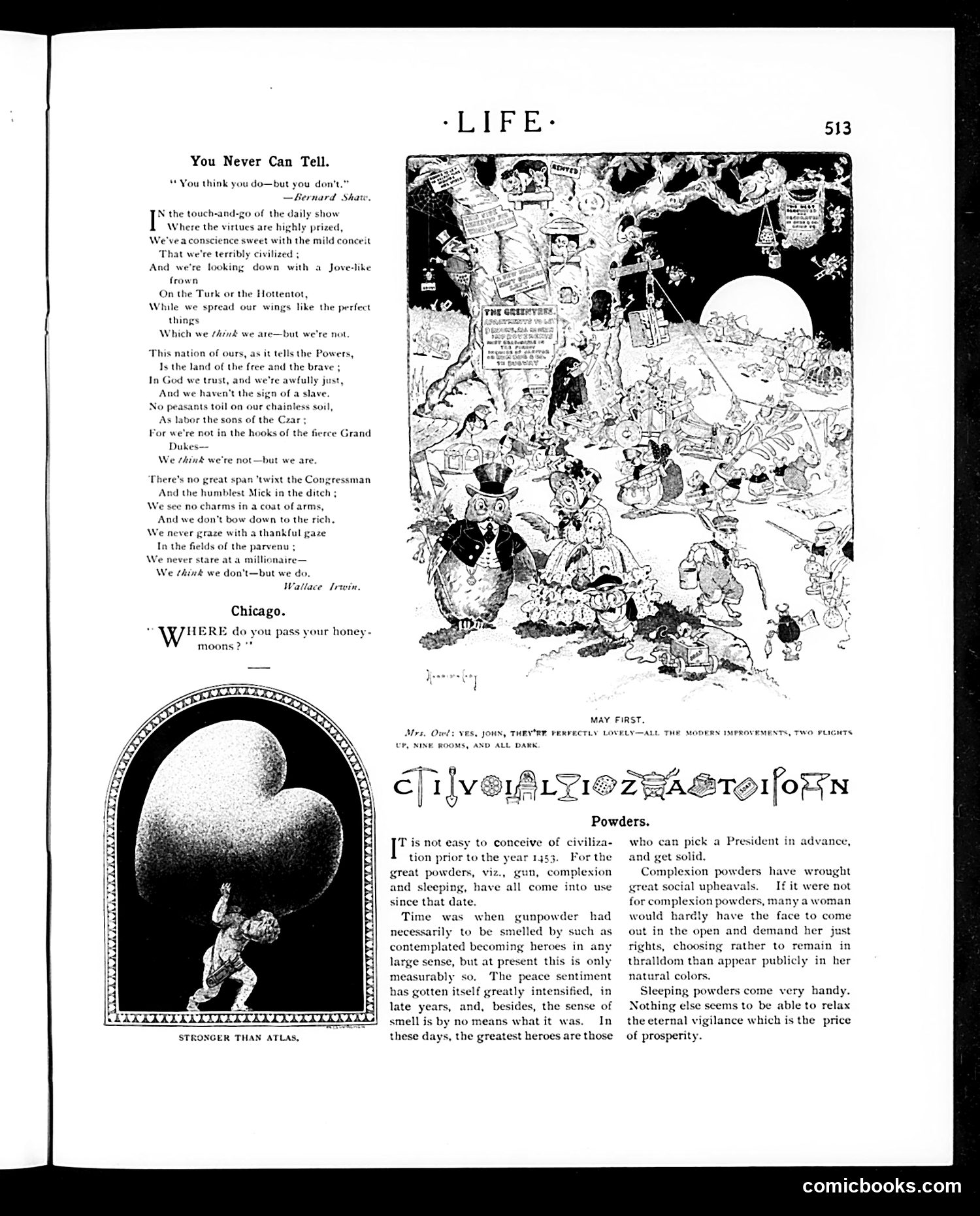
This page contains two distinct pieces of satirical social commentary: **"You Never Can Tell"** (poem by Wallace Irwin): A critique of American hypocrisy. The text mocks the nation's self-image as democratic and egalitarian while pointing out citizens actually *do* bow to wealth and status—contrary to their professed beliefs. The title and Bernard Shaw epigraph ("You think you do—but you don't") establish the core irony: Americans claim indifference to class distinctions but secretly observe them. References to "the Turk or the Hottentot" reflect period attitudes about perceived American moral superiority. **"Civilization"** (advertisement section): A humorous piece arguing that three "powders"—gunpowder, complexion powder, and sleeping powder—define modern civilization. It satirizes both militarism (heroes need gunpowder) and emerging consumer culture. The complexion powder section mockingly suggests women's liberation depends on cosmetics allowing them public appearance. It's cynical commentary on superficial "progress" and consumerism masquerading as genuine social advancement. Both pieces share skeptical humor about American claims of enlightenment and equality.
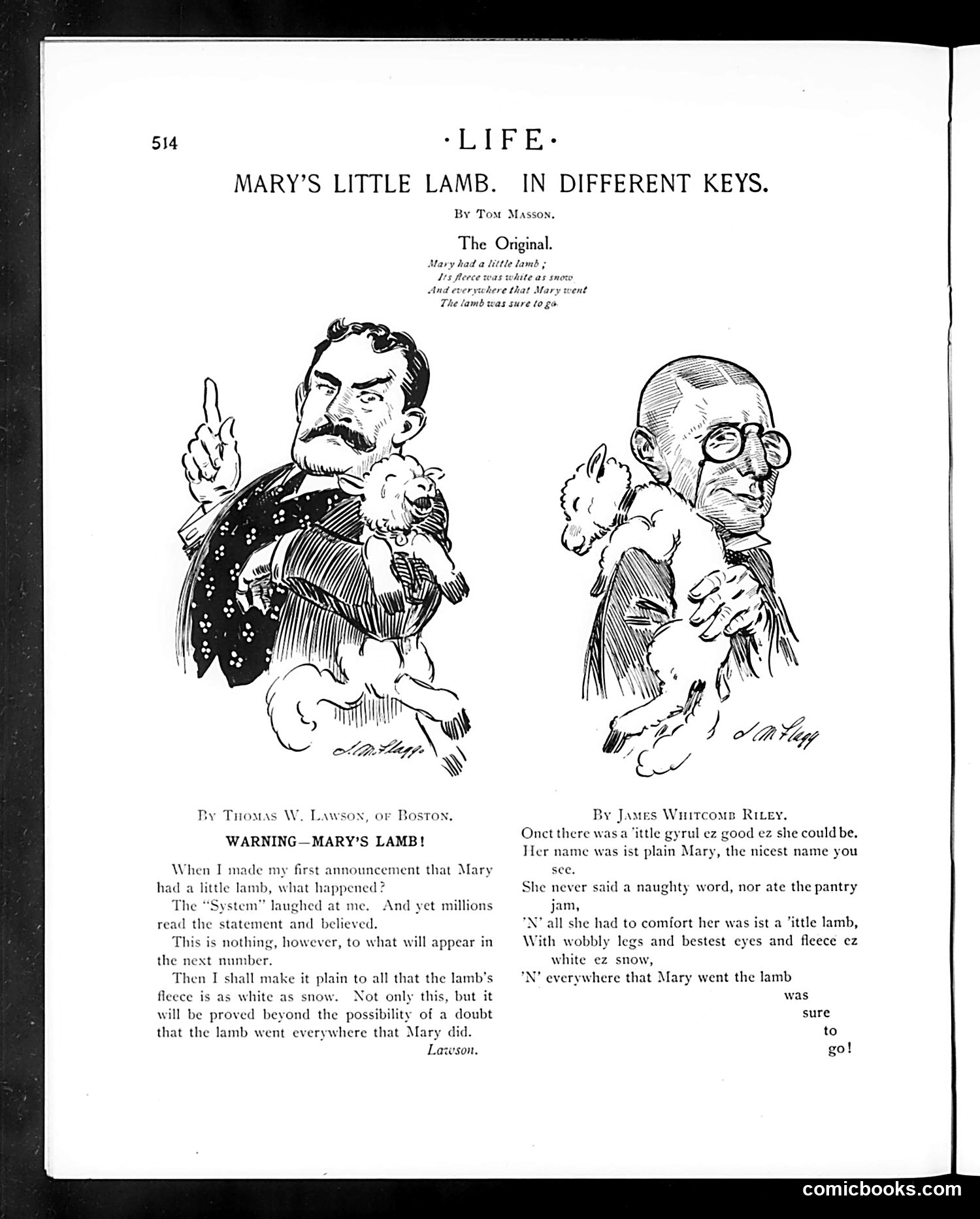
This satirical page parodies the famous children's poem by presenting it in contrasting "keys" or styles from different authors. **Thomas W. Lawson's version** (left) mocks muckraking journalism. Lawson, a Boston financier and reformer, announces Mary's lamb as if breaking a major scandal. His exaggerated "WARNING" tone and promise of further revelations satirize sensationalist investigative reporting—the absurdity being that he treats a simple nursery rhyme as exposé-worthy conspiracy, complete with references to "the System" opposing him. **James Whitcomb Riley's version** (right) is sentimental Americana. Riley, a known Indiana poet of rustic, folksy verse, presents the same story in gentle dialect ("ez," "'ittle"), emphasizing virtue and innocent beauty. The joke: the same nursery rhyme becomes either melodramatic political theater or saccharine sentimentality depending on the author's style. It's satire of both overwrought reformist rhetoric and clichéd romantic Americana.
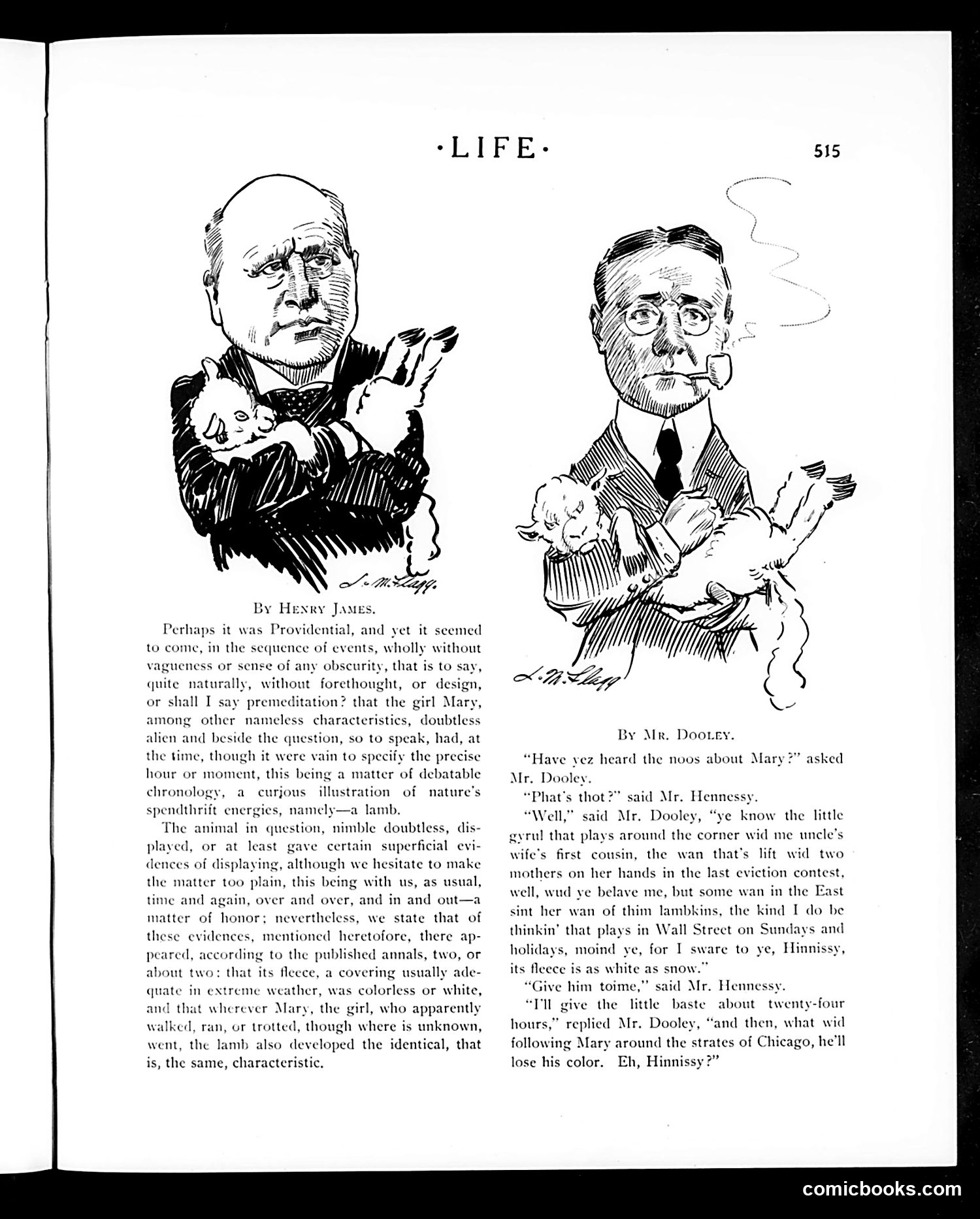
This page presents two satirical treatments of the nursery rhyme "Mary Had a Little Lamb": **Left cartoon (by Henry James):** A parody of James's famously convoluted prose style, deliberately obscuring the simple Mary-and-lamb story under layers of verbose, philosophical language. The joke mocks James's tendency toward elaborate sentences and abstract rumination over straightforward narrative. **Right cartoon (by Mr. Dooley):** Features two Irish-American characters (identifiable by their dialect spelling) discussing a poor girl receiving a lamb as charity. The satire suggests the lamb will "lose his color" (turn dirty/gray) from following Mary through Chicago's filthy streets—a commentary on urban poverty, child welfare, and the grim conditions faced by working-class immigrants in American cities. Together, these pieces use the innocent nursery rhyme to satirize both literary pretension and social indifference to urban poverty.
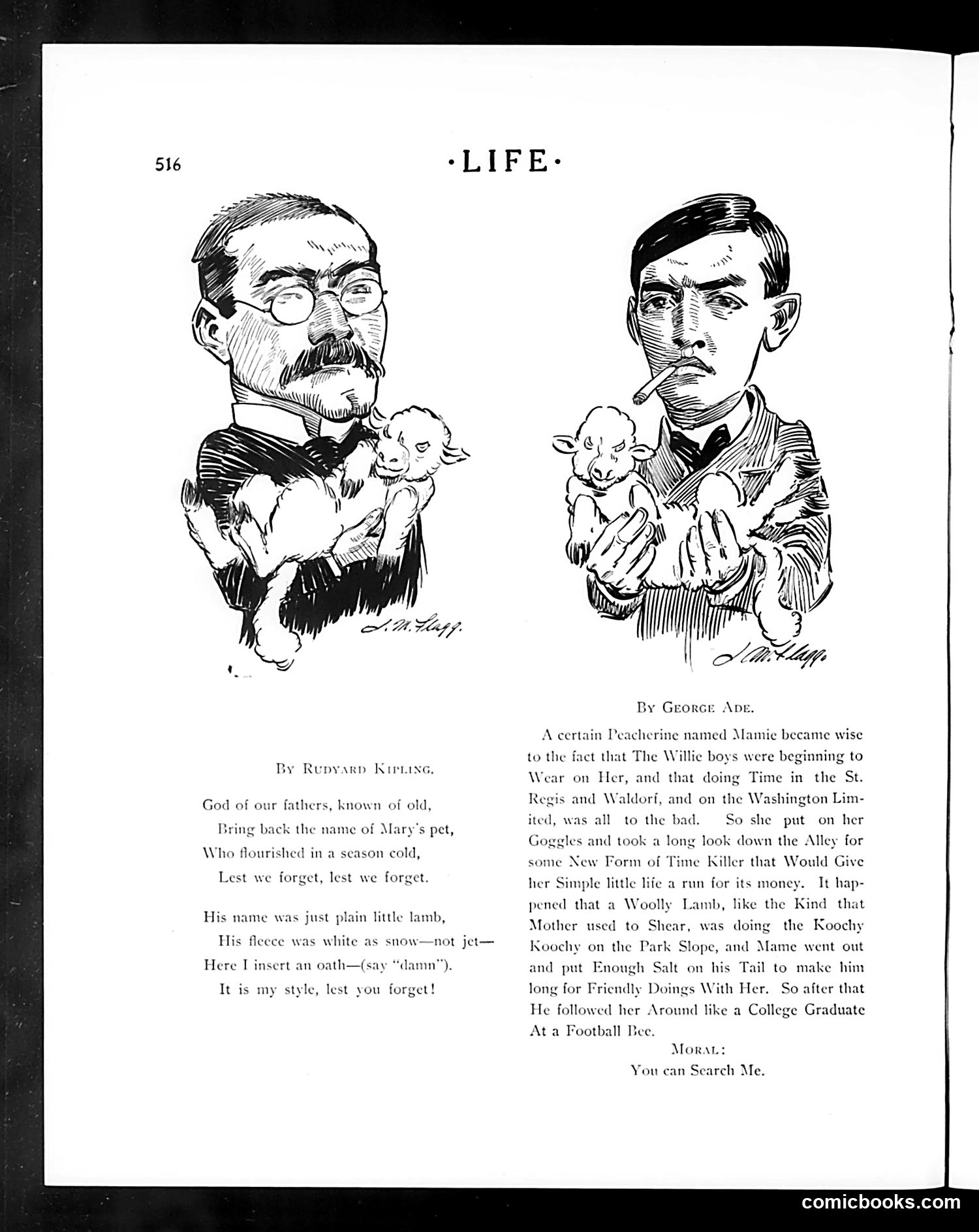
This Life magazine page features two caricatured portraits (likely of public figures, though names aren't specified in the visible text) holding small animals—a lamb and a goat. **Left side:** Rudyard Kipling's poem nostalgically references "Mary's pet"—the famous lamb from the nursery rhyme "Mary Had a Little Lamb." The verse playfully laments forgetting this innocent figure. **Right side:** George Ade's satirical prose story mocks a woman named "Mamie" seeking entertainment. She discovers a "Woolly Lamb" performing at the Park Slope and becomes obsessed with it, salting its tail to keep it following her around "like a College Graduate At a Football Bee." The moral: "You can Search Me"—meaning the point is unclear or absurd. **The satire:** This appears to mock sentimental nostalgia (Kipling's earnest poem) against frivolous modern amusement-seeking. The juxtaposition suggests contemporary society's shallow pursuit of novelty versus cherished traditions. The specific individuals caricatured remain unclear from this image alone.
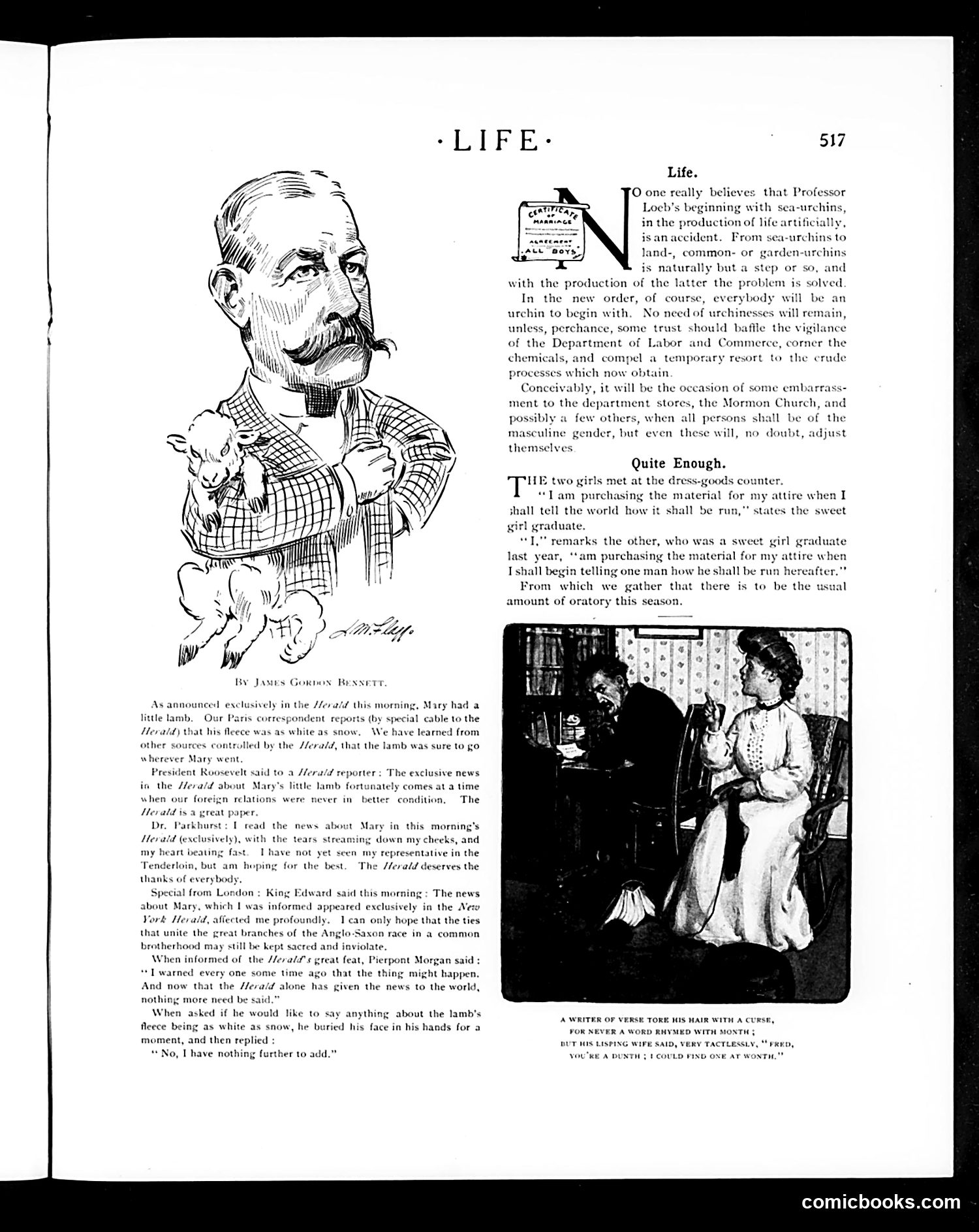
This page contains two distinct satirical pieces: **Top Section - "Life" Editorial:** Mocks Professor Loeb's artificial life-creation experiments (likely Jacques Loeb's early 1900s work on sea-urchin reproduction). The satire envisions a dystopian future where artificially-created humans ("urchins") solve labor problems but create absurd social consequences: all people would be male, embarrassing department stores and the Mormon Church. It's satirizing both overconfident scientific utopianism and anxieties about gender roles. **Bottom Section - Herald Newspaper Parody:** Ridicules the *New York Herald* newspaper's sensational, self-promotional coverage of "Mary's Little Lamb." Various famous figures (Theodore Roosevelt, Dr. Parkhurst, King Edward) are quoted as if the nursery rhyme were breaking news—mocking yellow journalism's exaggeration and the Herald's boastful exclusivity claims. The byline credits James Gordon Bennett, the Herald's actual owner. The cartoonish caricature on the left appears to be Bennett himself, depicted holding lambs.
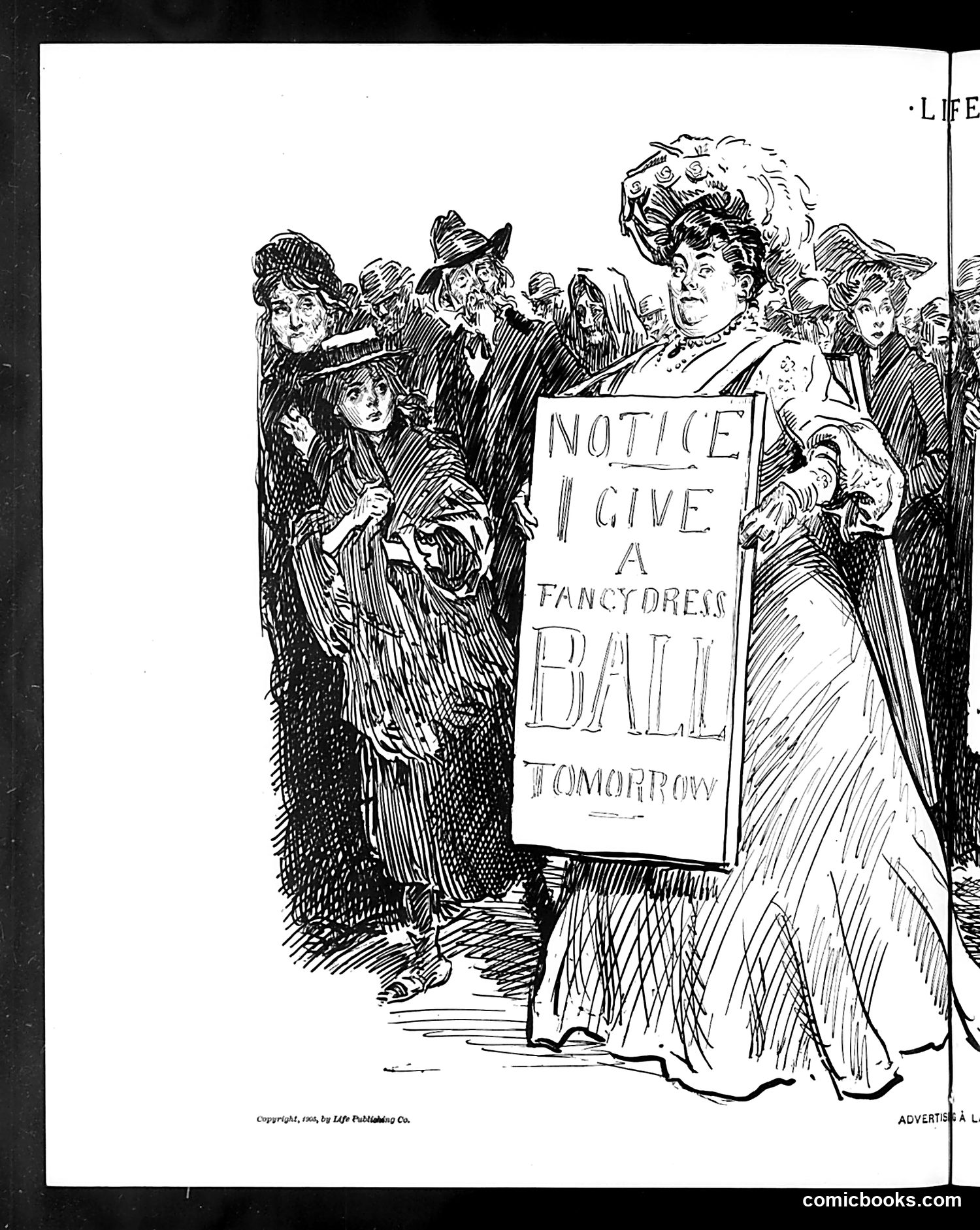
This is a satirical cartoon from *Life* magazine advertising a fancy dress ball. A well-dressed woman on the right holds a notice announcing "I GIVE A FANCY DRESS BALL TOMORROW," while a crowd of elaborately-dressed figures on the left—appearing to be society women in various theatrical costumes and elaborate hats—react with apparent enthusiasm or interest. The satire appears to target the pretentiousness of upper-class social events and fashion. The exaggerated costumes and the woman's prominent announcement suggest mockery of wealthy society's obsession with formal balls and conspicuous display. The crowded, somewhat chaotic composition emphasizes the frenzied nature of high-society social climbing and the artificial nature of these events. The cartoon likely resonated with *Life*'s middle-class readership by gently poking fun at wealthy elites and their cultural pretensions.
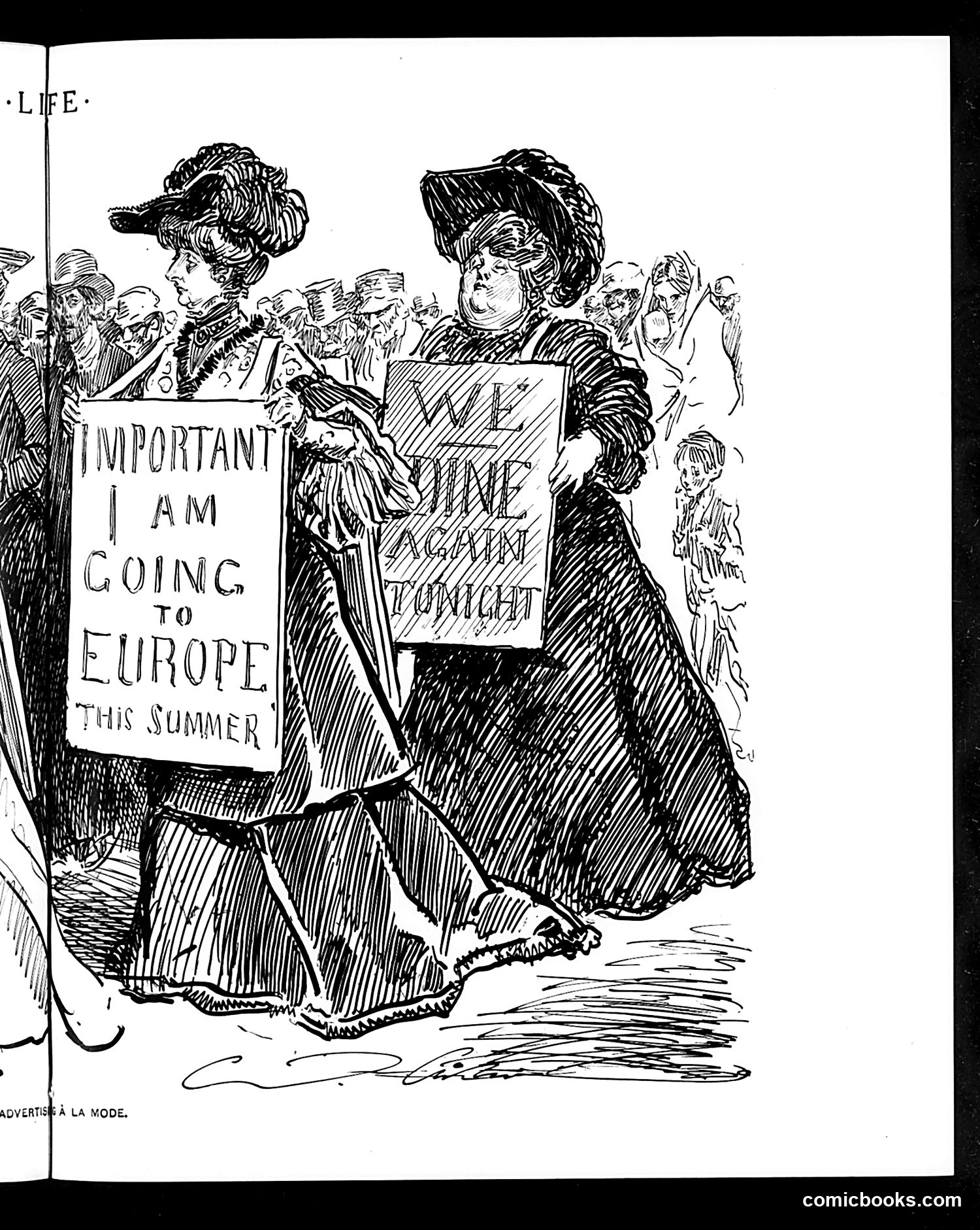
This satirical cartoon depicts two fashionably dressed women displaying signs about European travel. The left figure holds a sign reading "IMPORTANT I AM GOING TO EUROPE THIS SUMMER," while the right figure's sign states "I'M GOING AGAIN TONIGHT." The satire targets wealthy American women's obsession with European travel as a status symbol during the early 20th century. The exaggerated fashion, elaborate hats, and public announcement of their plans mock how women advertised their trips as markers of social importance and wealth. The progression from "this summer" to "again tonight" amplifies the absurdity—suggesting constant, almost desperate travel as performative status-seeking. The caption "ADVERTISE À LA MODE" (advertising in fashionable style) emphasizes how such trips became fashion statements rather than genuine experiences, reducing travel to mere social posturing among affluent circles.
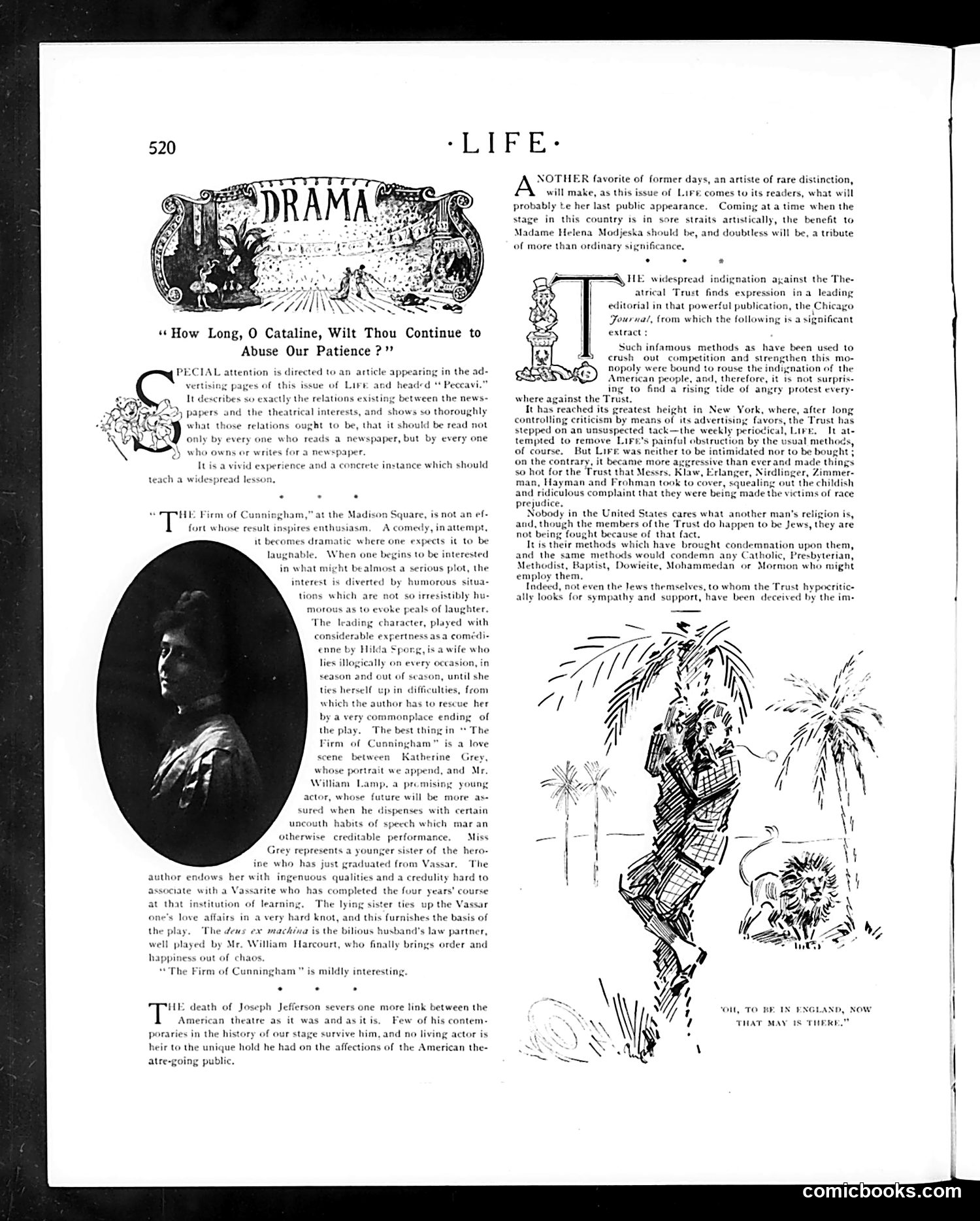
This page discusses theatrical controversies of the early 1900s. The main article attacks the **Theatrical Trust** (a monopoly controlled by producers Klaw, Erlanger, Hayman, Frohman, and Zimmerman) for using corrupt methods—including advertising manipulation—to crush competition. **Key references:** - **"The Firm of Cunningham"** is a theatrical production reviewed as "mildly interesting," illustrating the dramatic fare of the period - **Joseph Jefferson's death** marks the end of an era in American theater - **Madame Helena Modjeska** (likely the actress mentioned) is performing what may be her final public appearance - The **Chicago Journal** is quoted condemning the Trust's "infamous methods" **The satire's point:** Life magazine positions itself as standing against the Trust's bullying tactics, specifically resisting their attempt to suppress the magazine through advertising pressure and other intimidation. The Trust's complaint about being "made victims of race prejudice" is dismissed as childish whining. Life celebrates its own resistance to monopoly control. The ornamental heading and illustrations are typical period magazine design.
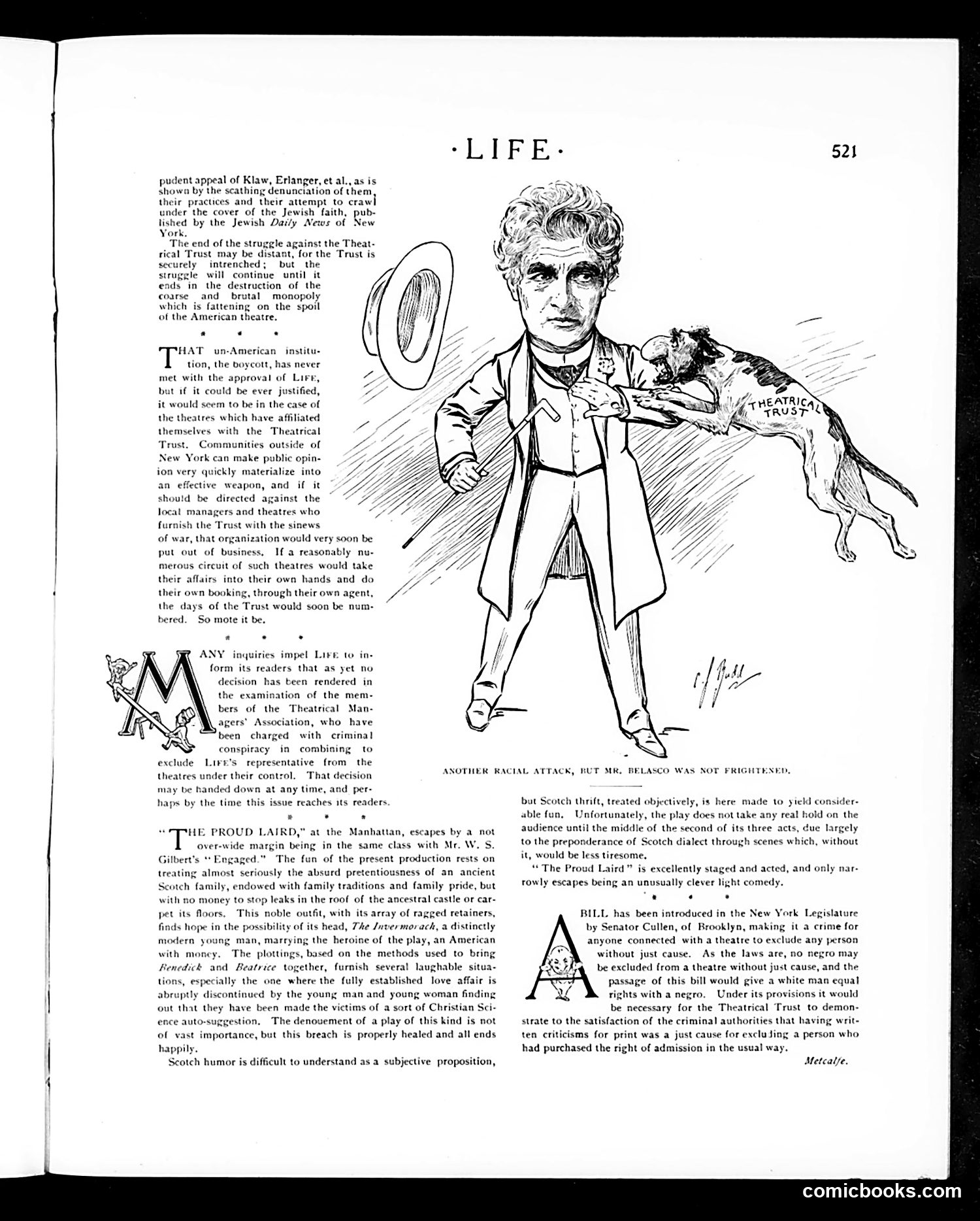
This page addresses the **Theatrical Trust**, a monopolistic organization controlling American theater booking and venues in the early 1900s. The central cartoon depicts a man being attacked by a dog labeled "THEATRICAL TRUST"—illustrating the Trust's aggressive tactics against those who challenge its control. The text discusses Life magazine's opposition to the Trust's "coarse and brutal monopoly," mentioning figures **Klaw and Erlanger** (appears to be Trust leaders). Life advocates for boycotts and independent theater circuits as weapons against the monopoly. The page also reviews "The Proud Laird" play and references a proposed New York bill by Senator Cullen criminalizing theater discrimination—suggesting legislative attempts to break the Trust's exclusionary practices. The satire targets corporate monopolistic power in American entertainment and the need for antitrust reform.
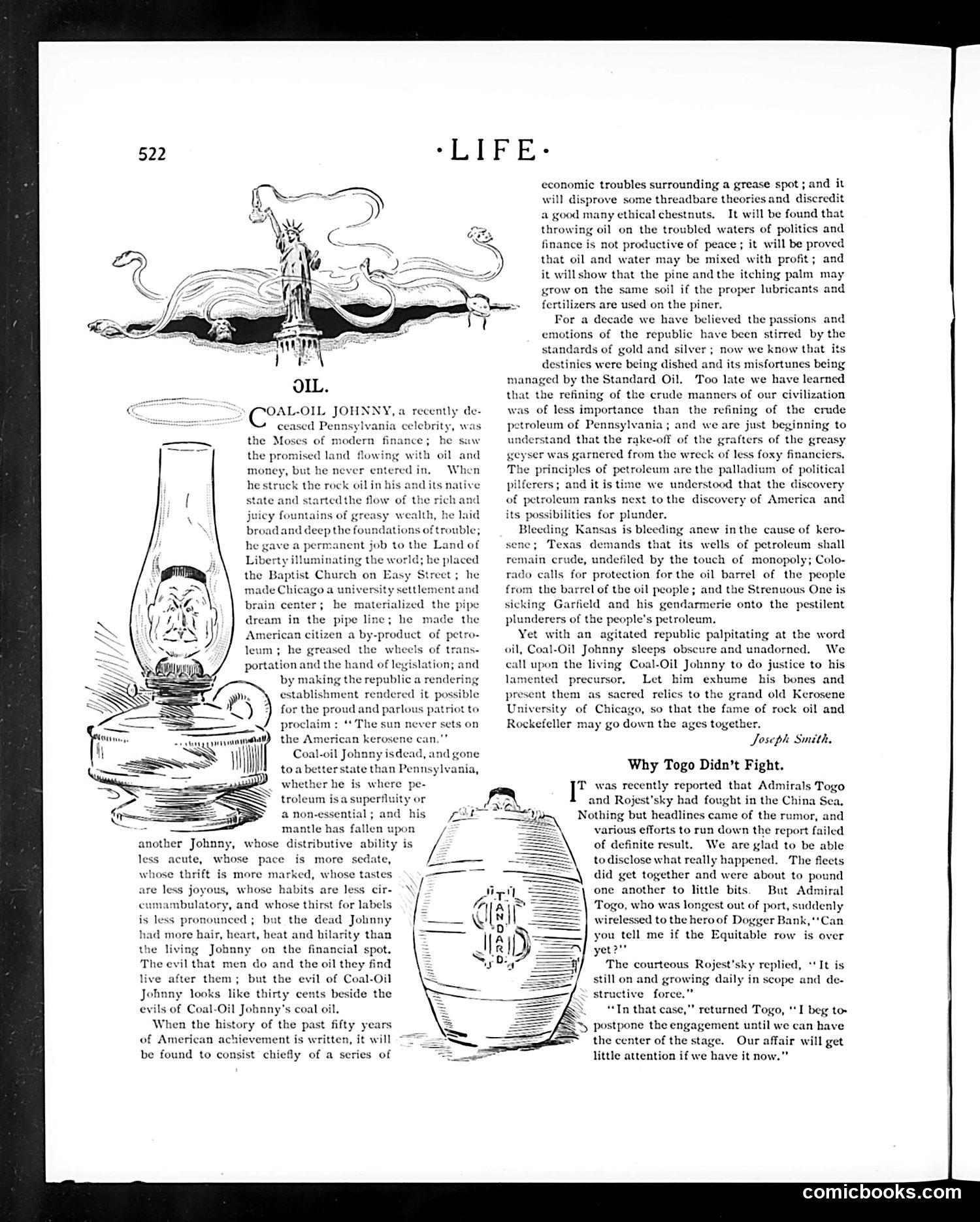
This page satirizes the oil industry's corrupting influence on American politics and finance. "Coal-Oil Johnny" appears to be a historical figure—a Pennsylvania oil prospector whose discovery of petroleum wealth created widespread economic and social problems. The article argues that oil, not gold and silver, now secretly controls the nation's destiny through Standard Oil's monopoly. The satire targets how petroleum wealth has become a corrupting "lubricant" in politics and finance, enriching grafters while destabilizing society. The author (Joseph Smith) calls for Rockefeller (the living "Coal-Oil Johnny") to honor his predecessor by donating his bones to the "Kerosene University of Chicago"—a mocking suggestion that oil money now defines even educational institutions. The piece reflects Progressive Era anxieties about monopoly capitalism, particularly Standard Oil's dominance during this period.
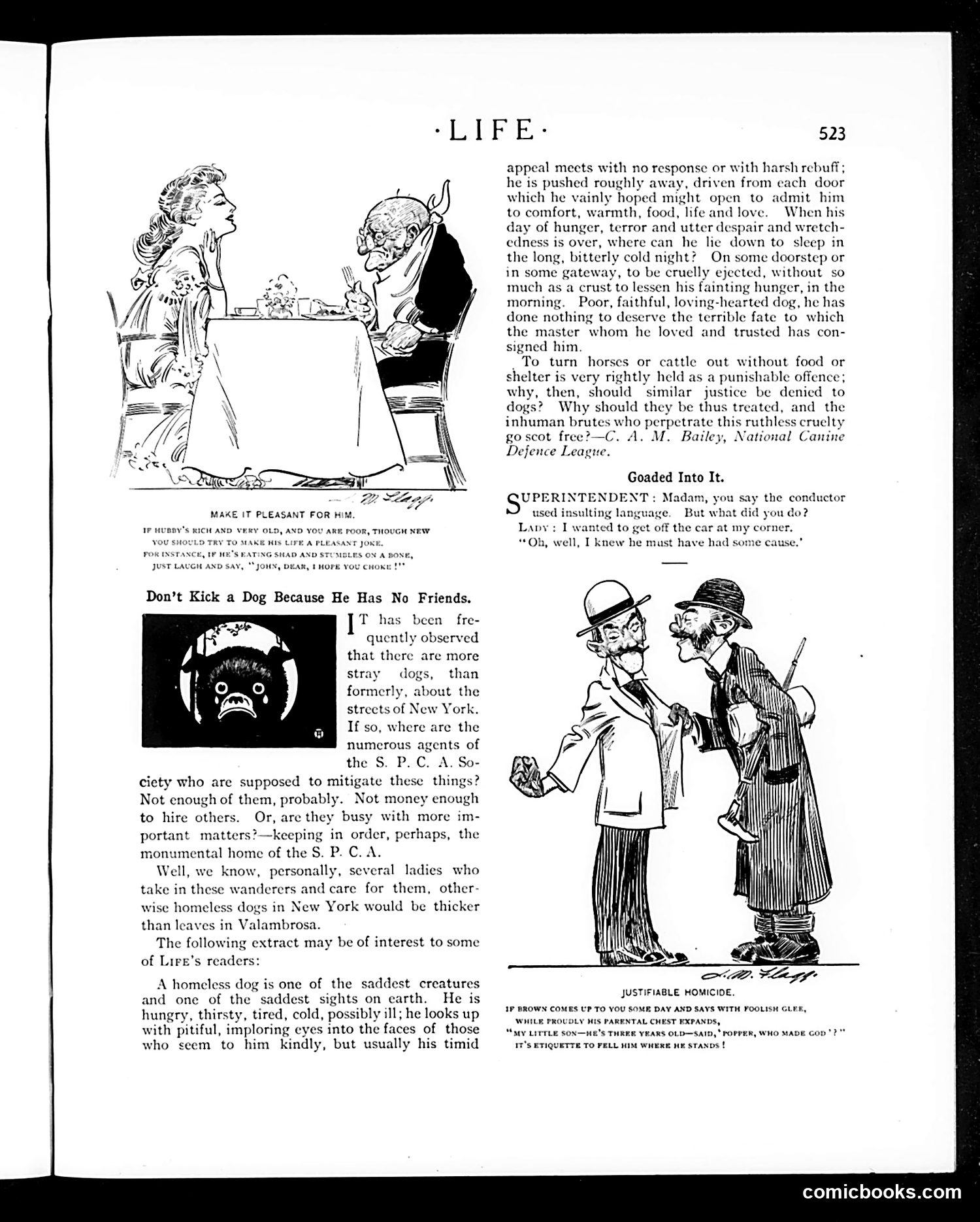
This page contains social commentary on animal cruelty in early 20th-century New York. The main article "Don't Kick a Dog Because He Has No Friends" criticizes the SPCA (Society for the Prevention of Cruelty to Animals) for failing to address the city's growing stray dog problem. The author argues the organization lacks sufficient funding or manpower, while private citizens do more to help homeless dogs than the SPCA itself. The accompanying cartoons use humor to address related social issues: the top cartoon satirizes fortune-hunting marriages, while "Justifiable Homicide" and "Goaded Into It" suggest that cruel behavior often stems from desperation or provocation—implying society shares responsibility when people act brutally. The overall message: vulnerable beings (animals and the poor) deserve protection and compassion rather than dismissal or cruelty.
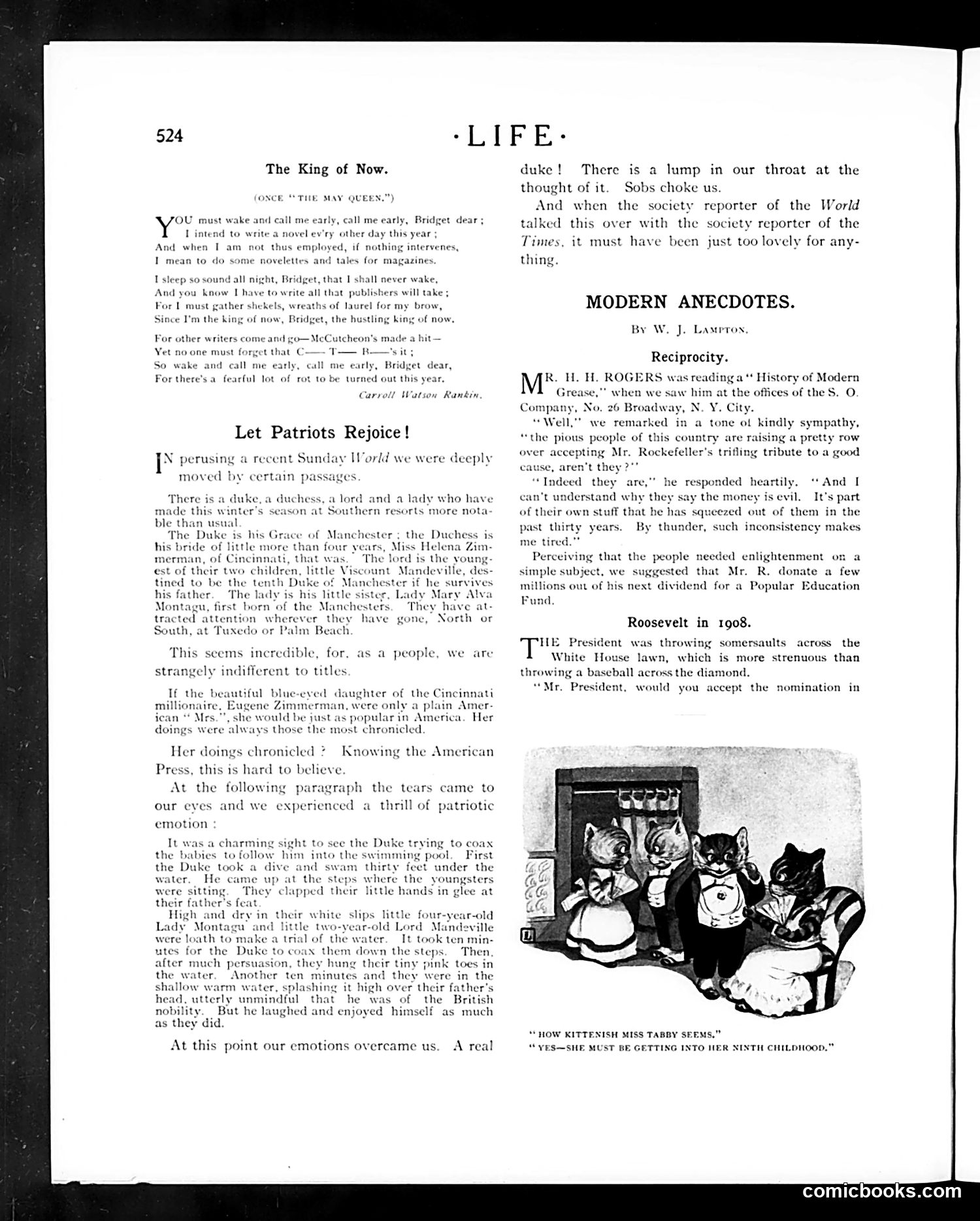
This page contains three satirical pieces reflecting early 1900s American social attitudes: **"The King of Now"** mocks a female writer obsessed with commercial productivity—churning out novels and magazine stories for money and fame rather than artistic merit. The title sardonically references Tennyson's "The May Queen." **"Let Patriots Rejoice!"** satirizes American press obsession with British nobility. The piece describes a Duke and Duchess (likely the Manchesters) visiting Southern resorts, noting that American society reporters treat their every mundane action—like swimming with their children—as newsworthy spectacle. The satire targets both American class-consciousness and superficial journalism that chronicles aristocrats' trivial activities while ignoring substantive news. **"Modern Anecdotes"** features a brief joke about H.H. Rogers (a Standard Oil executive) discussing Rockefeller's charitable donations with ironic cynicism about public hypocrisy. The **cat illustration** appears unrelated to the text, likely accompanying a separate humor piece about feline mischief. The overall page reflects Progressive Era skepticism toward both commercialism and class deference.
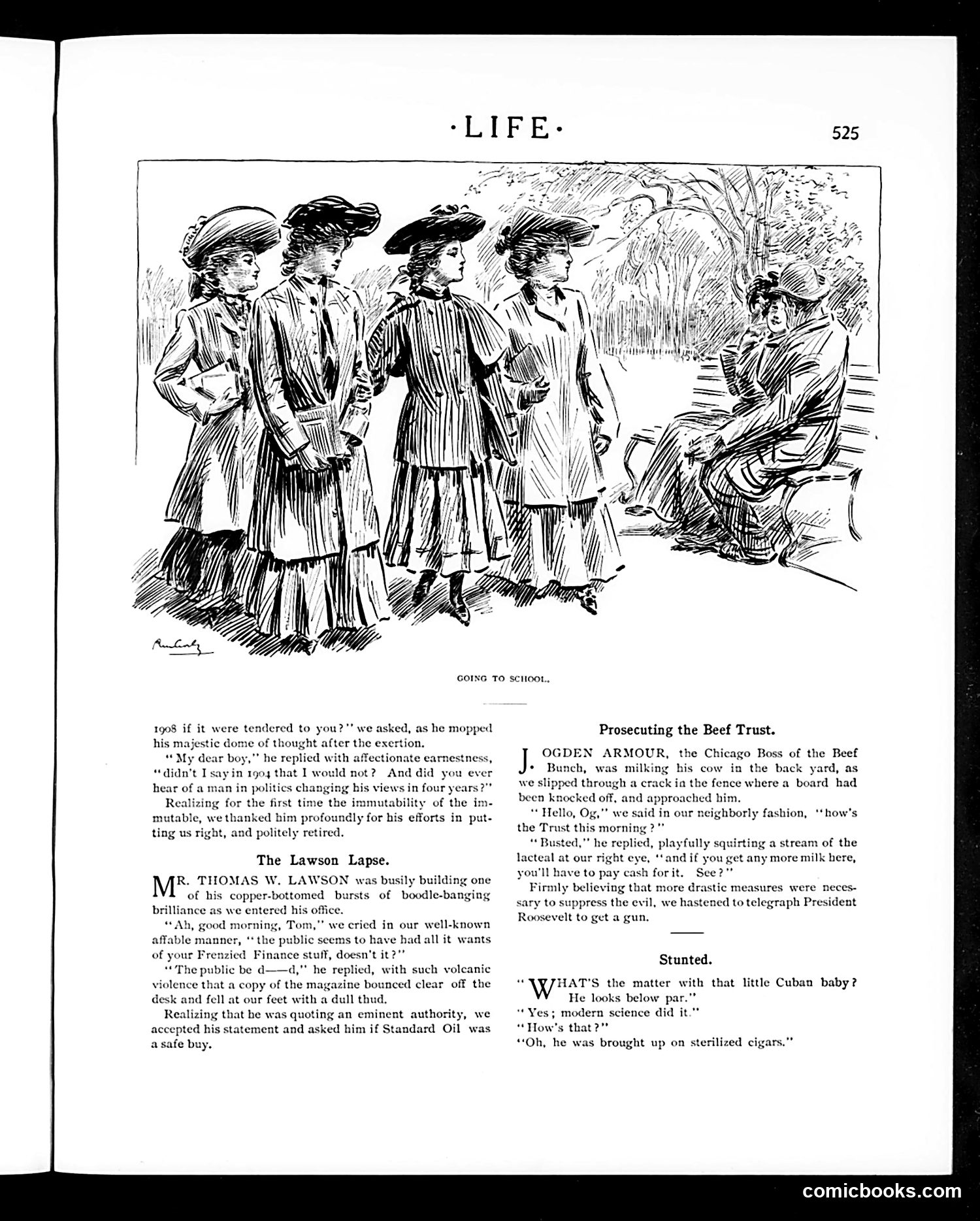
This page contains three satirical pieces from early 1900s Life magazine: **"Going to School"** (illustration, top): Four women approach a seated man, likely referencing a political figure's flip-flopping on policy positions—the satire mocks someone who claimed consistency while changing views. **"The Lawson Lapse"**: Thomas W. Lawson, a financial writer known for his exposé "Frenzied Finance" about Wall Street corruption, is satirized for his volatile temper and questionable financial advice. The joke: he angrily dismisses public interest in his work, then contradicts himself by defending Standard Oil's safety—undermining his credibility as a reformer. **"Prosecuting the Beef Trust"**: Ogden Armour, a Chicago meatpacking magnate, is mocked during the Roosevelt administration's trust-busting era. His refusal to provide free milk symbolizes corporate greed; the satire suggests only presidential intervention (getting "a gun") could combat such monopolies. **"Stunted"**: A brief joke about Cuban cigars and modern sterilization science—likely referencing both American imperial interests in Cuba and contemporary anxieties about industrialization. All pieces mock wealthy industrialists and their evasiveness.
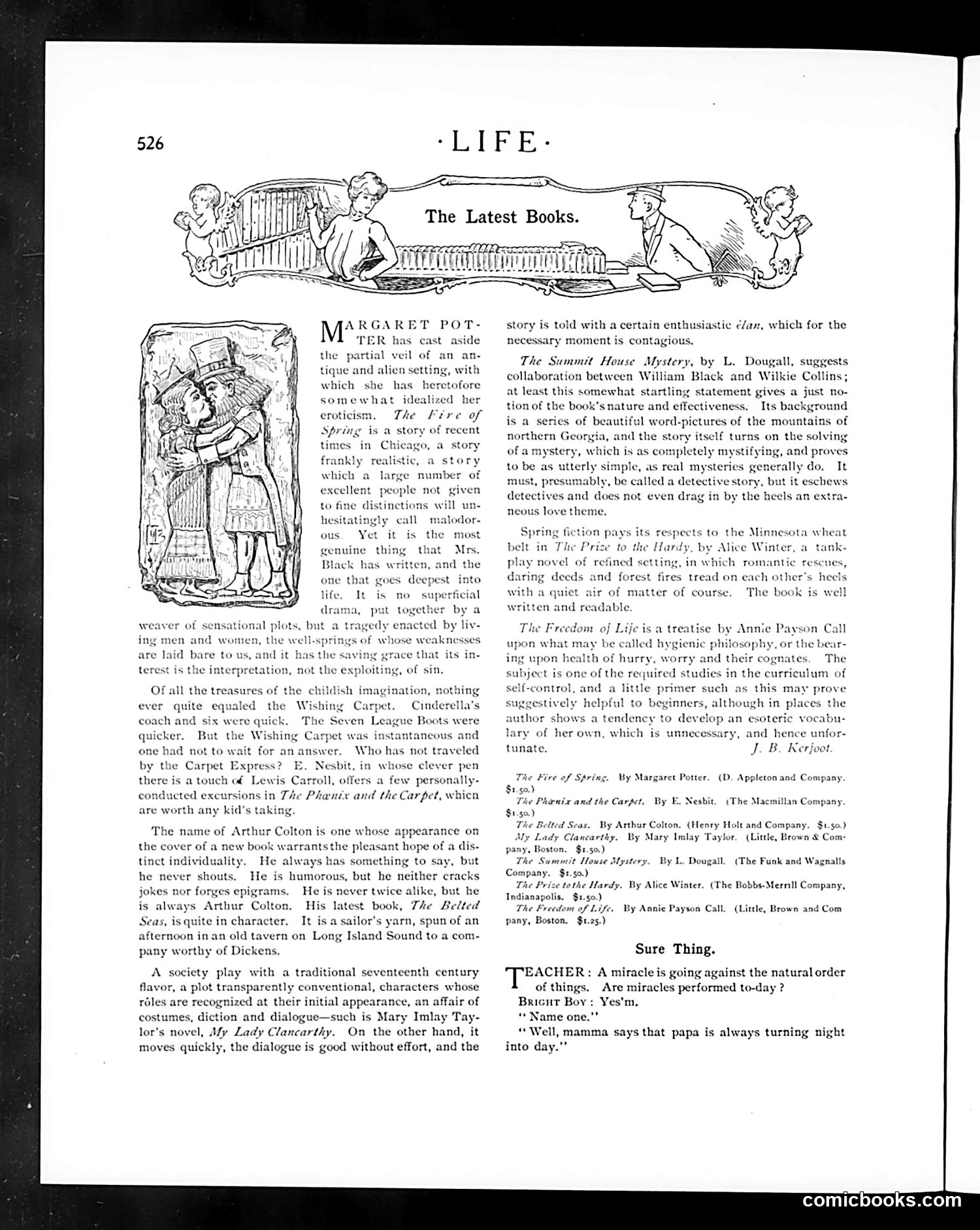
This is a book review section from *Life* magazine, not a political cartoon. The page features literary criticism of several contemporary novels, including works by Margaret Potter, Arthur Colton, and Mary Imlay Taylor. The decorative illustrations are typical Victorian-era ornamental headers rather than satirical cartoons. At the bottom, there's a brief humorous dialogue labeled "Sure Thing" between a Teacher and Bright Boy about miracles—a simple joke playing on the boy's literal interpretation of the teacher's question about whether miracles occur "to-day" (today), with the child's mother turning night into day as an example of a "miracle." This is gentle classroom humor rather than social satire. The page is primarily a straightforward book review and advertisement section typical of early 20th-century magazines.
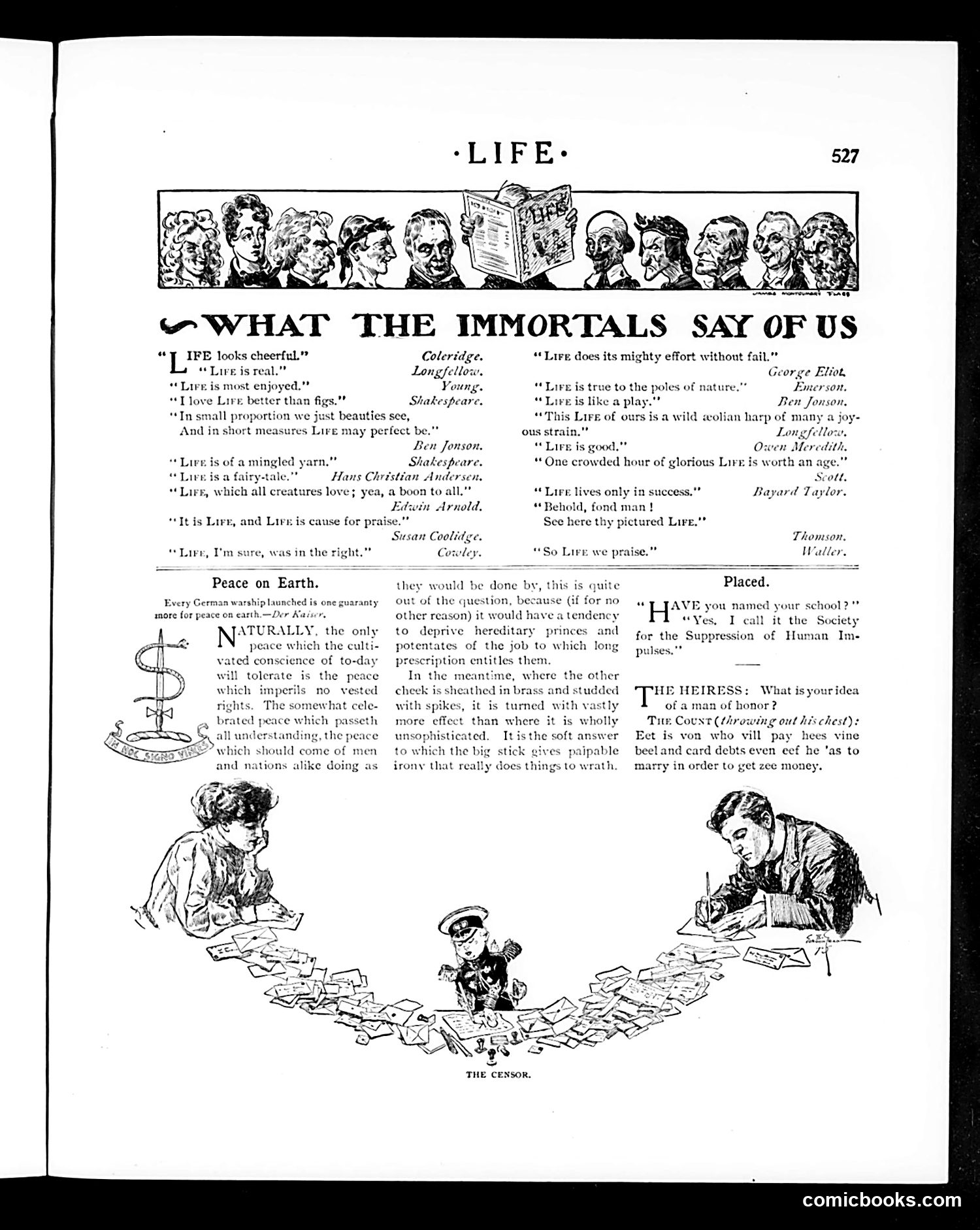
This page collects famous literary and philosophical quotations about life, attributed to immortal figures (Shakespeare, Ben Jonson, Emerson, etc.). It's a humorous conceit: these canonical writers offer contradictory platitudes—life is "cheerful" yet "real," a "fairy-tale" yet "true to nature"—suggesting that even great minds offer little practical wisdom. Below are two satirical cartoons: "Peace on Earth" mocks Kaiser Wilhelm II's claim that German warships guarantee peace, with an ironic illustration of a censor drowning in correspondence. "Placed" depicts two brief social jokes: a school named for suppressing "human impulses" (prudishness), and a decadent foreign count defining honor as marrying for money to pay debts. The satire targets pretension, censorship, and aristocratic hypocrisy.
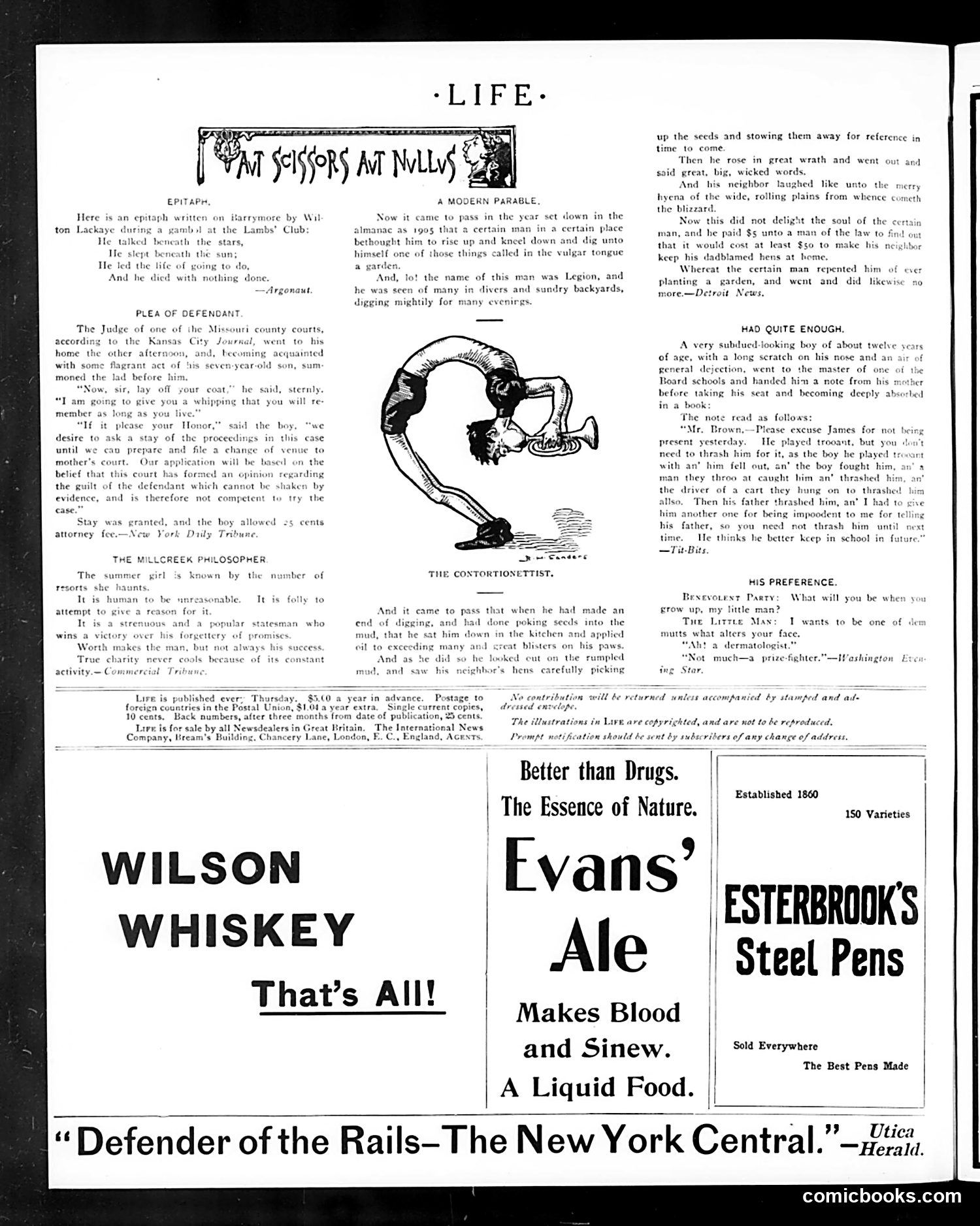
This page contains several satirical anecdotes typical of *Life* magazine's humor, plus period advertisements. The main cartoons mock social pretensions and foolish behavior: 1. **"Plea of Defendant"**: A Missouri judge receives a note from a boy's mother excusing him from school thrashing because he's already been beaten by multiple parties (other boys, a cart driver, his father). The satire targets both the mother's absurd logic and corporal punishment culture. 2. **"Had Quite Enough"**: A boy requesting to become a "dermatologist" because he's tired of people altering his face—either through fighting or prize-fighting. This jokes about both childhood violence and the emerging medical profession. 3. **"His Preference"**: A child tells a society lady he wants to be a dermatologist, with the lady misinterpreting it as wanting to alter faces for money. The advertisements are period-typical, including whiskey, patent "ale" (marketed as nutrition), and steel pens—none reflecting modern sensibilities about alcohol or health claims. The humor assumes readers familiar with rural schooling, class distinctions, and period medical quackery.
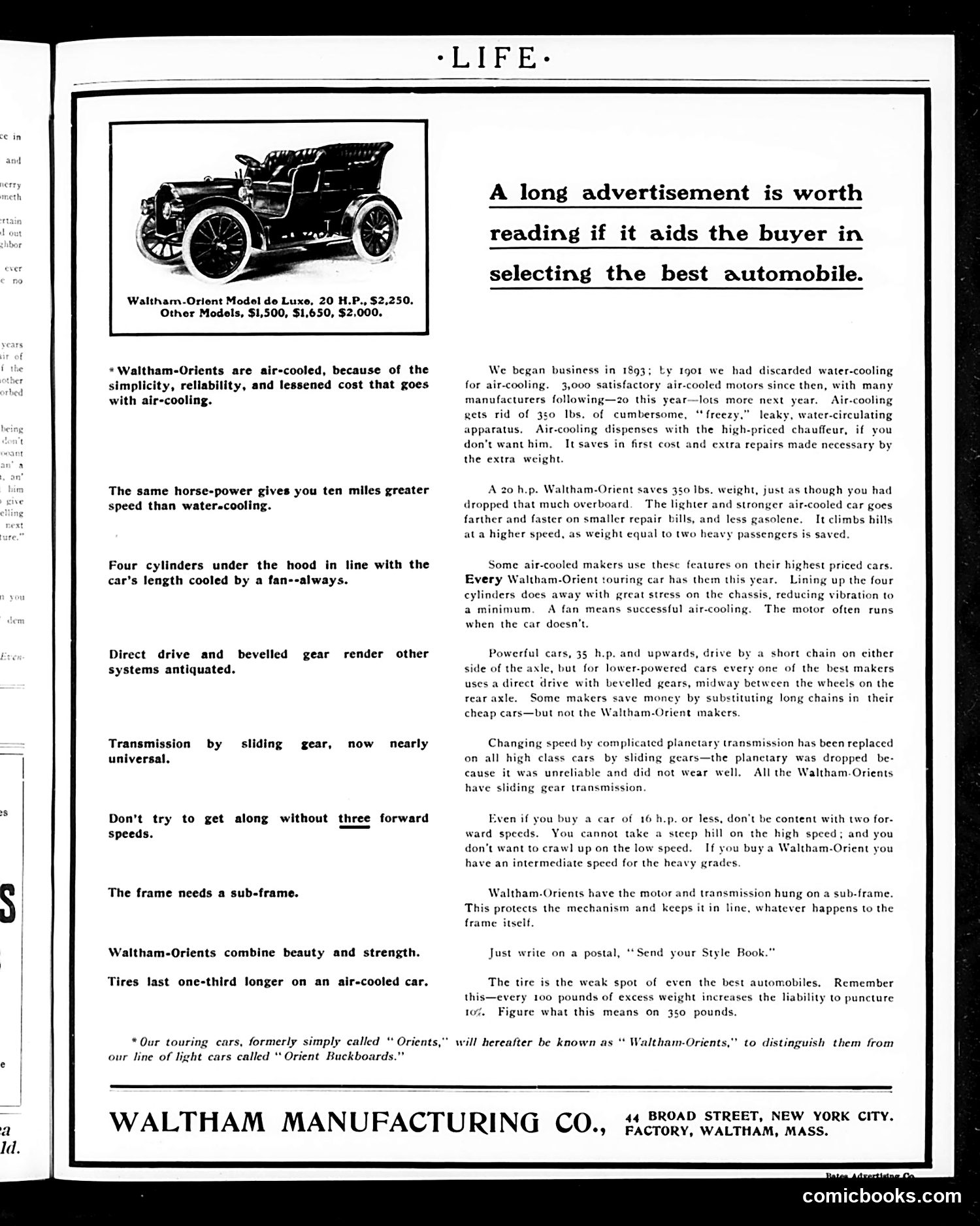
This is **not a cartoon or satire**—it's a straightforward automobile advertisement from *Life* magazine (circa early 1900s). The page promotes the Waltham-Orient car by listing technical superiority claims: air-cooling over water-cooling, direct drive transmission, three forward speeds, and weight savings. The opening statement—"A long advertisement is worth reading if it aids the buyer in selecting the best automobile"—is meta-commentary acknowledging the ad's length while asserting its educational value. The ad targets affluent buyers by emphasizing reliability, lower maintenance costs ("dispenses with the high-priced chauffeur"), and performance advantages. Technical details about cylinders, gearing, and tire durability appeal to early automotive enthusiasts who understood such specifications. The image shows the Model de Luxe touring car priced at $2,250 (expensive for the era). This is informational advertising, not satire.
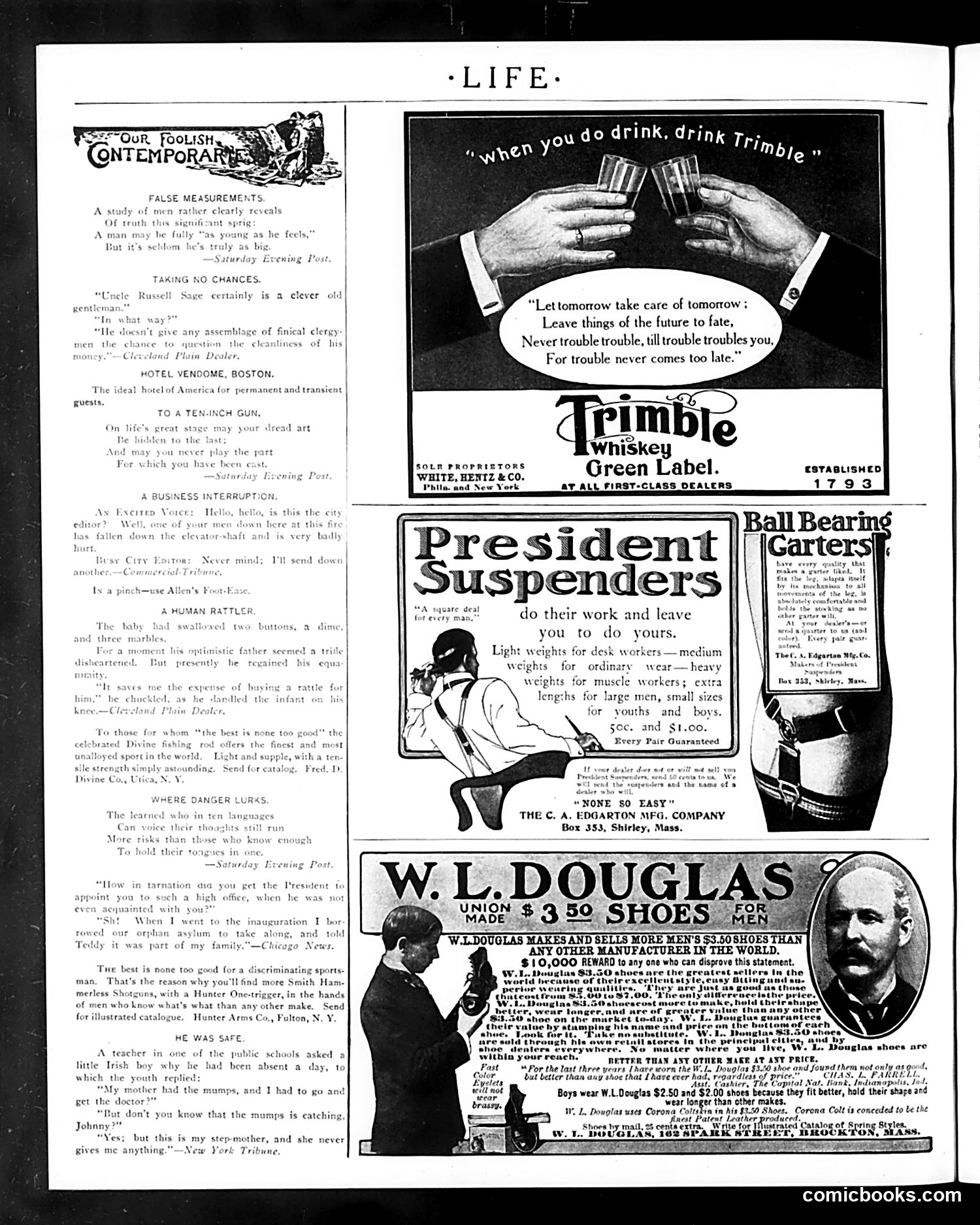
This page consists primarily of **period advertisements** interspersed with brief humorous anecdotes in Life's "Our Foolish Contemporary" column. The ads feature: - **Trimble Whiskey** (established 1793): Uses the phrase "When you do drink, drink Trimble"—promoting moderate consumption with a cautionary poem about procrastination and trouble. - **President Suspenders**: Markets work suspenders in various weights for different occupations, emphasizing functionality. - **W.L. Douglas Shoes** ($3.50): A dominant advertisement claiming Douglas manufactures more men's shoes than any competitor, offering a $10,000 reward to disprove the claim. Features testimonials and competitive pricing for boys' and men's footwear. The humor sections mock contemporary pretension and human nature—discussing false measurements, taking no chances, and a stepmother who gives nothing. **No political cartoons or caricatures appear on this page.** It's primarily a commercial advertising page typical of early 20th-century magazines that blended content with sponsored material.
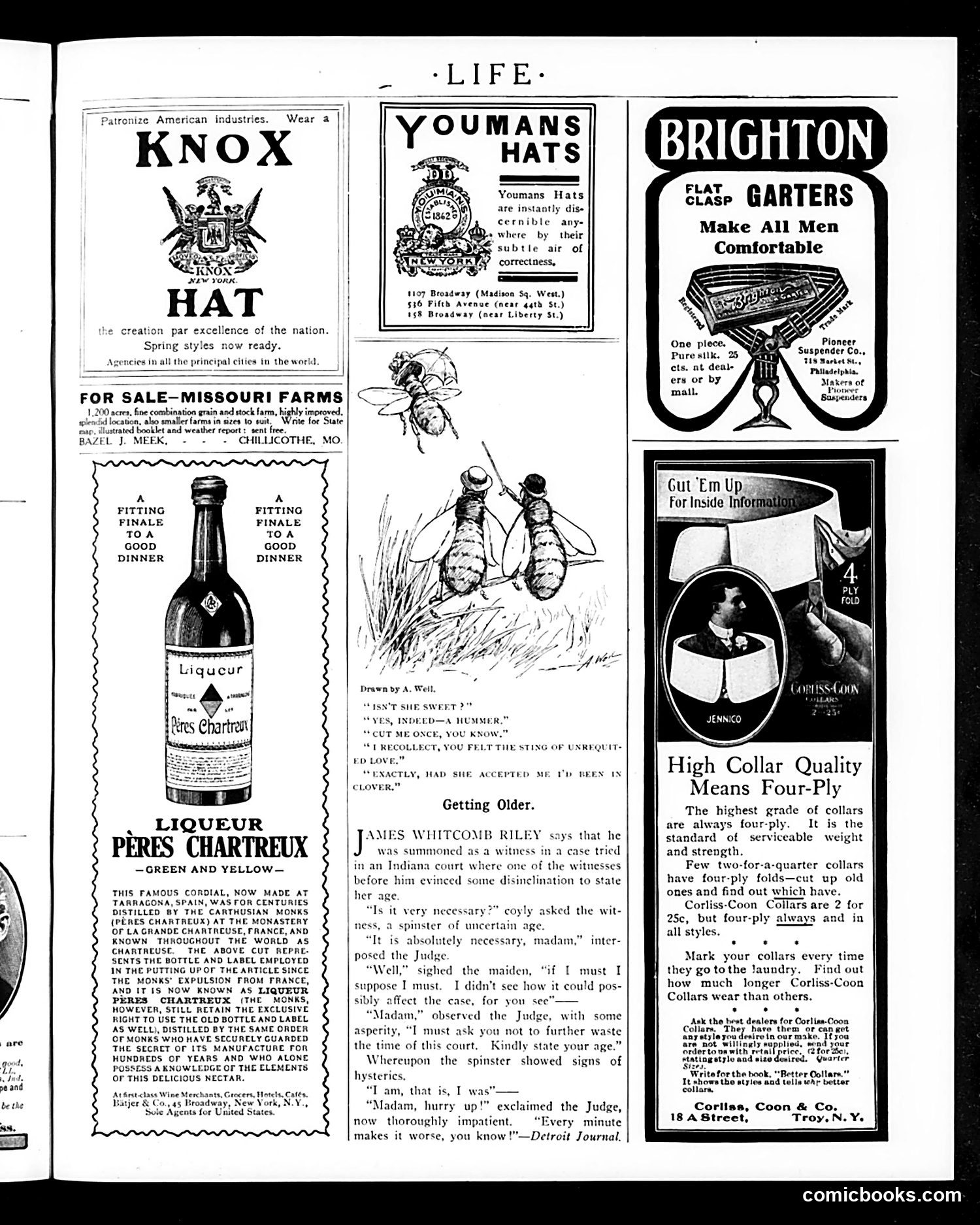
This page is primarily **advertisements** with one humorous anecdote. The main satirical content is a cartoon dialogue about unrequited love, drawn by A. Weil, titled "Isn't She Sweet?" It depicts two men discussing a woman, with one claiming he'd "been in clover" if she'd accepted his proposal—a joke about how rejection stings precisely because the relationship was never consummated. The accompanying text, attributed to writer James Whitcomb Riley, is a courthouse anecdote mocking female vanity: a spinster witness refuses to state her age in court, creating a comedic standoff with an increasingly impatient judge. The joke satirizes women's sensitivity about aging. The remaining content consists entirely of product advertisements: Knox hats, Youmans hats, Père Chartreuse liqueur, Brighton garters, and Corliss-Coon collars—typical early 20th-century Life magazine advertisements targeting affluent male readers.
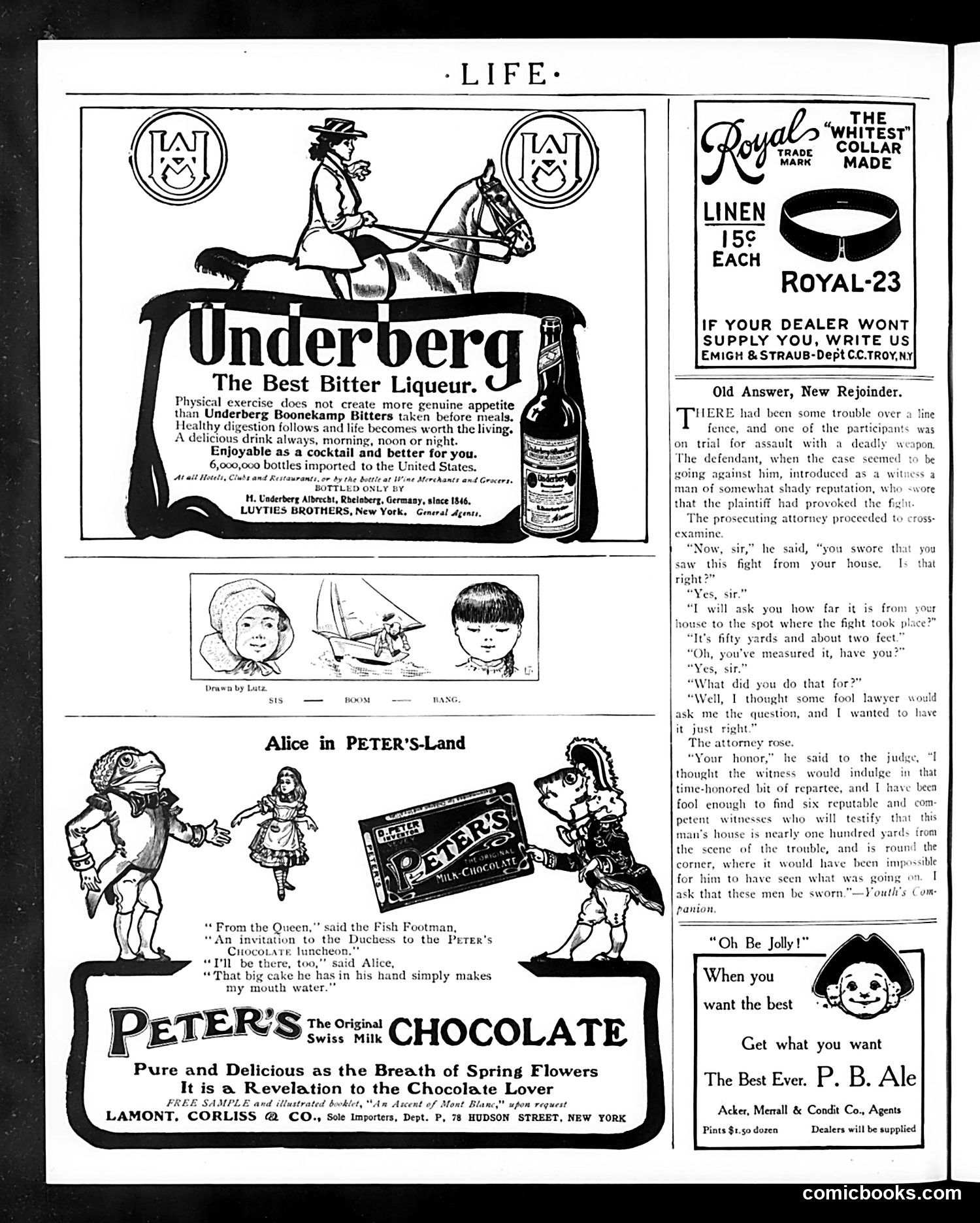
This page is primarily **advertising with one humorous anecdote**. The main content includes: **Advertisements:** - Underberg Bitters (digestive liqueur) - Peter's Swiss Milk Chocolate (with whimsical Alice in Wonderland-themed illustrations) - Royal linen collars (15¢) - P.B. Ale beer **The Humor ("Old Answer, New Rejoinder"):** A courtroom anecdote about a defendant's shady witness who claims he measured the distance from his house to a fight scene (fifty yards) to anticipate cross-examination. The joke: the prosecution has already found six credible witnesses proving the house is actually nearly one hundred yards away *around a corner*—making the witness's "prepared" answer hilariously useless. It satirizes **legal gamesmanship and overly clever witnesses** who outsmart themselves. The page reflects early 20th-century Life magazine's mix of light social satire, domestic humor, and commercial advertising aimed at middle-class readers.
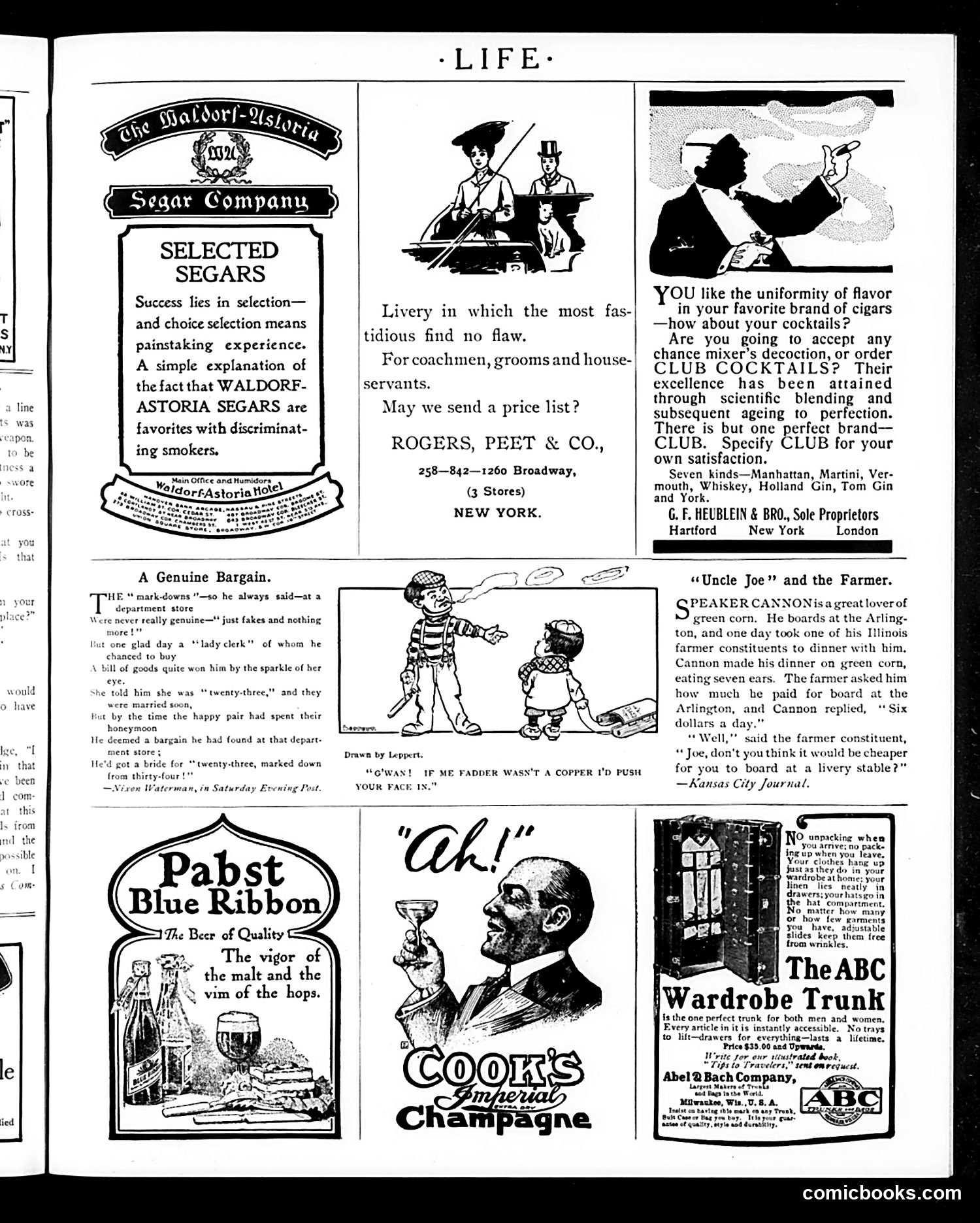
This is primarily an **advertising page** from Life magazine, featuring various product promotions typical of the early 20th century. The page contains one genuine **cartoon with social commentary**: "A Genuine Bargain" and "'Uncle Joe' and the Farmer." The first uses a common trope—a man finding a "bargain" bride marked down from "thirty" to "twenty-three" at a department store—to satirize both the commercialization of romance and women's reduced status to merchandise. The second mocks Speaker **Cannon** (Joseph G. Cannon, a prominent politician), depicting him as absurdly cheap: he eats seven ears of corn at an expensive hotel but won't pay fair board rates. The Illinois farmer's suggestion he use a livery stable instead suggests Cannon values his horse's comfort over honest dealings. The remaining content is **advertising**—cigars, cocktails, beer, trunks, and clothing—marketed to affluent, discriminating consumers. These ads reflect period class assumptions about refined taste and luxury consumption.
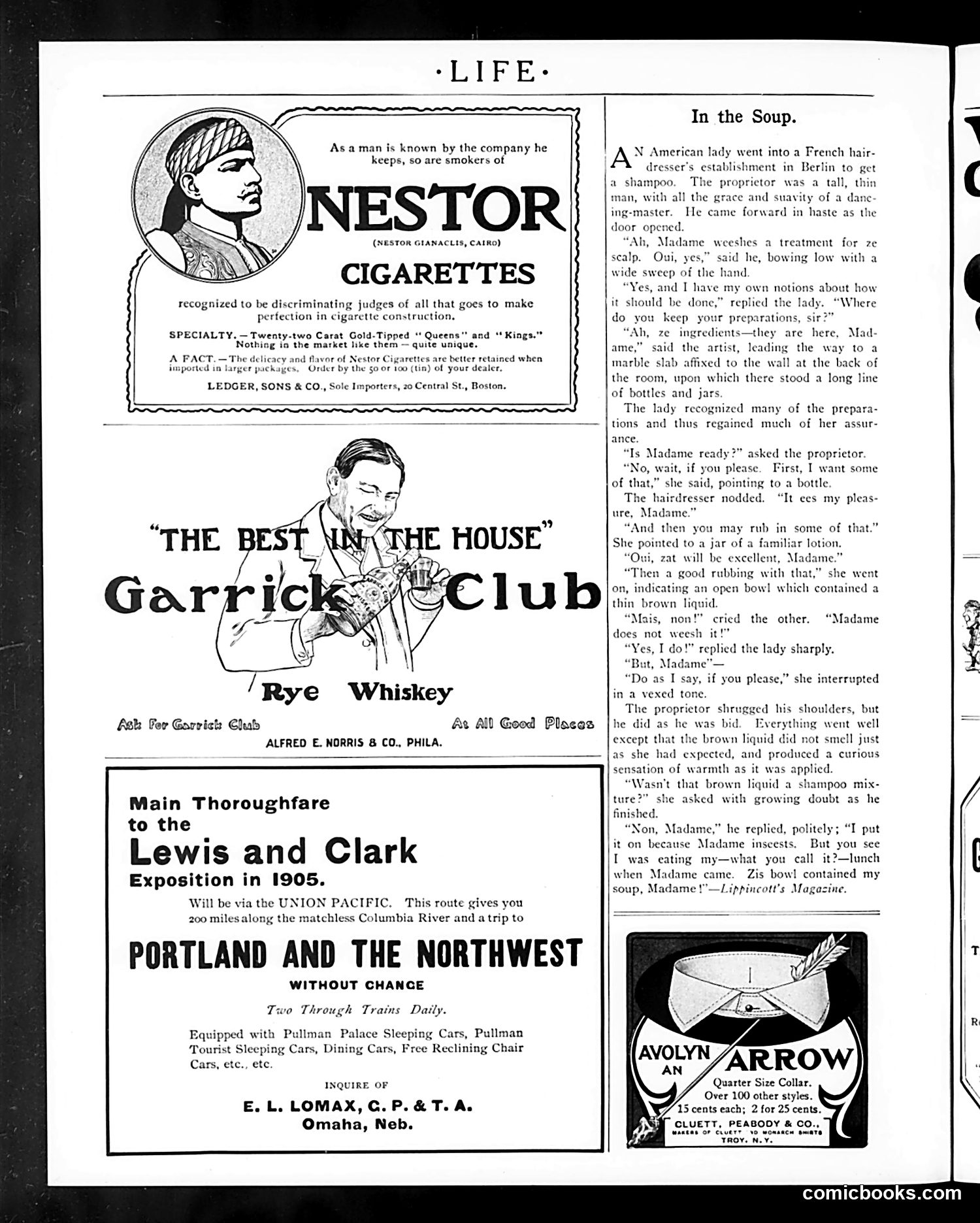
This page is primarily advertisements with a humor story. The main content is a satirical anecdote mocking both a pretentious French hairdresser and an imperious American lady. **The joke:** An American woman enters a Berlin hair salon and demands the proprietor use specific bottles for her shampoo treatment without listening to his warnings. The punchline reveals the "brown liquid" she insisted he apply was actually his soup—he'd been eating lunch when she arrived. The story satirizes: (1) American tourist arrogance and refusal to take local expertise seriously, and (2) the fussy, demanding behavior of wealthy female clients who ignore professional advice. The surrounding ads (Nestor cigarettes, Garrick Club whiskey, Lewis and Clark Exposition travel) reflect typical early-1900s luxury brand marketing to Life's affluent readership.
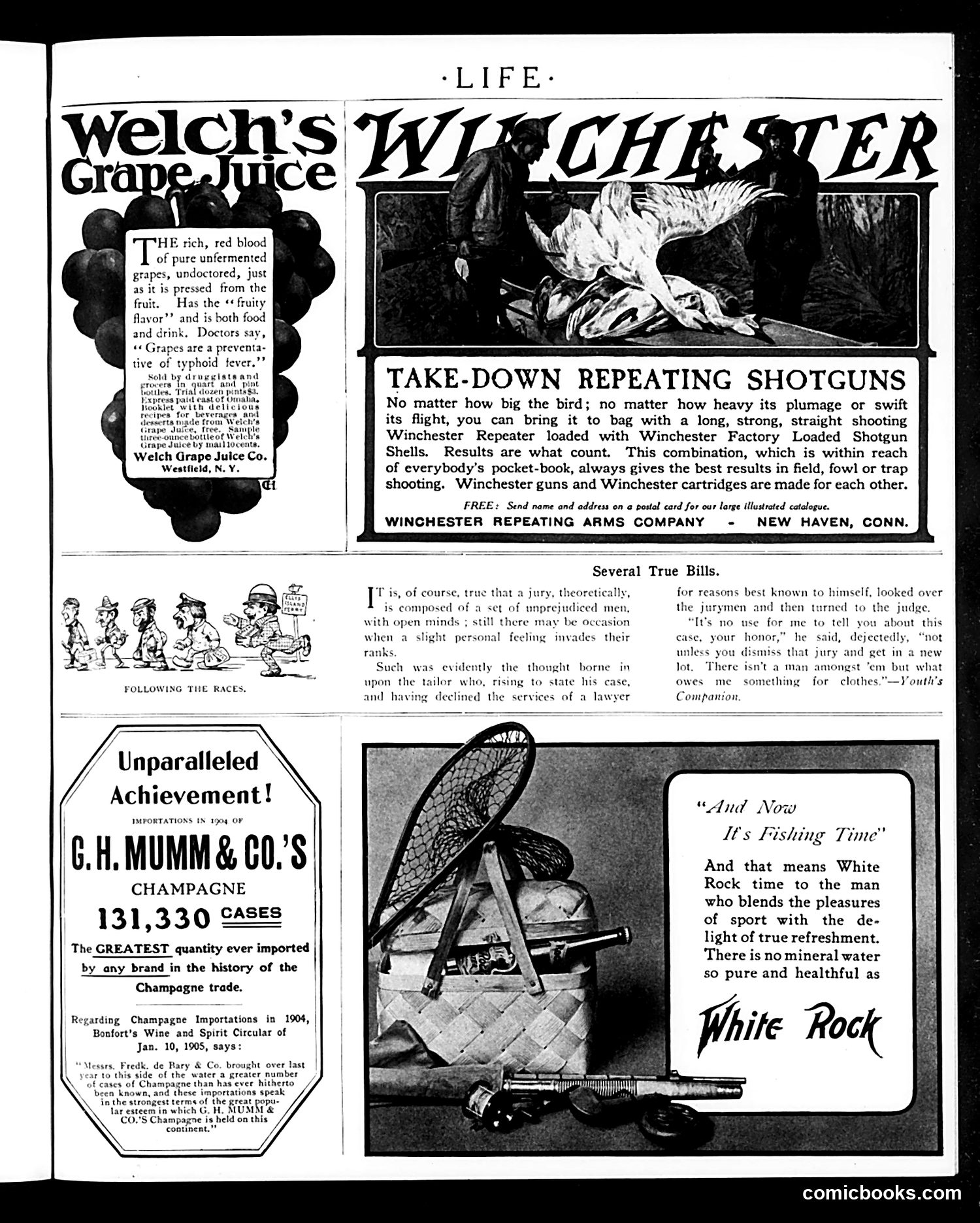
This page from *Life* magazine contains primarily **advertisements** rather than political cartoons, reflecting early 1900s consumer culture. The ads reveal period concerns: Welch's Grape Juice marketed as a health tonic and typhoid preventative (disease anxiety was high). Winchester shotguns advertised for hunting, reflecting the sporting lifestyle of affluent readers. G.H. Mumm Champagne boasted record importation numbers—a status symbol during the Gilded Age. The only satirical content is a brief cartoon titled "Several True Bills," mocking jury selection. A tailor declines legal representation, asking the judge to dismiss a jury where every member owes him money for clothes—a joke about small-town interconnectedness and conflicts of interest in justice systems. The White Rock mineral water ad emphasizes purity and healthfulness, typical health-conscious marketing of the era when water safety was genuinely questionable.
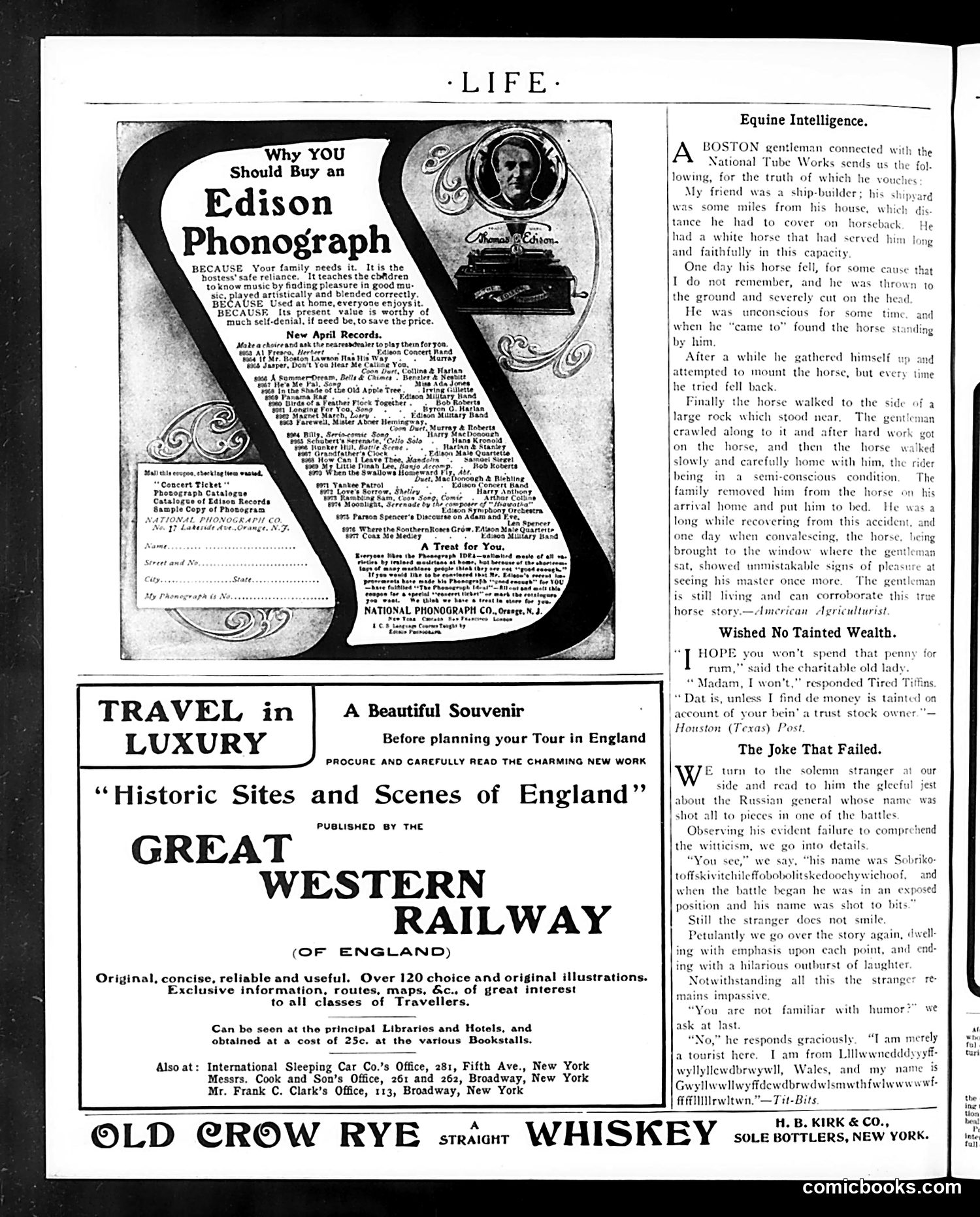
This page is primarily **advertising**, with three major ads for Edison Phonographs, Great Western Railway travel guides, and Old Crow Whiskey, plus several short humor pieces. The Edison Phonograph ad (top) uses common early 1900s marketing rhetoric: phonographs provide family entertainment, cultural education, and justify financial sacrifice. It lists popular recording artists and songs of the era. The right column contains three brief humorous anecdotes: "Equine Intelligence" describes a loyal horse that assists its injured master home; "Wished No Tainted Wealth" is a dialect joke about refusing "tainted" money from trusts; "The Joke That Failed" appears incomplete but ridicules someone's failed attempt to tell a joke about a Russian general. These pieces represent *Life*'s typical satirical content—light social commentary and gentle mockery rather than sharp political critique. The overall page reflects early 20th-century American leisure culture and commercial consumption.
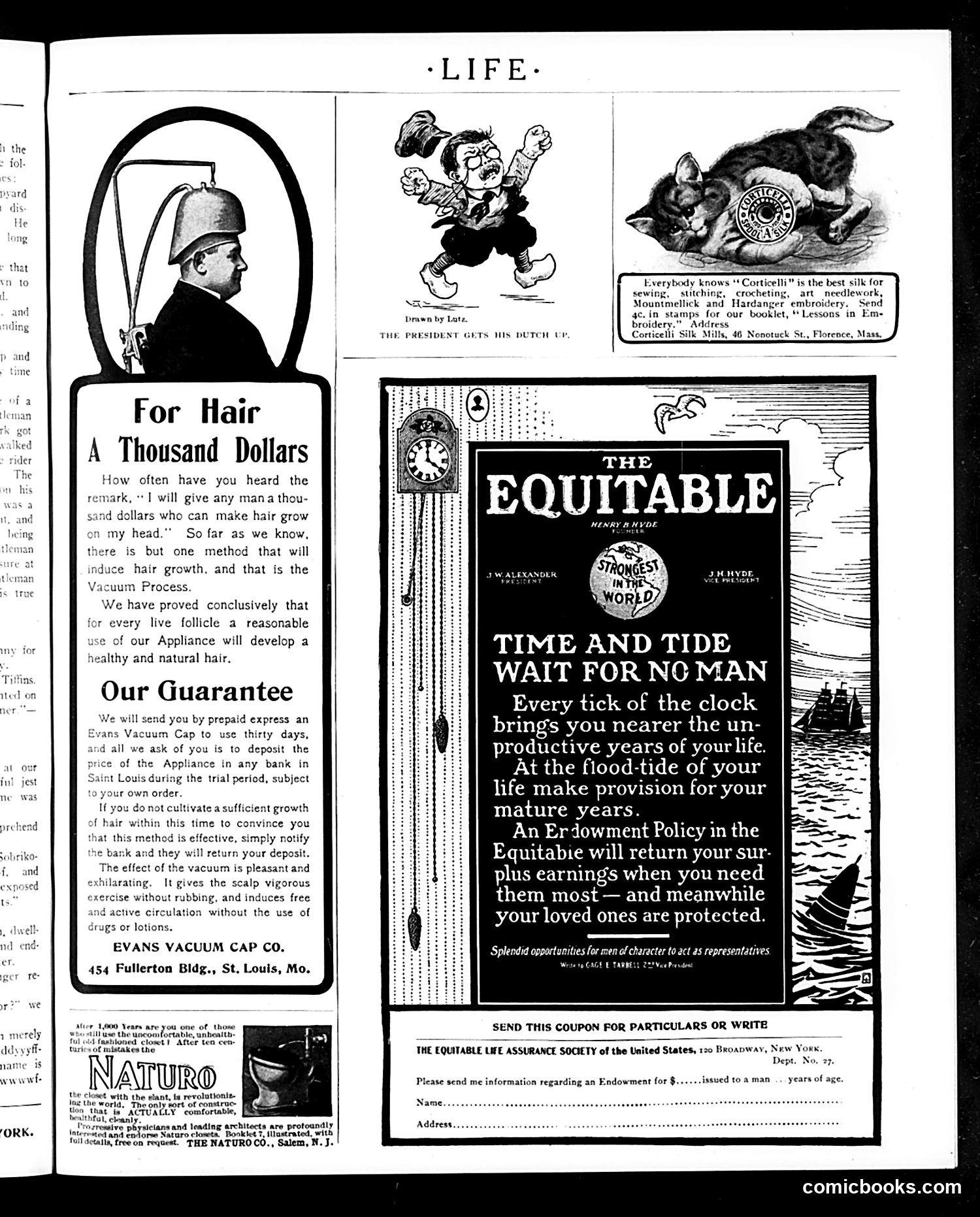
This page is primarily **advertising**, not political satire. The main content includes: 1. **"For Hair — A Thousand Dollars"** (Evans Vacuum Cap Co.): A mail-order hair-growth device using a "Vacuum Process." The ad promises to stimulate follicles and includes a money-back guarantee—typical of early 20th-century patent medicine marketing. 2. **Small cartoon labeled "The President Gets His Dutch Up"**: Drawn by Latz, this shows a caricatured figure (likely Roosevelt, given the "Dutch" reference—a nickname) jumping excitedly. The political point is unclear without more context, but appears to mock presidential behavior. 3. **"The Equitable" insurance ad**: A large endorsement ad for life insurance, using dramatic maritime imagery and messaging about mortality and providing for "mature years." 4. **Minor ads**: Including "Corticelli" silk thread and "Naturo" closets. The page reflects early 1900s consumer culture: hair-loss anxiety, life insurance marketing, and genteel home goods—with minimal actual satire or political commentary.
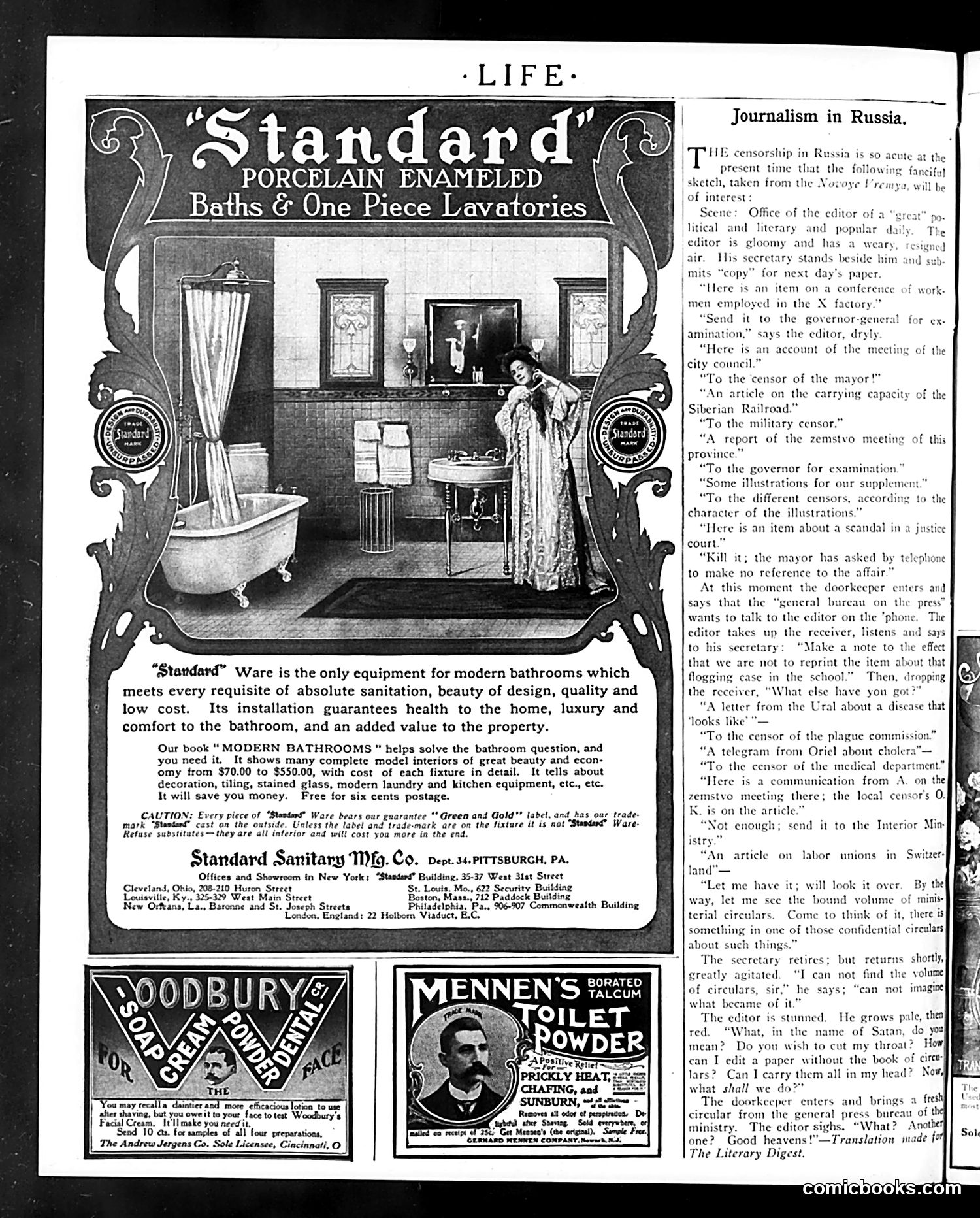
This satirical article depicts Russian newspaper censorship under Tsarist rule. An editor receives various story submissions—about factory workers, city council, the railroad, a scandal, disease, and labor unions—and systematically routes each to different government censors: the governor-general, military censor, plague commission, medical department, and Interior Ministry. The joke is that virtually *every* news item requires approval from some official body before publication. The editor's only independent decision is to kill a school flogging story because the mayor requested it. Even foreign labor news gets reviewed. The satire exposes how pervasive and absurd Russian censorship had become by routing innocuous items through byzantine bureaucratic approval chains, leaving editors with almost no editorial autonomy. This reflects the repressive press conditions in early 20th-century Russia under Tsarist control.
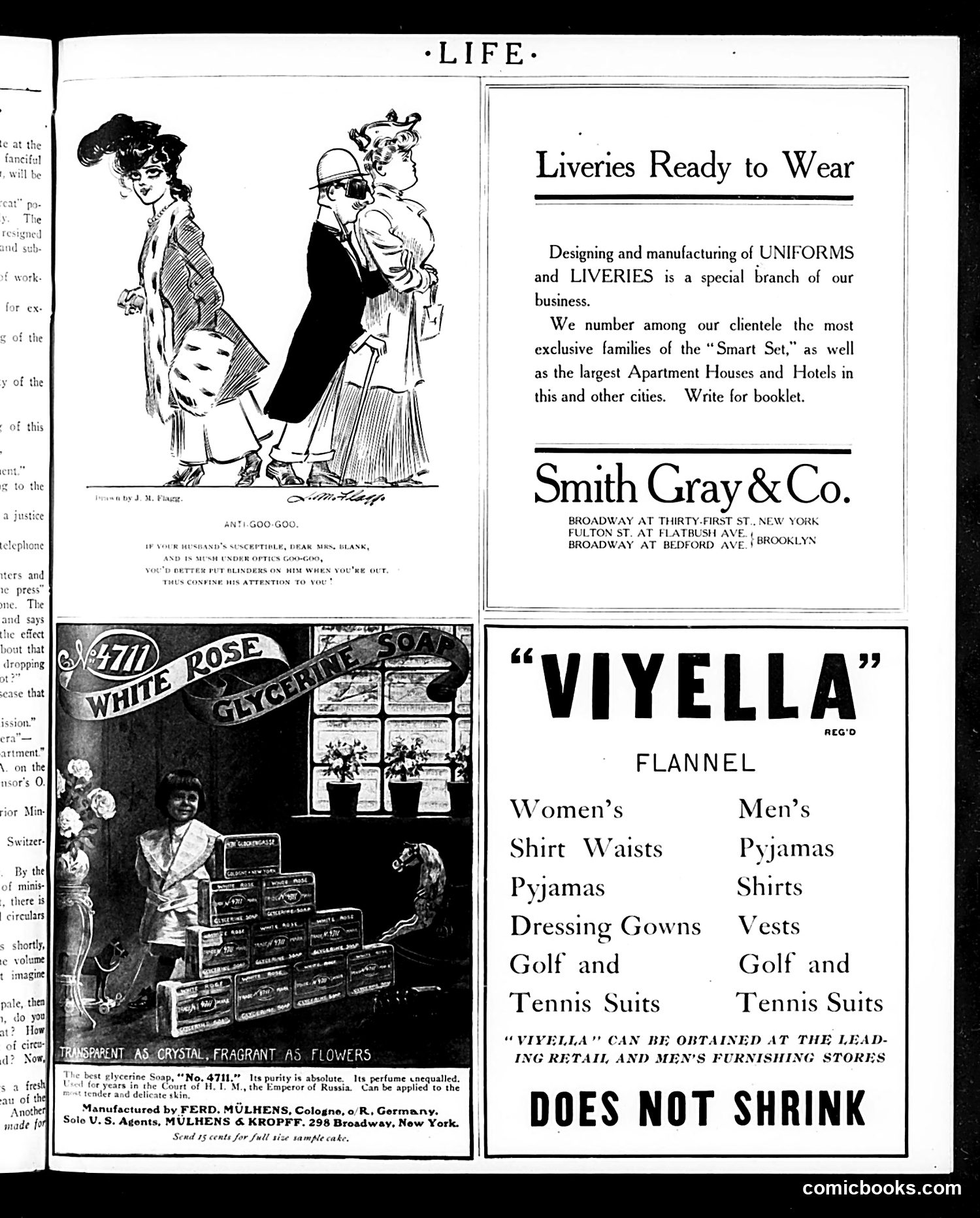
This page is primarily **advertising**, not satirical content. It contains three distinct ads: 1. **Smith Gray & Co.** (top right): Promotes ready-made uniforms and liveries for wealthy households, apartment buildings, and hotels—targeting the upper class who could afford servants. 2. **"Viyella" Flannel** (bottom right): Advertises British flannel clothing (shirt waists, pajamas, dressing gowns, golf/tennis suits) for both men and women, emphasizing the fabric "does not shrink." 3. **White Rose Glycerine Soap #4711** (bottom left): Features a woman displaying the product, claiming its purity and perfume were favored by Russian imperial courts. Appeals to luxury consumers. The single cartoon (top left) depicts a couple—the woman in fashionable dress, the man in formal attire holding a baby—with the caption joking about husbands noticing their wives' new outfits when properly dressed. The page reflects early 20th-century consumer culture targeting affluent readers, emphasizing class status through servants, fine fabrics, and imported luxury goods.
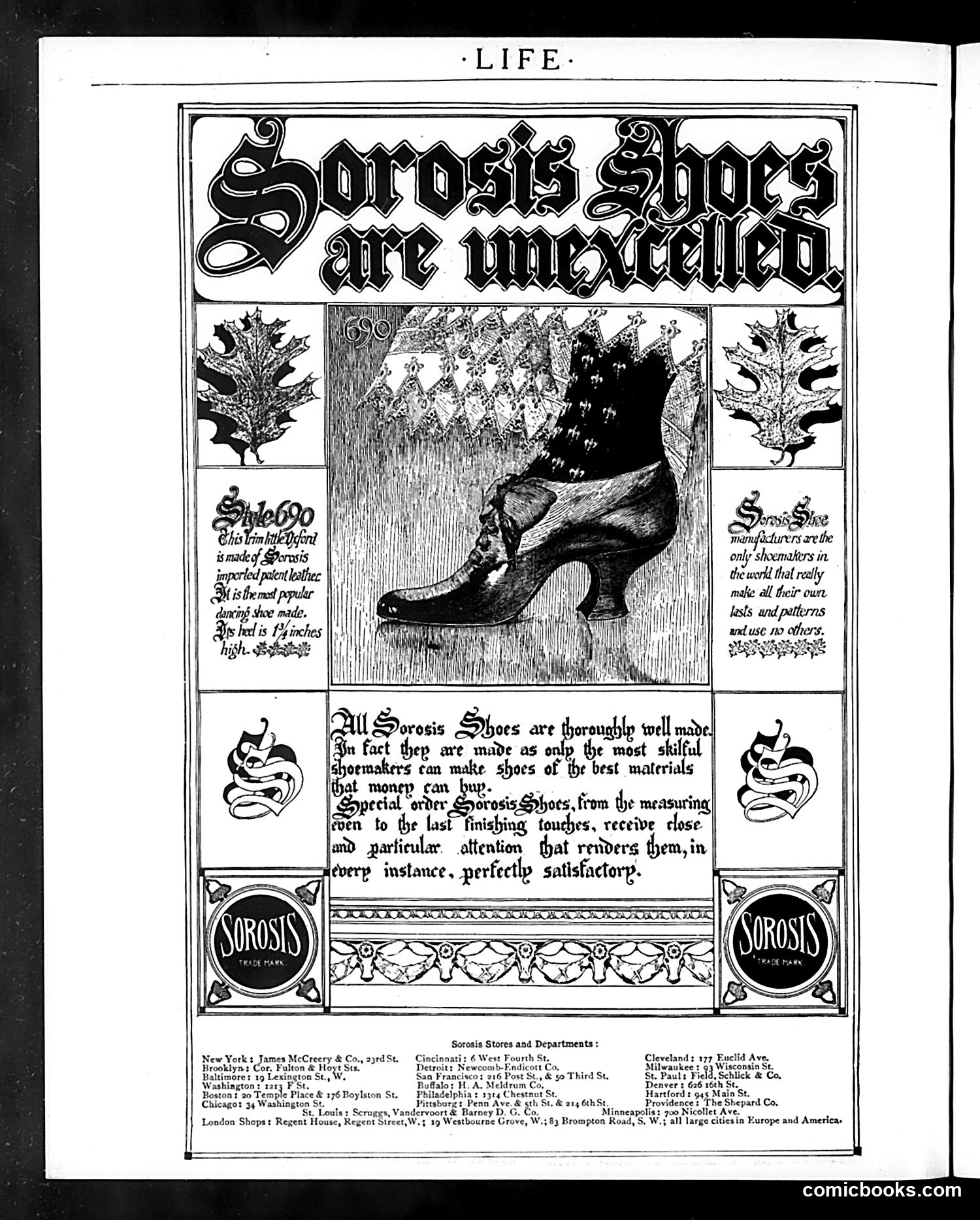
This is a **shoe advertisement**, not political satire. The page promotes Sorosis brand shoes for women, emphasizing their quality and craftsmanship. The central image shows an elegant women's shoe with a curved heel. The advertisement claims Sorosis shoes are "thoroughly well made" and uniquely manufactured—asserting that Sorosis is "the only shoemakers in the world that really make all their own lasts and patterns and use no others." The decorative elements (leaf designs, serpent motifs, and ornamental borders) are typical of early 20th-century advertising aesthetics. The text highlights that each custom order receives "close and particular attention" from manufacturing to finishing. The bottom lists numerous Sorosis retail locations across major American and European cities, indicating this was a widespread, upscale brand targeting affluent female consumers.
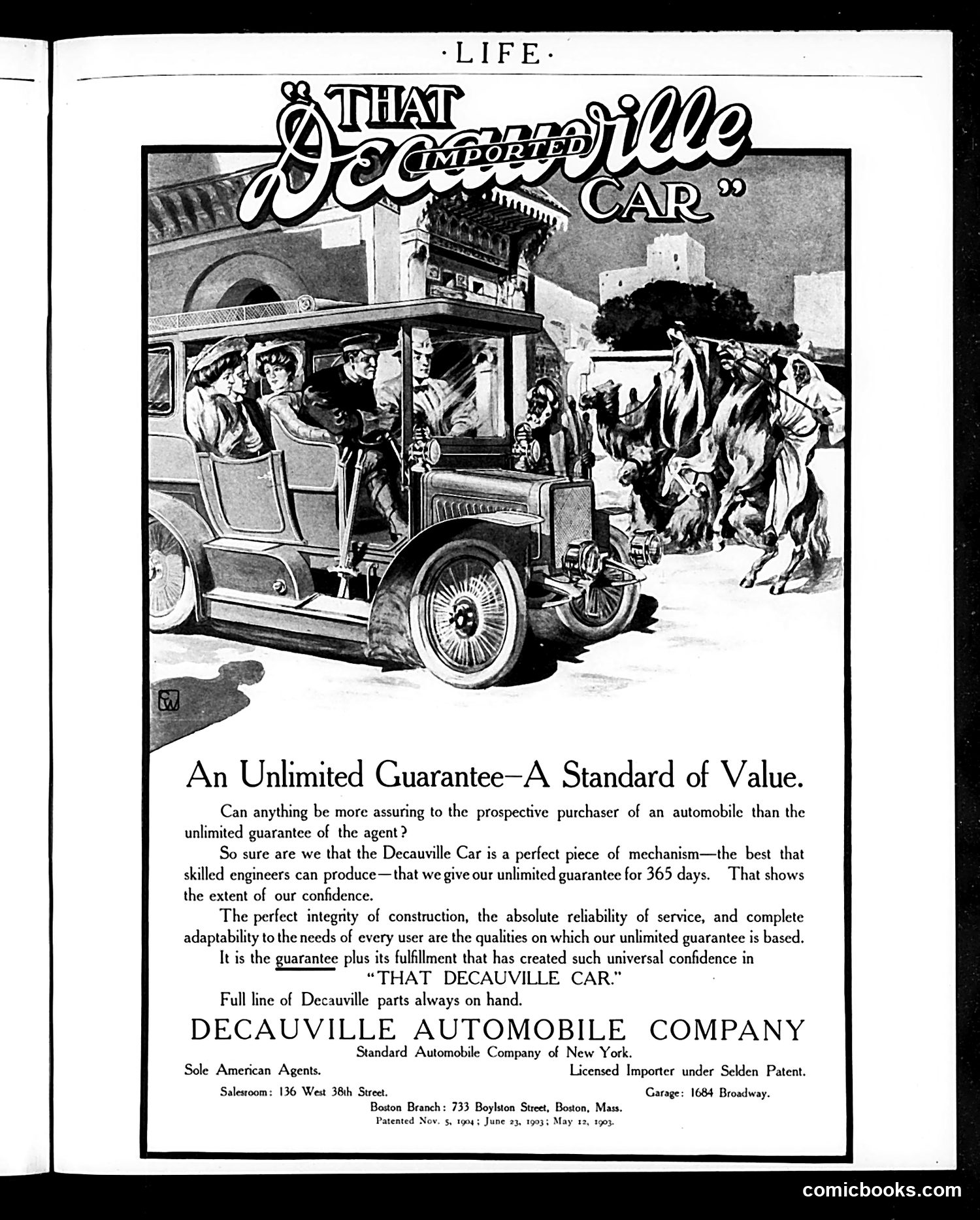
This is **not satire or a political cartoon**—it's a straightforward automobile advertisement. The page is from *Life* magazine's advertising section, promoting the Decauville Car, a French-imported automobile sold in America by the Decauville Automobile Company. The illustration depicts a well-dressed couple in an early 1900s motorcar driving through what appears to be a European street scene, with pedestrians and architecture visible. The ad's pitch emphasizes the manufacturer's confidence through an "unlimited guarantee for 365 days," positioning reliability as a major selling point for prospective buyers—a significant concern when automobiles were relatively new and unproven technology. The references to the Selden Patent and New York locations reflect actual business details of early auto distribution. This is period advertising aimed at wealthy consumers who could afford imported vehicles.
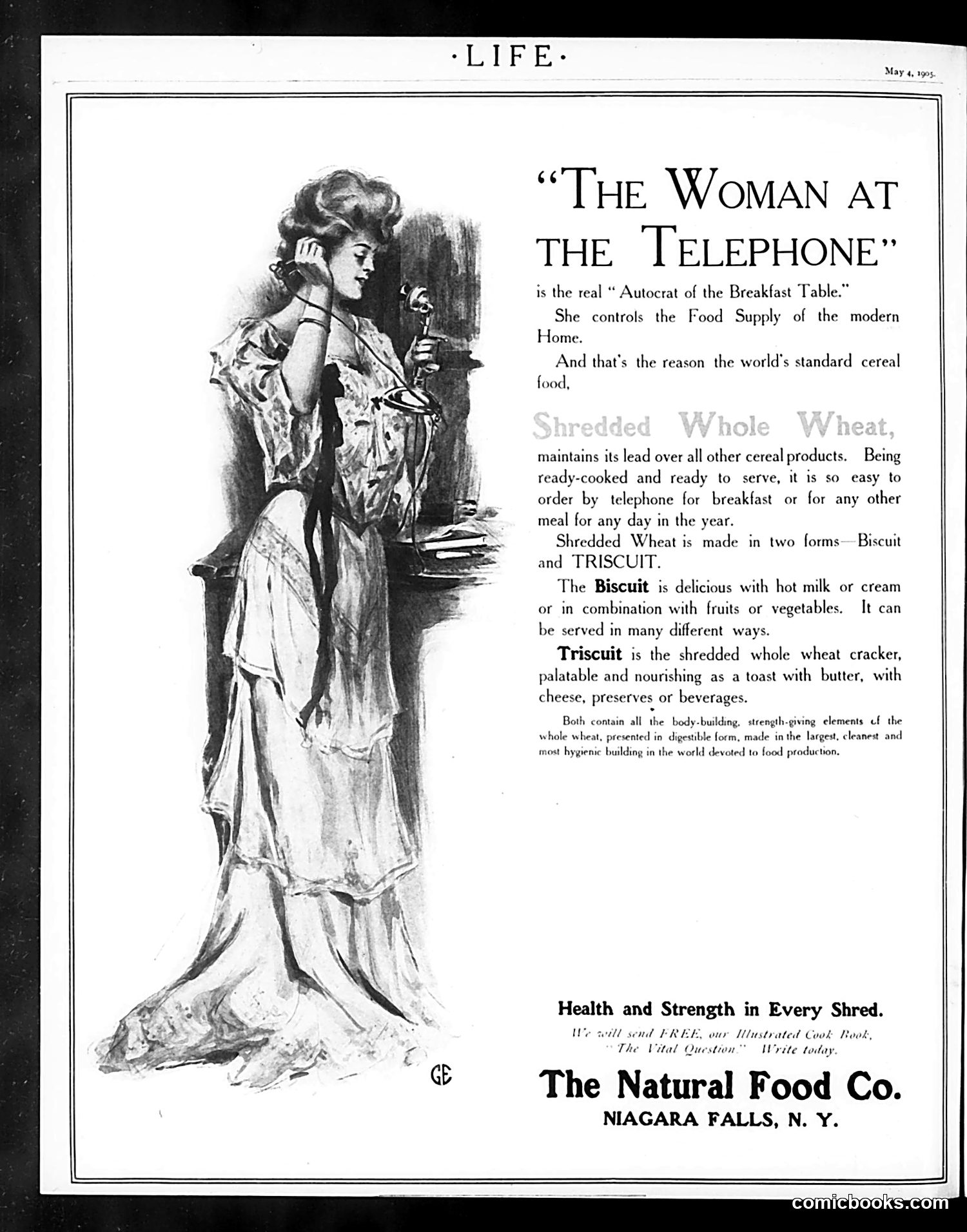
This is primarily a **Shredded Wheat cereal advertisement** from 1905, not satire or political commentary. The illustration depicts an elegant woman at a telephone, dressed in fashionable early-1900s attire. The ad's central conceit is that the "woman at the telephone" controls her household's food supply—she's the decision-maker who orders groceries by phone. The joke/appeal relies on a era-specific observation: telephone technology was novel enough that ordering food by phone represented modern convenience. The ad positions women as domestic authorities ("Autocrat of the Breakfast Table") whose purchasing power influences which cereals dominate the market. The ad emphasizes Shredded Wheat's ready-to-serve convenience—appealing to busy women managing households—and promotes two product forms: Biscuit and Triscuit. By modern standards, this reads as: a gendered marketing pitch that acknowledges women's household purchasing power while reinforcing their primary role as domestic managers. The "woman at the telephone" is simultaneously empowered (she controls food supply) and confined (to domestic consumption decisions).