
Life, 1905-05-04 · page 21 of 48
Life — May 4, 1905 — page 21: what you’re looking at
What you’re looking at
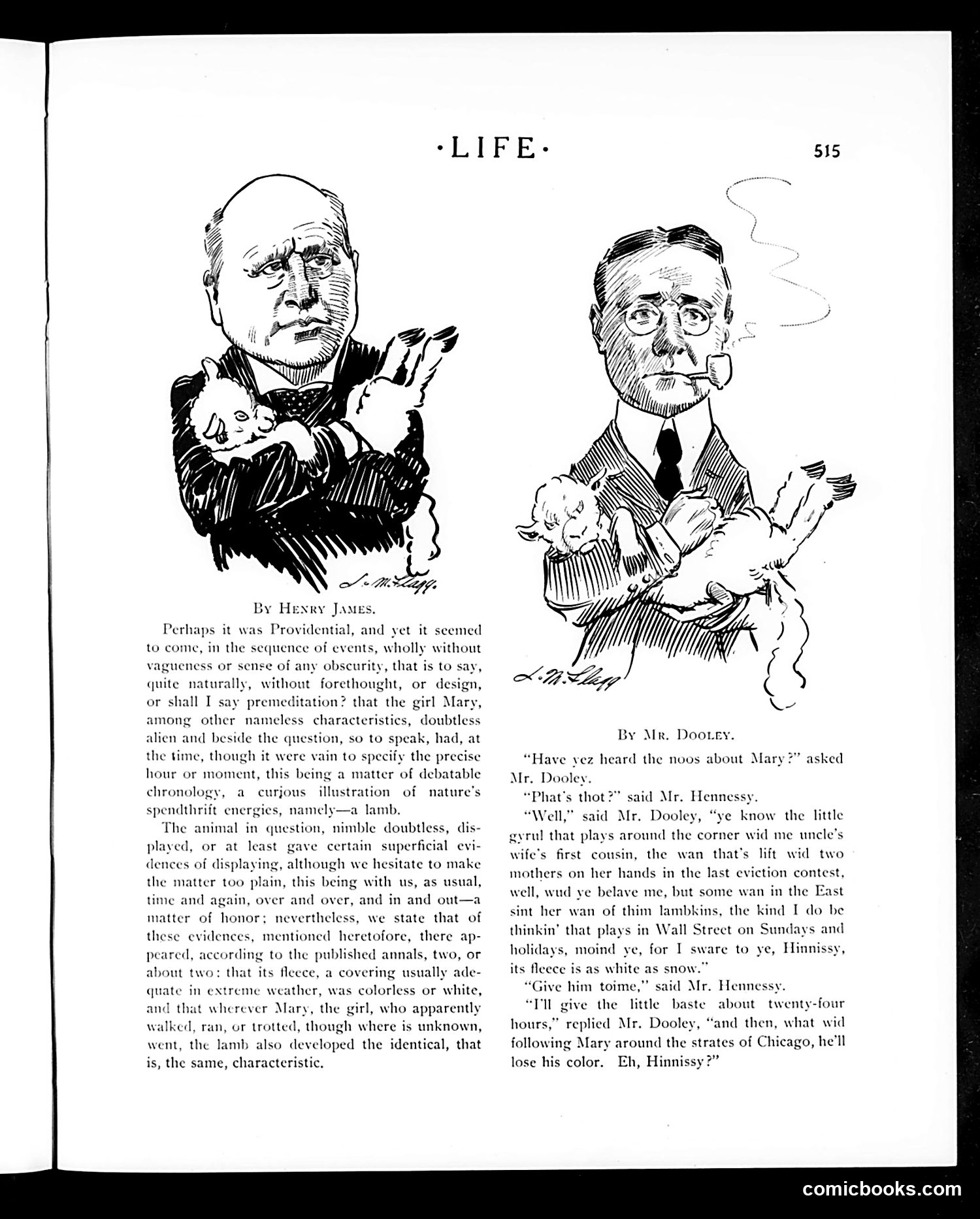
This page presents two satirical treatments of the nursery rhyme "Mary Had a Little Lamb": **Left cartoon (by Henry James):** A parody of James's famously convoluted prose style, deliberately obscuring the simple Mary-and-lamb story under layers of verbose, philosophical language. The joke mocks James's tendency toward elaborate sentences and abstract rumination over straightforward narrative. **Right cartoon (by Mr. Dooley):** Features two Irish-American characters (identifiable by their dialect spelling) discussing a poor girl receiving a lamb as charity. The satire suggests the lamb will "lose his color" (turn dirty/gray) from following Mary through Chicago's filthy streets—a commentary on urban poverty, child welfare, and the grim conditions faced by working-class immigrants in American cities. Together, these pieces use the innocent nursery rhyme to satirize both literary pretension and social indifference to urban poverty.
📄 Transcribed text from this page (OCR, searchable)
Machine-transcribed from the original scan — historical spelling and the odd misread are preserved.
By H Perhaps it was Providential, and yet it seemed to come, in the sequence of events, wholly without RY JAMES. vagueness or sense of any obscurity, that is to say, quite naturally, without forethought, or design, or shall I say premeditation? that the girl Mary, among other nameless characteristics, doubtless alien and beside the question, so to speak, had, at the time, though it were vain to specify the precise hour or moment, this being a matter of debatable chronology, a curjous illustration of nature's spendthrift energies, namely—a lamb. The animal in question, nimble doubtless, dis- played, or at least gave certain superficial evi- dences of displaying, although we hesitate to make the matter too plain, this being with us, as usual, time and again, over and over, and in and out—a matter of honor; nevertheless, we state that of these evidences, mentioned heretofore, there ap- peared, according to the published annals, two, or about two: that its fleece, a covering usually ade- quate in extreme weather, was colorless or white, and that wherever Mary, the girl, who apparently walked, ran, or trotted, though where is unknown, went, the lamb also developed the identical, that is, the same, characteristic. By Mr. Dootry. “Have yez heard the noos about Mary?” asked Mr. Dooley. “Phat’s thot?” said Mr. Hennessy “Well,” said Mr, Dooley, “ye know the little gyrul that plays around the corner wid me uncle’s wife's first cousin, the wan that’s lift wid two mothers on her hands in the last eviction contest, well, wud ye belave me, but some wan in the East sint her wan of thim lambkins, the kind I do be thinkin’ that plays in Wall Strect on Sundays and holidays, moind ye, for I s its fleece is as white as snow. ¢ him toime,” said Mr. Hennessy. twenty-four are to ye, Hinnissy, ve the little baste about replied Mr. Dooley, “and then, what wid following Mary around the strates of Chicago, he'll lose his color. Eh, Hinnissy?” comicbooks.com