
Life, 1905-05-04 · page 13 of 48
Life — May 4, 1905 — page 13: what you’re looking at
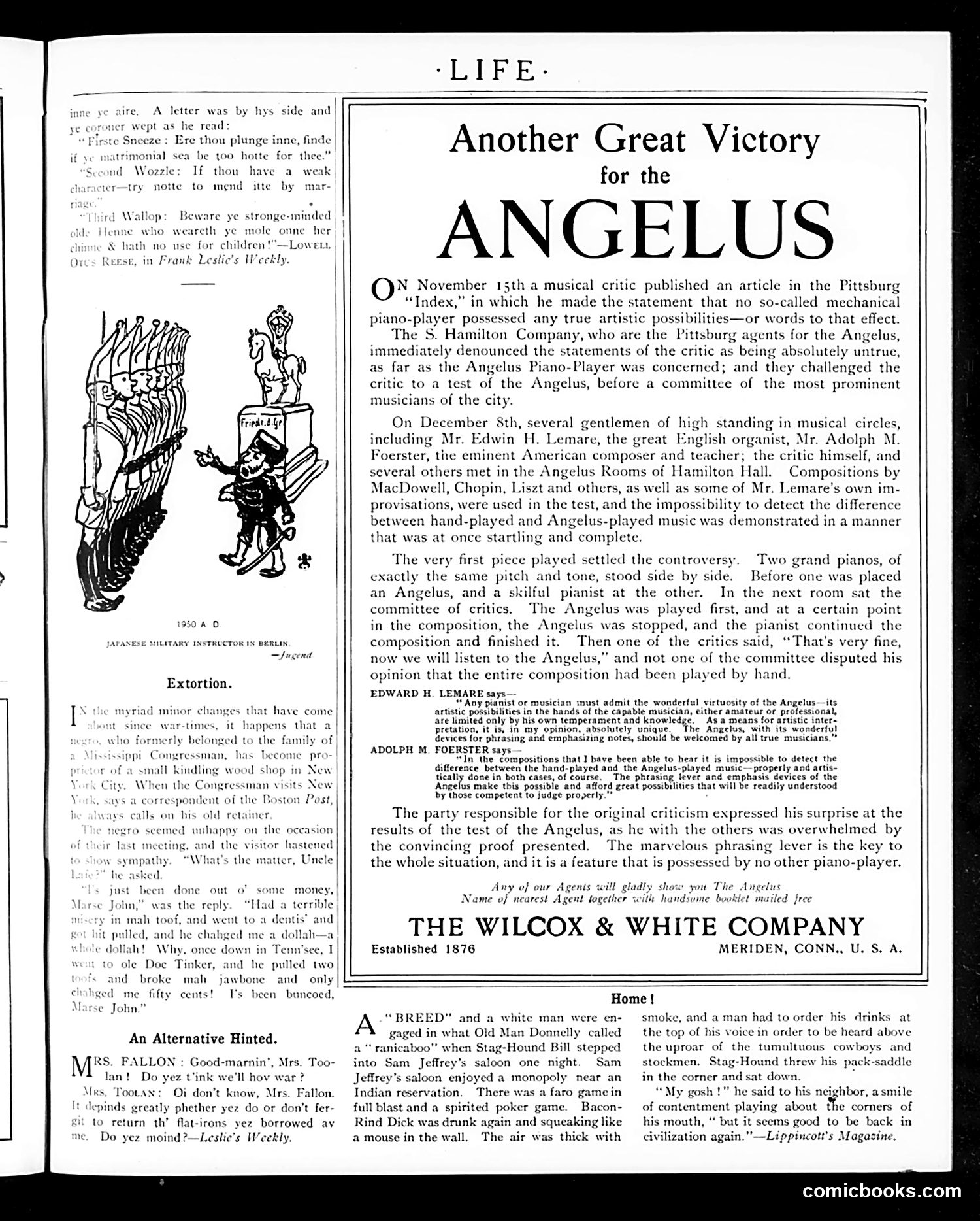
What you’re looking at
This page contains two distinct items: **Left side ("Exortion"):** A brief humorous anecdote about a Mississippi Congressman visiting Boston. His old African American retainer seems unhappy about the trip. When asked why, the servant replies he once lost money in Boston—a pickpocket stole his dollars. The joke plays on period stereotypes about Black servants and their speech patterns, presenting the anecdote as lighthearted folk humor. **Right side ("Another Great Victory for the Angelus"):** This is primarily **advertising** for the Angelus piano-player—a mechanical player-piano device. It describes a December 8th test where prominent musicians, including organist Edwin Lemare and composer Adolph Foerster, allegedly couldn't distinguish between hand-played piano and Angelus-played music. The "victory" is the machine fooling the critics. Testimonials from the musicians endorse the device's "phrasing lever" capabilities. This advertorial format was common in Life magazine.
📄 Transcribed text from this page (OCR, searchable)
Machine-transcribed from the original scan — historical spelling and the odd misread are preserved.
A | ire, A letter was by hys side and r wept as he read: Sree Ere thon pungent Another Great Victory utr al sca be too hotte for thee Worle: If thou have aw for the er—try notte to mend itte by mar- [hird Wallop: Beware ye stronge-minded lenne who weareth ye mole onne her «© & hath no use for children! WELL, Ores Reese, in Frank Lestic's Weekly. N November 15th a musical critic published an article in the Pittsburg “Index,” in which he made the statement that no so-called mechanical piano-player possessed any true artistic possibilities—or words to that effect. The S. Hamilton Company, who are the Pittsburg agents for the Angelus, immediately denounced the statements of the critic as being absolutely untrue, as far as the Angelus Piano-Player was concerned; and they challenged the critic to a test of the Angelus, before a committee of the most prominent musicians of the city. On December 8th, several gentlemen of high standing in musical circles, including Mr. Edwin H. Lemare, the great inglish organist, Mr. Adolph M. Foerster, the eminent American composer and teacher; the entie himself, and several others met in the Angelus Rooms of Hamilton Hall. Compositions by MacDowell, Chopin, Liszt and others, as well as some of Mr. lLemare’s own im- provisations, were used in the test, and the i imposs bility to detect the difference between hand-played and Angelus-played music was demonstrated in a manner that was at once startling and complete. The very first piece played settled the controversy. Two grand pianos, of exactly the same pitch and tone, stood side by side. Before one was placed an Angelus, and a skilful pianist at the other. In the next room sat the committee of critics. The Angelus was played first, and at a certain point 1950 A in the composition, the Angelus was stopped, and the pianist continued the JAPANESE SHLITARY INSTRUCTOR IN BERLIN composition and finished it. Then one of the s That's very fine, now we will listen to the Angelus,” and not one of the committe disputed his opinion that the entire composition had been played by hand. EDWARD H. LEMARE says— “ Any pianist or musician imust admit the wonderful virtuosity of the Angelus—its at have come artistic possibilities in the hands of the capable musician, either amateur or professional, 1 | are limited only by his own temperament and knowledge. As a means for artistic inter- happens that a pretation, it i in my opinion, absolutely unique. The Angelus, with its wonderful ged to the family of devices for phrasing and emphasizing notes, should be welcomed by all true musicians,” 7 ADOLPH M. FOERSTER says Congress pro- In the compositions that I have been able to hear it is impossible to detect the mall kindling woo New difference between the hand-played and the Angelus-played music— properly and artis tically done in both cases, of course. The phrasing lever and emphasis devices of the Wh Congressman visits New Angelus make this possible and afford great possibilities that will be readily understood Boston: Pest by those competent to judge properly.” Extortion. sippi us a correspondent of the uys calls rsa old retainer The party responsible for the original criticism expressed his surprise at the negro seemed unhappy on the occasion results of the test of the Angelus, as he with the others was overwhelmed by 5 the convincing proof presented. The marvelous phrasing lever is the key to the whole situation, and it is a feature that is possessed by no other piano-player. en done out 0’ some money, | Any of our Agents will glad! 1 ame 9, a. 4 ther 3 was tlie re « a terrible ne of nearest Agent together ty in mah toof, and went to a dentis’ and dolla!) Why, once down in Tenn'see, I Established 1876 MERIDEN, CONN., U. S. A. to ole Doc Tinker, and he pulled two and broke mah jawbone and only I me fifty cents! T's been buncoed, John.” Home! A “BREED” and a white man were en- smoke, anc in had to order his drinks An Alternative Hinted. ged in what Old Man Donnelly called the top of his voice in order to be heard above a‘ ranicaboo” when Stag-Hound Bill stepped — the uproar of the tumultuous cowboys and RS. FALLON : Good-marnin’, Mrs. Too- into Sam Jeffrey's saloon one night. Sam — stockmen, Stag-Hound threw his pack-saddle lan! Do yez tink we'll hov war ? Jeffrey's saloon enjoyed a monopoly near an in the corner and sat down i Mas, Tootax: Qi don’t know, Mrs. Fallon. Indian reservation. There was a faro gamein “My gosh !"" he said to his neighbor, a smile pinds greatly phether yez do or don't fer- full blast and a spirited poker game. Bacon- of contentment playing about the corners of to return th’ flat-irons yez borrowed av Rind Dick was drunk again and squeaking like his mouth, “ but it seems good to be back in Do yez moind?—Leslie’s Weekly. a mouse in the wall. The air was thick with — civilizati in."—Lippincott’s Magazine. comicbooks.com