
Life, 1905-05-04 · page 26 of 48
Life — May 4, 1905 — page 26: what you’re looking at
What you’re looking at
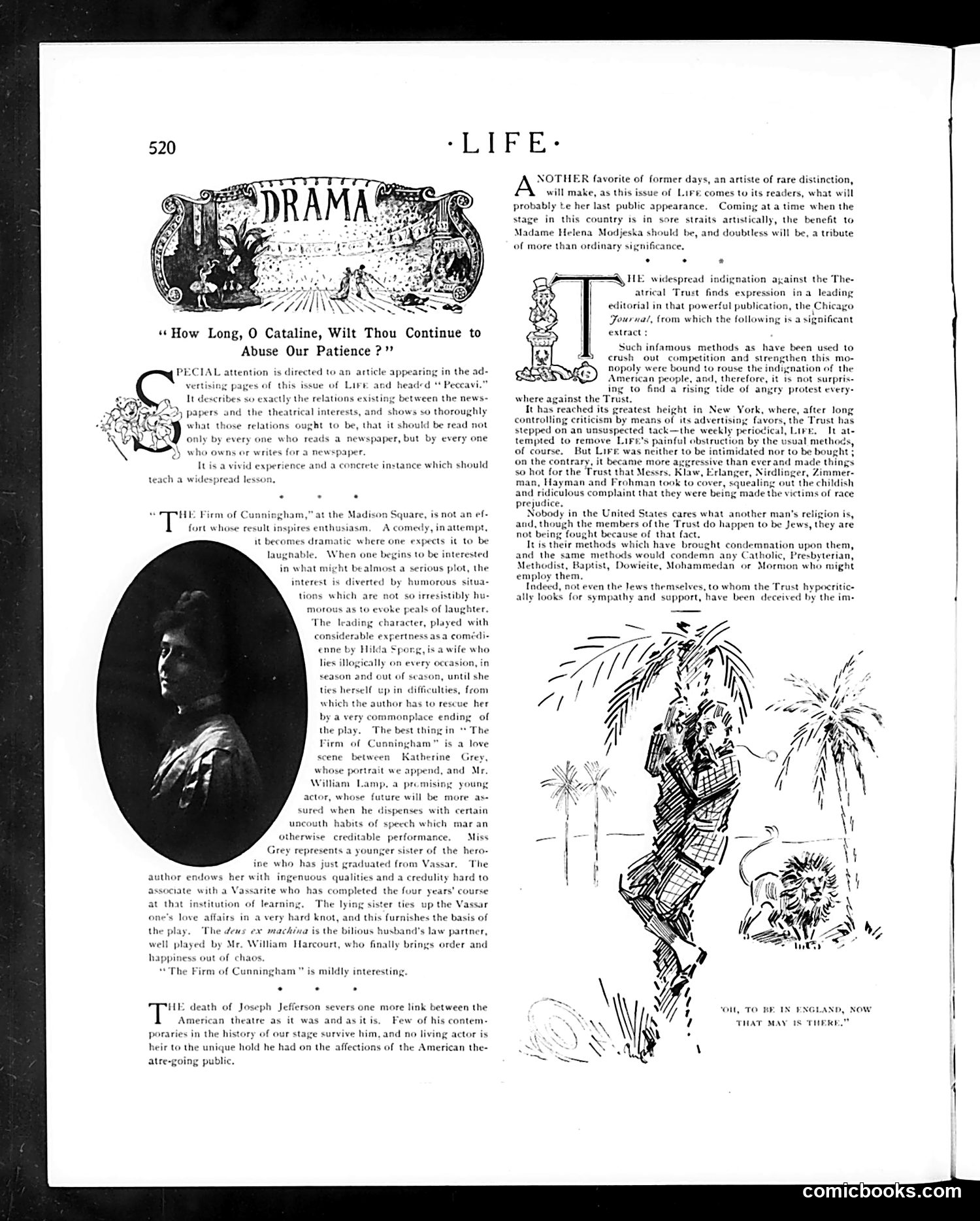
This page discusses theatrical controversies of the early 1900s. The main article attacks the **Theatrical Trust** (a monopoly controlled by producers Klaw, Erlanger, Hayman, Frohman, and Zimmerman) for using corrupt methods—including advertising manipulation—to crush competition. **Key references:** - **"The Firm of Cunningham"** is a theatrical production reviewed as "mildly interesting," illustrating the dramatic fare of the period - **Joseph Jefferson's death** marks the end of an era in American theater - **Madame Helena Modjeska** (likely the actress mentioned) is performing what may be her final public appearance - The **Chicago Journal** is quoted condemning the Trust's "infamous methods" **The satire's point:** Life magazine positions itself as standing against the Trust's bullying tactics, specifically resisting their attempt to suppress the magazine through advertising pressure and other intimidation. The Trust's complaint about being "made victims of race prejudice" is dismissed as childish whining. Life celebrates its own resistance to monopoly control. The ornamental heading and illustrations are typical period magazine design.
📄 Transcribed text from this page (OCR, searchable)
Machine-transcribed from the original scan — historical spelling and the odd misread are preserved.
“How Long, 0 Cataline, Wilt Thou Continue to Abuse Our Patience ?” PECIAL attention is directed to an article appearing in the ad- e of Lire and headed * Peceavi.” xb vertising pages of this iss It dexe een the news- exactly the relations existi papers and the theatrical interests, and s cht to be, that it should be who re »ws so thorough what those relations 0 only by every on is a newspaper, but by every who own fF writes for newspaper, It is a vivid experience and a concrete instance which should read les teach a wide “THE Firm of Cu fort whose result inspires ent at the Madison Square, is not an ef- A comedy, inattempt, it becomes dramatic where one expects it to be J ous plot, the laughable, When one begins to be intere in what interest is diverted by humorous situa- tions which are not so irresistibly hu- Hilda Sp ically on every occasion, in sa wife who d out of season, until she ficulties, from c her ace ending of ties herself up in ¢ which the author has to rest by a very commonp the play. The best t Firm of © scene betwe gin * The is a love pningham Katherine Gre we append, and Mr, whose port William Ls actor, whose { a promising you re will be more as ed when he dispenses with certain un h habits of speech which mar an atherwise creditable performance. — Miss nts a younger sister of the hero- ine who has just graduated from Vassar. The author endows her with ingenuous qualities and a credulity hard to associate with a Va at that i rite who has completed the four years! course learn The ly p the Vassar affairs in a very hard knot the basis of lay. T played by Mr. W of chaos tution ¢ sister ties he jous husband's law partner, and this furr the e deus ex machina is the bi well am Harcourt, who fi ally brings order and happ “The Firm of Cunningham ” is mildly interesting. HIE death of Joseph Jefferson severs one more link between the American theatre as it was and as it is, st Few of his contem- poraries in the history of survive him, and heir to the unique hold he had on the affections of the American the- atre-going public. living actor is -LIFE- NOTHER favorite of former days, an artiste of rare distinction, will make, as this issue of Lire comes to its readers, what will probably te her last public appearance. Comin stage in this count Madame Helena Mo of more than ordinary significance, ata time when the s in sore straits artistically, the benefit to ka should be, and doubtless will be, a tribute A HE widespread i ighation ayainst the The- atrical Trust finds expression ina leading editorial in that power Journal, {rom which extract : ful publication, the Chicago at he following is a sign Such infamous methods as have been used to crush out competition and strengthen this mo- nopoly were bound to rouse the i the American people, pris- ¢ to find a risi of angry protest every where against the Trust. It has reached its greatest height in New York, where, after long controlling criticism by means of its advertising favors, the Trust has stepped on an unsuspected tack—the weekly periodical, Ling, It at- tempted to remove LiFe’s painful obstruction by the usual methods, of course, But Lire was neither to be intimidated nor to be bought j on the contrary, it became more aggre: made things so hot for the Trust that Messrs, Klaw er, Zimmer- man, Hayman and Frohman took to cover, squealing out the childish and ridiculous complaint that they were being made the victims of race dice. Nobody in the United States cares what another man's r h the members of the Trust do happen to be Jews, ng fought because of that fact. anation upon them, nn any Catholic, Presbyterian, ammedan or Mornion who might and the same methods would con: Methodist, Baptist, Dowieite, 3 employ them, Indeed, not even the Tews themselves, to whom the Trust hypocritic+ ally looks for sympathy and support, have been deceived by the im+ HEIN ENGLAND, NOW T MAY IS THER comicbooks.com