
Life, 1905-05-04 · page 27 of 48
Life — May 4, 1905 — page 27: what you’re looking at
What you’re looking at
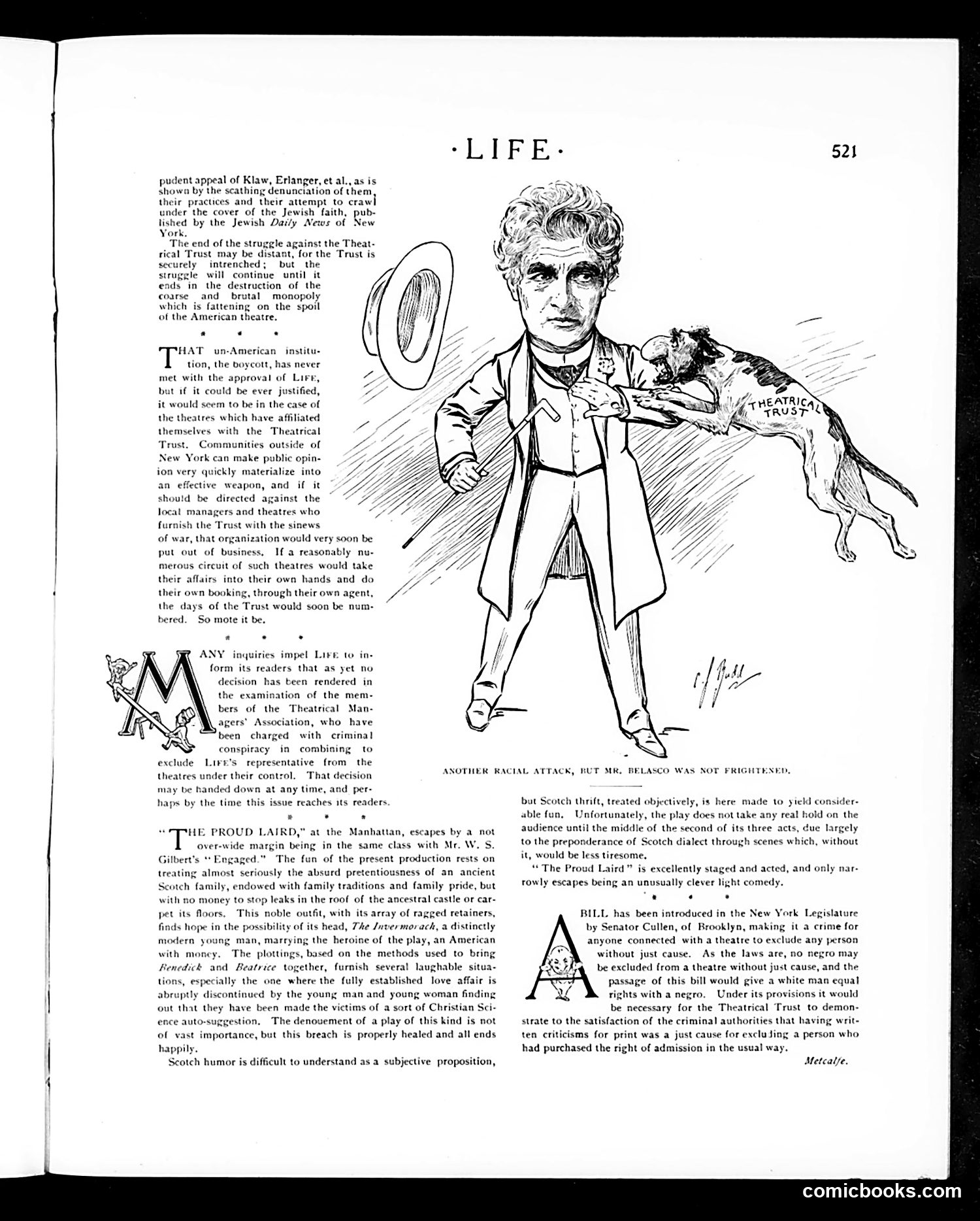
This page addresses the **Theatrical Trust**, a monopolistic organization controlling American theater booking and venues in the early 1900s. The central cartoon depicts a man being attacked by a dog labeled "THEATRICAL TRUST"—illustrating the Trust's aggressive tactics against those who challenge its control. The text discusses Life magazine's opposition to the Trust's "coarse and brutal monopoly," mentioning figures **Klaw and Erlanger** (appears to be Trust leaders). Life advocates for boycotts and independent theater circuits as weapons against the monopoly. The page also reviews "The Proud Laird" play and references a proposed New York bill by Senator Cullen criminalizing theater discrimination—suggesting legislative attempts to break the Trust's exclusionary practices. The satire targets corporate monopolistic power in American entertainment and the need for antitrust reform.
📄 Transcribed text from this page (OCR, searchable)
Machine-transcribed from the original scan — historical spelling and the odd misread are preserved.
pudent appeal of Klaw, Erlanger, et al.,as is showa by the scathing denunciation of them their practices and their attempt to crawl under the cover of the Jewish faith, pub- lished by the Jewish Dai/y News of New York The end of the struggle against the Theat- rical Trust may be distant, for the Trust is securely intrenched; but the struggle will continue until it ends in the destruction of the coarse and brutal monopoly which is fattening on the spoil of the American theatre. HAT un-American institu: tion, the boycott, has never met with the approval of Lire, but if it could be ever justified, it would seem to be in the case of the theatres which have affiliated themselves with the Theatrical Trust. Communities outside of New York can make public opin- ion very quickly materialize into an effective weapon, and if it should be directed against the local managers and theatres who furnish the Trust with the sinews of war, that organization would very soon be put out of business, If a reasonably nu- merous circuit of such theatres would take their affairs into their own hands and do their own booking, through their own agent, the days of the Trust would soon be num- bered. So mote it be, ANY inquiries impel Lie to in form its readers that as yet decision has been rendered in the examination of the mem- bers of the Theatrical M. agers’ Association, who have been charged with criminal conspiracy in combining to exclude Lire’s representative from th hat dec and per- e this issue reaches its readers. a theatres under their control. n may be handed down at any time haps by the “DHE PROUD LAIRD,” at the Manhattan, escapes by a not over-wide margin being in the same class with Mr. W. S. Gilbert’s “ Engaged.” The fun of the present production rests on treating almost seriously the absurd pretentiousness of an ancient ch family, endowed with family traditions and family pride, but to stop leaks in the roof of the ancestral castle or car- with no mon pet its floors, This noble outét, with its array of ragged retainers, finds hope in the possibility of its head, The Jnvermorach, a distinctly modern young man, marrying the heroine of the play, an American with moncy, The plottings, based on the methods used to bring Renedick and Beatrice together, furnish several laughable situa- tions, especially the one where the fully established love affal tly discontinued by the young man and young woman finding s abi out that they have been made the victims of a sort of Christian Sci- ence auto-suggestion, The denouement of a play of this kind is not of vast importance, but this breach is properly healed and all ends happily. Scotch humor is difficult to understand as a subjective proposition, EATRIC, nERUS . ANOTHER KACIAL ATTACK, RUT MR, DELASCO WAS NOT FRIGHTENED, but Scotch thrift, treated objectively, is here made to yield consider- able fun, Unfortunately, the play does not take any real hold on the audience until the middle of the second of its three acts, due largely to the preponderance of Scotch dialect through scenes which, without it, would be less tiresome, “The Proud Laird” is excellently staged and acted, and only rowly escapes being an unusually clever light comedy. BILL has been introduced in the New York Legislature by Senator Cullen, of Brooklyn, making it a crime for anyone connected with a theatre to exclude apy person without just cause, As the laws are, no n be excluded from a theatre without just cause, and the passage of this bill would give a white man equal rights with a negro, Under its provisions it would be necessary for the Theatrical Trust to demon- strate to the satisfaction of the criminal authorities that having writ- ten criticisms for print was a just cause for exclu Jing a person who had purchased the right of admission in the usual way, ro may Metcalfe. comicbooks.com