
Life, 1905-05-04 · page 32 of 48
Life — May 4, 1905 — page 32: what you’re looking at
What you’re looking at
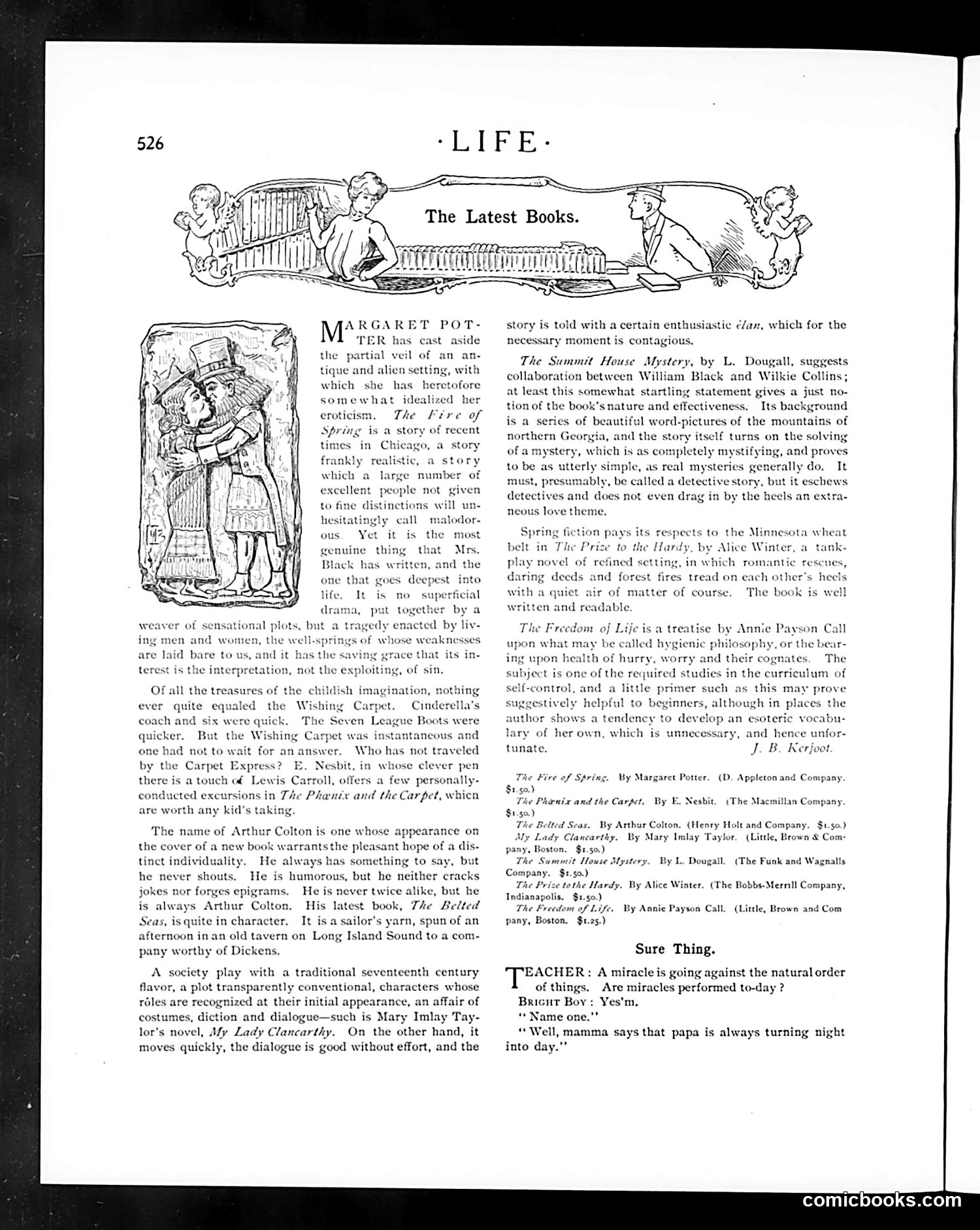
This is a book review section from *Life* magazine, not a political cartoon. The page features literary criticism of several contemporary novels, including works by Margaret Potter, Arthur Colton, and Mary Imlay Taylor. The decorative illustrations are typical Victorian-era ornamental headers rather than satirical cartoons. At the bottom, there's a brief humorous dialogue labeled "Sure Thing" between a Teacher and Bright Boy about miracles—a simple joke playing on the boy's literal interpretation of the teacher's question about whether miracles occur "to-day" (today), with the child's mother turning night into day as an example of a "miracle." This is gentle classroom humor rather than social satire. The page is primarily a straightforward book review and advertisement section typical of early 20th-century magazines.
📄 Transcribed text from this page (OCR, searchable)
Machine-transcribed from the original scan — historical spelling and the odd misread are preserved.
‘LUPE - ARGARET POT- R has cast aside tique and alien setting, with which she iT fore somewhat idealized her The Fire of ecent eroticism, ring is a story , a story y realistic, a story a large number of lent people not giv inctions will un. ous, Yet genuine th Black one that goes dee wedy enacted by liv. jose weaknesses that its in- weaver of sensational plots, but a ing men and women, the well-spr bare to us, and it terest is the interpretation, not t ing, of sin, Of all the treasures of the agination, nothing ever quite equaled the Wishing Carpet. Cinderella's coach and six were quick. The Seven L xe Boots were quicker. But the Wishing Carpet was instantaneous and one had not to wait for an answer. Who has not traveled by the Carpet Express? Nesbit, in whose clever pen there is a touch o€ Lewis Carroll, offers a few personally- conducted excursions in The Phandx and the Carpet,» are worth any kid's taking. The name of Arthur Colton is one whose appearance on the cover of a new book warrants the pleasant hope of a dis- tinct individuality ys ng to say, but he never shouts. He humorous, but he neither cracks jokes nor forges epigrams. He is never twice alike, but he is always Arthur Colton. His est book, The Belted Seas, isquite in character, It isa pun o} afternoon in an old tavern on Long Island Sound to a com- pany worthy of Dickens. A society play with a traditional seventeenth century flavor, a plot transparently conventional, characters whose roles are recognized at their initial appearance, an affair of costumes, diction and dialogue—such is Mary Imlay Tay- lor's novel, Afy Lady Clancarthy. On the other hand, it moves quickly, the dialogue is good without effort, and the ry is told with a certain enthusiastic ¢/ax, which for the necessary moment is contagious. The Summit House Mystery, by L. Dougall, suggests collaboration between William Black and Wilkie Collins; at least this somewhat startling statement gives a just no- tion of the book's nature and effectiveness, Its background is a series of beautiful word-pictures of the mountains of northern Georgia, and the story itself turns on the solving ofa mystery, which is as completely mystifying, and proves to be as utterly ies generally do, It 1 story, but it eschews. neous love theme, tion pays its respects to the Minnesota wheat belt in 7 Pri to the Hardy, by Alice Winte: play novel of refined setting, in which romantic rescues, deeds and forest 's tread on each other's heels jet air of matter of course. The book is w The Freedom of Lije upon wh i 20n | ise by Annie Payson Call may be called hygienic philosophy, or the bear- ect is one of the require adies in the curriculum of control, and a little primer such as this may prove estively helpful to beginners, although in places the author shows a tendency to develop an esoteric vocabu- lary of her own, which is unneces: tunate. ry, and hence unfor- J. B. Kerjoot The Fire of Sp $.50.) The Phinix and the Carpet. By ¥. Nesbit. By Margaret Potter. (D. Appleton and Company (The Macmillan Company. Belted Seas. By Arthur Colton. (Henry Holt and Company. $1.50.) Clancarthy. By Mary Imlay Taylor. (Little, Brown & Com: $1.50.) House Mystery $1.50.) tothe Hardy. By Mice Winter. (The Bobbs-Mernll Company, $1.50.) The Freedom of Li, pany, Boston, $1.25.) By L. Dougall, (The Funk and Wagnalls By Annie Payson Call. (Little, Brown and Com Sure Thing. EACHER: A miracle is going against the naturalorder of things. Are miracles performed to-day ? Bricut Boy : Yes'm, “Name one."" “Well, mamma says that papa is always turning night into day.” comicbooks.com