
A complete issue · 44 pages · 1904
Life — December 15, 1904
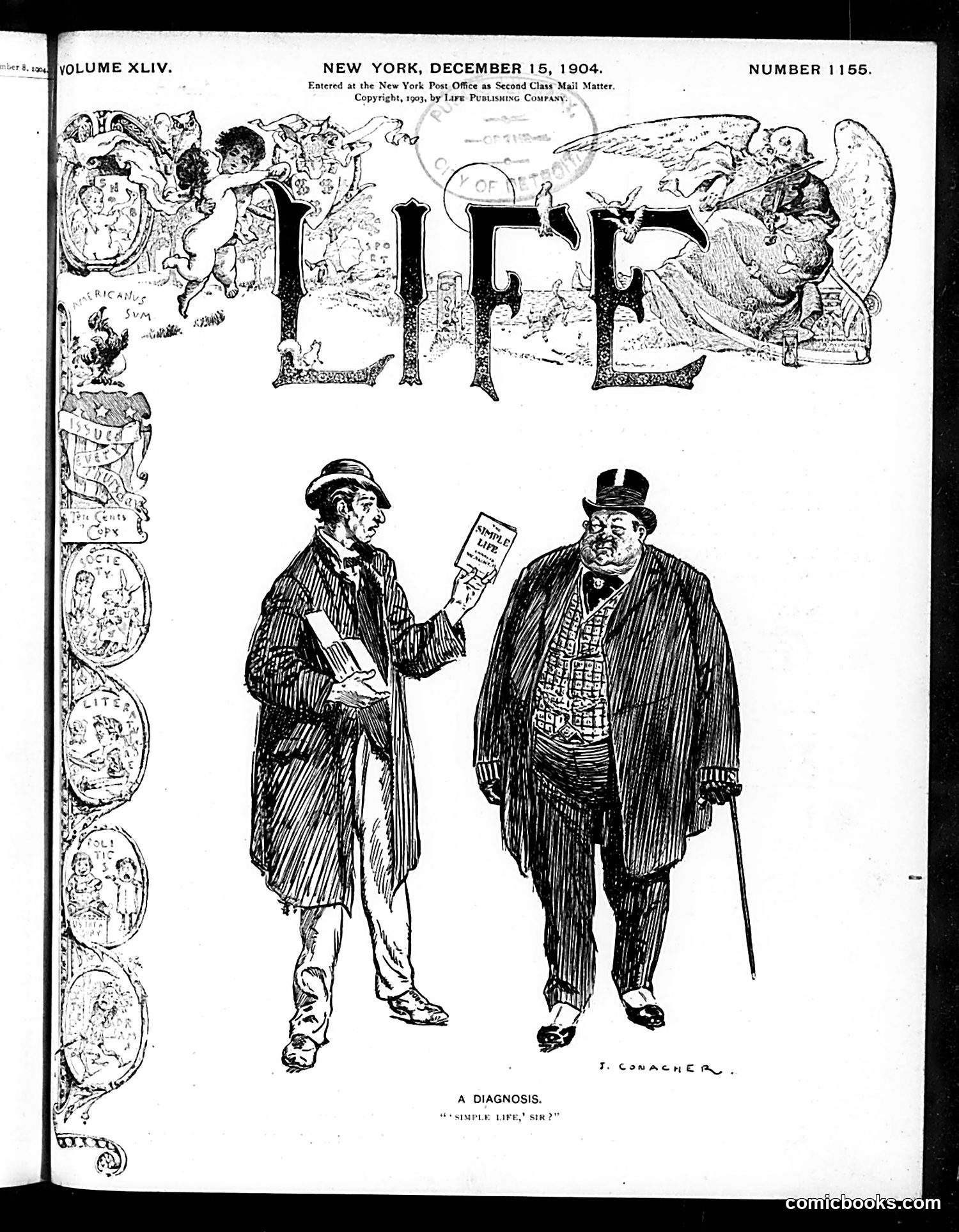
This December 1904 *Life* cartoon satirizes the "Simple Life" movement—a fashionable trend among wealthy Americans who romantically embraced rural simplicity and rejected urban materialism. The cartoon depicts two men: one thin figure holding a book titled "Simple Life" addresses a portly, well-dressed gentleman with a cane and top hat. The joke is visual irony: the wealthy man's expensive clothing, refined appearance, and obvious affluence contradict any genuine adoption of simple living. The satire mocks how rich Americans selectively adopted "simple life" philosophy as a trendy affectation while maintaining their actual wealth and status—preaching simplicity while practicing luxury. The thin man's earnest pitch contrasts sharply with the fat man's unmoved, skeptical expression, suggesting the concept's laughable incompatibility with genuine wealth.
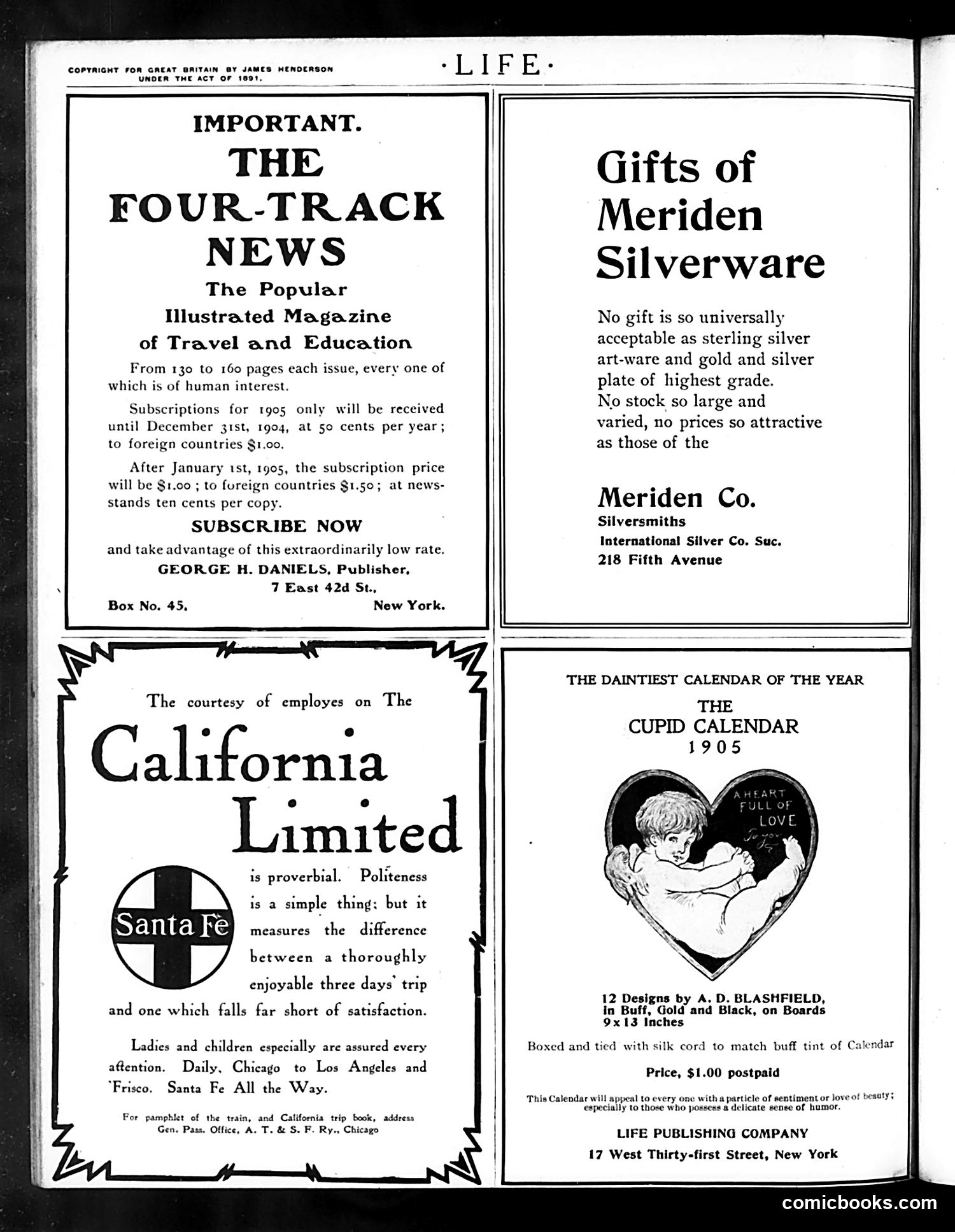
This page contains **no political cartoons or satire**—it's primarily **early 1900s advertising**. The content includes: 1. **Four-Track News** advertisement promoting an illustrated magazine of travel and education 2. **Meriden Silverware** ad marketing fine silver gifts 3. **California Limited** railroad advertisement (Santa Fe line) emphasizing politeness and service quality on their Chicago-to-Los Angeles route 4. **Cupid Calendar 1905** advertisement featuring romantic imagery The only potentially humorous element is the railroad ad's claim that "politeness is a simple thing" that distinguishes their service—a mild marketing appeal rather than satire. The page reflects turn-of-century consumer culture: luxury goods, travel, and gift-giving for an affluent readership. No political commentary or social satire is evident.
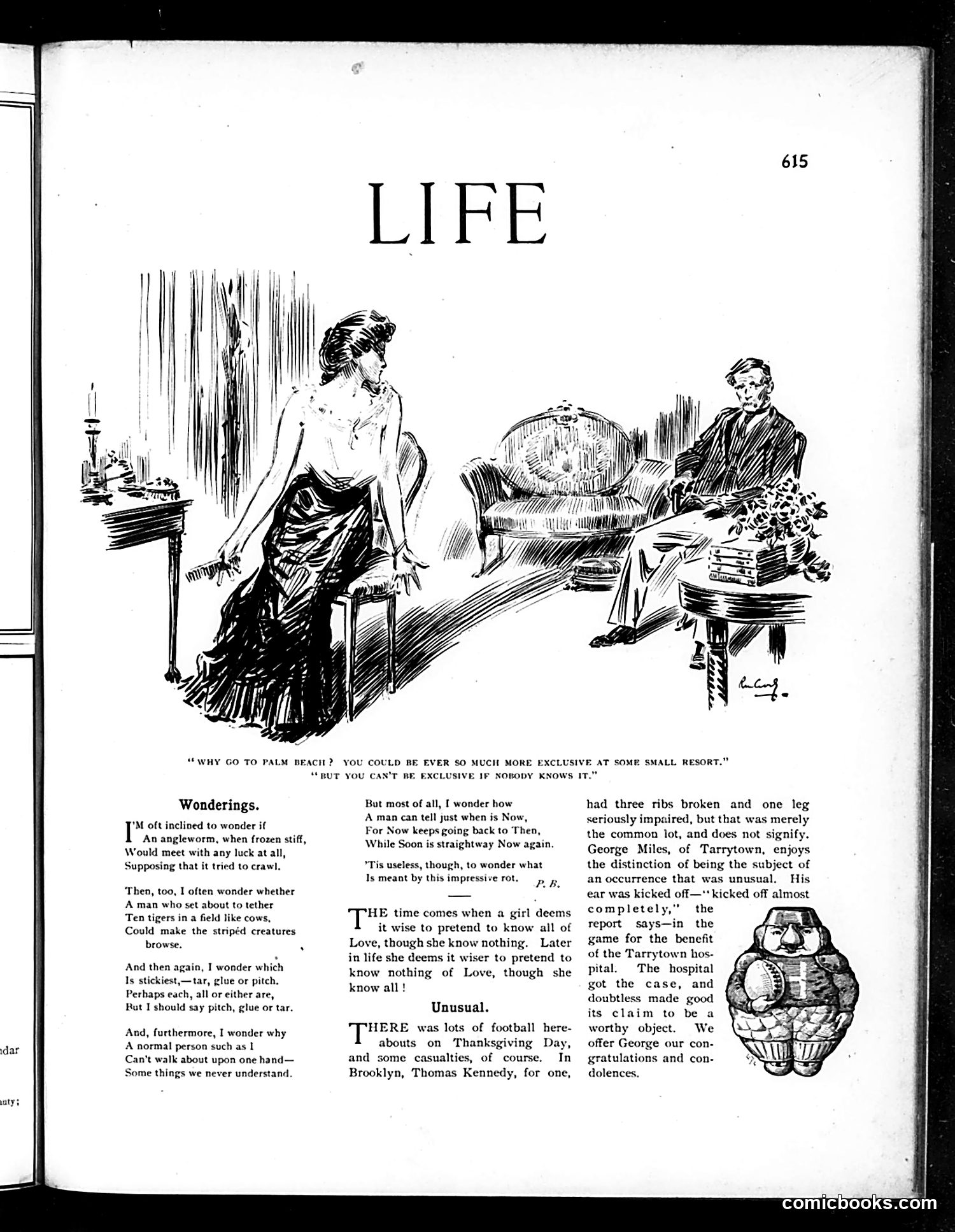
The main cartoon depicts a social scene with the caption: "Why go to Palm Beach? You could be ever so much more exclusive at some small resort." The joke satirizes wealthy Americans' pursuit of exclusivity and social status. Palm Beach was (and remains) an ultra-exclusive resort destination, so the cartoon mocks the irony that people seeking exclusivity flock to the same fashionable location as everyone else. The implication is that true exclusivity requires going somewhere *less* popular. The accompanying text includes reflective pieces titled "Wonderings" and "Unusual," offering humorous social commentary on human nature and romantic relationships, typical of Life's satirical approach to modern life and manners during this era.
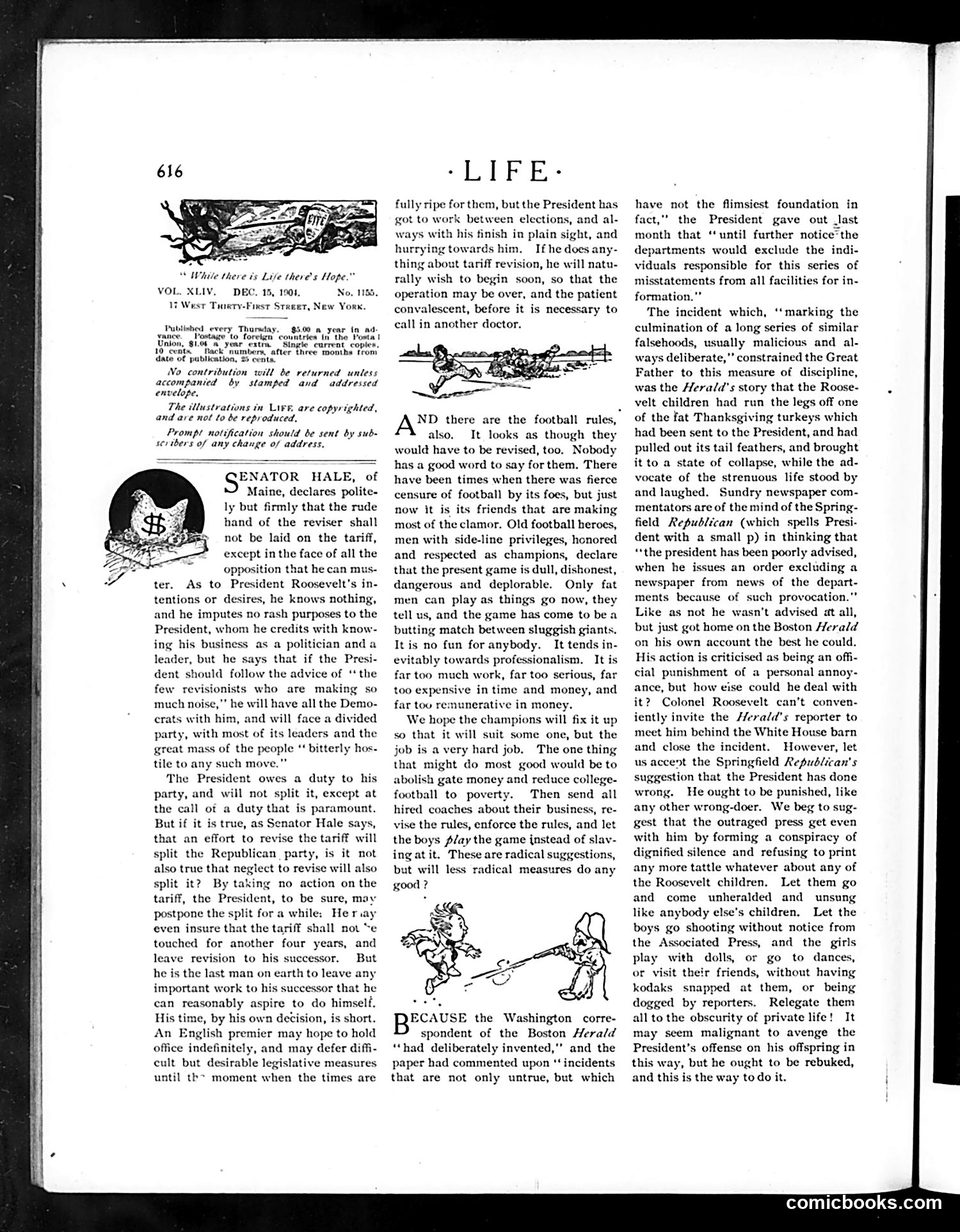
This page contains political commentary on President Theodore Roosevelt's first months in office. The main article, headlined "It is a Man's job to do a Man's Work," discusses Roosevelt's tariff revision efforts and his handling of football reform. The cartoon depicts **Senator Hale of Maine** criticizing Roosevelt's attempt to revise tariff policy, warning it will split the Republican Party. The text mocks newspapers (particularly the Boston Herald) for fabricating stories about Roosevelt's children—such as them shooting turkeys and behaving wildly—suggesting the press was inventing scandals. The satire criticizes both partisan opposition to Roosevelt's agenda and sensationalist journalism's invasion of presidential family privacy, presenting these as threats to legitimate governance.
This page presents a humorous poem titled "The Christmas Strike" that satirizes a labor dispute affecting Christmas supplies. The poem describes a dream where Santa Claus, disguised as "Uncle Sam" (representing the U.S. government), arrives with dire news: Christmas trees have "gone on strike" in the Philippines, Porto Rico, and Guam. The satire appears to reference early 1900s colonial labor issues in these U.S. territories, where workers refused to supply Christmas goods. Santa/Uncle Sam delivers wireless telegraph news that the strike has ended and trees will resume shipment, though "presents rare and Christmas greens" will be scarce. The accompanying small cartoon sketch (bottom right) shows a man struggling to maintain composure—likely depicting the public's anxiety about holiday shortages caused by labor unrest.
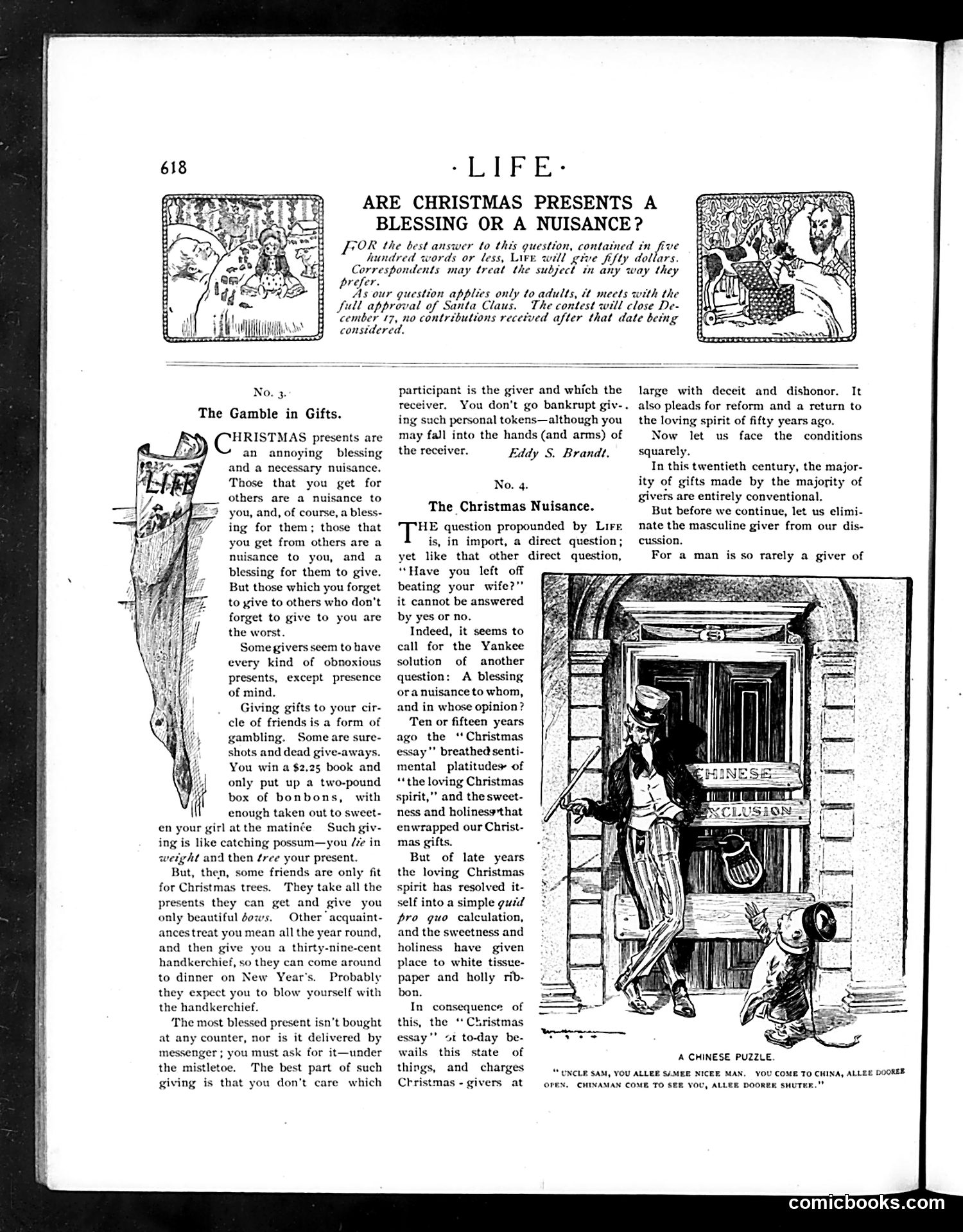
This page contains two satirical essays about Christmas gift-giving customs. The main text addresses whether Christmas presents are "a blessing or a nuisance," arguing they're often obligatory rather than meaningful. The left illustration shows a stocking labeled "LIFE," satirizing how Christmas gifts are sometimes impersonal or unwanted—portrayed as fishing with bait to catch recipients' attention. The right illustration, titled "A Chinese Puzzle," depicts a figure at a Chinese shop window. The caption's broken English ("Allee Samee Nicer Man") mimics period stereotypes about Chinese immigrants, likely satirizing how Christmas commercialism had become an absurd, cross-cultural spectacle divorced from genuine sentiment. Together, these pieces critique the hollow materialism and social awkwardness of Christmas gift obligations in early 20th-century America.
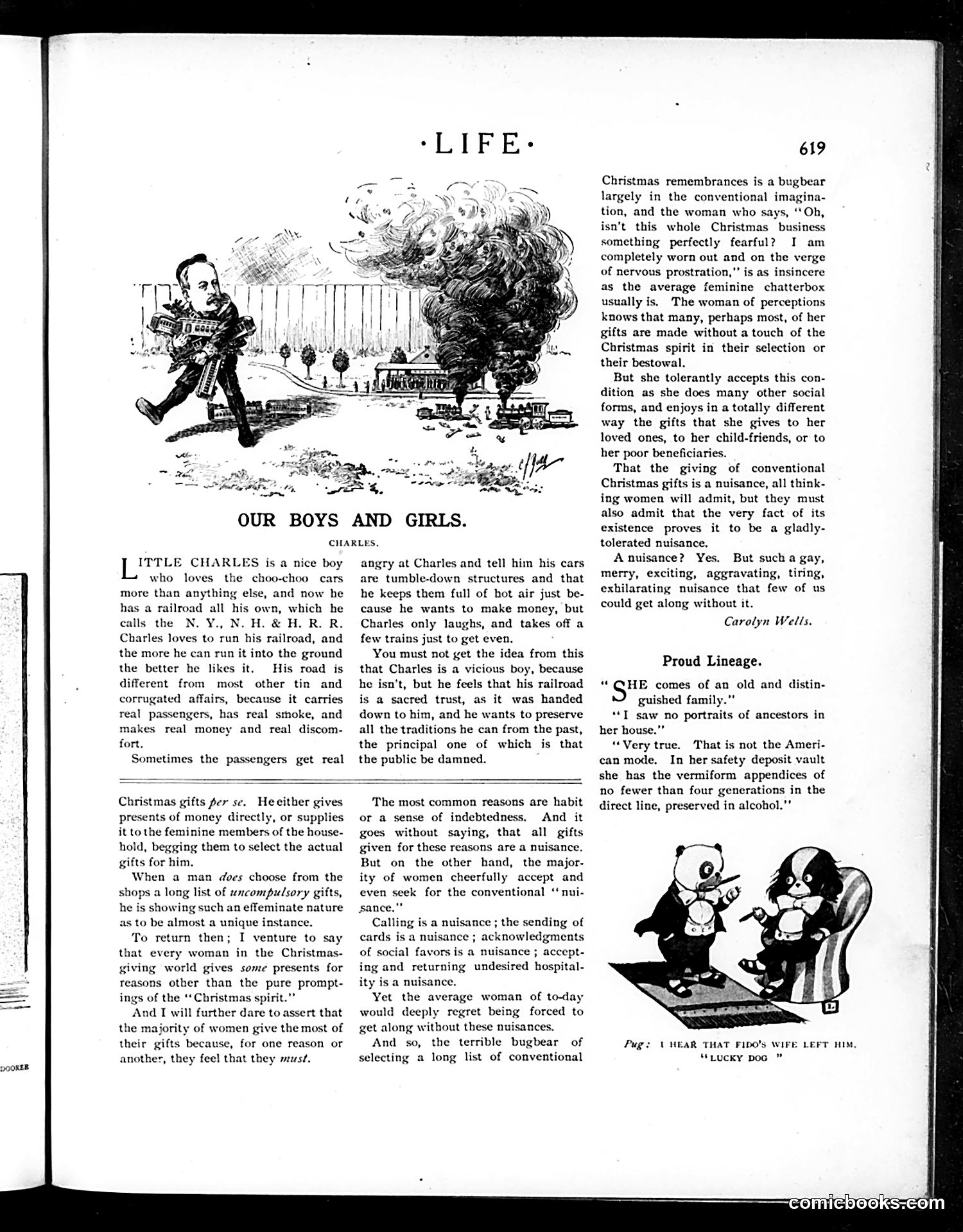
This page satirizes the commercialization of Christmas gift-giving, particularly criticizing women's role in perpetuating the custom. **The main cartoon** shows a small boy (Charles) who loves toy trains more than anything and operates his own railroad line, wanting to "make money." The satire suggests children absorb capitalist values early. **The text argues** that Christmas gift-giving is a tedious social obligation—a "gladly-tolerated nuisance" that women reluctantly maintain. The author (Carolyn Wells) contends that most gifts are given from habit or obligation rather than genuine Christmas spirit, and that women feel obligated to participate despite finding it exhausting. The piece critiques both commercialism and gender expectations around holiday consumption and domestic labor.
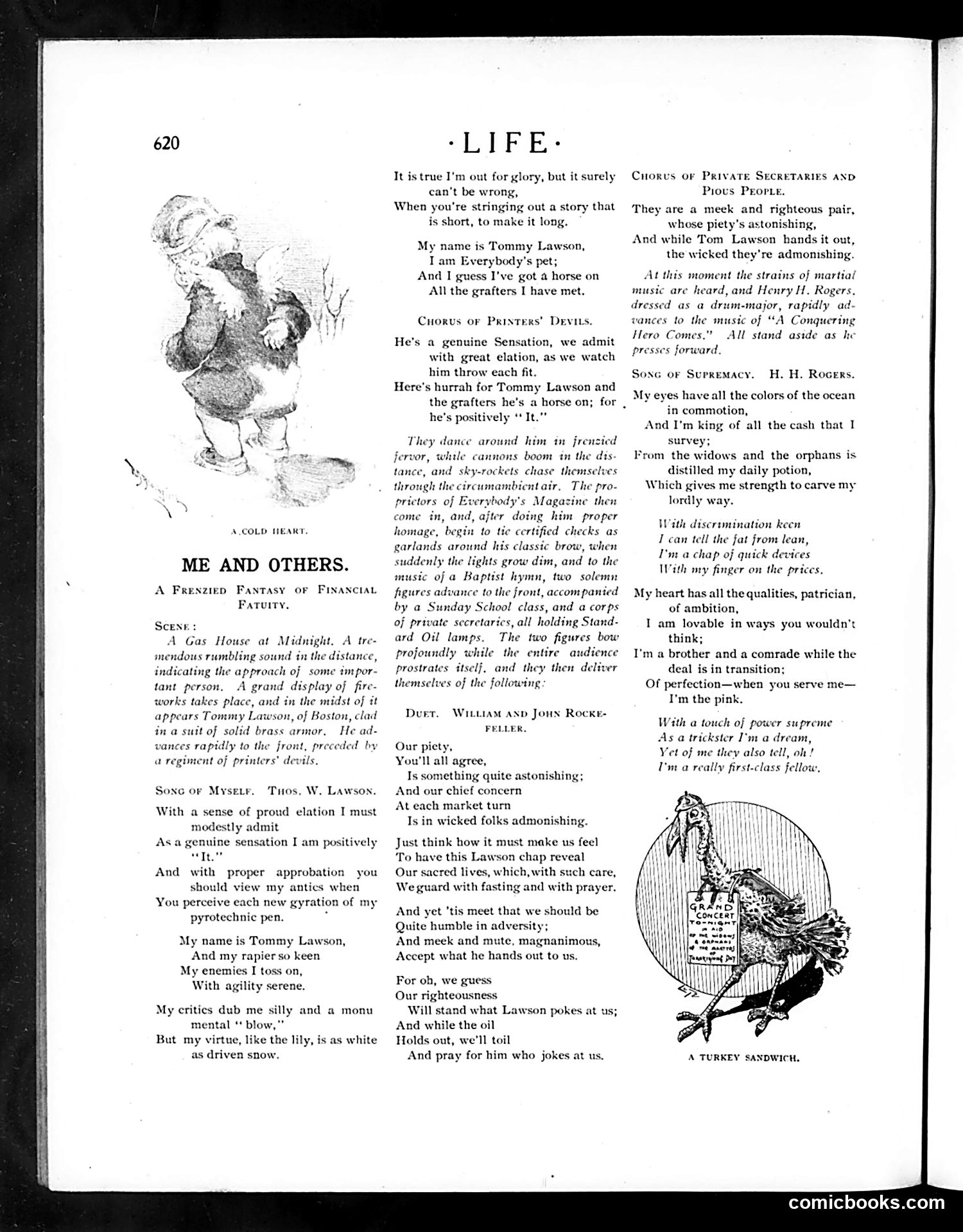
This page presents a comedic skit mocking a character named Tommy Lawson, described as "Everybody's pet"—a grifter or con artist who boasts of his exploits to various audiences. The accompanying sketch "A Cold Heart" depicts him as a diminutive, scheming figure. The satire ridicules Lawson's shamelessness and the public's fascination with such rogues. Multiple characters—printers' devils, private secretaries—deliver verses celebrating his audacity while ostensibly criticizing his dishonesty. The humor lies in the contradiction: they simultaneously mock and admire his ability to defraud people. The "Turkey Sandwich" illustration appears unrelated, suggesting miscellaneous filler typical of Life's satirical format.
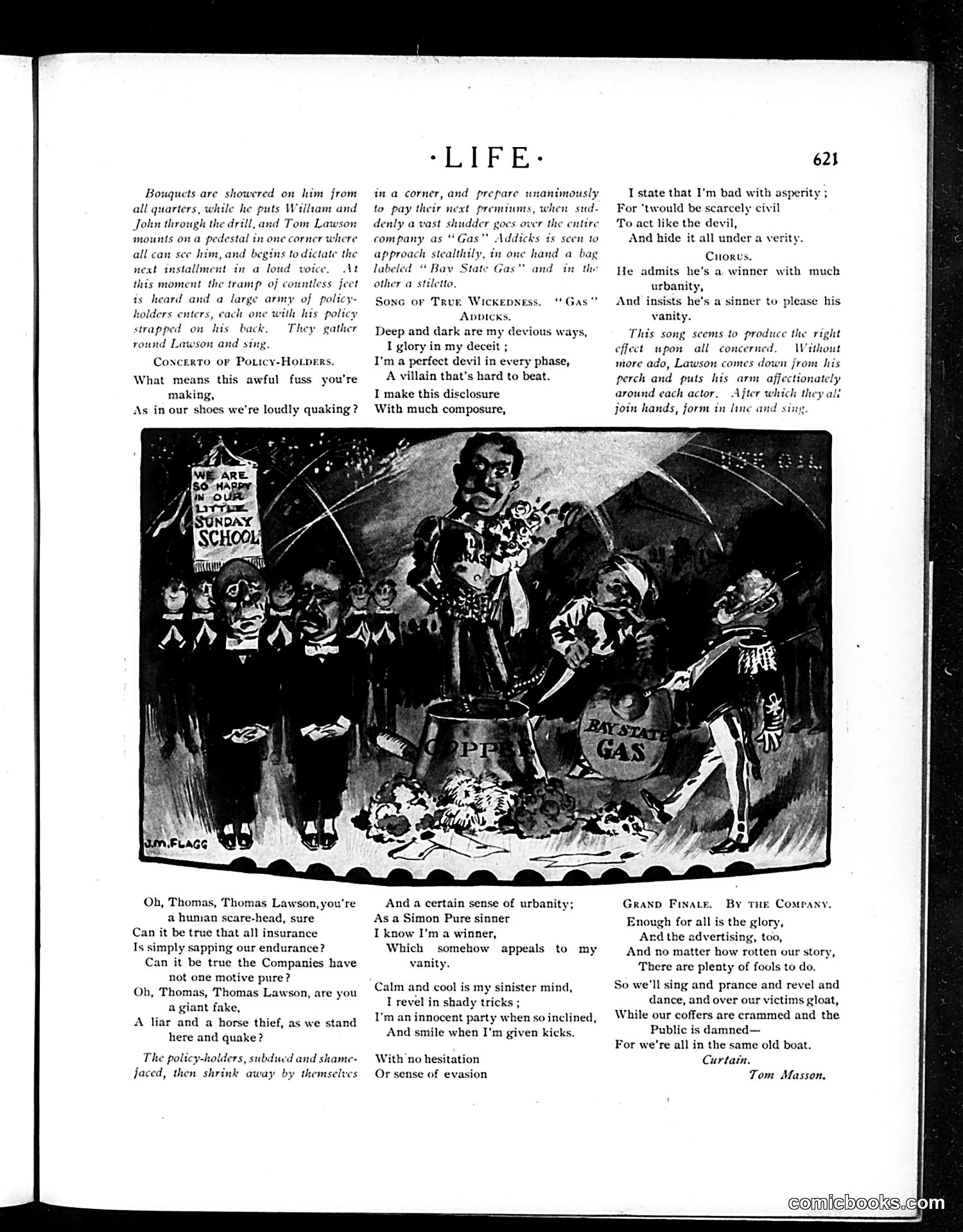
This page features a satirical musical number mocking corporate and political corruption. The central cartoon depicts a demonic figure (labeled "Gas" — likely referencing utility companies) surrounded by smaller devils representing "Policy-Holders" and insurance companies. They're performing at what appears to be a "Sunday School" (marked on a banner), creating an ironic contrast between moral instruction and immoral behavior. The lyrics, attributed to characters like "Addicks" and "Lawson," mock insurance executives and gas company officials as sinners who exploit the public. The satire targets the era's corporate scandals involving utilities and insurance fraud. The "Grand Finale" suggests this exposes widespread corruption as systemic rather than isolated — "we're all in the same old boat" implies complicity extends across the entire industry.
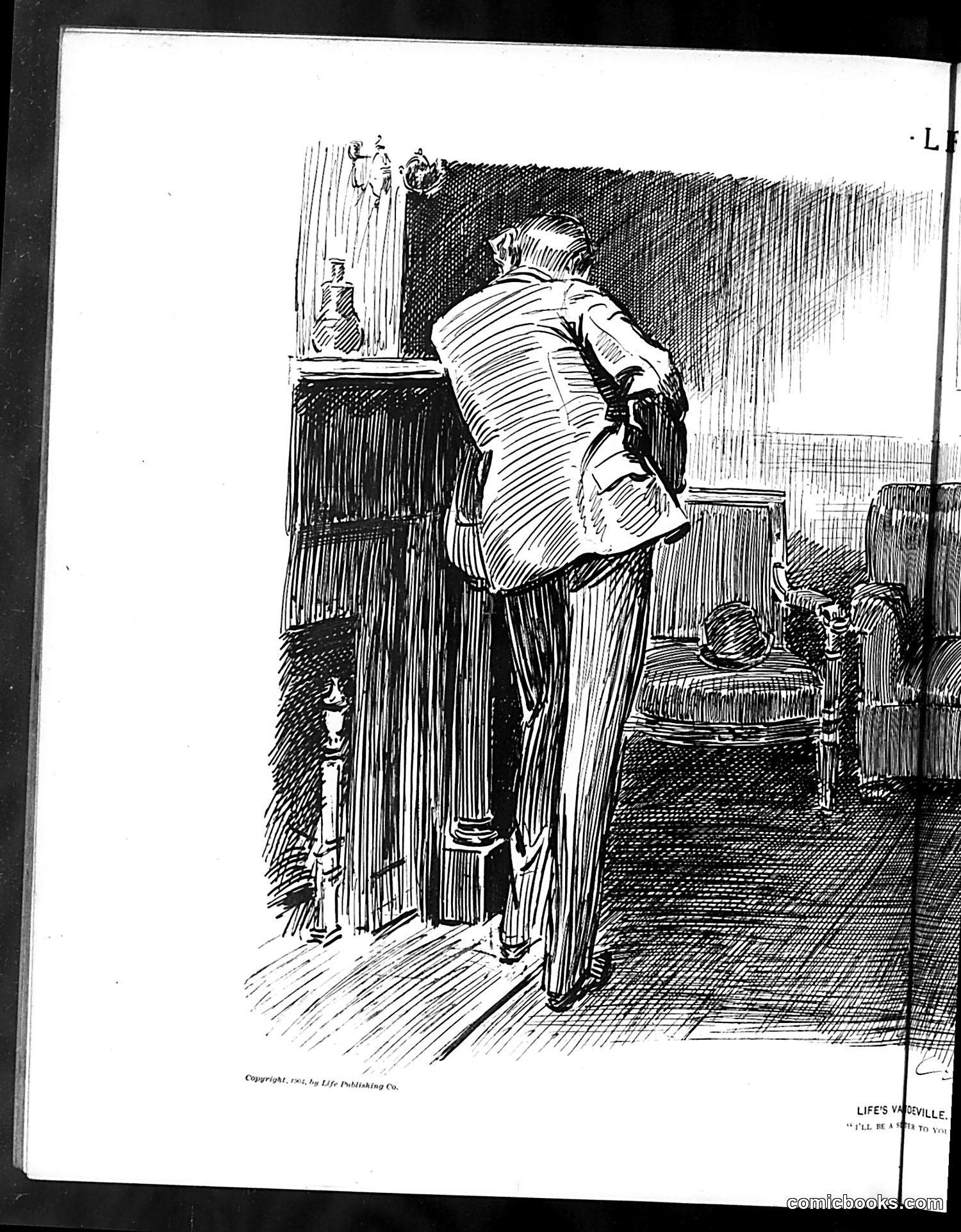
This is a black and white illustration showing a man in striped pajamas standing on a ladder, apparently looking into or adjusting something mounted on a wall or doorframe in what appears to be a bedroom. The style and copyright mark ("Copyright, 1902, by Life Publishing Co.") indicate this is from Life magazine's early 1900s satirical humor. The visible text fragment at bottom right reads "LIFE'S VAUDEVILLE" with partial text "'LL BE A BIT TO YO—" Without the complete caption or surrounding context, the specific satire is unclear. The ladder-and-pajamas scenario suggests domestic humor—possibly about a husband performing some household task or marital comedy. The "vaudeville" reference indicates Life presented this as entertainment/humor. The actual target of satire cannot be definitively determined from the image alone.
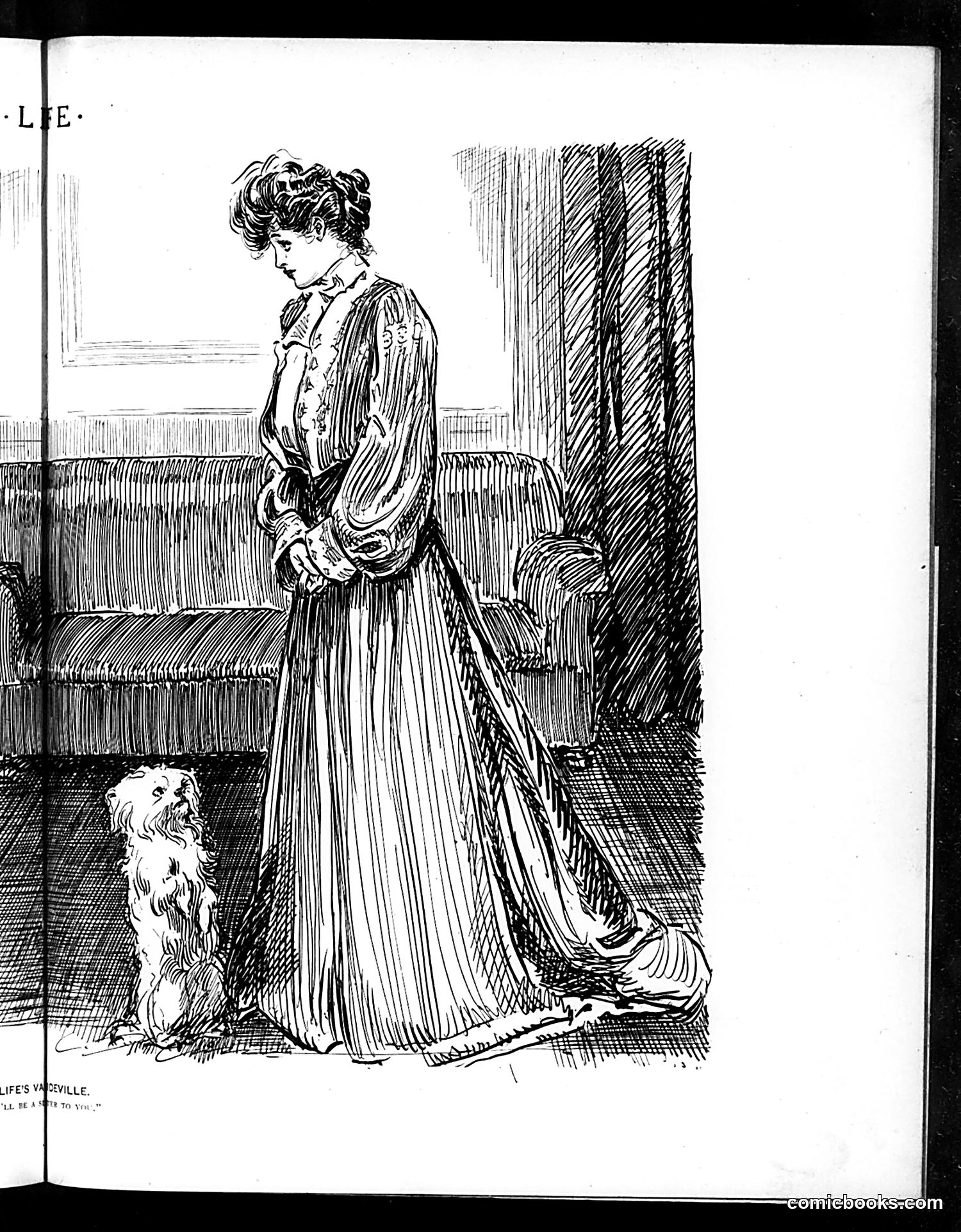
This appears to be an illustration from *Life* magazine, showing a fashionably dressed woman in an Edwardian-era gown standing in an interior room with a small dog at her feet. The drawing is labeled "LIFE'S VAUDEVILLE" at the bottom. Without clearer OCR text or additional context visible on the page, I cannot confidently identify the specific satirical point or reference. The illustration could be commenting on: - Fashion and vanity of the era - Women in theatrical/performance culture - Social pretension or "putting on a show" The "vaudeville" reference suggests theatrical or performative aspects of high society, but the exact satire intended remains unclear from this image alone. More page context would be needed for accurate interpretation.
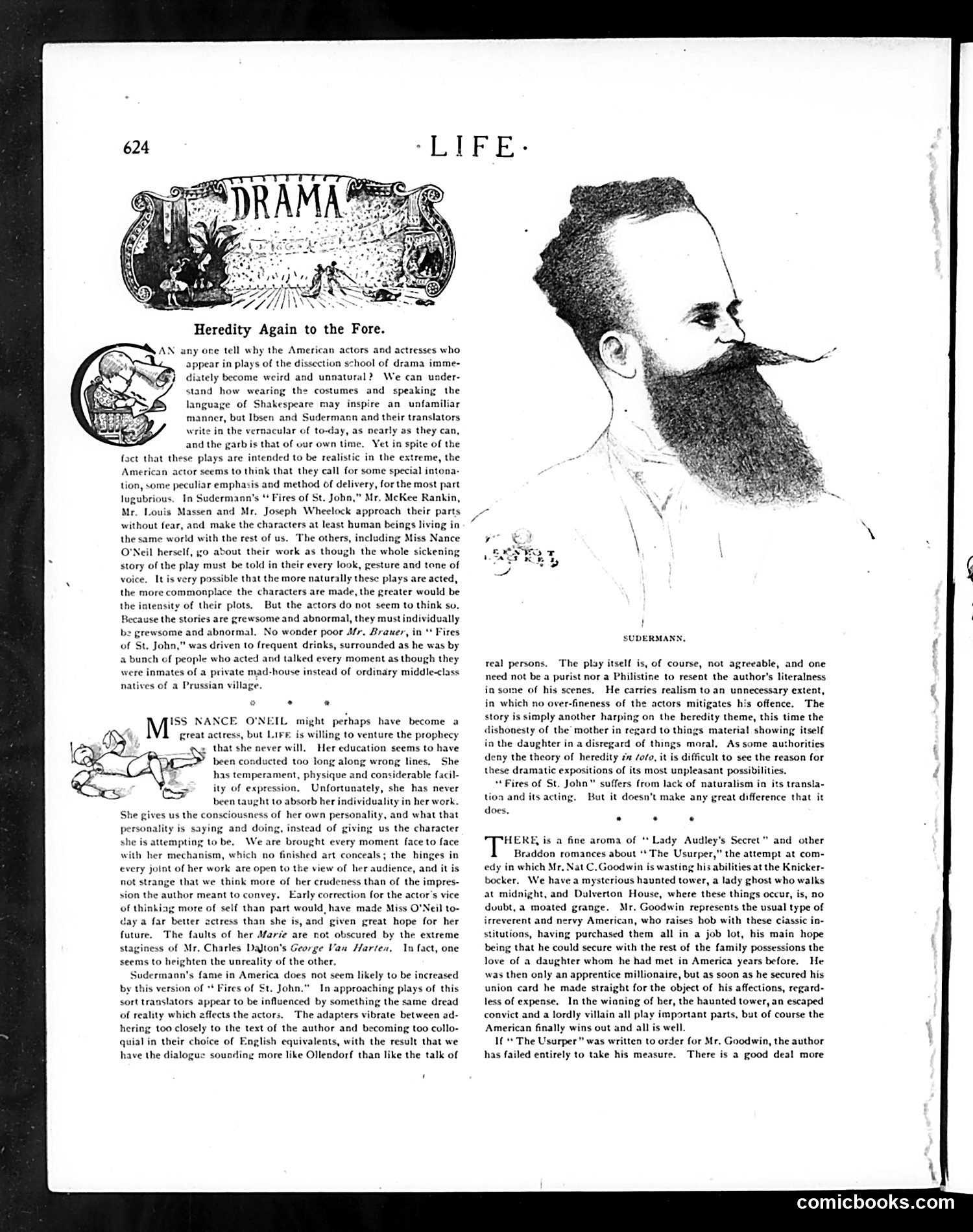
This is a drama criticism page titled "Heredity Again to the Fore." The article discusses American actors performing in plays from the "dissection school of drama"—realistic theatre that differs from traditional Shakespeare performances. The profile illustration appears to be **Sothern** (name visible below the sketch), likely Edward Sothern, a prominent actor of the era. The text critiques how actors in naturalistic plays become "weird and unnatural," arguing they overemphasize method and delivery. It specifically mentions performances in "Fires of St. John" by actors including Miss Nance O'Neil, praising some while questioning whether excessive realism serves the material. The article suggests the plays' "gloomy and abnormal" stories force actors into exaggerated performances, creating unintended comedy rather than drama. It's essentially defending traditional acting against emerging naturalistic techniques.
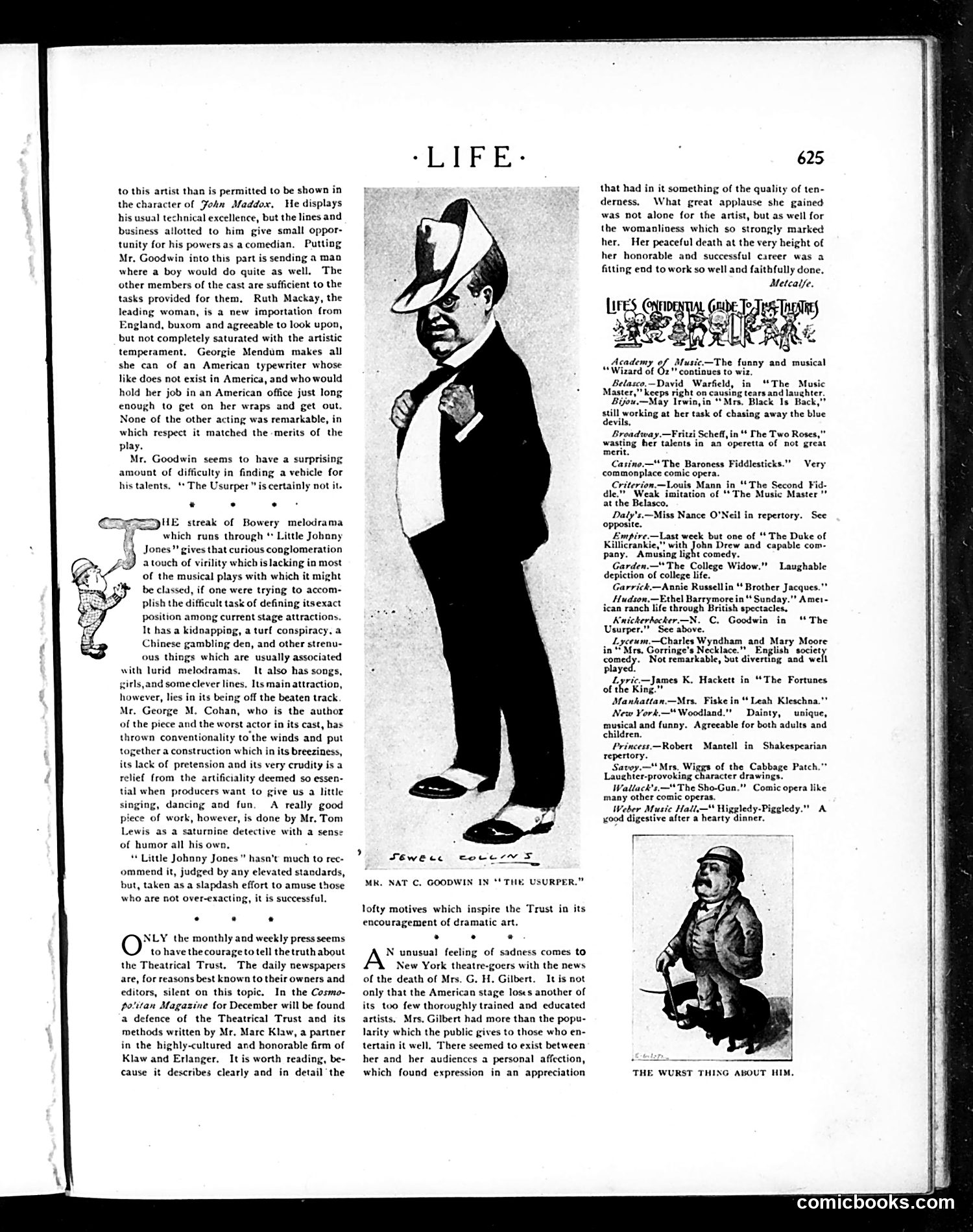
This page contains theatrical reviews from Life magazine's drama section. The main illustrations are caricatures of actors: **Nat C. Goodwin** in "The Usurper" (large central figure) and an unnamed character labeled "The Wurst Thing About Him" (lower right). The text critiques several Broadway productions. Goodwin is portrayed as underutilized talent—a skilled comedian wasted in an unsuitable role. "Little Johnny Jones," written by and starring **George M. Cohan**, is praised for its unpretentious, breezy "Bowery melodrama" style despite lacking artistic refinement. A significant section attacks the **Theatrical Trust** (Klaw and Erlanger's monopoly), noting that daily newspapers refuse to criticize it for undisclosed reasons, while monthly magazines defend it. The page concludes with an obituary honoring the death of **Mrs. G. H. Gilbert**, a respected veteran actress whose popularity stemmed from both talent and the "womanliness" audiences appreciated in her performances.
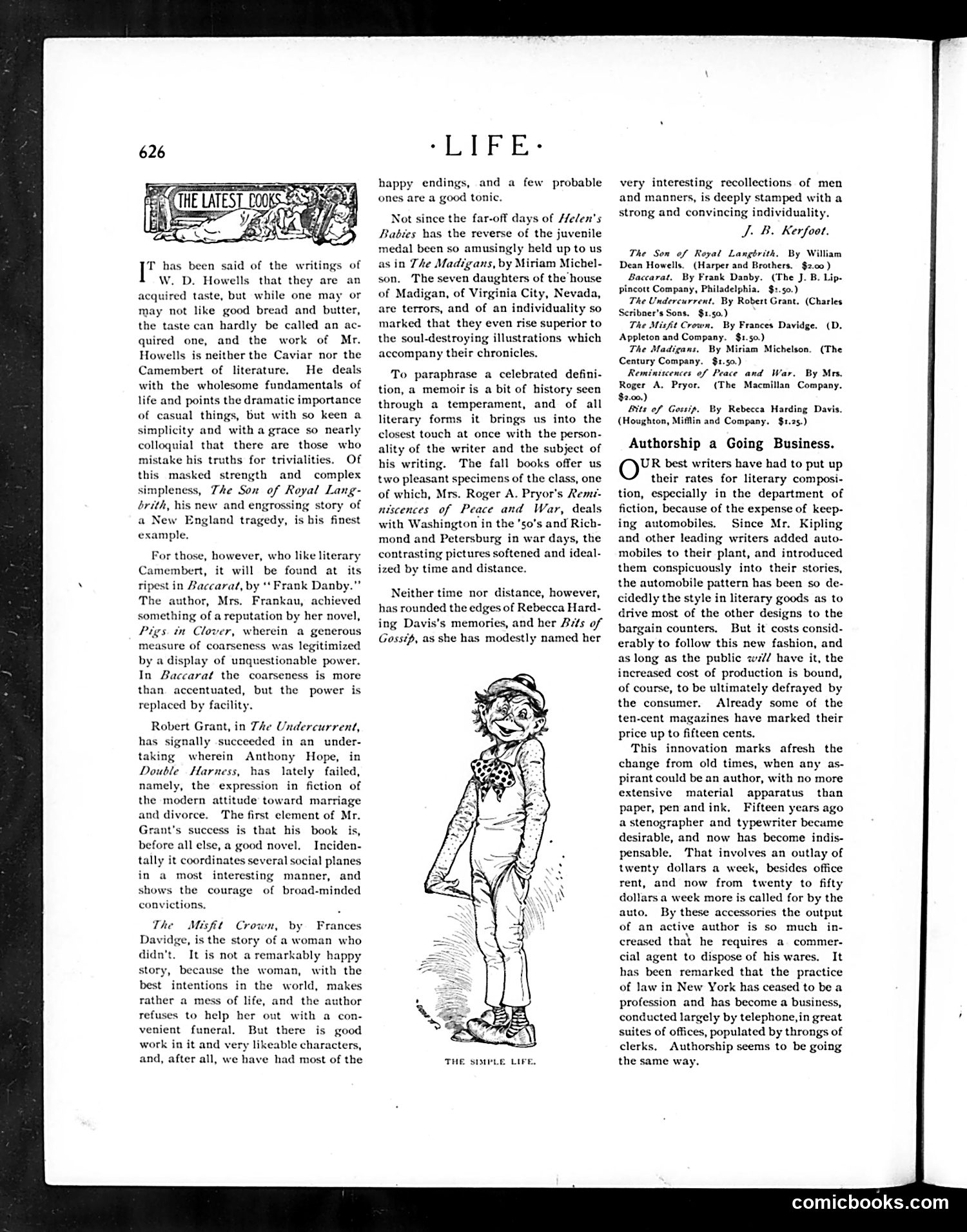
This page reviews several contemporary novels, with a small cartoon labeled "THE SIMPLE LIFE" depicting a thin, somewhat shabby-looking man in worn clothes. The cartoon appears to illustrate the concept of simple, unpretentious living. The reviews discuss W.D. Howells' *The Son of Royal Langbrith* favorably, praising his straightforward treatment of ordinary life. They contrast this with "Frank Danby's" *Baccarat*, which the critic suggests substitutes superficial facility for genuine power. Other novels reviewed include Robert Grant's *The Undercurrent* (favorably), and memoirs by Mrs. Roger A. Pryor and Rebecca Harding Davis. The cartoon's ironic title and depiction likely comment on the contrast between literary treatments of humble or "simple" life versus actual poverty—a common satirical theme in early 20th-century Life magazine.
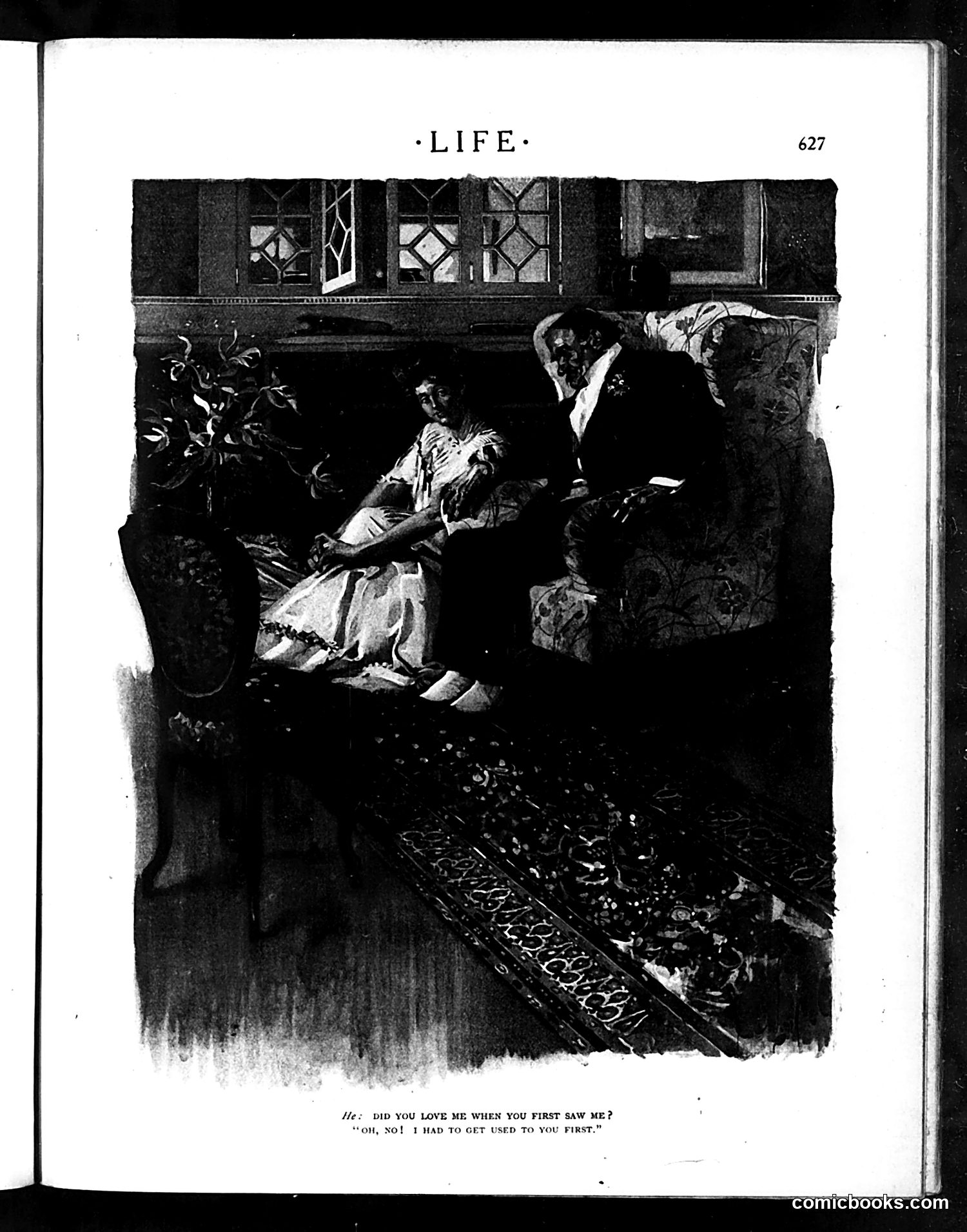
This is a domestic humor cartoon from *Life* magazine depicting a romantic exchange between a couple. The man asks if his partner loved him at first sight; she replies that she needed time to adjust to him first. The satire targets romantic idealization and the gap between courtship fantasy and married reality. Rather than affirming "love at first sight," the woman's honest response suggests that attraction and affection require familiarity and adaptation. The joke mocks both the man's expectation of instant devotion and the common experience of relationships requiring adjustment periods. The darkly-rendered interior setting and period clothing suggest this reflects early-to-mid 20th-century domestic relationships and expectations about marriage.
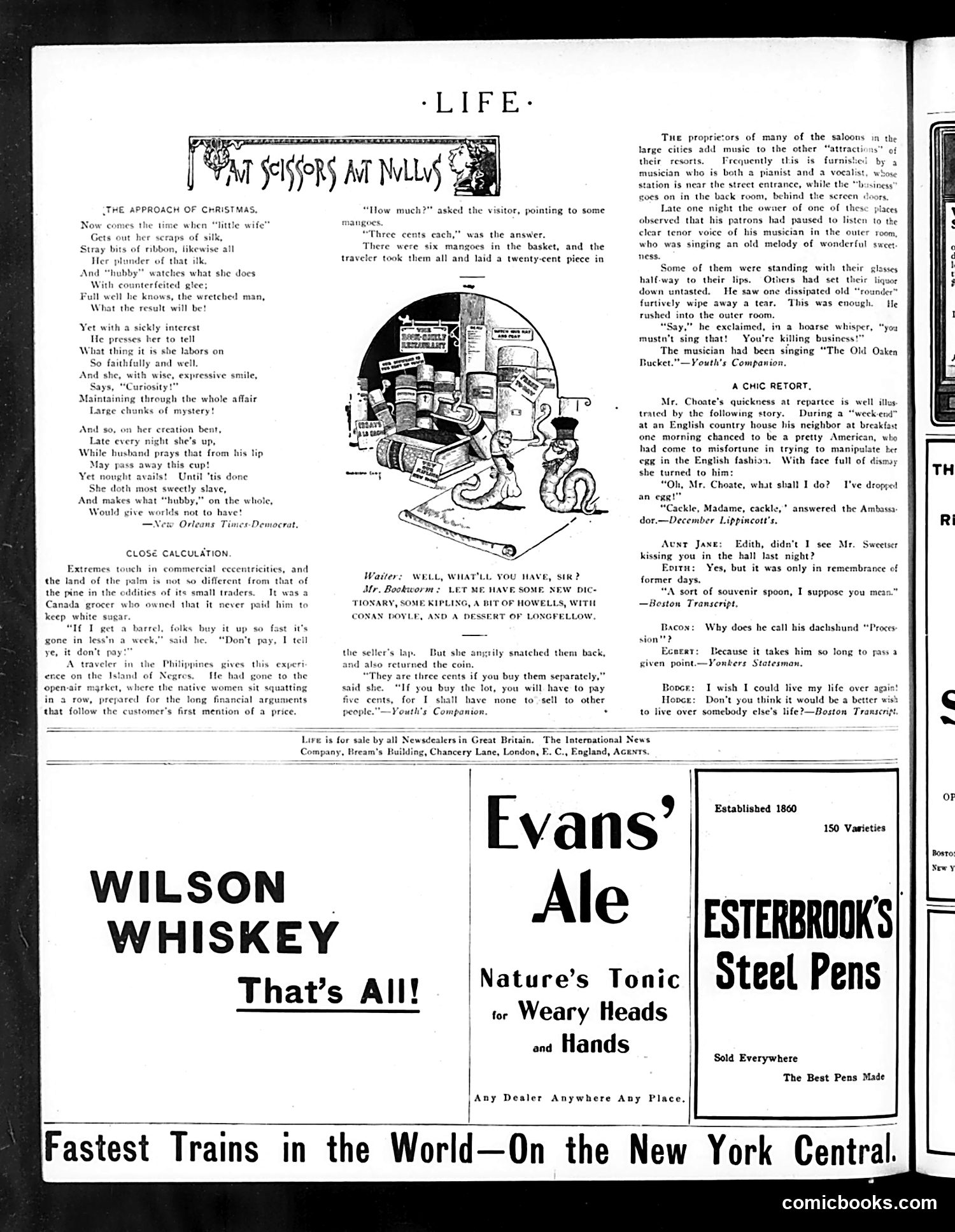
This page from *Life* magazine (a satirical publication) contains several brief humorous pieces satirizing everyday domestic and social situations of the era: **"The Approach of Christmas"** depicts the common domestic tension where wives secretly craft Christmas gifts while husbands feign curiosity but dread receiving unwanted presents—poking fun at traditional gender roles and marital dynamics. **"Close Calculation"** mocks penny-pinching merchants, using a Canadian grocer and Filipino market vendor as examples of traders so focused on quick profits they miss larger gains. The remaining anecdotes satirize various social types: a saloon owner who loses business when sentimental music stops drinking, a witty ambassador (Mr. Choate) making clever repartee about dropped eggs, and various comic misunderstandings about romance and pets. The cartoons and text collectively lampoon middle-class pretensions, marital relationships, and commercial greed—typical *Life* magazine fare mocking Victorian-era social conventions.
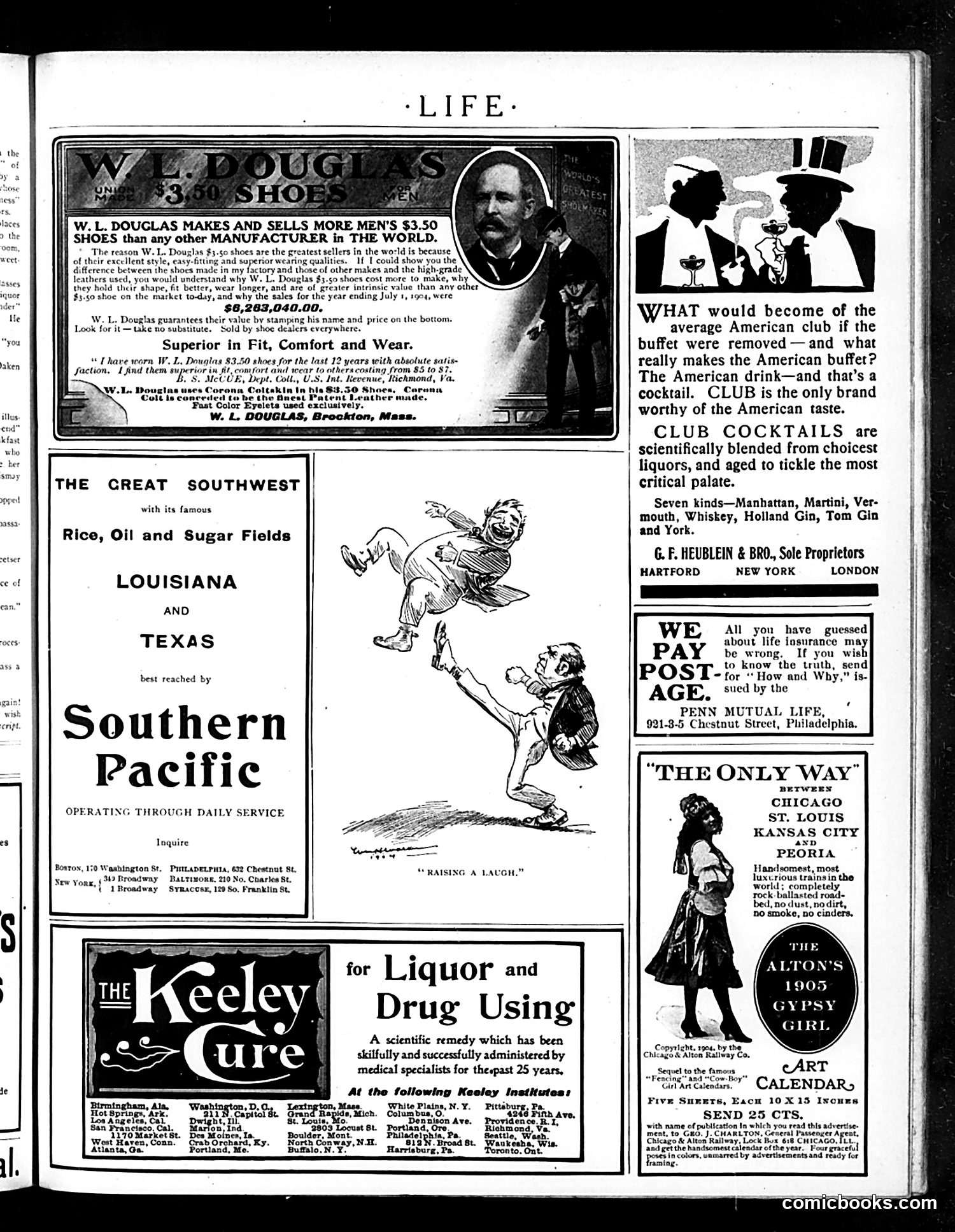
This page is primarily **advertising**, with one notable cartoon. The cartoon titled **"Raising a Laugh"** depicts two figures in exaggerated physical comedy—one man kicking another who's tumbling backward. This appears to be satirizing slapstick humor or vaudeville entertainment popular in the early 1900s, though the specific joke or reference is unclear without additional context. The advertisements reflect early-20th-century consumer culture: W.L. Douglas shoes (emphasizing affordability and durability), Southern Pacific Railroad travel promotion, and notably **The Keeley Cure**—a famous (and controversial) treatment facility claiming to remedy "liquor and drug using" through medical intervention. This reflects Progressive Era concerns about addiction. Also advertised: Club Cocktails (ironic given the Keeley ad), Penn Mutual Life Insurance, and the Alton Railway's "Gypsy Girl" calendar. The overall page illustrates how Life balanced satirical content with commercial messaging, while period advertising reveals contemporary social anxieties about vice, health, and consumption.
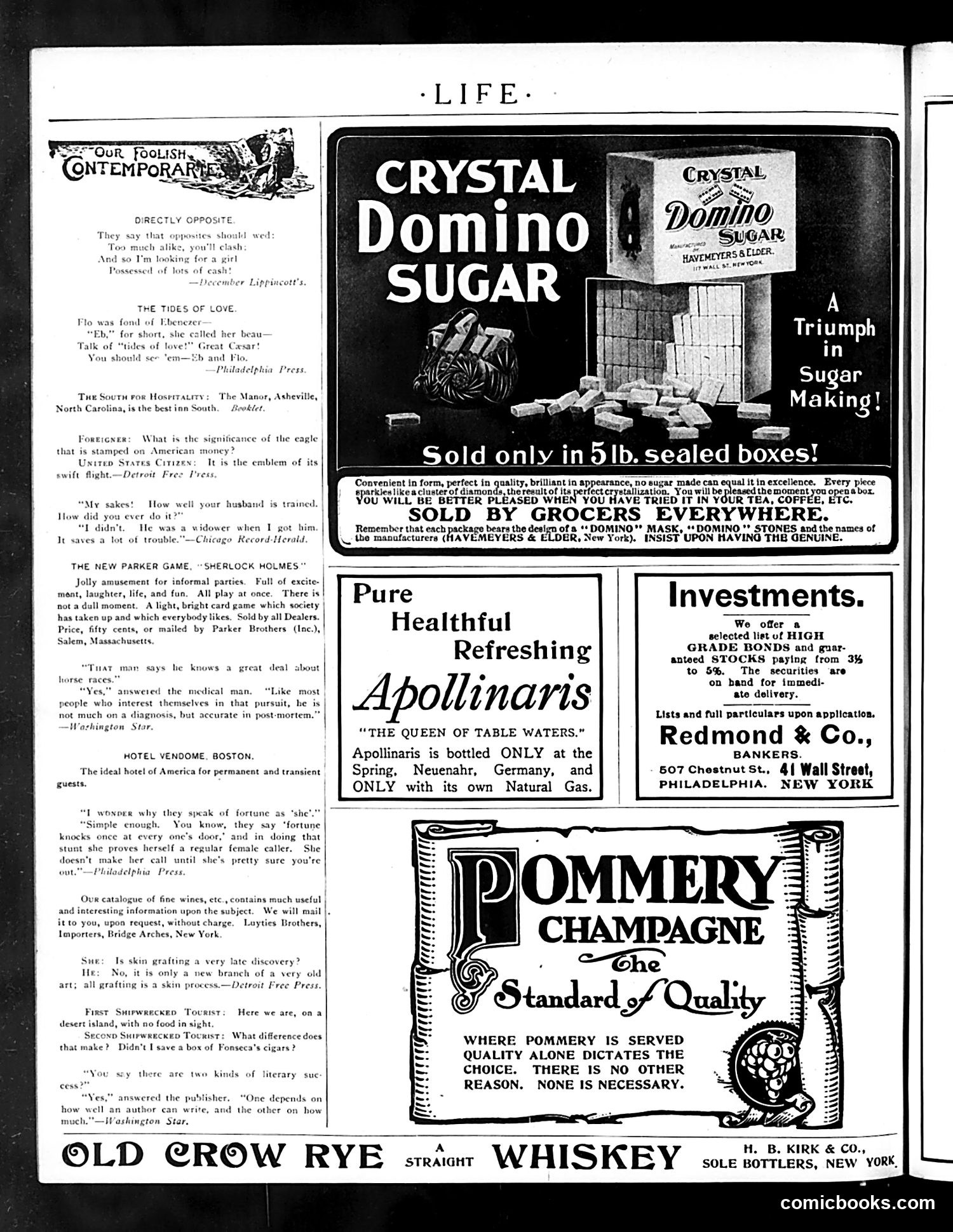
This page is primarily **advertising**, not political satire. The left column contains humorous short jokes and anecdotes—typical of Life's "Our Foolish Contemporaries" humor section—but these are apolitical observations about human nature (marriage training, fortune-telling, literary success). The bulk of the page features advertisements for luxury goods popular among affluent readers: Crystal Domino Sugar, Apollinaris bottled water, Pommery Champagne, Old Crow Rye whiskey, and investment services. These ads reflect early 20th-century consumer culture and aspirational marketing. The brief left-column jokes rely on wordplay and irony rather than political commentary—for example, a widow's husband was "trained" because he was already widowed (needing no adjustment), and a medical man knows horse races only "in post-mortem" analysis (after the fact). No identifiable political figures or events appear. This is a snapshot of period advertising and lighthearted social humor aimed at a genteel audience.
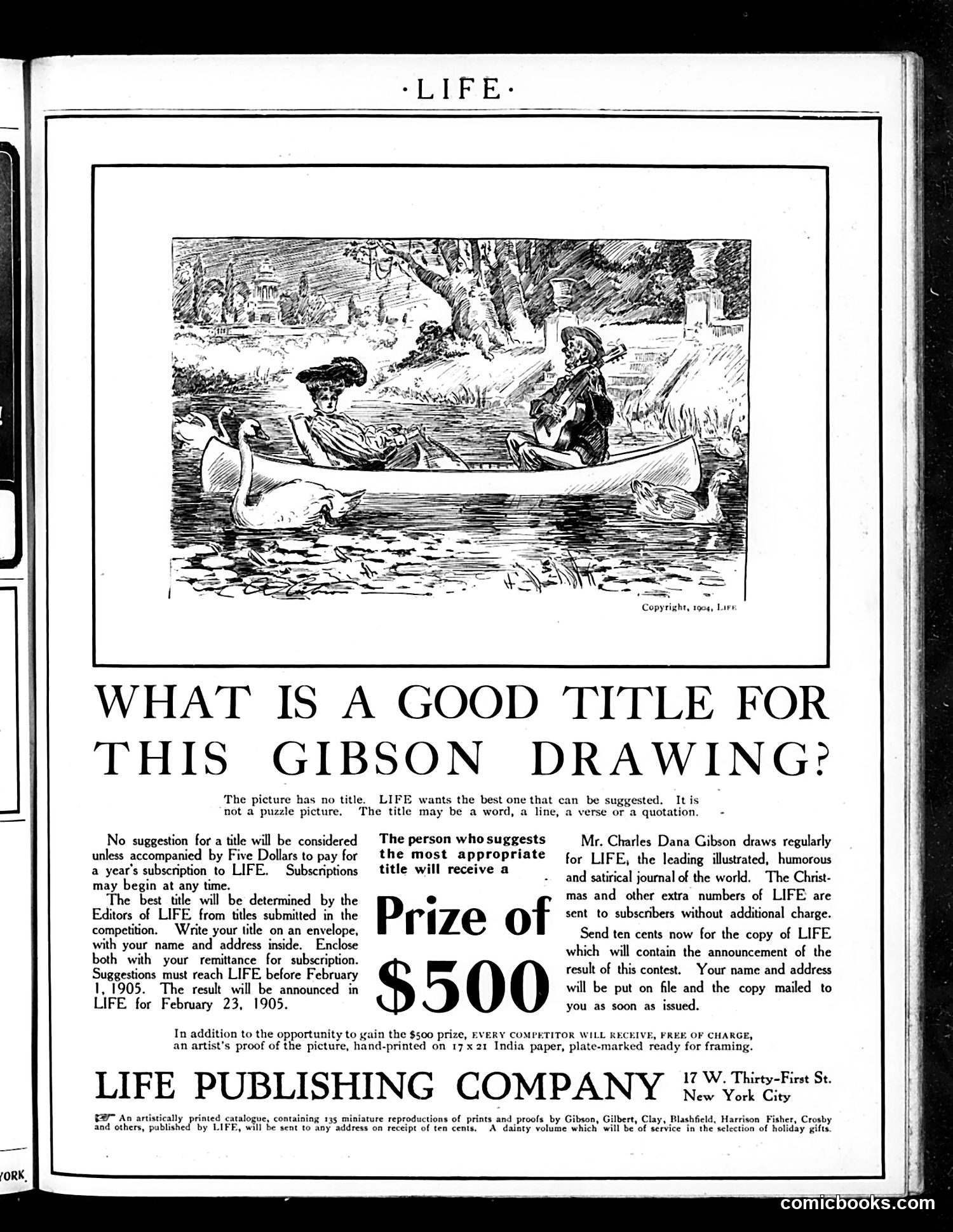
This is primarily an **advertisement/contest page** rather than political satire. Life magazine is soliciting title suggestions for a Charles Dana Gibson drawing depicting two elegantly dressed figures in a canoe on a river, with swans nearby. The cartoon itself appears to be a **romantic scene** — likely depicting courtship or leisure among the upper class, typical of Gibson's "Gibson Girl" era illustrations (early 1900s). The specific figures are unclear without additional context, but the pastoral setting and refined clothing suggest social satire about courtship or romance among the wealthy. The **satire lies in the contest structure itself**: Life charges $5 for a subscription just to *enter* a contest offering a $500 prize, ensuring they profit regardless of winners. This is somewhat tongue-in-cheek marketing — the magazine is openly commercializing reader engagement while pretending to seek artistic input. Modern readers would recognize this as an early example of **participatory marketing** and **crowdsourcing**, where companies profit from unpaid creative labor disguised as contests.
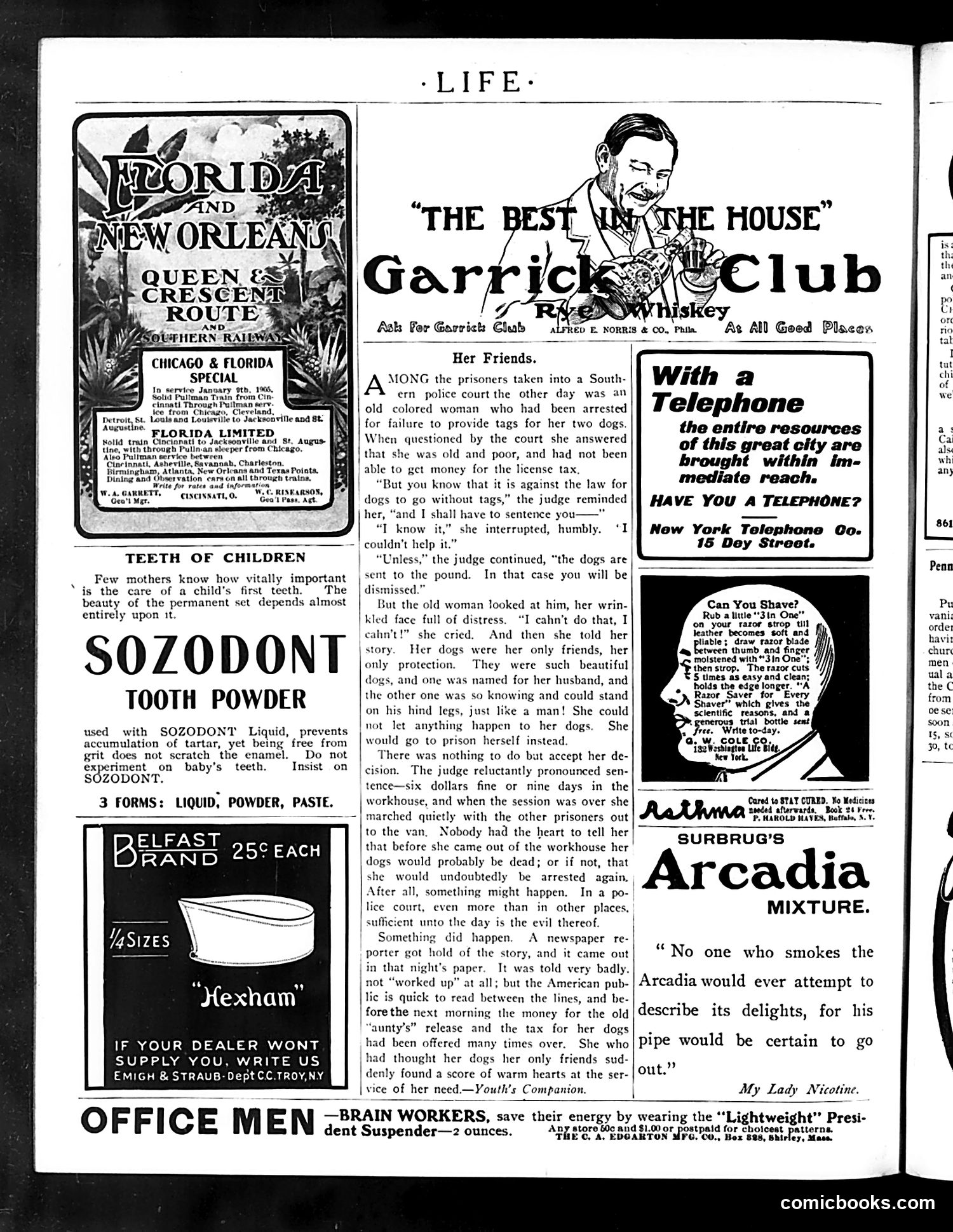
This page is primarily **advertising and serialized fiction**, not political satire. The main feature is a sentimental story titled "Her Friends" from *Youth's Companion*. It recounts how an elderly Black woman in the American South is arrested for not licensing her two dogs. Facing imprisonment, she chooses jail over surrendering her dogs—her only companions and protection. A newspaper reporter publicizes her plight, and readers respond with such generosity that her fine is paid and her dogs are saved. The narrative reflects **early-20th-century sentimentalism** about the bonds between humans and animals, and demonstrates faith in public compassion. The story's setting in the segregated South and its portrayal of a poor Black woman before an unsympathetic judge may reveal period attitudes, though the judge ultimately shows mercy. The page is surrounded by period **product advertisements** (Sozodont toothpaste, train schedules, razors, telephone service), which dominated Life's revenue model.
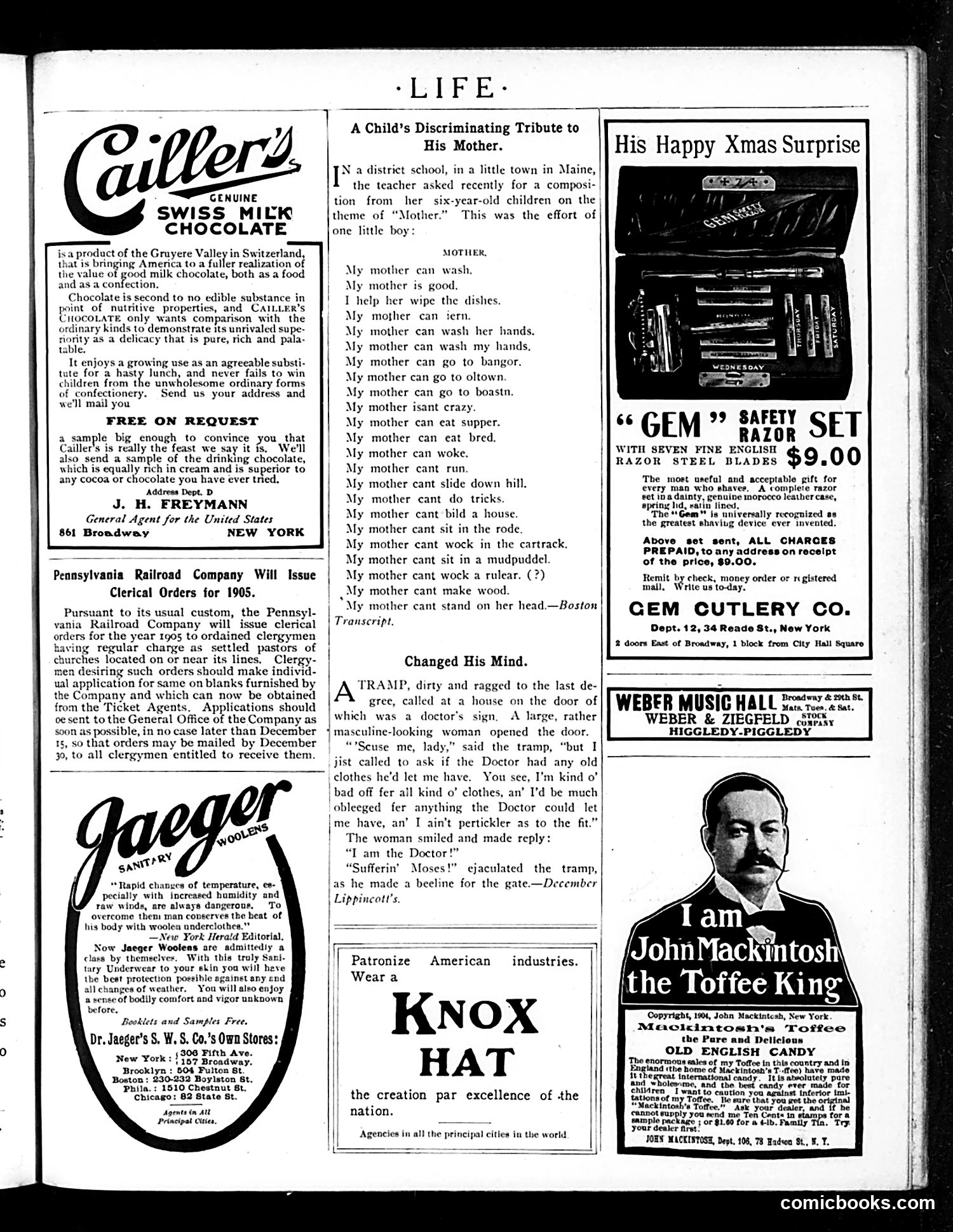
This is primarily an **advertising page** with one humorous anecdote. The main content includes: **The Child's Composition**: A charming piece where a six-year-old from Maine lists his mother's capabilities in simple, misspelled language ("woke" for "work," "iern" for "iron"). The humor derives from the child's innocent, literal catalog of domestic tasks—what mothers *can* do versus what they *cannot* (notably, she "isant crazy" and cannot "slide down hill"). This gentle satire of childhood observation was typical of Life's sentimental humor. **"Changed His Mind"**: An incomplete anecdote about a ragged tramp visiting a doctor's house, mistaking the doctor's masculine-looking wife for the doctor himself. The joke setup plays on gender assumptions. The page is otherwise filled with period advertisements for Cailler's Swiss chocolate, Jaeger woolens, Pennsylvania Railroad clergy passes, Knox hats, and a "Gem Safety Razor Set"—typical early-1900s consumer goods marketing. No significant political content is present.
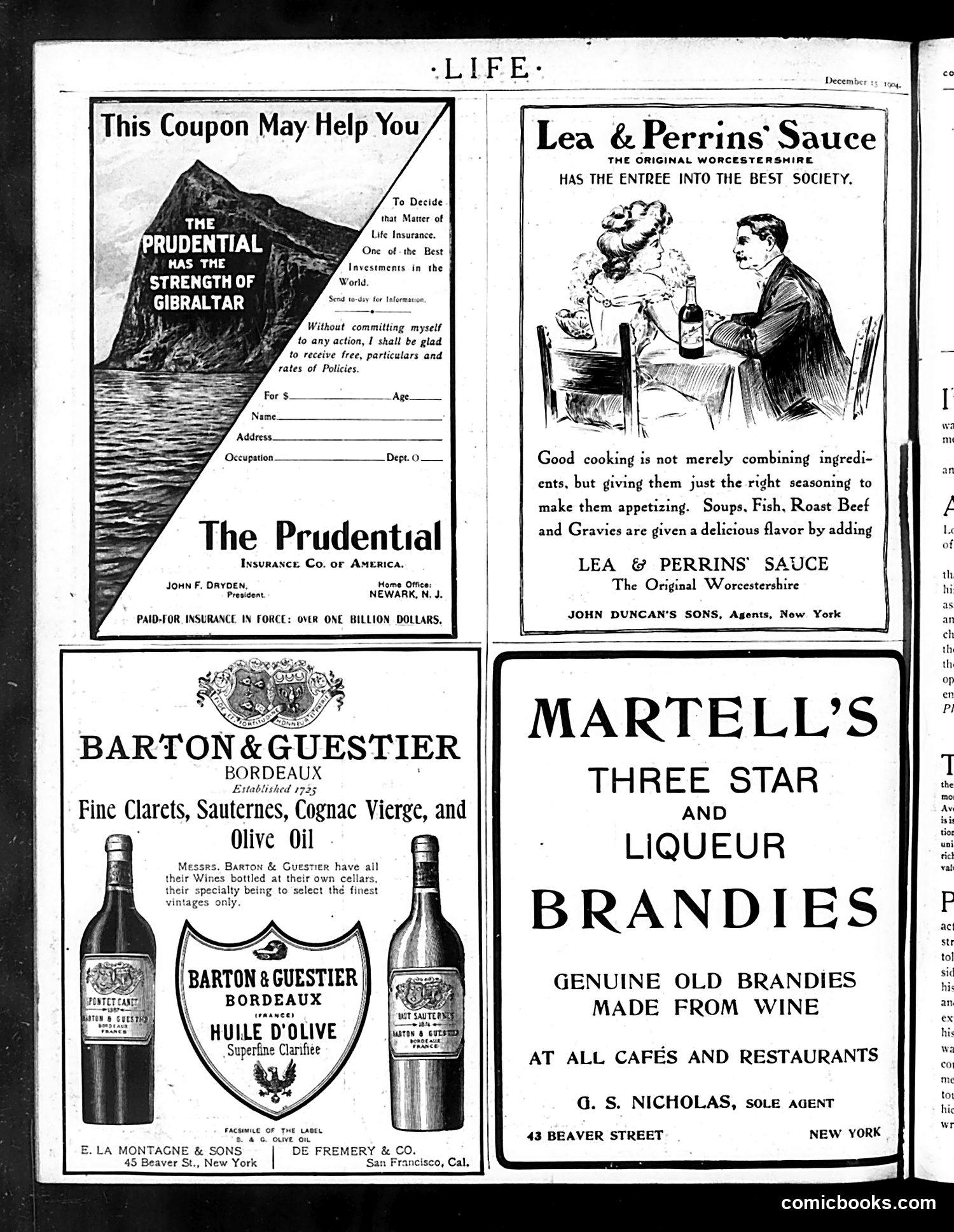
This page is primarily **advertising**, not editorial satire. It contains four luxury product advertisements targeting wealthy Americans: 1. **The Prudential Insurance** (top left): Uses the Rock of Gibraltar metaphor—a symbol of strength and permanence—to market life insurance as a solid investment. The coupon format invites readers to request information without obligation. 2. **Lea & Perrins Sauce** (top right): A humorous social-climbing pitch: the sauce claims to have "the entree into the best society," personified by a couple dining together. The joke is that proper seasoning grants social acceptance. 3. **Barton & Guestier** (bottom left): French wine merchants advertising fine claret, cognac, and olive oil imported directly from their own cellars—emphasizing authenticity and premium selection. 4. **Martell's Brandy** (bottom right): Markets "genuine old brandies" available at upscale establishments. These ads collectively target wealthy readers' aspirations for refined living, fine dining, financial security, and continental sophistication—typical of *Life's* affluent audience during the Gilded Age.
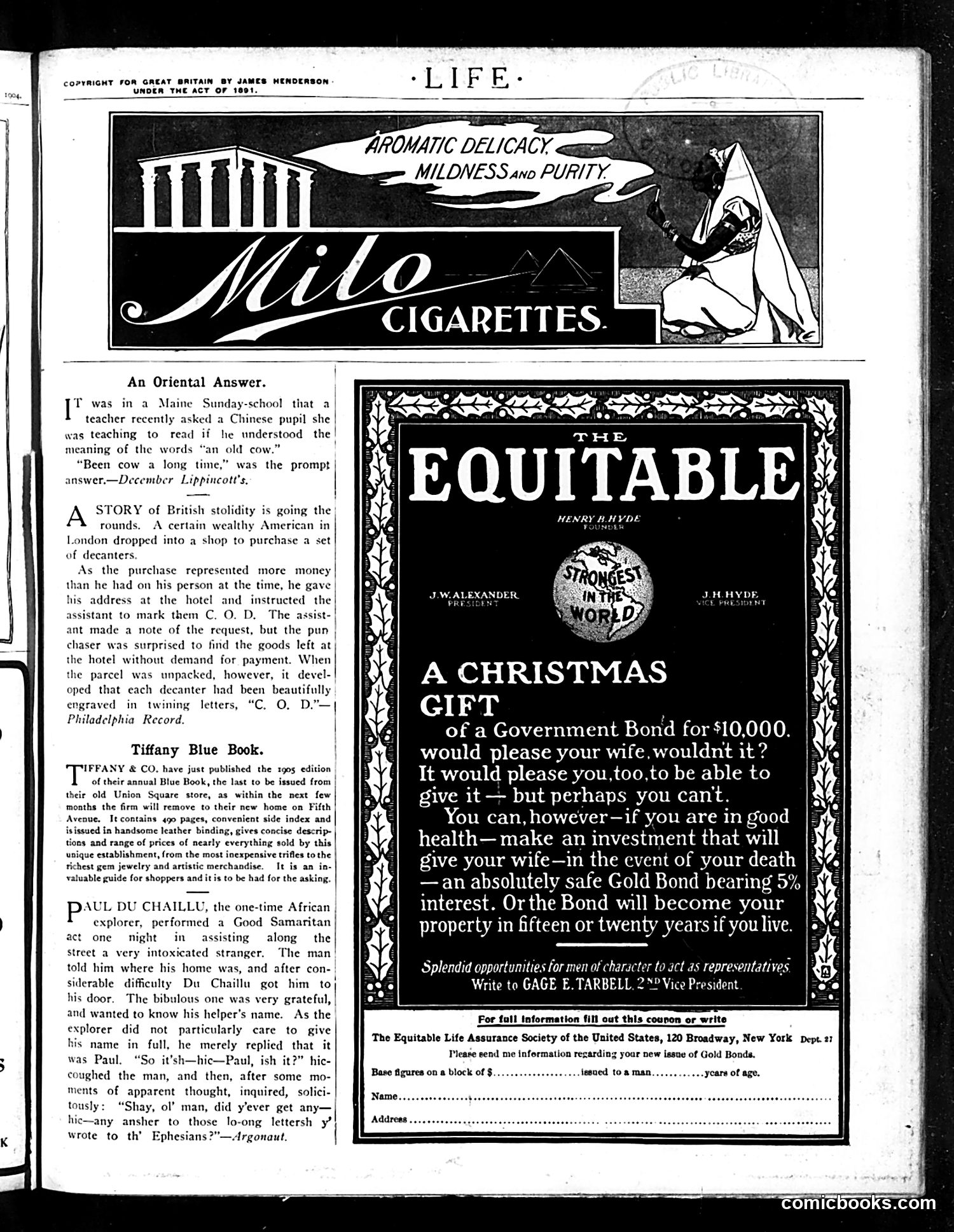
This page mixes humor pieces with period advertising. The three short anecdotes ("An Oriental Answer," "British Stolidity," "Du Chaillu") are ethnic/stereotypical jokes typical of early 1900s American humor—playing on presumed Chinese literalism, British coldness, and drunken behavior for laughs. The Milo Cigarettes advertisement at top uses orientalist imagery (draped figure) to sell "delicacy, mildness and purity"—marketing tactics common to the era that weaponized exotic stereotypes. The dominant advertisement is for **The Equitable Life Assurance Society's Gold Bond**—a life insurance product pitched as a Christmas gift. It explicitly targets men's financial anxiety: "you can't" afford a $10,000 government bond, but you *can* afford life insurance that protects your wife. This reflects genuine Edwardian-era concerns about male breadwinner responsibility and family security. The Tiffany Blue Book notice and Paul Du Chaillu anecdote are minor filler content from contemporary publications.
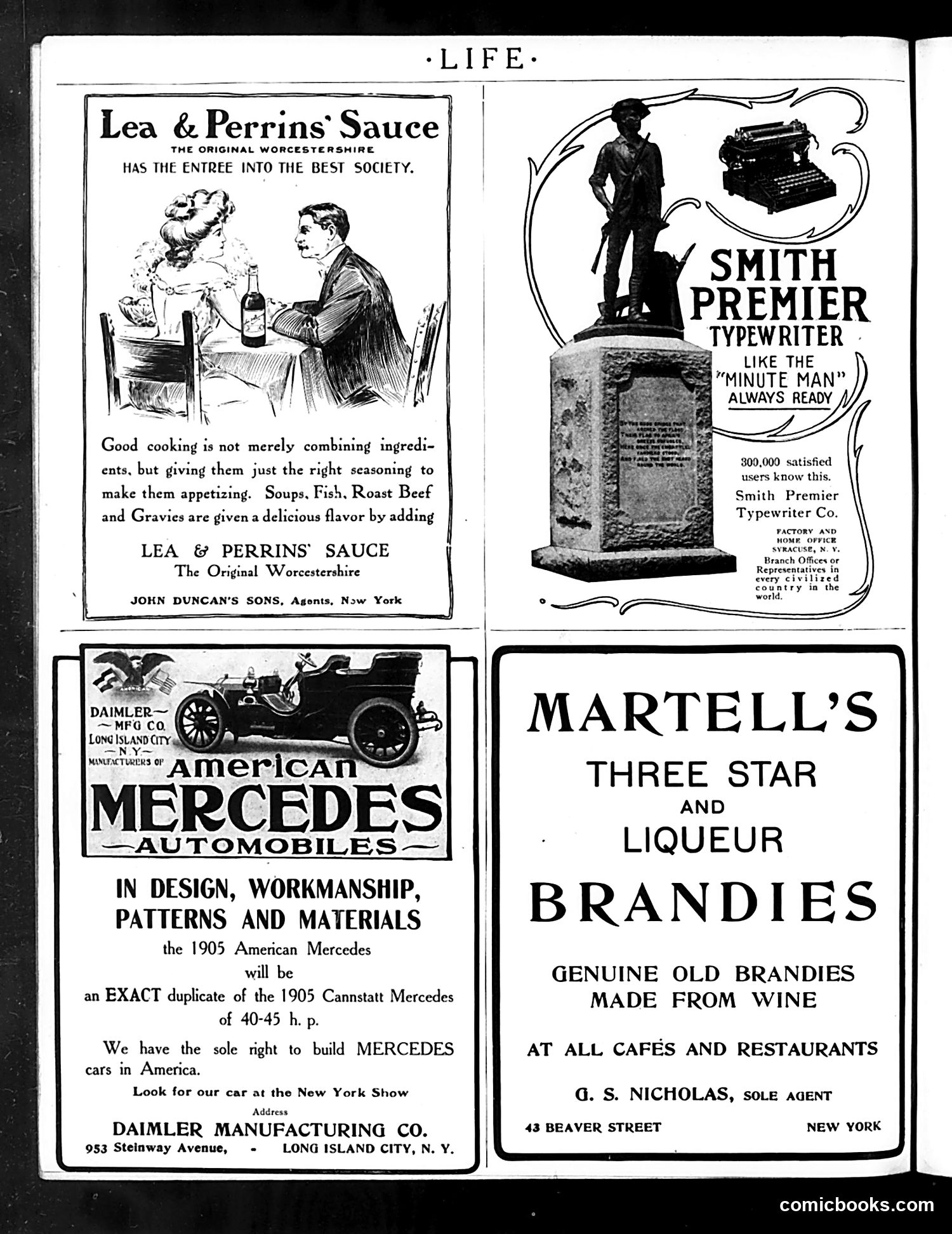
This is primarily an **advertising page**, not satirical content. It contains four unrelated product advertisements from approximately 1905: 1. **Lea & Perrins Sauce** — promotes Worcestershire sauce as essential to upper-class dining, using a sketch of well-dressed diners 2. **Smith Premier Typewriter** — emphasizes reliability with a "Minute Man" comparison and claims 300,000 satisfied users globally 3. **American Mercedes Automobiles** — announces that Daimler Manufacturing will build Mercedes cars in America as exact duplicates of the German 1905 Cannstatt model 4. **Martell's Brandy** — advertises French brandy available at restaurants and cafés The page reflects early 1900s consumer culture: imported luxury goods (sauce, brandy), emerging technology (typewriters), and prestigious automobiles. No political satire or caricature is evident—this is straightforward commercial promotion typical of *Life* magazine's revenue model.
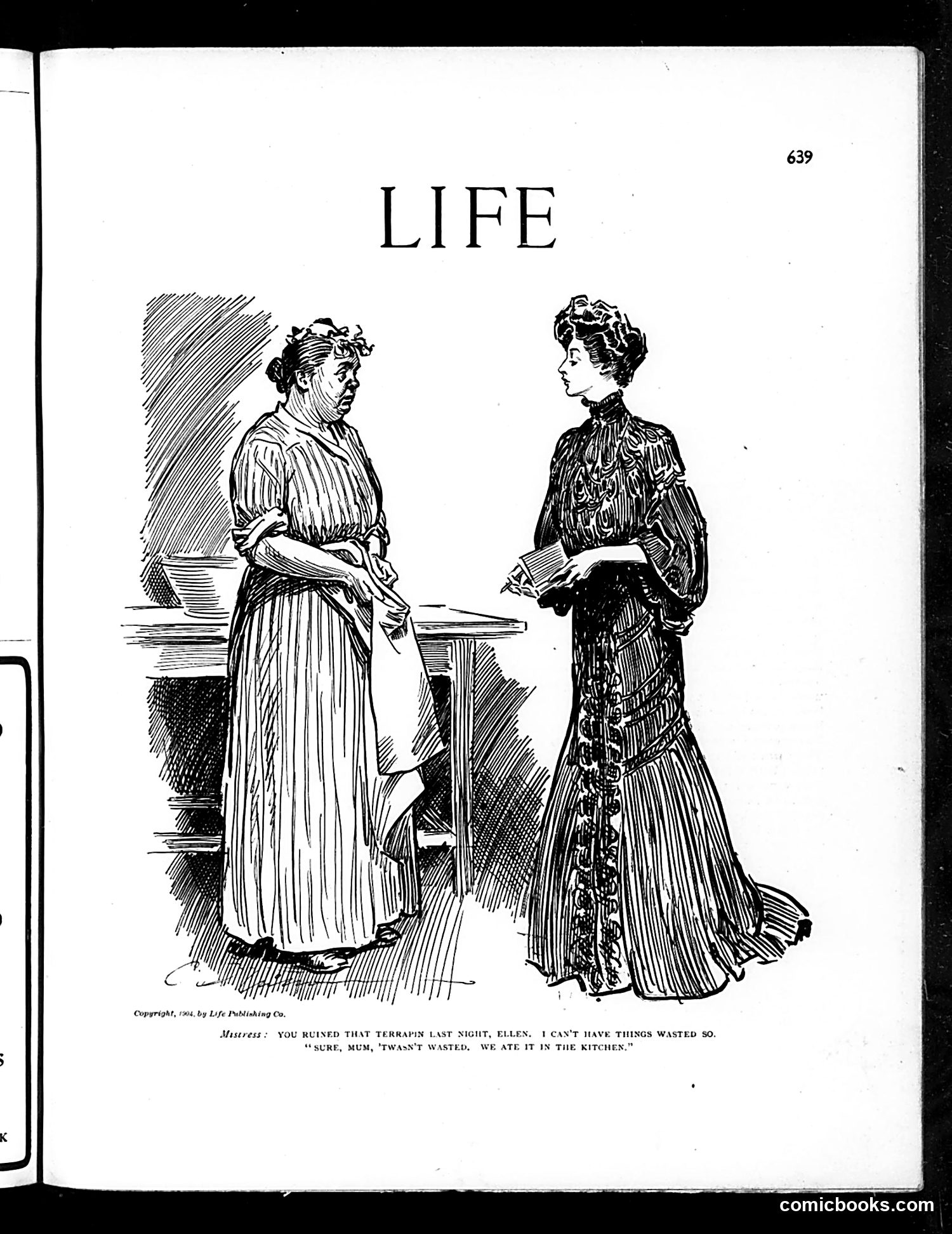
This is a domestic humor cartoon depicting a mistress scolding her servant Ellen about wasting food. The mistress criticizes Ellen for ruining a terrapin (a type of turtle, considered a delicacy in early 20th-century cuisine) the previous night, then contradicts herself by saying she can't have things wasted—yet they ate it in the kitchen anyway. The satire targets wealthy households' attitudes about servants and food waste. The mistress's complaint is illogical: she's upset about the ruined dish but admits they consumed it. This mocks the pretentious class consciousness of affluent homeowners who obsess over propriety while being wasteful themselves. The cartoon's humor derives from exposing this hypocrisy about household management and servant relations.
This page discusses President Theodore Roosevelt's recent message to Congress, which covered forty-five topics but stirred controversy primarily on two issues: his assertion of U.S. "police power" over hemispheric nations failing to maintain order and pay debts, and his recommendation to grant the Interstate Commerce Commission power to regulate railroad freight rates and eliminate rebates. The page notes Roosevelt faced competition for public attention from Thomas Lawson (a Boston financier publicizing his views through paid newspaper space) and especially Mrs. Cassie Chadwick of Cleveland, whose financial schemes generated sensational newspaper coverage. The text suggests Lawson grew frustrated by Chadwick's superior media attention and "butted" his stock holdings (Amalgamated Copper) in retaliation—a reference to his aggressive financial maneuvering against market manipulation.
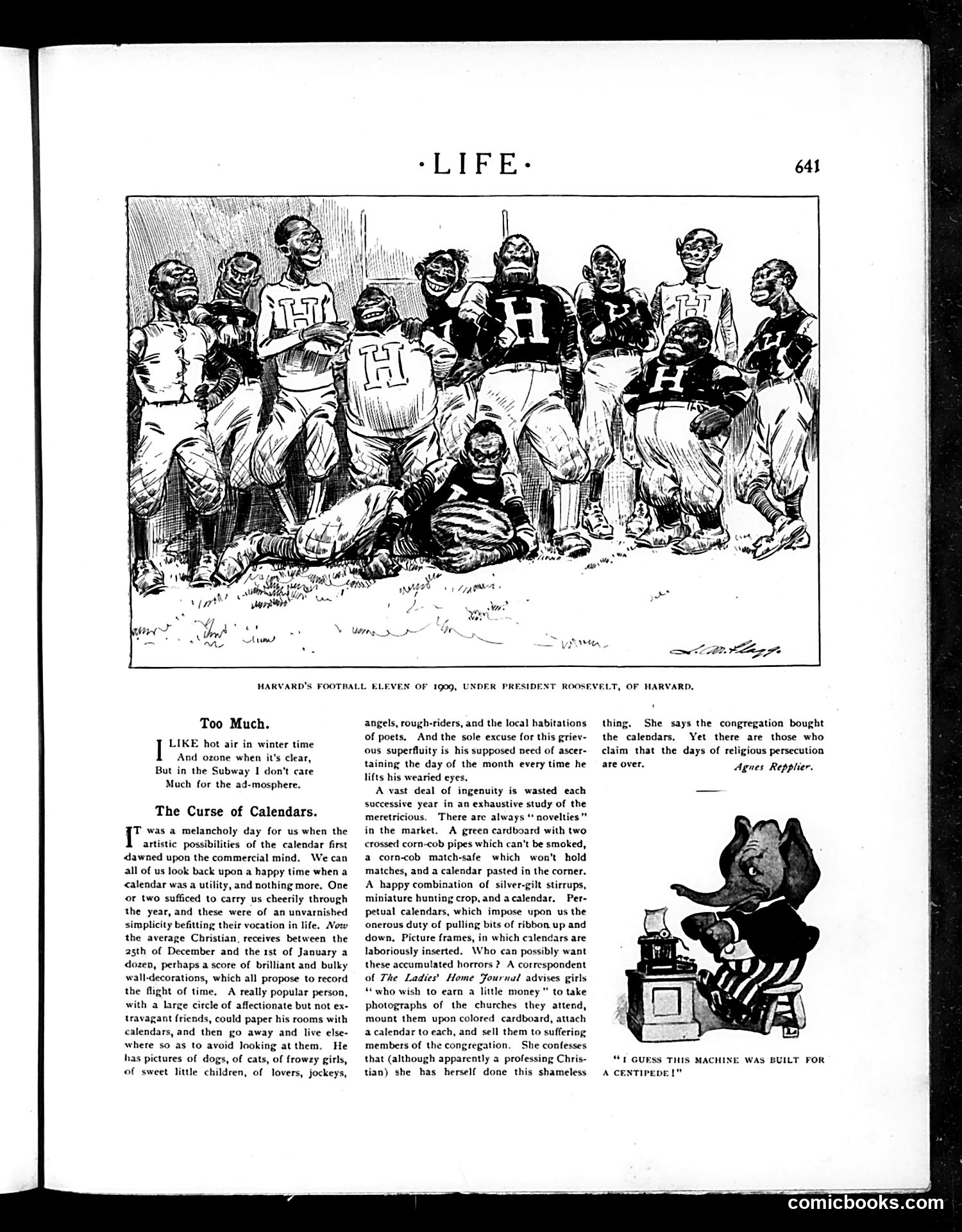
**Main Cartoon (Top):** Shows Harvard's 1909 football team as caricatured figures wearing "H" jerseys. The crude, exaggerated facial features appear to employ racial stereotyping common to early 1900s satirical illustration—a troubling historical norm. The satire likely mocks the team's performance that season or comments on collegiate athletics culture. **Text Content:** Two separate pieces: 1. **"Too Much"**: A humorous complaint about excessive advertising in subway stations ("ad-mosphere"). 2. **"The Curse of Calendars"** by Agnes Repplier: Social satire targeting the commercialization of calendars. The author critiques how novelty calendars—decorated with dogs, children, hunting themes, church photographs—have become ubiquitous gifts despite serving no practical purpose beyond showing dates. She particularly mocks women earning money by photographing churches and selling calendar-adorned versions, calling it shameless while noting the congregation still bought them. **Modern Relevance:** This satirizes consumer culture excess and gift-giving obligations—concerns that resonate today with holiday commercialization complaints.
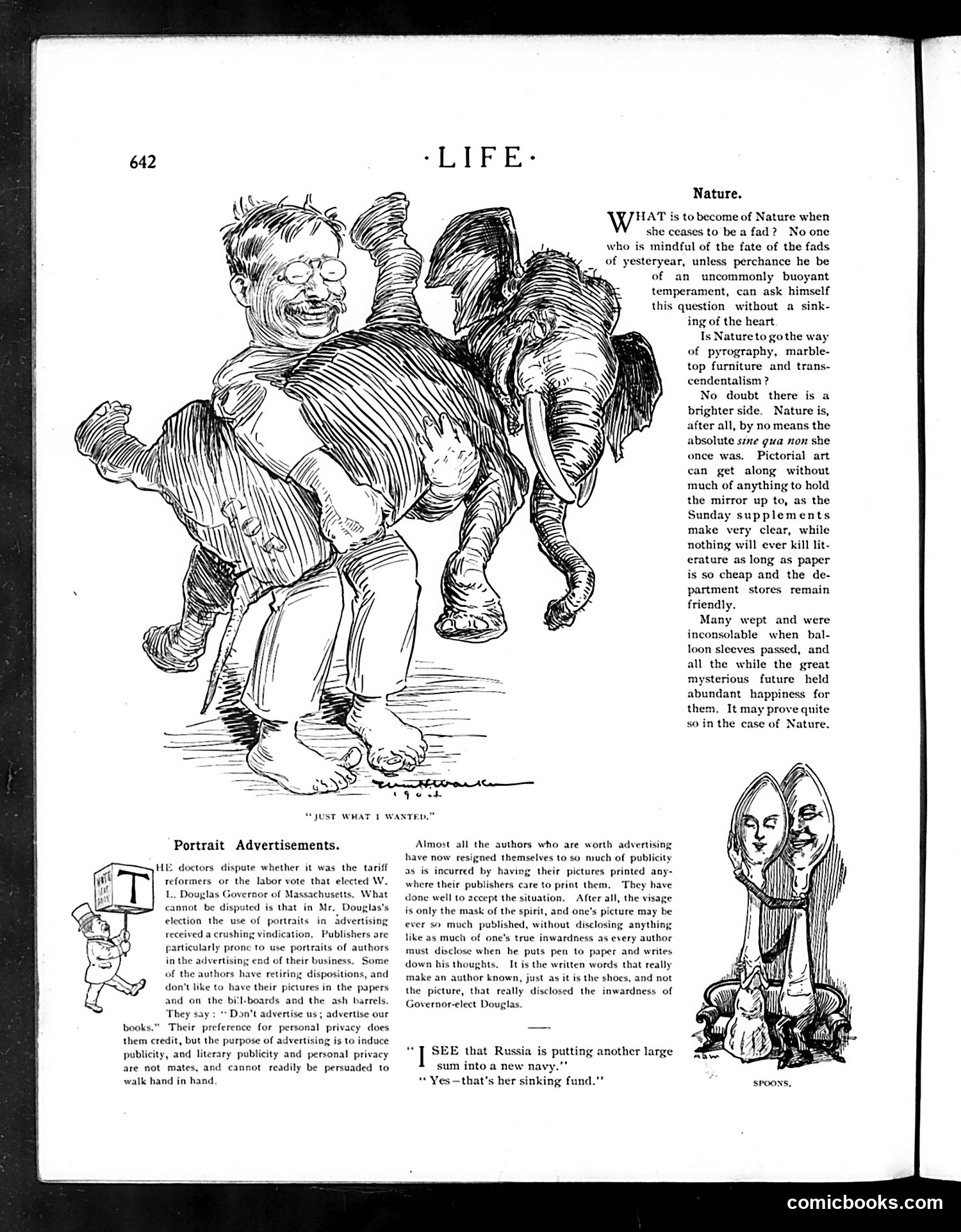
This page contains two satirical pieces: **Main Cartoon ("Just What I Wanted"):** A caricatured figure rides an elephant labeled "Nature," celebrating it as a fad. The satire mocks the contemporary fashion for celebrating "Nature"—suggesting it's a temporary trend destined to fade like other passing fads (balloon sleeves, pyrography). The essay questions what will happen to Nature's cultural relevance once this enthusiasm passes, cynically noting that literature and pictorial art survive regardless because they're cheap to produce and department stores support them. **"Portrait Advertisements":** References W.L. Douglas's election as Massachusetts Governor, attributing his success to portrait advertising—validating the practice of using authors' faces in ads despite some authors' privacy preferences. The piece argues written words, not pictures, truly reveal an author's character, then jokes that Douglas's shoes (not his portrait) best revealed his "inwardness." **"Sinking Fund" Joke:** A brief pun about Russia's naval spending—calling it a "sinking fund" because Russian ships sink. All three pieces employ ironic humor typical of Life's satirical approach.
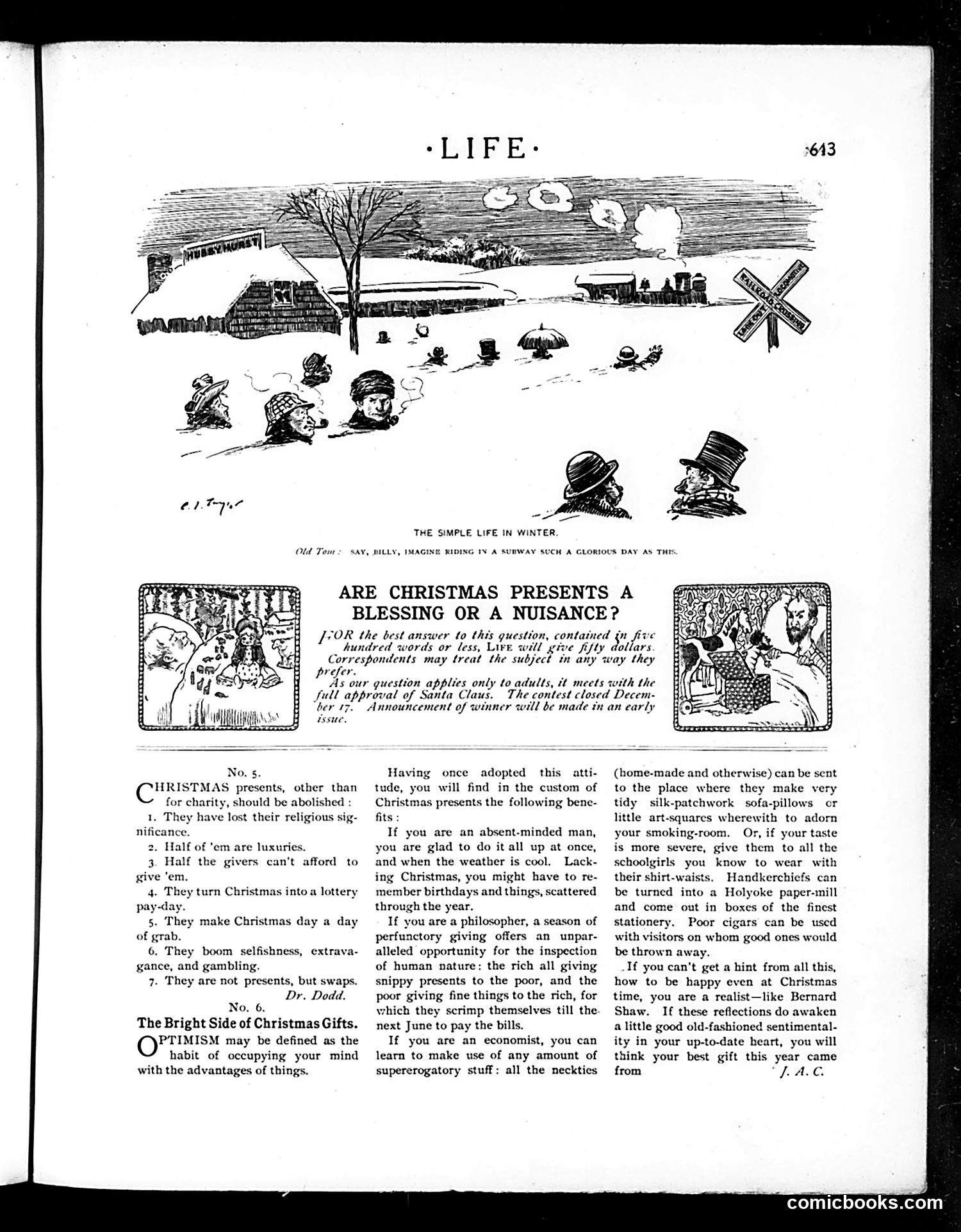
This page presents a **contest and editorial debate** about Christmas gift-giving, framed as social commentary typical of early 20th-century American magazines. **The Cartoon ("The Simple Life in Winter"):** A rural winter scene showing people enjoying outdoor activities rather than shopping, captioned with dialogue suggesting simple pleasures beat urban consumption—a dig at modern materialism. **The Debate:** The page juxtaposes two positions: - **Against gifts** (Dr. Dodd's view): Christmas presents have become commercialized, encourage selfishness, and burden those who can't afford them—turning a religious holiday into economic theater. - **For gifts** (the "Optimism" counterargument): Gifts offer practical benefits—consolidating gift-giving, revealing human nature, and allowing creative reuse of unwanted items (converting neckties into sofa pillows, etc.). The satire mocks both positions subtly, especially the "optimist's" tortured rationalizations. References to Bernard Shaw suggest intellectual debates of the era. This reflects genuine Progressive-era concern about commercialism's erosion of authentic values.
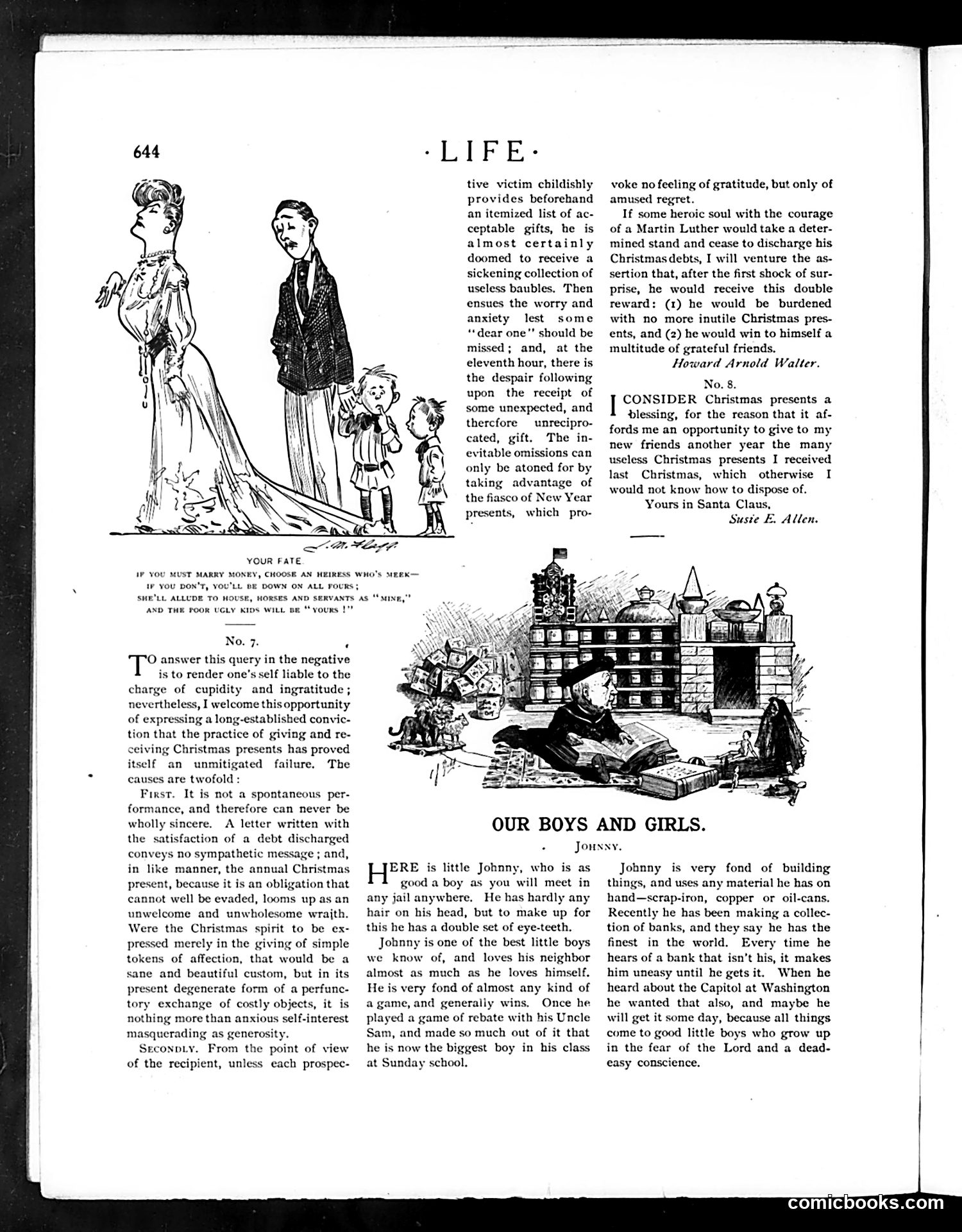
This page contains satirical commentary on Christmas gift-giving customs, paired with a humorous character sketch. **Top cartoon ("Your Fate"):** Illustrates the social anxiety surrounding mandatory gift exchange. The image shows a well-dressed woman with children, captioned with a cynical marriage warning about choosing a wealthy heiress to avoid financial ruin. **Main satire (Articles):** Two competing letters debate whether Christmas presents represent genuine generosity or obligatory hypocrisy. One writer argues the practice has "proved itself an unmitigated failure" because gifts are duty-driven rather than sincere. The counterargument defends presents as opportunities to regift unwanted items—itself a joke about the system's absurdity. **"Our Boys and Girls" section:** A mock-heroic profile of "Johnny" uses ironic praise to satirize American materialism and ambition. Johnny's collecting of banks and desire for the Capitol building, combined with his willingness to exploit his Uncle Sam in games, appears to critique both childhood greed and broader capitalist values. The phrase "dead-easy conscience" suggests satirical disapproval of amoral success-seeking.
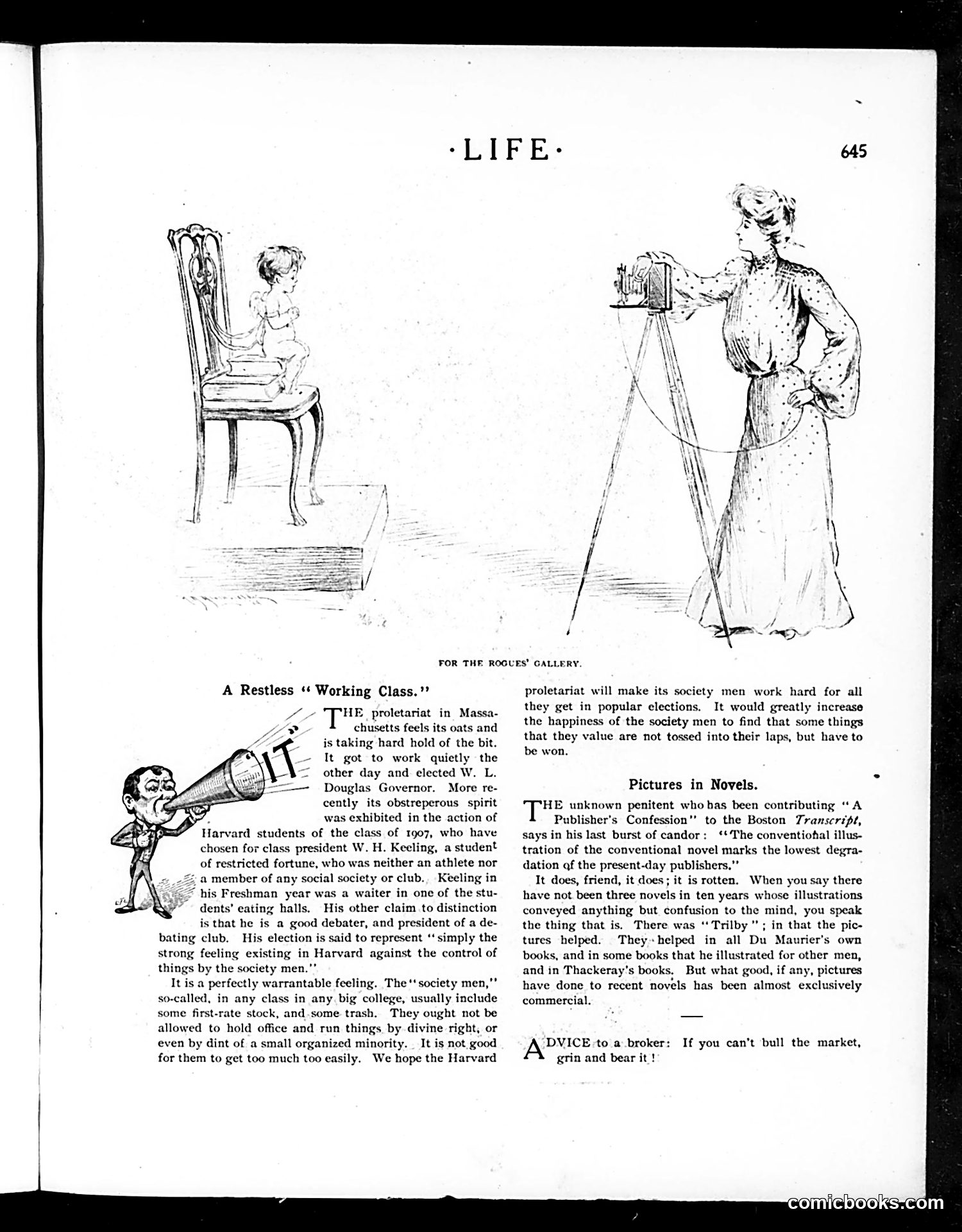
This page satirizes class tensions at Harvard and broader American society circa 1907. The main cartoon mocks Harvard's "society men"—wealthy, socially connected students who traditionally monopolized leadership positions. The satire celebrates the election of W. H. Keeling, a working-class student who earned his way through college as a dining-hall waiter, as class president. This represented a democratic revolt against aristocratic privilege. The piece frames this as part of a larger "proletariat" movement in Massachusetts, referencing W. L. Douglas's gubernatorial election, suggesting class-based political awakening. The cartoon's sketch shows a woman with a camera/telescope (representing the "working class" perspective) observing an elegantly-dressed society figure—visualizing the clash between working and privileged classes. A secondary section criticizes cheap novel illustrations as commercially-driven rather than artistically meaningful, using similar class critique: publishers exploit readers rather than serve them well. The closing financial advice ("grin and bear it") is cynical commentary on market manipulation.
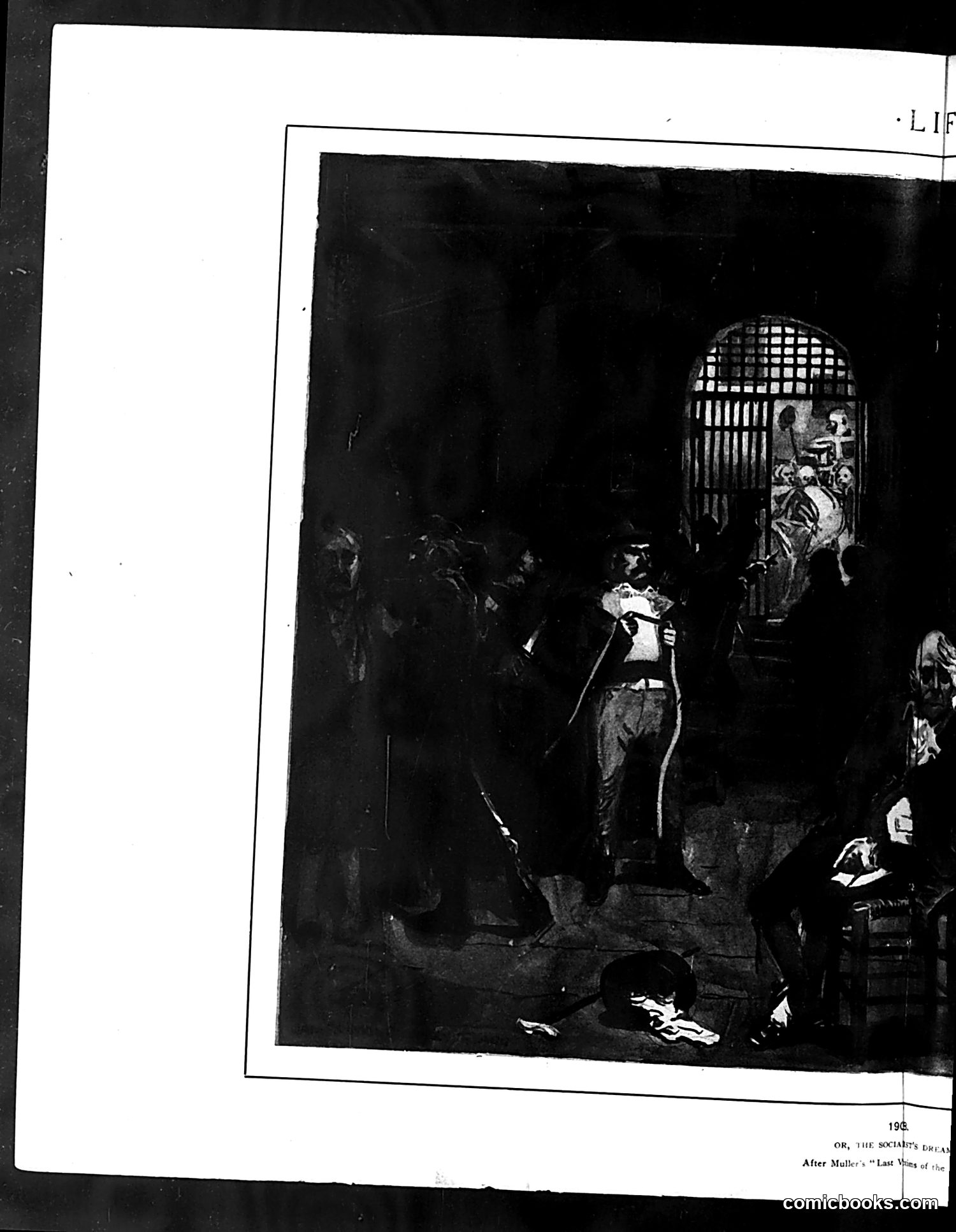
This page appears to be from *Life* magazine and shows a dramatic black-and-white illustration with the caption reference "After Mallery's 'Last Vow of the...'" (text cut off). The image depicts what seems to be a historical or theatrical scene set in a dungeon or prison, with figures in period costume. A woman in a white dress stands centrally, while guards or soldiers in armor surround her. The scene suggests imprisonment or execution. However, **the OCR text is too corrupted to read the actual caption or title**, making it impossible to identify the specific historical event, literary reference, or political satire being depicted. Without readable text, I cannot reliably explain what this cartoon means to a modern reader or identify the specific figures involved. The artistic style and composition suggest drama and tension, but the satirical point remains unclear.
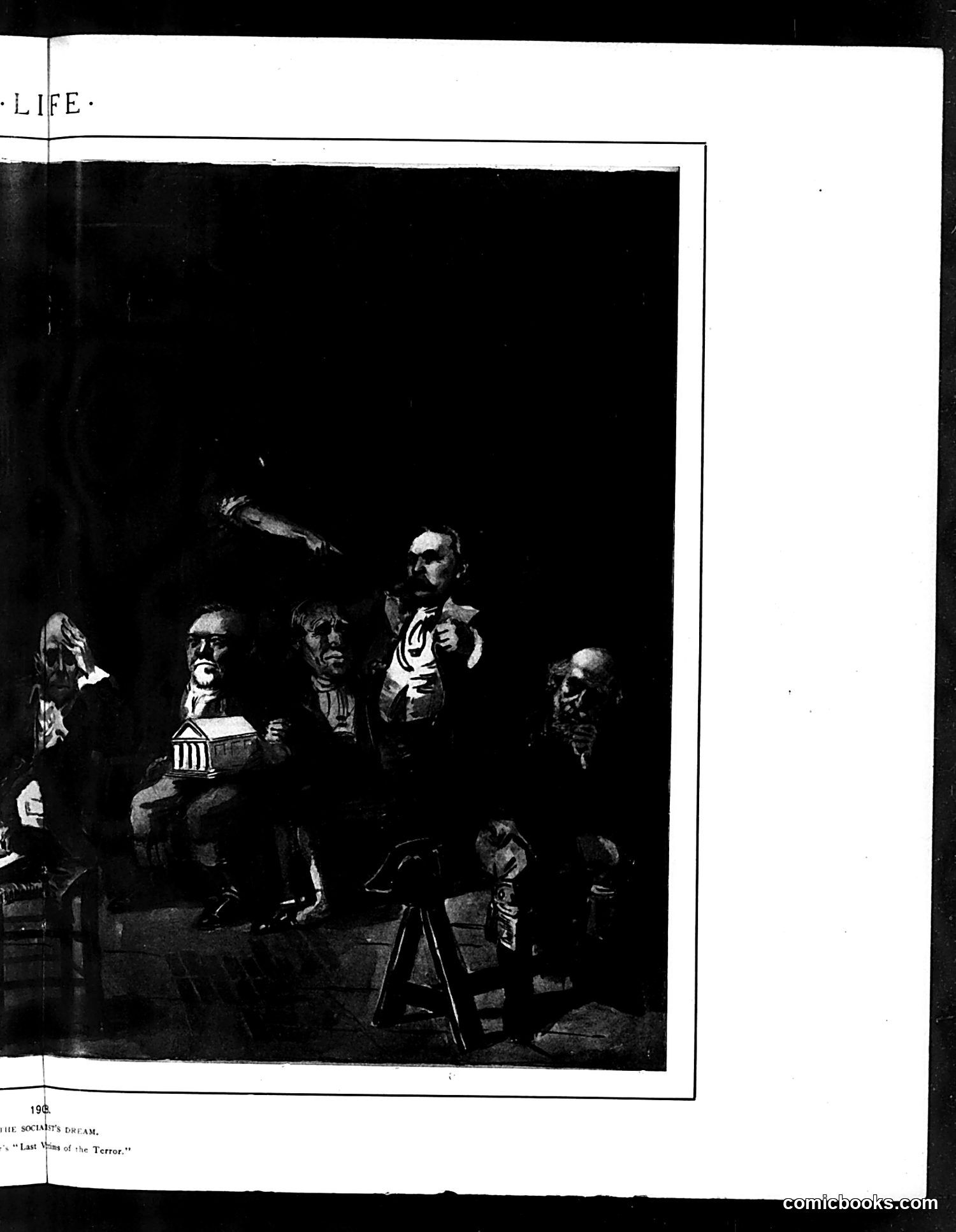
This page from *Life* magazine shows a dramatic theatrical or operatic scene rendered in high-contrast black and white. The image depicts several figures in military or formal dress uniforms arranged in a darkened interior space, appearing to be engaged in some kind of formal or confrontational scene. The visible text reference is fragmentary—mentioning "THE SOCIALIST'S DREAM" and what appears to be "Last Rites of the Terror," suggesting this satirizes socialist or revolutionary politics through dramatic theatrical staging. However, without the complete caption or publication date, I cannot definitively identify the specific political figures caricatured or the exact historical event being mocked. The formal military dress and theatrical presentation suggest satire of political pretension or revolutionary movements, but precise identification requires additional context.
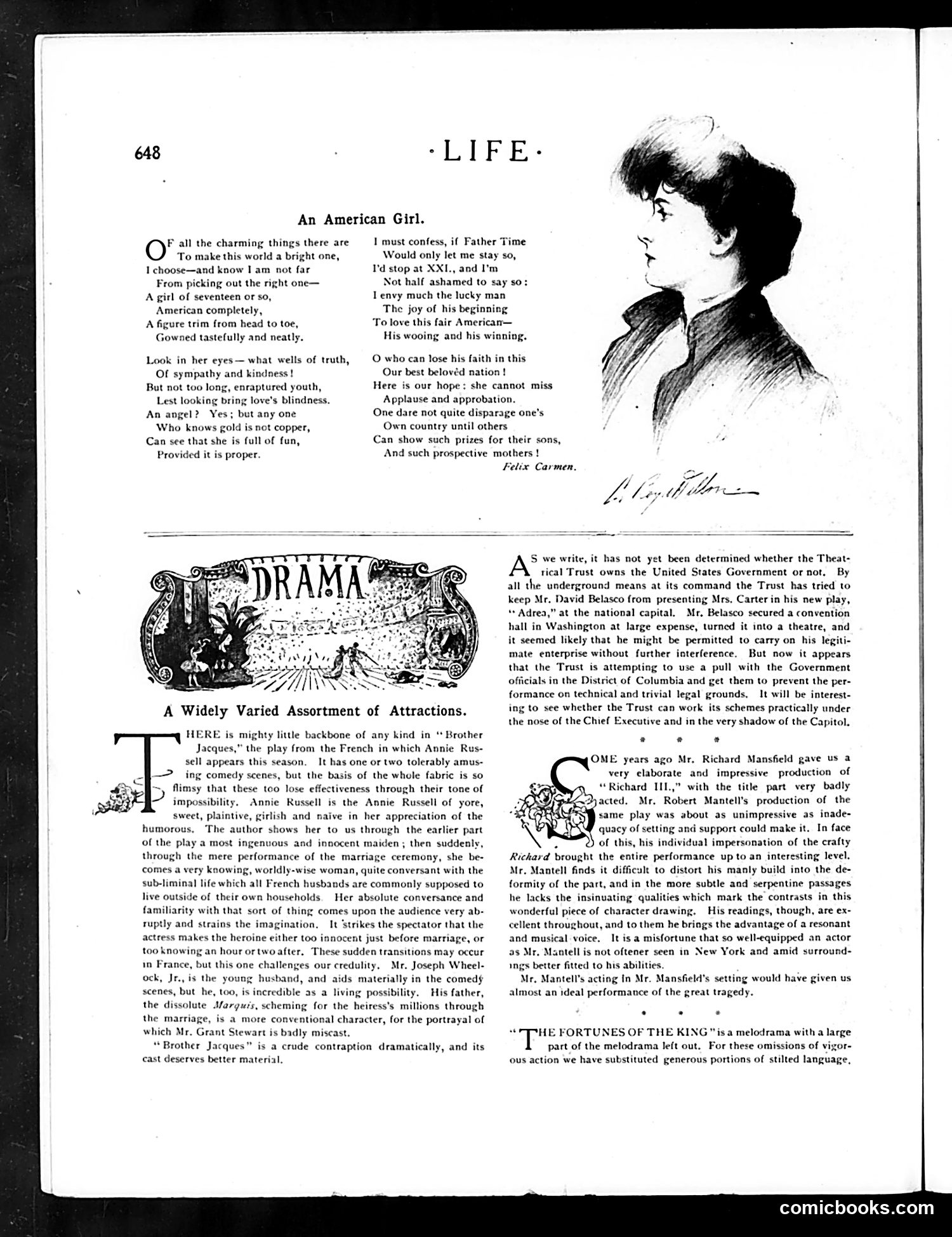
This page from *Life* magazine contains a poem praising the American girl, followed by theater reviews. **"An American Girl"** is a sentimental poem by Felix Carmen celebrating young American womanhood—specifically an idealized 21-year-old ("XX1.") embodying virtue, intelligence, humor, and proper decorum. The poem appeals to nationalism, positioning American girls as the nation's hope and future mothers, implicitly superior to their European counterparts. The accompanying sketch shows a fashionably dressed young woman in profile. The **drama section** reviews contemporary theatrical productions, including criticism of "Brother Jacques" with actress Annie Russell, and reports on a conflict between impresario David Belasco and the **Theatrical Trust**—a monopolistic booking organization controlling American theater distribution. The article suggests the Trust is attempting to prevent Belasco's independent production of "Adrea" in Washington, D.C., raising questions about corporate influence over government enforcement.
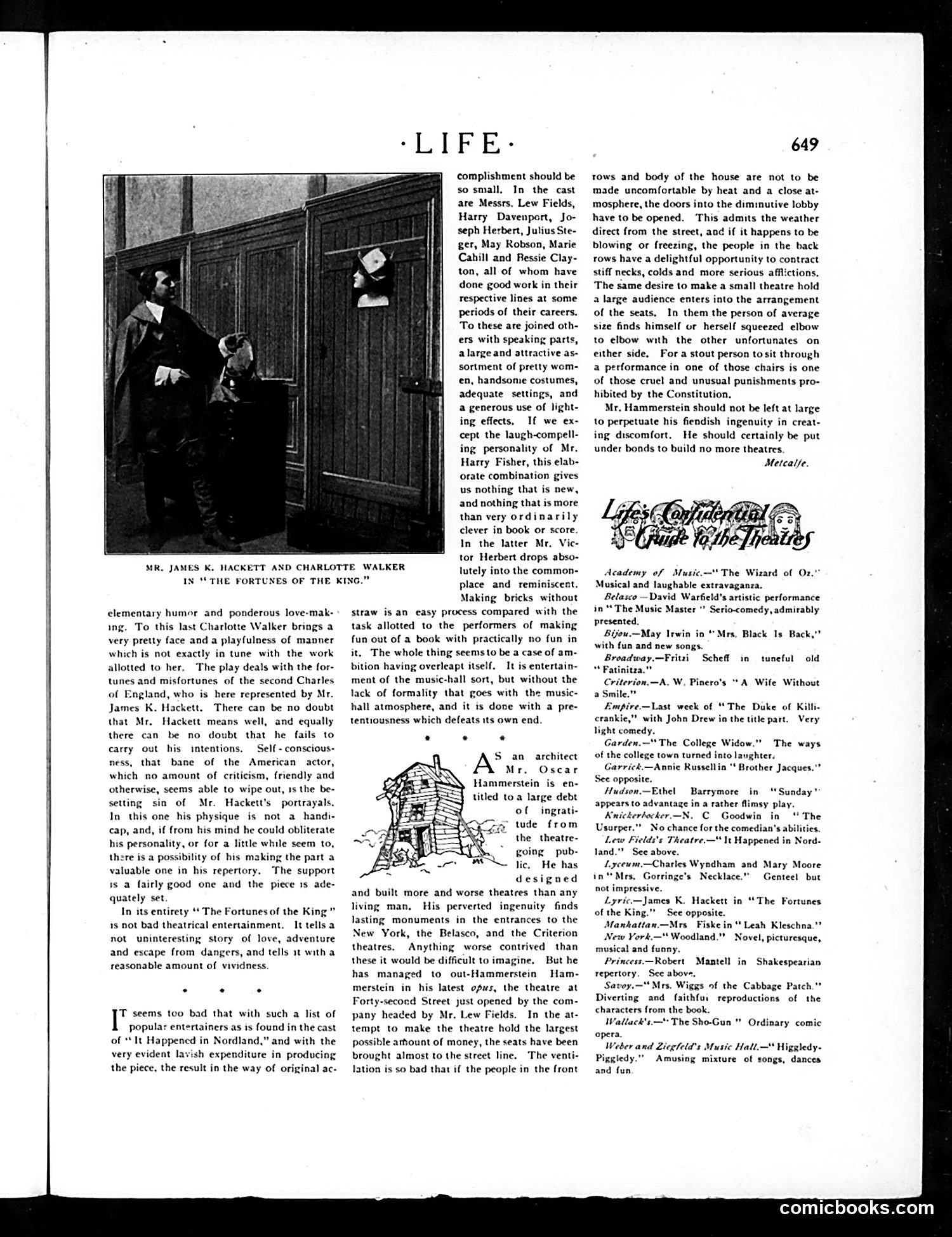
This page reviews theatrical productions, with the main photograph showing **James K. Hackett and Charlotte Walker in "The Fortunes of the King."** The principal satire targets **Oscar Hammerstein** (theater architect/producer), whom critic Metcalfe attacks for designing absurdly small theaters that prioritize maximum seating over audience comfort. Hammerstein's "fiendish ingenuity" creates cruel conditions: cramped seats force people into uncomfortable proximity, drafty doors plague back-row patrons, and the overall design constitutes "cruel and unusual punishment" (a constitutional reference for comic effect). The reviewer sardonically suggests Hammerstein "should not be left at large" and should be "put under bonds to build no more theatres." The satire mocks Hammerstein's commercial greed sacrificing basic human comfort—a critique of early 1900s theater practices prioritizing profit over patron welfare. The theatrical reviews below provide context on contemporary New York productions.
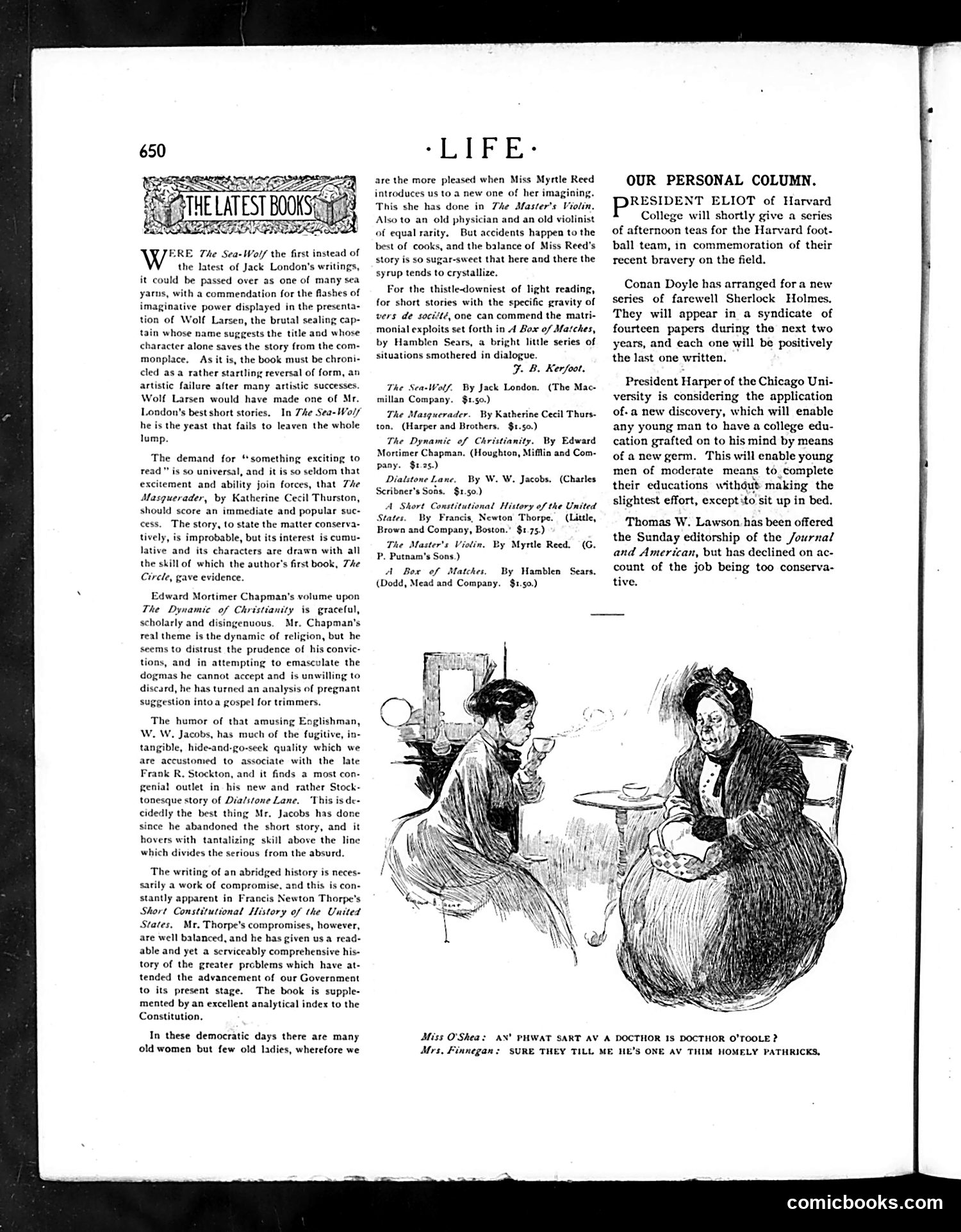
This page contains literary reviews rather than political satire. The cartoon at bottom—captioned "Miss O'Shea: 'An Irishwoman Saucy by a Doctor is Doctor O'Toole?'" with Mrs. Finnegan's response about "pathricks"—is a brief ethnic humor sketch playing on Irish stereotypes (apparent Irish names, dialect humor about doctors). The main content reviews contemporary books by Jack London, Katherine Cecil Thurston, and W.W. Jacobs. The reviewer criticizes London's *The Sea-Wolf* as structurally flawed despite its compelling protagonist, praises *The Masquerader* for exciting storytelling despite implausibility, and applauds Jacobs' *Dialstone Lane*. The reviews emphasize narrative skill and entertainment value—concerns typical of early-1900s literary culture—rather than political commentary.
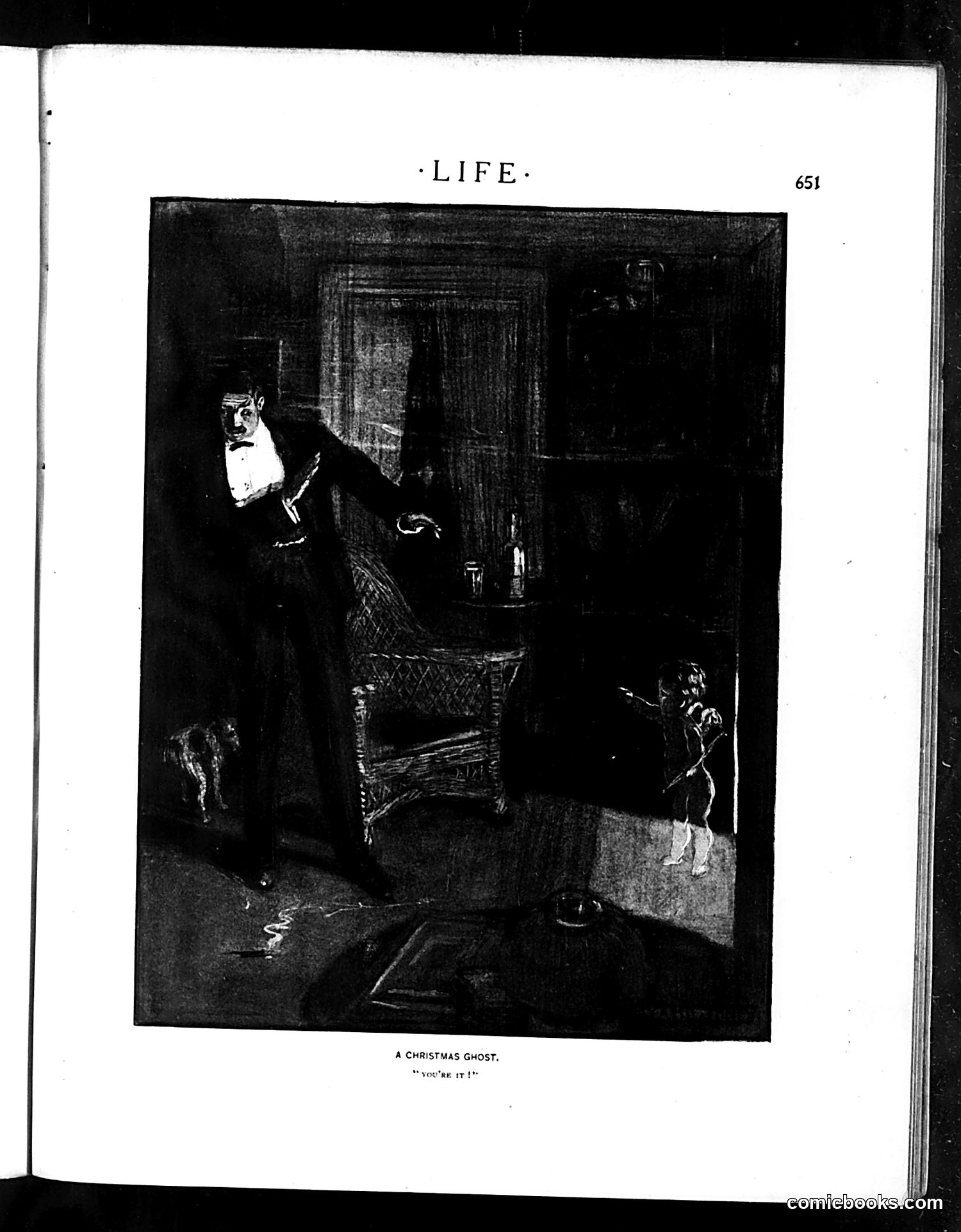
This illustration, titled "A Christmas Ghost" with the caption "You're it!", depicts a scene from Dickens's *A Christmas Carol*. The image shows what appears to be Scrooge confronted by a spectral figure in his darkened bedroom—likely the Ghost of Christmas Past, Present, or Yet to Come based on the ethereal appearance. The cartoon plays on the famous literary work as seasonal commentary. The "You're it!" caption suggests a children's game ("tag"), transforming Dickens's moral reckoning into something more playful. This appears to be satirical holiday content using the familiar ghost story to make a point about Christmas themes—possibly redemption, mortality, or social responsibility—though the specific contemporary reference remains unclear without additional context.
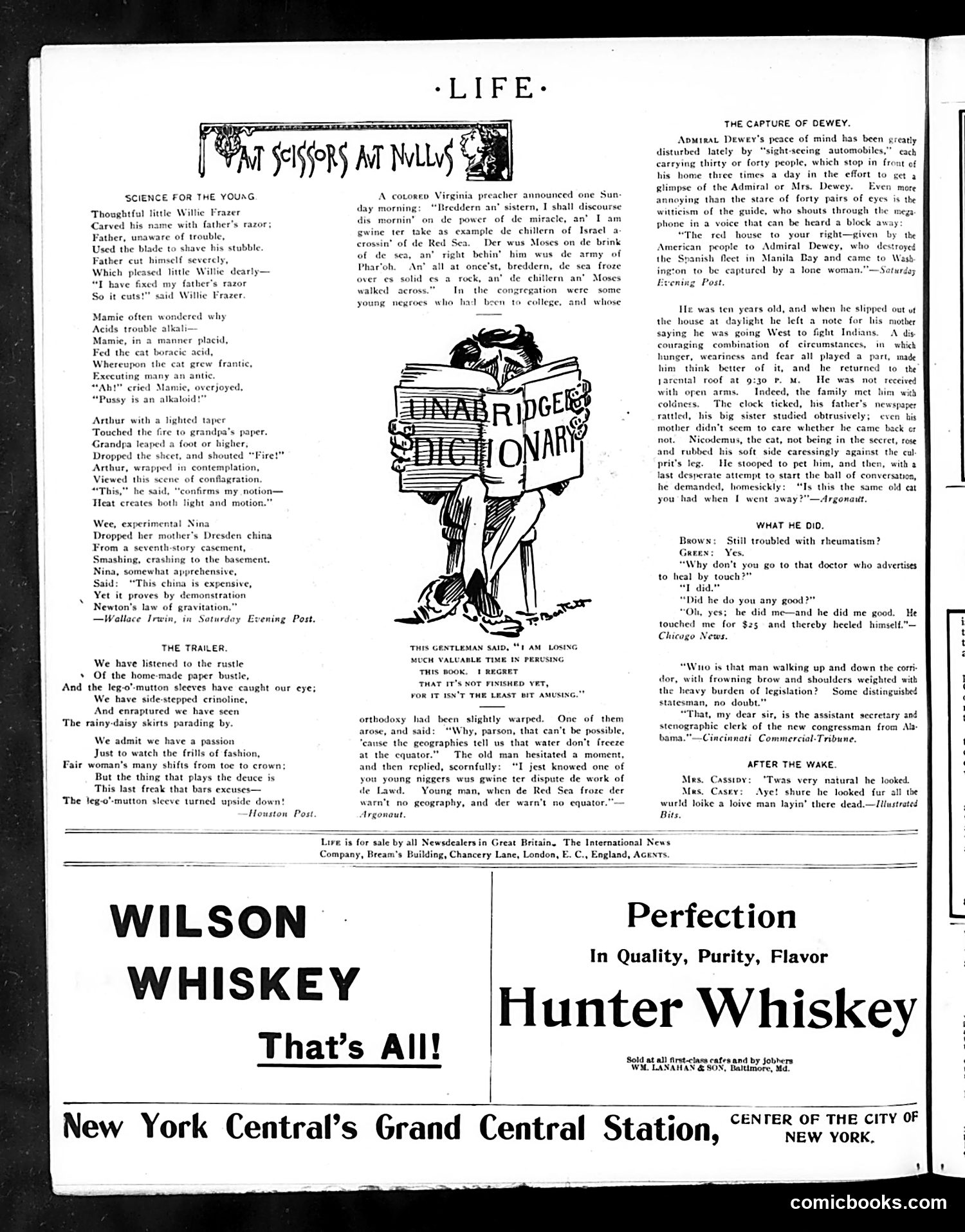
This page contains humorous satirical content typical of early 20th-century Life magazine: **"Science for the Young"** presents dark comedy sketches where children misapply scientific principles with dangerous results—a boy deliberately nicks his father's razor, a girl feeds acid to a cat to test alkalinity, a boy sets his grandfather's newspaper on fire "to demonstrate heat." The satire mocks both children's dangerous curiosity and adults' pseudo-intellectual explanations of accidents. **"The Trailer"** humorously critiques women's fashion, specifically the "leg-o'-mutton sleeve turned upside down"—an awkward garment detail the author finds absurd. **The sermon anecdote** features dialect humor (common but problematic by modern standards) contrasting a rural preacher's biblical literalism with educated congregation members who cite geography. The satire targets both religious dogmatism and pedantic rationalism. **"The Capture of Dewey"** references Admiral George Dewey (hero of the Spanish-American War), now pestered by tourist automobiles and guides. The satire gently mocks both aggressive tourism and the public's tendency to reduce heroes to spectacles. The page balances social observation with period advertising.
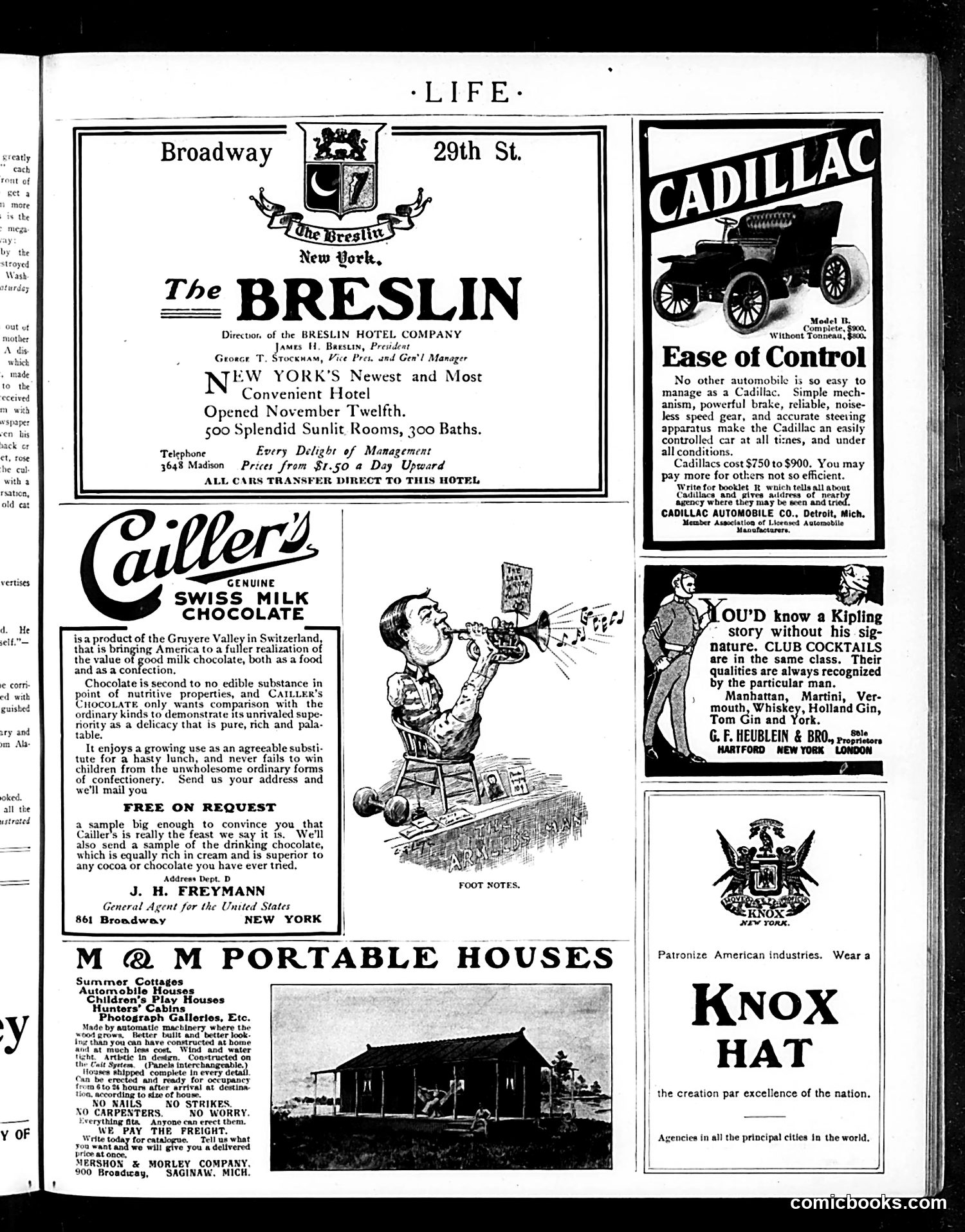
This page is primarily **advertising**, not political satire. It contains hotel, automobile, chocolate, and hat advertisements typical of early 1900s Life magazine. The only illustration with potential satirical content is the **"Foot Notes"** cartoon showing a caricatured figure (likely representing a wealthy or fashionable person) playing musical instruments while surrounded by shoes. The cartoon appears to be a visual pun on the phrase "foot notes"—mocking someone's obsession with footwear or fashionable appearance. The advertisements themselves reflect period concerns: The Cadillac emphasizes "ease of control"; Cailler's Swiss chocolate pitches nutrition; and M&M Portable Houses promote affordable, quick construction—all reflecting early 20th-century consumer values and industrialization. The Knox Hat advertisement simply urges readers to buy American products, a common patriotic appeal of the era. The page contains no identifiable political figures or commentary beyond standard commercial messaging.
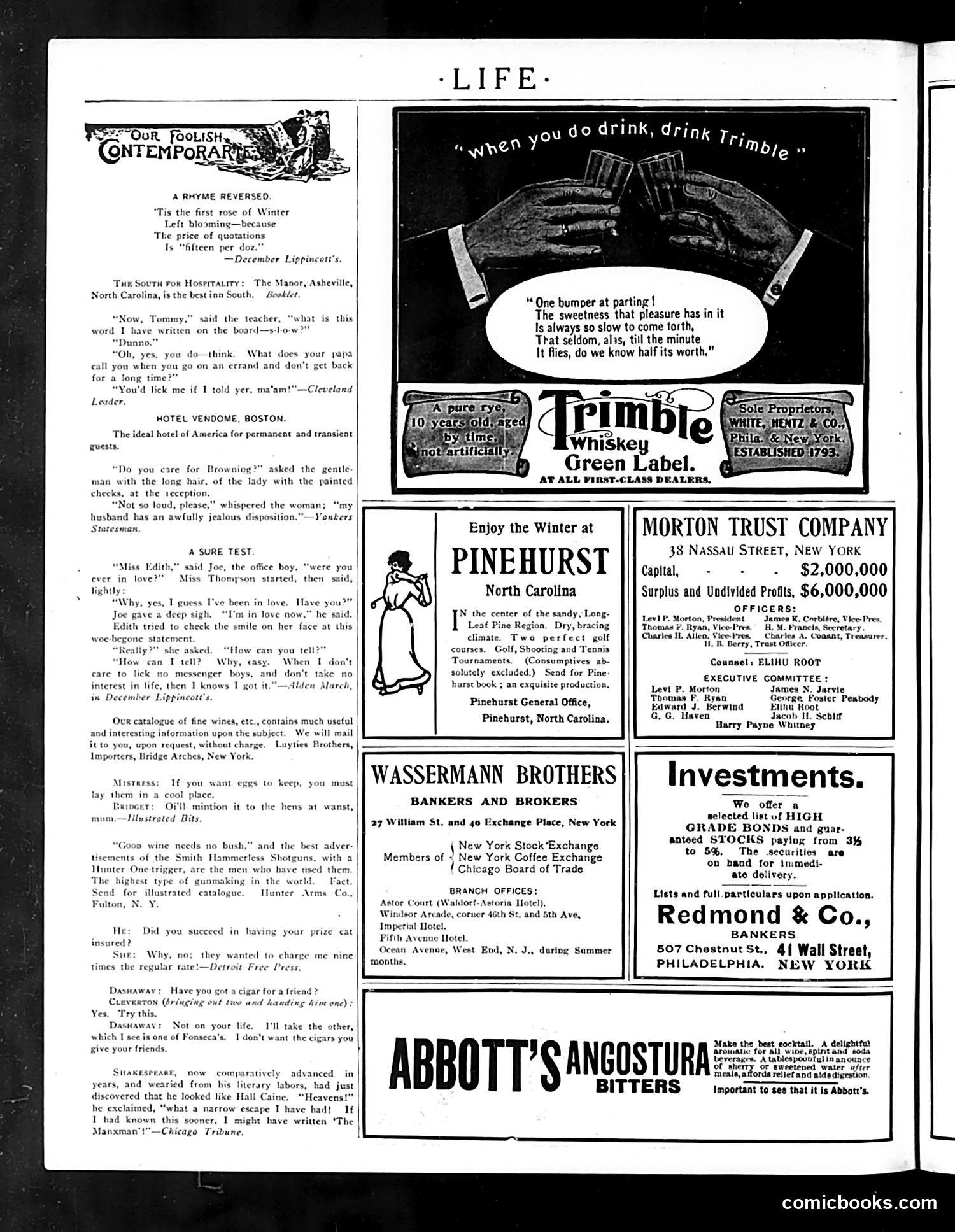
This page from *Life* (circa early 1900s) consists primarily of **humorous anecdotes and advertisements** rather than political cartoons. The left column contains satirical short humor pieces typical of the era—jokes about love, marriage, and social pretension (a wealthy hotel guest hiding a jealous husband; a schoolboy's cheeky response to a teacher). These reflect upper-class concerns and social anxieties of the period. The advertisements occupy most of the page and reveal era-specific products and institutions: **Trimble Whiskey** (with a "drink responsibly" message framed in verse), **Pinehurst resort** in North Carolina, the **Morton Trust Company** (a major New York financial institution), **Wassermann Brothers bankers**, and **Abbott's Angostura Bitters** (a medicinal tonic common in the early 1900s). No clear political figures or satirical commentary appear. The page captures everyday humor and commercial culture of the Edwardian era rather than topical satire.
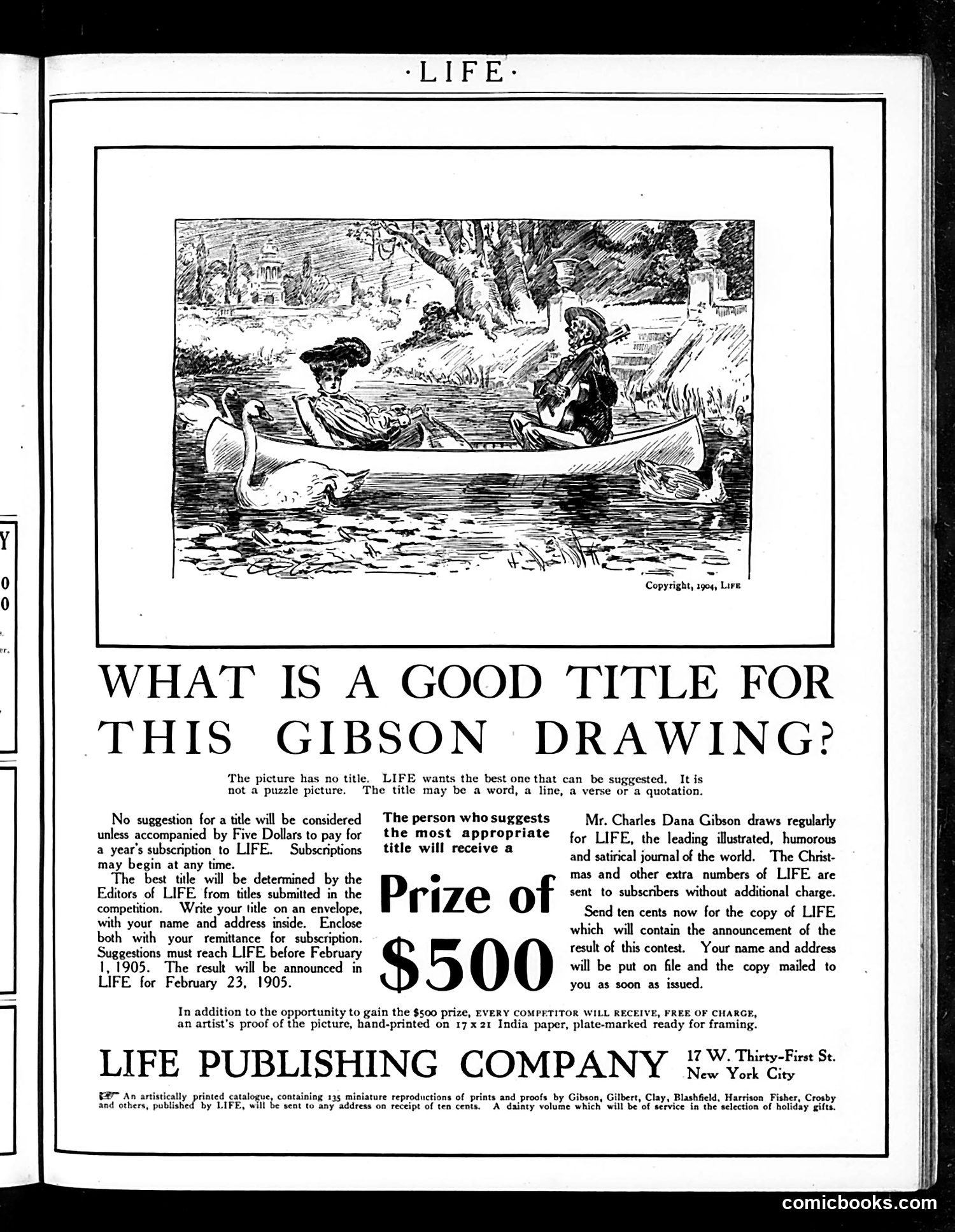
This is a **contest advertisement**, not a political cartoon. Life magazine is soliciting reader submissions for a title to a Charles Dana Gibson drawing depicting a romantic scene: a couple in a rowboat on a river, with swans nearby and a pastoral landscape behind them. **Key elements:** - Gibson was Life's premier illustrator, famous for his "Gibson Girl" imagery - Life (a leading satirical and humorous publication) is crowning the best title suggestion with a **$500 prize** (substantial in 1904) plus a year's subscription - Entries required a five-dollar subscription fee - The drawing itself appears straightforwardly romantic/sentimental—no obvious satire is present in the image - All participants received a free artist's proof as consolation **For modern readers:** This reflects early 20th-century magazine culture, where publications actively engaged readers through contests and Gibson's considerable cultural prominence as an illustrator.
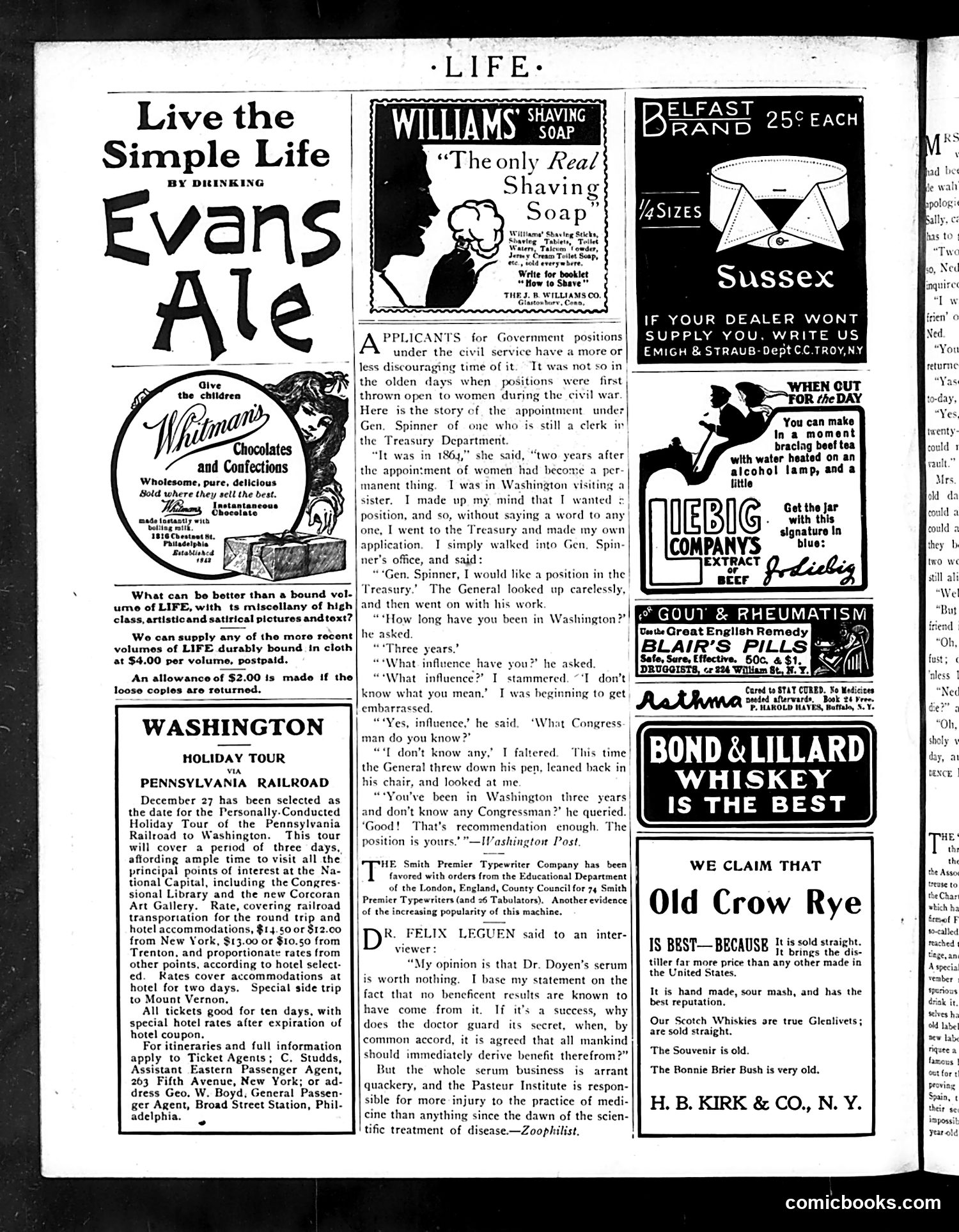
This page from *Life* magazine (appears early 20th century, based on styling) contains primarily **advertisements and a brief satirical anecdote** rather than political cartoons. The main text piece—a story attributed to the *Washington Post*—humorously critiques Civil Service patronage. It describes a woman seeking a Treasury Department position under General Spinner during the Civil War era. The joke's point: she succeeds *because* she has **no political connections or "influence,"** which impresses the General as refreshingly honest. This satirizes the contemporary problem of government jobs being awarded through political favor and personal connections ("influence") rather than merit. By inverting expectations—rewarding lack of political ties—the anecdote highlights how corrupt or based-on-patronage the system typically was. The remainder consists of commercial advertisements for ale, chocolates, typewriters, and medicines.
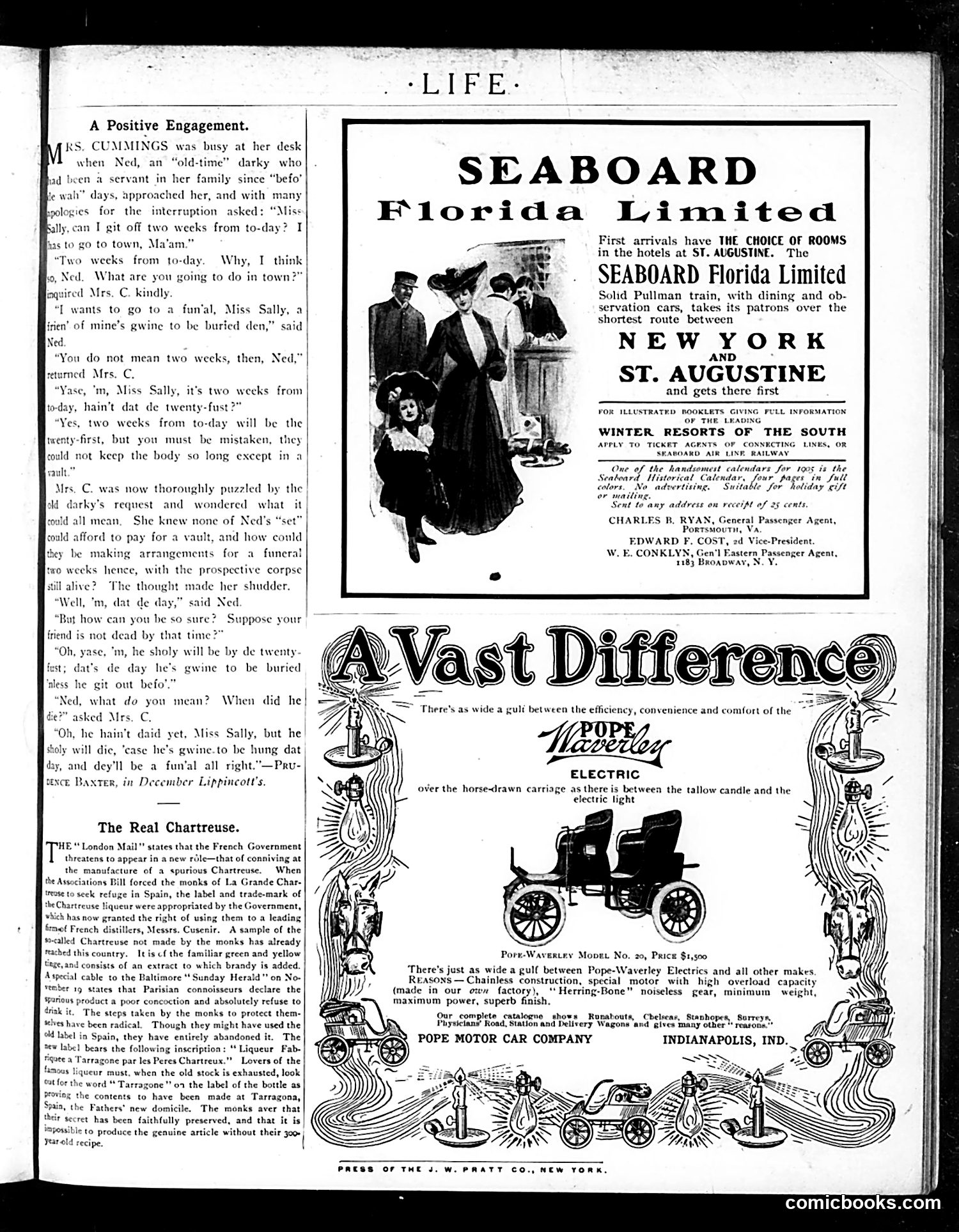
This page contains three distinct elements: **"A Positive Engagement"** (top left): A short story depicting a racist caricature of an enslaved or formerly enslaved Black man named Ned using exaggerated dialect. The "humor" relies on the stereotype of Black workers being simple-minded—Ned announces he needs two weeks off for a friend's funeral, but the friend isn't dead yet. When pressed, he explains the friend "is gwine to be hung" in two weeks, so the funeral is being pre-arranged. The satire mocks what the author presents as illogical thinking. **"The Real Chartreuse"** (bottom left): A piece about French liqueur. After French monks fled Spain, the government appropriated their Chartreuse trademark and licensed it to another distiller. The article notes Parisians reject this ersatz version, and the monks refuse to use their Spanish refuge, instead protecting their secret recipe. **Advertisements** (right side): Seaboard Florida Limited railroad and Pope-Waverley electric automobiles, promoting modern transportation and tourism. The page primarily showcases period advertising alongside entertainment content relying on racial stereotypes common to early 1900s American magazines.
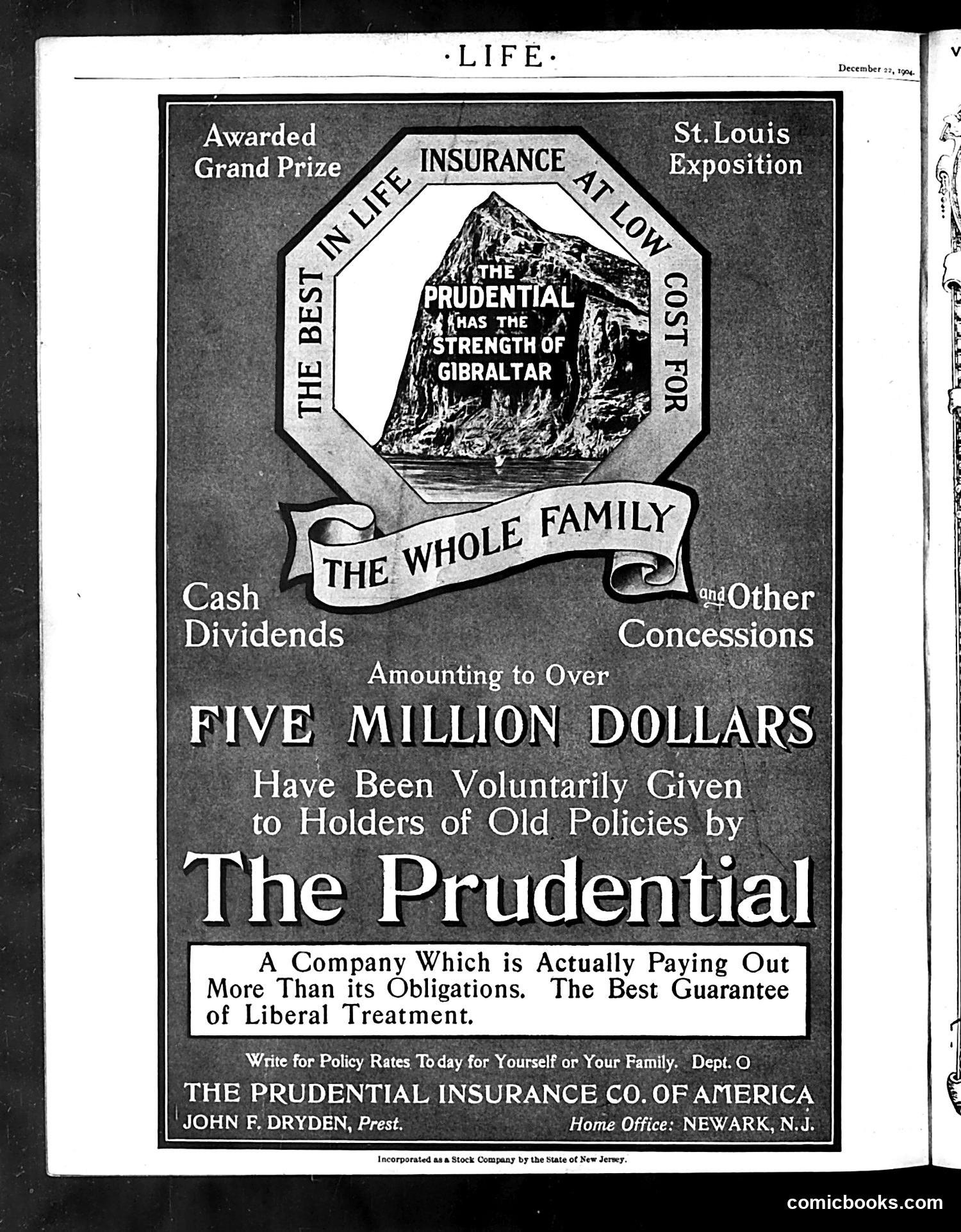
This is a full-page **advertisement**, not satire or political commentary. The Prudential Insurance Company is promoting itself to Life magazine's readers. The ad features the Rock of Gibraltar as a visual metaphor—Gibraltar's famous strength and permanence symbolize Prudential's stability and reliability. The tagline "The Prudential has the strength of Gibraltar" connects the company's financial solidity to an iconic landmark. The ad emphasizes that Prudential has paid out over five million dollars in cash dividends and "other concessions" to policyholders—exceeding contractual obligations. This was meant to demonstrate the company's generosity and trustworthiness during an era when insurance companies faced skepticism. The company claims an award from the St. Louis Exposition and identifies John F. Dryden as president, with headquarters in Newark, New Jersey. The message targets families seeking life insurance, promising "liberal treatment" of policyholders.