
Life, 1904-12-15 · page 26 of 44
Life — December 15, 1904 — page 26: what you’re looking at
What you’re looking at
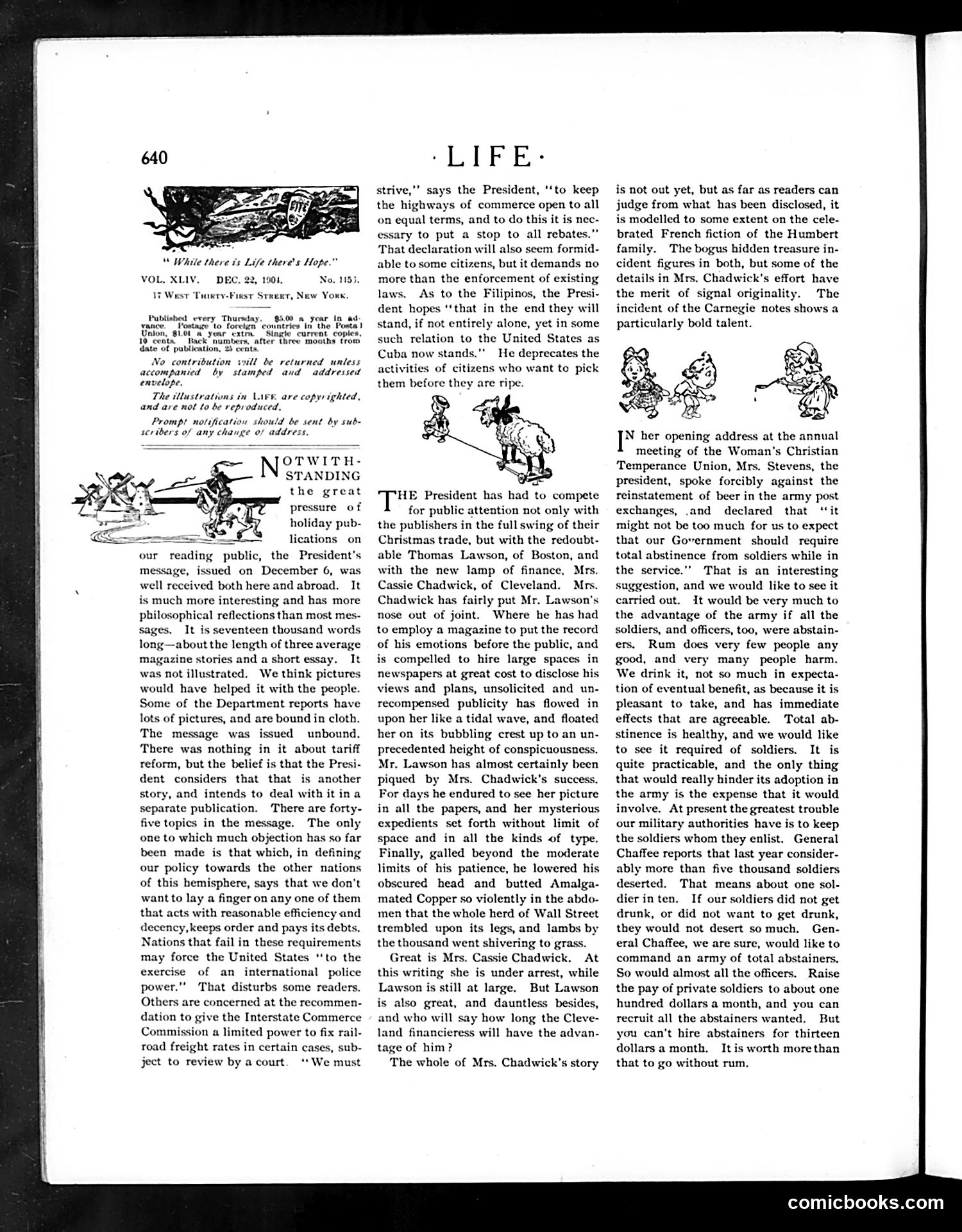
This page discusses President Theodore Roosevelt's recent message to Congress, which covered forty-five topics but stirred controversy primarily on two issues: his assertion of U.S. "police power" over hemispheric nations failing to maintain order and pay debts, and his recommendation to grant the Interstate Commerce Commission power to regulate railroad freight rates and eliminate rebates. The page notes Roosevelt faced competition for public attention from Thomas Lawson (a Boston financier publicizing his views through paid newspaper space) and especially Mrs. Cassie Chadwick of Cleveland, whose financial schemes generated sensational newspaper coverage. The text suggests Lawson grew frustrated by Chadwick's superior media attention and "butted" his stock holdings (Amalgamated Copper) in retaliation—a reference to his aggressive financial maneuvering against market manipulation.
📄 Transcribed text from this page (OCR, searchable)
Machine-transcribed from the original scan — historical spelling and the odd misread are preserved.
“* While there ts Life there's Hope.” VOL, XLIV, DEC, 22, 1901. No. 1153. 17 West Traery-First Sreeer, New Yous. Published every Thurstay. vance. Postage to foreign cs rtm. ‘Single current. coptes, re after three months trom ‘crate, will be returned untess stamped aud addressed $5.00 nm year to ad tries In the Posta date of publication No contribution accompanied by envelope. The illustrations in LAvk. are copyrighted, and are not to be reproduced, Prompt notification should be sent by sub- scribers of any change o/ address, OTWITH- STANDI the great pressure of holiday pub- lications on our reading public, the President's message, issued on December 6, was well received both here and abroad, It is much more interesting and has more philosophical reflections than most mes- sages. It is seventeen thousand words long—about the length of three average magazine stories and a short essay. It was not illustrated. We think pictures would have helped it with the people. Some of the Department reports have lots of pictures, and are bound in cloth. The message was issued unbound. There was nothing in it about tariff reform, but the belief is that the Presi- dent considers that that is another story, and intends to deal with it ina separate publication. here are forty- five topics in the message. The only one to which much objection has so far been made is that which, in defining our policy towards the other nations of this hemisphere, says that we don't want to lay a finger on any one of them that acts with reasonable efficiency and decency, keeps order and pays its debts. Nations that fail in these requirements may force the United States ‘‘to the exercise of an international police power.” That disturbs some readers. Others are concerned at the recommen- dation to give the Interstate Commerce jon a limited power to fix rail- road freight rates in certain cases, sub- ject to review by a court. ‘We must -LIFE- strive,” says the President, ‘to keep the highways of commerce open to all on equal terms, and to do this it is nec- essary to put a stop to all rebates.” That declaration will also seem formid- able to some citizens, but it demands no more than the enforcement of existing laws. As to the Filipinos, the Presi- dent hopes ‘that in the end they will stand, if not entirely alone, yet in some such relation to the United States as Cuba now stands."" He deprecates the ities of citizens who want to pick act them before they are ripe. HE President has had to compete for public attention not only with the publishers in the full swing of their Christmas trade, but with the redoubt- able Thomas Lawson, of Boston, and with the new lamp of finance, Mrs. Cassie Chadwick, of Cleveland. Mrs. Chadwick has fairly put Mr. Lawson's nose out of joint, Where he has had to employ a magazine to put the record of his emotions before the public, and is compelled to hire large spaces in newspapers at great cost to disclose his views and plans, unsolicited and un- recompensed publicity has flowed in upon her like a tidal wave, and floated her on its bubbling crest up to an un- precedented height of conspicuousness. Mr. Lawson has almost certainly been piqued by Mrs. Chadwick's success. For days he endured to see her picture in all the papers, and her mysterious expedients set forth without limit of space and in all the kinds of type. Finally, galled beyond the moderate limits of his patience, he lowered his obscured head and butted Amalga- mated Copper so violently in the abdo- men that the whole herd of Wall Street trembled upon its legs, and lambs by the thousand went shivering to grass. Great is Mrs. Cassie Chadwick. At this writing she is under arrest, while Lawson is still at large. But Lawson is also great, and dauntless besides, and who will say how long the Cleve- land financieress will have the advan- tage of him? The whole of Mrs. Chadwick's story is not out yet, but as far as readers can judge from what has been disclosed, it is modelled to some extent on the cele- brated French fiction of the Humbert family. The bogus hidden treasure in- cident figures in both, but some of the details in Mrs. Chadwick's effort have the merit of signal originality. The incident of the Carnegie notes shows a particularly bold talent. PP her opening address at the annual meeting of the Woman's Christian Temperance Union, Mrs. Stevens, the president, spoke forcibly against the reinstatement of beer in the army post exchanges, .and declared that ‘it might not be too much for us to expect that our Government should require total abstinence from soldiers while in the service.” That is an interesting suggestion, and we would like to see it carried out. It would be very much to the advantage of the army if all the soldiers, and officers, too, were abstain- ers. Rum does very few people any good, and very many people harm. We drink it, not so much in expecta- tion of eventual benefit, as because it is pleasant to take, and has immediate effects that are agreeable. Total ab- stinence is healthy, and we would like to see it required of soldiers. It is quite practicable, and the only thing that would really hinder its adoption in the army is the expense that it would involve. At present the greatest trouble our military authorities have is to keep the soldiers whom they enlist. General Chaffee reports that last year consider- ably more than five thousand soldiers deserted. That means about one sol- dier inten. If our soldiers did not get drunk, or did not want to get drunk, they would not desert so much. Gen- eral Chaffee, we are sure, would like to command an army of total abstainers, So would almost all the officers. Raise the pay of private soldiers to about one hundred dollars a month, and you can recruit all the abstainers wanted. But you can't hire abstainers for thirteen dollars a month. It is worth morethan that to go without rum. comicbooks.com