
Life, 1904-12-15 · page 6 of 44
Life — December 15, 1904 — page 6: what you’re looking at
What you’re looking at
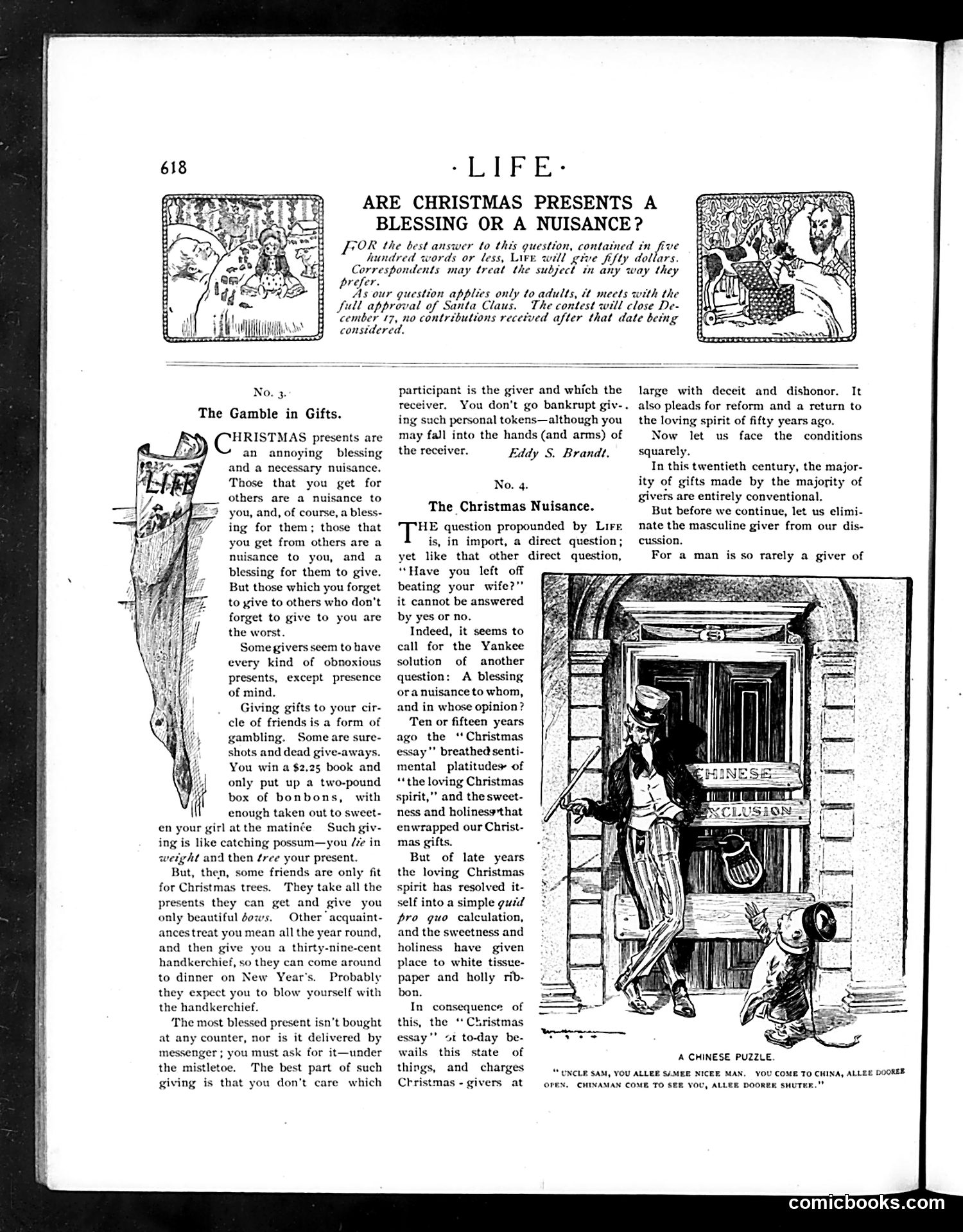
This page contains two satirical essays about Christmas gift-giving customs. The main text addresses whether Christmas presents are "a blessing or a nuisance," arguing they're often obligatory rather than meaningful. The left illustration shows a stocking labeled "LIFE," satirizing how Christmas gifts are sometimes impersonal or unwanted—portrayed as fishing with bait to catch recipients' attention. The right illustration, titled "A Chinese Puzzle," depicts a figure at a Chinese shop window. The caption's broken English ("Allee Samee Nicer Man") mimics period stereotypes about Chinese immigrants, likely satirizing how Christmas commercialism had become an absurd, cross-cultural spectacle divorced from genuine sentiment. Together, these pieces critique the hollow materialism and social awkwardness of Christmas gift obligations in early 20th-century America.
📄 Transcribed text from this page (OCR, searchable)
Machine-transcribed from the original scan — historical spelling and the odd misread are preserved.
*LIFE- ARE CHRISTMAS PRESENTS A BLESSING OR A NUISANCE? FOR the best answer to this question, contained in ied hundred words or less, Lv ai vill give fifty dol rs. Correspondents may treat the subject in any way they prefer. As our guestion applies only to adults, it meets with the full approval of Santa Claus. The contest will close De- cember 17, no contributions recetved after that date being considered. The Gamble in Gifts. (CERISTHAS presents are an annoying _ blessing and a necessary nuisance. Those that you get for others are a nuisance to you, and, of course, a bless- ing for them; those that you get from others are a nuisance to you, and a blessing for them to give. But those which you forget to yive to others who don't forget to give to you are the worst. Some givers seem to have every kind of obnoxious presents, except presence of mind. Giving gifts to your cir- cle of friends is a form of gambling. Some are sure- shots and dead give-aways. You win a $2.25 book and only put up a two-pound box of bonbons, with enough taken out to sweet- en your girl atthe matinée Such giv- ing is like catching possum—you /e in weight and then free your present. But, then, some friends are only fit for Christmas trees. They take all the presents they can get and give you only beautiful dows. Other ‘acquaint- ances treat you mean all the year round, and then give you a thirty-nine-cent handkerchief, so they can come around to dinner on New Year's. Probably they expect you to blow yourself with the handkerchief. ‘The most blessed present isn’t bought at any counter, nor is it delivered by messenger ; you must ask for it—under the mistletoe. The best part of such giving is that you don’t care which participant is the giver and which the receiver. You don’t go bankrupt giv-. ing such personal tokens—although you may fall into the hands (and arms) of the receiver. Eddy S, Brandt. No. 4. The Christmas Nuisance. T= question propounded by Lirr is, in import, a direct question; yet like that other direct question, “Have you left off beating your wife?” it cannot be answered by yes or no. Indeed, it seems to call for the Yankee solution of another question: A blessing ora nuisance to whom, and in whose opinion? Ten or fifteen years ago the ‘Christmas essay" breathed senti- mental platitudes of ‘the loving Christmas spirit,” and the sweet- ness and holinesgthat enwrapped our Christ- mas gifts. But of late years the loving Christmas spirit has resolved it- self into a simple gudd pro guo calculation, and the sweetness and holiness have given place to white tissue- paper and holly rib- bon. In consequence of the “ Christmas essay" ot to-day be- wails this state of things, and charges Christmas - givers at ores. “UNCLE SAM, YOU ALLEE S/MEE NICER MAN. CHINAMAN COME TO SER VOU, ALLEE DOOREE SMUTER." large with deceit and dishonor. It also pleads for reform and a return to the loving spirit of fifty years ago, Now let us face the conditions squarely, In this twentieth century, the major- ity of gifts made by the majority of givers are entirely conventional. But before we continue, let us elimi- nate the masculine giver from our dis- cussion. For a man is so rarely a giver of A CHINESE PUZZLE. comicbooks.com YOU COME TO CHINA, ALLEE DOOREB