
Life, 1904-12-15 · page 14 of 44
Life — December 15, 1904 — page 14: what you’re looking at
What you’re looking at
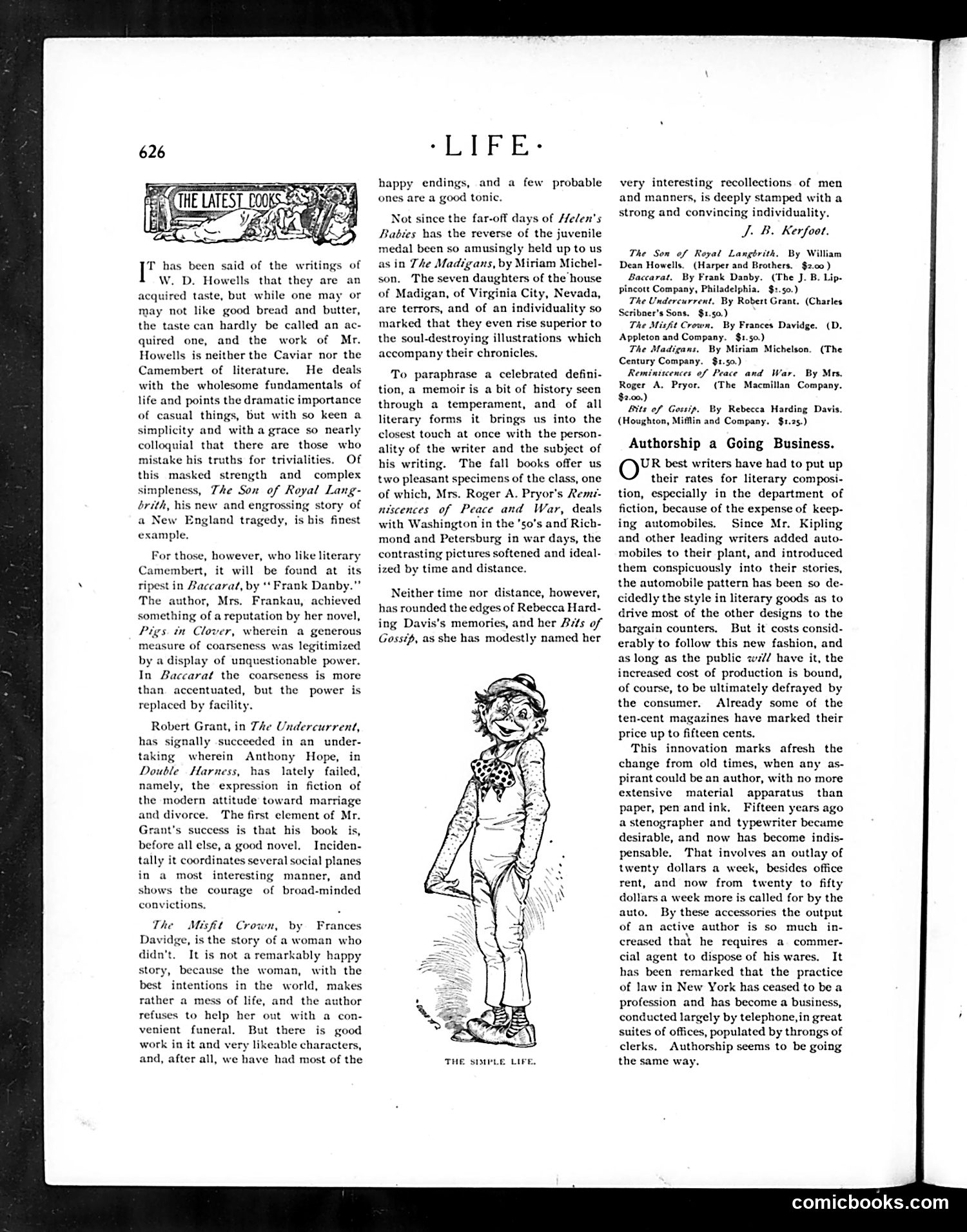
This page reviews several contemporary novels, with a small cartoon labeled "THE SIMPLE LIFE" depicting a thin, somewhat shabby-looking man in worn clothes. The cartoon appears to illustrate the concept of simple, unpretentious living. The reviews discuss W.D. Howells' *The Son of Royal Langbrith* favorably, praising his straightforward treatment of ordinary life. They contrast this with "Frank Danby's" *Baccarat*, which the critic suggests substitutes superficial facility for genuine power. Other novels reviewed include Robert Grant's *The Undercurrent* (favorably), and memoirs by Mrs. Roger A. Pryor and Rebecca Harding Davis. The cartoon's ironic title and depiction likely comment on the contrast between literary treatments of humble or "simple" life versus actual poverty—a common satirical theme in early 20th-century Life magazine.
📄 Transcribed text from this page (OCR, searchable)
Machine-transcribed from the original scan — historical spelling and the odd misread are preserved.
ie has been said of the writings of W. D. Howells that they are an acquired taste, but while one may or may not like good bread and butter, the taste can hardly be called an ac- quired one, and the work of Mr. Howells is neither the Caviar nor the Camembert of literature, He deals with the wholesome fundamentals of life and points the dramatic importance of casual things, but with so keen a simplicity and with a grace so nearly colloquial that there are those who i his truths for trivialities. Of this masked strength and complex simpleness, The Son of Royal Lang- brith, his new and engrossing story of a New England tragedy, is his finest example. For those, however, who like literary mbert, it will be found at its st in Baccarat, by “Frank Danby. The author, Mrs. Frankau, achieved something of a reputation by her novel, Pigs in Clover, wherein a generous measure of coarseness was legitimized by a display of unquestionable power. In Baccarat the coarseness is more than accentuated, but the power is replaced by facility. Robert Grant, in The Undercurrent, has signally succeeded in an under- taking wherein Anthony Hope, in Double Harness, has lately failed, namely, the expression in fiction of the modern attitude toward marriage and divorce. The first clement of Mr. Grant's success is that his book is, before all else, a good novel. Inciden- tally it coordinates several social planes in a most interesting manner, and shows the courage of broad-minded convictions. The Misfit’ Crown, by Frances Davidge, is the story of a woman who didn’t. It is not a remarkably happy story, because the woman, with the best intentions in the world, makes rather a mess of life, and the author refuses to help her out with a con- venient funeral. But there is good work in it and very likeable characters, and, after all, we have had most of the -LIFE- happy endings, and a few probable ones are a good tonic. Not since the far-off days of Helen's Babies has the reverse of the juvenile medal been so amusingly held up to us as in The Madigans, by Miriam Michel- son, The seven daughters of the house of Madigan, of Virginia City, Nevada, are terrors, and of an individuality so marked that they even rise superior to the soul-destroying illustrations which accompany their chronicles. To paraphrase a celebrated defini- tion, a memoir is a bit of history seen through a temperament, and of all literary forms it brings us into the closest touch at once with the person- ality of the writer and the subject of his writing. The fall books offer us two pleasant specimens of the class, one of which, Mrs. Roger A. Pryor's Remé- niscences of Peace and War, deals with Washington in the 'so's and Rich- mond and Petersburg in war days, the contrasting pictures softened and ideal- ized by time and distance. Neither time nor distance, however, has rounded the edges of Rebecca Hard- ing Davis's memories, and her Bits of Gossip, as she has modestly named her THE SDIPLE LIFE, very interesting recollections of men and manners, is deeply stamped with a strong and convincing individuality. J. B. Kerfoot. The Son of Royal Langbrith. By William Dean Howells, (Harper and Brothers. $2.00) Baccarat. By Frank Danby. (The J. B. Li pincott Company, Philadelphia. $2.50.) The Undercurrent, By Robert Grant. (Charles Scribner's Sons. $1.50.) The Misfit Crown. By Frances Davidge. (D. Appleton and Company. $1.50.) The Madigans, By Miriam Michelson. Century Company. $1.50.) Reminiscences of Peace and War. Roger A. Pryor. $2.00.) Bits of Gossip. By Rebecca Harding Davis. (Houghton, Mifflin and Company, $1.25.) (The By Mrs. (The Macmillan Company. Authorship a Going Business. Ov best writers have had to put up their rates for literary composi- tion, especially in the department of fiction, because of the expense of keep- ing automobil Since Mr. Kipling and other leading writers added auto- mobiles to their plant, and introduced them conspicuously into their stories, the automobile pattern has been so de- cidedly the style in literary goods as to drive most of the other designs to the bargain counters. But it costs consid- erably to follow this new fashion, and as long as the public we// have it, the increased cost of production is bound, of course, to be ultimately defrayed by the consumer. Already some of the ten-cent magazines have marked their price up to fifteen cents. This innovation marks afresh the change from old times, when any as- pirant could be an author, with no more extensive material apparatus than paper, pen and ink. Fifteen years ago a stenographer and typewriter became desirable, and now has become indis- pensable, That involves an outlay of twenty dollars a week, besides office rent, and now from twenty to fifty dollars a week more is called for by the auto, By these accessories the output of an active author is so much in- creased that he requires a commer- cial agent to dispose of his wares. It has been remarked that the practice of law in New York has ceased to be a profession and has become a business, conducted largely by telephone, in great suites of offices, populated by throngs of clerks. Authorship seems to be going the same way. comicbooks.com