
Life, 1904-12-15 · page 30 of 44
Life — December 15, 1904 — page 30: what you’re looking at
What you’re looking at
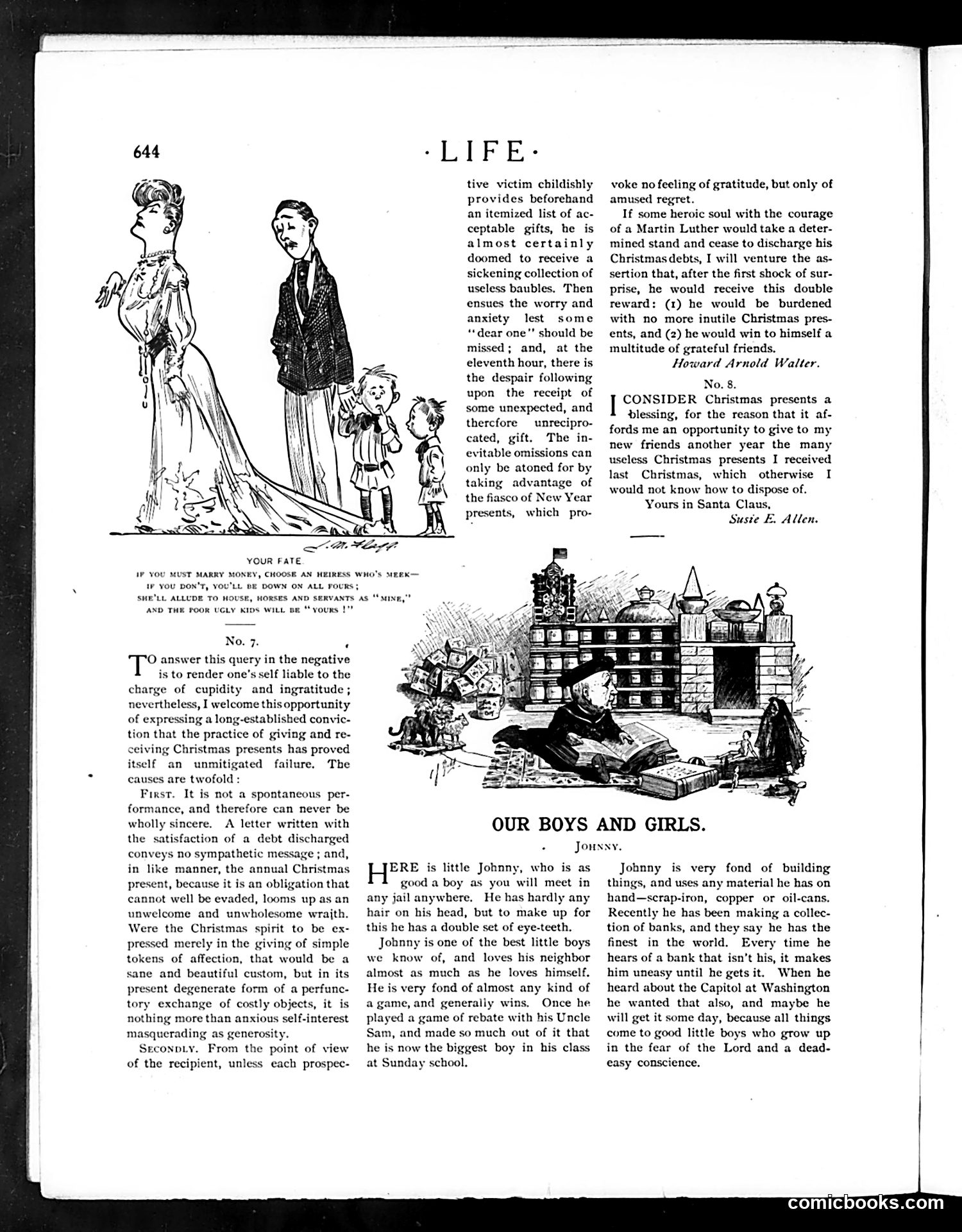
This page contains satirical commentary on Christmas gift-giving customs, paired with a humorous character sketch. **Top cartoon ("Your Fate"):** Illustrates the social anxiety surrounding mandatory gift exchange. The image shows a well-dressed woman with children, captioned with a cynical marriage warning about choosing a wealthy heiress to avoid financial ruin. **Main satire (Articles):** Two competing letters debate whether Christmas presents represent genuine generosity or obligatory hypocrisy. One writer argues the practice has "proved itself an unmitigated failure" because gifts are duty-driven rather than sincere. The counterargument defends presents as opportunities to regift unwanted items—itself a joke about the system's absurdity. **"Our Boys and Girls" section:** A mock-heroic profile of "Johnny" uses ironic praise to satirize American materialism and ambition. Johnny's collecting of banks and desire for the Capitol building, combined with his willingness to exploit his Uncle Sam in games, appears to critique both childhood greed and broader capitalist values. The phrase "dead-easy conscience" suggests satirical disapproval of amoral success-seeking.
📄 Transcribed text from this page (OCR, searchable)
Machine-transcribed from the original scan — historical spelling and the odd misread are preserved.
YOUR FATE * LIFE tive victim childishly provides beforehand an itemized list of ac- ceptable gifts, he is almost certainly doomed to receive a sickening collection of useless baubles. Then ensues the worry and anxiety lest some “dear one"’ should be missed; and, at the eleventh hour, there is the despair following upon the receipt of some unexpected, and thercfore unrecipro- cated, gift. The in- evitable omissions can only be atoned for by taking advantage of the fiasco of New Year presents, which pro- IP YOU MUST MARRY MONEY, CHOOSE AN HEIRESS WHO's MERK— Iv YOU DON'T, YOU'LL BE DOWN ON ALL FOLKS; SHE'LL ALLUDE TO MOUSE, HORSES AND SERVA: AND THE FOOR UGLY KIDS WILL BE ‘yours 1"? No. 7. P 'O answer this query in the negative is to render one’s self liable to the charge of cupidity and ingratitude ; nevertheless, I welcome this opportunity of expressing a long-established convic- tion that the practice of giving and re- ceiving Christmas presents has proved itself an unmitigated failure. The causes are twofold : First. It is not a spontaneous per- formance, and therefore can never be wholly sincere. A letter written with the satisfaction of a debt discharged conveys no sympathetic message ; and, in like manner, the annual Christmas present, because it is an obligation that cannot well be evaded, looms up as an unwelcome and unwholesome wrajth. Were the Christmas spirit to be ex- pressed merely in the giving of simple tokens of affection, that would be a sane and beautiful custom, but in its present degenerate form of a perfunc- tory exchange of costly object nothing more than anxious sel masquerading as generosity. SeconpLy. From the point of vi of the recipient, unless each prospec- voke no feeling of gratitude, but only of amused regret. If some heroic soul with the courage of a Martin Luther would take a deter- mined stand and cease to discharge his Christmas debts, I will venture the as- sertion that, after the first shock of sur- prise, he would receive this double reward: (1) he would be burdened with no more inutile Christmas pres- ents, and (2) he would win to himself a multitude of grateful friends. Howard Arnold Walter. No. 8. CONSIDER Christmas presents a dlessing, for the reason that it af- fords me an opportunity to give to my new friends another year the many useless Christmas presents I received last Christmas, which otherwise I would not know how to dispose of. Yours in Santa Claus, Susie E. Allen. OUR BOYS AND GIRLS. « Jouxsy. HERE is little Johnny, who is as good a boy as you will meet in any jail anywhere, He has hardly any hair on his head, but to make up for this he has a double set of eye-teeth. Johnny is one of the best little boys we know of, and loves his neighbor almost as much as he loves himself. He is very fond of almost any kind of a game, and generally wins, Once he played a game of rebate with his Uncle Sam, and made so much out of it that he is now the biggest boy in his class at Sunday school, Johnny is very fond of building things, and uses any material he has on hand—scrap-iron, copper or oil-cans. Recently he has been making a collec- tion of banks, and they say he has the finest in the world. Every time he hears of a bank that isn’t his, it makes him uneasy until he gets it. When he heard about the Capitol at Washington he wanted that also, and maybe he will get it some day, because all things come to good little boys who grow up in the fear of the Lord and a dead- easy conscience. comicbooks.com