
Life, 1904-12-15 · page 4 of 44
Life — December 15, 1904 — page 4: what you’re looking at
What you’re looking at
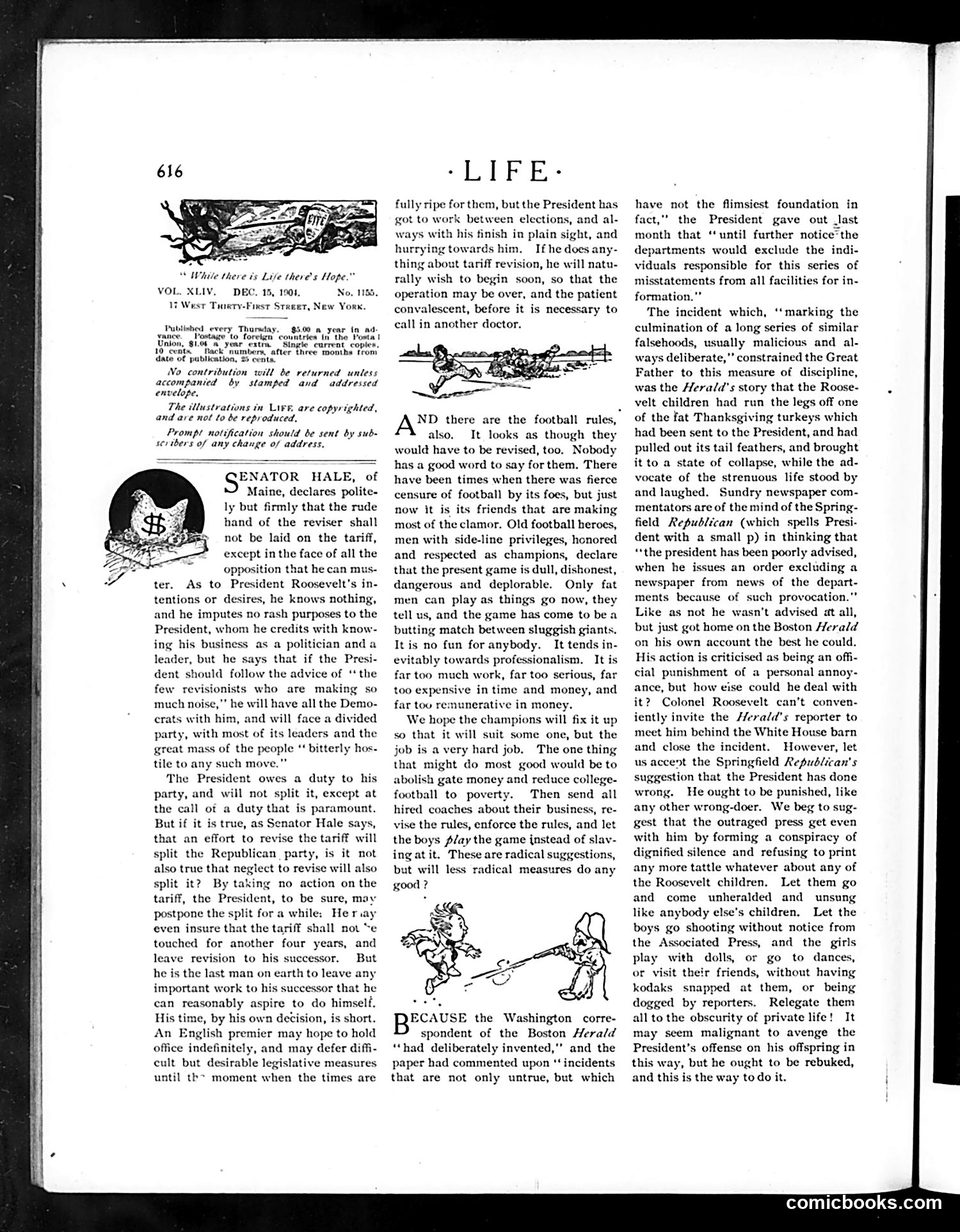
This page contains political commentary on President Theodore Roosevelt's first months in office. The main article, headlined "It is a Man's job to do a Man's Work," discusses Roosevelt's tariff revision efforts and his handling of football reform. The cartoon depicts **Senator Hale of Maine** criticizing Roosevelt's attempt to revise tariff policy, warning it will split the Republican Party. The text mocks newspapers (particularly the Boston Herald) for fabricating stories about Roosevelt's children—such as them shooting turkeys and behaving wildly—suggesting the press was inventing scandals. The satire criticizes both partisan opposition to Roosevelt's agenda and sensationalist journalism's invasion of presidential family privacy, presenting these as threats to legitimate governance.
📄 Transcribed text from this page (OCR, searchable)
Machine-transcribed from the original scan — historical spelling and the odd misread are preserved.
“* While there is Life there's Hope.” VOL. XLIV. DEC. 15, 1904, No. 1185, 17 West Tinery-Fixst Street, New Yorx. sed every Thursday, $5.00 a year in ad Vostage to foreign countries ti the Posta | SLO A year eatin ‘Single current copies, 19' cents" Rack’ numbers. after three momhs trom date of publication, 23 cents, No contribution will be returned untess accompanied by stamped and addressed envelope, The illustrations in Live, are copyrighted, and are not to be reproduced, Prompt notification should be sent by sub- sev tbers of any change of address, ENATOR HALE, of Maine, declares polite- ly but firmly that the rude hand of the reviser shall not be laid on the tariff, except in the face of all the opposition that he can mus- ter. As to President Roosevelt's tentions or desires, he knows nothing, and he imputes no rash purposes to the President, whom he credits with know- ing his business as a politician anda leader, but he says that if the Pi dent should follow the advice of ‘the jonists who are making so "he will have all the Demo- crats with him, and will face a divided party, with most of its leaders and the great mass of the people ‘‘ bitterly hos- tile to any such move.” The President owes a duty to his party, and will not split it, except at the call ot a duty that is paramount. But if it is true, as Senator Hale says, that an effort to revise the tariff will split the Republican, part: it not also true that neglect to revise will also split it?) By taking no action on the tariff, the President, to be sure, may postpone the split for a while: He ray even insure that the tariff shall not ‘e touched for another four years, and leave revision to his successor. But he is the last man on earth to leave any important work to his successor that he can reasonably aspire to do himself. His time, by his own decision, is short. An English premier may hope to hold office indefinitely, and may defer diffi- cult but desirable legislative measures until th> moment when the times are few revi much noise, fully ripe for them, but the President has got to work between elections, and al- s with his finish in plain sight, and hurrying towards him, If he does any- thing about tariff revision, he will natu- rally wish to begin soon, so that the operation may be over, and the patient convalescent, before it is necessary to call in another doctor. ND there are the football rules, also. It looks as though they would have to be revised, too. Nobody has a good word to say for them. There have been times when there was fierce censure of football by its foes, but just now it is its friends that are making most of the clamor. Old football heroes, men with side-line privileges, honored and respected as champions, declare that the present game is dull, dishonest, dangerous and deplorable. Only fat men can play as things go now, they tell us, and the game has come to bea butting match between sluggish giants. It is no fun for anybody. It tends in- evitably towards professionalism. It is far too much work, far too serious, far too expensive in time and money, and far tou remunerative in money. We hope the champions will fix it up so that it will suit some one, but the job is a very hard job. The one thing that might do most good would be to abolish gate money and reduce college- football to poverty. Then send all hired coaches about their business, re- vise the rules, enforce the rules, and let the boys f/ay the game instead of slav- ing at it. These are radical suggestions, but will less radical measures do any good ? ECAUSE the Washington corre- spondent of the Boston Herald “had deliberately invented,"’ and the paper had commented upon ‘incidents that are not only untrue, but which have not the flimsiest foundation in fact,’ the President gave out _last month that ‘until further notice’the departments would exclude the indi- viduals responsible for this series of misstatements from all facilities for in- formation,"” The incident which, ‘marking the culmination of a long series of similar falsehoods, usually malicious and al- ways deliberate,” constrained the Great Father to this measure of discipline, was the Herald's story that the Roose- velt children had run the legs off one of the fat Thanksgiving turkeys which had been sent to the President, and had pulled out its tail feathers, and brought it to a state of collapse, while the ad- vocate of the strenuous life stood by and laughed. Sundry newspaper com- mentators are of the mind of the Spring- field Republican (which spells Presi- dent with a small p) in thinking that “the president has been poorly advised, when he issues an order excluding newspaper from news of the depart- ments because of such provocation.” Like as not he wasn’t advised at all, but just got home on the Boston Herald on his own account the best he could. His action is criticised as being an offi- cial punishment of a personal annoy- ance, but how eise could he deal with it? Colonel Roosevelt can’t conven- iently invite the //era/d's reporter to meet him behind the White House barn and close the incident. However, let us accent the Springfield Repudlican's suggestion that the President has done wrong. He ought to be punished, like any other wrong-doer. We beg to sug- gest that the outraged press get even with him by forming a conspiracy of dignified silence and refusing to print any more tattle whatever about any of the Roosevelt children, Let them go and come unheralded and unsung like anybody else's children. Let the boys go shooting without notice from the Associated Press, and the girls play with dolls, or go to dances, or visit their friends, without having kodaks snapped at them, or being dogged by reporters. Relegate them all to the obscurity of private life! It may seem malignant to avenge the President's offense on his offspring in this way, but he ought to be rebuked, and this is the way todo it. comicbooks.com