
Life, 1904-12-15 · page 31 of 44
Life — December 15, 1904 — page 31: what you’re looking at
What you’re looking at
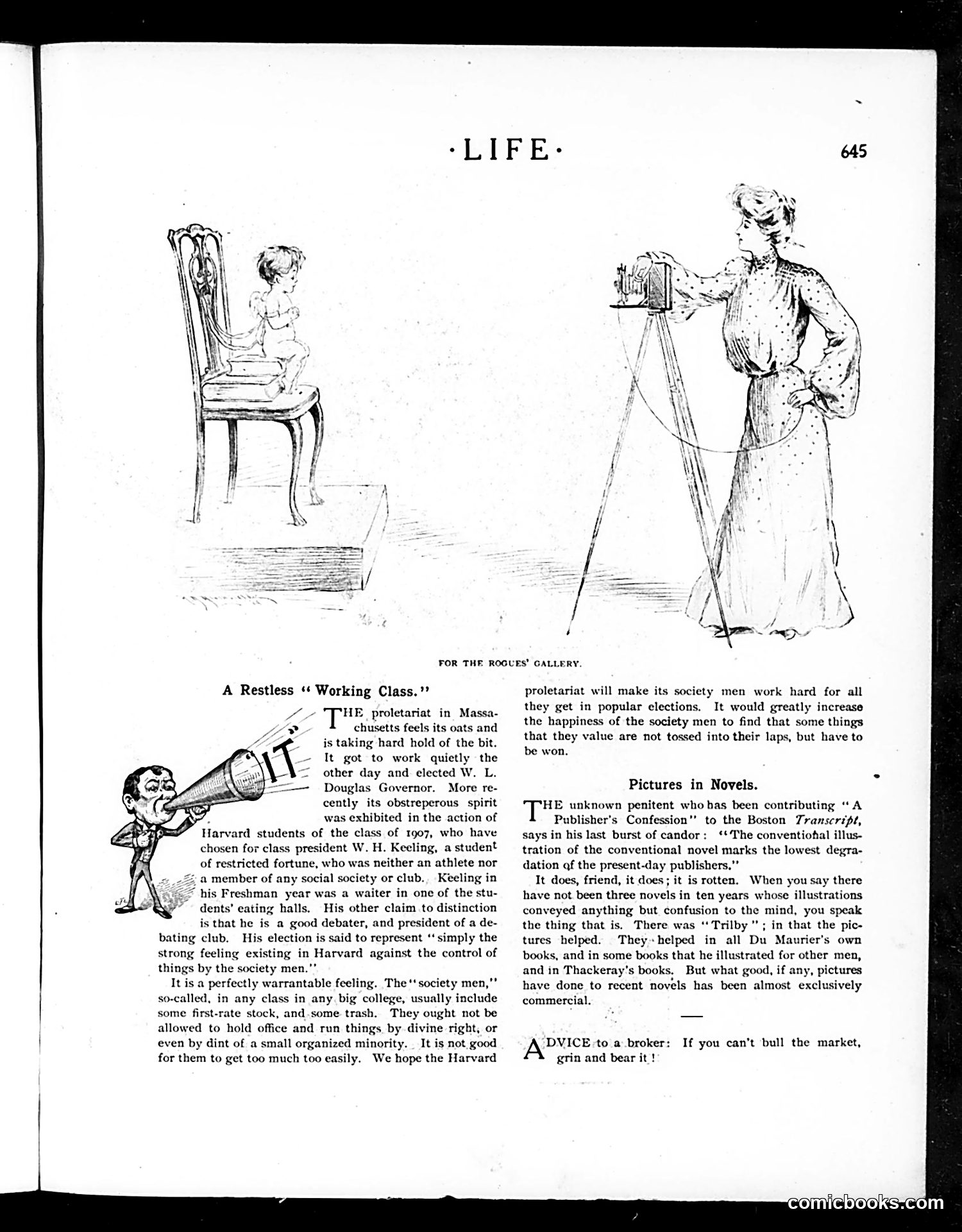
This page satirizes class tensions at Harvard and broader American society circa 1907. The main cartoon mocks Harvard's "society men"—wealthy, socially connected students who traditionally monopolized leadership positions. The satire celebrates the election of W. H. Keeling, a working-class student who earned his way through college as a dining-hall waiter, as class president. This represented a democratic revolt against aristocratic privilege. The piece frames this as part of a larger "proletariat" movement in Massachusetts, referencing W. L. Douglas's gubernatorial election, suggesting class-based political awakening. The cartoon's sketch shows a woman with a camera/telescope (representing the "working class" perspective) observing an elegantly-dressed society figure—visualizing the clash between working and privileged classes. A secondary section criticizes cheap novel illustrations as commercially-driven rather than artistically meaningful, using similar class critique: publishers exploit readers rather than serve them well. The closing financial advice ("grin and bear it") is cynical commentary on market manipulation.
📄 Transcribed text from this page (OCR, searchable)
Machine-transcribed from the original scan — historical spelling and the odd misread are preserved.
FOR THE ROGUES’ GALLERY. A Restless ‘¢ Working Class.” HE proletariat in Massa- chusetts feels its oats and is taking hard hold of the bit. It got to work quietly the other day and elected W. L. Douglas Governor. More re- cently its obstreperous spirit A was exhibited in the action of Harvard students of the class of 1907, who have chosen for class president W. H. Keeling, a student of restricted fortune, who was neither an athlete nor member of any social society or club. Keeling in his Freshman year was a waiter in one of the stu- dents’ eating halls. His other claim to distinction is that he is a good debater, and president of a de- bating club. His election is said to represent ‘‘ simply the strong feeling existing in Harvard against the control of things by the society men.’"" It is a perfectly warrantable feeling. The‘*society men,"’ so-called, in any class in any. big college, usually include some first-rate stock, and.some trash. They ought not be allowed to hold office and run things, by divine right, or even by dint of a small organized minority. _ It is not good for them to get too much too easily. We hope the Harvard proletariat will make its society men work hard for all they get in popular elections. It would greatly increase the happiness of the society men to find that some things that they value are not tossed into their laps, but have to be won. Pictures in Novels. Tr unknown penitent who bas been contributing “A Publisher's Confession’’ to the Boston Transcrtpt, says in his last burst of candor: ‘The conventiofal illus- tration of the conventional novel marks the lowest degra- dation af the present-day publishers,” It does, friend, it does; it is rotten. When you say there have not been three novels in ten years whose illustrations conveyed anything but confusion to the mind, you speak the thing that is, There was ‘Trilby "; in that the pic- tures helped. They»helped in all Du Maurier’s own books, and in some books that he illustrated for other men, and in Thackeray's books, But what good, if any, pictures have done to recent novels has been almost exclusively commercial. DVICE to a broker: grin and bear it! If you can’t bull the market,