
Life, 1904-12-15 · page 36 of 44
Life — December 15, 1904 — page 36: what you’re looking at
What you’re looking at
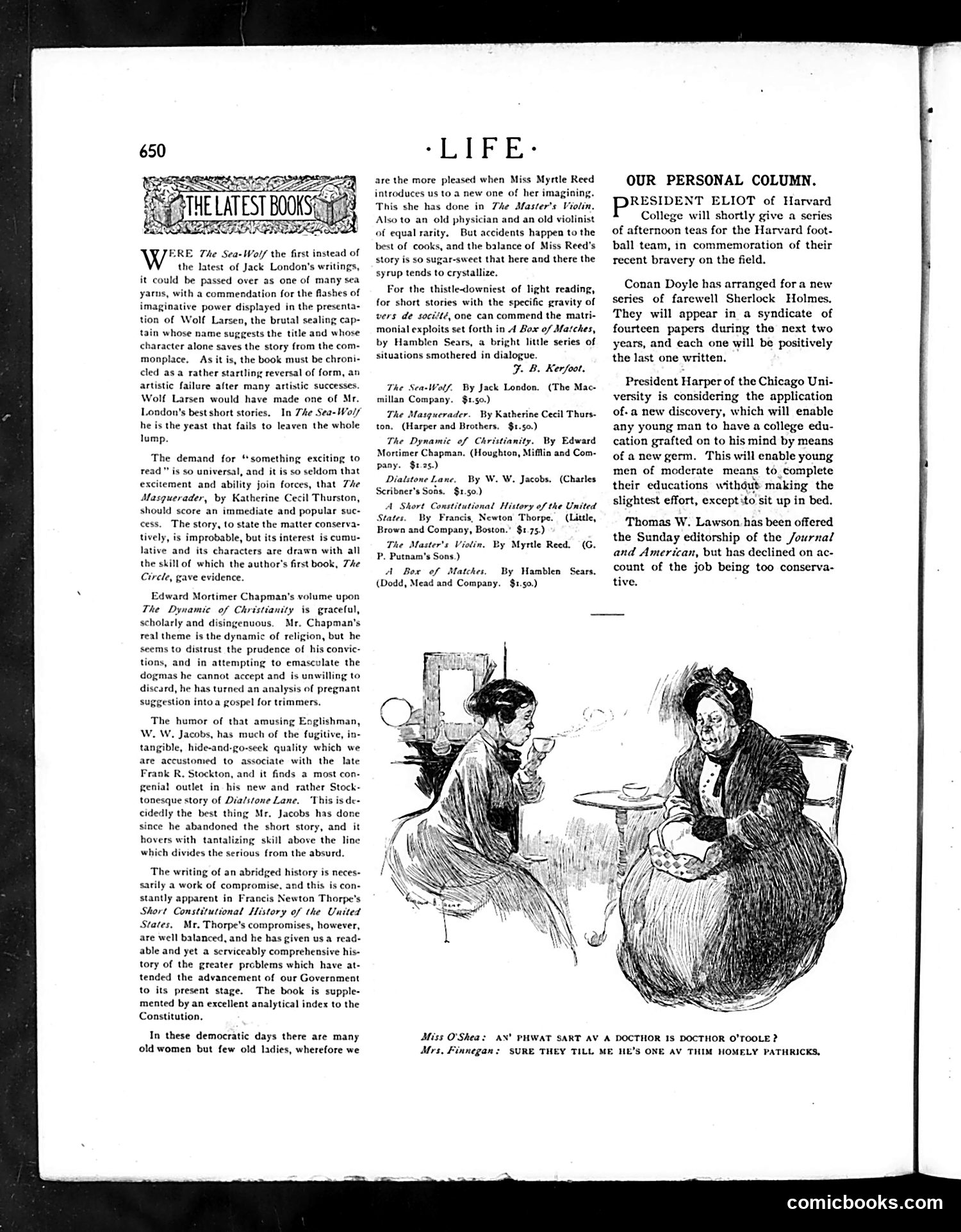
This page contains literary reviews rather than political satire. The cartoon at bottom—captioned "Miss O'Shea: 'An Irishwoman Saucy by a Doctor is Doctor O'Toole?'" with Mrs. Finnegan's response about "pathricks"—is a brief ethnic humor sketch playing on Irish stereotypes (apparent Irish names, dialect humor about doctors). The main content reviews contemporary books by Jack London, Katherine Cecil Thurston, and W.W. Jacobs. The reviewer criticizes London's *The Sea-Wolf* as structurally flawed despite its compelling protagonist, praises *The Masquerader* for exciting storytelling despite implausibility, and applauds Jacobs' *Dialstone Lane*. The reviews emphasize narrative skill and entertainment value—concerns typical of early-1900s literary culture—rather than political commentary.
📄 Transcribed text from this page (OCR, searchable)
Machine-transcribed from the original scan — historical spelling and the odd misread are preserved.
ERE The Sea-Wolf the first instead of the latest of Jack London's writings, it could be passed over as one of many sea yarus, with a commendation for the flashes of imaginative power displayed in the presenta- tion of Wolf Larsen, the brutal sealing cap- tain whose name suggests the title and whose character alone saves the story rom the com- monplace, As it is, the book must be chroni- cled asa rather startling reversal of form, an artistic failure after many artistic successes. Wolf Larsen would have made one of Mr. London's best short stories, In The Sea-Wol/ he is the yeast that fails to leaven the whole lump. The demand for “something exciting to read" is so universal, and it is so seldom that excitement and ability join forces, that 7he Masquerader, by Katherine Cecil Thurston, should score an immediate and popular suc- cess. The story, to state the matter conserva- tively, is improbable, but its interest is cumu- lative and its characters are drawn with all the skill of which the author's first book, The Circle, gave evidence. Edward Mortimer Chapman's volume upon The Dynamic of Christianity is gracetul, scholarly and disingenuous. Mr. Chapman's real theme is the dynamic of religion, but he seems to distrust the prudence of his convic- tions, and in attempting to emasculate the dogmas he cannot accept and is unwilling to discard, he has turned an analysis of pregnant suggestion into a gospel for trimmers, The humor of that amusing Englishman, W. W. Jacobs, has much of the fugitive, in- tangible, hide-and-go-seek quality which we are accustomed to associate with the late Frank R. Stockton, and it finds a most con- genial outlet in his new and rather Stock- tonesque story of Dialstone Lane, ‘This isde- cidedly the best thing Mr, Jacobs has done since he abandoned the short story, and it hovers with tantalizing skill above the line which divides the serious from the absurd. The writing of an abridged history is neces- sarily a work of compromise, and this is con- stantly apparent in Francis Newton Thorpe’s Short Constitutional History of the United States, Mr. Thorpe's compromises, however, are well balanced, and he has given usa read- able and yet a serviceably comprehensive his- tory of the greater problems which have at- tended the advancement of our Government to its present stage. The book is supple- mented by an excellent analytical index to the Constitution. In these democratic days there are many old women but few old ladies, wherefore we ‘LIF E# are the more pleased when Miss Myrtle Reed introduces us to a new one of her imagining. This she has done in The Master's Violin, Also to an old physician and an old violinist of equal rarity, But accidents happen to the best of cooks, and the balance of Miss Reed's story is so sugar-sweet that here and there the syrup tends to crystallize. For the thistledowniest of light reading, for short stories with the specific gravity of vers de société, one can commend the matri- monial exploits set forth in A Box of Matches, by Hamblen Sears, a bright little series of situations smothered in dialogue. J. B. Kerfoot. The Sea-Wolf. By Jack London. (The Mac- millan Company. $1.50.) The Masquerader. By Katherine Cecil Thurs- ton. (Harper and Brothers, $1.50.) The Dynamic of Christianity. By Edward Mortimer Chapman, (Houghton, Mifflin and Com- pany. $1.25.) Dialstone Lane. By W.W. Jacobs. (Charles Scribner's Sons. $1.50.) A Short Constitutional History of the United States. By Francis, Newton Thorpe. (Little, Brown and Company, Boston.” $1.75.) The Master's Violin. By Myrtle Reed. (G. P, Putnam's Sons.) A Box of Matches. By Hamblen Sears. (Dodd, Mead and Company. $1.50.) Miss O'Shea: OUR PERSONAL COLUMN. RESIDENT ELIOT of Harvard College will shortly give a series of afternoon teas for the Harvard foot- ball team, in commemoration of their recent bravery on the field. Conan Doyle has arranged for a new series of farewell Sherlock Holmes. They will appear in a syndicate of fourteen papers during the next two years, and each one will be positively the last one written. President Harper of the Chicago Uni- versity is considering the application of- a new discovery, which will enable any young man to have a college edu- cation grafted on to his mind by means of anew germ. This will enable young men of moderate means to complete their educations withdut making the slightest effort, exceptsto sit up in bed. Thomas W. Lawson has been offered the Sunday editorship of the Journal and American, but has declined on ac- count of the job being too conserva- tive. AN' PHWAT SART AV A DOCTHOR 1S DOCTHOR O'TOOLE ? Mrs, Finnegan: SURE THEY TILL ME HE'S ONE AV THIM HOMELY PATHRICKS, comicbooks.com