
Life, 1904-12-15 · page 12 of 44
Life — December 15, 1904 — page 12: what you’re looking at
What you’re looking at
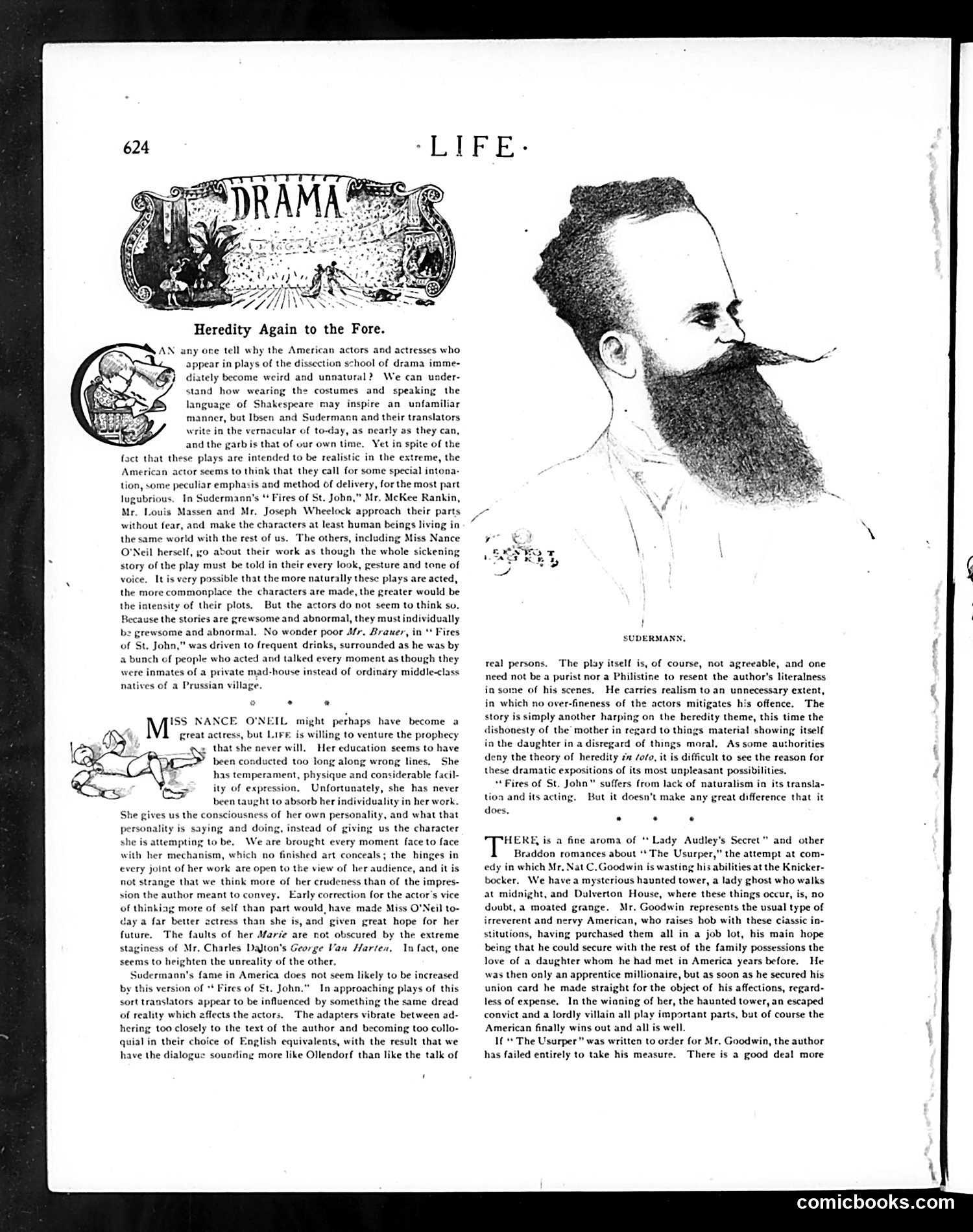
This is a drama criticism page titled "Heredity Again to the Fore." The article discusses American actors performing in plays from the "dissection school of drama"—realistic theatre that differs from traditional Shakespeare performances. The profile illustration appears to be **Sothern** (name visible below the sketch), likely Edward Sothern, a prominent actor of the era. The text critiques how actors in naturalistic plays become "weird and unnatural," arguing they overemphasize method and delivery. It specifically mentions performances in "Fires of St. John" by actors including Miss Nance O'Neil, praising some while questioning whether excessive realism serves the material. The article suggests the plays' "gloomy and abnormal" stories force actors into exaggerated performances, creating unintended comedy rather than drama. It's essentially defending traditional acting against emerging naturalistic techniques.
📄 Transcribed text from this page (OCR, searchable)
Machine-transcribed from the original scan — historical spelling and the odd misread are preserved.
Heredity Again to the Fore. N any ore tell why the American actors and actresses who appear in plays of the dissection school of drama imme- diately become weird and unnatural? We can under- stand how wearing the costumes and speaking the language of Shakespeare may inspire an unfamiliar manner, but Ibsen and Sudermann and their translators write in the vernacular of to-day, as nearly as they can, and the garb is that of our own time. Yet in spite of the fact that these plays are intended to be realistic in the extreme, the American actor seems to think that they call for some special intona- tion, some peculiar emphasis and method of delivery, for the most part lugubrious, In Sudermann’s “ Fires of St. Joho,” Mr. McKee Rankin, Mr. Louis Massen and Mr. Joseph Wheelock approach their parts without fear, and make the characters at least human beings living in the same world with the rest of us. The others, including Miss Nance O'Neil herself, go about their work as though the whole sickening story of the play must be told in their every look, gesture and tone of voice. It is very possible that the more naturally these plays are acted, the more commonplace the characters are made, the greater would be the intensity of their plots. But the actors do not seem to think so. Because the stories are grewsome and abnormal, they must individually be grewsome and abnormal. No wonder poor Mfr. Brauer, in * Fires of St, John," was driven to frequent drinks, surrounded as he was by a bunch of people who acted and talked every moment as though they were inmates of a private mad-house instead of ordinary middle-class natives of a Prussian villag ® . * NANCE O'NEIL might perhaps have become a great actress, but LiFe is willing to venture the prophecy » that she never will, Her education seems to have been conducted too long along wrong lines. She has temperament, physique and considerable facil- ity of expression, Unfortunately, she has never been taught to absorb her individuality in her work. She gives us the consciousness of her own personality, and what that personality is saying and doing, instead of giving us the character she is attempting to be. We are brought every moment face to face with her mechanism, which no finished art conceals; the binges in every joint of her work are open to the view of her audience, and it is not strange that we think more of her crudeness than of the impres- sion the author meant to convey. Early correction for the actor's vice of thinkiag more of self than part would, have made Miss O'Neil to- day a far better actress than she is, and given great hope for her future, The faults of her Marie are not obscured by the extreme staginess of Mr. Charles Da)ton’s George Van Harten, Vn fact, one seems to heighten the unreality of the other, Sudermann’s fame in America does not seem likely to be increased by this version of ** Fires of St, John.” In approaching plays of this sort translators appear to be influenced by something the same dread of reality which affects the actors. The adapters vibrate between ad- hering too closely to the text of the author and becoming too collo- quial in their choice of English equivalents, with the result that we have the dialogue sounding more like Ollendorf than like the talk of SUDERMANN, real persons. The play itself is, of course, not agreeable, and one need not be a purist nor a Philistine to resent the author's literalness in some of his scenes, He carries realism to an unnecessary extent, in which no over-fineness of the actors mitigates his offence. The story is simply another harping on the heredity theme, this time the dishonesty of the’ mother in regard to things material showing itself in the daughter in a disregard of things moral, As some authorities deny the theory of heredity ## /ofo, it is difficult to see the reason for these dramatic expositions of its most unpleasant possibilities, “+ Fires of St. John” suffers from lack of naturalism in its transla tioa and its acting, But it doesn’t make any great difference that it does, HERE, is a fine aroma of “Lady Audley’s Secret” and other Braddon romances about ‘The Usurper,” the attempt at com- edy in which Mr, Nat C.Goodwin is wasting his abilities at the Knicker- bocker. We havea mysterious haunted tower, a lady ghost who walks at midnight, and Dulverton House, where these things occur, is, no doubt, a moated grange. Mr. Goodwin represents the usual type of irreverent and nervy American, who raises hob with these ciassic in- stitutions, having purchased them all in a job lot, his main hope being that he could secure with the rest of the family possessions the Jove of a daughter whom he had met in America years before. He was then only an apprentice millionaire, but as soon as he secured his union card he made straight for the object of his affections, regard- less of expense. In the wining of her, the haunted tower, an escaped convict and a lordly villain all play important parts, but of course the American finally wins out and all is well. If * The Usurper” was written to order for Mr. Goodwin, the author has failed entirely to take his measure. There is a good deal more comicbooks.com