
Life, 1904-12-15 · page 28 of 44
Life — December 15, 1904 — page 28: what you’re looking at
What you’re looking at
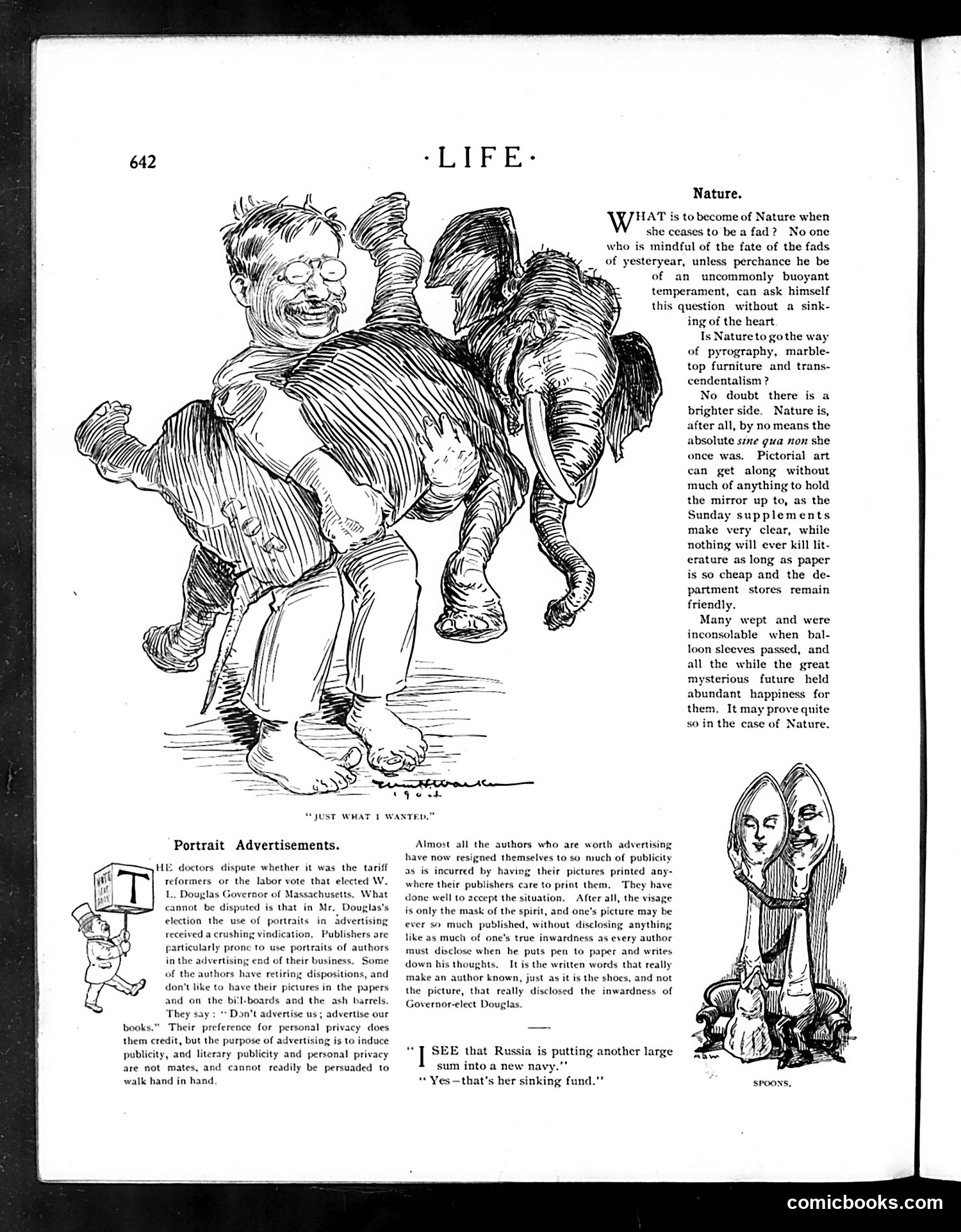
This page contains two satirical pieces: **Main Cartoon ("Just What I Wanted"):** A caricatured figure rides an elephant labeled "Nature," celebrating it as a fad. The satire mocks the contemporary fashion for celebrating "Nature"—suggesting it's a temporary trend destined to fade like other passing fads (balloon sleeves, pyrography). The essay questions what will happen to Nature's cultural relevance once this enthusiasm passes, cynically noting that literature and pictorial art survive regardless because they're cheap to produce and department stores support them. **"Portrait Advertisements":** References W.L. Douglas's election as Massachusetts Governor, attributing his success to portrait advertising—validating the practice of using authors' faces in ads despite some authors' privacy preferences. The piece argues written words, not pictures, truly reveal an author's character, then jokes that Douglas's shoes (not his portrait) best revealed his "inwardness." **"Sinking Fund" Joke:** A brief pun about Russia's naval spending—calling it a "sinking fund" because Russian ships sink. All three pieces employ ironic humor typical of Life's satirical approach.
📄 Transcribed text from this page (OCR, searchable)
Machine-transcribed from the original scan — historical spelling and the odd misread are preserved.
Nature. HAT is to become of Nature when she ceases to be a fad? No one who is mindful of the fate of the fads of yesteryear, unless perchance he be of an uncommonly buoyant temperament, can ask himself this question without a sink- acres “JUST WHAT 1 WANTED.” Portrait Advertisements. HE doctors dispute whether it was the tariff reformers or the labor vote that elected W. L, Douglas Goveroor of Massachusetts, What cannot be disputed is that in Mr, Douglas's election the use of portraits in advertising received a crushing vindication, Publishers are particularly prone to use portraits of authors in the advertising end of their business. Some of the authors have retiring dispositions, and don’t like to have their pictures in the papers and on the bi'l-boards and the ash barrels. They say : ** Don’t advertise us; advertise our books.” Their preference for personal privacy does them credit, but the purpose of advertising is to induce publicity, and literary publicity and personal privacy are not mates, and cannot readily be persuaded to walk hand in hand Almost all the authors who are worth advertising have now resigned themselves to so much of publicity as is incurred by having their pictures printed any- where their publishers care to print them, They have done well to accept the situation. After all, the visage is only the mask of the spirit, and one’s picture may be ever so much published, without disclosing anything like as much of one’s true inwardness as every author must disclose when he puts pen to paper and writes down his thoughts. It is the written words that really make an author known, just as it is the shoes, and not the picture, that really disclosed the inwardaess of Governor-elect Douglas. “| SEE that Russia is putting another large sum into a new navy.”’ es —that’s her sinking fund.’ ing of the heart Is Natureto gothe way of pyrography, marble- top furniture and trans- cendentalism ? No doubt there is a brighter side. Nature is, after all, by no means the absolute sine gua non she once was. Pictorial art can get along without much of anything to hold the mirror up to, as the Sunday supplements make very clear, while nothing will ever kill lit- erature as long as paper is so cheap and the de- partment stores remain friendly. Many wept and were inconsolable when bal- loon sleeves passed, and all the while the great mysterious future held abundant happiness for them. It may prove quite sointhe case of Nature. spoons. comicbooks.com