
Life, 1904-12-15 · page 35 of 44
Life — December 15, 1904 — page 35: what you’re looking at
What you’re looking at
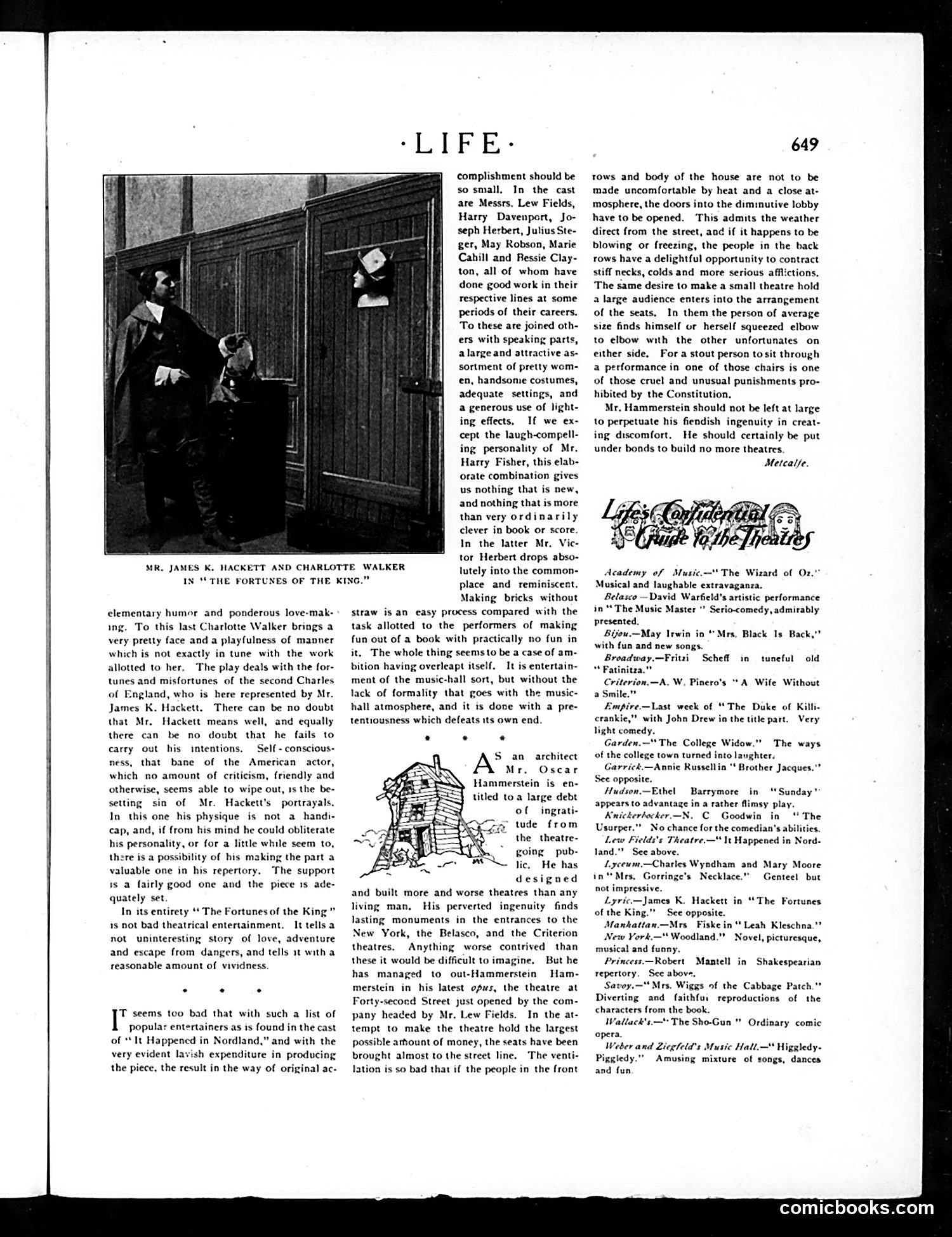
This page reviews theatrical productions, with the main photograph showing **James K. Hackett and Charlotte Walker in "The Fortunes of the King."** The principal satire targets **Oscar Hammerstein** (theater architect/producer), whom critic Metcalfe attacks for designing absurdly small theaters that prioritize maximum seating over audience comfort. Hammerstein's "fiendish ingenuity" creates cruel conditions: cramped seats force people into uncomfortable proximity, drafty doors plague back-row patrons, and the overall design constitutes "cruel and unusual punishment" (a constitutional reference for comic effect). The reviewer sardonically suggests Hammerstein "should not be left at large" and should be "put under bonds to build no more theatres." The satire mocks Hammerstein's commercial greed sacrificing basic human comfort—a critique of early 1900s theater practices prioritizing profit over patron welfare. The theatrical reviews below provide context on contemporary New York productions.
📄 Transcribed text from this page (OCR, searchable)
Machine-transcribed from the original scan — historical spelling and the odd misread are preserved.
-LIFE- 649 complishment shouldbe rows and body of the house are not to be so small, In the cast made uncomfortable by heat and a close at- are Messrs, Lew Fields, mosphere, the doors into the diminutive lobby Harry Davenport, Jo- have to be opened. This admits the weather seph Herbert, JuliusSte- direct from the street, aod if it happens to be ger, May Robson, Marie blowing or freezing, the people in the back Cahill and Ressie Clay- rows have a delightful opportunity to contract ton, all of whom have _ stiff necks, colds and more serious afflictions. done good work in their The same desire to make a small theatre hold respective lines at some a large audience enters into the arrangement periods of their careers. of the seats, In them the person of average ‘To these are joined oth- size finds himself or herself squeezed elbow ers with speaking parts, to elbow with the other unfortunates on alargeand attractive as- either side. For a stout person tosit through sortment of pretty wom- a performance in one of those chairs is one en, handsome costumes, of those cruel and unusual punishments pro- adequate settings, and hibited by the Constitution. a generous use of light- Mr, Hammerstein should not be left at large ing effects, If we ex- to perpetuate his fiendish ingenuity in creat- cept the laugh-compell- ing discomfort. He should certainly be put ing personality of Mr. under bonds to build no more theatres. Harry Fisher, this elab- Metcalfe. orate combination gives us nothing that is new, and nothing that is more than very ordinarily clever in book or score. In the latter Mr. tor Herbert drops abso- ic \ MR. JAMES IACKETT AND CHARLOTTE WALKER lutely into the common- Academy of Susic.—"The Wizard of Or." } IN “THE FORTUNES OF THE KINO. place and reminiscent. Musical and laughable extravaganza. j Making bricks without Belasco David Warfield's artistic performance elementary humor and ponderous love-mak- straw is an easy process compared with the!” The Music Master "" Serio-comedy, admirably ing. To this last Charlotte Walker brings a task allotted to the performers of making Presented 7 | ;, ‘ ‘ Bijou.—May Irwin in “Mrs, Black Is Back,’ very pretty face and a playfulness of manner fun out of a book with practically no fun im 7th rue which is not exactly in tune with the work it, ‘The whole thing seemstobeacaseofam- "psc itay.-Fritsi Scheff in tuneful old allotted to her. The play deals with the for- bition having overleapt itself, It isentertain- — « patinitz: tunes and misfortunes of the second Charles ment of the music-hall sort, but without the Criterion. of England, who is here represented by Mr. lack of formality that goes with the music- a Smile."* James K. Hackett. There can be no doubt hall atmosphere, and it is done with a pre- — Empire.—Last week of “The Duke of Killi- that Mr. Hackett means well, and equally — tentiousness which defeats its own end crankie,”” with John Drew in the title part. Very light comed: there can be no doubt that he fails to é Garden. Th Wii oad ys carry out his intentions. Self - conscious- Garden 1e College Widow." The ways . . : S an architect of the college town turned into laughter. ness; tbat (bane; OF the! American. <cior, A Mr. Oscar — Garrick.—Annie Russellin Brother Jacques.”” which no amount of criticism, friendly and : otherwise, seems able to wipe out, 1s the be- setting sin of Mr. Hackett's portrayals, In this one his physique is not a handi- cap, and, if from his mind he could obliterate his personality, or for a little while seem to, there is a possibility of his making the part a valuable one in his repertory, The support 1s a fairly good one and the piece 1s ade- quately set. In its entirety “¢ The Fortunes of the King” 1s not bad theatrical entertainment. It tells a not uninteresting story of love, adventure and escape from dangers, and tells 1t with a A.W. Pinero's “A Wife Without in is ene Se posite, aeraee dats Hudson.—Ethel Barrymore in ‘Sunday? appears to advantage in a rather flimsy play. of ingrat Knickerbocker. C Goodwin in ‘The tude from — Usurper."" No chance for the comedian’s abilities. the theatre- Lew Fields's Theatre.—" \t Happened in Nord- going pub- — land."? See above. lic, He has Lyceun.—Charles Wyndham and Mary Moore designed 'n"Mrs, Gorringe's Necklace.” Gentee!_but not impressive. Lyric—James K. Hackett in “The Fortunes of the King.” i Manhattan.—Mrs_ Fiske in“ Leah Kleschna.”” New York," Woodland." Novel, picturesque, Anything worse contrived than musical and funny, and built more and worse theatres than any living man, His perverted ingenuity finds lasting monuments in the entrances to the New York, the Belasco, and the Criterion theatre jeasonable amount of vovisesk these it would be difficult to imagine, But he Princess.—Robert Mantell in| Shakespearian has managed to out-Hammerstein Ham- repertory. Sce above. Fy ‘ 2 merstein in his latest opus, the theatre at Savoy.—"' Mrs. Wiggs of the Cabbage Patch.” Forty-secoed Street just opened by the com- Diverting and faith(or reproductions of the T seems too bad that with such a list of pany headed by Mr, Lew Fields. In the at- sheseciery (rom Se Pek + Ora F popular entertainers as 1s found in the cast. tempt to make the theatre hold the largest mak aces SRO SN td TSI OSY SPREE of "It Happened in Nordland," and with the possible arhount of money, the seats have been yey and Zicgfeld's Music Hall. Higgledy- very evident lavish expenditure in producing brought almost to the street line. ‘The venti- piggiedy.” Amusing mistare. of songs, dances the piece, the result in the way of original ac- lation is so bad that if the people in the front. and fun comicbooks.com