
A complete issue · 38 pages · 1904
Life — September 1, 1904
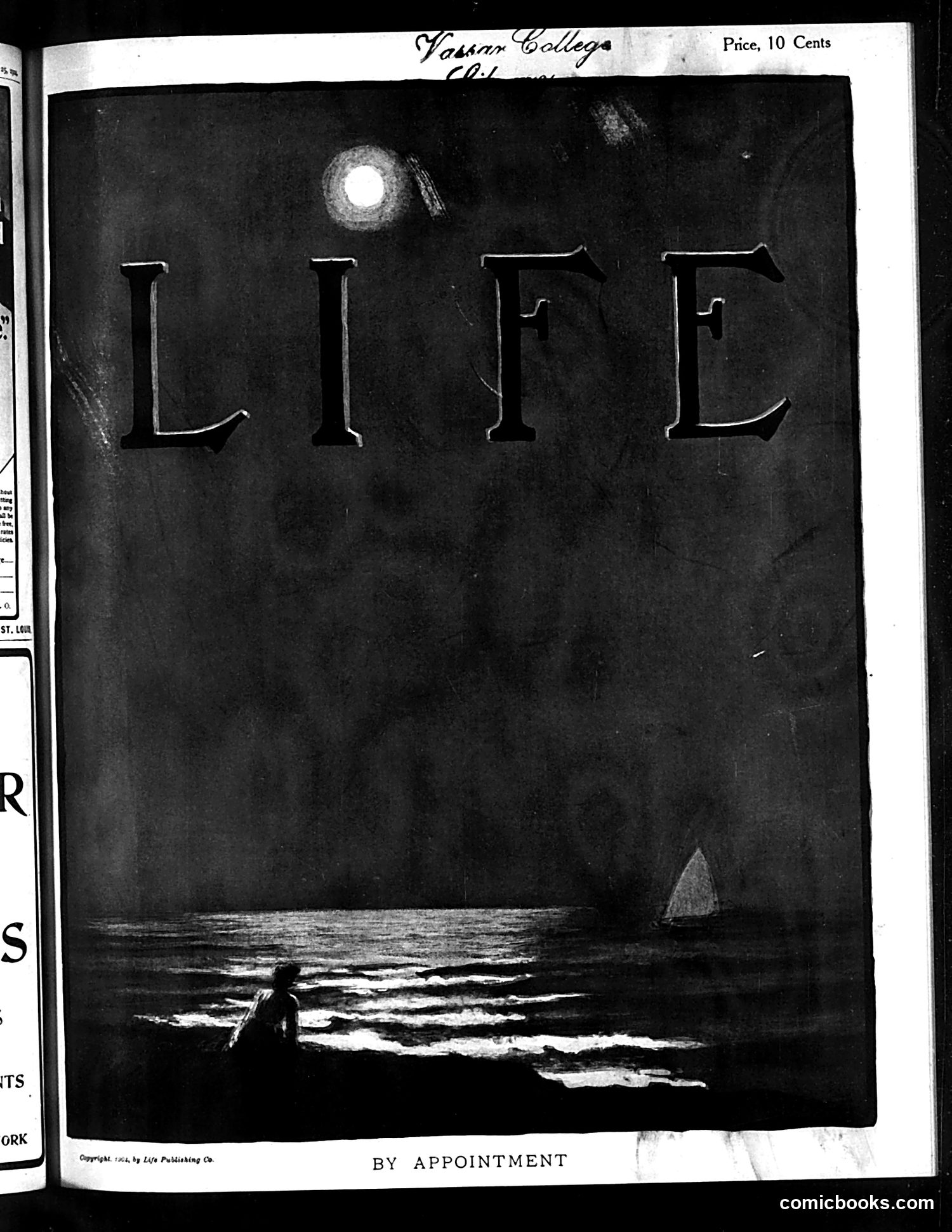
This appears to be a cover for Life magazine (priced at 10 cents, indicating early 20th century publication). The word "LIFE" dominates in large letters against a dark, moody nighttime seascape. The image shows a solitary figure wading in turbulent ocean waters beneath a full moon, with a sailboat visible in the distance. The composition evokes melancholy and isolation rather than humor typical of Life's satirical content. Without additional visible text identifying the specific issue, subject matter, or date, I cannot determine the precise political or social commentary intended. The credits note "BY APPOINTMENT" and "Copyright 1924 by Life Publishing Co" (visible at bottom), but the cover's thematic meaning remains unclear without more context about the issue's contents.
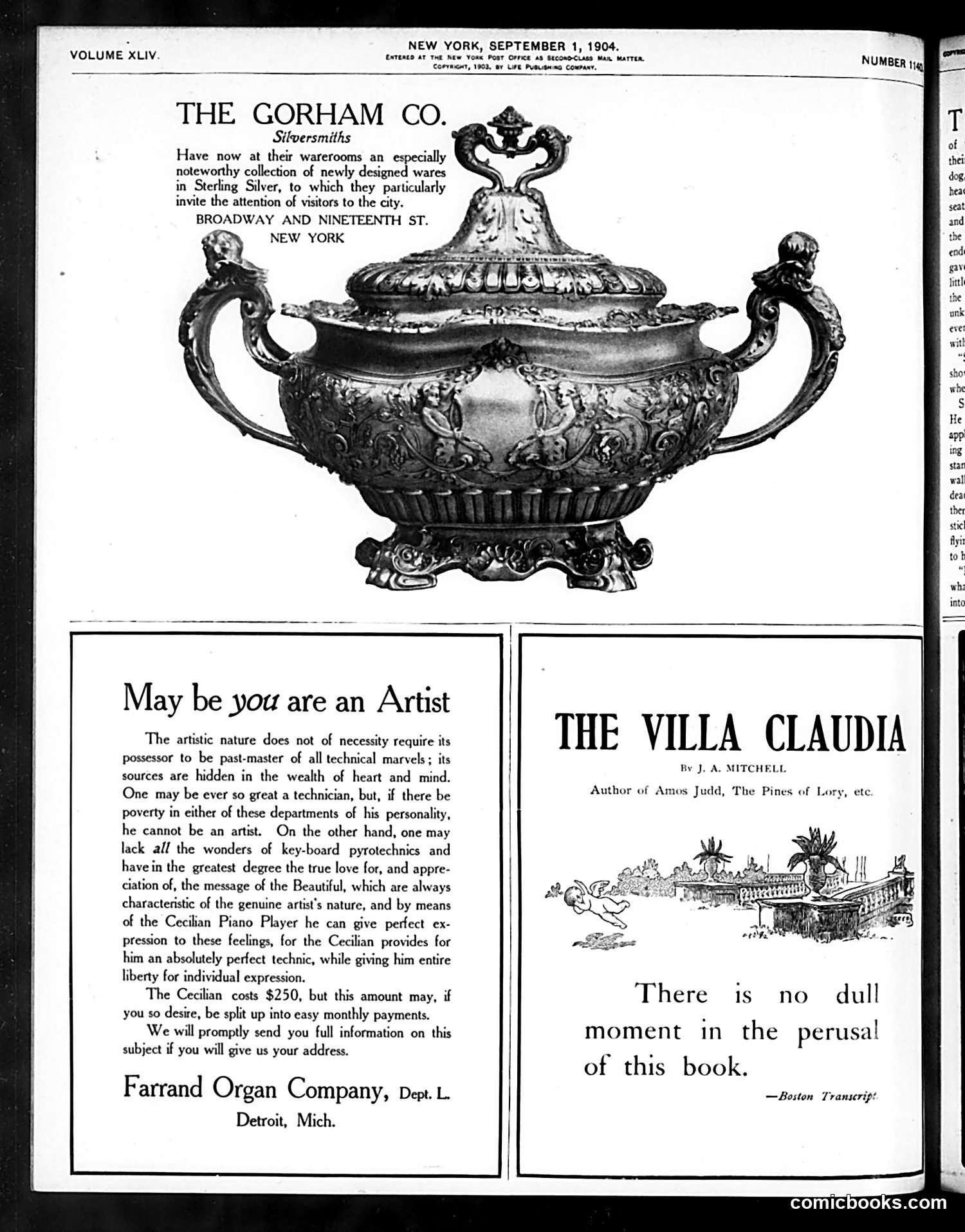
This page is primarily **advertising**, not political satire or comics. The top advertisement features The Gorham Co., a prestigious silversmith located at Broadway and 19th Street in New York. They're showcasing an ornate sterling silver tureen with elaborate handles and lid—representative of high-end decorative metalwork from the Edwardian era. Below are two additional advertisements: one for the Farrand Organ Company (Detroit) promoting a Cecilian Piano Player for $250 with monthly payment options, and another for "The Villa Claudia," a novel by J.A. Mitchell. There is no political cartoon or satirical content on this page. It reflects early 1900s consumer culture and publishing industry advertisements typical of *Life* magazine's revenue model during this period.
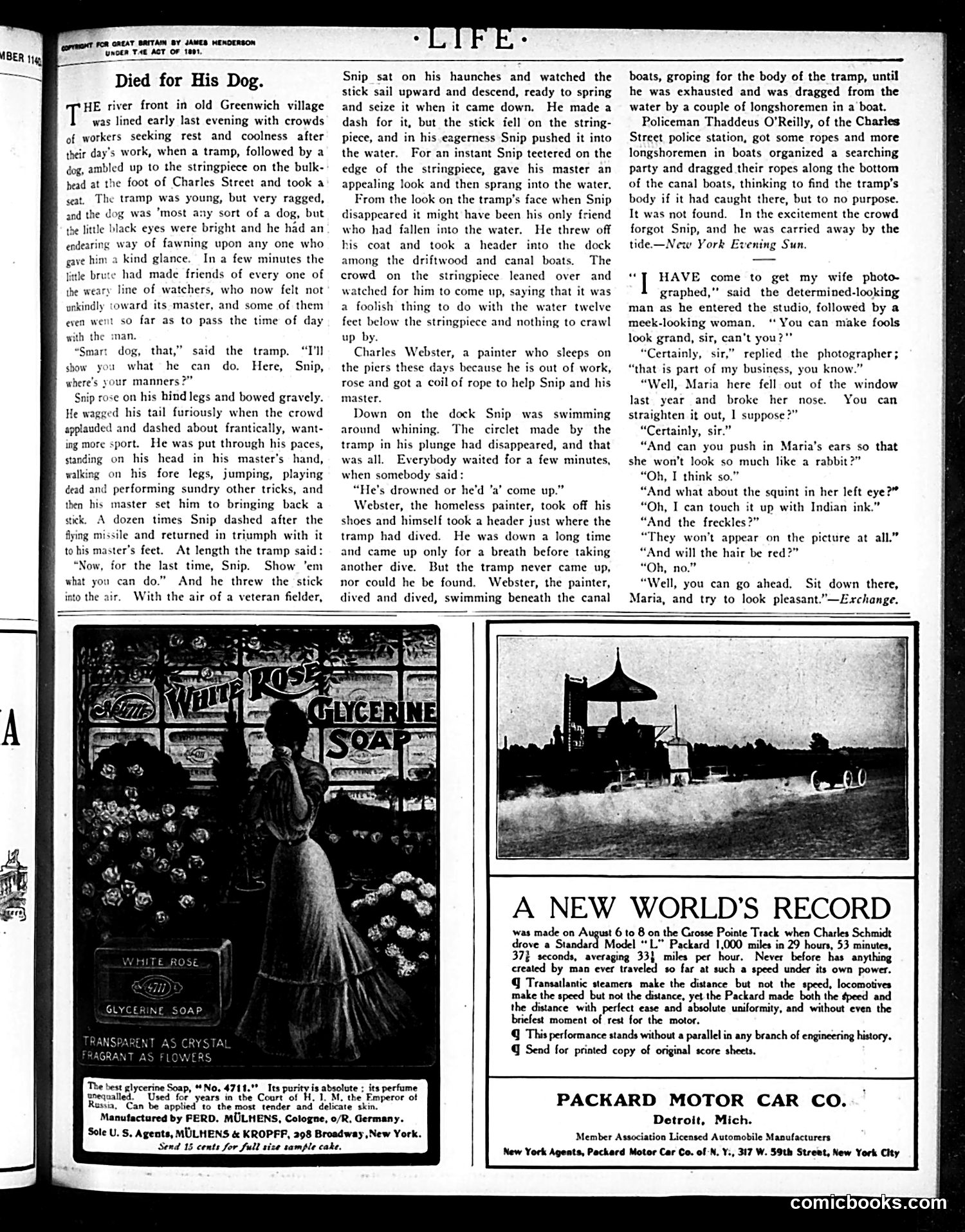
This page contains primarily **narrative fiction and advertising rather than political satire**. The main story, "Died for His Dog," depicts a tramp's devotion to his dog Snip in Greenwich Village. When the dog falls into a canal, the tramp drowns attempting a rescue. It's a sentimental tale about working-class loyalty and sacrifice—typical of Life's mixed content approach. The advertisements include White Rose Glycerine Soap and a Packard Motor Car advertisement highlighting a speed record. **No political cartoon or caricature appears on this page.** The content reflects early 20th-century Life magazine's dual nature: part satirical commentary, part general-interest storytelling and commercial promotion. This particular page emphasizes human-interest narrative over social critique.
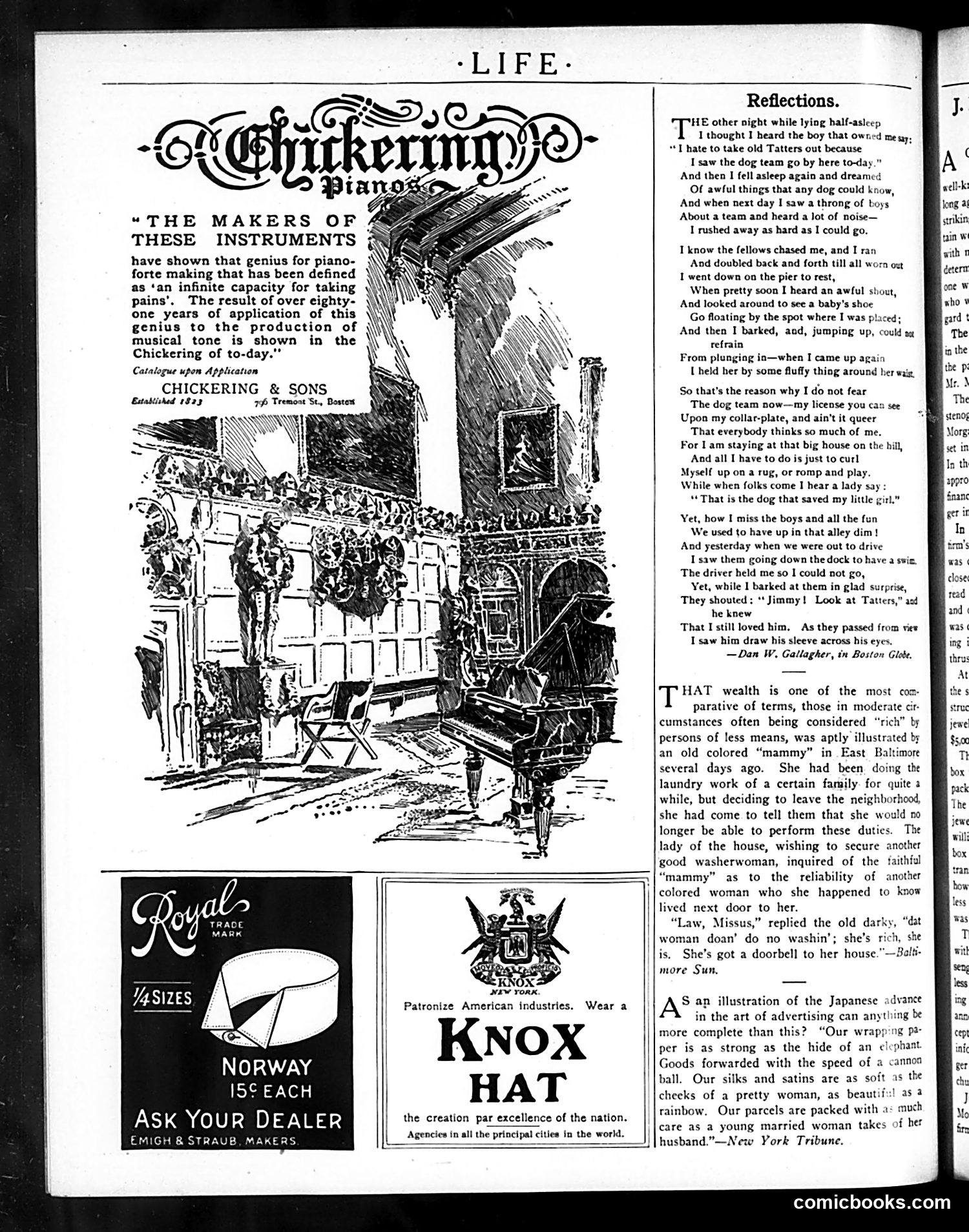
This page is primarily **advertising and fiction**, not political satire. The left side features a Chickering Pianos advertisement with an illustration of a crowded street scene—likely depicting urban life or commerce—meant to showcase the piano maker's prominence. The right side contains "Reflections," a short story or poem about a dog named Tatters that the narrator misses. It's sentimental in tone, describing childhood memories of the dog and boys in an alley. Below are ads for Royal Norway hats (15¢) and Knox Hats, promoting American-made goods. The page reflects early 20th-century Life magazine's mix of **light fiction, nostalgia, and consumer advertising**—common content for the era's middle-class readership. No significant political commentary is present.
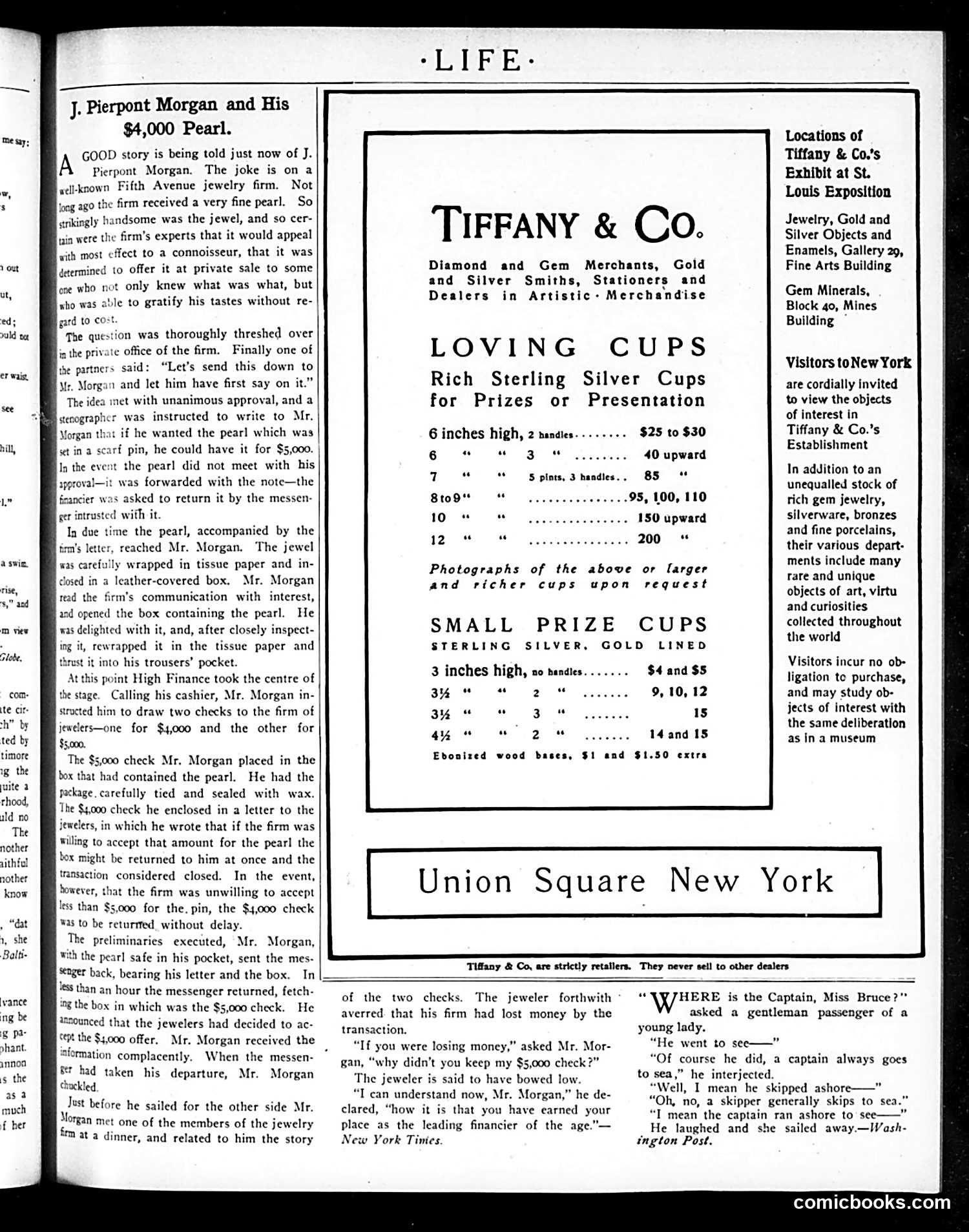
This page contains **no political cartoon**. The left column presents a humorous anecdote titled "J. Pierpont Morgan and His $4,000 Pearl"—a story about the wealthy financier J. Pierpont Morgan receiving an exceptionally fine pearl. A jeweler offered to buy it, but Morgan, through intermediaries, demanded $5,000. When the jeweler balked, Morgan placed the pearl in a sealed box with a $5,000 check, leaving terms that the box could only be returned unopened or kept at that price. The jeweler ultimately accepted, validating Morgan's confident assessment of the pearl's value. The right side is a **Tiffany & Co. advertisement** featuring their "Loving Cups" and "Small Prize Cups," with prices and specifications, plus exhibition location details at the St. Louis Exposition. The bottom contains a brief humorous dialogue about a ship's captain.
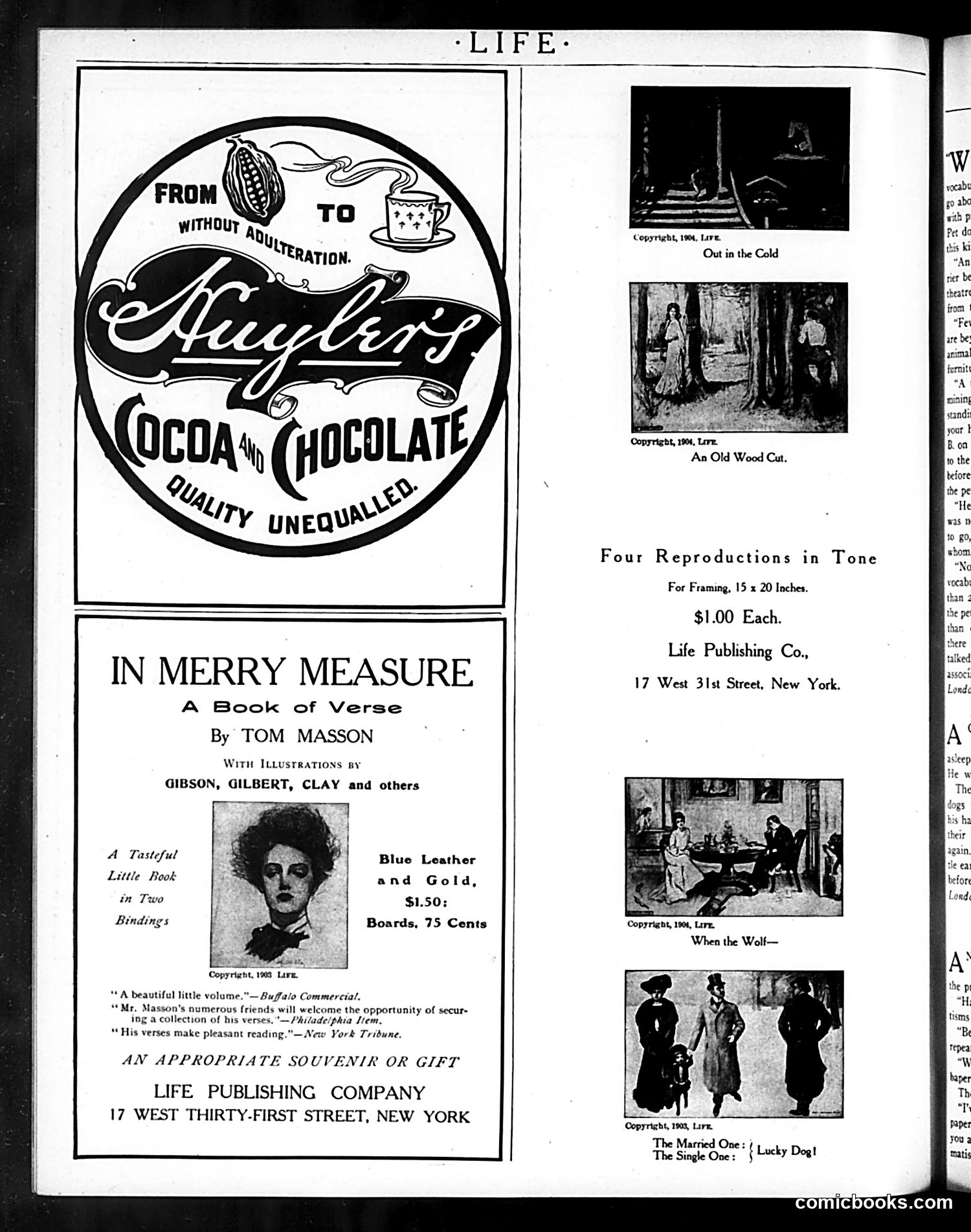
This page is primarily **advertising and book promotion** rather than political satire. The left side features an advertisement for Auylong Cocoa and Chocolate, emphasizing purity ("without adulteration") and quality. Below that is a book ad for "In Merry Measure," a poetry collection by Tom Masson illustrated by Gibson, Gilbert, Clay and others—marketed as a tasteful gift. The right side shows **four photographic reproductions** available for purchase from Life Publishing Co.: "Out in the Cold," "An Old Wood Cut," "When the Wolf—," and "The Married One; The Single One; Lucky Dog!" These appear to be theatrical or dramatic scenes from 1904, offered as framed prints for $1.00 each. The page contains no identifiable political cartoons or satirical commentary.
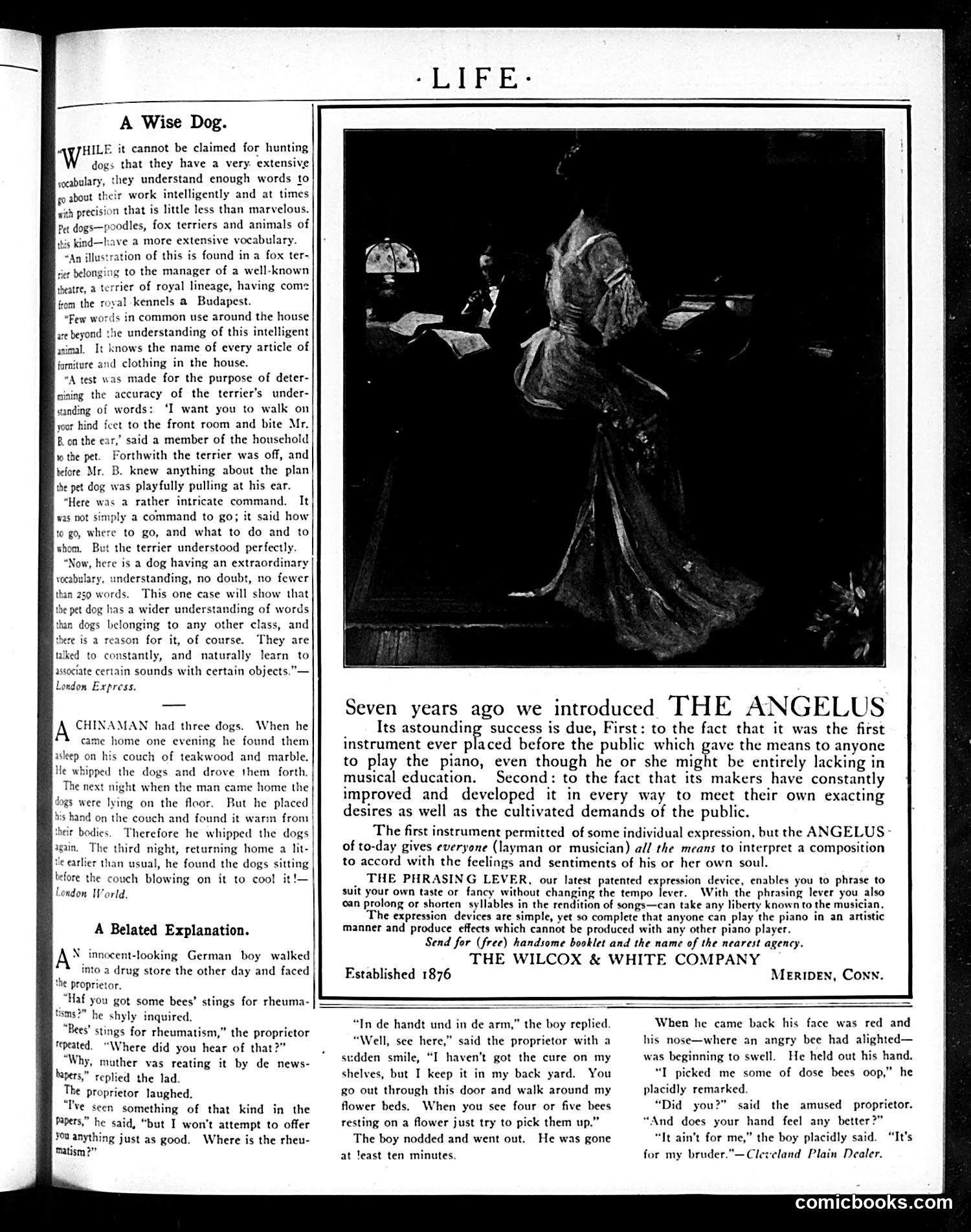
This page is primarily **advertising and anecdotal content** rather than political satire. The top left contains a humorous article titled "A Wise Dog" about a fox terrier's extensive vocabulary—a lighthearted piece on animal intelligence. The large right-side image and text advertise **"The Angelus"** by The Wilcox & White Company (established 1876, Meriden, Connecticut). This was a patented mechanical device allowing non-musicians to play piano compositions by operating a lever mechanism. Below is an unrelated humorous anecdote about a German boy seeking rheumatism cures at a drugstore. **No political cartoon or satire appears on this page.** The content reflects early 1900s consumer advertising and light humor typical of *Life* magazine's miscellaneous filler material.
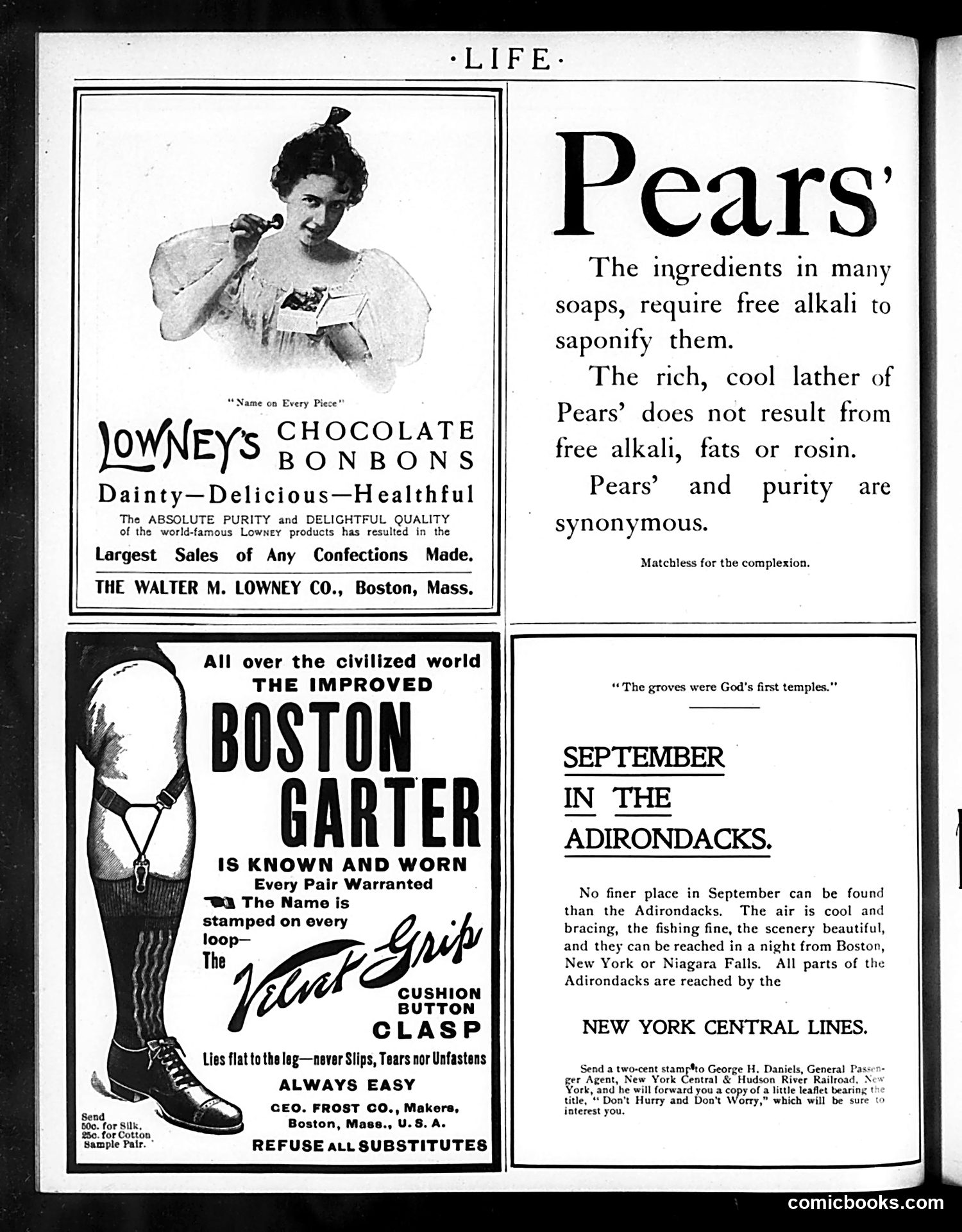
This page contains **advertisements, not political satire**. The top features **Lowney's Chocolate Bonbons**, emphasizing "purity" and "delightful quality." Below that, **Pears' soap** uses similar "purity" messaging, claiming its lather comes from ingredients other than "free alkali, fats or rosin." The ad states "Pears' and purity are synonymous" and calls the soap "Matchless for the complexion." The bottom advertises the **Boston Garter** (hosiery) with an illustration of a woman's leg, promoting it as "known and worn" worldwide. The right side contains a brief travel piece about **September in the Adirondacks**, promoting tourism via the New York Central Lines. These are standard early 20th-century product advertisements emphasizing quality and purity—common messaging of the era—rather than political commentary.
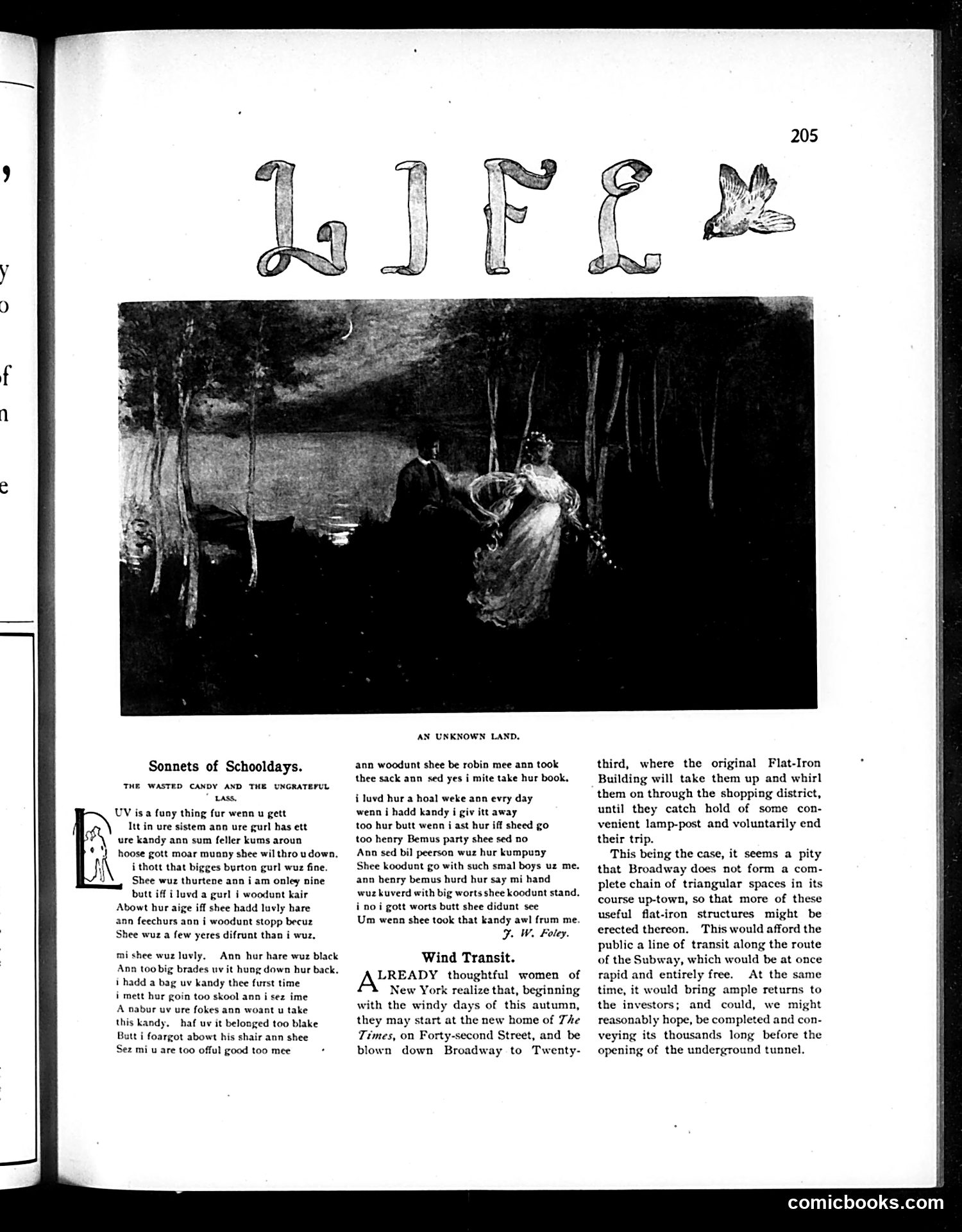
This page contains two literary pieces rather than political cartoons: 1. **"Sonnets of Schooldays"** — A nostalgic poem by an unnamed author about childhood memories, including references to candy, mischief, and schoolyard romance. The tone is sentimental reflection on youthful experiences. 2. **"Wind Transit"** — An article discussing New York City women's concerns about autumn winds affecting their appearance as they travel between The Times building on Forty-second Street and Broadway to Twenty-third Street. It humorously suggests this windy route could become a subway line, which would provide shelter and potentially boost the city's morale while awaiting the underground tunnel's opening. Both pieces are lighthearted social commentary typical of Life's satirical approach to everyday urban and domestic life.
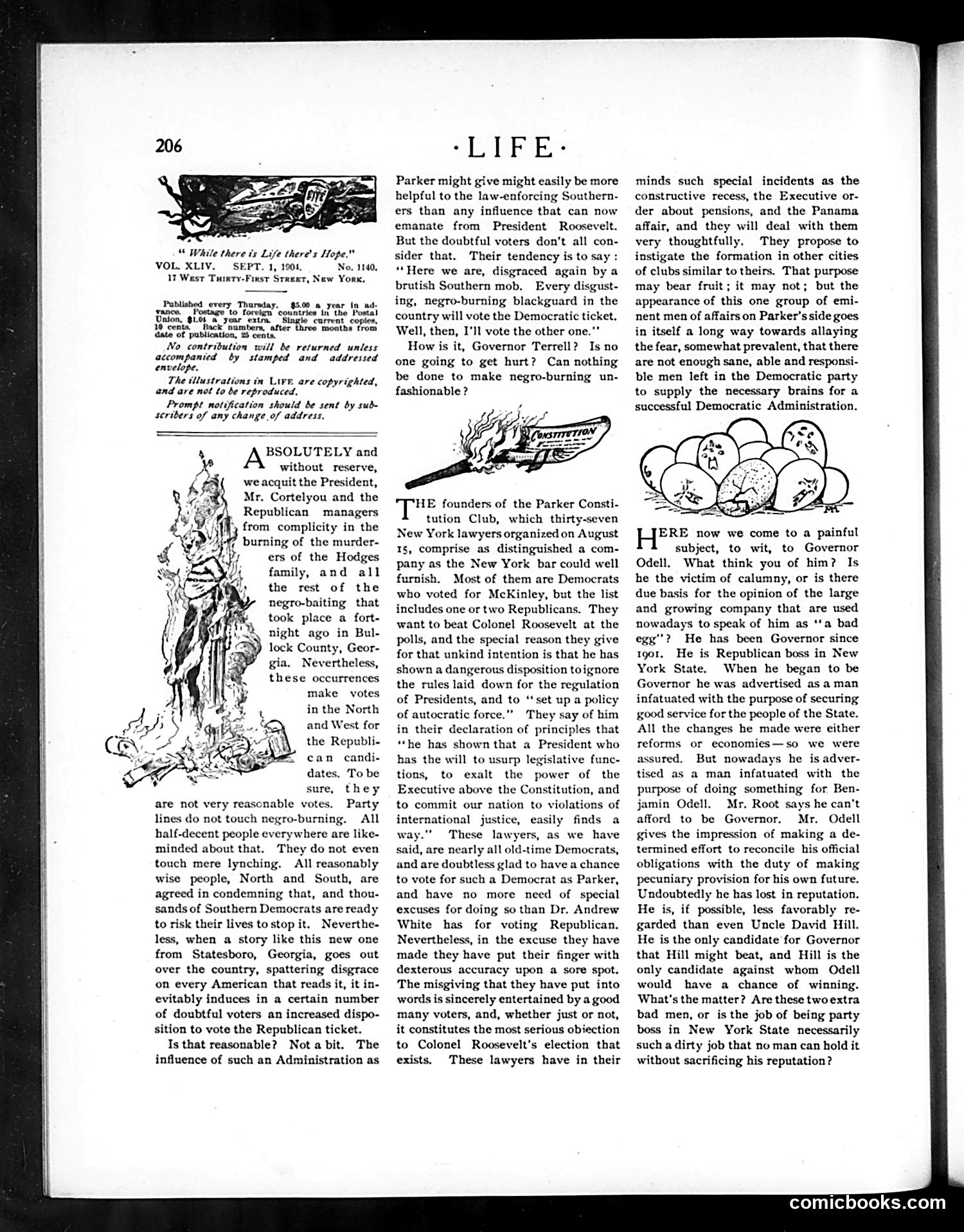
This page critiques Governor **Odell of New York** and the **Parker Constitution Club**, a group of thirty-seven New York lawyers (mostly Democrats) organized to prevent Colonel Roosevelt's election. The left illustration depicts a skeletal, demonic figure—likely representing the specter of **lynching and racial violence** in the South. The text argues that Southern voters, disgraced by "negro-burning blackguard[s]," will vote Democratic regardless of administration influence. The satire attacks Odell's reputation as "inflated" and questions whether he can afford to support a Democrat (Parker) without sacrificing his political standing. The cartoonist suggests these lawyers' opposition to Roosevelt is merely partisan opportunism, not principled governance—a "dirty job" that damages Odell's credibility.
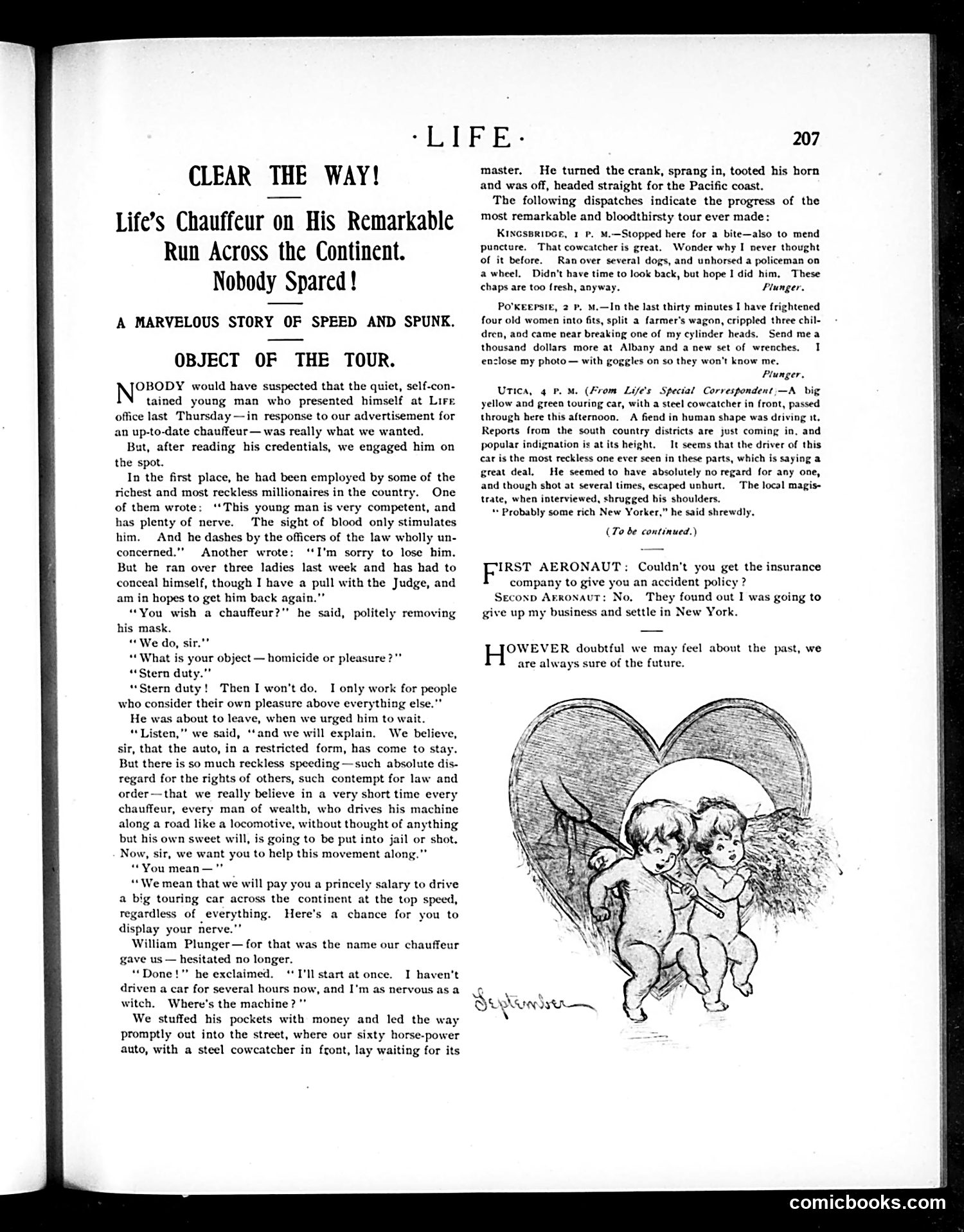
This page contains an article titled "Clear the Way!" about a chauffeur hired to drive a car across the American continent at high speed. The piece satirizes reckless early automobile drivers and their disregard for public safety and traffic laws. The article mocks the chauffeur's dangerous driving habits—speeding, endangering pedestrians, and showing contempt for regulations. The editors hired him specifically to demonstrate this problem, arguing that such drivers belong "in jail or shot." The brief dialogue at bottom about aeronauts obtaining insurance appears unrelated, likely transitional content. The small illustration shows cherubs or cupids, possibly decorative rather than integral to the satire. The overall point: early motorists posed genuine public hazards, and their cavalier attitudes toward safety were absurd and dangerous.
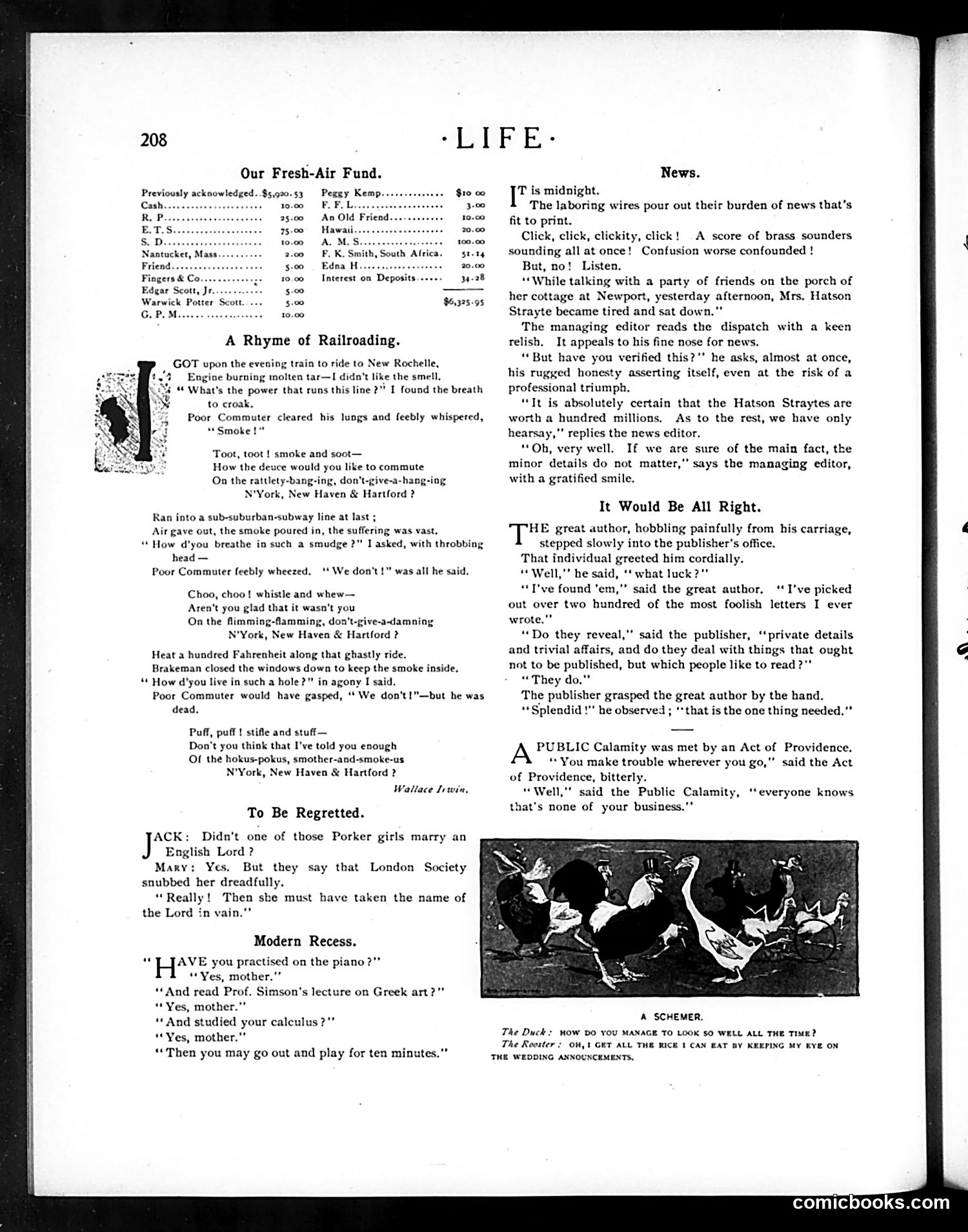
The bottom illustration depicts ducks in a farmyard scene. The caption reveals the satire: a duck brags to a rooster about managing to look well while eating all the time, specifically by keeping its eye on "the wedding announcements." The joke is a social commentary on fortune-hunting: the duck represents someone (likely a woman, given period conventions) who strategically pursues wealthy people by monitoring marriage announcements—identifying eligible partners or opportunities through these public notices. The duck's self-satisfied tone mocks this calculated approach to social advancement. This reflects turn-of-the-century anxieties about mercenary marriage and social climbing, satirizing those who viewed matrimony as financial opportunity rather than romantic partnership.
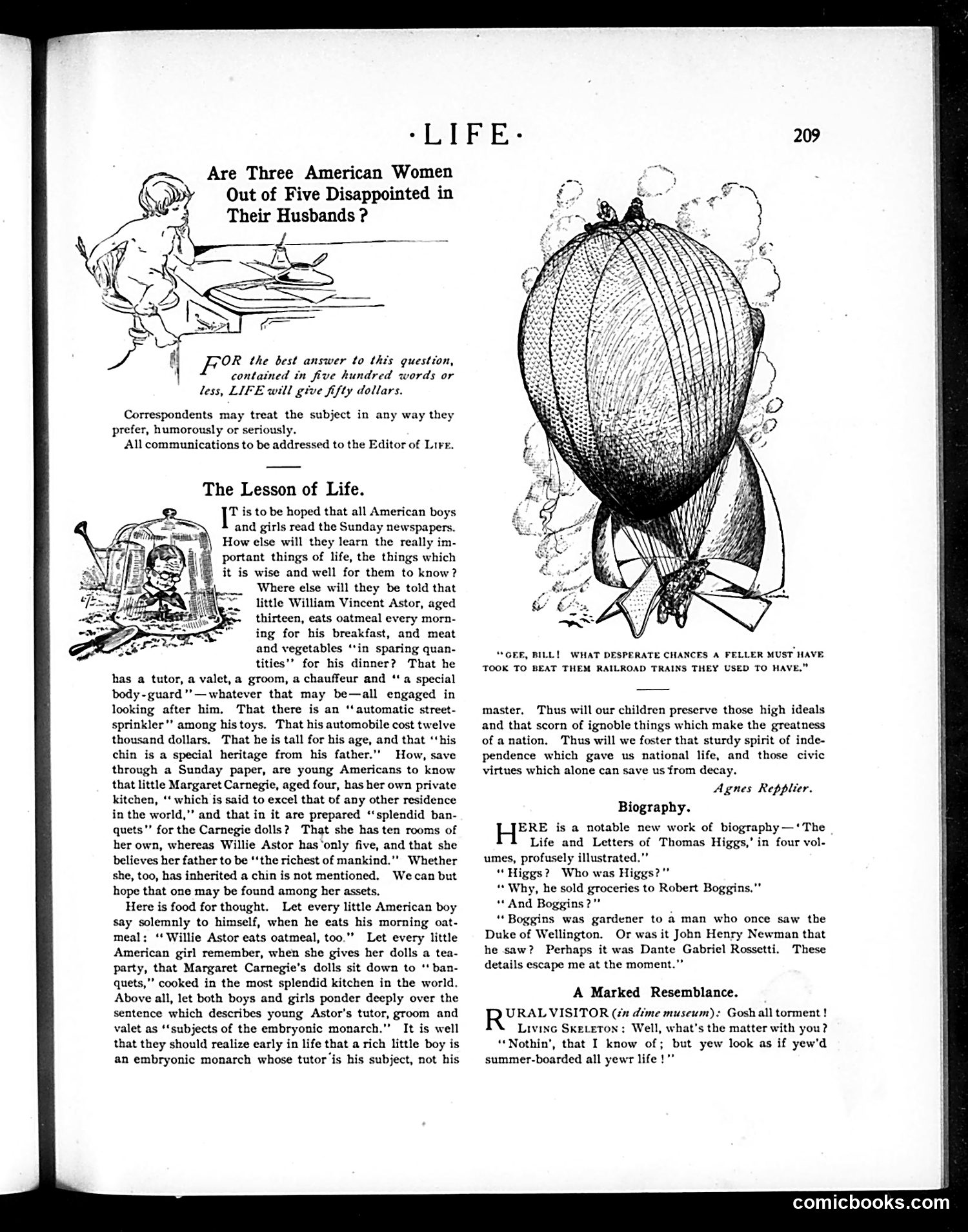
This page contains three satirical pieces mocking American society: **"The Lesson of Life"** (main essay by Agnes Repplier) sarcastically critiques how Sunday newspapers celebrate the extravagant lives of wealthy children like William Vincent Astor (age 13) and Margaret Carnegie (age 4). The piece mocks their excessive possessions—Astor's $12,000 automobile, Carnegie's private kitchen for dolls, their servants and tutors—while suggesting this teaches poor American children to accept class hierarchy as natural. The satire targets both sensationalist journalism and the implicit message that wealth creates a natural aristocracy ("embryonic monarch"). **"Biography"** ridicules inflated biographical works by satirizing how authors trace tenuous connections to famous people (a gardener who saw the Duke of Wellington). **"A Marked Resemblance"** (bottom) is a brief visual gag about a museum skeleton looking starved—likely commentary on poverty or exploitation. The page's header contest asks readers to answer whether three of five American women are disappointed in their husbands, offering $50 for the best response.
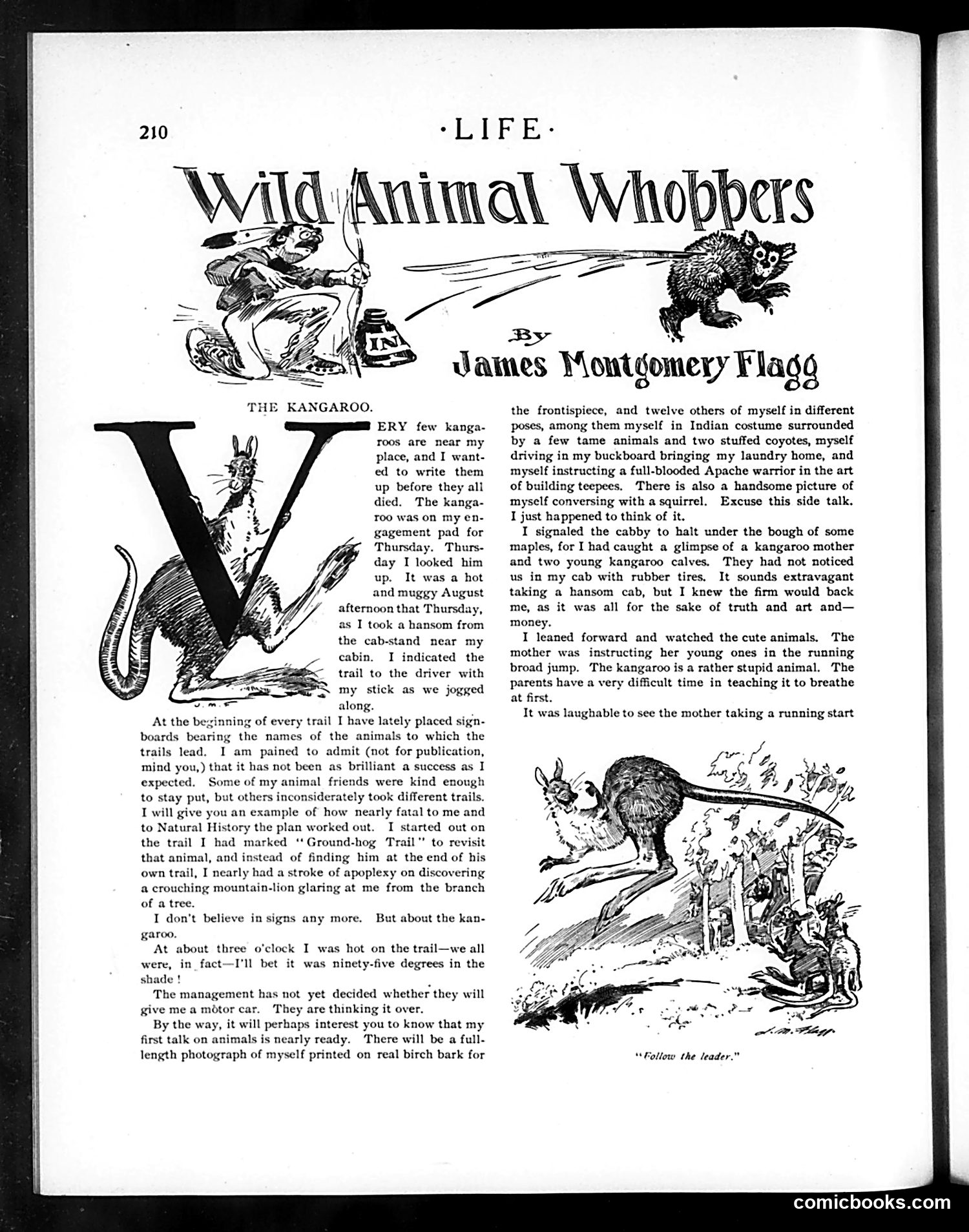
This is a humorous essay by illustrator James Montgomery Flagg about his supposed wildlife documentation work. The piece gently mocks both Flagg himself and contemporary nature writing through exaggerated claims and absurd anecdotes. Flagg purports to be creating an elaborate animal-tracking project with signposted trails, claiming he'll appear in numerous posed photographs—some in "Indian costume" with stuffed coyotes, others driving a buckboard or instructing "Apache warriors." The humor lies in his self-aware vanity: he's ostensibly documenting animals but constantly inserts himself into the narrative. The kangaroo anecdote demonstrates the satire's core joke: Flagg's carefully-planned system fails immediately when animals refuse to cooperate with his schemes. His climactic near-encounter with a mountain lion on the wrong trail undercuts any pretense of scientific methodology. The piece gently ridicules popular adventure narratives and nature writing of the era while celebrating Flagg's own theatrical self-promotion—presented tongue-in-cheek as the real "whopper" (tall tale) being told.
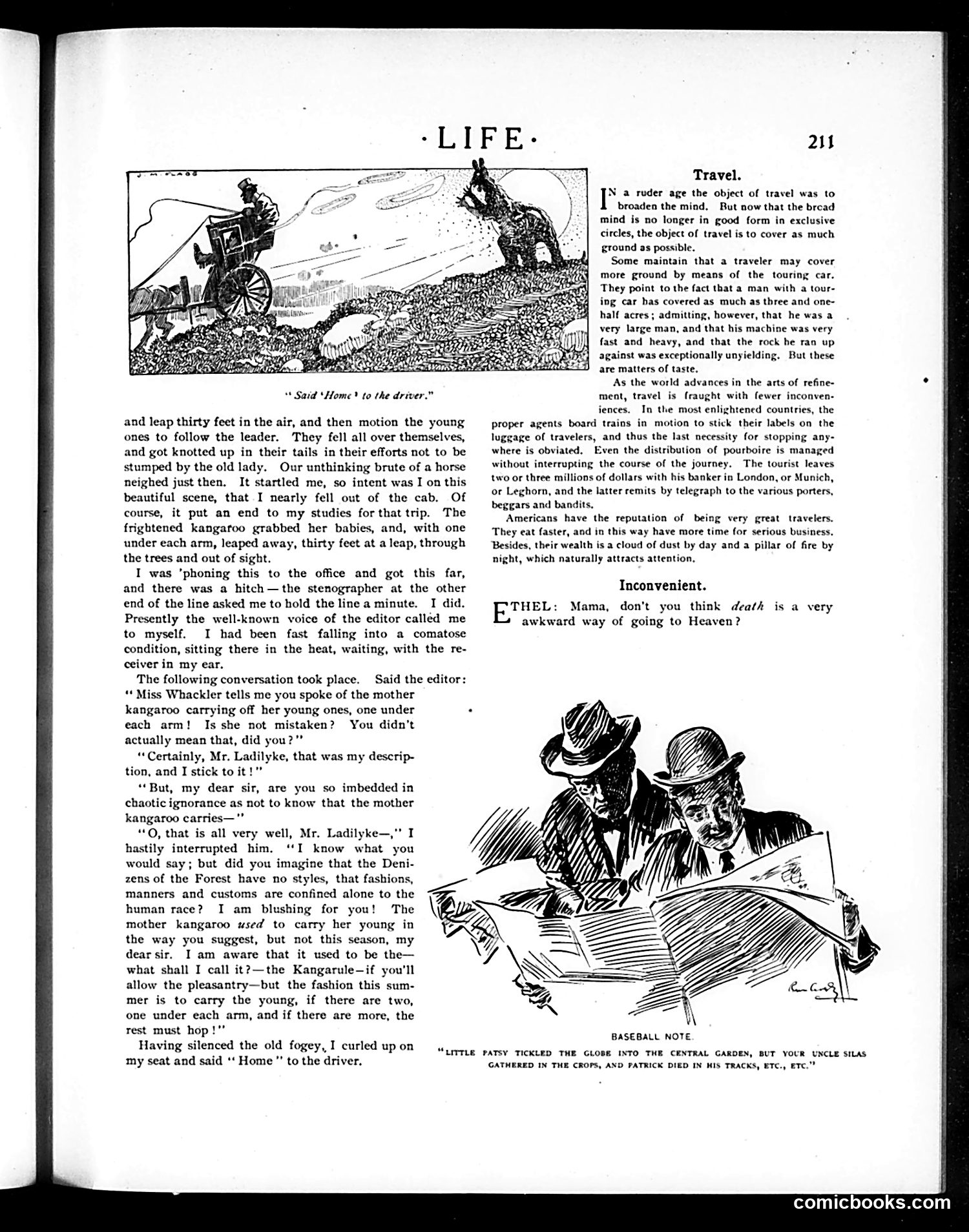
The page contains two distinct pieces of satirical content: **"Travel" essay (top):** A humorous account mocking both travelers and travel journalism. A reporter witnesses a kangaroo carrying her young "one under each arm"—an impossible pose. When questioned by his editor, the reporter defensively insists this is the current "fashion" among kangaroos this season, sarcastically coining "Kangarule." The satire targets journalistic credibility and the absurdity of unquestioned authority figures. **"Baseball Note" cartoon (bottom):** Two men in hats reading what appears to be a newspaper or scorecard. The caption references a child ("Little Patsy") entering a "central garden" where her uncle Silas gathered crops, with Patrick dying "in his tracks." This appears to be dark humor about a child's innocent intrusion into adult agricultural or criminal matters, though the exact reference is unclear without additional historical context. Both pieces exemplify *Life* magazine's satirical style: deflating pretension through absurdist humor and darkly comedic social observation.
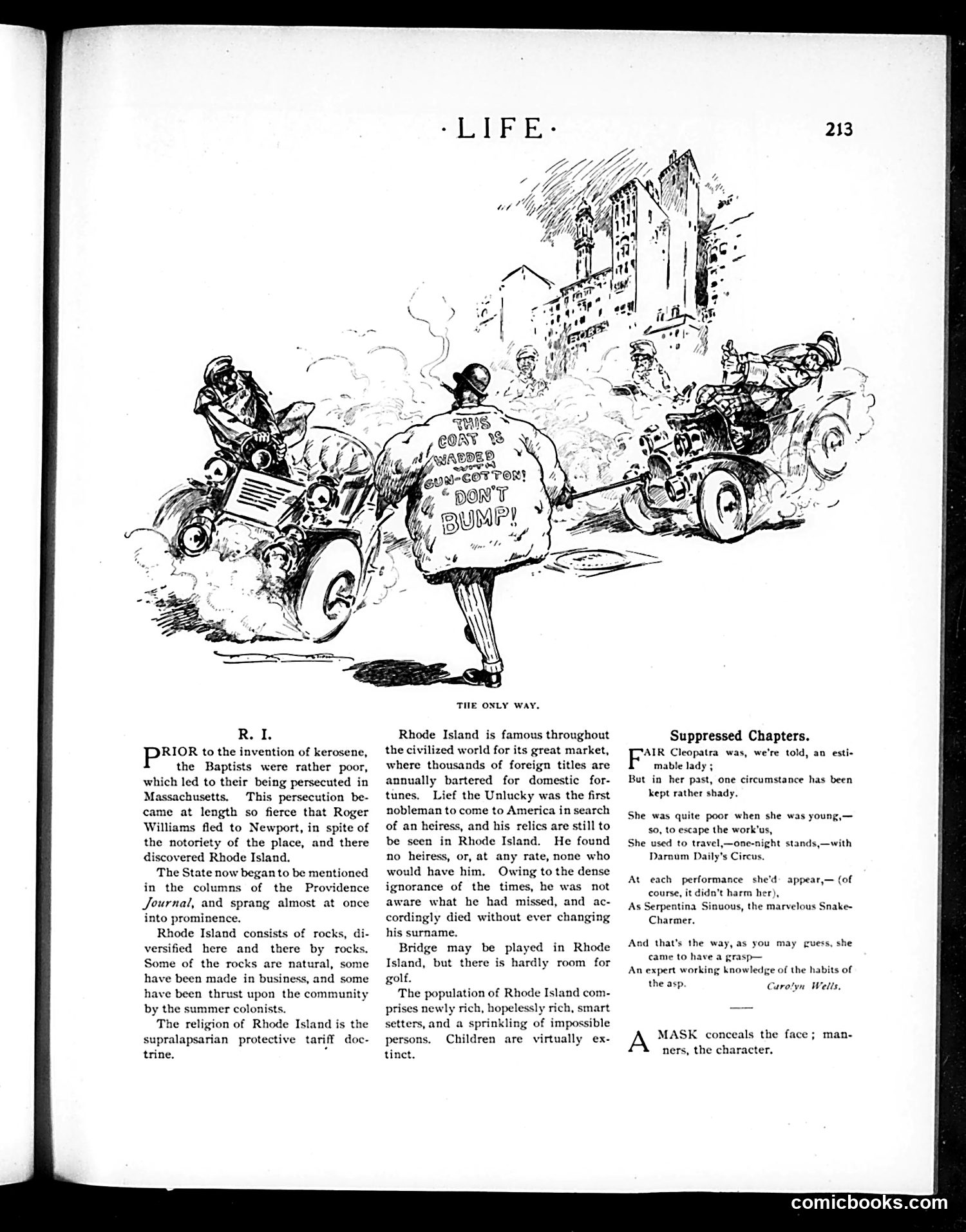
This cartoon satirizes Rhode Island's economy and society circa early 1900s. The central figure wears a large sign reading "THIS GOAT IS WARDER GUY-GETTER! DON'T BUMP!" — depicting the state itself as a "goat" being paraded before wealthy suitors in automobiles. The accompanying text mocks Rhode Island's primary industry: wealthy heiresses marrying foreign noblemen for titles, while foreigners marry American wealth for money. The joke is that Rhode Island's actual economy depends on this "market" where "thousands of foreign titles are annually bartered for domestic fortunes." The cartoon shows this literally as a traffic jam of vehicles (representing suitors and wealth) circling around the "Rhode Island goat," suggesting the state exists primarily as a marriage-broker's carnival — "the only way" for Rhode Island to achieve prominence. The satire targets the state's apparent lack of legitimate industry or culture, reduced to matchmaking between old European nobility and new American money.
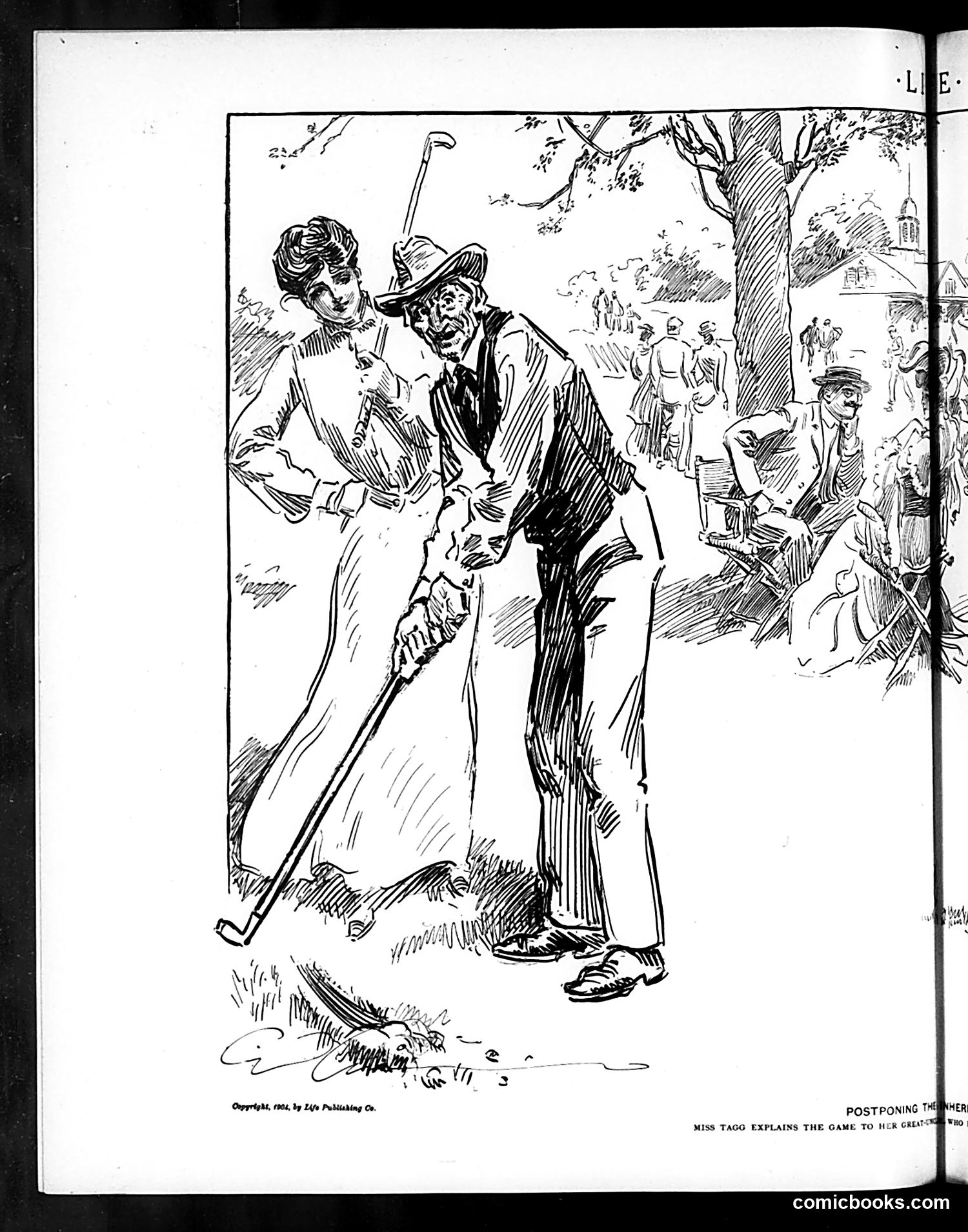
This 1904 *Life* magazine cartoon depicts a woman in an elegant white dress explaining golf to an older, poorly-dressed man in dark clothing. The caption reads "MISS TAGO EXPLAINS THE GAME TO HER GREAT-UNCLE." The satire appears to mock class contrasts and generational divides. The well-dressed, refined young woman represents modern sophistication, while the bewildered older man—likely from a working-class or rural background—represents an older generation unfamiliar with fashionable leisure activities like golf. The humor lies in the incongruity: a society woman patiently educating an apparent outsider about an upper-class sport. This reflects early 1900s class anxieties and the growing cultural gap between genteel society and working-class America. The "great-uncle" appears comically out of place in this leisure setting.
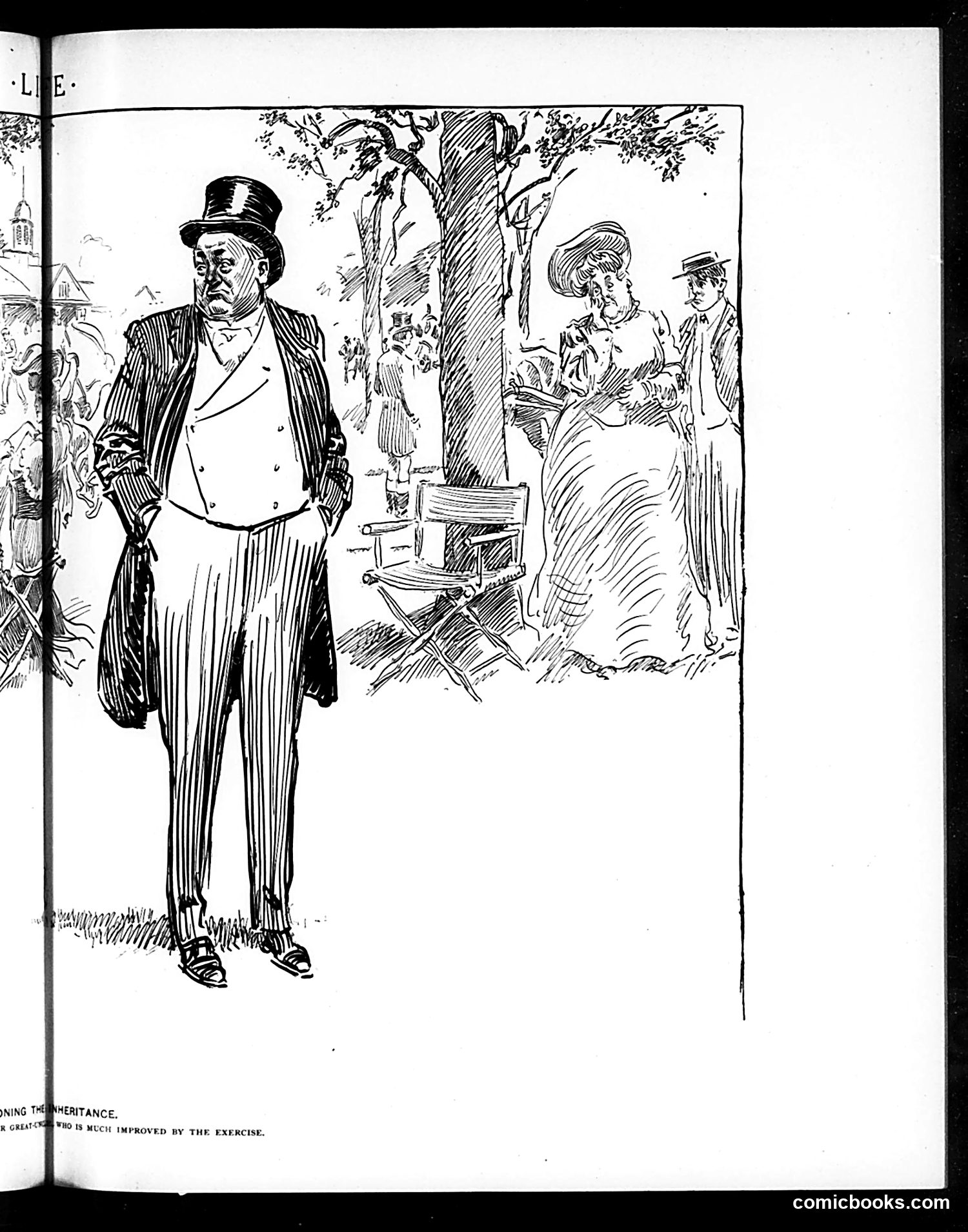
This appears to be a satirical cartoon about inheritance, based on the visible text "NING THE INHERITANCE" and "IS MUCH IMPROVED BY THE EXERCISE." The image shows a stout, well-dressed gentleman in formal attire (top hat, tailcoat) standing prominently in the foreground, while in the background, a woman, child, and another man are depicted near a tree. The composition suggests a commentary on wealth transfer or family dynamics related to inheritance. The satire likely critiques either the process of inheriting wealth itself or the character of the inheritor. The phrase about being "much improved by the exercise" suggests ironic commentary—possibly that managing an inheritance improves one's character or circumstances, or conversely, that the pursuit of inheritance reveals unflattering traits. Without additional context or visible publication date, the specific historical reference remains unclear.
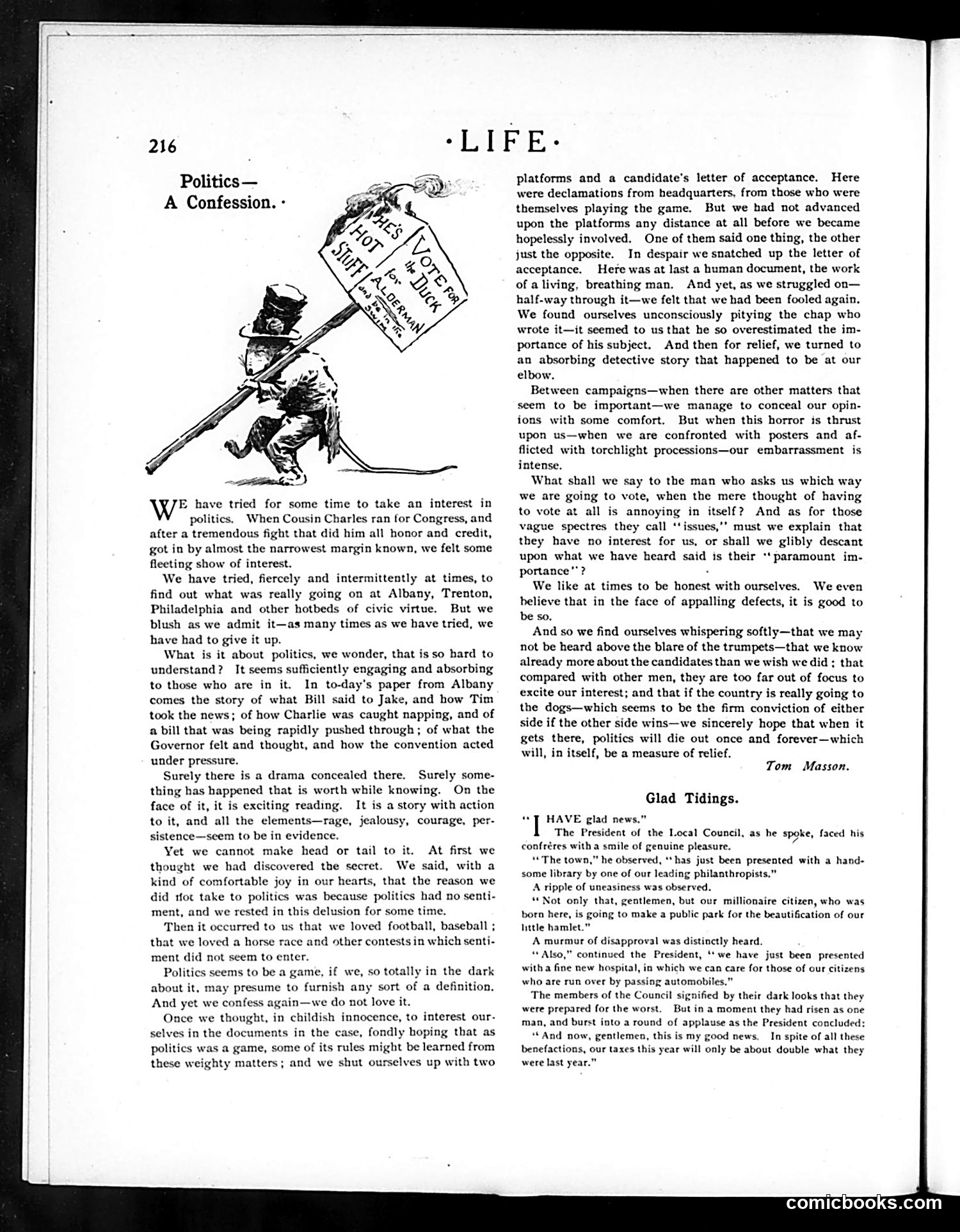
The cartoon depicts a figure struggling to carry a large platform plank labeled with political text, humorously illustrating the article's central complaint: the author's inability to understand or engage with politics despite genuine attempts. The piece satirizes the bewildering nature of American political discourse in the early 20th century. The writer confesses that despite trying—attending to campaign coverage, reading party platforms and candidates' acceptance letters—political content remains incomprehensible. Political narratives seem exciting ("Bill said to Jake," conflicts between figures), yet lack coherence or emotional resonance. The satire's point: politics appears designed as a game with obscure rules that even intelligent observers cannot decipher. Platform documents contradict themselves; acceptance letters seem artificially overwrought. The author finds distraction in a detective story instead—suggesting politics is less engaging than fiction despite having drama's elements. The confession humorously expresses voter alienation and frustration with opaque political messaging.
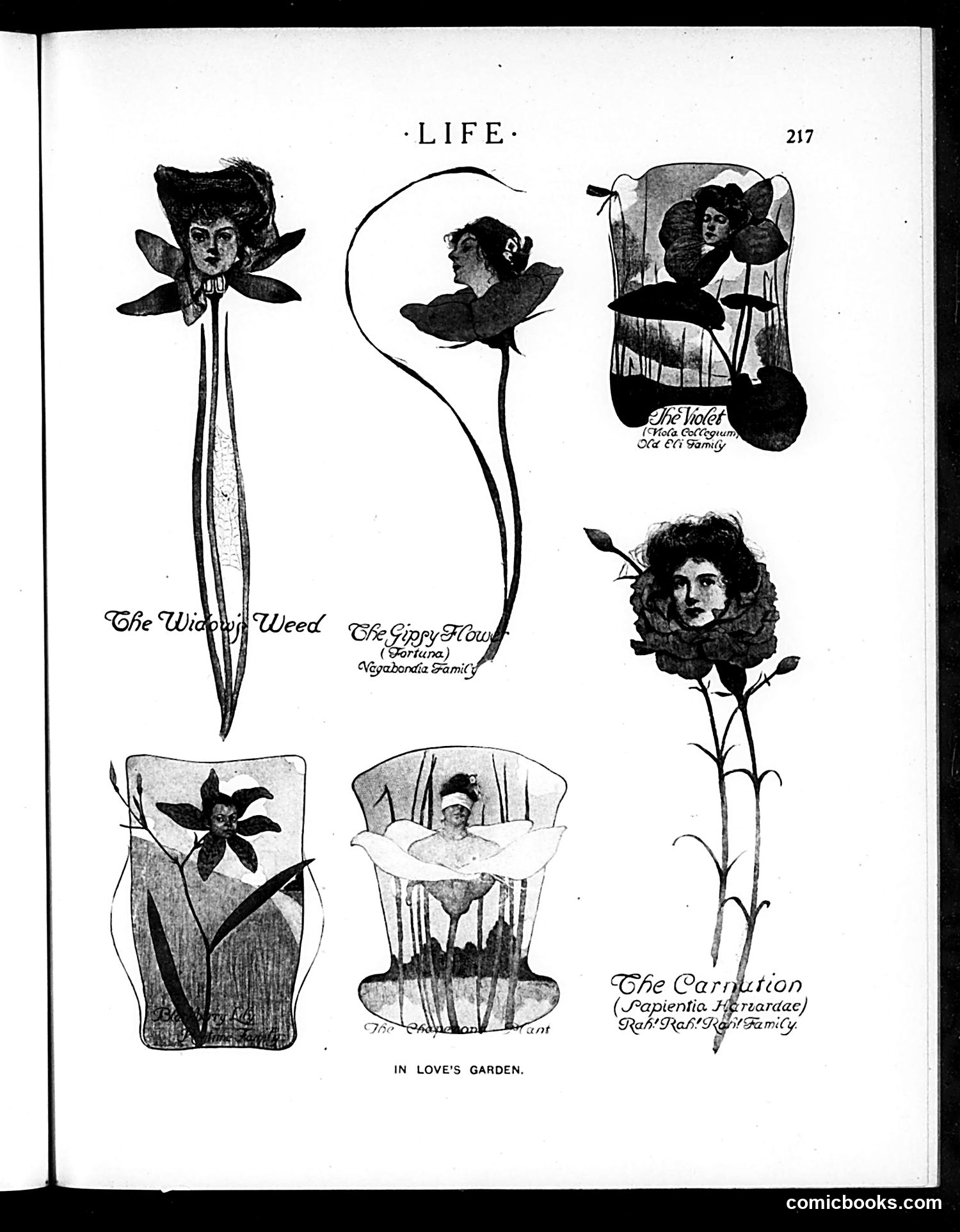
This page presents a satirical visual essay titled "In Love's Garden," combining flowers with human faces to create personified plants. Each illustration pairs a botanical specimen with a human head integrated into the flower's structure. The satire appears to mock Victorian sentimentality about flowers and romance. By literalizing the common metaphor of women as flowers, the artist creates absurdist humor—the "Widow's Weed," "Gipsy Howl," "Violet," and "Carnation" become grotesque hybrids rather than delicate symbols. The scientific family names (like "Negabodia Family") suggest pseudo-botanical classification, parodying both scientific pretension and the era's tendency to categorize human types. The overall effect lampoons sentimental floral symbolism and romanticized notions of femininity popular in early-20th-century American culture.
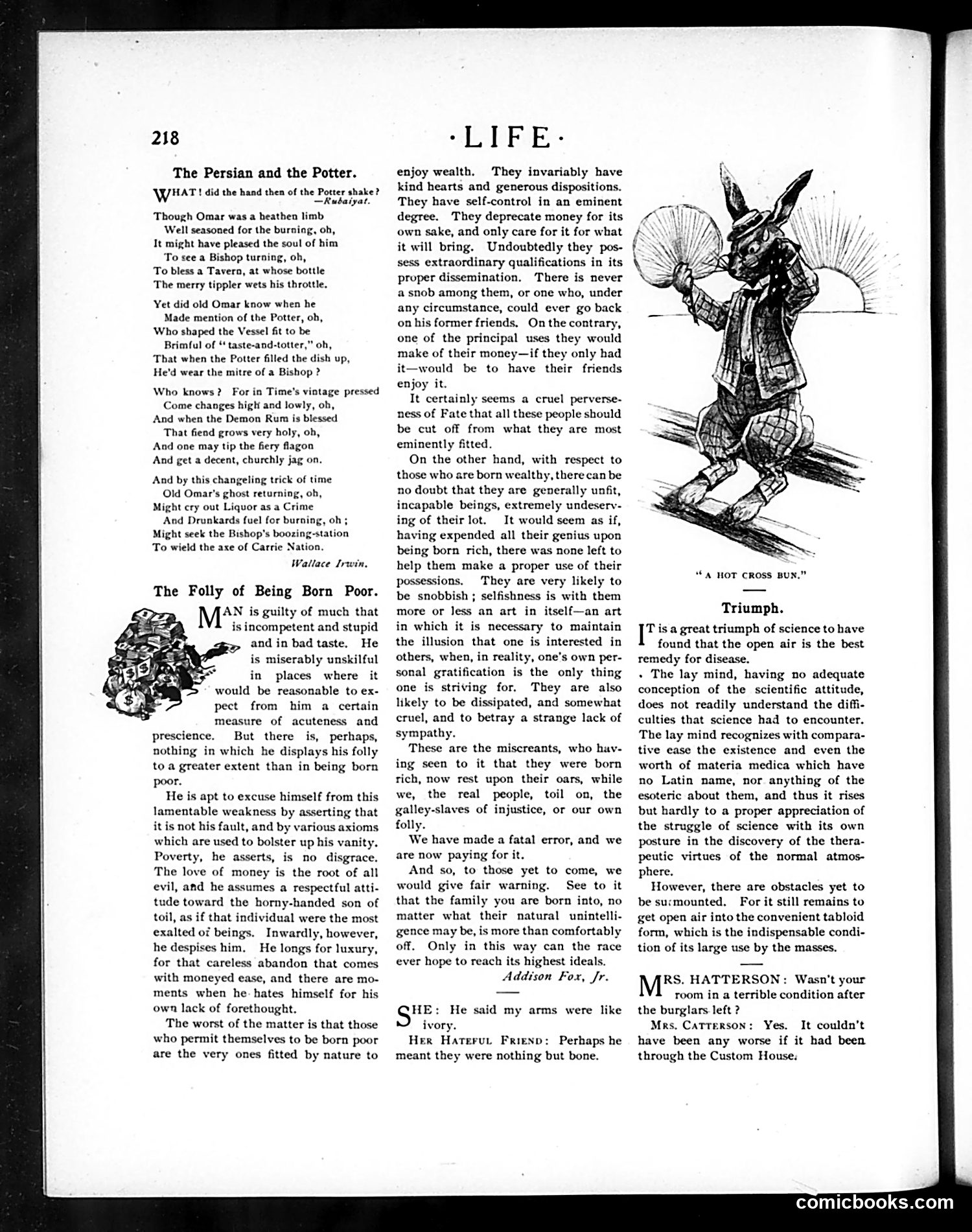
This page contains two satirical pieces attacking hypocrisy and social inequality in early 20th-century America. **"The Persian and the Potter"** (poem by Wallace Irwin) mocks religious hypocrisy regarding alcohol. It references Omar Khayyam's *Rubaiyat* (celebrating wine) and imagines if Omar's ghost returned to see bishops drinking—implying clergy who condemn alcohol while secretly indulging. The reference to "Carrie Nation" (the famous Prohibition activist) suggests ironic reversal: a stern reformer wielding an axe against drinking establishments. **"The Folly of Being Born Poor"** (essay with illustration) uses biting irony to critique class inequality. It sarcastically claims poor people are naturally virtuous, generous, and deserving of wealth, while the rich are inherently selfish and incompetent—yet circumstance prevents the worthy poor from accessing money. The essay exposes the hypocrisy of middle-class moralizing that blames poverty on personal failure while romanticizing "the horny-handed son of toil." Both pieces satirize American pretension and social injustice through ironic inversion of conventional wisdom.
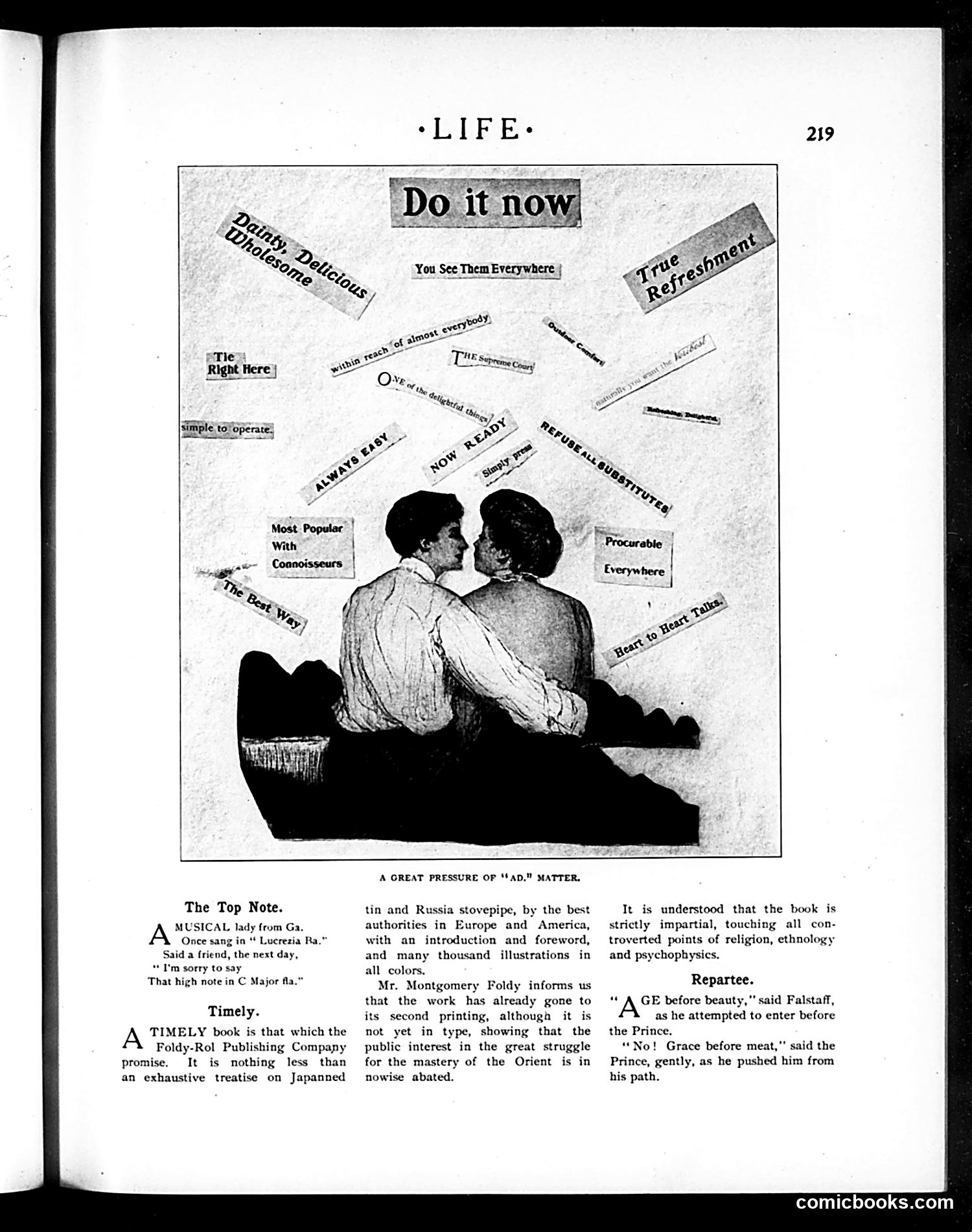
The main cartoon shows two figures sitting together surrounded by advertising slogans ("Do it now," "The Refreshment," "Always Easy," "Now Ready," etc.). Titled "A Great Pressure of 'Ad' Matter," it satirizes the overwhelming flood of advertising that surrounds people in daily life—the couple cannot escape commercial messages even in an intimate moment. Below are three brief humorous pieces: a musical joke about a Georgia singer hitting a bad high note; a mock review of a nonexistent book about japanned stovepipes by the "Foldy-Rol Publishing Company" that's already in its second printing despite not being typeset (mocking rushed, sensationalist publishing); and a Shakespeare riff on manners between Falstaff and the Prince. The page's central point: modern advertising has become so pervasive and intrusive that it invades every aspect of life, even romance. This reflects early 20th-century concerns about commercialism's growing dominance.
This is a short fiction piece satirizing wealthy, idle gentlemen. Two bored club members—Castleton and Caterby—make a wager: each will select a street boy and take him to a restaurant to see whose can eat more food. The "winner" gets ten dollars. The satire targets the casual cruelty and condescension of the wealthy toward the poor. These men treat a hungry newsboy as an object for entertainment and gambling, exploiting his desperation for food. The boy, starving and amazed by the opportunity, obeys without question, consuming enormous quantities. The piece mocks how the privileged amuse themselves at the expense of the vulnerable, turning hunger—a serious hardship—into sport. The newsboy becomes a commodity in their bet, reduced to his capacity to consume. The story suggests the moral emptiness of the bored rich and their indifference to poverty.
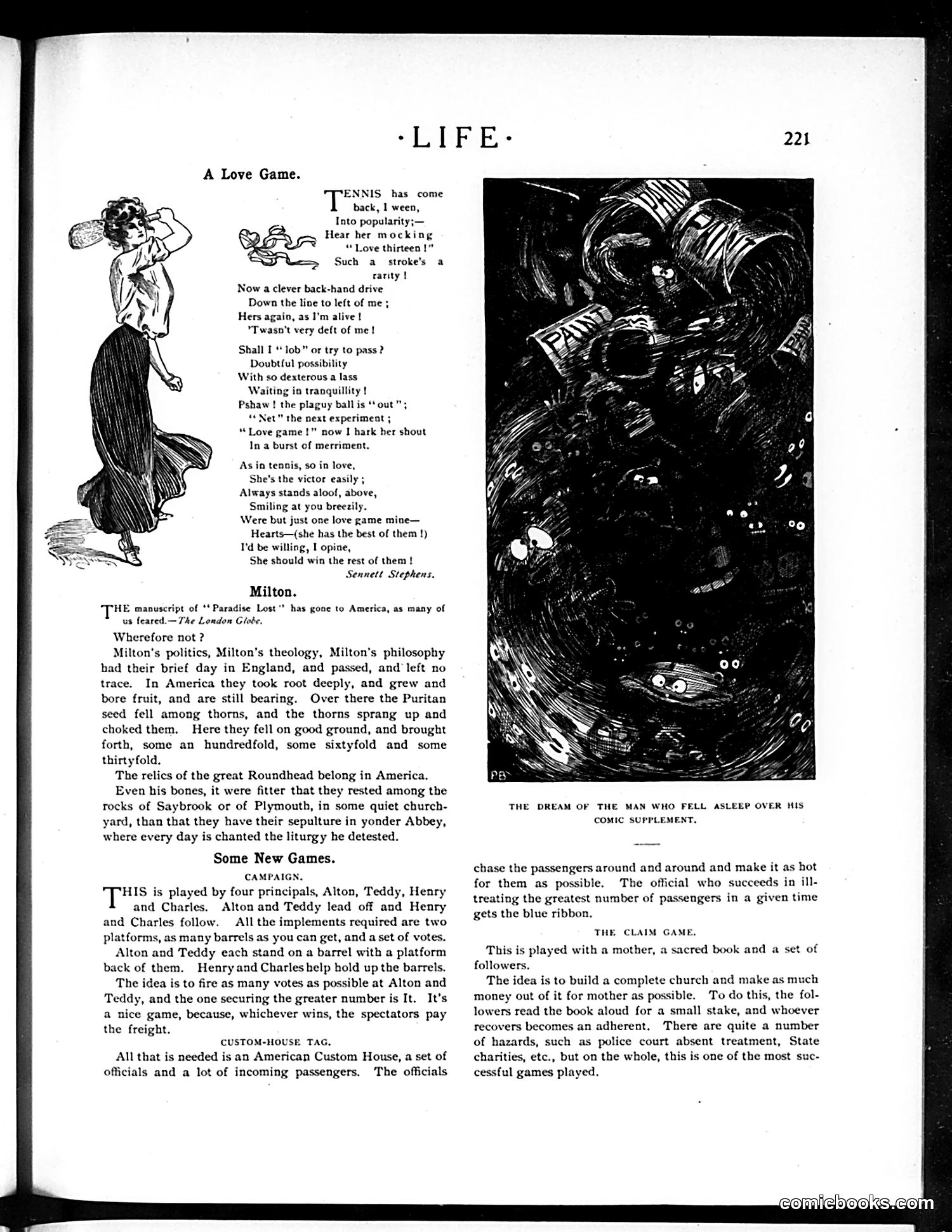
The page contains three distinct pieces of satire: **"A Love Game"** (left): A romantic poem using tennis metaphors to describe courtship, where the female player consistently outmaneuvers her male opponent. The joke inverts traditional gender dynamics—she dominates the "game" effortlessly while he fumbles. **"Milton"** (center): Satirizes English cultural anxiety about America's rising influence. The piece mocks the concern that John Milton's *Paradise Lost* manuscript has been sold to America, arguing that Milton's Puritan philosophy actually *belongs* in America, where such ideas took root more successfully than in England. It's a backhanded insult to both nations. **"Some New Games"** (right): Three satirical "games" mocking American politics and religion: "Campaign" ridicules electoral contests where voters/spectators always "pay"; "Custom-House Tag" attacks bureaucratic corruption; "The Claim Game" parodies evangelical tent revivals as money-making schemes. These are thinly veiled critiques of institutional dishonesty. The right illustration appears to be dreamlike surrealism unrelated to the text.
This is a book review section from *Life* magazine. There are no political cartoons here—it's literary criticism discussing newly published novels and reference works. The reviews reveal early 1900s literary tastes: critics praise character-driven narratives and personal correspondence (like Mrs. Bancroft's letters from 1850s England), while dismissing formulaic work. They mock "As a Chinaman Saw Us"—a book where a supposed Chinese author conveniently speaks like an American humorist rather than authentically, suggesting the author (Gratton) is using the "foreign perspective" as a thin disguise for familiar satirical humor. The repeated complaint about Egyptian ghost stories—that tomb descriptions and mummies have become clichéd—shows how quickly supernatural fiction became exhausted as a genre. The section titled "How a Lamb Is Shorn" appears to be a poem about lost hope, unexpected reversals, and emptiness, likely commenting on romantic or social disappointment common in the era's literature.
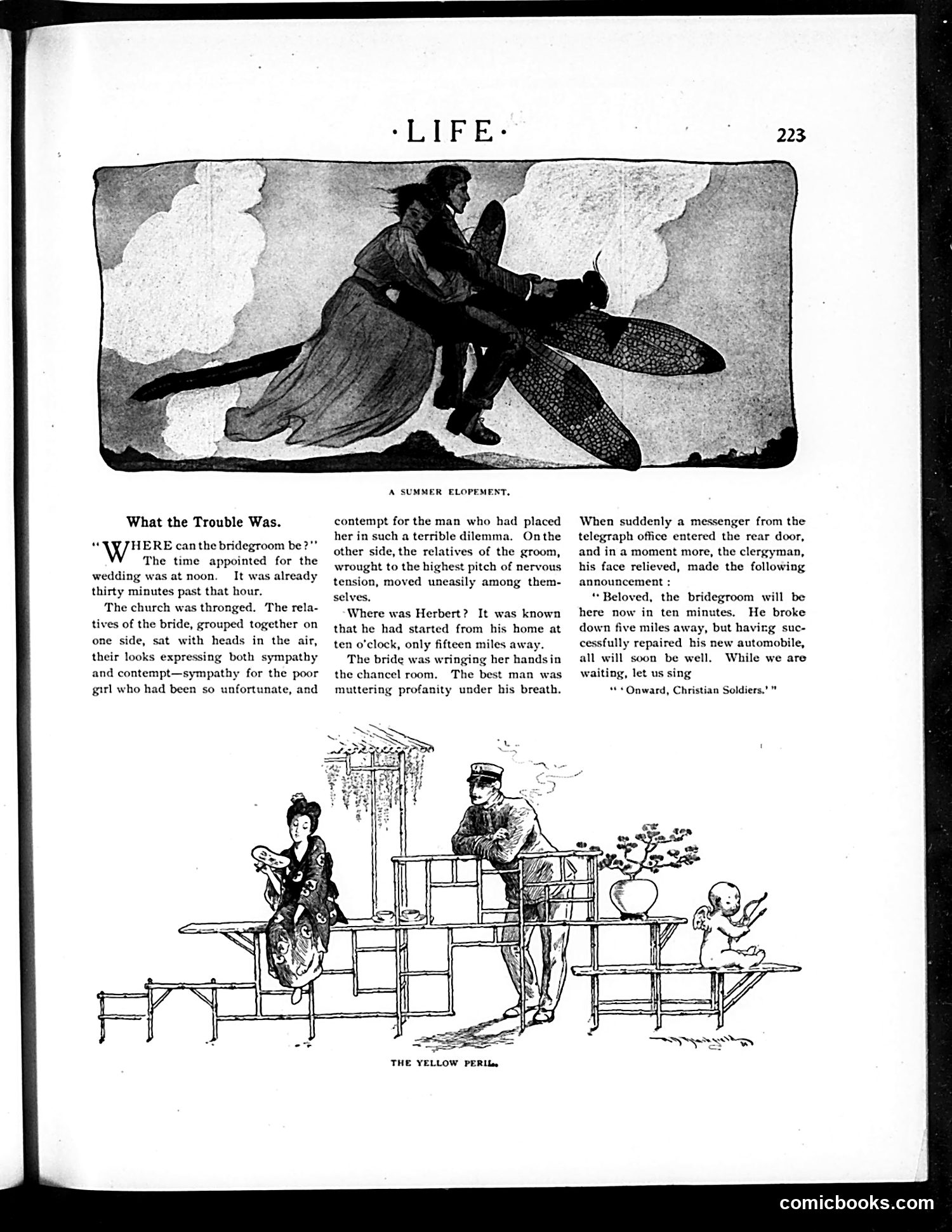
This page contains two satirical pieces about early 1900s American life: **"What the Trouble Was"** mocks the anxieties of a wedding delayed by the groom's automobile breaking down. The humor turns on the absurdity that modern technology—the "new automobile"—has become so central that mechanical failure can nearly derail a major social ceremony. The congregation's relief that the car was repaired, and the suggestion they sing "Onward, Christian Soldiers" while waiting, satirizes how quickly automobiles integrated into everyday life and became sources of both pride and anxiety. **"A Summer Elopement"** (top illustration) depicts a couple literally flying away on what appears to be a large insect or fantastical creature—a visual pun suggesting romantic escape. The caption title suggests this is mocking the phenomenon of summer elopements. **"The Yellow Peril"** (bottom illustration) remains unclear without additional context—it may reference contemporary anxieties about Asian immigration or influence, a common theme in early 1900s American satire, though the specific scenario isn't evident from the image alone. The overall page reflects period concerns about technology, romance, and social customs.
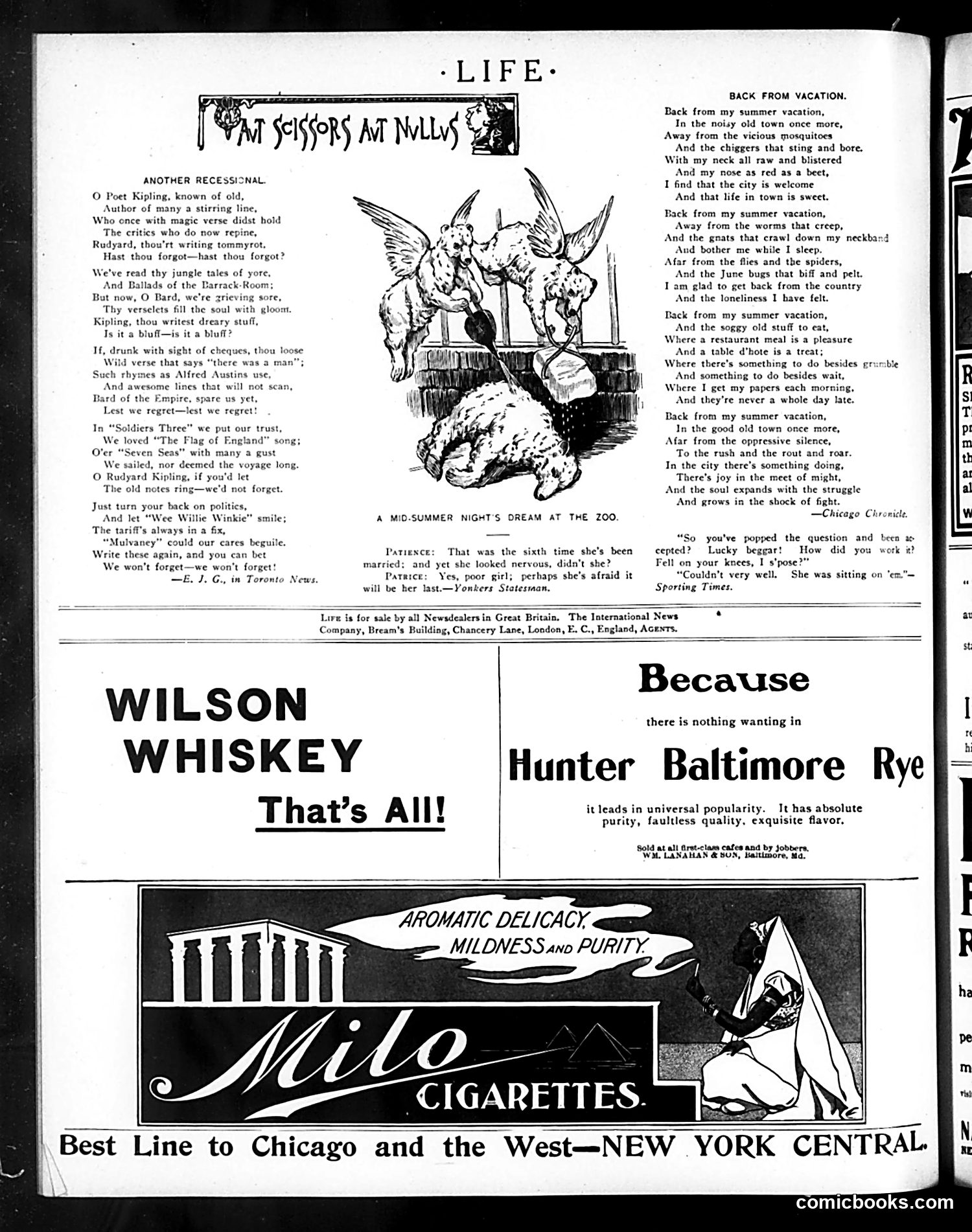
This page contains literary and social commentary typical of *Life* magazine's satirical format. **"Another Recessional"** is a critical poem addressing Rudyard Kipling, the famous British author. The writer laments that Kipling's recent work has declined in quality—his verse now feels forced and poorly constructed ("awful," "dreary stuff"). The poem nostalgically references Kipling's earlier, beloved works (*Jungle Book*, "Soldiers Three," *Seven Seas*) and begs him to return to writing fiction rather than pursuing politics. The satire suggests Kipling has lost his literary touch by focusing on political matters. **"Back from Vacation"** humorously catalogs rural vacation complaints—insects, bad food, isolation—celebrating return to city life's conveniences and stimulation. **"A Mid-Summer Night's Dream at the Zoo"** is a brief joke about a woman's six marriages; she appears nervous at her seventh, fearing it might be her last. The page primarily showcases *Life*'s satirical poetry and humor, with contemporary whiskey and cigarette advertisements typical of the era.
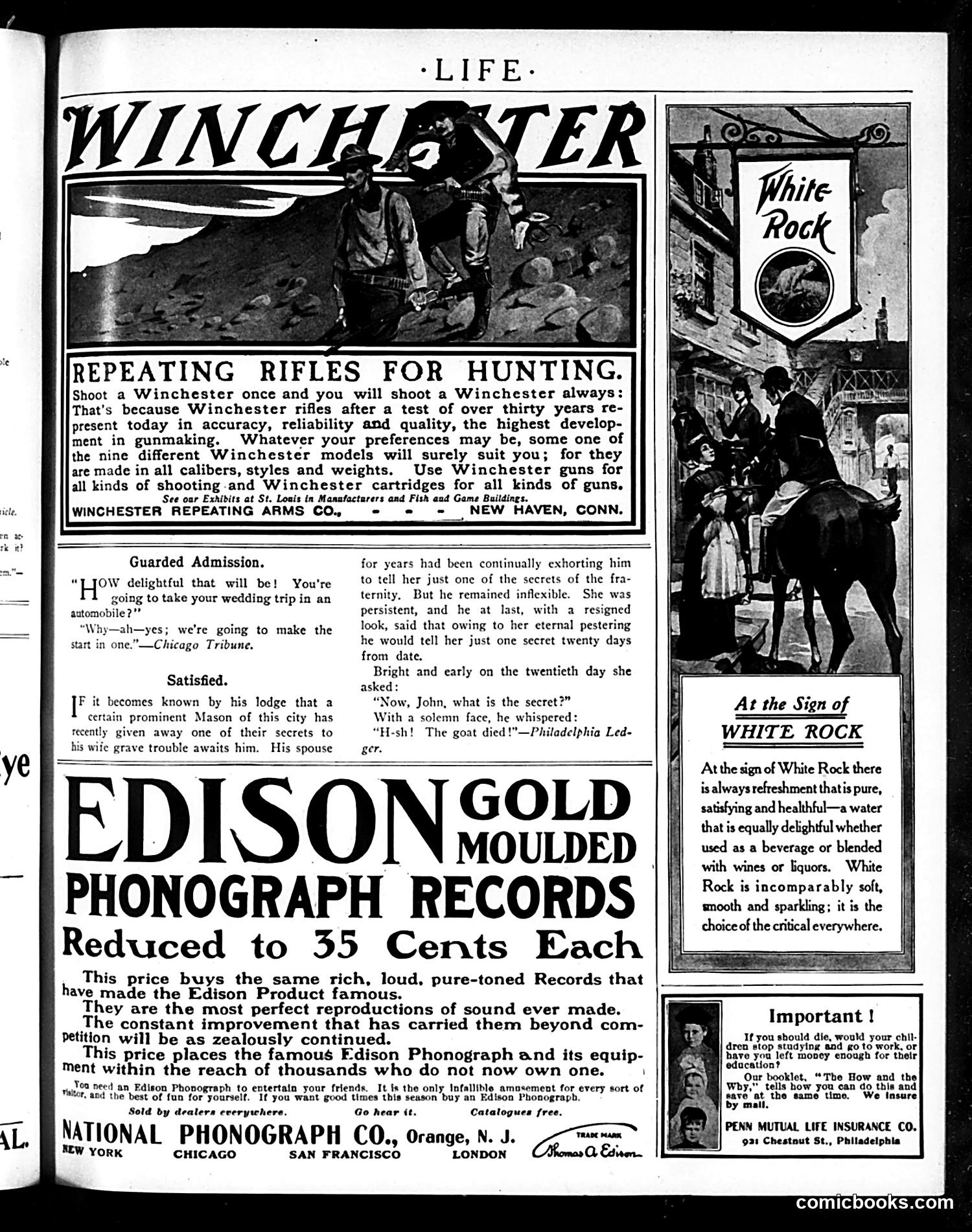
This page is primarily **advertising**, with two brief humorous anecdotes embedded among commercial messages. The **two jokes** are: 1. "Guarded Admission"—a Chicago Tribune quip about newlyweds taking an automobile trip, with the wife making a suggestive innuendo about "making the start in one." 2. "Satisfied"—a Philadelphia Ledger piece mocking Masonic secrecy. A Mason's wife pesters him for years to reveal fraternal secrets. When he finally agrees, his "secret" is merely "The goat died!"—a deflating punchline that both protects actual lodge mysteries and humorously suggests the "secrets" may be trivial or absurd. Both jokes play on marital dynamics and institutional (Masonic) pomposity—common satirical targets in early 20th-century Life magazine. The **advertisements** include Winchester rifles, Edison phonographs, White Rock water, and Penn Mutual Life Insurance—products reflecting the era's consumer culture and concerns about family financial security.
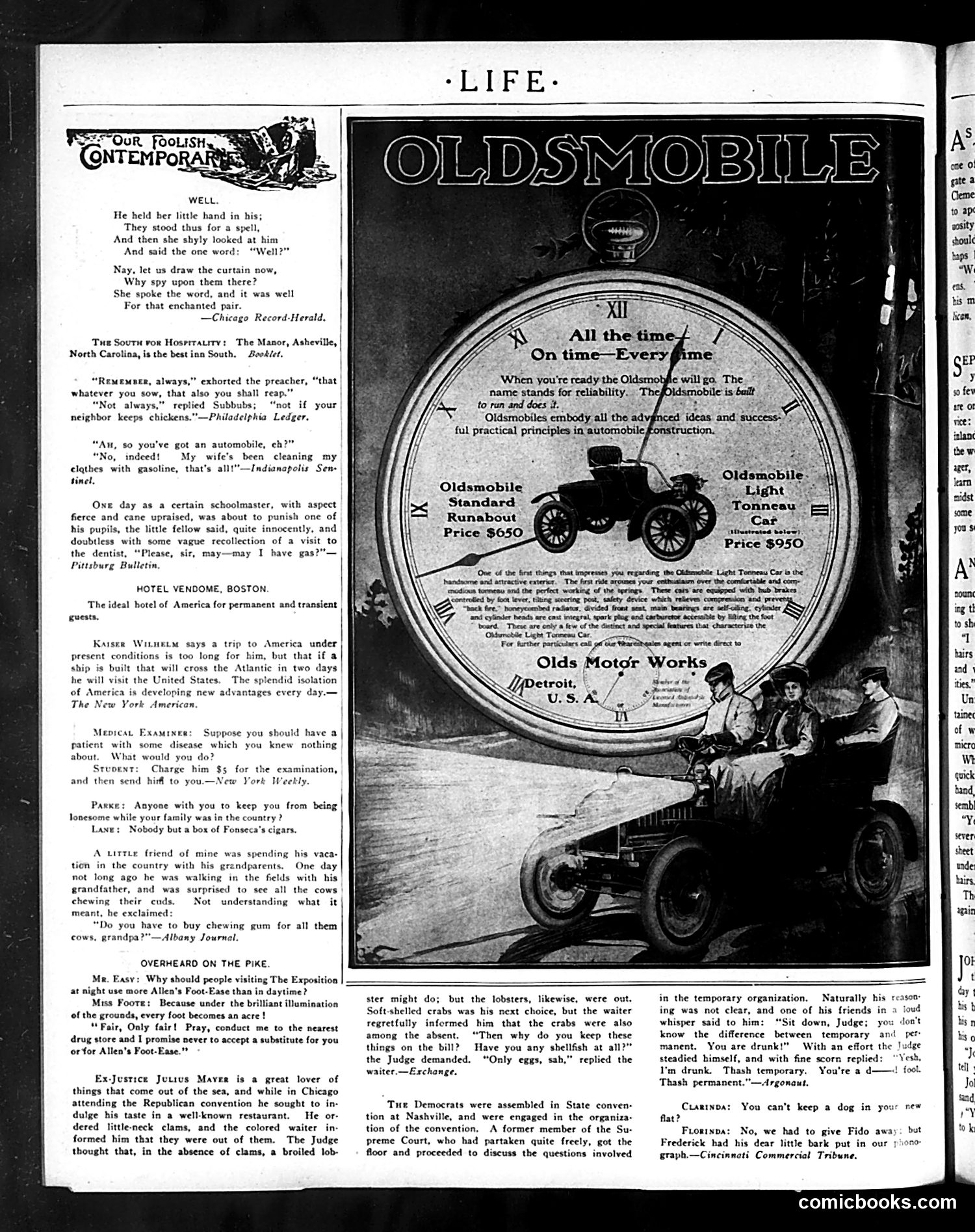
This page combines humor columns with an **Oldsmobile automobile advertisement** disguised as editorial content. **The Advertisement:** The large clock-face image showcases two Oldsmobile models (Standard Runabout at $650 and Light Tonneau at $950), with testimonial text emphasizing reliability and construction quality. The "All the time—On time—Every time" slogan emphasizes dependability—a key selling point for early automobiles, which were still unreliable. **The Humor Columns:** Surrounding the ad are brief jokes typical of Life's satirical style: - A poem about a couple's romantic moment - Puns about automobiles (wives using gasoline to clean clothes; a schoolboy asking for "gas" at the dentist) - Social commentary jokes (about preaching, neighbors' chickens, medical fees) - A story about Judge Meyer ordering lobster when clams weren't available **The Point:** These are genteel, family-friendly jokes reflecting early 1900s concerns—automobiles as novelties, domestic life, class distinctions. The advertisement exploits the editorial space to appear as content rather than mere promotion, a common magazine practice of the era.
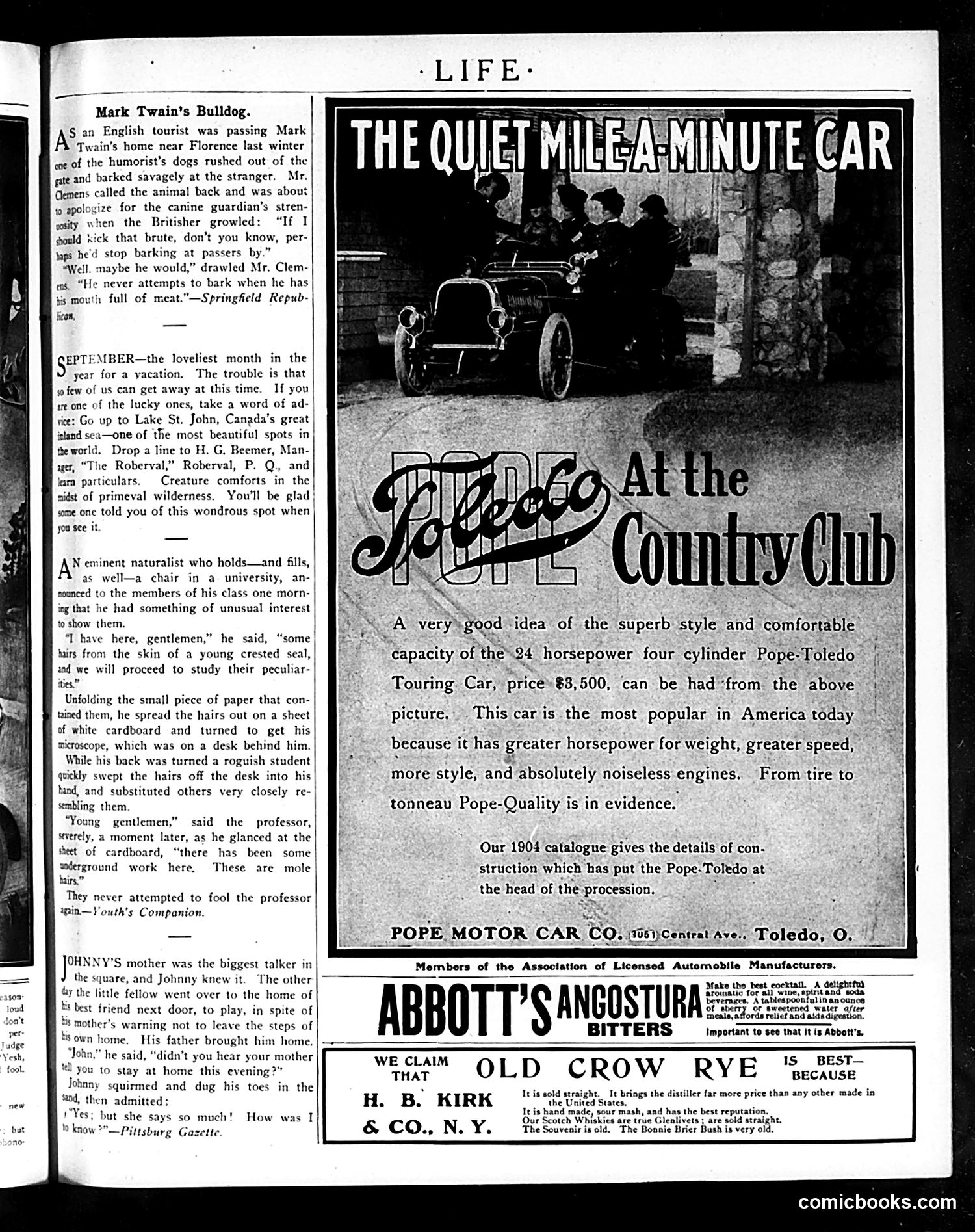
This page is primarily **advertisements** with filler content. The main feature is a large ad for the **Pope-Toledo automobile** (1904), promoted as "the most popular in America today" due to superior horsepower, speed, and "absolutely noiseless engines." The left column contains brief anecdotes: - **Mark Twain's Bulldog**: A joke about Twain's dog in Florence that stops barking when it has food—implying the visitor could silence it by feeding it meat. - **Academic prank**: A professor's crested seal hairs are replaced with mole hairs by students; he immediately detects the substitution. - **Johnny's excuse**: A boy ignores his mother's warnings because she talks too much. These are generic humor pieces typical of *Life* magazine's filler content. The ads below promote whiskey and bitters—products marketed with health claims (aiding digestion) that would now be considered dubious medical advertising.
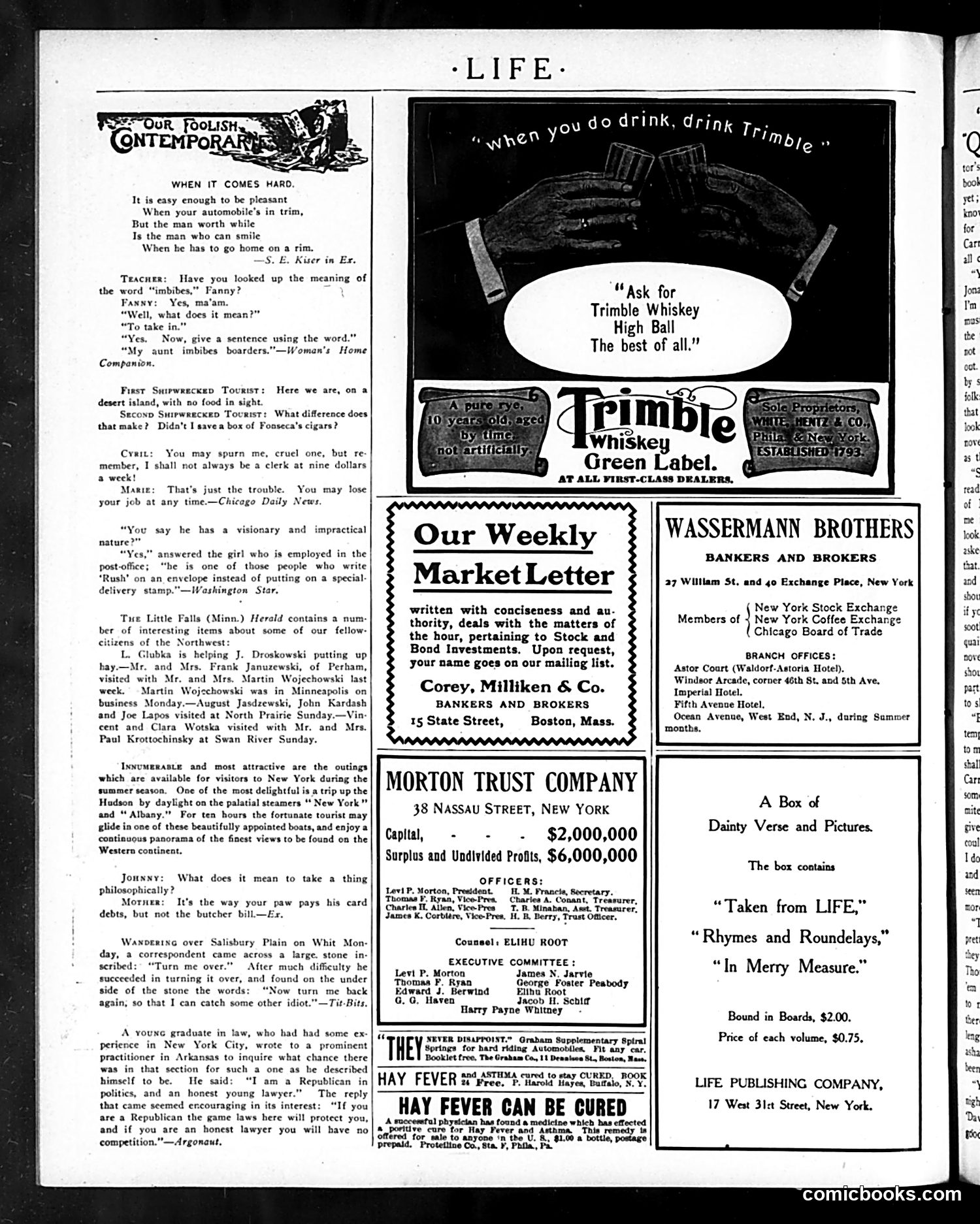
This page primarily contains **humorous short jokes and advertisements** rather than political cartoons. The content reflects early 20th-century American humor: **The jokes mock:** - Male romantic rejection (a clerk complains he'll lose his job; his girlfriend dismisses his prospects) - Malapropism (a postal worker's aunt "imbibes boarders" instead of taking in boarders) - Rural Midwestern names (a newspaper section lists Poles and Slavic immigrants with unpronounceable surnames—likely satirizing immigration and assimilation) - Bureaucratic absurdity (a lawyer writes "Rush" on envelopes instead of paying for delivery) - Regional stereotypes (Arkansas has no competition for honest lawyers because Republicans are legally protected game) **The advertisements** include Trimble Whiskey, Morton Trust Company, and various financial services—typical of a magazine targeting educated, affluent readers. The humor is genteel and class-conscious, reflecting *Life*'s intended audience of educated urbanites amused by working-class predicaments and regional quirks.
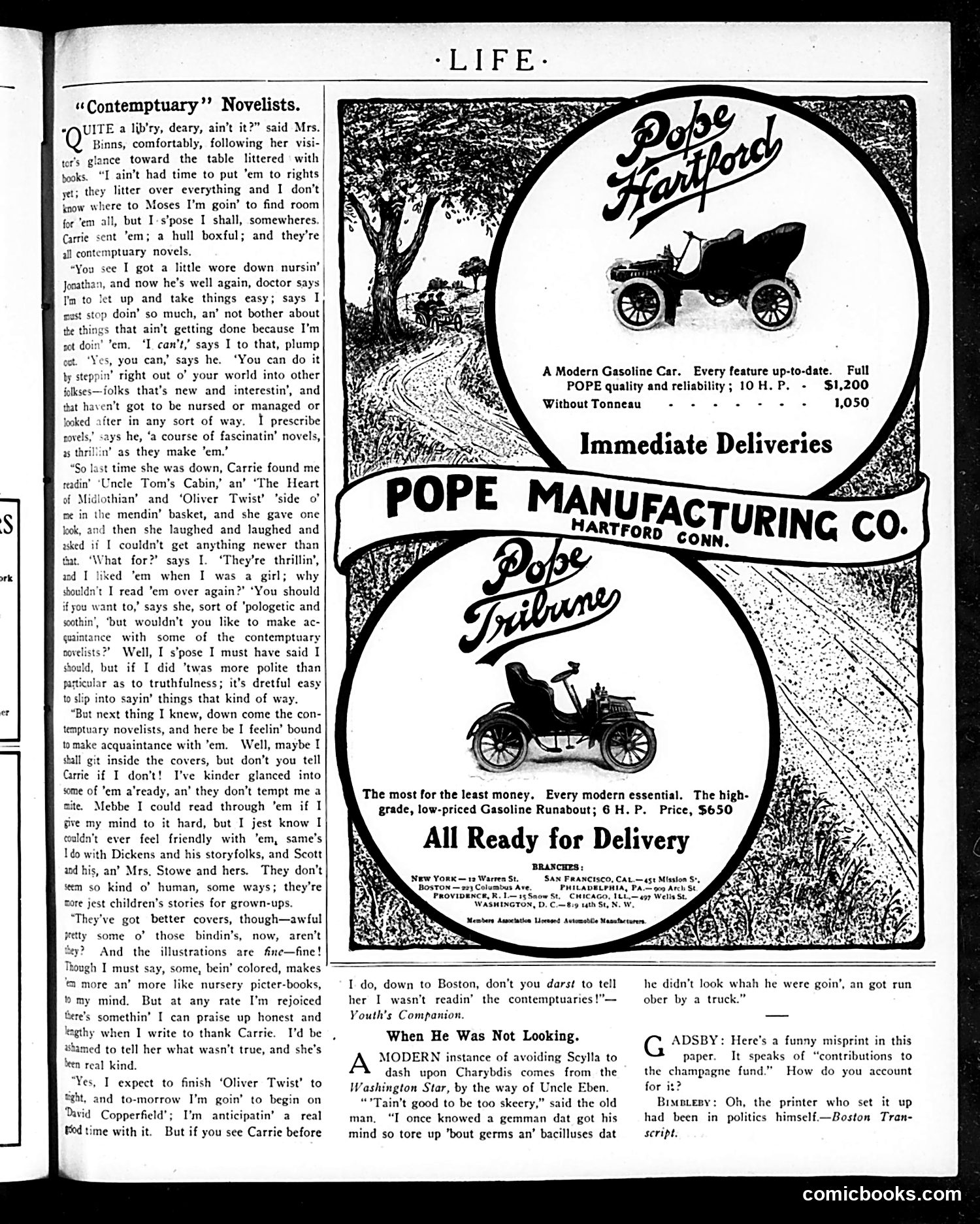
This page satirizes the literary tastes of early 20th-century Americans through "Contemporary Novelists," a humorous monologue by Mrs. Binns, an older woman whose daughter Carrie has gifted her modern novels. **The Satire's Point:** Mrs. Binns prefers classic literature (Uncle Tom's Cabin, Oliver Twist, Scott's works) but feels socially obligated to read trendy "contemporary" novels. She finds them superficial—"pretty some o' those bindin's" but lacking the humanity of older classics. They're dismissed as merely "children's stories for grown-ups." **The Social Commentary:** The piece mocks both contemporary fiction's shallow appeal and the social pressure to adopt fashionable literary tastes. It suggests modern novels prioritize style (colored illustrations, attractive bindings) over substance. **The Advertisements:** The Pope Manufacturing Co. car ads represent the era's "contemporary" technological innovations—marketed as modern, essential, and forward-thinking—mirroring how contemporary novels were pitched. The humor lies in vindicating traditional literature while gently ridiculing those who chase literary fashions.
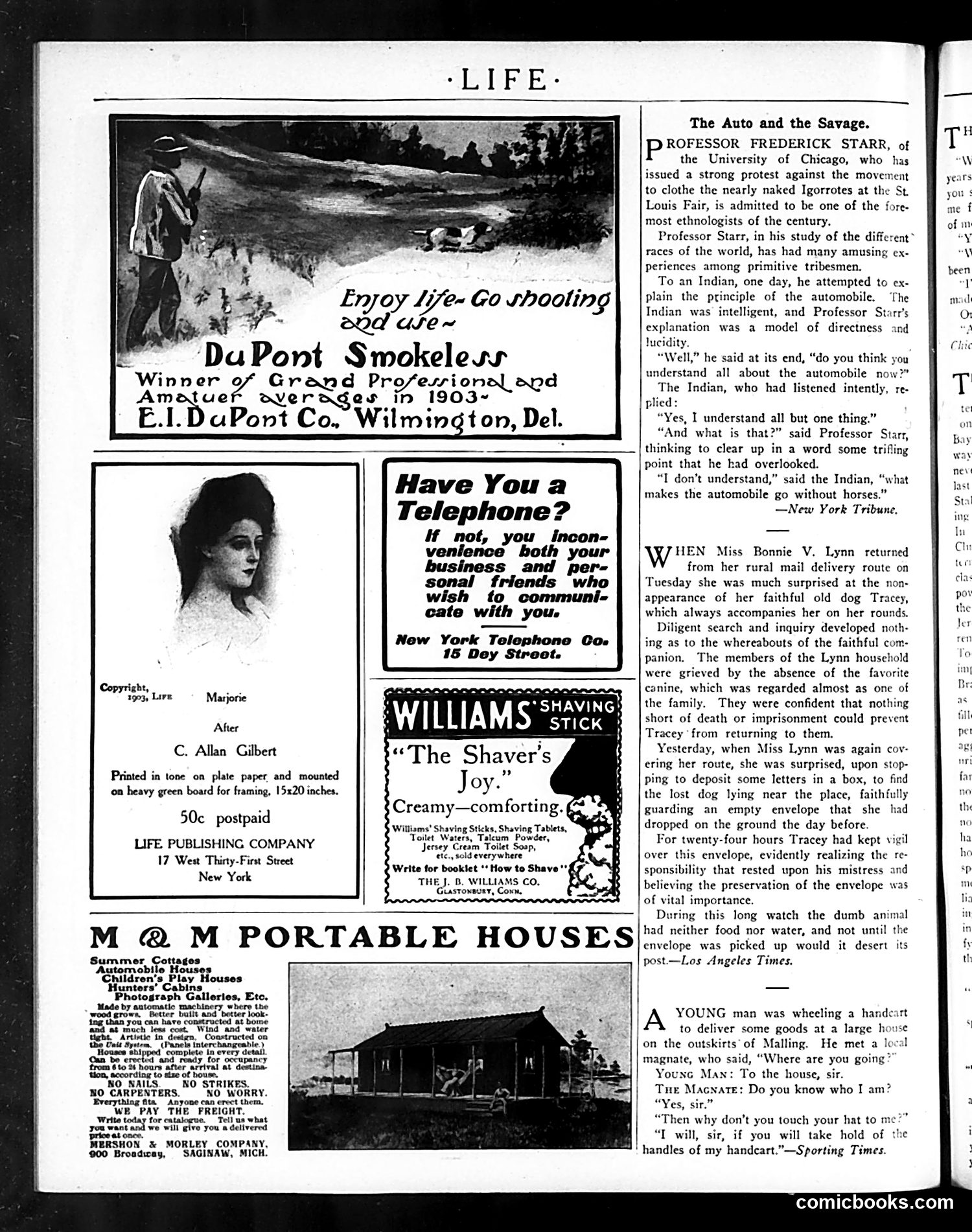
This piece satirizes the gulf between Western "civilization" and indigenous peoples during the era of world's fairs and ethnological exhibits (the St. Louis Fair is referenced). **The Setup:** Professor Frederick Starr, a University of Chicago ethnologist, attempts to explain the automobile to a Native American man, confident his "model of directness and lucidity" will enlighten him. **The Joke:** After the lengthy explanation, the Indian says he understands everything except one thing: "what makes the automobile go without horses." **The Satire's Point:** The humor cuts both ways—it mocks both the professor's condescension (assuming primitive peoples cannot grasp mechanical principles) and simultaneously suggests the Indian's question reveals a logical gap in the explanation itself. The "savage" isn't stupid; the "civilized" expert may have glossed over the actual mechanism. It's gentle mockery of Western intellectual pretension and the era's flawed ethnological assumptions.
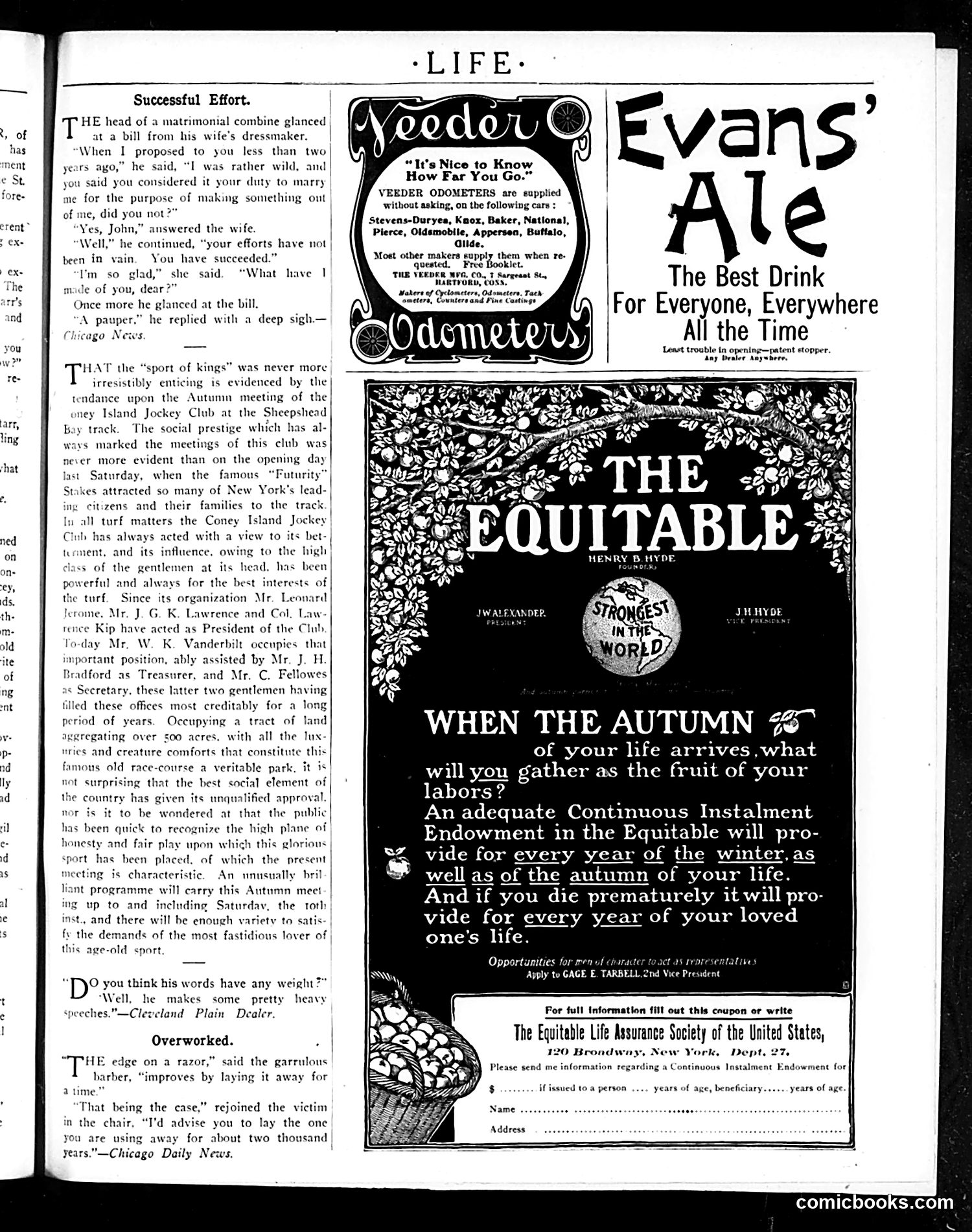
**The Page Structure:** This is primarily an advertising page with three short humorous anecdotes in the margins. The main content is two large advertisements for insurance and automobiles. **The Anecdotes:** The three jokes mock everyday situations: a husband discovering his wife has bankrupted him through dress bills despite her promise to "improve" him; the popularity of horseracing at New York's Coney Island Jockey Club as a social institution; and a barber's dull razor that needs retirement. **The Advertisements:** —**Veeder Odometers**: Promoting automobile speedometer technology, listing luxury car brands like Pierce and Oldsmobile as customers. —**Evans' Ale**: A beer advertisement claiming universal appeal. —**The Equitable Life Insurance**: The dominant ad uses autumn as metaphor for life's later years, promising financial security through continuous installment endowments—protecting against premature death or poverty in old age. This reflects early 20th-century anxieties about retirement before modern Social Security existed. The page reflects consumer culture, male anxiety about marriage expenses, and emerging insurance as a financial solution.
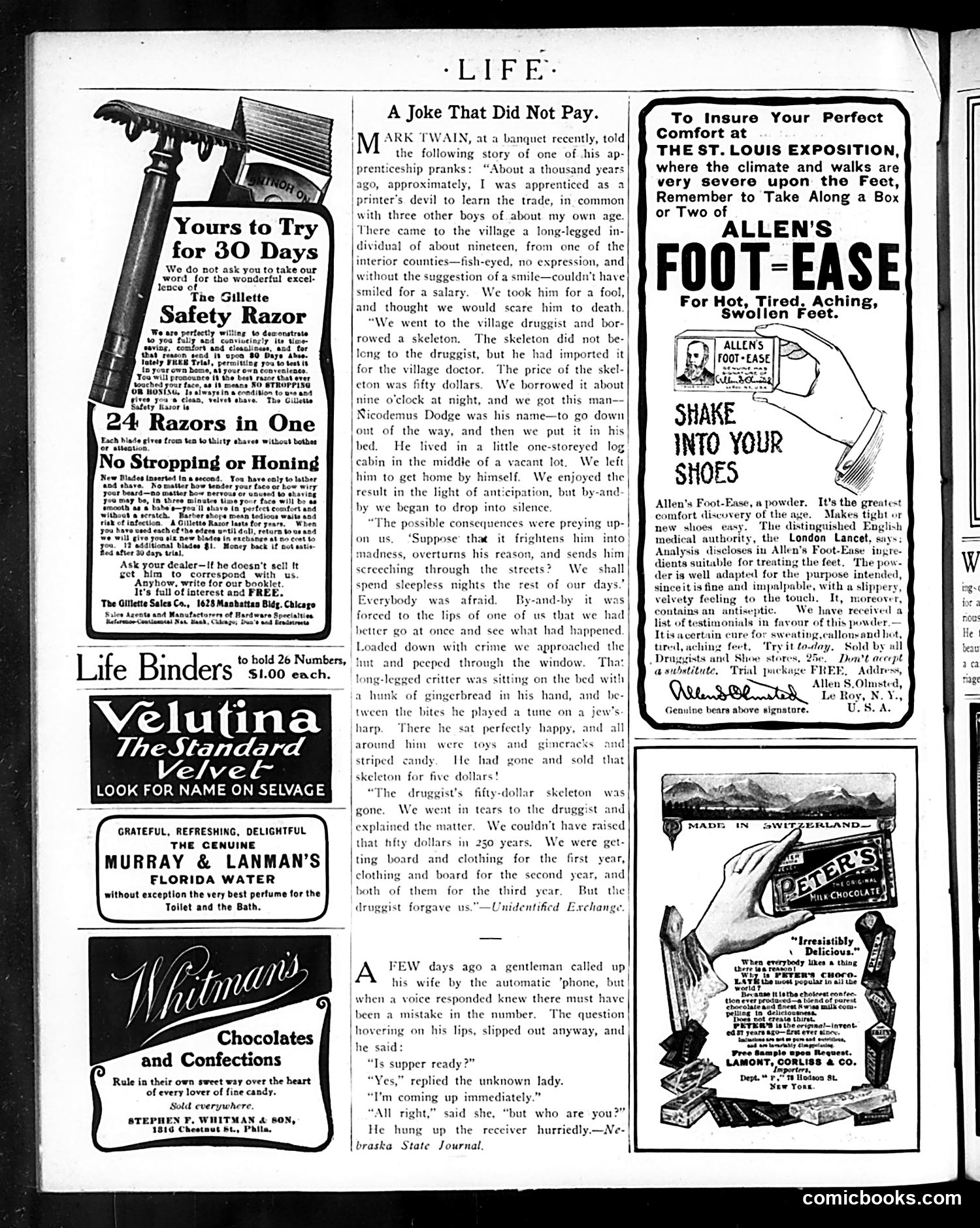
This page is primarily **advertising**, with one notable narrative content piece. The main story is Mark Twain recounting a prank from his apprenticeship as a printer's devil. Young Twain and friends borrowed a skeleton from a druggist (worth $50—substantial money then) to scare a new arrival in town. Their plan backfired: the long-legged newcomer simply sold the skeleton for five dollars and spent the evening contentedly eating candy and playing a jew's harp, utterly unfazed by their scare attempt. The satire targets **youthful overconfidence**: the pranksters expected psychological devastation but encountered indifference instead. The joke's irony—they feared ruining someone financially while actually losing the druggist's expensive property—suggests that good intentions don't guarantee outcomes. The surrounding ads promote period products: Gillette Safety Razors, Velutina Velvet fabric, Allen's Foot-Ease powder, Whitman's Chocolates, and Murray & Lanman's Florida Water cologne. These reflect early-1900s consumer culture.
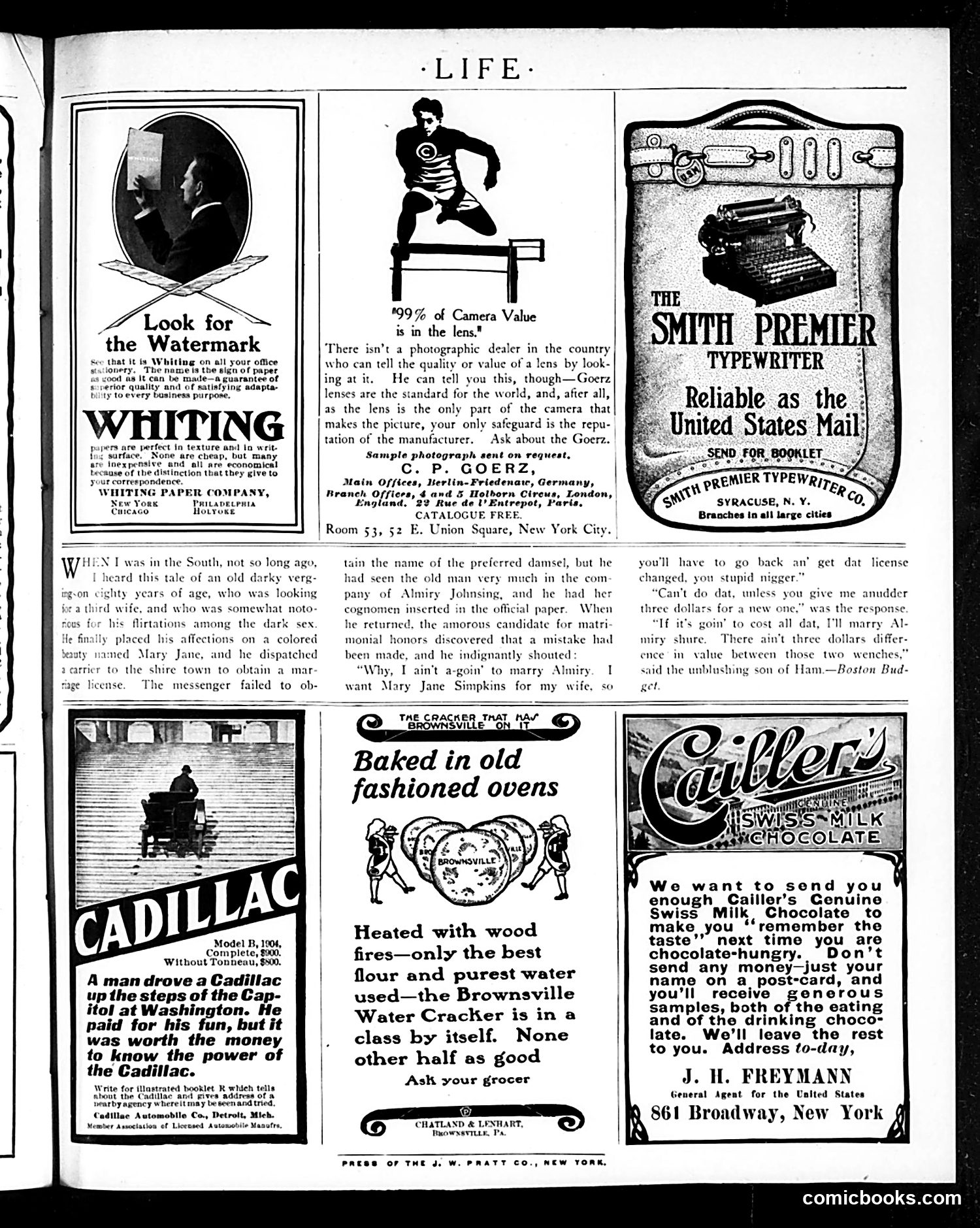
This page is primarily **advertising**, with one satirical story. The advertisements promote period products: Whiting paper, Goerz camera lenses, Cadillac automobiles, and Swiss chocolates. The satirical content is a short dialect story mocking African Americans. It describes an elderly Black man seeking a marriage license, where the town clerk mistakenly records the wrong woman's name. The man's response uses a racial slur and reduces women to commercial commodities, treating the mix-up as merely a financial inconvenience ("ain't three dollars difference in value between those two wenches"). The humor relies on racist stereotypes: exaggerated dialect, portrayal of Black people as stupid and morally base, and the framing device ("the unblushing son of Ham") invoking biblical curse mythology used to justify racism. For modern readers: this reflects early 1900s casual racism in mainstream American media, where such content appeared alongside ordinary advertising without apparent controversy.
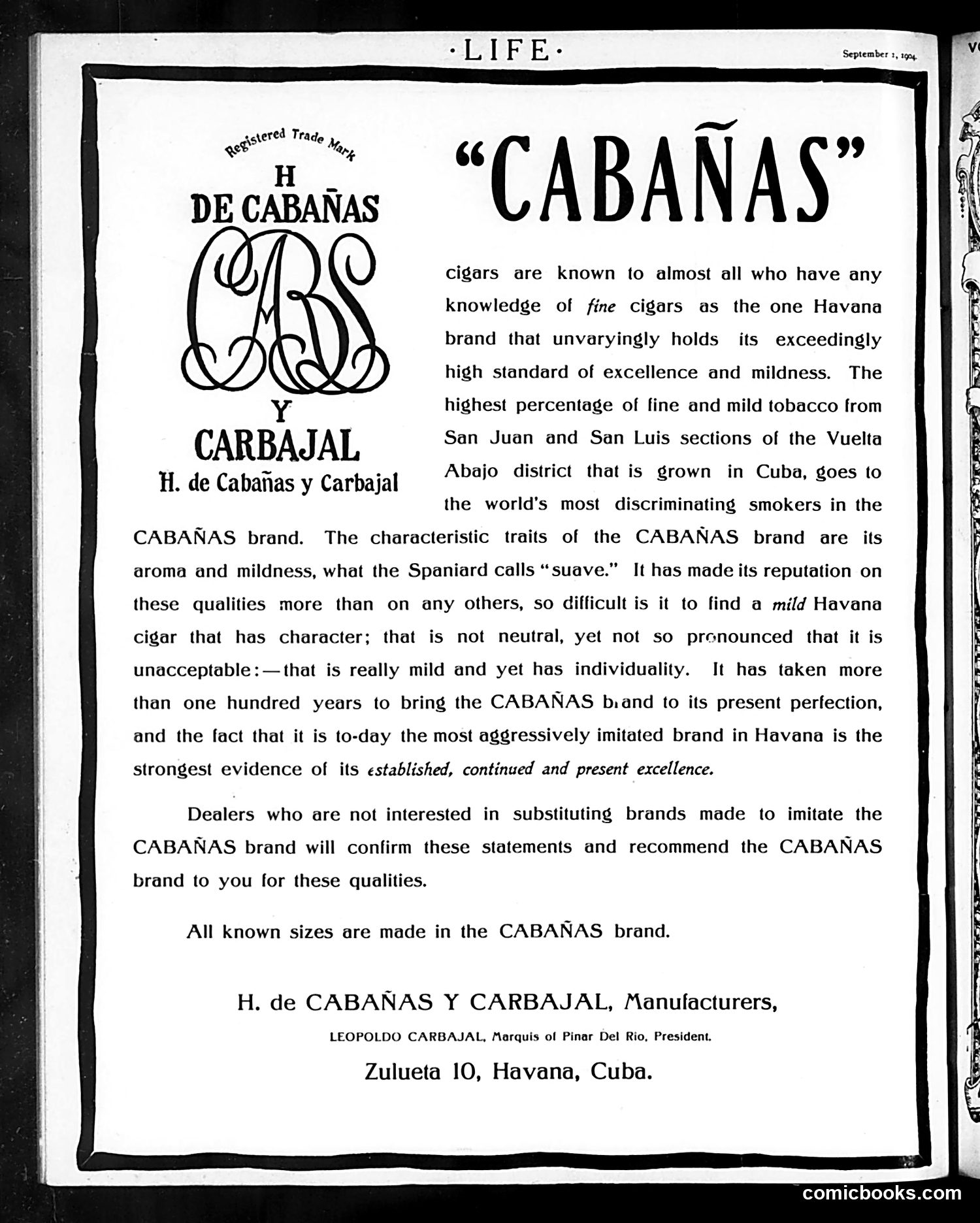
This page is a full-page advertisement for Cabañas cigars, a Havana brand. There are no cartoons or satirical content—it's purely a commercial advertisement from Life magazine (dated September 1, 1904, not 1994 as the OCR suggests). The ad emphasizes Cabañas cigars' reputation for mildness and quality, claiming over one hundred years of excellence. It notes the brand is "aggressively imitated," using this as evidence of its superiority. The manufacturer, H. de Cabañas y Carbajal, is located in Havana, Cuba, with Leopoldo Carbajal listed as president (identified as Marquis of Pinar Del Rio). For modern readers: This reflects the early 1900s cigar trade's prominence and Cuban tobacco's prestige before the later 20th-century cigar embargo. The ad's tone assumes readers understand fine cigars as status markers.