
Life, 1904-09-01 · page 15 of 38
Life — September 1, 1904 — page 15: what you’re looking at
What you’re looking at
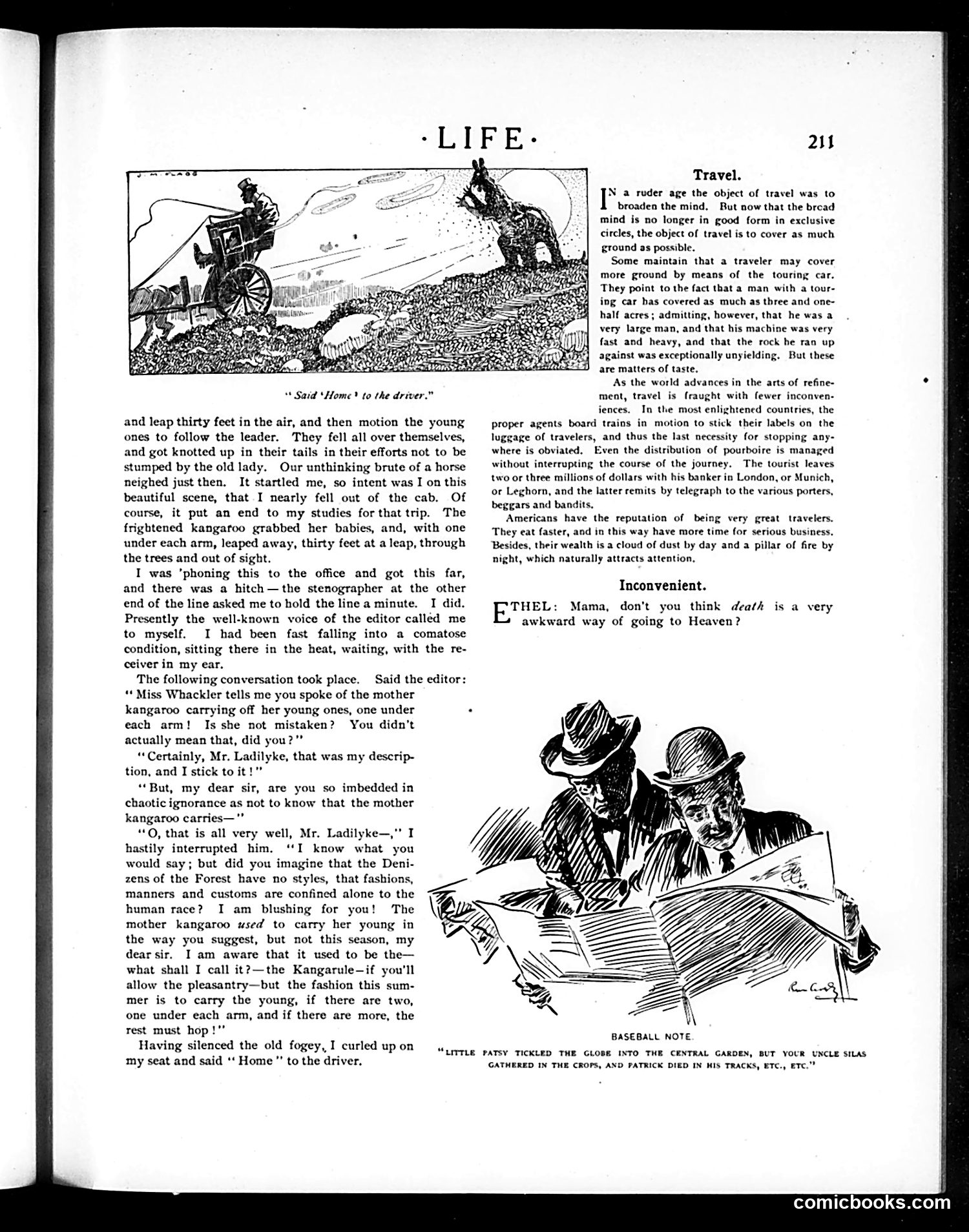
The page contains two distinct pieces of satirical content: **"Travel" essay (top):** A humorous account mocking both travelers and travel journalism. A reporter witnesses a kangaroo carrying her young "one under each arm"—an impossible pose. When questioned by his editor, the reporter defensively insists this is the current "fashion" among kangaroos this season, sarcastically coining "Kangarule." The satire targets journalistic credibility and the absurdity of unquestioned authority figures. **"Baseball Note" cartoon (bottom):** Two men in hats reading what appears to be a newspaper or scorecard. The caption references a child ("Little Patsy") entering a "central garden" where her uncle Silas gathered crops, with Patrick dying "in his tracks." This appears to be dark humor about a child's innocent intrusion into adult agricultural or criminal matters, though the exact reference is unclear without additional historical context. Both pieces exemplify *Life* magazine's satirical style: deflating pretension through absurdist humor and darkly comedic social observation.
📄 Transcribed text from this page (OCR, searchable)
Machine-transcribed from the original scan — historical spelling and the odd misread are preserved.
2i4 “Said ‘Home to the driver.” and leap thirty feet in the air, and then motion the young ones to follow the leader. They fell all over themselves, and got knotted up in their tails in their efforts not to be stumped by the old lady. Our unthinking brute of a horse neighed just then. It startled me, so intent was I on this beautiful scene, that I nearly fell out of the cab. Of course, it put an end to my studies forthattrip. The frightened kangaroo grabbed her babies, and, with one under each arm, leaped away, thirty feet at a leap, through the trees and out of sight. I was ’phoning this to the office and got this far, and there was a hitch—the stenographer at the other end of the line asked me to hold the line a minute. I did. Presently the well-known voice of the editor called me to myself. I had been fast falling into a comatose condition, sitting there in the heat, waiting, with the re- ceiver in my ear, The following conversation took place. Said the editor: “Miss Whackler tells me you spoke of the mother kangaroo carrying off her young ones, one under each arm! Is she not mistaken? You didn’t actually mean that, did you?” “Certainly, Mr. Ladilyke, that was my descrip- tion, and I stick to it!" “But, my dear sir, are you so imbedded in chaotic ignorance as not to know that the mother kangaroo carries—"’ “‘O, that is all very well, Mr. Ladilyke—,"" I hastily interrupted him. ‘(I know what you would say; but did you imagine that the Deni- zens of the Forest have no styles, that fashions, manners and customs are confined alone to the human race? I am blushing for you! The mother kangaroo used to carry her young in the way you suggest, but not this season, my dear sir. I am aware that it used to be the— what shall I call it?—the Kangarule—if you'll allow the pleasantry—but the fashion this sum- mer is to carry the young, if there are two, one under each arm, and if there are more, the rest must hop !"" Having silenced the old fogey, I curled up on my seat and said ‘‘ Home”’ to the driver. Travel. Na ruder age the object of travel was to broaden the mind. But now that the bread mind is no longer in good form in exclusive circles, the object of travel is to cover as much ground as possible. Some maintain that a traveler may cover more ground by means of the touring car. They point to the fact that a man with a tour- ing car has covered as much as three and one- half acres; admitting, however, that he was a very large man, and that his machine was very fast and heavy, and that the rock he ran up against was exceptionally unyielding, But these are matters of taste, As the world advances in the arts of refine- ment, travel is fraught with fewer inconven- iences. In the most enlightened countries, the proper agents board trains in motion to stick their labels on the luggage of travelers, and thus the last necessity for stopping any- where is obviated. Even the distribution of pourboire is managed without interrupting the course of the journey. The tourist leaves two or three millions of dollars with his banker in London, or Munich, or Leghorn, and the latter remits by telegraph to the various porters, beggars and bandits, Americans have the reputation of being very great travelers. They eat faster, and in this way have more time for serious business, Besides, their wealth is a cloud of dust by day and a pillar of fire by night, which naturally attracts attention, Inconvenient. THEL: Mama, don't you think death is a very awkward way of going to Heaven? BASEBALL NOTE “LITTLE PATSY TICKLED THE GLOBE INTO THE CENTRAL GARDEN, BUT YOUR UNCLE SILAS GATHERED IN THE CROPS, AND PATRICK DIED IN MIS TRACKS, ETC., ETC.” comicbooks.com