
Life, 1904-09-01 · page 20 of 38
Life — September 1, 1904 — page 20: what you’re looking at
What you’re looking at
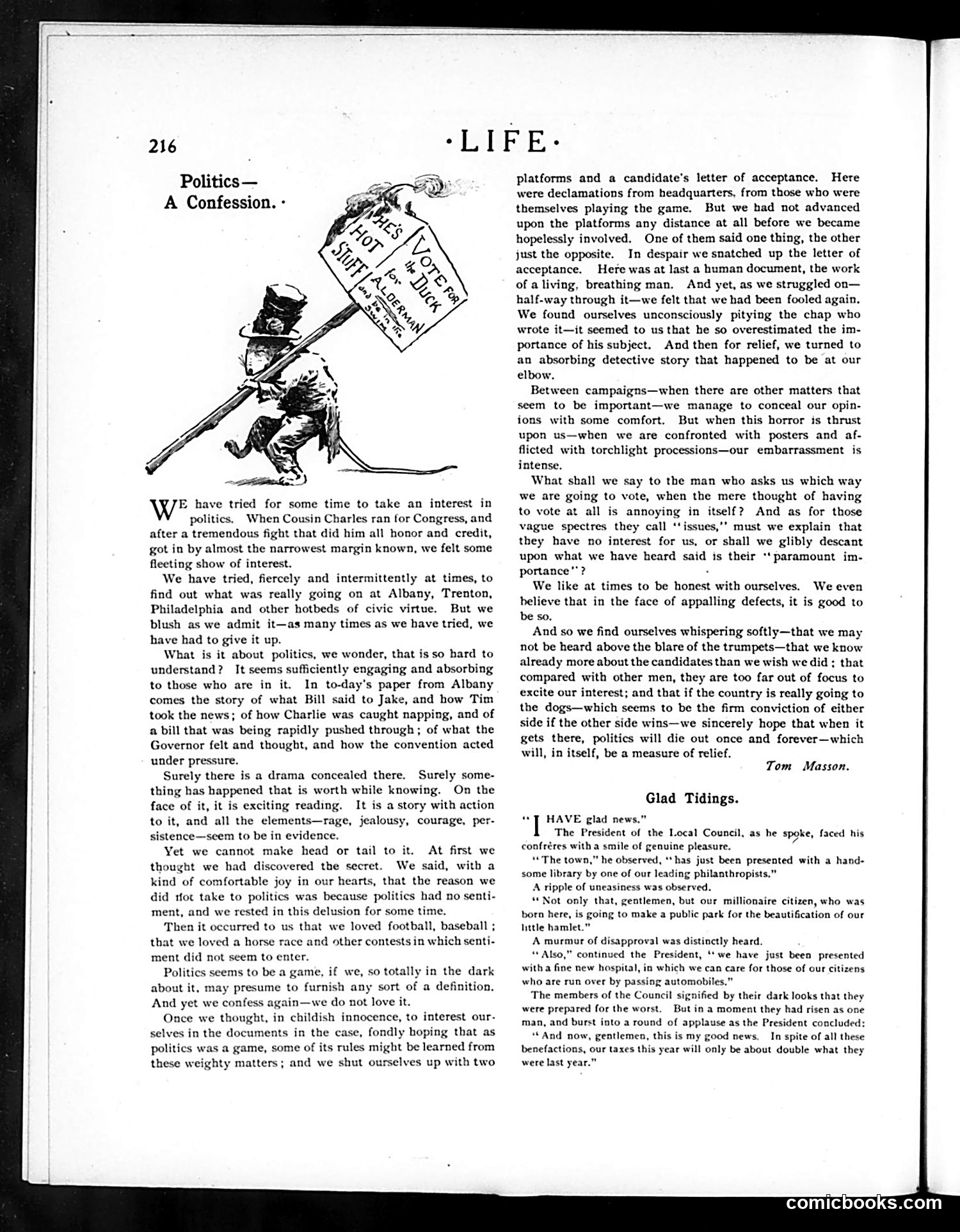
The cartoon depicts a figure struggling to carry a large platform plank labeled with political text, humorously illustrating the article's central complaint: the author's inability to understand or engage with politics despite genuine attempts. The piece satirizes the bewildering nature of American political discourse in the early 20th century. The writer confesses that despite trying—attending to campaign coverage, reading party platforms and candidates' acceptance letters—political content remains incomprehensible. Political narratives seem exciting ("Bill said to Jake," conflicts between figures), yet lack coherence or emotional resonance. The satire's point: politics appears designed as a game with obscure rules that even intelligent observers cannot decipher. Platform documents contradict themselves; acceptance letters seem artificially overwrought. The author finds distraction in a detective story instead—suggesting politics is less engaging than fiction despite having drama's elements. The confession humorously expresses voter alienation and frustration with opaque political messaging.
📄 Transcribed text from this page (OCR, searchable)
Machine-transcribed from the original scan — historical spelling and the odd misread are preserved.
216 Politics — A Confession. - E have tried for some time to take an interest in politics, When Cousin Charles ran for Congress, and after a tremendous fight that did him all honor and credit, got in by almost the narrowest margin known, we felt some fleeting show of interest. We have tried, fiercely and intermittently at times, to find out what was really going on at Albany, Trenton, Philadelphia and other hotbeds of civic virtue. But we blush as we admit it—as many times as we have tried, we have had to give it up. What is it about politics, we wonder, that is so hard to understand? It seems sufficiently engaging and absorbing to those who are in it. In to-day's paper from Albany comes the story of what Bill said to Jake, and how Tim took the news; of how Charlie was caught napping, and of a bill that was being rapidly pushed through; of what the Governor felt and thought, and how the convention acted under pressure. Surely there is a drama concealed there. Surely some- thing has happened that is worth while knowing. On the face of it, it is exciting reading. It is a story with action to it, and all the elements—rage, jealousy, courage, per- sistence—scem to be in evidence. Yet we cannot make head or tail to it. At first we thought we had discovered the secret. We said, with a kind of comfortable joy in our hearts, that the reason we did rfot take to politics was because politics had no senti- ment, and we rested in this delusion for some time. Then it occurred to us that we loved football, baseball ; that we loved a horse race and other contests in which senti- ment did not seem to enter. Politics seems to be a game, if we, so totally in the dark about it, may presume to furnish any sort of a definition. And yet we confess again—we do not love it. Once we thought, in childish innocence, to interest our- selves in the documents in the case, fondly hoping that as politics was a game, some of its rules might be learned from these weighty matters; and we shut ourselves up with two platforms and a candidate's letter of acceptance. Here were declamations from headquarters, from those who were themselves playing the game. But we had not advanced upon the platforms any distance at all before we became hopelessly involved. One of them said one thing, the other just the opposite. In despair we snatched up the letter of acceptance. Here was at last a human document, the work of a living, breathing man. And yet, as we struggled on— half-way through it—we felt that we had been fooled again. We found ourselves unconsciously pitying the chap who wrote it—it seemed to us that he so overestimated the im- portance of his subject. And then for relief, we turned to an absorbing detective story that happened to be at our elbow. Between campaigns—when there are other matters that seem to be important—we manage to conceal our opin- ions with some comfort. But when this horror is thrust upon us—when we are confronted with posters and af- flicted with torchlight processions—our embarrassment is intense. What shall we say to the man who asks us which way we are going to vote, when the mere thought of having to vote at all is annoying in itself? And as for those vague spectres they call ‘* must we explain that they have no interest for us, or shall we glibly descant upon what we have heard said is their ‘paramount im- portance"? . We like at times to be honest with ourselves, We even believe that in the face of appalling defects, it is good to be so. And so we find ourselves whispering softly—that we may not be heard above the blare of the trumpets—that we know already more about the candidates than we wish we did ; that compared with other men, they are too far out of focus to excite our interest; and that if the country is really going to the dogs—which seems to be the firm conviction of either side if the other side wins—we sincerely hope that when it gets there, politics will die out once and forever—which will, in itself, be a measure of relief. Tom Masson. Glad Tidings. ‘HAVE glad news.” The President of the Local Council, as he spoke, faced his confréres with a smile of genuine pleasure. “The town,” he observed, “has just been presented with a hand- some library by one of our leading philanthropists.” A ripple of uneasiness was observed. “Not only that, gentlemen, but our millionaire citizen, who was born here, is going to make a public park for the beautification of our litle hamlet.” A murmur of disapproval was distinctly heard. Iso,” continued the President, ‘we have just been presented with a fine new hospital, in which we can care for those of our citizens who are run over by passing automobiles,” The members of the Council signified by their dark looks that they were prepared for the worst. But in a moment they had risen as one man, and burst into a round of applause as the President concluded: “And now, gentlemen, this is my good news. In spite of alll these benefactions, our taxes this year will only be about double what they were last year. comicbooks.com